
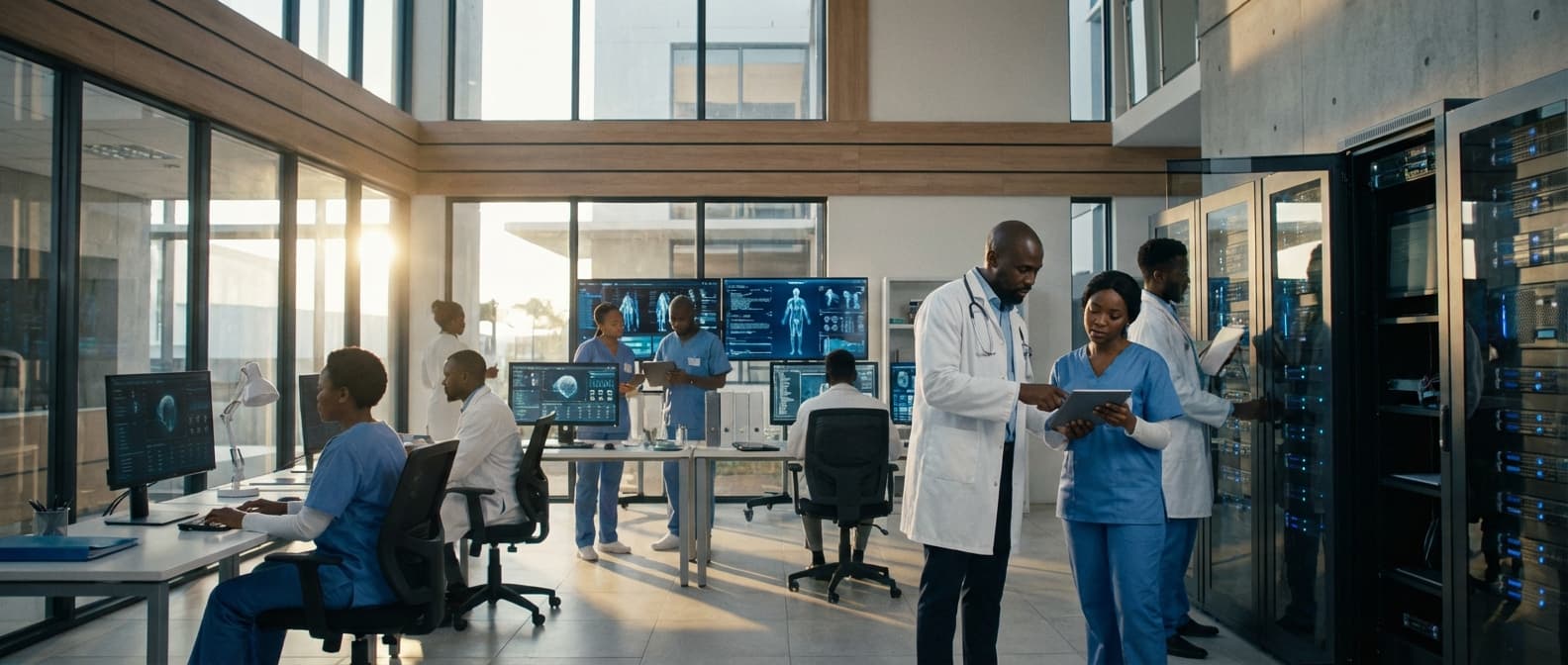
Medical IT Consultation in Ghana
Engineering Excellence & Technical Support
Strategic technology consulting to optimize healthcare operations, streamline workflows, and integrate cutting-edge medical information systems. High-standard technical execution following OEM protocols and local regulatory frameworks.
Cloud Infrastructure Modernization
Spearheading the migration of hospital EMR systems and patient data to secure, scalable cloud platforms, enhancing accessibility, disaster recovery, and reducing on-premise hardware costs for Ghanaian healthcare providers.
AI-Powered Diagnostics & Workflow Automation
Implementing and integrating Artificial Intelligence solutions for preliminary image analysis (radiology, pathology) and automating administrative tasks, leading to faster diagnoses, improved clinician efficiency, and optimized patient flow within Ghanaian hospitals.
Robust Cybersecurity & Data Privacy Frameworks
Designing and deploying comprehensive cybersecurity strategies tailored to the Ghanaian regulatory landscape, safeguarding sensitive patient information, preventing data breaches, and ensuring compliance with data protection laws.
What Is Medical It Consultation In Ghana?
Medical IT Consultation in Ghana refers to specialized advisory services focused on the strategic planning, implementation, optimization, and management of information technology (IT) systems within healthcare organizations. This encompasses a broad range of technologies and applications designed to enhance clinical operations, administrative efficiency, data security, patient care, and research capabilities. The service aims to bridge the gap between healthcare delivery needs and the effective leverage of IT solutions, considering the unique technological infrastructure, regulatory landscape, and economic realities present in Ghana.
| Who Needs Medical IT Consultation? | Typical Use Cases |
|---|---|
| Hospitals (Public & Private): Requiring modernization of patient management systems, implementation of EHRs, and enhancement of cybersecurity. | Implementing a hospital-wide EHR system to centralize patient records and improve clinical decision-making. Upgrading network infrastructure to support telemedicine services. Developing a data analytics strategy to identify trends in disease prevalence and treatment effectiveness. Establishing robust cybersecurity measures to protect against data breaches and ransomware attacks. |
| Clinics & Diagnostic Centers: Seeking to digitize patient records, improve appointment scheduling, and enhance diagnostic imaging management. | Deploying a cloud-based practice management system for streamlined patient registration, billing, and scheduling. Integrating digital imaging systems (PACS) with an EHR for easier access to diagnostic reports. Implementing a secure patient portal for appointment booking and accessing test results. |
| Government Health Agencies & Ministries: Needing to develop national health information strategies, facilitate data collection for public health initiatives, and ensure interoperability. | Developing a national e-health strategy to standardize healthcare IT across the country. Implementing a public health surveillance system for early detection and response to outbreaks. Facilitating the interoperability of data from different regional health facilities for national reporting. Ensuring compliance with data privacy regulations for national health databases. |
| Pharmaceutical Companies & Medical Device Manufacturers: Requiring IT solutions for supply chain management, clinical trials, and regulatory reporting. | Implementing a supply chain management system to track pharmaceuticals and medical devices. Utilizing IT for data collection and analysis in clinical trials of new drugs. Ensuring compliance with IT-related regulations for product registration and post-market surveillance. |
| Non-Governmental Organizations (NGOs) & Humanitarian Health Organizations: Needing to manage patient data in resource-constrained settings, implement mobile health solutions, and ensure data security. | Deploying low-cost EHR solutions for remote health posts. Implementing mobile health (mHealth) applications for data collection and patient outreach in rural areas. Ensuring secure data storage and transmission in challenging environments. |
| Medical Training Institutions: Requiring IT infrastructure for research, digital learning platforms, and administrative efficiency. | Setting up IT labs for training healthcare professionals in using EHR systems. Developing digital learning management systems for medical education. Implementing IT solutions for research data management and analysis. |
Key Components of Medical IT Consultation in Ghana
- IT Strategy Development: Formulating long-term IT roadmaps aligned with organizational goals, including digital transformation initiatives.
- Electronic Health Records (EHR) / Electronic Medical Records (EMR) Implementation: Guidance on selecting, deploying, and optimizing EHR/EMR systems for improved patient data management and accessibility.
- Healthcare Data Management & Analytics: Designing and implementing robust data warehousing, data governance, and advanced analytics solutions for insights into patient outcomes, operational efficiency, and public health trends.
- Health Information Exchange (HIE): Facilitating the secure and interoperable sharing of patient health information among different healthcare providers and systems.
- Telemedicine & Remote Patient Monitoring: Advising on the infrastructure, platforms, and workflows for delivering healthcare services remotely, crucial for reaching underserved populations.
- Cybersecurity & Data Privacy: Developing and implementing comprehensive security protocols, compliance strategies (e.g., relevant data protection laws), and disaster recovery plans to safeguard sensitive patient data.
- IT Infrastructure Assessment & Optimization: Evaluating existing hardware, software, and network capabilities and recommending upgrades or replacements for enhanced performance and scalability.
- Clinical Workflow Optimization: Analyzing and redesigning clinical processes to integrate IT solutions seamlessly, improving efficiency and reducing medical errors.
- Procurement & Vendor Management: Assisting in the selection, negotiation, and management of IT vendors and solutions.
- Regulatory Compliance: Ensuring IT systems and practices adhere to Ghanaian healthcare regulations and international best practices.
Who Needs Medical It Consultation In Ghana?
Medical IT consultation in Ghana is crucial for a wide range of healthcare providers aiming to leverage technology for improved patient care, operational efficiency, and data security. The adoption of digital health solutions, from electronic health records (EHRs) to telemedicine platforms, presents unique challenges and opportunities that necessitate expert guidance. Hospitals, clinics, and even individual practitioners are increasingly seeking specialized IT support to navigate the complexities of healthcare technology, ensure regulatory compliance, and optimize their IT infrastructure.
| Target Customer Segment | Key Departments Requiring IT Consultation | Specific IT Needs/Challenges |
|---|---|---|
| Public Hospitals | Administration, IT Department, Clinical Departments (e.g., Radiology, Pharmacy, Wards), Medical Records | Implementing/upgrading EHR systems, network infrastructure, cybersecurity, data management, telemedicine integration, compliance with national health data standards. |
| Private Hospitals & Clinics | Management, IT Department, Finance, Patient Services, Clinical Staff | Customizing EHRs, optimizing patient portals, cloud migration, cybersecurity for patient data, practice management software, telehealth solutions, business intelligence for operational insights. |
| Diagnostic Labs & Imaging Centers | Laboratory Information System (LIS) Team, Radiology Department, IT Department, Administration | Integrating LIS with EHRs, Picture Archiving and Communication Systems (PACS) implementation/management, data security and transfer protocols, remote diagnostics, regulatory compliance for medical imaging. |
| Government Health Agencies | Health Information Management, Public Health Programs, IT Directorate, Planning & Research | Developing national health information systems, data analytics for public health surveillance, interoperability of health data across facilities, cybersecurity for national health databases, policy development for digital health. |
| Medical Training Institutions | IT Department, Medical Simulation Labs, Research Departments, Administration | Implementing simulation software, managing networked learning environments, cybersecurity for student and research data, IT support for digital learning platforms, research data management. |
| NGOs in Healthcare | Program Management, M&E Departments, IT Support Staff, Field Operations | Implementing mobile health (mHealth) solutions for data collection, managing remote health data, cloud-based platforms for program management, secure data sharing with partners, capacity building for local IT staff. |
Target Customers and Departments for Medical IT Consultation in Ghana
- Hospitals (Public and Private)
- Polyclinics and Health Centers
- Specialty Clinics (e.g., Diagnostic Labs, Imaging Centers)
- Pharmaceutical Companies (for R&D and supply chain IT)
- Government Health Agencies
- Medical Training Institutions
- Non-Governmental Organizations (NGOs) in Healthcare
Medical It Consultation Process In Ghana
The Medical IT Consultation Process in Ghana outlines the structured approach adopted by IT service providers to address the unique technology needs of healthcare facilities. This process is crucial for ensuring efficient operations, data security, and improved patient care. It typically begins with an initial inquiry from a healthcare provider and progresses through a series of defined stages until the project's successful execution and ongoing support.
| Phase | Description | Key Activities | Deliverables |
|---|---|---|---|
| Initial contact from a healthcare provider seeking IT solutions. | Receiving inquiries via phone, email, or website form. Initial understanding of the client's general needs. | Acknowledgement of inquiry. Scheduling initial consultation. |
| Deep dive into the client's current IT landscape, pain points, and objectives. | Site visits, stakeholder interviews, infrastructure audits, documentation review, requirements gathering. | Needs Assessment Report. Detailed understanding of client requirements and challenges. |
| Crafting a tailored IT solution and service offering. | Solution design, technology selection, cost estimation, scope definition, service level agreement (SLA) formulation. | Formal IT Consultation Proposal. Includes scope of work, timeline, budget, and proposed solutions. |
| Formalizing the engagement and terms of service. | Review of proposal, negotiation of terms, contract signing. | Signed Service Level Agreement (SLA) and Master Service Agreement (MSA). |
| Developing a detailed roadmap for implementation. | Work breakdown structure (WBS), resource allocation, risk assessment, communication plan, project schedule creation. | Detailed Project Plan. Project kickoff meeting agenda. |
| Installing and configuring the agreed-upon IT solutions. | Hardware/software installation, network configuration, system integration, data migration, security setup. | Installed and configured IT systems. Integrated solutions. |
| Ensuring the solutions function as intended and meet quality standards. | Unit testing, integration testing, user acceptance testing (UAT), security vulnerability testing, performance testing. | Test reports. UAT sign-off. Quality assurance documentation. |
| Empowering users and IT staff with the knowledge to manage the new systems. | Developing training materials, conducting training sessions, providing user manuals and technical documentation, system handover. | Trained personnel. Comprehensive documentation. System handover checklist. |
| Launching the new systems and providing ongoing operational assistance. | System launch, issue resolution, help desk support, proactive monitoring, regular maintenance. | Live and operational systems. Ongoing support and maintenance services. |
| Continuously evaluating and improving system performance and user experience. | Performance metrics analysis, security audits, user feedback collection, system updates and upgrades, recommending enhancements. | Performance reports. Optimization recommendations. Post-implementation review. |
Medical IT Consultation Workflow in Ghana
- Inquiry and Initial Contact: Healthcare providers reach out to IT consultation firms with specific IT needs or challenges.
- Needs Assessment & Discovery: A comprehensive understanding of the client's current IT infrastructure, challenges, goals, and budget is established.
- Proposal Development: Based on the needs assessment, a tailored IT solution proposal is created, outlining recommended technologies, services, timelines, and costs.
- Contract Negotiation & Signing: The proposal is reviewed, and terms are finalized. A formal contract is signed to formalize the engagement.
- Project Planning & Design: Detailed project plans are developed, including resource allocation, timelines, risk management, and technical architecture design.
- Implementation & Deployment: The proposed IT solutions are installed, configured, and integrated into the healthcare facility's existing systems.
- Testing & Quality Assurance: Thorough testing is conducted to ensure the functionality, security, and performance of the implemented solutions.
- Training & Handover: End-users and IT staff are trained on the new systems and technologies. Documentation and access credentials are provided.
- Go-Live & Post-Implementation Support: The new systems are officially launched. Ongoing support, maintenance, and troubleshooting are provided.
- Performance Monitoring & Optimization: Regular monitoring of system performance, security, and user satisfaction to identify areas for improvement and optimization.
Medical It Consultation Cost In Ghana
The cost of medical IT consultation in Ghana can vary significantly based on several key factors. These factors influence the overall pricing, making it essential for healthcare providers to understand them when budgeting for IT services. The 'local currency' for Ghana is the Ghanaian Cedi (GHS).
| Service Type | Estimated Price Range (GHS) | Notes |
|---|---|---|
| Basic IT Strategy Review/Assessment | 1,500 - 5,000 | For small clinics or general IT health check. |
| EHR/EMR System Selection & Implementation Strategy | 4,000 - 15,000+ | Can vary significantly based on the scale of the facility and complexity of the chosen system. |
| Cybersecurity Assessment & Recommendations | 3,000 - 10,000+ | Depends on the size of the network, data sensitivity, and depth of assessment. |
| Network Infrastructure Assessment & Planning | 2,500 - 8,000 | For optimizing connectivity and performance within a healthcare facility. |
| Telemedicine Platform Consultation | 3,000 - 12,000+ | Includes platform selection, integration, and workflow optimization. |
| Data Management & Analytics Consultation | 3,500 - 10,000+ | Focus on patient data organization, reporting, and insights. |
| Full IT Audit & Digital Transformation Roadmap | 8,000 - 30,000+ | Comprehensive assessment for larger hospitals or healthcare groups. |
| Hourly/Daily Rate (Expert Consultant) | 300 - 1,500+ per hour/day | Common for ongoing advice or specialized tasks. Varies greatly with expertise. |
Factors Influencing Medical IT Consultation Costs in Ghana:
- Scope of Consultation: This is perhaps the most significant driver. A basic consultation for general IT advice will be less expensive than a comprehensive assessment covering cybersecurity, electronic health records (EHR) implementation, cloud migration, or network infrastructure upgrades.
- Consultant's Expertise and Experience: Highly specialized consultants with a proven track record in the healthcare IT sector, particularly within Ghana or similar African markets, will command higher fees than general IT consultants.
- Project Complexity: Complex projects involving integration of multiple systems, data migration, or regulatory compliance (e.g., data privacy laws) will naturally incur higher consultation costs.
- Duration of Engagement: Whether the consultation is a one-off assessment, an ongoing advisory role, or a project-specific engagement will impact the total cost. Hourly, daily, or project-based rates are common.
- Provider's Location: While not as significant as other factors, consultants operating from major urban centers like Accra might have slightly different pricing structures compared to those in more remote areas, though this is less common for specialized IT services.
- Technology Stack Involved: Consultations focused on specific, advanced technologies (e.g., AI in healthcare, advanced telemedicine platforms) may be more expensive due to the specialized knowledge required.
- Deliverables Expected: The specific outcomes or reports required from the consultation (e.g., a detailed risk assessment, an implementation roadmap, vendor recommendations) can influence the pricing.
- Urgency of the Request: Rush requests may sometimes incur a premium, though this is less standard in professional IT consulting.
Affordable Medical It Consultation Options
Navigating the complexities of Medical IT can be daunting, especially for smaller practices or those with budget constraints. Fortunately, various affordable medical IT consultation options exist that offer significant value. These often revolve around flexible service models and strategic cost-saving measures. Understanding these options can empower healthcare providers to leverage expert IT guidance without breaking the bank.
| Service Model | Typical Cost Structure | Best For | Cost-Saving Aspect |
|---|---|---|---|
| Project-Based | Fixed fee per project | Specific, well-defined needs (e.g., EMR implementation) | Avoids ongoing fees for non-essential services |
| Retainer-Based | Fixed monthly fee for defined hours/services | Ongoing proactive management, predictable budgeting | Predictable costs, prevents small issues from escalating |
| On-Demand | Hourly rate | Urgent issues, ad-hoc advice | Pay only for actual time spent, flexible |
| Virtual Support | Hourly or retainer-based (often lower rates) | Remote troubleshooting, advice, monitoring | Reduced overhead and travel expenses |
Key Affordable Medical IT Consultation Options
- {"title":"Project-Based Consultations","description":"Ideal for specific, well-defined IT needs such as EMR/EHR implementation, cybersecurity assessments, or network upgrades. You pay for the expertise and deliverables for a particular project, making it cost-effective for targeted improvements."}
- {"title":"Retainer-Based Support","description":"A fixed monthly fee grants access to a predetermined amount of IT consultation and support hours. This offers predictable budgeting and proactive IT management, preventing small issues from becoming costly emergencies."}
- {"title":"On-Demand Consulting","description":"Pay-as-you-go services for when you need immediate assistance with urgent IT problems or expert advice on new technologies. This is a flexible option for unpredictable needs."}
- {"title":"Virtual IT Support","description":"Leveraging remote access tools and communication platforms, virtual consultants can provide many of the same services as on-site consultants at a reduced cost, saving on travel expenses and overhead."}
- {"title":"Specialized Niche Consultancies","description":"Instead of a large, all-encompassing IT firm, consider consultants specializing in specific areas like HIPAA compliance, medical imaging IT, or telehealth infrastructure. This can lead to more focused and cost-effective expertise."}
Verified Providers In Ghana
In Ghana, identifying trusted healthcare providers is paramount for ensuring quality care and patient safety. Franance Health stands out as a leading platform dedicated to verifying healthcare professionals and facilities, offering a streamlined and reliable way for individuals to find the best medical services. This commitment to credentialing and transparency makes Franance Health a cornerstone in Ghana's healthcare landscape, empowering patients with confidence in their choices.
| Key Features of Franance Health's Verification | Benefit to Patients |
|---|---|
| License and Certification Validation | Ensures providers are legally qualified and have met industry-specific educational requirements. |
| Background Checks and Disciplinary Record Review | Identifies any history of malpractice or professional misconduct, protecting patients from potentially harmful practitioners. |
| Verification of Educational Qualifications | Confirms that providers have received proper training from accredited institutions. |
| Professional Affiliation and Membership Verification | Indicates adherence to professional codes of conduct and ongoing professional development. |
| Patient Feedback and Ratings Integration | Provides real-world insights into provider performance and patient satisfaction. |
Why Franance Health Represents the Best Choice for Verified Providers in Ghana:
- Rigorous Verification Process: Franance Health employs a multi-faceted verification system that goes beyond surface-level checks. This includes validating medical licenses, professional certifications, educational backgrounds, and adherence to ethical standards. This meticulous approach ensures that only qualified and reputable providers are listed on their platform.
- Comprehensive Provider Directory: The platform boasts an extensive and diverse directory of healthcare professionals across various specialties, from general practitioners and specialists to dentists, pharmacists, and mental health experts. This breadth of coverage means users can find the precise care they need, all within a trusted framework.
- Patient-Centric Reviews and Ratings: Beyond verification, Franance Health incorporates a robust system for patient reviews and ratings. This empowers users to share their experiences, providing invaluable insights into the quality of care, patient communication, and overall satisfaction. This transparency helps others make informed decisions.
- Accessibility and Convenience: Franance Health makes finding verified providers incredibly convenient. Their user-friendly platform allows for easy searching, filtering by location, specialty, and even insurance acceptance. This saves individuals time and reduces the stress often associated with seeking medical help.
- Commitment to Healthcare Standards: Franance Health is dedicated to upholding and promoting high healthcare standards in Ghana. By partnering with and promoting verified providers, they actively contribute to raising the bar for quality, safety, and patient experience across the nation's healthcare sector.
- Trust and Peace of Mind: Ultimately, the greatest benefit of using Franance Health is the assurance of trust and peace of mind. Knowing that the healthcare providers you find have undergone thorough vetting and are supported by real patient feedback allows for a more confident and secure healthcare journey.
Scope Of Work For Medical It Consultation
This Scope of Work (SOW) outlines the services to be provided by [Consultant Name/Company Name] (hereinafter referred to as "Consultant") to [Client Name/Organization Name] (hereinafter referred to as "Client") for Medical IT Consultation. The project aims to [briefly state the primary goal of the consultation, e.g., optimize EMR system performance, develop a cybersecurity roadmap, assess cloud migration readiness]. This SOW details the technical deliverables and standard specifications to ensure successful project completion.
| Phase/Activity | Description | Deliverables | Standard Specifications/Metrics |
|---|---|---|---|
| Conduct in-depth interviews with key stakeholders, review existing documentation, and perform a comprehensive audit of current IT infrastructure and systems. | Current State Assessment Report, Infrastructure Inventory, Risk Register | Report format: PDF. Inventory completeness: 95%. Risk assessment: Qualitative and quantitative analysis. |
| Analyze findings from the assessment phase, identify pain points, and develop strategic recommendations aligned with organizational goals and best practices. | Gap Analysis Report, IT Strategy Framework, Preliminary Roadmap | Analysis methodology: SWOT, PESTLE. Strategy framework: Documented. Roadmap: Milestone-based, 3-5 year horizon. |
| Develop detailed technical specifications for recommended solutions, including system architecture, integration plans, and cybersecurity measures. | Technical Design Documents, Solution Architecture Diagrams, Cybersecurity Policy Recommendations, Implementation Plan Outline | Design documents: Compliant with industry standards (e.g., HL7 for interoperability). Architecture diagrams: Using standard notation (e.g., UML). Cybersecurity policy: Aligned with NIST CSF or similar frameworks. |
| If applicable, assist in evaluating and selecting IT vendors for new solutions or services. | Vendor Evaluation Criteria, RFI/RFP Assistance, Vendor Scorecards | Evaluation criteria: Clearly defined and weighted. RFI/RFP assistance: Development and review. Scorecards: Objective scoring mechanism. |
| Consolidate all findings and recommendations into a comprehensive final report and present to Client stakeholders. | Final Consultation Report, Executive Summary, Presentation Deck | Report: Executive-level clarity, actionable insights. Presentation: Engaging and informative, addressing key concerns. |
Project Objectives
- To assess the current state of the Client's medical IT infrastructure, including hardware, software, networks, and data security.
- To identify key challenges, risks, and opportunities related to the Client's medical IT systems.
- To provide actionable recommendations for improvement and optimization in areas such as EMR/EHR, PACS, telehealth, interoperability, and data analytics.
- To develop a strategic roadmap for future IT investments and implementations.
- To ensure compliance with relevant healthcare regulations (e.g., HIPAA, HITECH).
Service Level Agreement For Medical It Consultation
This Service Level Agreement (SLA) outlines the agreed-upon service levels for Medical IT Consultation services provided by [Your Company Name] (hereinafter referred to as "Provider") to [Client Company Name] (hereinafter referred to as "Client"). This SLA defines response times for support requests and uptime guarantees for critical IT systems relevant to the consultation services.
| Service Level | Priority Level | Description | Target Response Time | Target Resolution Time | Uptime Guarantee |
|---|---|---|---|---|---|
| Medical IT Consultation Support | Critical (e.g., EHR system outage, patient data accessibility issue) | Urgent issues impacting patient care or data integrity. | 1 hour during Business Hours | 4 business hours | 99.9% monthly uptime for Critical Systems |
| Medical IT Consultation Support | High (e.g., performance degradation of medical devices, non-critical application issues) | Issues impacting efficiency or non-essential functions. | 2 business hours during Business Hours | 8 business hours | 99.5% monthly uptime for Critical Systems |
| Medical IT Consultation Support | Medium (e.g., feature requests, minor configuration changes) | Requests for enhancements or non-urgent adjustments. | 4 business hours during Business Hours | 3 business days | N/A (System uptime is not directly tied to this level) |
| Medical IT Consultation Support | Low (e.g., general inquiries, documentation requests) | Routine questions or requests for information. | 8 business hours during Business Hours | 5 business days | N/A (System uptime is not directly tied to this level) |
Key Definitions
- Business Hours: Monday through Friday, 9:00 AM to 5:00 PM [Client's Time Zone], excluding public holidays.
- Critical System: Any IT system directly impacting the Client's ability to provide medical services or access patient data as identified and agreed upon by both parties.
- Downtime: The period during which a Critical System is unavailable for use by the Client.
- Incident: Any event that causes or may cause an interruption to or a reduction in the quality of an IT service.
- Response Time: The maximum time allowed for the Provider to acknowledge and begin actively working on an Incident or request after it has been reported.
Frequently Asked Questions

Ready when you are
Let's scope your Medical IT Consultation in Ghana project in Ghana.

Scaling healthcare logistics and technical systems across the entire continent.