
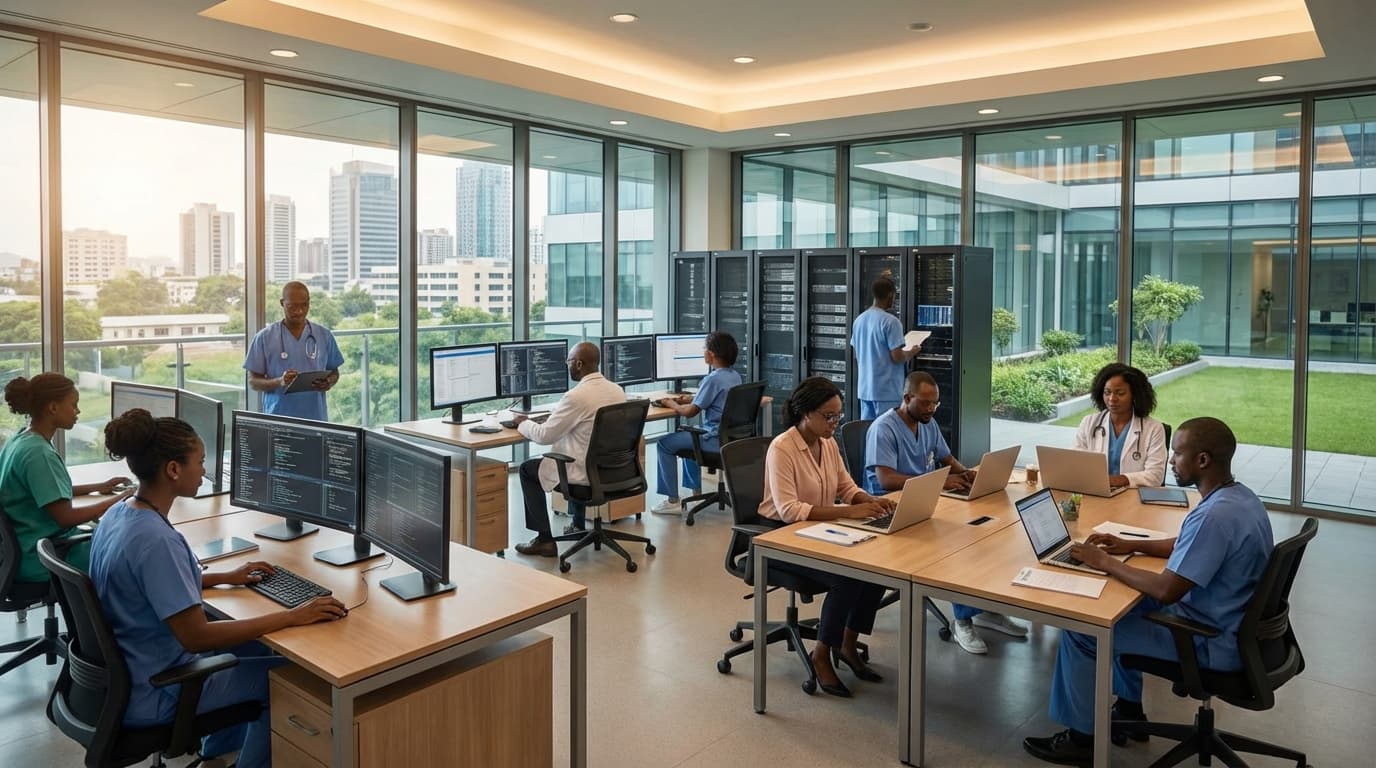
Radiology Reader & Reporting Support in Ghana
Engineering Excellence & Technical Support
Remote radiology reading and reporting services High-standard technical execution following OEM protocols and local regulatory frameworks.
AI-Powered Diagnostic Assistance
Leveraging cutting-edge AI algorithms to flag potential abnormalities in radiological images, reducing missed diagnoses and improving reporting efficiency for Ghanaian radiologists.
Remote Reading & Collaboration Platform
A secure, cloud-based platform enabling radiologists in remote or underserved areas of Ghana to access and report on imaging studies, facilitating specialist consultation and expanding access to advanced diagnostics.
Streamlined Reporting Workflow & Templates
Intuitive reporting interface with customizable templates and structured reporting tools to standardize and accelerate the generation of high-quality radiology reports, ensuring consistency and compliance with international standards in Ghana.
What Is Radiology Reader & Reporting Support In Ghana?
Radiology Reader & Reporting Support in Ghana refers to the provision of remote expert interpretation of medical imaging studies and the generation of comprehensive diagnostic reports, primarily for healthcare facilities lacking on-site or sufficient radiologist staffing. This service leverages telemedicine and teleradiology platforms to extend specialized diagnostic capabilities, improving patient care access and efficiency within the Ghanaian healthcare ecosystem. It bridges the gap created by the scarcity of qualified radiologists, particularly in underserved or remote areas, by connecting local healthcare providers with international or national remote radiology expertise. The service encompasses the acquisition, transmission, interpretation, and reporting of various imaging modalities, including X-ray, CT, MRI, ultrasound, and mammography.
| Who Needs This Service? | Typical Use Cases | ||||
|---|---|---|---|---|---|
| Hospitals and Clinics in Underserved/Remote Areas: Facilities with limited or no on-site radiologist presence, especially those in rural or geographically isolated regions. | Emergency Departments: Providing rapid interpretation of critical imaging studies (e.g., head CT for stroke, chest X-ray for trauma) outside of regular working hours or when on-site staff is overwhelmed. | Specialized Medical Centers: Centers focusing on specific specialties (e.g., oncology, cardiology) that require subspecialty radiology expertise not readily available locally. | Outpatient Imaging Centers: Ensuring timely and accurate reporting for routine diagnostic imaging procedures, enhancing patient throughput and satisfaction. | Public Health Initiatives: Supporting national or regional screening programs (e.g., tuberculosis screening via chest X-ray) that require large-scale image interpretation. | Training and Educational Institutions: Providing access to expert readings for diagnostic trainees and facilitating continuous professional development for referring physicians. |
| 24/7 Emergency Radiology Coverage: Ensuring immediate interpretation of emergent imaging studies, reducing diagnostic delays and improving patient outcomes. | Subspecialty Consultations: Accessing expert opinions in fields like neuroradiology, musculoskeletal radiology, or interventional radiology for complex cases. | Overload Management: Assisting local radiology departments during periods of high patient volume or staff shortages. | Second Opinions: Providing an independent review of imaging studies to confirm or refute initial diagnoses. | Quality Improvement Initiatives: Facilitating case reviews and audits to enhance the quality of local diagnostic services. | Cost-Effective Solution: Offering a financially viable alternative to recruiting and retaining full-time, on-site radiologists, particularly for smaller facilities. |
Key Components of Radiology Reader & Reporting Support
- Image Acquisition & Transmission: Facilitation of secure and efficient transfer of DICOM (Digital Imaging and Communications in Medicine) compliant images from originating sites to the remote reading center.
- Expert Interpretation: Performance of diagnostic reading and analysis of medical images by board-certified or equivalent radiologists with subspecialty expertise where applicable.
- Report Generation: Creation of structured, clear, and concise diagnostic reports, adhering to established medical reporting standards and including findings, impressions, and recommendations.
- Quality Assurance: Implementation of robust quality control measures to ensure accuracy, consistency, and adherence to best practices in interpretation and reporting.
- Communication & Collaboration: Establishment of communication channels for referring physicians to discuss complex cases, clarify findings, and receive additional insights.
- IT Infrastructure & Security: Provision and maintenance of secure, HIPAA-compliant (or equivalent local regulatory standards) teleradiology platforms for data transmission, storage, and access.
Who Needs Radiology Reader & Reporting Support In Ghana?
Radiology reading and reporting support is a critical service that addresses the shortage of qualified radiologists and the increasing demand for diagnostic imaging services in Ghana. This support is vital for improving the accuracy and speed of diagnoses, thereby enhancing patient care and outcomes across various healthcare settings.
| Customer Type | Typical Size/Scope | Primary Need | Specific Departments Benefiting |
|---|---|---|---|
| Public Hospitals (District) | Medium to Large | Basic diagnostic imaging support, workload management, access to sub-specialty interpretation. | Radiology, General Medicine, Surgery, Orthopedics. |
| Public Hospitals (Regional) | Large | Advanced imaging interpretation, sub-specialty coverage, peer review, training support. | Radiology, all medical and surgical specialties. |
| Public Hospitals (Teaching) | Very Large | Complex case interpretation, research support, resident training, quality assurance. | Radiology, all clinical departments, research units. |
| Private Hospitals & Clinics | Small to Large | Timely reporting for competitive advantage, specialized interpretation not available in-house, overflow support. | Radiology, all clinical departments. |
| Diagnostic Imaging Centers | Medium to Large | Increased reporting capacity, 24/7 coverage, specialized readings, quality control. | Radiology, referring clinicians. |
| Specialty Hospitals (e.g., Oncology, Cardiology) | Medium to Large | Expert interpretation of specific modalities and conditions (e.g., PET-CT, cardiac MRI). | Radiology, Oncology, Cardiology, relevant surgical teams. |
| Medical Schools | N/A (institutional) | Educational support, case studies, access to expert readers for teaching. | Radiology, Clinical Departments. |
Target Customers and Departments in Ghana for Radiology Reader & Reporting Support
- {"items":["Public Hospitals (District, Regional, Teaching)","Private Hospitals and Clinics","Diagnostic Imaging Centers","Specialty Hospitals (e.g., Oncology, Cardiology)","Health Insurance Providers (indirectly, through improved diagnostic quality)","Medical Schools and Research Institutions"],"title":"Primary Target Customers"}
- {"items":["Radiology/Diagnostic Imaging Department (primary recipient)","Emergency/Accident & Emergency Departments","Orthopedics","Internal Medicine","Pediatrics","Surgery (all sub-specialties)","Oncology","Cardiology","Neurology","Maternity and Gynecology"],"title":"Key Departments Requiring Support"}
Radiology Reader & Reporting Support Process In Ghana
This document outlines the typical workflow for radiology reading and reporting support in Ghana, from an initial inquiry to the final execution of the report. The process is designed to ensure efficient and accurate interpretation of radiological images, facilitating timely clinical decision-making.
| Stage | Description | Key Actors | Output/Deliverable |
|---|---|---|---|
| Request for radiology reading and reporting services is initiated. | Referring Clinician, Radiology Department | Inquiry details (patient info, clinical history, modality, diagnostic questions) |
| Inquiry is received, assessed for urgency, and assigned to a reader. | Coordination Unit, Radiology Manager | Assigned Radiologist, Confirmed Availability |
| Imaging data is securely transferred to the assigned radiologist. | IT Department, PACS Administrator, Radiologist | DICOM Images |
| Radiologist reviews images and clinical information. | Radiologist | Image Interpretation |
| Radiologist dictates or types the preliminary report. | Radiologist | Preliminary Report |
| Report is reviewed for accuracy and finalized. | Radiologist (Senior Radiologist if applicable) | Finalized Report |
| Final report is transmitted to the referring clinician/department. | Radiology Department, PACS Administrator | Final Radiology Report |
| Referring clinician receives and uses the report for patient care. | Referring Clinician | Patient Management Decisions |
| Billing and administrative tasks are completed. | Billing Department, Administration | Completed Billing Records |
Radiology Reader & Reporting Support Process in Ghana
- The process begins with an inquiry, typically from a referring clinician or a radiology department facing a shortage of readers.
- Inquiry details include patient information, clinical history, type of imaging modality, and the specific diagnostic questions.
- The inquiry is received by a central coordination unit or a designated radiology manager.
- This unit assesses the inquiry's urgency and the availability of qualified radiologists.
- If external support is required, the inquiry is forwarded to a panel of qualified radiologists (internal or external to the institution).
- Radiologists review the request, confirm their availability, and accept the case.
- The imaging data (DICOM files) is securely transferred to the designated radiologist via a PACS (Picture Archiving and Communication System) or a secure transfer protocol.
- The radiologist meticulously reviews the images, correlating them with the provided clinical information.
- During interpretation, the radiologist may consult with referring clinicians for clarification or additional information.
- Upon completion of the interpretation, the radiologist dictates or types a preliminary report.
- The preliminary report is then reviewed and finalized by the same radiologist or a senior radiologist if available, ensuring accuracy and completeness.
- The final report is uploaded back into the PACS or securely transmitted to the referring clinician/department.
- The referring clinician receives and reviews the final report, integrating it into patient management.
- Billing and administrative procedures are completed for the services rendered.
- Feedback mechanisms are in place to assess the quality and timeliness of the reporting.
Radiology Reader & Reporting Support Cost In Ghana
The cost of radiology reader and reporting support in Ghana can vary significantly based on several factors. These factors influence the pricing structure for services that involve expert radiologists interpreting medical images (like X-rays, CT scans, MRIs, ultrasounds) and generating detailed reports. The primary drivers for cost include the complexity and type of imaging study, the urgency of the report, the experience and specialization of the radiologist, and the provider's operational overhead. The local currency is the Ghanaian Cedi (GHS).
| Service Type (Estimated Range) | Typical Turnaround Time | Estimated Cost (GHS) |
|---|---|---|
| Routine X-ray Interpretation (e.g., Chest X-ray, Limb X-ray) | 24-48 hours | GHS 150 - GHS 400 |
| Routine Ultrasound Interpretation (e.g., Abdominal, Pelvic) | 24-48 hours | GHS 200 - GHS 500 |
| CT Scan Interpretation (e.g., Head, Abdomen, Chest - Non-contrast) | 24-48 hours | GHS 400 - GHS 900 |
| CT Scan Interpretation (e.g., with Contrast) | 24-48 hours | GHS 500 - GHS 1,200 |
| MRI Scan Interpretation (e.g., Brain, Spine, Joint) | 24-72 hours | GHS 700 - GHS 2,000 |
| STAT/Rush Interpretation (Any Modality) | 1-6 hours | Additional 50% - 100% on base rate |
| Sub-specialty Consultation/Reporting (e.g., Neuroradiology, Interventional) | 48-72 hours | GHS 800 - GHS 3,000+ |
Key Pricing Factors for Radiology Reader & Reporting Support in Ghana:
- Type of Imaging Modality: Different imaging techniques (e.g., plain X-ray, CT, MRI, Ultrasound) have varying levels of complexity in interpretation, impacting cost.
- Complexity of the Study: A routine chest X-ray will be less expensive than a complex multi-slice CT scan of the abdomen with contrast or a detailed MRI of the brain.
- Urgency/Turnaround Time: Standard reporting times are generally cheaper than rush or STAT (immediate) interpretations, which require expedited radiologist allocation.
- Radiologist's Expertise and Specialization: Sub-specialists (e.g., neuroradiologists, interventional radiologists, pediatric radiologists) may command higher fees due to their niche expertise.
- Volume of Cases: Larger hospitals or imaging centers may negotiate volume-based discounts.
- Technology and Infrastructure: Providers with advanced PACS (Picture Archiving and Communication System) and teleradiology platforms might have different cost structures.
- Geographic Location within Ghana: While not a primary driver for remote reading, local operational costs can subtly influence pricing.
- Reporting Format and Detail: The level of detail and the inclusion of specific recommendations in the report can affect pricing.
- Ancillary Services: Reporting support might be bundled with other services, influencing the overall cost.
Affordable Radiology Reader & Reporting Support Options
Healthcare providers are increasingly seeking cost-effective solutions for radiology reading and reporting. Fortunately, a range of affordable options and strategic approaches can significantly reduce expenses without compromising quality. Value bundles, which combine multiple services at a discounted rate, and various cost-saving strategies are key to achieving these efficiencies.
| Strategy/Concept | Description | Cost-Saving Benefit |
|---|---|---|
| Value Bundles | Packages of radiology reading, reporting, and potentially other related services (e.g., quality assurance, IT support) offered by a single vendor at a reduced overall price compared to purchasing each service individually. | Economies of scale, reduced administrative overhead, predictable pricing, and often includes service level agreements for guaranteed quality and turnaround. |
| Tiered Service Agreements | Different service levels with varying turnaround times and subspecialty coverage options, allowing providers to select the most appropriate and cost-effective tier based on clinical urgency and need. | Pay for what you need, avoiding overspending on premium services for routine cases. Allows for customization of support. |
| Volume-Based Discounts | Negotiating lower per-study rates with teleradiology providers or AI vendors based on the projected volume of studies to be processed. | Direct reduction in the cost per radiology report as the volume of work increases. |
| Technology Integration & Workflow Optimization | Investing in or leveraging AI and PACS (Picture Archiving and Communication System) integrations that streamline workflows, reduce manual tasks, and improve radiologist efficiency. | Increased radiologist productivity, faster report turnaround, and reduced labor costs per study. |
| Subspecialty Pooling | Instead of maintaining multiple in-house subspecialists, utilize teleradiology services that offer access to a broad range of subspecialists on demand, shared across multiple client institutions. | Reduces the cost of maintaining niche subspecialty expertise in-house, as the cost is distributed among many users. |
| Performance-Based Contracts | Structuring contracts with vendors where payment is partially tied to performance metrics such as turnaround time, accuracy, and client satisfaction. | Incentivizes the vendor to deliver high-quality, efficient services, leading to better outcomes and potentially lower long-term costs due to reduced errors or rework. |
Affordable Radiology Reader & Reporting Support Options
- {"title":"Teleradiology Services","description":"Outsourcing radiology interpretation to remote specialists. Offers flexibility, 24/7 coverage, and access to subspecialists, often at a lower per-study cost than employing in-house radiologists, especially for off-peak hours or specialized reads."}
- {"title":"AI-Powered Diagnostic Support","description":"Artificial intelligence tools can assist radiologists by pre-screening images, flagging potential abnormalities, and improving turnaround times. This can enhance radiologist efficiency, allowing them to read more studies or focus on complex cases."}
- {"title":"Hybrid Models","description":"A combination of in-house and outsourced radiology services. For instance, using teleradiology for overnight reads or subspecialty coverage while maintaining an in-house team for core operations."}
- {"title":"Shared Services or Cooperative Purchasing","description":"Collaborating with other healthcare organizations to share radiology reading services or collectively negotiate rates with teleradiology providers. This leverages group purchasing power for better pricing."}
- {"title":"Flexible Staffing Models","description":"Utilizing locum tenens radiologists for temporary coverage during peak times, vacations, or staff shortages, which can be more cost-effective than hiring full-time staff for fluctuating needs."}
Verified Providers In Ghana
In Ghana's burgeoning healthcare sector, identifying reliable and credentialed providers is paramount for individuals seeking quality medical care. Franance Health stands out as a leading platform dedicated to connecting patients with verified healthcare professionals. This commitment to verification ensures that all listed providers meet rigorous standards of expertise, licensure, and ethical practice, offering peace of mind and confidence to users. Choosing Franance Health means opting for a service that prioritizes patient safety and facilitates access to the best medical talent available in Ghana.
| Provider Category | Key Credentials Verified | Benefits of Choosing Franance Health Verified |
|---|---|---|
| Doctors (General & Specialists) | Medical Degree (MBChB/MD), Professional License (GMC/GMC-equivalent), Specialty Certifications, Continuing Professional Development (CPD) | Access to licensed and qualified medical experts, accurate diagnoses, effective treatment plans, and safe medical procedures. |
| Nurses | Nursing Diploma/Degree, Professional License (N&MCN), Specialty Certifications (e.g., Midwifery, Critical Care) | Competent and ethical nursing care, post-operative support, patient education, and a safe care environment. |
| Pharmacists | Pharmacy Degree, Professional License (PAG), Registration with Pharmacy Council | Accurate prescription dispensing, medication counseling, drug interaction checks, and safe pharmaceutical practices. |
| Dentists | Dental Degree, Professional License (GDC-equivalent), Specialty Certifications (e.g., Orthodontics, Periodontics) | Expert oral health assessments, preventive care, restorative treatments, and specialized dental procedures. |
| Allied Health Professionals (e.g., Physiotherapists, Radiologists, Lab Technicians) | Relevant Degree/Diploma, Professional Body Registration, Specialty Training | Comprehensive diagnostic services, rehabilitative care, and specialized therapeutic interventions delivered by trained professionals. |
Why Franance Health Providers are the Best Choice:
- Rigorous Verification Process: Every provider on Franance Health undergoes a thorough vetting procedure, confirming their qualifications, certifications, and ethical standing.
- Access to Top Medical Professionals: We connect you with a diverse range of specialists and general practitioners known for their expertise and patient-centric approach.
- Enhanced Patient Trust and Safety: Our verification system builds trust by assuring you of the competency and legitimacy of the healthcare providers you choose.
- Streamlined Healthcare Navigation: Franance Health simplifies the process of finding and booking appointments with qualified doctors, making healthcare more accessible.
- Commitment to Quality Care: By partnering with credentialed professionals, we ensure that users receive high-quality, effective, and safe medical treatment.
Scope Of Work For Radiology Reader & Reporting Support
This Scope of Work (SOW) outlines the requirements for providing radiology reader and reporting support services. This service aims to augment existing radiology departments by providing qualified radiologists to interpret medical images and generate comprehensive reports, thereby improving turnaround times, enhancing diagnostic accuracy, and supporting efficient patient care. The technical deliverables are designed to ensure seamless integration with existing Picture Archiving and Communication Systems (PACS) and Electronic Health Records (EHRs), while standard specifications will guide the quality and format of the delivered reports.
| Technical Deliverable | Standard Specification | Description | Format/Protocol |
|---|---|---|---|
| Radiology Reports | ACR Appropriateness Criteria® Alignment | Reports shall reflect accurate interpretation and be structured to include findings, impression, and recommendations. Where applicable, reporting should consider the principles of the ACR Appropriateness Criteria®. | Standardized report templates (e.g., structured reporting), DICOM SR (for specific structured reports), HL7 (for report transmission). |
| Image Access & Review | PACS Integration | Radiologists will access images directly from the client's PACS. Secure and reliable access is paramount. | DICOM (Digital Imaging and Communications in Medicine) for image viewing and retrieval. |
| Report Transmission | EHR/RIS Integration | Generated reports will be transmitted electronically to the client's Electronic Health Record (EHR) or Radiology Information System (RIS). | HL7 (Health Level Seven) messaging for report integration into EHR/RIS. Secure API integration may also be utilized. |
| Critical Findings Notification | Established Communication Protocol | A defined protocol for immediate notification of critical findings to the referring physician or designated personnel. | Secure phone calls, secure messaging platforms (e.g., Surescripts), or integrated alerts within EHR/RIS. |
| Data Security & Privacy | HIPAA Compliance | All data handling and transmission must strictly adhere to HIPAA regulations and other relevant data privacy laws. | Secure data transmission protocols (e.g., TLS/SSL), data encryption at rest and in transit, access controls, audit trails. |
| Quality Assurance Feedback | Regular Review Cycles | Mechanisms for providing and receiving feedback on report quality, accuracy, and turnaround times. | Scheduled case reviews, quality dashboards, formal feedback channels. |
| System Performance Monitoring | Uptime & Latency Standards | Monitoring of remote reading platform performance to ensure minimal downtime and acceptable image loading/reporting latency. | Defined SLAs for uptime (e.g., 99.9%), maximum acceptable latency for image loading and report saving. |
Key Areas of Support
- Image interpretation across various modalities (e.g., X-ray, CT, MRI, Ultrasound, Nuclear Medicine).
- Generation of clear, concise, and clinically relevant radiology reports.
- Real-time or near real-time reporting based on agreed-upon service level agreements (SLAs).
- Adherence to established radiological reporting guidelines and best practices.
- Communication with referring physicians for critical findings or clarification, as needed.
- Participation in quality assurance and peer review processes.
Service Level Agreement For Radiology Reader & Reporting Support
This Service Level Agreement (SLA) outlines the performance standards and guarantees for the Radiology Reader & Reporting Support services provided. It defines the expected response times for critical and non-critical requests, as well as uptime guarantees for the reporting platform and associated services.
| Service Component | Priority Level | Response Time Guarantee | Resolution Time Guarantee (Target) | Uptime Guarantee |
|---|---|---|---|---|
| Radiology Reading Platform (Web Interface) | Critical (System Outage, inability to report) | 15 minutes | 2 hours | 99.9% |
| Radiology Reading Platform (Web Interface) | High (Major functionality impaired, significant impact) | 30 minutes | 4 hours | 99.9% |
| Radiology Reading Platform (Web Interface) | Medium (Minor functionality impaired, moderate impact) | 1 hour | 8 business hours | 99.5% |
| Radiology Reading Platform (Web Interface) | Low (Feature request, general inquiry) | 4 business hours | 3 business days | N/A (as this is not a system downtime issue) |
| Reporting Access & Data Retrieval | Critical (Unable to access reports) | 15 minutes | 1 hour | 99.9% |
| Reporting Access & Data Retrieval | High (Slow access, partial data missing) | 30 minutes | 4 hours | 99.9% |
| Reader Support (Technical Assistance) | Critical (Login issues preventing immediate work) | 15 minutes | 1 hour | N/A (Service dependent on platform uptime) |
| Reader Support (Technical Assistance) | High (Software malfunction impacting workflow) | 30 minutes | 3 hours | N/A (Service dependent on platform uptime) |
| Reader Support (Technical Assistance) | Medium (Configuration questions, minor issues) | 2 business hours | 1 business day | N/A (Service dependent on platform uptime) |
| Reporting Support (Report generation issues, template questions) | Critical (Unable to generate essential reports) | 30 minutes | 2 hours | 99.9% (Platform uptime required) |
| Reporting Support (Report generation issues, template questions) | High (Incorrect report formatting, delayed generation) | 1 hour | 4 business hours | 99.9% (Platform uptime required) |
| Reporting Support (Report generation issues, template questions) | Medium (Minor formatting adjustments, guidance) | 4 business hours | 2 business days | N/A (Service dependent on platform uptime) |
Key Performance Indicators (KPIs)
- Response Time: The maximum allowable time to acknowledge and begin addressing a reported issue or request.
- Resolution Time: The maximum allowable time to fully resolve a reported issue or fulfill a request.
- Uptime: The percentage of time the Radiology Reader & Reporting Support services are operational and accessible to users.
- Availability: The ability of users to access and utilize the reporting platform and its core functionalities.
Frequently Asked Questions

Ready when you are
Let's scope your Radiology Reader & Reporting Support in Ghana project in Ghana.

Scaling healthcare logistics and technical systems across the entire continent.