
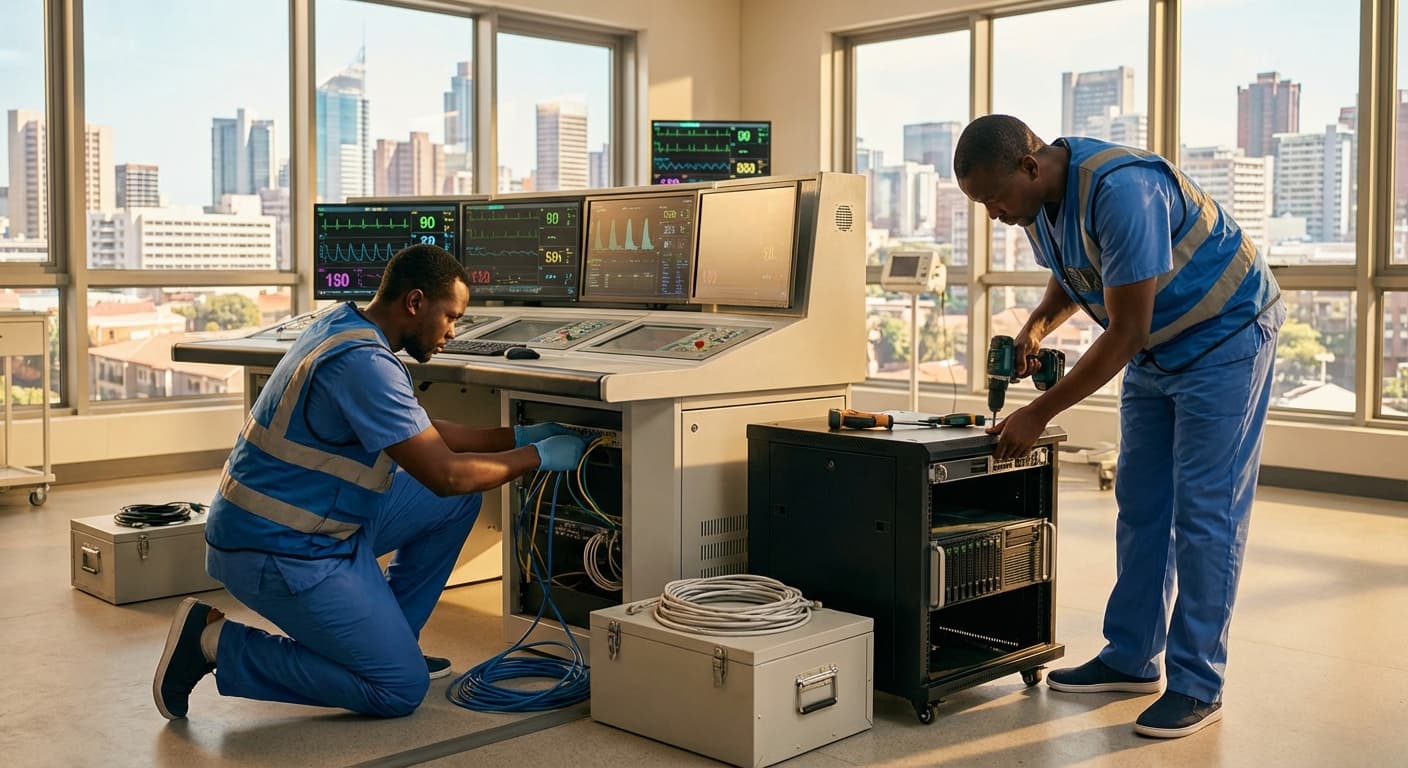
ICU Central Monitoring Station Installation Service in Ghana
Engineering Excellence & Technical Support
ICU Central Monitoring Station Installation Service High-standard technical execution following OEM protocols and local regulatory frameworks.
Robust Network Infrastructure Design
We engineer resilient and scalable network architectures specifically for ICU central monitoring, ensuring reliable data transmission and minimal downtime. Our Ghana-based installations prioritize high-bandwidth, low-latency solutions to support real-time critical patient data.
Advanced Cybersecurity Integration
Patient data security is paramount. Our service integrates state-of-the-art cybersecurity protocols, including data encryption, access control, and intrusion detection systems, tailored to the unique regulatory environment and infrastructure challenges in Ghana.
Optimized Display and Alert Configuration
We meticulously configure central monitoring displays and alert systems for optimal clinical workflow and immediate response. Our expertise ensures critical patient parameters are prominently displayed and actionable alerts are efficiently managed, enhancing patient safety in Ghanaian ICUs.
What Is Icu Central Monitoring Station Installation Service In Ghana?
ICU Central Monitoring Station Installation Service in Ghana refers to the comprehensive process of setting up and configuring a centralized command and control hub for the continuous, real-time monitoring of critically ill patients within an Intensive Care Unit (ICU). This service ensures that vital patient physiological data, transmitted from bedside monitoring equipment, is collected, displayed, analyzed, and managed efficiently from a dedicated station. The installation encompasses the physical setup of hardware (servers, workstations, displays, network infrastructure), software deployment and configuration (patient data management systems, alarm management software, trending modules), and the integration of diverse medical devices.
| Service Recipient | Need for Service | Typical Use Cases |
|---|---|---|
| Hospitals/Healthcare Facilities in Ghana with Intensive Care Units (ICUs) | To enhance patient safety, improve clinical decision-making, and optimize resource allocation within the ICU by providing continuous, real-time oversight of multiple critically ill patients. | Monitoring patients with complex cardiopulmonary, neurological, or hemodynamic instability. Facilitating early detection and intervention for critical events. Streamlining data collection for research and quality improvement initiatives. Enabling remote observation of patients by a dedicated monitoring team. |
| New Hospital Construction or Renovation Projects | As a foundational element of a modern ICU infrastructure, ensuring that advanced patient monitoring capabilities are integrated from the initial design phase. | Designing and implementing a state-of-the-art ICU with integrated central monitoring. Ensuring compatibility with emerging medical technologies and future scalability. |
| Existing ICUs Seeking to Upgrade or Expand | To replace outdated monitoring systems, enhance existing capabilities, or accommodate increased patient capacity with a more efficient and advanced monitoring solution. | Replacing legacy monitoring systems with integrated digital platforms. Adding new monitoring modules or workstations to an existing setup. Improving alarm management efficiency to reduce clinician burden. |
Key Components of ICU Central Monitoring Station Installation
- Network Infrastructure Deployment: Establishing a robust, secure, and high-bandwidth network to facilitate seamless data transmission between bedside monitors and the central station.
- Hardware Installation: Procuring, installing, and configuring central servers, high-resolution display monitors, workstations for nursing staff, and any necessary network switches or routers.
- Software Configuration and Integration: Installing and configuring specialized ICU monitoring software, including patient data management systems (PDMS), alarm aggregation and management platforms, and data trending and analysis tools. This also involves integrating the software with existing hospital information systems (HIS) or electronic health records (EHR).
- Device Connectivity and Calibration: Ensuring reliable and accurate connectivity of all bedside monitoring devices (e.g., ECG, SpO2, NIBP, EtCO2, invasive pressure monitors) to the central system. This includes proper calibration and validation of data streams.
- Alarm Management System Setup: Configuring alarm parameters, priorities, and notification protocols to effectively alert clinical staff to critical patient events while minimizing alarm fatigue.
- User Interface Customization: Tailoring the display interfaces and dashboards to meet the specific workflows and information needs of the ICU clinical team.
- Security Implementation: Establishing robust cybersecurity measures to protect sensitive patient data and ensure compliance with data privacy regulations.
- Testing and Validation: Conducting comprehensive system testing to verify functionality, data accuracy, alarm integrity, and overall performance.
- Staff Training: Providing in-depth training to ICU clinicians and IT support staff on the operation, maintenance, and troubleshooting of the central monitoring system.
Who Needs Icu Central Monitoring Station Installation Service In Ghana?
ICU Central Monitoring Station installation services are crucial for any healthcare facility in Ghana aiming to provide advanced, continuous, and real-time patient care in critical conditions. These stations allow a team of nurses and doctors to remotely monitor multiple ICU patients from a central location, enabling faster responses to changes in patient status, improved resource allocation, and enhanced patient safety. This service is particularly vital for hospitals looking to upgrade their intensive care capabilities, increase efficiency, and adhere to international standards of critical care delivery.
| Target Customer Type | Relevant Departments |
|---|---|
| Public Hospitals | Intensive Care Unit (ICU), Emergency Department (ED), Anesthesiology Department |
| Private Hospitals and Clinics | Intensive Care Unit (ICU), Cardiology Department, Neurology Department, Emergency Department (ED) |
| Teaching Hospitals and University Medical Centers | Intensive Care Unit (ICU), Critical Care Medicine Department, Anesthesiology Department, Cardiology Department, Neurology Department |
| Large Corporate Hospitals | Intensive Care Unit (ICU), All specialized critical care units (e.g., Medical ICU, Surgical ICU, Cardiac ICU), Emergency Department (ED) |
| Regional and District Hospitals | Intensive Care Unit (ICU), Emergency Department (ED), General Surgery Department, Internal Medicine Department |
| Specialty Hospitals | Intensive Care Unit (ICU), relevant specialty departments (e.g., Cardiac Surgery ICU, Neuro ICU), Anesthesiology Department |
Target Customers for ICU Central Monitoring Station Installation Services in Ghana
- Public Hospitals (Government-funded facilities seeking to modernize and expand critical care capacity).
- Private Hospitals and Clinics (Entities aiming to offer high-end critical care services and attract a wider patient base).
- Teaching Hospitals and University Medical Centers (Institutions requiring state-of-the-art technology for training and complex patient management).
- Large Corporate Hospitals (Organizations with a focus on comprehensive healthcare services and advanced medical infrastructure).
- Regional and District Hospitals (Facilities looking to improve the quality and accessibility of critical care in underserved areas).
- Specialty Hospitals (e.g., Cardiac Centers, Neuro-hospitals, Oncology Centers) that have dedicated ICU units requiring specialized monitoring.
Icu Central Monitoring Station Installation Service Process In Ghana
This document outlines the comprehensive workflow for the ICU Central Monitoring Station Installation Service Process in Ghana, from initial inquiry to final execution and handover. We aim to provide a transparent and efficient service, ensuring optimal functionality and client satisfaction.
| Stage | Description | Activities Involved | Key Deliverables | Timeline (Indicative) |
|---|---|---|---|---|
| Initial contact from the client to express interest in the ICU Central Monitoring Station installation service. | Initial discussion to understand client needs, existing infrastructure, and project scope. Clarification of service offerings and benefits. | Understanding of client requirements, preliminary scope definition. | 1-3 Days |
| A detailed evaluation of the hospital's ICU environment to ensure feasibility and identify specific requirements. | On-site visit by technical experts. Assessment of power availability, network infrastructure, existing medical equipment compatibility, space allocation, and safety regulations. Development of a detailed installation plan. | Site assessment report, detailed installation plan, technical specifications. | 3-7 Days |
| Presentation of a comprehensive proposal and formalization of the service agreement. | Development of a detailed quotation based on site assessment and client requirements. Negotiation of terms and conditions. Signing of the Service Level Agreement (SLA) and contract. | Formal quotation, signed SLA and contract. | 2-5 Days |
| Acquisition and delivery of all necessary equipment and components to the installation site. | Ordering of the central monitoring station hardware, software, network devices, cables, and any required accessories. Coordination of shipping, customs clearance (if applicable), and delivery to the hospital. | Procured and delivered equipment, logistics manifest. | 2-6 Weeks (dependent on equipment availability and shipping times) |
| The physical setup and software configuration of the central monitoring station. | Installation of the central monitoring unit, server, workstations, and network infrastructure. Cabling, power connections, and network configuration. Software installation, database setup, and initial system configuration. | Installed hardware, configured software, functioning network connectivity. | 5-15 Days |
| Thorough verification of the system's functionality and performance. | Comprehensive testing of all system components, including data acquisition from patient monitors, alarm functionality, data storage, and user interface. System calibration and validation to ensure accuracy and reliability. | Test reports, commissioned system, operational verification. | 3-7 Days |
| Empowering hospital staff to effectively use and manage the new system. | Conducting comprehensive training sessions for ICU medical staff and IT personnel on system operation, monitoring, alarm management, troubleshooting, and basic maintenance. Formal handover of the installed system and all relevant documentation. | Trained personnel, user manuals, system documentation, formal handover certificate. | 2-5 Days |
| Ongoing assistance to ensure the continued optimal performance of the system. | Provision of warranty, technical support, remote assistance, and scheduled maintenance as per the SLA. Addressing any post-installation queries or issues. Optional ongoing monitoring and optimization services. | Ongoing technical support, maintenance services, issue resolution. | Continuous (as per SLA) |
Key Stages of the Installation Service Process
- Inquiry & Consultation
- Site Assessment & Planning
- Quotation & Agreement
- Procurement & Logistics
- Installation & Configuration
- Testing & Commissioning
- Training & Handover
- Post-Installation Support
Icu Central Monitoring Station Installation Service Cost In Ghana
Installing an ICU central monitoring station in Ghana involves a range of costs influenced by several factors. These stations are critical for patient care, allowing healthcare professionals to continuously monitor vital signs of multiple ICU patients from a central location. The pricing is not a fixed figure and can vary significantly based on the complexity of the system, the brand of equipment chosen, the size and existing infrastructure of the hospital, and the specific services required from the installation provider. It's crucial for Ghanaian hospitals to get detailed quotes from reputable medical equipment suppliers and installers who understand local regulations and logistics.
| Component/Service | Estimated Price Range (GHS) | Notes |
|---|---|---|
| Basic Patient Monitor (per bed) | 8,000 - 30,000+ | Depends on parameters (ECG, SpO2, NIBP, etc.) and brand. |
| Advanced Patient Monitor (per bed) | 30,000 - 100,000+ | Includes invasive pressure, capnography, advanced algorithms, touchscreen. |
| Central Station Server & Software | 50,000 - 250,000+ | Scales with the number of beds and data storage/processing needs. |
| Display Consoles (per station) | 15,000 - 60,000+ | High-resolution monitors, touch capabilities, ergonomic design. |
| Networking & Cabling (per bed/area) | 2,000 - 15,000+ | Includes installation, switches, patch panels, and testing. Varies based on existing infrastructure. |
| Installation & Configuration Labor | 10,000 - 50,000+ | Depends on project complexity, team size, and duration. |
| Staff Training | 5,000 - 25,000+ | For clinicians and IT staff; can be per session or comprehensive. |
| Annual Maintenance Contract (AMC) (Annual) | 5% - 15% of initial system cost | Covers servicing, minor repairs, and software updates. |
| Total System Installation (Example: 10-bed ICU) | 200,000 - 1,000,000+ | Highly variable, this is a rough estimate for a moderately equipped system. |
Key Pricing Factors for ICU Central Monitoring Station Installation in Ghana:
- Number of Patient Monitoring Beds: The more beds that need to be integrated into the central monitoring system, the higher the cost of sensors, cables, and software licenses.
- Type and Sophistication of Monitoring Equipment: Advanced multi-parameter monitors (ECG, SpO2, NIBP, respiration, temperature, invasive pressures) will be more expensive than basic units. Features like touchscreen interfaces, integrated drug calculators, and advanced alarm management also add to the cost.
- Central Station Hardware and Software: This includes the main server, display consoles for the nurses' station, and the specialized software to aggregate and display patient data. The capacity and processing power of the server will impact the price.
- Networking and Cabling Infrastructure: The existing network infrastructure of the hospital plays a significant role. If extensive new cabling, switches, or wireless access points are required to ensure reliable data transmission, costs will increase. Integration with existing Electronic Health Records (EHR) systems also adds complexity and cost.
- Brand and Manufacturer: Reputable international brands often come with a higher price tag but offer advanced features, reliability, and better after-sales support. Localized or less well-known brands might offer a more budget-friendly option, but due diligence on their performance and support is essential.
- Installation and Configuration Services: This covers the physical installation of equipment, cabling, network setup, software installation and configuration, and initial testing. The complexity of the installation environment (e.g., existing building constraints) can affect labor costs.
- Training: Comprehensive training for medical staff and IT personnel on operating and maintaining the system is a crucial, albeit often overlooked, cost component.
- After-Sales Support and Maintenance Contracts: Extended warranties, annual maintenance contracts (AMCs), and availability of spare parts are vital for long-term operational efficiency and can significantly influence the overall investment.
- Import Duties and Taxes: For imported equipment, applicable customs duties, taxes, and import processing fees in Ghana will add to the final cost.
- Location and Site Preparation: While often included in installation, specific site preparation needs (e.g., power outlets, grounding) or logistical challenges in reaching the installation site can influence costs.
Affordable Icu Central Monitoring Station Installation Service Options
Establishing a robust ICU Central Monitoring Station (CMS) is crucial for providing high-quality patient care and optimizing resource allocation. This service focuses on the seamless installation and integration of CMS technology, ensuring critical patient data is accessible and actionable. We offer flexible options to meet diverse budgetary needs, including value bundles and strategic cost-saving measures.
| Service Tier | Features | Typical Value Bundle Components | Estimated Cost Range (USD) | Cost-Saving Strategies |
|---|---|---|---|---|
| Basic Essentials | Core CMS functionality, essential monitoring, and basic integration. | 1-2 Central monitoring workstations, basic network setup, 5-10 patient bedside units, EMR integration for vital signs only, standard alarm notifications. | $25,000 - $60,000 | Phased implementation, focus on essential departments first, explore refurbished high-quality equipment, leverage existing network infrastructure where possible. |
| Enhanced Performance | Advanced features, improved data analysis, and expanded integration. | 2-4 Central monitoring workstations with advanced analytics, robust network, 15-25 patient bedside units, comprehensive EMR/EHR integration (vitals, waveforms, alerts), advanced alarm management with tiered notifications. | $50,000 - $120,000 | Negotiate bulk discounts on equipment, consider cloud-based storage solutions, utilize open-source software for certain functionalities, train in-house IT staff for basic maintenance. |
| Premium Integration & Scalability | State-of-the-art technology, seamless workflow integration, and future-proofing. | 4+ Central monitoring workstations with AI-driven insights, high-speed secure network, 30+ patient bedside units, full EMR/EHR integration with order entry and trend analysis, predictive alarm analytics, remote monitoring capabilities, comprehensive training and ongoing support package. | $100,000+ | Lease equipment instead of outright purchase, explore partnerships with technology providers for bundled solutions, prioritize vendors offering extended warranties and comprehensive service plans, invest in modular systems for easier future upgrades. |
Key Components of an ICU Central Monitoring Station Installation:
- Centralized monitoring displays and workstations
- Network infrastructure for data transmission
- Patient bedside monitoring units (e.g., vital signs monitors, ventilators)
- Integration with existing EMR/EHR systems
- Alarm management and notification systems
- Data storage and retrieval solutions
- On-site training and support
Verified Providers In Ghana
In Ghana's growing healthcare landscape, identifying reliable and accredited medical facilities is paramount for ensuring quality patient care. Verified providers stand out due to their commitment to rigorous standards, patient safety, and ethical practices. Franance Health has established itself as a leading name in this domain, consistently upholding the highest credentials and offering a superior healthcare experience.
| Credential/Aspect | Franance Health Verification | Benefit to Patients |
|---|---|---|
| Regulatory Compliance | Ensures all partner facilities meet or exceed Ghana Health Service regulations. | Guarantees safe and legally compliant medical services. |
| International Accreditation Standards | Partnerships often include facilities adhering to JCI, ISO, or similar global benchmarks. | Access to world-class healthcare standards and practices. |
| Continuous Professional Development (CPD) for Staff | Mandatory CPD programs for all affiliated medical personnel. | Patients receive care from up-to-date, skilled, and knowledgeable professionals. |
| Patient Safety Protocols | Rigorous implementation and monitoring of infection control and patient safety measures. | Minimizes risks and ensures a secure healing environment. |
| Ethical Medical Practice | Adherence to a strict code of medical ethics and patient rights. | Trustworthy and respectful treatment, with patient autonomy prioritized. |
| Modern Diagnostic and Treatment Technology | Partnerships with facilities investing in advanced medical equipment. | Accurate diagnosis and effective, evidence-based treatment options. |
Why Franance Health is the Best Choice for Verified Providers in Ghana:
- Accreditation and Compliance: Franance Health partners exclusively with facilities that have undergone stringent accreditation processes by recognized national and international bodies. This ensures adherence to best practices in patient care, safety protocols, and operational efficiency.
- Qualified Medical Professionals: The network comprises highly trained and experienced doctors, nurses, and specialists, all of whom are licensed and continuously engaged in professional development to stay abreast of the latest medical advancements.
- State-of-the-Art Facilities: Franance Health prioritizes partnerships with healthcare providers equipped with modern medical technology and infrastructure, facilitating accurate diagnostics and effective treatments.
- Patient-Centric Approach: A core tenet of Franance Health is its unwavering focus on patient well-being and satisfaction. This translates to compassionate care, clear communication, and personalized treatment plans.
- Transparent Operations: Verified providers within the Franance Health network operate with a high degree of transparency, providing clear information about services, costs, and treatment outcomes.
- Commitment to Quality Improvement: These providers are dedicated to continuous quality improvement initiatives, regularly reviewing their services and patient feedback to enhance the overall healthcare delivery.
Scope Of Work For Icu Central Monitoring Station Installation Service
This Scope of Work (SOW) outlines the services required for the installation of an Intensive Care Unit (ICU) Central Monitoring Station (CMS). The project encompasses the complete installation, configuration, testing, and commissioning of the CMS hardware and software, ensuring seamless integration with existing ICU patient monitoring devices and the hospital's network infrastructure. The objective is to provide a reliable and efficient central hub for monitoring critical patient data, improving clinical workflow, and enhancing patient care within the ICU.
| Technical Deliverable | Description | Standard Specification |
|---|---|---|
| CMS Server(s) | High-performance server(s) for data acquisition, processing, storage, and application hosting. | Minimum dual Intel Xeon processors, 64GB RAM, 4TB RAID 10 SSD storage, redundant power supplies, enterprise-grade network interfaces. |
| CMS Workstations/Operator Consoles | Workstations for clinical staff to view patient data, manage alarms, and interact with the system. | Minimum Intel Core i7 processor, 16GB RAM, 512GB SSD, high-resolution (24" or larger) displays with multi-monitor support (minimum 2 displays per console). |
| Large Display Screens (Wall-mounted) | High-visibility screens for displaying aggregated patient data and critical alerts in the ICU nursing station. | Minimum 55" LED displays, 1920x1080 resolution, wide viewing angles, network connectivity. |
| Network Infrastructure | Switches, cabling (e.g., Cat 6a or higher), and connectors to support data transmission between monitoring devices, servers, and workstations. | Managed Gigabit Ethernet switches, minimum 24 ports per switch, support for VLANs and QoS, fiber optic connectivity for backbone if required. |
| CMS Software Suite | Integrated software for patient data display, alarm management, trend analysis, historical data retrieval, reporting, and user management. | Vendor-certified, HIPAA-compliant, scalable architecture, user-friendly interface, robust audit trails, interoperability standards (e.g., HL7). |
| Integration Modules/Gateways | Hardware or software modules facilitating data exchange between the CMS and various patient monitoring devices and HIS/EMR. | Compatibility with industry-standard protocols (e.g., HL7, DICOM, proprietary vendor protocols), secure data encryption. |
| Power Distribution Units (PDUs) & UPS | Redundant power supplies and uninterruptible power supply systems for the CMS hardware. | Rack-mountable PDUs with surge protection, appropriately sized UPS to provide sufficient runtime during power outages. |
| Cable Management Systems | Organized and secure routing of all network and power cables. | Cable trays, raceways, Velcro ties, and labeling for all connections. |
| As-Built Documentation | Detailed drawings and documentation of the final installed system, including network topology, cable runs, and equipment placement. | CAD drawings, equipment inventory, configuration details, and operational manuals. |
| Test and Validation Reports | Documentation of all testing phases, including functional, performance, and UAT results, signed off by relevant stakeholders. | Formal reports detailing test cases, execution results, and resolution of any identified issues. |
Key Phases of the Installation Service
- Planning and Design: Detailed site survey, system design validation, network assessment, and finalization of installation plan.
- Equipment Procurement and Delivery: Sourcing and delivery of all CMS hardware, including servers, workstations, displays, network switches, and cabling, according to specifications.
- Infrastructure Preparation: Installation of necessary power outlets, network cabling, and mounting structures in the designated CMS room and ICU bedside areas.
- Hardware Installation and Cabling: Physical installation of all CMS hardware components, including servers, workstations, and displays, and professional cabling for power and data transmission.
- Software Installation and Configuration: Installation and configuration of the CMS software, including patient data management, alarm management, trend analysis, and reporting modules. Integration with existing hospital information systems (HIS) and electronic medical records (EMR) will be performed.
- Integration with Patient Monitoring Devices: Connecting and configuring the CMS to receive data streams from existing ICU bedside patient monitors (e.g., vital signs monitors, ventilators, ECG machines).
- Network Integration: Seamless integration of the CMS into the hospital's existing IT network, ensuring secure data transmission and communication.
- Testing and Commissioning: Comprehensive system testing, including functional tests, performance tests, and user acceptance testing (UAT), to ensure all components operate as designed and meet performance requirements.
- Training: Provision of comprehensive training to clinical and IT staff on the operation, maintenance, and troubleshooting of the CMS.
- Documentation and Handover: Delivery of all relevant technical documentation, including as-built drawings, system manuals, and training materials, followed by formal system handover.
- Post-Installation Support: Provision of a defined period of post-installation support to address any emergent issues and ensure system stability.
Service Level Agreement For Icu Central Monitoring Station Installation Service
This Service Level Agreement (SLA) outlines the response times and uptime guarantees for the installation of an ICU Central Monitoring Station. It is designed to ensure minimal disruption to critical patient care during the installation process and to guarantee the operational availability of the monitoring station post-installation.
| Service Component | Response Time (During Installation) | Downtime Impact | Uptime Guarantee (Post-Installation) | Escalation Procedure |
|---|---|---|---|---|
| Initial Installation & Configuration | Within 1 hour of scheduled start time. Any delay must be communicated with a revised ETA. | N/A (installation is a planned activity) | N/A | Project Manager to Technical Lead |
| Emergency Outages (Critical Failure) | Within 30 minutes of confirmed critical failure notification. | Immediate cessation of monitoring. Requires highest priority resolution. | 99.9% uptime (measured monthly) | On-call Engineer to Senior Support Manager |
| Urgent Issues (Major Failure) | Within 1 hour of confirmed major failure notification. | Significant degradation of monitoring capabilities. Requires expedited resolution. | 99.9% uptime (measured monthly) | Technical Lead to Support Manager |
| Routine Issues (Minor Issue) | Within 4 business hours of confirmed minor issue notification. | May cause minor inconveniences but does not compromise core monitoring. | 99.9% uptime (measured monthly) | Helpdesk to Technical Support Team |
| System Updates & Scheduled Maintenance | Scheduled in advance with at least 48 hours' notice. Work to be performed during off-peak hours or with planned downtime communication. | Planned and communicated. Downtime will be minimized. | N/A (part of ongoing maintenance, but uptime targets apply between scheduled maintenance windows) | System Administrator to IT Management |
Key Definitions
- Installation Period: The timeframe during which the ICU Central Monitoring Station hardware and software are physically installed, configured, and tested.
- Uptime: The percentage of time the ICU Central Monitoring Station is fully operational and accessible, as measured from the official handover date.
- Downtime: Any period during which the ICU Central Monitoring Station is not fully operational or accessible.
- Critical Failure: A complete loss of functionality of the ICU Central Monitoring Station, preventing the monitoring of all connected patient devices.
- Major Failure: A significant loss of functionality affecting the monitoring of a substantial portion of connected patient devices or essential features.
- Minor Issue: A localized problem or performance degradation that does not significantly impact the core monitoring functions.
Frequently Asked Questions

Ready when you are
Let's scope your ICU Central Monitoring Station Installation Service in Ghana project in Ghana.

Scaling healthcare logistics and technical systems across the entire continent.