
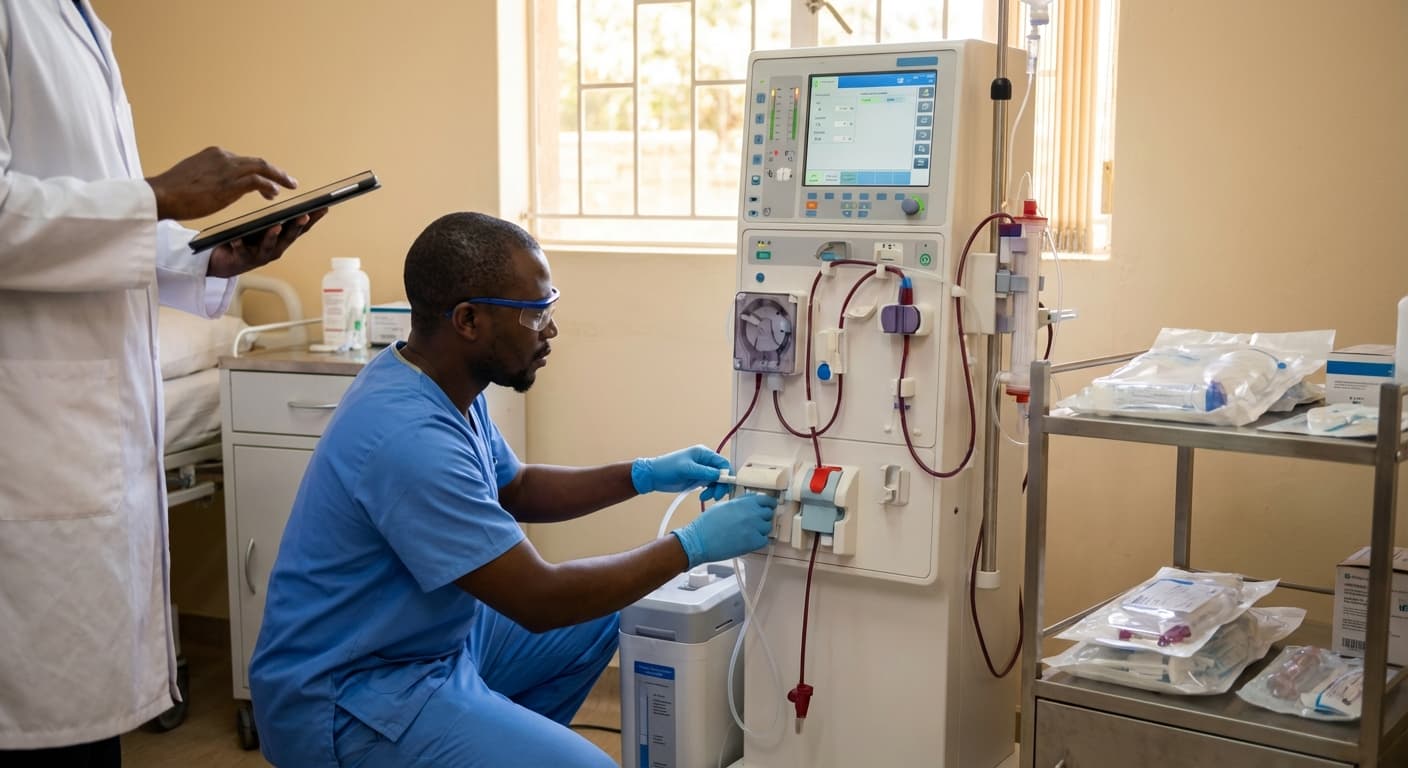
Hemodialysis Machine Installation Service in Ghana
Engineering Excellence & Technical Support
Hemodialysis Machine Installation Service High-standard technical execution following OEM protocols and local regulatory frameworks.
Expert Site Assessment & Preparation
Our certified technicians conduct thorough site surveys, ensuring optimal placement, robust utility connections (water, power, drainage), and adherence to all local regulatory requirements for your hemodialysis machine installation in Ghana.
Seamless Integration & Calibration
We provide meticulous installation and precise calibration of all hemodialysis machine components, guaranteeing optimal performance, patient safety, and compliance with international standards throughout Ghana.
Comprehensive Training & Handover
Upon installation, our specialists deliver comprehensive training to your medical staff on machine operation, maintenance, and troubleshooting, ensuring a smooth transition and confident utilization of your new hemodialysis technology in Ghana.
What Is Hemodialysis Machine Installation Service In Ghana?
Hemodialysis Machine Installation Service in Ghana refers to the professional provision of services required to set up, configure, and commission hemodialysis machines for clinical use within healthcare facilities across Ghana. This encompasses a comprehensive process ensuring the machine is operational, calibrated, and integrated into the existing medical infrastructure according to manufacturer specifications and local regulatory standards. The service is crucial for enabling the safe and effective delivery of hemodialysis treatment to patients suffering from end-stage renal disease (ESRD) or acute kidney injury (AKI).
| Who Needs Hemodialysis Machine Installation Service? | Typical Use Cases | ||||||
|---|---|---|---|---|---|---|---|
| Renal Dialysis Centers: Dedicated facilities focused on providing chronic hemodialysis treatment. | Hospitals (General and Tertiary): Facilities offering acute dialysis for patients with sudden kidney failure or those requiring dialysis as part of a broader medical treatment. | Specialized Clinics: Clinics that may offer hemodialysis as part of their service offering. | Government Health Institutions: Public hospitals and clinics requiring new or replacement dialysis equipment. | Private Healthcare Providers: New or expanding private hospitals and clinics establishing or upgrading dialysis units. | Non-Governmental Organizations (NGOs): Organizations involved in providing healthcare services, including dialysis, in underserved areas. | Medical Equipment Suppliers/Distributors: Companies that sell and deliver hemodialysis machines and require professional installation services as part of their offering. | Existing Healthcare Facilities: Facilities requiring the decommissioning, relocation, or reinstallation of existing hemodialysis machines. |
| Establishment of New Dialysis Units: Setting up dialysis capabilities in facilities that previously lacked them. | Expansion of Existing Dialysis Services: Increasing the number of dialysis machines to meet growing patient demand. | Replacement of Outdated Equipment: Installing new-generation hemodialysis machines to improve efficiency, safety, and treatment capabilities. | Relocation of Dialysis Facilities: Moving an entire dialysis unit or individual machines to a new location within a facility or to a different site. | Post-Maintenance Reinstallation: Reinstalling machines after major repairs or upgrades requiring complete disassembly. | Emergency Dialysis Setup: Rapid installation in response to public health emergencies or outbreaks requiring immediate access to dialysis. |
Service Components:
- Site Assessment and Planning: Evaluating the physical space, power, water, and waste disposal infrastructure to ensure compatibility with the hemodialysis machine requirements.
- Delivery and Unpacking: Safe transportation and careful unpacking of the hemodialysis machine and its associated accessories.
- Physical Installation: Assembling and connecting all components of the hemodialysis machine, including plumbing, electrical connections, and fluid lines.
- Calibration and Testing: Performing rigorous calibration procedures to ensure accurate operation of all machine parameters (e.g., dialysate composition, blood flow rate, ultrafiltration rate) and conducting functional tests to verify performance.
- Integration with Water Treatment Systems: Connecting the hemodialysis machine to a compliant reverse osmosis (RO) or other appropriate water purification system, a critical step for patient safety.
- Electrical Safety Checks: Ensuring compliance with electrical safety standards to prevent hazards.
- Initial Operational Validation: Running a simulated or actual treatment cycle under expert supervision to confirm proper functioning.
- User Training (Basic): Providing initial training to clinical staff on the fundamental operation, safety features, and basic troubleshooting of the installed machine.
- Documentation and Handover: Providing all necessary technical manuals, warranty information, and installation reports, officially handing over the operational machine to the healthcare facility.
- Regulatory Compliance Verification: Ensuring the installation adheres to relevant Ghanaian health regulations and standards for medical equipment.
Who Needs Hemodialysis Machine Installation Service In Ghana?
In Ghana, the need for reliable and expert hemodialysis machine installation services is growing as the prevalence of kidney disease rises and more healthcare facilities aim to offer life-sustaining treatments. This service is crucial for ensuring that dialysis machines are set up correctly, calibrated precisely, and integrated seamlessly into hospital infrastructure, guaranteeing patient safety and treatment efficacy.
| Customer Type | Relevant Departments | Key Needs |
|---|---|---|
| Public Hospitals | Nephrology Department, Biomedical Engineering Department, Facility Management | Reliable installation, adherence to national standards, long-term maintenance support, staff training |
| Private Hospitals and Clinics | Clinical Services Department, Procurement Department, Biomedical Engineering Unit | Swift installation, integration with existing IT systems, premium service quality, patient comfort considerations |
| NGOs and Charitable Foundations | Program Management, Operations Department, Technical Support Team | Cost-effective solutions, scalable installations, basic operational training, community impact focus |
| Medical Equipment Suppliers | Sales Department, Technical Services, After-Sales Support | Professional and timely installation, client satisfaction, warranty adherence, technical expertise |
| Regional Health Directorates/Ministry of Health | Planning Department, Infrastructure Unit, Public Health Programs | Standardized installations across facilities, capacity building, quality assurance, adherence to public health policies |
Target Customers and Departments for Hemodialysis Machine Installation Services in Ghana
- {"title":"Public Hospitals","description":"Government-funded hospitals, often serving a large patient population, are key recipients. They may be establishing new dialysis units or upgrading existing ones. These institutions require robust and scalable solutions."}
- {"title":"Private Hospitals and Clinics","description":"Private healthcare providers, catering to a segment of the population that can afford private care, are increasingly investing in advanced medical equipment, including hemodialysis machines, to offer comprehensive services."}
- {"title":"Non-Governmental Organizations (NGOs) and Charitable Foundations","description":"Organizations focused on improving healthcare access for underserved communities often establish or support dialysis centers. They may require cost-effective and efficient installation solutions."}
- {"title":"Medical Equipment Suppliers and Distributors","description":"Companies that sell hemodialysis machines often partner with installation service providers to offer a complete package to their clients. This ensures a smooth transition from purchase to operational use."}
- {"title":"Regional Health Directorates and Ministry of Health","description":"Government bodies responsible for healthcare planning and oversight may commission installation services for public health initiatives or to equip facilities across different regions."}
Hemodialysis Machine Installation Service Process In Ghana
This document outlines the comprehensive workflow for Hemodialysis Machine Installation Services in Ghana, covering the entire process from initial client inquiry to successful execution and handover. The service aims to ensure that healthcare facilities receive timely, efficient, and compliant installations, guaranteeing the optimal functioning of vital medical equipment.
| Phase | Key Activities | Responsible Parties | Deliverables/Outcomes | Estimated Timeline (Ghana Context) |
|---|---|---|---|---|
| Phase 1: Inquiry and Initial Consultation | Client expresses interest in hemodialysis machine installation. Initial discussions to understand client needs, machine type, quantity, and location. Provide preliminary information about the service and general requirements. | Client (Hospital/Clinic Management, Biomedical Department) Service Provider (Sales/Consultation Team) | Understanding of client requirements. Provision of initial service overview and contact information. | 1-3 Business Days |
| Phase 2: Site Assessment and Planning | On-site visit to the healthcare facility. Detailed assessment of the installation site: space, power supply, water quality and plumbing, drainage, ventilation, and structural integrity. Review of existing infrastructure and any necessary modifications. Identification of potential challenges and risks. | Service Provider (Technical Team, Installation Engineers) Client (Biomedical Department, Facilities Management) | Comprehensive site assessment report. Identification of infrastructure requirements and potential issues. Preliminary installation plan. | 3-7 Business Days |
| Phase 3: Quotation and Agreement | Development of a detailed quotation based on the site assessment and client requirements. Inclusion of machine cost (if applicable), installation labor, materials, transportation, and any additional services. Negotiation of terms and conditions. Formalization of contract and service agreement. | Service Provider (Sales/Commercial Team) Client (Procurement Department, Management) | Formal quotation. Signed service agreement/contract. Payment schedule. | 5-10 Business Days |
| Phase 4: Procurement and Logistics | Procurement of the hemodialysis machine(s) and necessary accessories/consumables. Arrangement of transportation and customs clearance (if imported). Coordination of delivery schedule to the client's facility. | Service Provider (Procurement and Logistics Department) Third-Party Logistics Providers | Hemodialysis machine(s) and accessories procured. Logistics plan for transportation and delivery. Delivery confirmation. | Varies (dependent on machine availability and import status, typically 4-12 weeks for new machines, shorter for local stock) |
| Phase 5: Pre-Installation Preparations | Preparation of the installation site based on the site assessment report. Carrying out any necessary civil works, electrical upgrades, or plumbing modifications. Ensuring compliance with local health and safety regulations. Confirmation of power and water supply quality. | Client (Facilities Management, Contractors) Service Provider (Supervisory Role) | Site ready for installation. All necessary infrastructure modifications completed. Compliance with safety standards confirmed. | Varies (dependent on infrastructure needs, typically 1-4 weeks) |
| Phase 6: Installation and Configuration | Unpacking and careful positioning of the hemodialysis machine(s). Connection to power, water, and drainage systems. Installation of any ancillary equipment (e.g., water treatment systems). Initial configuration of machine settings and parameters. | Service Provider (Installation Engineers, Biomedical Technicians) | Hemodialysis machine(s) physically installed. Connections made and secured. Basic configuration complete. | 1-3 Business Days per machine |
| Phase 7: Testing and Commissioning | Rigorous testing of all machine functions and components. Simulated dialysis treatments to verify operational parameters. Water quality testing to ensure it meets dialysis standards. Calibration of sensors and alarms. Verification of all safety features. | Service Provider (Installation Engineers, Application Specialists) Client (Biomedical Department, Nursing Staff) | Fully functional hemodialysis machine(s). Commissioning report detailing test results. Confirmation of operational readiness. | 1-2 Business Days per machine |
| Phase 8: Training and Handover | Comprehensive training for the healthcare facility's staff (nurses, technicians, biomedical engineers). Training covers machine operation, basic troubleshooting, maintenance procedures, and safety protocols. Formal handover of the installed machine(s) and all relevant documentation. | Service Provider (Application Specialists, Training Engineers) Client (End-users, Biomedical Department) | Trained staff capable of operating and maintaining the machine. User manuals, service manuals, and warranty information provided. Signed handover certificate. | 2-5 Business Days |
| Phase 9: Post-Installation Support and Documentation | Provision of post-installation support for an agreed-upon period. Follow-up visits to address any immediate concerns. Finalization and submission of all project documentation, including installation reports, test results, and training records. | Service Provider (Technical Support, Service Department) Client (Biomedical Department) | Smooth transition to operational use. Comprehensive project documentation archive. Satisfied client. | Ongoing (Initial support period typically 1-3 months post-handover) |
Hemodialysis Machine Installation Service Process in Ghana
- Phase 1: Inquiry and Initial Consultation
- Phase 2: Site Assessment and Planning
- Phase 3: Quotation and Agreement
- Phase 4: Procurement and Logistics
- Phase 5: Pre-Installation Preparations
- Phase 6: Installation and Configuration
- Phase 7: Testing and Commissioning
- Phase 8: Training and Handover
- Phase 9: Post-Installation Support and Documentation
Hemodialysis Machine Installation Service Cost In Ghana
Installing a hemodialysis machine in Ghana involves several cost factors, impacting the overall price. These include the type and complexity of the machine itself, the required infrastructure modifications at the healthcare facility, the qualifications and availability of specialized technicians, and potential ongoing maintenance contracts. The installation process often necessitates plumbing, electrical upgrades, and potentially dedicated water purification systems, all of which add to the cost. Geographical location within Ghana can also play a role, with transportation and logistics costs varying between urban centers and more remote areas. Furthermore, the warranty and after-sales support offered by the supplier are crucial considerations that influence the initial installation service price.
| Service Component | Estimated Cost Range (GHS) | Notes |
|---|---|---|
| Basic Hemodialysis Machine Installation (excluding machine cost) | 8,000 - 25,000 | Covers technician labor, basic setup, and initial testing for standard machines. |
| Advanced Hemodialysis Machine Installation (e.g., HDF) | 15,000 - 40,000+ | Includes more complex setup, calibration, and potentially integration with advanced water systems. |
| Water Treatment System Installation/Integration | 10,000 - 50,000+ | This is a significant factor and depends on the scale and complexity of the Reverse Osmosis (RO) system. |
| Electrical Upgrades & Generator Integration | 5,000 - 20,000+ | Costs vary based on existing infrastructure and the capacity of the required backup power. |
| Site Preparation & Minor Civil Works | 2,000 - 10,000 | For minor adjustments, power outlets, and plumbing connections. |
| Commissioning & Initial Calibration | 1,000 - 5,000 | Ensuring the machine meets operational standards. |
| Staff Training (per session/group) | 2,000 - 7,000 | Can be a separate cost if not included in the initial package. |
| Transportation & Logistics (variable) | 500 - 5,000+ | Dependent on distance and accessibility of the facility. |
Key Factors Influencing Hemodialysis Machine Installation Costs in Ghana
- Machine Type and Features: Advanced, multi-functional machines with features like online hemodiafiltration (HDF) will generally have higher installation costs than basic models.
- Infrastructure Requirements: This includes the need for specialized plumbing (e.g., reverse osmosis water purification systems), adequate electrical supply with backup generators, and potentially dedicated treatment rooms.
- Technician Expertise and Labor: The cost of engaging certified and experienced biomedical engineers or technicians for the installation and initial setup.
- Geographical Location: Transportation costs for equipment and personnel to the installation site, especially in remote areas.
- Site Preparation and Modifications: Any necessary civil works, such as wall modifications, flooring, or ventilation system adjustments.
- Testing and Calibration: Costs associated with thorough testing, calibration, and commissioning of the machine to ensure optimal performance.
- Training for Healthcare Staff: While often bundled, dedicated training for nurses and technicians on machine operation and maintenance can be a separate cost component.
- Warranty and Support Packages: The price of installation can be influenced by the included warranty period and the level of ongoing technical support offered by the supplier.
Affordable Hemodialysis Machine Installation Service Options
Installing a hemodialysis machine is a significant investment for healthcare facilities, and optimizing costs without compromising quality is crucial. This guide explores affordable installation service options, highlighting the value of service bundles and effective cost-saving strategies to ensure efficient and economical setup. We'll cover everything from initial planning to ongoing maintenance considerations.
| Value Bundle Component | Description | Cost-Saving Potential |
|---|---|---|
| Basic Installation Package | Includes machine placement, connection to water and power, basic functional testing, and initial user orientation. | Lower upfront cost, but may require additional services for advanced setup and training. |
| Standard Installation Package | Includes basic package plus: full system calibration, water quality testing, integration with existing IT systems (if applicable), and comprehensive staff training. | Better value than basic, offers a more complete solution, and reduces the need for separate training costs. |
| Premium Installation & Service Bundle | Includes standard package plus: extended warranty, proactive maintenance plan, priority technical support, and potential discounts on consumables. | Highest upfront investment but offers significant long-term savings through reduced downtime, predictable maintenance costs, and potential volume discounts. |
| Site Preparation & Infrastructure Upgrade Services | If your facility requires plumbing, electrical, or water purification system upgrades, bundling these services with the machine installation can streamline the process and potentially offer package discounts. | Can reduce project management overhead and leverage bulk pricing from the vendor. |
| Consumables & Spare Parts Integration | Some bundles include an initial stock of essential consumables and spare parts. Negotiating this as part of the installation can secure favorable pricing. | Ensures immediate availability of critical supplies and can lock in introductory pricing. |
| Remote Monitoring & Diagnostics Setup | Bundling the setup of remote monitoring systems allows for proactive issue detection and can be part of a comprehensive service plan. | Reduces the likelihood of critical failures and can lead to faster, less disruptive on-site technician visits. |
Key Considerations for Affordable Hemodialysis Machine Installation
- Early Planning & Needs Assessment: Thoroughly understanding your facility's current and future dialysis needs is paramount. This includes patient volume, types of treatments, available space, and existing infrastructure.
- Machine Selection: The choice of hemodialysis machine significantly impacts installation costs. Consider features, brand reputation, and availability of local support and spare parts.
- Installation Scope: Clearly define what is included in the installation service. This could range from basic setup and connection to full room retrofitting and integration with existing systems.
- Vendor Evaluation: Research and compare multiple installation service providers. Look beyond just price and consider their experience, certifications, customer reviews, and warranty offerings.
- Location & Infrastructure: The physical location of the installation and the readiness of your facility's water purification, electrical, and plumbing systems can significantly affect costs. Upgrades may be necessary.
- Ongoing Maintenance & Service Contracts: Factor in the long-term costs of maintenance and service. Bundling installation with a service contract can often lead to discounts and predictable expenses.
- Training: Ensure the installation package includes comprehensive training for your staff on operating and maintaining the new equipment.
Verified Providers In Ghana
In Ghana's growing healthcare landscape, identifying reliable and trustworthy medical providers is paramount. Franance Health stands out as a beacon of quality and integrity, offering a curated network of verified providers who meet stringent criteria. This commitment to excellence ensures patients receive the highest standard of care, backed by professionalism and expertise. Choosing a Franance Health verified provider means opting for peace of mind, knowing you are in capable hands.
| Provider Type | Franance Health Verification Focus | Benefits for Patients |
|---|---|---|
| Hospitals | State-of-the-art facilities, experienced medical staff, adherence to international safety protocols, patient care quality. | Access to comprehensive medical services, advanced treatments, and a high level of patient safety. |
| Clinics | Qualified and licensed practitioners, efficient service delivery, patient privacy, accessibility. | Reliable primary care, specialized consultations, and prompt medical attention. |
| Specialists (e.g., Cardiologists, Dermatologists) | Board certification, specialized training, extensive experience in their field, positive patient outcomes. | Expert diagnosis and treatment for specific health conditions. |
| Diagnostic Centers (e.g., Labs, Imaging) | Accurate and reliable diagnostic equipment, skilled technicians, timely results, adherence to quality standards. | Precise and dependable medical testing for accurate diagnosis. |
Why Franance Health Credentials Matter
- Rigorous Vetting Process: Franance Health employs a comprehensive vetting process that goes beyond basic licensing.
- Quality Assurance: Continuous monitoring and quality assurance measures are in place to maintain high standards.
- Patient-Centric Approach: Verified providers are committed to patient well-being and satisfaction.
- Access to Expertise: A network of specialists and general practitioners with diverse expertise.
- Transparency and Trust: Clear credentials and verifiable track records build patient confidence.
Scope Of Work For Hemodialysis Machine Installation Service
This Scope of Work (SOW) outlines the technical deliverables and standard specifications for the installation service of hemodialysis machines. The service aims to ensure that each hemodialysis machine is installed, tested, and commissioned according to manufacturer guidelines, relevant healthcare regulations, and hospital standards, guaranteeing optimal functionality and patient safety.
| Item | Description | Standard Specifications / Deliverables | Verification Method |
|---|---|---|---|
| 1 | Site Preparation and Assessment | Verification of adequate space, power supply (voltage, grounding, dedicated circuits), water supply (quality, pressure, flow rate), drain access, and environmental conditions (temperature, humidity) as per manufacturer specifications. | On-site inspection, measurement, and documentation (e.g., photographs, checklists). |
| 2 | Machine Unpacking and Inspection | Careful unpacking of the hemodialysis machine(s) and accessories. Visual inspection for any signs of damage during transit. Verification of all components against the packing list. | Visual inspection, component count verification against packing list. |
| 3 | Machine Placement and Connection | Positioning of the hemodialysis machine in the designated area. Connection to power, water, and drain lines using approved and validated connectors and tubing. | Physical placement confirmation, connection integrity check, leak testing. |
| 4 | Water Treatment System Integration (if applicable) | Connection and integration of the hemodialysis machine with the central or point-of-use water treatment system. Ensuring proper flow and quality of treated water to the machine as per standards (e.g., AAMI, ISO). | Water quality testing (e.g., conductivity, TOC, bacterial counts), flow rate verification, system pressure checks. |
| 5 | Electrical and Grounding Verification | Confirmation of correct electrical supply and secure grounding of the machine to prevent electrical hazards. Compliance with local electrical codes and safety standards. | Electrical testing (e.g., insulation resistance, leakage current), grounding resistance measurement. |
| 6 | Initial Machine Power-Up and System Checks | Powering up the hemodialysis machine and performing initial system diagnostics as per manufacturer's startup procedures. Verification of all internal system checks and error code absence. | Observation of boot-up sequence, review of internal diagnostic logs, absence of error messages. |
| 7 | Functional Testing and Calibration | Performing all essential functional tests including dialysate preparation, fluid balancing, blood pump calibration, pressure monitoring accuracy, air detector functionality, and alarm system testing. Calibration of critical parameters. | Execution of predefined test sequences, measurement of key performance indicators (e.g., flow rates, pressures, temperatures), alarm response verification. |
| 8 | Disinfection and Sterilization Cycles | Performing and documenting at least one full disinfection and/or sterilization cycle (as per manufacturer recommendation) to ensure the machine is free from contaminants before patient use. | Execution and documentation of disinfection/sterilization cycles, review of cycle logs. |
| 9 | Installation Documentation and Handover | Provision of a comprehensive installation report including: site preparation checklist, machine serial number, installation date, test results, calibration certificates, and user manuals. Formal handover of the installed machine to hospital biomedical/nursing staff. | Review and acceptance of the installation report, signed handover document. |
| 10 | Basic User Training (Optional/As specified) | Providing initial basic operational training to designated hospital staff on machine setup, operation, routine checks, and basic troubleshooting. (Specific training scope to be defined in separate agreement if required). | Attendance record of training, confirmation of understanding by trainees. |
Key Objectives
- To ensure the safe and compliant installation of hemodialysis machines.
- To verify the operational readiness and performance of each installed machine.
- To provide comprehensive documentation of the installation process and outcomes.
- To ensure trained personnel are available for initial operation and troubleshooting.
Service Level Agreement For Hemodialysis Machine Installation Service
This Service Level Agreement (SLA) outlines the performance standards and guarantees for the Hemodialysis Machine Installation Service provided by [Your Company Name] (hereinafter referred to as 'Provider') to [Client Name] (hereinafter referred to as 'Client'). This SLA aims to ensure timely and reliable installation of hemodialysis machines to minimize disruption to patient care.
| Service Component | Response Time | Resolution Time Target | Uptime Guarantee |
|---|---|---|---|
| New Machine Installation Scheduling | Within 2 business days of confirmed order and site readiness verification. | N/A (Scheduling is based on mutual availability and site readiness). | N/A |
| On-site Installation Commencement | Within 24 hours of scheduled installation date and time. | N/A (Installation duration varies by machine type and site complexity). | N/A |
| Critical Malfunction during Installation (Machine unusable) | Within 4 business hours of reported issue. | Within 8 business hours of reported issue. | N/A |
| Non-Critical Issue during Installation (Minor performance deviation) | Within 8 business hours of reported issue. | Within 16 business hours of reported issue. | N/A |
| Post-Installation Support (within 30 days of installation) | Within 8 business hours of reported issue. | Within 16 business hours of reported issue. | 99.5% during operational hours for the newly installed machine (excluding scheduled maintenance and unavoidable downtime). |
Scope of Service
- Installation of new hemodialysis machines, including unpacking, physical setup, and initial power-on.
- Connection of machines to provided water treatment systems and electrical outlets.
- Basic functional testing to confirm machine readiness for clinical use.
- On-site technician support during the installation process.
- Post-installation orientation for designated clinical staff on basic machine operation and troubleshooting.
Frequently Asked Questions

Ready when you are
Let's scope your Hemodialysis Machine Installation Service in Ghana project in Ghana.

Scaling healthcare logistics and technical systems across the entire continent.