
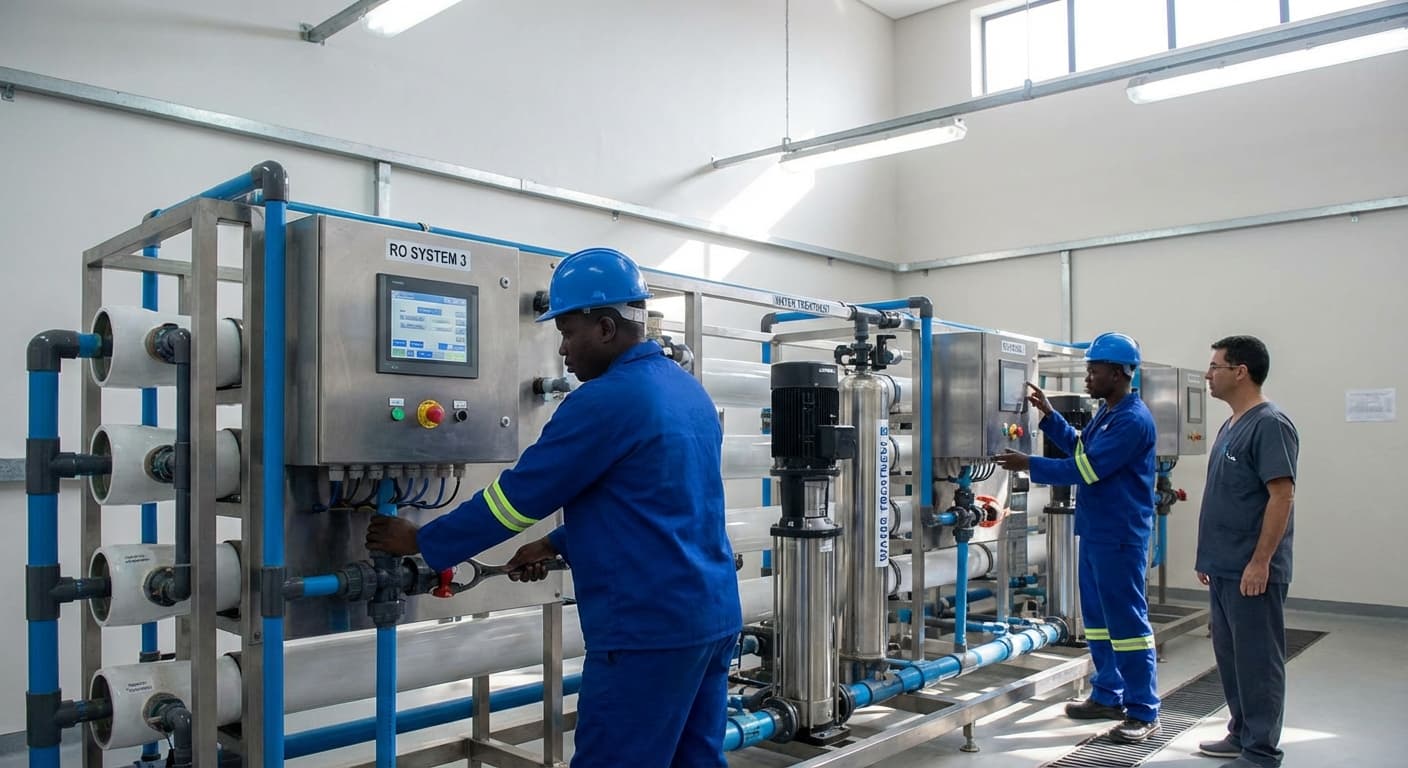
Dialysis RO/Water Treatment Plant Installation Service in Ghana
Engineering Excellence & Technical Support
Dialysis RO/Water Treatment Plant Installation Service High-standard technical execution following OEM protocols and local regulatory frameworks.
Uncompromising Purity Standards
We engineer and install state-of-the-art RO and water treatment systems designed to meet and exceed stringent international purity standards, ensuring the absolute safety and efficacy of dialysis treatments in Ghana.
Rapid Deployment & Local Expertise
Our specialized teams are equipped for swift, efficient installation across Ghana, leveraging deep local knowledge of infrastructure and operational requirements for minimal disruption and maximum uptime.
Robust, Sustainable Solutions
We provide durable, low-maintenance RO and water treatment plants built with high-quality components, offering sustainable, cost-effective water purification tailored to the unique demands of Ghana's healthcare facilities.
What Is Dialysis Ro/water Treatment Plant Installation Service In Ghana?
Dialysis RO/Water Treatment Plant Installation Service in Ghana refers to the comprehensive process of designing, supplying, installing, commissioning, and validating Reverse Osmosis (RO) and associated water treatment systems specifically for healthcare facilities in Ghana that provide hemodialysis treatments. These systems are critical for producing ultra-pure water, a fundamental requirement for patient safety and effective dialysis therapy. The service ensures that the water used in dialysis machines meets stringent international standards (e.g., AAMI, ISO) for chemical, microbial, and endotoxin contamination, thereby preventing patient complications such as pyrogenic reactions, hemolysis, and infections. The installation encompasses all stages from initial site assessment and system specification to final testing and staff training.
| Who Needs This Service? | Typical Use Cases in Ghana |
|---|---|
| Hospitals and Healthcare Centers: Both public and private medical facilities offering nephrology services and hemodialysis. This includes university teaching hospitals, regional hospitals, and specialized kidney care centers. | New Dialysis Unit Setups: Establishing new hemodialysis centers or expanding existing ones to accommodate increasing patient demand. Upgrade or Replacement of Existing Systems: When older water treatment systems are inefficient, no longer meet current standards, or require frequent repairs. Compliance with Regulatory Standards: Ensuring adherence to national and international guidelines for water quality in dialysis, mandated by health authorities. Minimizing Patient Complications: Providing a reliable source of safe dialysis water to prevent treatment-related adverse events. Operational Efficiency and Cost Reduction: Implementing advanced treatment technologies to optimize water usage and reduce the cost of consumables and maintenance over time. |
Key Components of Dialysis RO/Water Treatment Plant Installation:
- Site Assessment and Water Analysis: Evaluating the incoming municipal water quality, available space, power supply, and existing infrastructure to design a customized treatment solution.
- System Design and Specification: Engineering the RO system, pre-treatment modules (e.g., sediment filtration, carbon filtration, water softening), post-treatment polishing (e.g., UV sterilization, ultrafiltration), and distribution loop design based on patient volume and dialysis machine requirements.
- Component Sourcing and Procurement: Acquiring high-quality RO membranes, pumps, filters, piping, valves, tanks, control panels, and monitoring instruments from reputable manufacturers.
- Physical Installation: Assembling and connecting all components, including piping, electrical wiring, and structural mounting, according to engineered designs and safety protocols.
- System Commissioning: Initial startup, flushing, and testing of the entire water treatment system to verify operational parameters (flow rates, pressures, water quality indicators).
- Validation and Quality Assurance: Conducting rigorous testing to ensure the produced water meets all specified quality standards for dialysis (e.g., total organic carbon (TOC), conductivity, microbial counts, endotoxin levels). This often involves independent laboratory analysis.
- Staff Training: Educating biomedical engineers, dialysis technicians, and facility management on the operation, routine maintenance, troubleshooting, and water quality monitoring of the installed system.
- Documentation and Handover: Providing comprehensive operation and maintenance manuals, as-built drawings, validation reports, and warranty information.
Who Needs Dialysis Ro/water Treatment Plant Installation Service In Ghana?
In Ghana, the demand for reliable and safe water is critical, especially for healthcare facilities and industries where water quality directly impacts health and product integrity. Dialysis requires highly purified water, free from contaminants and minerals, to prevent complications for patients. Similarly, various industrial processes depend on treated water to ensure efficiency and prevent equipment damage. This necessitates specialized Dialysis RO/Water Treatment Plant Installation Services.
| Target Customer | Key Departments/Functions Involved | Specific Needs/Reasons |
|---|---|---|
| Dialysis Centers & Hospitals | Nephrology Department, Biomedical Engineering, Facility Management, Procurement | Patient safety is paramount; impure water can cause life-threatening complications. Compliance with health regulations. |
| Pharmaceutical Manufacturers | Quality Control (QC), Production, Engineering, R&D | Ensuring product purity and efficacy; preventing contamination; meeting Good Manufacturing Practices (GMP). |
| Food & Beverage Producers | Quality Assurance (QA), Production, Operations, Engineering | Maintaining product quality and safety; extending shelf life; preventing equipment scaling and corrosion. |
| Laboratories (Medical & Research) | Laboratory Management, Research & Development, Clinical Services | Accurate experimental results; reliable diagnostic tests; preventing interference from water impurities. |
| Power Plants | Boiler Operations, Maintenance, Engineering | Preventing boiler scaling and corrosion, which reduces efficiency and can lead to catastrophic failures. |
| Large Hospitality Establishments (Hotels) | Housekeeping, Engineering, Food & Beverage | Providing safe drinking water for guests; maintaining appliance longevity (ice machines, laundry); water for culinary purposes. |
| Manufacturing Industries with High Water Purity Requirements | Production, Engineering, Quality Control | Specific processes (e.g., electronics, printing) require ultrapure water to avoid defects and ensure product quality. |
Who Needs Dialysis RO/Water Treatment Plant Installation Service in Ghana?
- Dialysis Centers & Hospitals
- Pharmaceutical Manufacturers
- Food & Beverage Producers
- Laboratories (Medical & Research)
- Power Plants
- Large Hospitality Establishments (Hotels)
- Manufacturing Industries with High Water Purity Requirements
Dialysis Ro/water Treatment Plant Installation Service Process In Ghana
This document outlines the comprehensive workflow for Dialysis RO/Water Treatment Plant Installation Services in Ghana, covering the entire process from the initial customer inquiry to the final execution and handover. We aim to provide a transparent and efficient service, ensuring optimal water quality for dialysis units across the nation.
| Stage | Key Activities | Deliverables/Outcomes | Typical Timeline (Ghana) |
|---|---|---|---|
| Receive inquiry from dialysis centers, hospitals, or clinics. Discuss immediate needs, water source quality, and desired system capacity. Initial technical discussion to understand scope. | Understanding of client's basic requirements. Initial advice on potential solutions. | 1-3 business days |
| Site visit to the facility. Detailed assessment of water source (borehole, mains, etc.), flow rates, existing infrastructure, power availability, and space constraints. Precise water quality analysis (pH, TDS, hardness, microbial count, etc.). | Comprehensive site report. Detailed water analysis report. Finalized system specifications and capacity. | 3-7 business days (depending on travel and analysis) |
| Develop a tailored proposal outlining the recommended RO/Water Treatment system, including technical specifications, components, features, and benefits. Provide a detailed quotation with pricing for equipment, installation, training, and any optional services. | Formal proposal document. Itemized quotation. Proposed project timeline. | 5-10 business days (after site assessment) |
| Client reviews and approves the proposal. Negotiation of terms and conditions. Signing of the service agreement/contract. Client issues purchase order. Deposit payment (if applicable). | Signed contract. Confirmed purchase order. Secured project commitment. | 3-7 business days |
| Order and procure all necessary RO/Water Treatment plant components, membranes, filters, pumps, control systems, piping, and ancillaries from reputable suppliers. Arrange for customs clearance and transportation to Ghana. | All required equipment and materials sourced. Efficient logistics and delivery plan. | 4-12 weeks (depending on import times and availability) |
| Coordinate with the client for site readiness. This includes ensuring adequate power supply, water inlet/outlet points, drainage, and a clean installation area. Minor civil works may be required (e.g., concrete pad for the unit). | Prepared installation site. Necessary utilities accessible. | 1-2 weeks (concurrent with equipment arrival or just before) |
| Our certified technicians travel to the site. Unpacking and assembly of the RO/Water Treatment plant. Installation of piping, electrical connections, and control systems. Adherence to all safety protocols. | Physically installed RO/Water Treatment plant. All components connected and secured. | 3-7 business days (depending on system size and complexity) |
| Initial system startup and testing. Flushing of the system to remove debris. Calibration of sensors and control parameters. Verification of operational integrity and performance under simulated load. | Fully functional RO/Water Treatment plant. All system parameters within operational range. | 1-2 business days |
| Conduct comprehensive post-installation water quality testing to ensure it meets dialysis standards (e.g., WHO, local health authority guidelines). This includes testing for TDS, conductivity, chlorine, endotoxins, and other critical parameters. | Validated water quality reports meeting all regulatory requirements. Certificate of compliance (if applicable). | 1-3 business days (including lab analysis) |
| Provide thorough training to the client's technical and operational staff on the system's operation, routine maintenance, troubleshooting, and emergency procedures. Official handover of the system with all documentation (manuals, reports, warranties). | Trained client staff. Comprehensive system documentation. Client sign-off on handover. | 1-2 business days |
| Offer ongoing technical support, preventative maintenance services, and spare parts supply. This ensures the long-term reliability and optimal performance of the dialysis RO/Water Treatment plant. | Continued system reliability. Reduced downtime. Proactive maintenance. | Ongoing (as per service agreement) |
Dialysis RO/Water Treatment Plant Installation Service Process in Ghana
- Initial Inquiry & Consultation
- Site Assessment & Requirement Gathering
- Proposal & Quotation Submission
- Contract Agreement & Order Placement
- Equipment Procurement & Logistics
- Pre-Installation Site Preparation
- On-Site Installation & Assembly
- System Testing & Commissioning
- Water Quality Analysis & Validation
- Staff Training & Handover
- Post-Installation Support & Maintenance
Dialysis Ro/water Treatment Plant Installation Service Cost In Ghana
Installing a Reverse Osmosis (RO) and Water Treatment plant for dialysis facilities in Ghana involves a range of costs influenced by several key factors. These include the capacity of the plant, the level of purification required (e.g., meeting specific medical standards like AAMI), the type and quality of equipment chosen, the complexity of the installation, the location of the facility, and the services of the installation provider. Given the specialized nature of dialysis water treatment, ensuring a reliable and safe supply is paramount, which can impact the overall investment. Costs are typically quoted in Ghana Cedis (GHS).
| Installation Type/Capacity | Estimated Cost Range (GHS) | Notes |
|---|---|---|
| Small Dialysis Unit (e.g., 5-10 stations, ~200-500 L/hr capacity) | GHS 30,000 - GHS 80,000 | Basic to intermediate pre-treatment, standard RO, single UV sterilization. |
| Medium Dialysis Center (e.g., 10-25 stations, ~500-1500 L/hr capacity) | GHS 70,000 - GHS 200,000 | More robust pre-treatment, higher-grade RO membranes, dual UV or ozone sterilization, advanced monitoring systems. |
| Large Dialysis Facility/Hospital Unit (e.g., 25+ stations, 1500+ L/hr capacity) | GHS 150,000 - GHS 500,000+ | Comprehensive pre-treatment, high-performance RO, redundant sterilization systems, full automation, compliance with highest medical standards (e.g., AAMI), potential for deionization. |
| Retrofitting/Upgrading Existing Systems | Varies widely based on scope | Can range from partial component replacement to a complete overhaul. |
Key Pricing Factors for Dialysis RO/Water Treatment Plant Installation in Ghana
- Plant Capacity: The volume of purified water required per hour or per day is a primary cost driver. Larger capacities necessitate bigger and more expensive equipment.
- Water Quality Standards: Dialysis requires extremely high-purity water. Meeting stringent medical standards (e.g., AAMI standards) often requires more advanced filtration and sterilization stages, increasing costs.
- Pre-treatment Requirements: The source water quality in Ghana can vary significantly. If the raw water has high levels of sediment, minerals, or contaminants, extensive pre-treatment (e.g., sediment filters, water softeners, carbon filters) will be necessary, adding to the system's complexity and cost.
- Type and Brand of Equipment: The choice between different RO membrane types, pump brands, sterilization methods (UV, ozone), and control systems will impact the price. Reputable international brands often come with a higher price tag but may offer better reliability and longevity.
- Number of Treatment Stages: Multi-stage filtration, including ultrafiltration, activated carbon, and reverse osmosis, are standard. Additional stages like deionization or specific polishing filters for trace contaminants will increase cost.
- Installation Complexity and Site Requirements: The ease of access to the installation site, the need for significant plumbing modifications, electrical upgrades, or specialized construction for the plant room can affect labor and material costs.
- Service Provider Expertise and Reputation: Experienced and certified providers who specialize in medical-grade water treatment often charge more due to their expertise, warranty, and after-sales support.
- Ancillary Services: Costs can also include water testing before and after installation, commissioning, operator training, and initial maintenance packages.
- Geographic Location: While less significant than other factors, transportation of large equipment and potential site-specific logistical challenges in remote areas could slightly influence pricing.
Affordable Dialysis Ro/water Treatment Plant Installation Service Options
Installing a reliable Reverse Osmosis (RO) and water treatment plant is crucial for dialysis centers, ensuring patient safety and operational efficiency. Our affordable installation service options are designed to meet your specific needs while maximizing value. We offer flexible packages, transparent pricing, and expert guidance to help you navigate the process and achieve cost savings without compromising on quality.
| Value Bundle | Description | Key Benefits | Estimated Cost Range (Illustrative) |
|---|---|---|---|
| Essential Care Bundle | Includes basic RO unit, essential pre-treatment filters, and standard installation. Ideal for smaller clinics or those with good initial water quality. | Cost-effective entry point, reliable basic purification, quick setup. | $5,000 - $10,000 |
| Comprehensive Health Bundle | Features advanced multi-stage RO, enhanced pre-treatment (e.g., water softener, activated carbon), post-treatment options (e.g., UV disinfection), and full commissioning. | Superior water purity, extended equipment life, robust contaminant removal, peace of mind. | $10,000 - $20,000 |
| Premium Performance Bundle | Top-of-the-line RO system with double pass RO, advanced filtration (e.g., ultrafiltration), sophisticated monitoring systems, remote diagnostics, and extended warranty. | Highest water quality standards, maximum efficiency, proactive maintenance, minimal downtime. | $20,000 - $35,000+ |
| Custom Solution | Fully bespoke design and installation based on unique requirements, including specialized treatment for complex water issues or high-volume needs. | Perfect fit for specific challenges, optimized performance, long-term cost efficiency. | Variable based on complexity |
Key Features of Our Affordable Dialysis RO/Water Treatment Plant Installation Service
- Comprehensive Needs Assessment: We begin with a thorough evaluation of your water quality, volume requirements, and existing infrastructure.
- Customized Plant Design: Tailored solutions to fit your budget and specific treatment goals.
- High-Quality Equipment Sourcing: Partnerships with reputable manufacturers for reliable and durable RO and water treatment systems.
- Expert Installation & Commissioning: Skilled technicians ensuring proper setup, calibration, and performance testing.
- Post-Installation Support & Maintenance: Ongoing services to guarantee optimal plant operation and longevity.
- Compliance Guidance: Assistance in meeting all relevant health and safety regulations.
Verified Providers In Ghana
In Ghana's evolving healthcare landscape, identifying and trusting healthcare providers is paramount. This is where the role of verification and credible credentialing bodies becomes crucial. Franance Health has emerged as a significant entity in this regard, offering a robust system for verifying healthcare providers and their services. Understanding Franance Health's credentials and the standards they uphold illuminates why their verified providers represent the best choice for quality and reliable healthcare.
| Provider Type | Franance Health Verification Means | Why This Matters to Patients |
|---|---|---|
| Doctors (GPs & Specialists) | Verification of Medical Degree (MBChB/MD), Ghana Medical and Dental Council (GMDC) registration and license, and any specialist board certifications. | Ensures you are treated by a legally qualified and competent medical professional with the right expertise for your condition. |
| Nurses | Verification of Nursing Diploma/Degree, Nursing and Midwifery Council (N&MC) registration and license. | Guarantees that your nursing care is provided by a trained and licensed professional who meets national standards. |
| Pharmacists | Verification of Pharmacy Degree, Pharmacy Council of Ghana (PCG) registration and license. | Assures that your medications are dispensed by a qualified professional who understands drug interactions and dosages. |
| Hospitals & Clinics | Inspection of facility infrastructure, equipment, adherence to hygiene and safety protocols, and verification of licensed medical personnel on staff. | Confirms that the healthcare facility meets essential standards for safe and effective medical treatment and patient comfort. |
| Diagnostic Laboratories | Verification of laboratory licenses, qualified personnel, and adherence to quality control measures. | Ensures accurate and reliable diagnostic test results crucial for proper diagnosis and treatment. |
| Therapists (Physio, etc.) | Verification of relevant professional degrees and registration with respective Ghanaian professional bodies. | Confirms that therapy services are delivered by qualified and licensed professionals dedicated to your recovery and well-being. |
Understanding Franance Health's Verification Process and Benefits
- Rigorous Vetting: Franance Health employs a multi-faceted verification process that goes beyond simple registration. This includes scrutinizing educational qualifications, professional licenses, and any specialized certifications of healthcare practitioners.
- Quality Assurance Standards: Verified providers commit to adhering to specific quality assurance benchmarks set by Franance Health. These standards often encompass patient care protocols, hygiene practices, and ethical conduct, ensuring a consistent level of service.
- Patient Safety Focus: A core element of Franance Health's verification is the emphasis on patient safety. They assess facilities for necessary equipment, safety measures, and the competence of staff in handling emergencies.
- Accessibility and Transparency: Franance Health aims to provide a transparent platform where patients can easily find verified healthcare professionals and understand their qualifications and areas of expertise.
- Trust and Reliability: By providing a list of vetted and approved providers, Franance Health instills trust and reliability in the Ghanaian healthcare system, reducing the risk of encountering unqualified or substandard services.
- Continuous Monitoring: Franance Health's commitment extends to ongoing monitoring of their verified providers to ensure continued adherence to their standards and to address any patient feedback or concerns.
Scope Of Work For Dialysis Ro/water Treatment Plant Installation Service
This Scope of Work (SOW) outlines the requirements for the installation services of a Dialysis Reverse Osmosis (RO) / Water Treatment Plant. It details the technical deliverables, standard specifications, and responsibilities of the service provider to ensure a successful, compliant, and operational water treatment system for dialysis applications.
| Category | Technical Deliverables | Standard Specifications |
|---|---|---|
| 1. System Design Verification | Confirmation of the submitted design drawings and specifications against actual site conditions. | Compliance with all relevant national and international standards for medical water purification (e.g., AAMI, ISO 13485, local health regulations). |
| 2. Material Procurement and Delivery | Delivery of all specified RO membranes, filters, pumps, piping, valves, control panels, and ancillary equipment to the site. | Materials to be new, unused, and of manufacturer-approved quality. All materials to be accompanied by material certifications. |
| 3. Site Preparation | Ensuring adequate space, power supply, drainage, and access for installation and maintenance. | Electrical requirements to meet plant specifications, with proper grounding. Drainage to be sufficient for backwash and flush cycles. |
| 4. Installation of RO/Water Treatment Plant | Assembly and secure mounting of all plant components (pre-filters, RO modules, post-filters, UV sterilizer, storage tanks, etc.). | Piping to be of food-grade/medical-grade material (e.g., SS316L, CPVC, PEX) with proper support and leak-free connections. Electrical wiring to be neat, labeled, and compliant with electrical codes. |
| 5. Plumbing and Electrical Connections | Connecting the plant to incoming water supply and outgoing purified water distribution points. Connecting the plant to the designated power source. | All connections to be robust, properly sealed, and tested for leaks. Electrical connections to be performed by certified electricians. |
| 6. Control System Integration | Installation and configuration of the plant's control panel, including PLCs, sensors, and HMI (Human-Machine Interface). | Control system to allow for automated operation, monitoring of key parameters (pressure, flow, conductivity), and alarm functions. |
| 7. Pre-Commissioning Checks | Thorough inspection of all installed components, connections, and electrical wiring before system startup. | Verification of correct component orientation, secure fastenings, and absence of damage. |
| 8. Flushing and Sanitization | Initial flushing of the system to remove debris and contaminants. Sanitization of all wetted surfaces. | Flushing procedures to follow manufacturer's recommendations. Sanitization to use approved chemicals and methods for medical water systems. |
| 9. Commissioning and Performance Testing | Startup of the RO/Water Treatment Plant. Testing of all operational parameters (flow rates, pressure, water quality). | Water quality to meet stringent dialysis standards for conductivity, TOC, bacteria, and endotoxins. Performance to be validated through documented test results. |
| 10. As-Built Drawings | Provision of updated drawings reflecting the actual installed configuration of the plant. | Drawings to include all piping layouts, electrical schematics, and component locations. |
| 11. Operation and Maintenance Manuals | Delivery of comprehensive manuals for operation, troubleshooting, and routine maintenance. | Manuals to be clear, concise, and include detailed procedures and parts lists. |
| 12. Operator Training | Training sessions for designated personnel on the operation, monitoring, and basic maintenance of the RO/Water Treatment Plant. | Training to be practical and hands-on, covering all aspects of daily operation and emergency procedures. |
| 13. Final Handover and Acceptance | Formal handover of the installed and commissioned plant, including all documentation and training records. | Acceptance based on successful performance testing and client satisfaction. |
Project Phases and Key Activities
- Phase 1: Site Assessment and Planning
- Phase 2: Pre-Installation and Preparation
- Phase 3: Installation and Commissioning
- Phase 4: Training and Handover
- Phase 5: Post-Installation Support (Optional/As per Contract)
Service Level Agreement For Dialysis Ro/water Treatment Plant Installation Service
This Service Level Agreement (SLA) outlines the agreed-upon response times and uptime guarantees for the installation services of Dialysis Reverse Osmosis (RO) and Water Treatment Plants. The objective is to ensure minimal disruption and efficient deployment of critical dialysis water treatment systems.
| Service Component | Response Time (Business Hours) | Uptime Guarantee | Notes |
|---|---|---|---|
| Initial Site Survey & Consultation | 2 Business Days | N/A | To confirm site readiness and finalize installation plan. |
| Installation Commencement (Post-Agreement & Site Readiness) | 5 Business Days | N/A | Actual installation start date will be mutually agreed upon. |
| Critical System Component Failure (during installation) | 4 Business Hours | N/A | Applies to issues preventing the continuation of installation work. |
| Routine Technical Support (during installation) | 8 Business Hours | N/A | For non-critical inquiries or minor adjustments. |
| System Commissioning & Testing Completion | 1 Business Day (post-installation) | 99.5% (during warranty period) | Uptime guarantee applies after successful commissioning and for the duration of the warranty. |
| Post-Installation Technical Support (during warranty) | 8 Business Hours | N/A | For operational questions and troubleshooting. |
| Emergency System Failure (after commissioning & during warranty) | 2 Business Hours | N/A | For issues directly impacting dialysis treatment water quality or flow. |
Scope of Service
- Installation of new Dialysis RO/Water Treatment Plant systems, including all associated plumbing, electrical, and control systems.
- Configuration and initial testing of the installed systems to meet specified performance parameters.
- On-site training for facility staff on the operation and basic maintenance of the new system.
- Post-installation support for a defined warranty period.
Frequently Asked Questions

Ready when you are
Let's scope your Dialysis RO/Water Treatment Plant Installation Service in Ghana project in Ghana.

Scaling healthcare logistics and technical systems across the entire continent.