
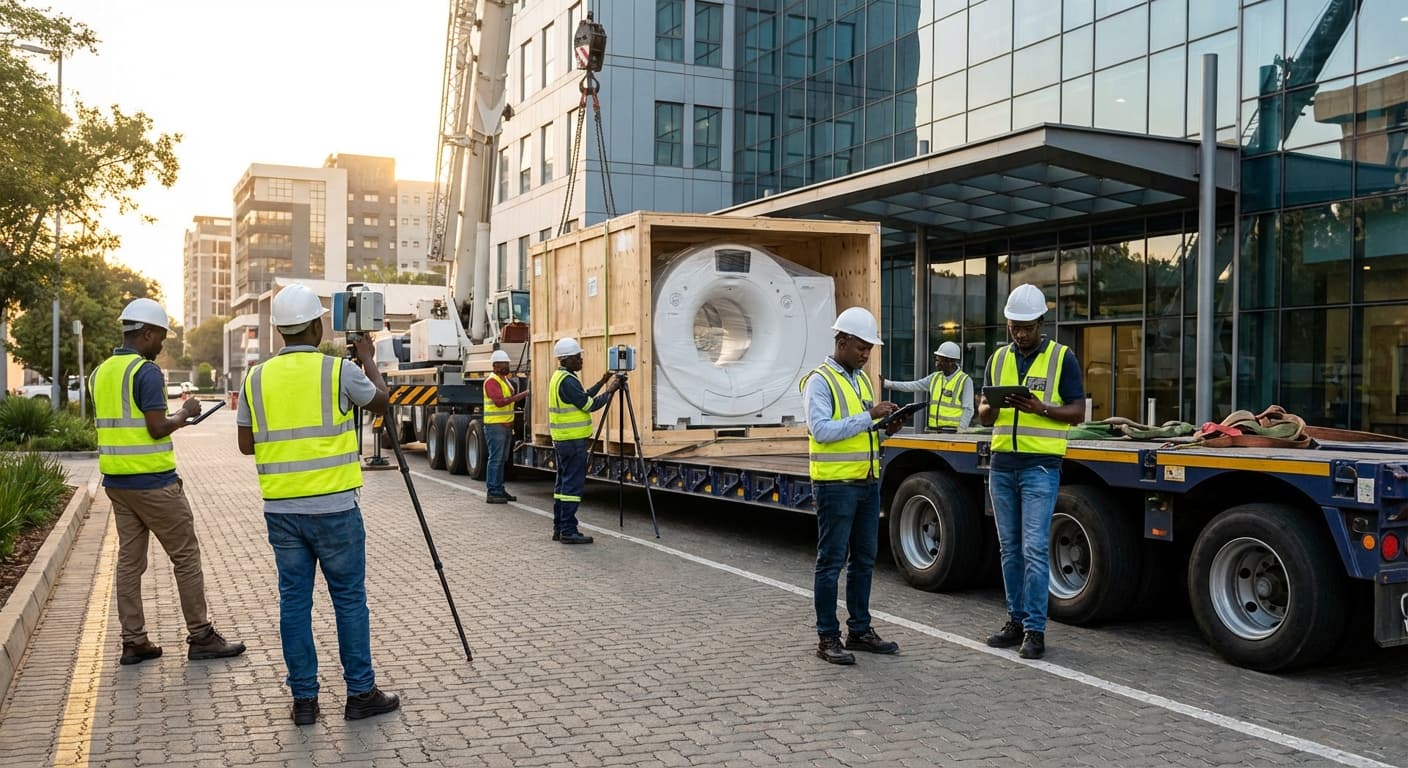
Route Survey & Rigging Plan Service for Heavy Medical Equipment in Ghana
Engineering Excellence & Technical Support
Route Survey & Rigging Plan Service for Heavy Medical Equipment High-standard technical execution following OEM protocols and local regulatory frameworks.
Precision Site Assessment & Pathway Mapping
Leveraging advanced surveying technologies (e.g., 3D laser scanning, drone-based photogrammetry), we conduct meticulous route surveys to identify optimal pathways for heavy medical equipment. This includes detailed analysis of terrain, existing infrastructure, potential obstructions, and structural load capacities. Our data-driven approach ensures a clear, safe, and efficient transit route, mitigating risks and guaranteeing accessibility to the installation site.
Customized Rigging & Lifting Solutions
We design and implement highly specialized rigging and lifting plans tailored to the unique weight, dimensions, and fragility of each medical equipment piece. Our experienced engineers meticulously calculate load distribution, select appropriate lifting gear (cranes, gantries, specialized rigging accessories), and develop step-by-step procedures for safe and controlled movement, exceeding industry safety standards for critical healthcare infrastructure.
Risk Mitigation & Regulatory Compliance Assurance
Our comprehensive service includes a proactive risk assessment and mitigation strategy. We identify potential hazards throughout the survey and rigging process, from transport to final placement, and implement robust safety protocols. Furthermore, we ensure full compliance with all relevant Ghanaian safety regulations, import/export requirements, and site-specific operational permits, providing peace of mind and a seamless, compliant project execution.
What Is Route Survey & Rigging Plan Service For Heavy Medical Equipment In Ghana?
Route Survey & Rigging Plan Service for Heavy Medical Equipment in Ghana is a specialized logistical and engineering discipline focused on the safe and efficient transportation, installation, and positioning of large-scale, high-value, and often delicate medical apparatus within Ghana. This service is critical due to the unique challenges presented by Ghana's infrastructure, including varying road conditions, urban density, building access limitations, and the specific requirements of advanced medical technology. It encompasses a comprehensive assessment of the entire logistical chain, from the point of arrival (e.g., port or airport) to the final operational site within a healthcare facility. The objective is to mitigate risks associated with damage, delays, and safety hazards throughout the process.
| Who Needs the Service | Typical Use Cases | Rationale for Ghana |
|---|---|---|
| Hospitals and Healthcare Providers (Public & Private) | Installation of MRI scanners, CT scanners, linear accelerators, X-ray machines, specialized surgical robots, large laboratory equipment, and modular imaging suites. | Ghana's growing healthcare infrastructure necessitates advanced medical equipment, often imported, requiring specialized handling. Limited robust infrastructure and specific import logistics present unique challenges. |
| Medical Equipment Manufacturers & Distributors | Ensuring successful delivery, site preparation, and installation of their products for end-users in Ghana. | Manufacturers require assurance that their high-value, sensitive equipment will reach its destination and be installed correctly, adhering to their specifications, despite local logistical complexities. |
| Project Management Firms for Healthcare Development | Overseeing the successful integration of new medical technologies within new or renovated healthcare facilities. | These firms act as intermediaries, requiring expert support to manage the intricacies of heavy equipment logistics and installation within their development projects. |
| Government Ministries & Agencies (e.g., Ministry of Health) | Procurement and deployment of large-scale medical equipment for public health initiatives and infrastructure upgrades. | Ensuring that public funds are utilized efficiently and that critical medical assets are deployed safely and effectively across the nation. |
Key Components of Route Survey & Rigging Plan Service:
- Route Feasibility Assessment: Detailed analysis of transportation routes, identifying potential obstacles such as bridge load capacities, overhead clearances (power lines, trees, signage), road surface integrity, traffic patterns, and turning radii for specialized transport vehicles. This includes preliminary site visits and data collection.
- Site Accessibility Analysis: Evaluation of access points to the healthcare facility, including loading docks, doorways, corridors, elevator capacity and dimensions, stairwells, and the structural integrity of flooring at the final installation location. Modifications or temporary structural reinforcements may be identified.
- Environmental Hazard Identification: Assessment of environmental factors that could impact the equipment during transit or installation, such as extreme weather conditions, seismic activity considerations (if applicable), and site-specific dust or vibration levels.
- Risk Assessment and Mitigation Strategies: Proactive identification of potential risks (e.g., equipment tip-over, structural damage, personnel injury) and development of specific mitigation plans. This includes contingency planning for unforeseen circumstances.
- Rigging and Lifting Plan Development: Engineering design of specialized lifting and rigging procedures. This involves calculating load capacities, specifying appropriate lifting equipment (cranes, hoists, gantries), selecting certified rigging hardware, and defining precise lifting sequences and safety protocols.
- De-rigging and Re-assembly Planning: For equipment requiring disassembly for transit or installation, detailed plans for these processes are developed to ensure proper re-assembly and functionality.
- Regulatory Compliance and Permitting: Ensuring adherence to all relevant Ghanaian transportation regulations, building codes, and obtaining necessary permits for oversized loads or specialized lifting operations.
- Documentation and Reporting: Comprehensive documentation of all surveys, analyses, plans, and reports, including detailed schematics, risk registers, and sign-off procedures.
Who Needs Route Survey & Rigging Plan Service For Heavy Medical Equipment In Ghana?
In Ghana, the specialized service of Route Survey & Rigging Plan for heavy medical equipment is crucial for a range of clients and departments. This service ensures the safe and efficient transportation, installation, and placement of large, sensitive, and often extremely heavy medical machinery, such as MRI scanners, CT scanners, linear accelerators, and large-scale laboratory equipment. Without meticulous planning and execution, these operations carry significant risks, including damage to the equipment, infrastructure, and personnel. Therefore, any organization or facility dealing with such equipment requires expert route survey and rigging services.
| Department/Function | Specific Needs Addressed | Examples of Equipment |
|---|---|---|
| Radiology/Imaging Department | Safe transit and installation of MRI, CT scanners, X-ray machines, and mammography units. Ensuring power and cooling requirements are met. Navigating through building structures. | MRI Scanners, CT Scanners, PET Scanners, X-ray Machines, Ultrasound Machines |
| Oncology Department | Precise placement and anchoring of linear accelerators, brachytherapy units, and radiation therapy equipment. Managing weight and structural load requirements. | Linear Accelerators (LINACs), Brachytherapy Units, Cobalt-60 Therapy Machines |
| Operating Theatres/Surgical Suites | Installation of large surgical tables, specialized lighting systems, and heavy diagnostic equipment within sterile environments. Planning for access and maneuverability. | Surgical Robots, Anesthesia Machines, Advanced Surgical Lights, Large C-Arm Systems |
| Laboratory & Pathology Departments | Movement and setup of large-scale automated analyzers, centrifuges, and specialized diagnostic instruments. Ensuring environmental controls. | Automated Immunoassay Analyzers, High-Capacity Centrifuges, Blood Gas Analyzers |
| Central Sterilization Supply Department (CSSD) | Installation of large autoclaves, sterilizers, and washer-disinfectors. Ensuring access to utilities and waste management. | Large Steam Autoclaves, Washer-Disinfectors, Sterilization Chambers |
| Facility Management & Engineering | Ensuring building infrastructure (floors, elevators, doorways, structural supports) can accommodate the weight and dimensions of equipment. Planning for utility connections and maintenance access. | All types of heavy medical equipment |
| Procurement & Biomedical Engineering Departments | Managing the logistics and installation phases of equipment acquisition. Ensuring compliance with project timelines and budget, and minimizing risks of damage. | All types of heavy medical equipment |
Target Customers and Departments in Ghana Requiring Route Survey & Rigging Services for Heavy Medical Equipment:
- {"title":"Hospitals and Healthcare Facilities","description":"The primary users of this service. This includes both public and private hospitals, specialized clinics, and diagnostic centers that are acquiring new, upgrading existing, or relocating heavy medical equipment."}
- {"title":"Government Health Ministries & Agencies","description":"Responsible for public healthcare infrastructure development, procurement of large-scale medical equipment for national or regional hospitals, and ensuring compliance with safety standards."}
- {"title":"Medical Equipment Manufacturers & Suppliers","description":"Companies that import, sell, and often install heavy medical equipment in Ghana. They need to ensure their products are delivered and set up safely and efficiently to meet client expectations and warranty requirements."}
- {"title":"Construction & Engineering Firms (Healthcare Projects)","description":"Companies involved in building or renovating healthcare facilities. They need to ensure that the planned routes and installation points for heavy medical equipment are integrated into the building's design and construction, including structural integrity and access."}
- {"title":"Logistics & Relocation Companies (Specialized)","description":"While general logistics providers exist, those specializing in oversized and heavy cargo, particularly for the medical sector, will require these services to manage complex projects."}
- {"title":"Research & Educational Institutions (Medical)","description":"Universities, medical schools, and research institutes that house advanced medical equipment for training and research purposes."}
Route Survey & Rigging Plan Service For Heavy Medical Equipment Process In Ghana
Our Route Survey & Rigging Plan Service for Heavy Medical Equipment in Ghana is designed to ensure the safe, efficient, and compliant transport and installation of your critical medical assets. This comprehensive service tackles the unique challenges of moving large, sensitive, and often delicate medical machinery within Ghana's diverse infrastructure. From initial inquiry to final handover, we manage every detail, minimizing risk and disruption.
| Phase | Key Activities | Deliverables | Typical Timeline (Ghana Context) |
|---|---|---|---|
| Inquiry & Initial Consultation | Receive client inquiry, understand equipment specifications (dimensions, weight, fragility), destination details, and project timeline. Initial discussion on scope of services and preliminary feasibility. | Understanding of project scope, equipment profile, preliminary feasibility assessment. | 1-3 Days |
| Site Assessment & Data Gathering | On-site surveys of origin, destination, and key points along the potential route. Detailed measurement of doorways, corridors, elevators, and internal access points. Assessment of road conditions, bridge clearances, utility line heights, turning radii, and potential obstructions. Gathering of local regulations and infrastructure limitations. | Detailed site survey reports, photographic and video evidence, accurate measurements, infrastructure data. | 2-7 Days (depending on route complexity and number of sites) |
| Route Planning & Risk Analysis | Identification of the most feasible and safest transport route considering all gathered data. Analysis of potential hazards (e.g., traffic, road closures, weather, terrain). Development of contingency plans for unexpected issues. Selection of appropriate transport vehicles. | Optimized route map, risk assessment matrix, contingency plans, transport vehicle recommendations. | 2-5 Days |
| Rigging & Lifting Plan Development | Detailed engineering plans for lifting, maneuvering, and securing the medical equipment at both origin and destination. Selection of appropriate rigging equipment (cranes, slings, dollies, forklifts). Calculation of load capacities and safety factors. Development of step-by-step rigging procedures. | Comprehensive rigging and lifting plan, equipment specifications, safety protocols, visual aids (diagrams, CAD drawings). | 3-10 Days (highly dependent on equipment complexity and site challenges) |
| Permitting & Stakeholder Coordination | Securing necessary permits and approvals from local authorities (e.g., road closures, transport permits). Liaising with utility companies, traffic management, and local community leaders to ensure smooth operations and minimize disruption. | All required permits and authorizations, stakeholder communication records, approved traffic management plans. | 3-14 Days (can be highly variable in Ghana due to administrative processes) |
| Equipment & Resource Mobilization | Procurement or rental of specialized rigging equipment, transport vehicles, and safety gear. Mobilization of trained personnel (riggers, operators, supervisors, safety officers). Confirmation of all logistical arrangements. | Mobilized equipment, confirmed personnel, logistical schedules, safety equipment inventory. | 3-7 Days |
| Execution: Transport & Rigging | Careful loading of equipment onto transport vehicles. Safe and controlled transport along the planned route, adhering to traffic management and safety protocols. Precise rigging and placement of equipment at the destination, following the detailed plan. On-site supervision and real-time problem-solving. | Successful transport and installation of medical equipment, adherence to safety standards, live progress updates. | 1-3 Days (per move, depending on distance and complexity) |
| Final Inspection & Handover | Thorough inspection of the installed equipment to ensure no damage occurred during the process. Verification against the initial specifications and client expectations. Formal handover of the equipment to the client. | Post-installation inspection report, signed handover documentation, client confirmation of successful delivery. | 1 Day |
| Post-Execution Review & Reporting | Internal review of the project execution, identifying lessons learned and areas for improvement. Preparation of a comprehensive post-project report for the client, including safety records, incident reports (if any), and a summary of the entire process. | Project completion report, lessons learned documentation, safety audit findings. | 2-5 Days |
Workflow from Inquiry to Execution
- Inquiry & Initial Consultation:
- Site Assessment & Data Gathering:
- Route Planning & Risk Analysis:
- Rigging & Lifting Plan Development:
- Permitting & Stakeholder Coordination:
- Equipment & Resource Mobilization:
- Execution: Transport & Rigging:
- Final Inspection & Handover:
- Post-Execution Review & Reporting:
Route Survey & Rigging Plan Service For Heavy Medical Equipment Cost In Ghana
Understanding the cost of Route Survey and Rigging Plan services for heavy medical equipment in Ghana requires a nuanced approach, as several factors significantly influence the final price. These services are crucial for ensuring the safe and efficient transportation and installation of complex and sensitive medical machinery, often involving specialized expertise and equipment. The pricing typically involves a combination of labor, specialized tools, risk assessment, and logistical coordination. When seeking these services in Ghana, expect prices to be quoted in Ghanaian Cedi (GHS), with potential for USD quotations in some international contractor scenarios, which would then be converted at the prevailing exchange rate.
The following discussion outlines the key pricing factors and provides estimated cost ranges in Ghanaian Cedis.
| Service Component | Estimated Cost Range (GHS) |
|---|---|
| Initial Route Survey (Basic Assessment) | 1,500 - 5,000 |
| Detailed Route Survey & Mapping (Complex Routes) | 5,000 - 15,000+ |
| Rigging Plan Development (Standard Equipment) | 3,000 - 8,000 |
| Rigging Plan Development (Highly Complex Equipment) | 8,000 - 25,000+ |
| On-site Supervision & Execution (per day) | 2,000 - 7,000+ |
| Specialized Rigging Equipment Rental (per day) | 1,000 - 10,000+ (depending on equipment) |
| Permits & Administrative Fees | 500 - 3,000+ |
| Contingency Planning & Risk Assessment | 1,000 - 5,000+ |
| Total Project Cost (Small to Medium Equipment) | 10,000 - 50,000 |
| Total Project Cost (Large/Complex Medical Equipment) | 50,000 - 250,000+ |
Key Factors Influencing Route Survey & Rigging Plan Costs in Ghana
- Equipment Size, Weight, and Sensitivity: Larger, heavier, and more delicate medical equipment (e.g., MRI machines, CT scanners, linear accelerators) will naturally require more extensive planning, specialized rigging gear, and a higher level of expertise, thus increasing costs. Fragile components and strict environmental requirements also add complexity.
- Route Complexity and Distance: The length of the transport route and the complexity of the terrain are major cost drivers. Navigating narrow streets, uneven surfaces, inclines, curves, and areas with overhead obstructions (bridges, power lines) requires detailed surveying and potentially temporary infrastructure adjustments, all contributing to higher costs.
- Site Accessibility and Preparation: The ease of access to both the origin and destination points plays a significant role. If sites require extensive preparation, such as temporary road widening, crane access points, or reinforcement of load-bearing surfaces, these costs will be factored in.
- Rigging Requirements: The specific rigging techniques and equipment needed will directly impact the price. This can include the use of specialized cranes, hydraulic jacks, dollies, forklifts, and trained personnel for complex lifts and maneuvers.
- Survey Scope and Detail: The depth and breadth of the route survey are critical. This includes detailed topographical analysis, obstacle identification, structural integrity checks of bridges and roads, and traffic management planning. A more comprehensive survey translates to higher costs.
- Permits and Approvals: Obtaining necessary permits from local authorities, traffic management agencies, and potentially port authorities for imported equipment adds administrative and time-related costs.
- Risk Assessment and Contingency Planning: Thorough risk assessments and the development of contingency plans for potential issues (e.g., weather delays, equipment failure, unexpected route blockages) require specialized expertise and are built into the service cost.
- Timeline and Urgency: Rush services or tight deadlines can incur premium charges due to the need for expedited planning, resource allocation, and potentially overtime work.
- Experience and Reputation of the Service Provider: Established companies with a proven track record in heavy lifting and specialized logistics often command higher prices due to their expertise, reliability, and insurance coverage.
- Insurance Coverage: Adequate insurance for the equipment during transit and rigging is essential and will be reflected in the overall service cost.
Affordable Route Survey & Rigging Plan Service For Heavy Medical Equipment Options
Navigating the complexities of transporting and installing heavy medical equipment requires specialized expertise. Our affordable Route Survey & Rigging Plan Service ensures a safe, efficient, and cost-effective solution. We meticulously assess transportation routes for potential obstacles, weight restrictions, and accessibility, while developing detailed rigging plans that prioritize equipment integrity and personnel safety. Understanding your budgetary constraints, we offer flexible value bundles and implement strategic cost-saving measures without compromising quality or safety.
| Cost-Saving Strategy | Description | Benefit |
|---|---|---|
| Early Planning & Proactive Assessment | Engaging our services early in the project lifecycle allows for thorough route evaluation and identification of potential issues before they escalate. | Minimizes costly last-minute changes, rerouting, or specialized equipment rentals. |
| Standardized Workflow & Templates | Leveraging our experience, we utilize proven methodologies and templates for route surveys and rigging plans, reducing development time and associated costs. | Increases efficiency and predictability of service delivery, leading to lower overall project costs. |
| Bundle Discounts & Package Deals | Our value bundles are priced to offer significant savings compared to purchasing individual services. | Provides a clear and cost-effective solution for comprehensive planning needs. |
| Off-Peak Scheduling Options | Where feasible, scheduling surveys and planning sessions during off-peak hours or less demanding periods can reduce resource allocation costs. | Potentially lower service fees and faster turnaround times. |
| Digital Documentation & Reporting | Utilizing digital tools for surveys and plan generation reduces printing and distribution costs. | Environmentally friendly and streamlines information sharing. |
Value Bundles for Route Survey & Rigging Plans
- {"title":"Basic Essentials Package","description":"Ideal for straightforward installations with minimal logistical challenges. Includes essential route survey and a standard rigging plan."}
- {"title":"Standard Efficiency Bundle","description":"Offers a comprehensive route survey, detailed rigging plan, and on-site preliminary assessment. Suitable for moderately complex moves."}
- {"title":"Premium Logistics Solution","description":"Our most inclusive package. Features an in-depth route survey with multiple options, a highly detailed rigging and installation plan, risk assessment, and pre-installation site verification. Designed for high-value or exceptionally challenging equipment."}
- {"title":"Customizable Add-ons","description":"Tailor any package with specific services like detailed traffic management plans, specialized equipment sourcing, or post-installation validation."}
Verified Providers In Ghana
In Ghana's burgeoning healthcare landscape, identifying truly verified and reputable healthcare providers is paramount for patients seeking quality and trustworthy medical services. This is where Franance Health emerges as a leading platform, meticulously vetting and credentialing healthcare professionals and facilities. Their rigorous verification process ensures that listed providers meet stringent standards, offering Ghanaians peace of mind and access to the best possible care. This document outlines Franance Health's credentialing process and illuminates why their verified providers represent the optimal choice for health needs.
| Why Franance Health Verified Providers Are the Best Choice | Key Benefits for Patients |
|---|---|
| Unwavering Trust and Reliability: Franance Health's verification acts as a seal of approval, guaranteeing that providers have met high standards. Patients can engage with these providers with confidence. | Access to safe and effective medical treatments. |
| Access to Qualified Professionals: The platform ensures that practitioners possess the necessary qualifications, skills, and ethical standing to deliver excellent care. | Reduced risk of encountering unqualified or fraudulent practitioners. |
| Enhanced Patient Safety: By vetting facilities and practices, Franance Health helps minimize risks associated with substandard healthcare. | Improved outcomes and a more positive healthcare experience. |
| Streamlined Healthcare Navigation: Franance Health simplifies the process of finding reputable doctors, specialists, and hospitals, saving patients time and effort. | Efficiently connect with the right medical expertise. |
| Promotion of Healthcare Excellence: By highlighting and supporting verified providers, Franance Health encourages a culture of quality and continuous improvement within Ghana's healthcare sector. | Contribution to a stronger and more dependable national healthcare system. |
Franance Health's Rigorous Credentialing Process
- Licensing and Accreditation Verification: Franance Health meticulously checks the validity and current standing of all professional licenses and facility accreditations with the relevant Ghanaian regulatory bodies, such as the Medical and Dental Council and the Ghana Health Service.
- Educational and Professional Qualifications: They scrutinize academic degrees, specialized training certifications, and continuing professional development records of all healthcare practitioners.
- Background Checks and Disciplinary History: A comprehensive review of any past disciplinary actions or professional misconduct is conducted to ensure a clean record.
- Peer Review and Endorsements: Where applicable, Franance Health may solicit peer reviews and endorsements from established and respected figures within the medical community.
- Facility Standards and Equipment Assessment: For healthcare facilities, Franance Health assesses infrastructure, equipment, hygiene protocols, and patient safety measures.
- Patient Feedback and Service Quality: While not solely determinative, anonymized patient feedback and service quality assessments contribute to the overall evaluation of providers.
Scope Of Work For Route Survey & Rigging Plan Service For Heavy Medical Equipment
This Scope of Work (SOW) outlines the requirements for route survey and rigging plan services for the transportation and installation of heavy medical equipment. The service provider will be responsible for conducting thorough route surveys to identify the safest and most efficient path for transportation and developing detailed rigging plans for the safe lifting, maneuvering, and positioning of the equipment at the final destination.
| Phase | Task | Description | Deliverables | Standard Specifications/Considerations |
|---|---|---|---|---|
| Route Survey | Initial Site Assessment | On-site visit to the origin and destination locations to understand site constraints, access points, and potential challenges. | Initial Site Assessment Report. | Review of site plans, architectural drawings, and access agreements. |
| Route Survey | Transportation Route Identification & Mapping | Identify and map the optimal transportation route, considering road conditions, bridge clearances, turning radii, overhead obstructions, and traffic regulations. | Detailed Route Map with annotated potential hazards and restrictions. | GPS data logging, Google Maps/Street View analysis, local traffic authority consultation. |
| Route Survey | Obstacle Identification & Analysis | Identify and document all potential obstacles such as low bridges, narrow doorways, sharp turns, uneven surfaces, power lines, and underground utilities. | Obstacle Log with dimensions, photographs, and mitigation strategies. | Laser scanning, physical measurements, liaison with utility companies. |
| Route Survey | Environmental & Regulatory Review | Assess environmental factors (e.g., weather dependency, ground stability) and review local transportation regulations and permit requirements. | Environmental & Regulatory Compliance Report. | Consultation with local authorities, weather forecasting tools, soil reports (if necessary). |
| Rigging Plan Development | Equipment Assessment | Detailed review of the medical equipment's dimensions, weight, center of gravity, lifting points, and any special handling requirements. | Equipment Specification Sheet (compiled). | Manufacturer's datasheets, equipment manuals, 3D models (if available). |
| Rigging Plan Development | Load Calculation & Analysis | Perform calculations for lifting forces, sling angles, load distribution, and stress analysis on lifting equipment. | Load Calculation Report. | Engineering principles, relevant lifting standards (e.g., ASME, ISO). |
| Rigging Plan Development | Rigging Equipment Selection | Specify appropriate rigging equipment such as cranes, hoists, slings, shackles, spreader beams, and other necessary accessories. | Rigging Equipment Specification List. | Capacity ratings, safety factors, material specifications, load charts. |
| Rigging Plan Development | Lifting & Movement Procedure | Develop step-by-step procedures for lifting, maneuvering, and positioning the equipment at the origin, during transit, and at the destination. | Detailed Lifting & Movement Procedure Document. | Visual aids (diagrams, illustrations), sequence of operations, communication protocols. |
| Rigging Plan Development | Risk Assessment & Mitigation | Identify potential risks associated with rigging operations and develop corresponding mitigation measures. | Risk Assessment Matrix with identified risks and mitigation plans. | HAZOP studies, safety checklists, emergency procedures. |
| Rigging Plan Development | Final Rigging Plan Document | Compile all findings and procedures into a comprehensive Rigging Plan document. | Comprehensive Rigging Plan (including all previous deliverables). | Clear, concise language, detailed diagrams, safety warnings, sign-off sheets. |
Key Objectives
- Ensure safe and damage-free transportation of heavy medical equipment.
- Identify and mitigate potential risks and obstacles along the transportation route.
- Develop comprehensive and technically sound rigging plans.
- Minimize downtime and disruption during installation.
- Comply with all relevant safety regulations and industry best practices.
Service Level Agreement For Route Survey & Rigging Plan Service For Heavy Medical Equipment
This Service Level Agreement (SLA) outlines the response times and uptime guarantees for the Route Survey & Rigging Plan Service provided for the transportation and installation of heavy medical equipment. This agreement is between [Your Company Name] (hereinafter referred to as "Provider") and [Client Company Name] (hereinafter referred to as "Client").
| Service Component | Response Time (Business Hours) | Uptime Guarantee | Service Level Objective (SLO) |
|---|---|---|---|
| Initial Route Survey Request Acknowledgment | 2 Business Hours | N/A | Acknowledgment of receipt of the request and confirmation of feasibility. |
| Delivery of Preliminary Route Survey Report | 5 Business Days (from receipt of all necessary client-provided information) | N/A | Provision of a preliminary report outlining potential route options and initial feasibility assessment. |
| Final Route Survey Report Delivery | 10 Business Days (from completion of on-site survey) | N/A | Delivery of the comprehensive route survey report including all findings and recommendations. |
| Rigging Plan Draft Delivery | 7 Business Days (from client approval of final route survey report and receipt of equipment specifications) | N/A | Provision of a draft rigging plan for client review and feedback. |
| Final Rigging Plan Delivery | 3 Business Days (from receipt of client feedback on the draft plan) | N/A | Delivery of the finalized rigging plan incorporating all agreed-upon modifications. |
| Technical Support during Survey/Rigging Operations | 2 Business Hours (for urgent queries) | 99.5% Uptime for Remote Support Access | Availability of technical support to address critical issues and provide guidance during scheduled operations. |
Scope of Services
- Comprehensive route survey including assessment of road conditions, bridge capacities, overhead clearances, and traffic regulations relevant to the transport of heavy medical equipment.
- Development of detailed rigging plans for the safe loading, unloading, and positioning of heavy medical equipment at the designated site.
- Identification and mitigation of potential risks and challenges during the survey and rigging process.
- Provision of photographic and written documentation of the route survey findings.
- Provision of detailed rigging plans including lift schematics, equipment requirements, and safety protocols.
Frequently Asked Questions

Ready when you are
Let's scope your Route Survey & Rigging Plan Service for Heavy Medical Equipment in Ghana project in Ghana.

Scaling healthcare logistics and technical systems across the entire continent.