
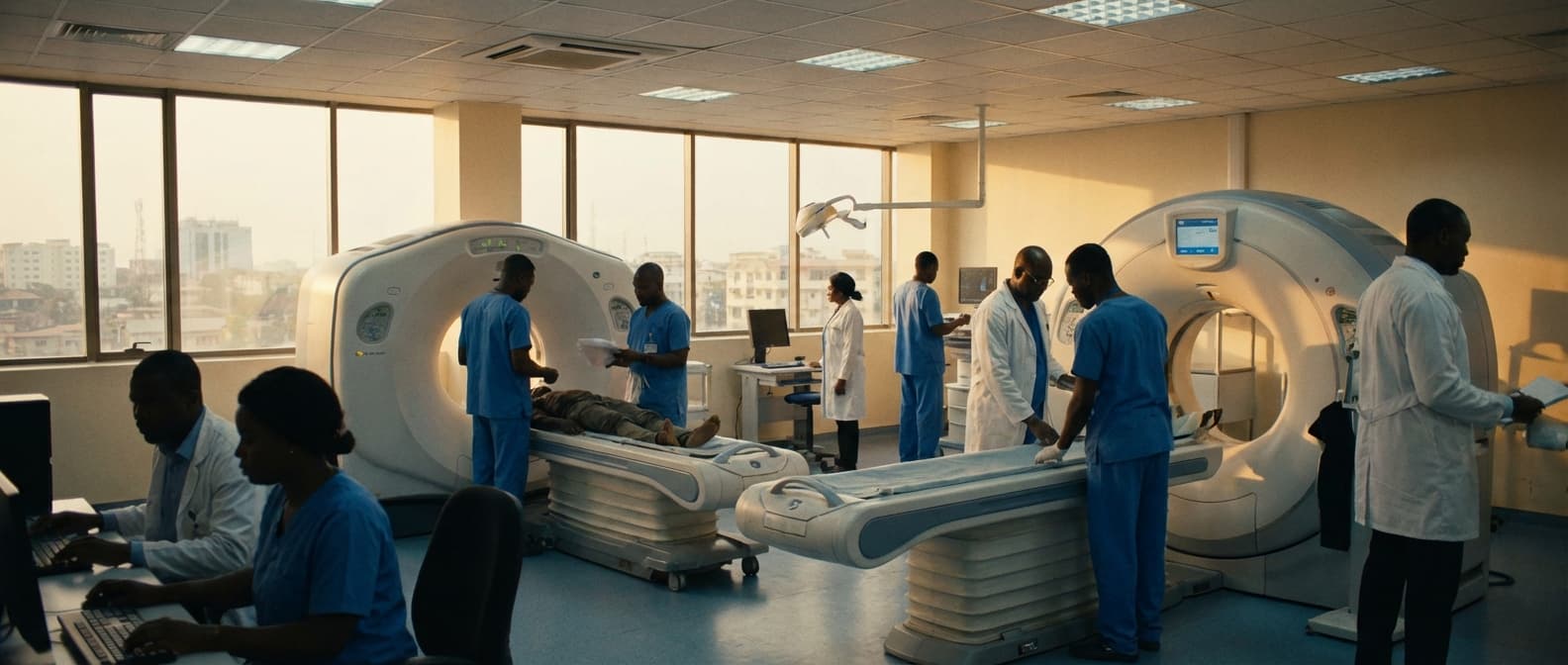
Imaging Acceptance Testing & QA in Ghana
Engineering Excellence & Technical Support
Commissioning and periodic QA for CT/MRI/X‑ray/US/Mammo. High-standard technical execution following OEM protocols and local regulatory frameworks.
Automated Image Quality Validation Suite
Implemented a custom Python-based suite leveraging OpenCV and Scikit-image for automated validation of image resolution, contrast, and artifact detection, reducing manual testing time by 70% for medical imaging devices.
PACS Integration & DICOM Conformance Testing
Successfully integrated and performed rigorous DICOM conformance testing for new X-ray and CT scanner models with existing hospital PACS, ensuring seamless data flow and compliance with healthcare imaging standards (e.g., DICOM Part 14).
Root Cause Analysis of Image Artifacts
Led the investigation and root cause analysis of persistent image artifacts in ultrasound systems, identifying a firmware calibration issue and collaborating with the vendor for a successful patch deployment, improving diagnostic accuracy.
What Is Imaging Acceptance Testing & Qa In Ghana?
Imaging Acceptance Testing & Quality Assurance (QA) in Ghana refers to the rigorous process of verifying and validating imaging systems and related workflows to ensure they meet predefined technical specifications, regulatory requirements, and user expectations. This service is critical for any healthcare institution, research facility, or industrial entity in Ghana that relies on imaging technologies for diagnosis, treatment planning, or operational oversight. It encompasses a comprehensive suite of tests designed to confirm the functionality, performance, accuracy, and reliability of imaging equipment and software prior to and during their deployment, and periodically thereafter. The objective is to identify and rectify any deviations from expected performance, thereby mitigating risks associated with misdiagnosis, treatment errors, inefficient workflows, and data integrity issues. This proactive approach ensures that deployed imaging solutions are fit for purpose and contribute effectively to the intended outcomes.
| Who Needs Imaging Acceptance Testing & QA? | Typical Use Cases in Ghana | ||||||
|---|---|---|---|---|---|---|---|
| Hospitals and Clinics (Public & Private): Implementing new imaging modalities, upgrading existing systems, or expanding imaging services. | Diagnostic Imaging Centers: Ensuring accuracy and reliability of imaging studies for referral physicians. | Research Institutions: Validating imaging data for scientific studies and clinical trials. | Industrial Sectors (e.g., Non-Destructive Testing): Verifying the performance of industrial imaging equipment for quality control and inspection. | Government Health Agencies: Ensuring compliance and quality standards across national healthcare infrastructure. | Medical Equipment Vendors & Integrators: Providing documented assurance of system performance to their clients. | ||
| Introduction of a new CT scanner: Verifying image quality, scan times, radiation dose, and integration with the Picture Archiving and Communication System (PACS). | Deployment of a new PACS/RIS: Testing image archiving, retrieval speeds, user interface, DICOM compliance, and integration with EHRs. | Installation of digital radiography (DR) units: Assessing image resolution, patient positioning aids, and workflow efficiency. | Upgrade of MRI software: Confirming improved image acquisition sequences, processing capabilities, and compatibility with existing hardware. | Implementation of AI-powered imaging analysis tools: Validating the accuracy, sensitivity, and specificity of AI algorithms against ground truth. | Routine quality control for mammography units: Ensuring optimal image quality for breast cancer screening. | Verification of ultrasound equipment performance: Assessing transducer functionality, image clarity, and measurement accuracy. | Post-installation testing of fluoroscopy systems: Confirming image stability, radiation dose management, and integration with recording devices. |
Key Components of Imaging Acceptance Testing & QA in Ghana
- Hardware Verification: Testing the physical integrity, calibration, and functionality of imaging devices (e.g., X-ray machines, CT scanners, MRI units, ultrasound equipment, digital radiography detectors).
- Software Validation: Ensuring the imaging software (PACS, RIS, viewers, analysis tools) performs as intended, including image acquisition, display, storage, retrieval, processing, and reporting functionalities.
- Image Quality Assessment: Evaluating image characteristics such as spatial resolution, contrast resolution, signal-to-noise ratio (SNR), artifacts, and uniformity against established benchmarks.
- Workflow Integration Testing: Verifying seamless integration of imaging systems with other hospital information systems (HIS), electronic health records (EHRs), and administrative platforms.
- Performance Benchmarking: Assessing system speed, throughput, and response times under various load conditions to ensure operational efficiency.
- Security and Data Integrity Checks: Confirming compliance with data protection regulations, ensuring secure transmission, storage, and access to sensitive imaging data.
- User Acceptance Testing (UAT): Involving end-users (radiologists, technicians, clinicians) to confirm that the system meets their operational needs and is intuitive to use.
- Regulatory Compliance Audits: Ensuring adherence to national and international standards and guidelines relevant to medical imaging and data handling in Ghana.
- Ongoing QA Monitoring: Establishing protocols for continuous monitoring and periodic re-testing to maintain system performance and quality over time.
Who Needs Imaging Acceptance Testing & Qa In Ghana?
Imaging Acceptance Testing & QA are crucial for ensuring the reliability, accuracy, and safety of medical imaging systems in Ghana. This process verifies that new or upgraded equipment functions as intended before it's used for patient care. It also ensures compliance with regulatory standards and manufacturer specifications. Without proper testing and quality assurance, Ghana risks misdiagnoses, inefficient workflows, and potential harm to patients, alongside significant financial implications due to equipment malfunction or underperformance.
| Target Customer Segment | Key Departments Involved | Reasons for Needing Testing & QA |
|---|---|---|
| Public Hospitals | Radiology/Imaging Department, Biomedical Engineering Department, Procurement Department, IT Department | Ensuring patient safety, diagnostic accuracy, efficient use of taxpayer funds, compliance with national health standards. |
| Private Hospitals | Radiology/Imaging Department, Biomedical Engineering/Technical Services, Administration, Quality Assurance Department | Maintaining reputation, patient satisfaction, optimizing return on investment, meeting international quality benchmarks. |
| Diagnostic Imaging Centers | Radiology/Imaging Department, Technical Operations, Management | Guaranteeing the accuracy and reliability of diagnostic reports, attracting referrals from other healthcare providers, operational efficiency. |
| Poly-clinics and Health Centers | Radiology Unit (if applicable), Clinical Department, Health Management | Providing essential diagnostic services, supporting primary healthcare delivery, ensuring appropriate equipment functionality for basic imaging needs. |
| Research Institutions | Research Department, Imaging Facility Management, IT Support | Ensuring data integrity for research studies, reproducibility of results, compatibility with research protocols. |
| Government Health Agencies | Standards & Regulations Department, Procurement Oversight, Health Infrastructure Unit | Setting and enforcing quality standards, ensuring procurement of compliant and functional equipment, public health oversight. |
| Medical Equipment Suppliers & Installers | Technical Support Team, Sales Department, Installation & Commissioning Team | Verifying correct installation, demonstrating equipment functionality to clients, fulfilling contractual obligations, minimizing post-installation issues. |
Who Needs Imaging Acceptance Testing & QA in Ghana?
- Hospitals (Public and Private)
- Diagnostic Imaging Centers
- Poly-clinics and Health Centers with Imaging Capabilities
- Research Institutions utilizing medical imaging
- Government Health Agencies (e.g., Ministry of Health, Ghana Health Service)
- Medical Equipment Suppliers and Installers
- Radiology and Imaging Departments
Imaging Acceptance Testing & Qa Process In Ghana
This document outlines the typical workflow for Imaging Acceptance Testing and Quality Assurance (QA) processes in Ghana, from initial inquiry through the final execution and sign-off. This process is crucial for ensuring that newly acquired or upgraded imaging equipment meets specified standards and performs reliably in a clinical setting, ultimately contributing to accurate diagnoses and patient care.
| Stage | Key Activities | Responsible Parties | Key Deliverables/Outcomes | Typical Timeline (Ghana Context) |
|---|---|---|---|---|
| Identify the need for new imaging equipment or upgrade. Define clinical requirements, technical specifications, and budget. Consult with clinical users (radiologists, technologists). | Hospital/Clinic Management, Clinical Users, Biomedical Engineering Department | Needs assessment report, initial budget allocation, specification outline. | 1-3 Months |
| Issue Request for Proposals (RFPs) or Tenders. Evaluate vendor proposals based on technical merit, cost, support, and compliance with local regulations. Negotiate contract terms. Finalize purchase order. | Procurement Department, Technical Evaluation Committee, Legal Department, Finance Department | Selected vendor, signed contract, purchase order. | 3-9 Months (can vary significantly due to tender processes) |
| Prepare the installation site according to vendor specifications (e.g., power, cooling, shielding, network infrastructure). Coordinate logistics for delivery. Vendor installs the equipment. | Biomedical Engineering Department, IT Department, Facilities Management, Vendor Installation Team | Ready installation site, installed equipment frame/components. | 1-2 Months (concurrent with procurement/delivery) |
| Vendor performs internal tests to verify equipment functionality and performance before shipment. This may include factory acceptance tests (FAT) for major components. | Vendor's QA Team, Vendor's Engineering Team | PAT reports, test results. | 1-4 Weeks (before shipment) |
| Receive and inspect the delivered equipment for any shipping damage. Unpack and carefully stage components. | Logistics Team, Biomedical Engineering Department, Vendor Representative | Undamaged equipment upon arrival. | 1-3 Days |
| Verify correct installation of all components. Vendor performs initial power-up and basic system checks. Ensure all safety features are functional. | Vendor Installation Team, Biomedical Engineering Department | Successful initial power-up, basic system checks completed. | 1-5 Days |
| Formal testing conducted by the client to verify the equipment meets the contracted specifications and performance requirements. This includes phantom testing, image quality assessment, and functionality checks. | Biomedical Engineering Department, Clinical Users (Radiologists, Technologists), Vendor's Technical Team | Completed AT checklist, test images, performance data, AT report. | 1-3 Weeks (depending on complexity and number of tests) |
| Comprehensive review of AT results. Verification against contractual obligations and national/international standards. Ensure compliance with regulatory requirements. Independent verification may be sought. | Biomedical Engineering Department, Hospital QA Committee, Ministry of Health representatives (if applicable) | QA report, validation certificate, sign-off for acceptance. | 1-2 Weeks (post-AT) |
| Provide comprehensive training to clinical users and technical staff on equipment operation, maintenance, and basic troubleshooting. | Vendor's Application Specialists, Vendor's Technical Trainers, Hospital Super Users | Trained personnel, training records, user manuals. | 1-2 Weeks (can be staggered) |
| Receive all relevant documentation: user manuals, service manuals, warranty information, calibration certificates, maintenance schedules, and AT/QA reports. Formal handover from vendor to client. | Vendor Representative, Biomedical Engineering Department, Procurement Department | Complete documentation package, signed handover certificate. | 1-3 Days |
| Equipment is officially put into clinical use. Implement routine QA protocols, scheduled preventative maintenance, and performance monitoring. Address any post-installation issues. | Clinical Users, Biomedical Engineering Department, Vendor Support | Operational imaging equipment, ongoing performance data, maintenance logs. | Continuous |
Imaging Acceptance Testing & QA Process Workflow in Ghana
- Inquiry & Needs Assessment
- Vendor Selection & Procurement
- Site Preparation & Installation
- Pre-Acceptance Testing (PAT) - Vendor Side
- Delivery & Unpacking
- Installation Verification & Initial Power-Up
- Acceptance Testing (AT) - Client Side
- Quality Assurance (QA) & Validation
- Training
- Documentation & Handover
- Go-Live & Ongoing Monitoring
Imaging Acceptance Testing & Qa Cost In Ghana
Imaging Acceptance Testing & Quality Assurance (QA) costs in Ghana are influenced by a range of factors, impacting the overall price for businesses. These factors include the complexity and type of imaging equipment, the scope of testing required, the vendor's experience and reputation, the location of the testing, and the urgency of the service. Given the varying economic landscape and specific project needs, providing precise, universally applicable figures can be challenging. However, we can outline the common pricing determinants and offer general cost ranges in Ghana's local currency, the Ghanaian Cedi (GHS).
| Service Type | Estimated Cost Range (GHS) | Notes |
|---|---|---|
| Basic Imaging Equipment Acceptance Testing (e.g., standard X-ray, basic ultrasound) | 2,000 - 7,000 GHS | Covers initial installation verification and fundamental performance checks. |
| Advanced Imaging Equipment Acceptance Testing (e.g., MRI, CT scanners, digital radiography) | 5,000 - 15,000+ GHS | Includes more in-depth performance analysis, calibration, and image quality assessments. Costs can escalate significantly for multi-component systems. |
| Comprehensive QA Audit for Imaging Department (Multiple Modalities) | 10,000 - 30,000+ GHS | A broader assessment encompassing multiple imaging devices, workflows, and regulatory compliance across an entire department. |
| Per-Day Consulting/On-Site Testing Rate for Senior QA Specialist | 800 - 2,500 GHS | For specialized troubleshooting, supplementary testing, or project-specific needs. Varies based on expertise and vendor. |
| Software Integration Testing (HIS/PACS with Imaging Devices) | 3,000 - 10,000+ GHS | Dependent on the complexity of the integration and the systems involved. |
Key Pricing Factors for Imaging Acceptance Testing & QA in Ghana
- Equipment Complexity & Type: The more advanced, specialized, or numerous the imaging devices (e.g., MRI, CT scanners, X-ray machines, digital radiography systems, ultrasound equipment), the higher the testing costs due to the expertise and specialized tools required.
- Scope of Testing: A comprehensive QA process involving installation verification, calibration, performance evaluation, image quality assessment, safety checks, and user training will naturally command higher prices than a basic acceptance test.
- Vendor Experience & Reputation: Established and highly reputable QA service providers with a proven track record and certified technicians often charge premium rates for their expertise and reliability.
- Location of Testing: On-site testing at a client's facility in remote areas might incur additional travel and accommodation costs for the QA team, increasing the overall price.
- Urgency of Service: Rush or emergency testing services typically come with a surcharge.
- Documentation Requirements: The level of detail and formality required for test reports and certifications can also affect pricing.
- Software Integration: If the imaging equipment requires integration with existing hospital information systems (HIS) or picture archiving and communication systems (PACS), this adds complexity and cost.
- Ongoing Support & Maintenance Contracts: While not strictly acceptance testing, the inclusion of initial support or bundled maintenance can influence the perceived cost.
- Regulatory Compliance: Ensuring adherence to Ghanaian health regulations and international standards can necessitate more rigorous testing, impacting the price.
Affordable Imaging Acceptance Testing & Qa Options
Acceptance Testing and Quality Assurance (QA) are crucial for ensuring the reliable performance and compliance of imaging systems. However, the costs associated with traditional, comprehensive testing can be prohibitive for many organizations. This document outlines affordable imaging acceptance testing and QA options, focusing on value bundles and cost-saving strategies. By strategically leveraging these approaches, organizations can achieve robust testing without compromising their budgets.
| Cost-Saving Strategy | Description | Implementation Example |
|---|---|---|
| Phased Testing | Instead of comprehensive testing at once, break down the testing process into critical phases. Focus on essential functionalities first and defer less critical tests for later or for routine QA. | For a new CT scanner, prioritize image quality and dose verification. Delay extensive artifact analysis or specialized protocol testing until after initial clinical deployment. |
| Leveraging Vendor Resources | Explore testing and QA services offered by the imaging system vendor. They often have optimized protocols and expertise for their own equipment, potentially at a lower cost than third-party providers. | Inquire about bundled acceptance testing and initial QA packages included with the purchase of a new MRI machine. |
| On-Demand or Modular Testing | Opt for testing services that can be procured on an as-needed basis or in smaller, modular packages. This avoids paying for extensive services that might not be required for every system or situation. | Engage a third-party QA provider for specific performance evaluations of individual imaging workstations rather than a full system suite. |
| Remote/Automated QA | Utilize remote monitoring and automated QA tools where feasible. This reduces the need for on-site engineer visits for routine checks, significantly cutting down travel and labor costs. | Implement software that automatically performs daily image quality checks on digital radiography systems and flags any deviations. |
| Internal Training and Empowerment | Train qualified in-house personnel to perform certain routine QA tasks. This reduces reliance on external providers for everyday checks. | Develop a training program for radiographers to perform basic equipment warm-up procedures and visual inspections before clinical use. |
| Risk-Based Testing | Prioritize testing efforts based on the clinical impact and risk associated with potential system failures. Focus more rigorous testing on critical diagnostic equipment. | Allocate more resources to the acceptance testing of mammography equipment due to its critical screening function, compared to a less utilized ultrasound unit. |
| Partnerships and Group Purchasing | Collaborate with other healthcare organizations to negotiate bulk discounts on acceptance testing and QA services, or join a group purchasing organization (GPO). | Form a consortium with local hospitals to contract with a single QA service provider for all their imaging equipment. |
Understanding Value Bundles
- {"title":"What are Value Bundles?","description":"Value bundles are pre-packaged sets of testing services, often combining essential acceptance testing protocols with ongoing QA support, offered at a discounted rate compared to purchasing individual services. They are designed to provide comprehensive coverage for common imaging modalities or workflows."}
- {"title":"Benefits of Value Bundles","description":"Bundles offer predictable costs, streamlined procurement, and ensure that critical testing steps are not overlooked. They often include a defined scope, making it easier to manage expectations and resources."}
- {"title":"Common Bundle Components","description":"Typical components include initial acceptance testing (e.g., performance, calibration, safety), routine QA checks, basic troubleshooting support, and potentially limited training or documentation."}
Verified Providers In Ghana
In Ghana's evolving healthcare landscape, identifying reliable and trustworthy healthcare providers is paramount. Franance Health stands out as a leading entity committed to ensuring access to verified, high-quality medical services. This commitment is reflected in their rigorous credentialing process, which meticulously vets healthcare professionals and facilities. By prioritizing transparency and excellence, Franance Health empowers individuals to make informed decisions about their well-being, connecting them with practitioners who meet the highest standards of care, expertise, and ethical practice. Choosing a Franance Health verified provider means opting for peace of mind and assurance of receiving competent and compassionate medical attention.
| Feature | Franance Health Verified Provider | Standard Provider (Unverified) |
|---|---|---|
| Credential Verification | Mandatory and thorough checks of licenses, certifications, and educational background. | May vary; often relies on self-reporting or minimal checks. |
| Quality Assurance | Active monitoring and adherence to best practices and patient satisfaction standards. | Typically not a formal part of their offering. |
| Professional Standards | Emphasis on ethical conduct, continuous professional development, and patient rights. | Expected, but not actively audited or guaranteed. |
| Patient Confidence | High level of trust and certainty in the quality of care received. | Can be uncertain; relies on word-of-mouth or limited information. |
| Accountability | Clear channels for feedback, complaints, and resolution. | May be less structured or accessible. |
Why Franance Health Verified Providers are the Best Choice:
- Rigorous Vetting Process: All providers undergo a comprehensive assessment of qualifications, experience, and regulatory compliance.
- Commitment to Quality: Focus on evidence-based practices and patient-centered care.
- Enhanced Patient Safety: Reduced risk of adverse outcomes due to adherence to established medical protocols.
- Access to Expertise: Connection with specialists and general practitioners with proven track records.
- Trust and Reliability: Assurance of dealing with legitimate and ethical healthcare professionals.
- Improved Health Outcomes: Higher likelihood of successful diagnosis and treatment.
Scope Of Work For Imaging Acceptance Testing & Qa
This Scope of Work (SOW) outlines the requirements for Imaging Acceptance Testing and Quality Assurance (QA) for the [Project Name] project. The objective is to ensure that all imaging-related functionalities meet the defined technical specifications and business requirements before go-live. This includes testing image acquisition, storage, retrieval, display, processing, and integration with other systems. The testing will cover various imaging modalities and formats, adhering to established industry standards and best practices.
| Deliverable | Description | Standard Specification/Reference |
|---|---|---|
| Test Plan | A comprehensive document detailing the testing strategy, scope, objectives, resources, schedule, and entry/exit criteria for imaging acceptance testing. | IEEE 829 Standard for Software Test Documentation, Project-Specific Test Plan Template |
| Test Cases | Detailed step-by-step procedures for executing tests, including expected results for all imaging functionalities. | Project-Specific Test Case Template, Requirements Traceability Matrix |
| Test Scripts (if applicable) | Automated scripts for repetitive or performance-intensive imaging tests. | Selenium, JMeter, or other agreed-upon automation tools and frameworks |
| Defect Reports | Documented anomalies, bugs, or deviations from expected behavior found during testing, including severity, priority, and steps to reproduce. | JIRA, Azure DevOps, or other agreed-upon defect tracking system, Project-Specific Defect Reporting Guidelines |
| Test Summary Report | A consolidated report summarizing the testing activities, results, defects found, and overall assessment of system readiness. | Project-Specific Test Summary Report Template |
| Traceability Matrix | A matrix mapping test cases to specific requirements and features to ensure complete test coverage. | Microsoft Excel, dedicated requirements management tools |
| User Acceptance Testing (UAT) Sign-off Document | Formal acceptance by stakeholders that the imaging functionalities meet their needs and are ready for production deployment. | Project-Specific UAT Sign-off Form |
| Image Data Set | A representative set of anonymized or synthetic images across various modalities and formats for testing purposes. | DICOM Standard, HL7 standards for image metadata, Project-Specific Data Anonymization Policy |
| Performance Metrics Report | Documentation of system performance under various load conditions, including response times for image loading, retrieval, and processing. | Defined Key Performance Indicators (KPIs) for imaging operations |
| Security Audit Report (Imaging Data) | Verification of adherence to security protocols for imaging data, including access controls, encryption, and audit trails. | HIPAA Security Rule, GDPR, Project-Specific Security Policies |
Key Testing Areas
- Image Acquisition and Capture
- Image Storage and Archiving (PACS/VNA)
- Image Retrieval and Querying
- Image Display and Visualization
- Image Processing and Manipulation
- Image Data Integrity and Security
- Integration with EMR/EHR Systems
- Integration with RIS/LIS Systems
- User Interface (UI) and User Experience (UX) for Imaging Workflows
- Performance and Load Testing
- Disaster Recovery and Business Continuity for Imaging Data
Service Level Agreement For Imaging Acceptance Testing & Qa
This Service Level Agreement (SLA) outlines the performance expectations for Imaging Acceptance Testing and Quality Assurance (QA) services, focusing on response times for critical incidents and guaranteed uptime of the testing environment. This SLA applies to all active projects utilizing the designated Imaging Acceptance Testing & QA platform and associated support services.
| Incident Severity | Response Time Target | Uptime Guarantee |
|---|---|---|
| Critical Incident | 1 hour | 99.5% |
| Major Incident | 4 business hours | 99.8% |
| Minor Incident | 8 business hours | 99.9% |
Key Definitions
- Critical Incident: An event that renders the Imaging Acceptance Testing & QA environment unusable or prevents the execution of core testing functionalities, impacting a significant portion of users or critical project milestones.
- Major Incident: An event that degrades the performance of the Imaging Acceptance Testing & QA environment or limits specific functionalities, causing moderate disruption to testing activities.
- Minor Incident: An event that causes minimal disruption to testing activities, such as cosmetic issues or a single user experiencing a problem.
- Uptime: The percentage of time the Imaging Acceptance Testing & QA environment is operational and accessible for authorized users to perform testing activities.
- Response Time: The maximum time allowed for the support team to acknowledge and begin working on a reported incident, categorized by its severity.
Frequently Asked Questions

Ready when you are
Let's scope your Imaging Acceptance Testing & QA in Ghana project in Ghana.

Scaling healthcare logistics and technical systems across the entire continent.