
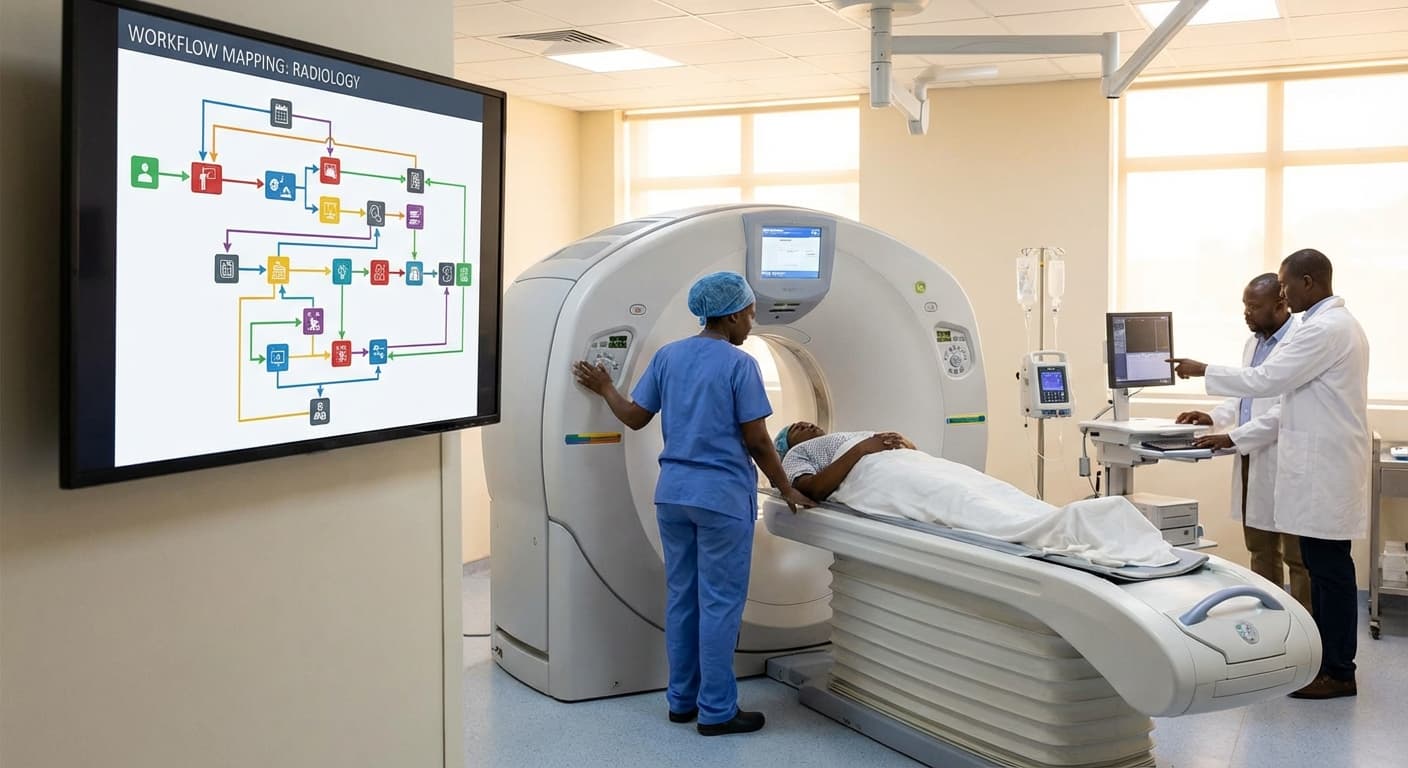
Department Workflow Mapping Service (Radiology/ICU/OT/Lab/Dialysis) in Ghana
Engineering Excellence & Technical Support
Department Workflow Mapping Service (Radiology/ICU/OT/Lab/Dialysis) High-standard technical execution following OEM protocols and local regulatory frameworks.
Optimizing Cardiac Care Pathways
Streamlining patient journeys from admission to discharge in Ghanaian ICUs, ensuring faster access to critical interventions, reduced wait times for echo-cardiograms, and enhanced inter-departmental communication for time-sensitive cardiac emergencies.
Accelerating Diagnostic Throughput
Mapping and optimizing workflows for Radiology departments across Ghana, from patient registration and image acquisition to radiologist interpretation and reporting, leading to quicker diagnosis turnaround times and improved patient outcomes for a growing caseload.
Elevating Laboratory Efficiency & Accuracy
Digitally mapping and refining laboratory processes in Ghana, from sample collection and testing to results validation and dissemination. This initiative enhances sample tracking, reduces manual errors, and ensures timely, accurate diagnostic information for effective patient management across various healthcare facilities.
What Is Department Workflow Mapping Service (Radiology/icu/ot/lab/dialysis) In Ghana?
Department Workflow Mapping Service (Radiology/ICU/OT/Lab/Dialysis) in Ghana refers to the systematic analysis, documentation, and optimization of processes within specific high-demand hospital departments. This service aims to identify inefficiencies, bottlenecks, and areas for improvement in patient flow, resource utilization, communication protocols, and data management. By visualizing the end-to-end journey of a patient or a task through these critical departments, stakeholders can gain a comprehensive understanding of current operational realities and identify strategic interventions for enhanced performance, patient safety, and service delivery quality. The mapping process typically involves interviews with staff, direct observation, data analysis, and the creation of detailed process maps (e.g., flowcharts, swimlane diagrams).
| Stakeholder Group | Needs | Typical Use Cases |
|---|---|---|
| Hospital Administrators/Management | Improve operational efficiency, reduce costs, enhance patient satisfaction, ensure regulatory compliance, optimize resource allocation, and support strategic planning. | Identifying opportunities for cost savings through process streamlining in high-volume departments; evaluating the feasibility of new technologies or service expansions; developing performance improvement initiatives; ensuring compliance with national healthcare standards. |
| Department Heads (Radiology, ICU, OT, Lab, Dialysis) | Optimize departmental workflows, improve staff productivity, reduce errors, enhance patient safety, manage resource constraints effectively, and maintain high-quality clinical output. | Reducing patient turnaround times for diagnostic imaging or lab results; improving patient flow within the ICU to maximize bed availability; streamlining surgical scheduling and resource allocation in the OT; ensuring timely and accurate processing of dialysis treatments. |
| Clinical Staff (Doctors, Nurses, Technicians) | Clarify roles and responsibilities, reduce administrative burden, improve communication and coordination, minimize patient wait times, and enhance patient safety. | Defining clear pathways for critical patient handoffs in the ICU; standardizing specimen collection and handling procedures in the lab; optimizing scheduling and preparation for OT procedures; ensuring efficient patient management in dialysis units. |
| IT and Systems Support Teams | Understand current data flows and integration points, identify requirements for system upgrades or new implementations, and ensure seamless information exchange between departments. | Mapping data requirements for implementing a Picture Archiving and Communication System (PACS) in Radiology; designing integrated electronic health records (EHR) for ICU patient management; facilitating data interoperability between laboratory information systems (LIS) and hospital information systems (HIS). |
| Quality Assurance and Patient Safety Officers | Identify and mitigate risks, establish standardized protocols, improve compliance with safety standards, and monitor performance against quality benchmarks. | Analyzing medication administration pathways in the ICU; assessing sterilization and infection control processes in the OT; evaluating adherence to diagnostic testing protocols in the lab; ensuring consistent patient monitoring during dialysis. |
Key Components of Department Workflow Mapping Service
- Process Identification and Scoping: Defining the specific departmental workflows to be mapped (e.g., patient admission to discharge in ICU, sample processing from collection to reporting in the lab, appointment scheduling to procedure completion in Radiology).
- Data Collection: Gathering information through direct observation of activities, interviews with clinicians, technicians, administrative staff, and review of existing documentation (SOPs, protocols, patient records).
- Process Visualization: Creating visual representations of the workflows using standardized notation (e.g., BPMN, UML diagrams), illustrating the sequence of steps, decision points, roles involved, and information exchange.
- Bottleneck and Inefficiency Analysis: Identifying areas of delay, redundancy, rework, excessive waiting times, or suboptimal resource allocation within the mapped processes.
- Root Cause Analysis: Investigating the underlying reasons for identified inefficiencies, which may involve technological limitations, training gaps, communication breakdowns, or structural issues.
- Optimization and Re-engineering Recommendations: Proposing actionable strategies and interventions to streamline processes, reduce lead times, improve accuracy, enhance patient safety, and optimize resource utilization.
- Implementation Support and Monitoring: Assisting in the rollout of recommended changes and establishing metrics to track the effectiveness of the implemented improvements.
Who Needs Department Workflow Mapping Service (Radiology/icu/ot/lab/dialysis) In Ghana?
In Ghana's rapidly evolving healthcare landscape, optimizing operational efficiency is paramount for delivering high-quality patient care. Department workflow mapping services are crucial for identifying bottlenecks, streamlining processes, and ensuring seamless patient journeys within critical hospital departments. This service offers a comprehensive analysis of existing workflows, from patient registration and testing to treatment and discharge, pinpointing areas for improvement and recommending actionable solutions. This not only enhances patient outcomes but also contributes to cost savings and improved staff satisfaction. This service is particularly vital for departments handling high patient volumes and complex, time-sensitive procedures.
| Target Customer Segment | Specific Departments Benefiting | Key Needs Addressed |
|---|---|---|
| Public Hospitals (e.g., Korle-Bu Teaching Hospital, Komfo Anokye Teaching Hospital) | Radiology, Intensive Care Unit (ICU), Operating Theatre (OT), Laboratory, Dialysis Unit | Improving patient throughput, reducing diagnostic delays, optimizing equipment utilization, ensuring patient safety in critical care, enhancing specimen handling and analysis, managing complex surgical schedules, and standardizing dialysis procedures. |
| Private Hospitals and Clinics (e.g., Ridge Hospital, Accra Specialist Hospital, Beacon Health) | Radiology, Intensive Care Unit (ICU), Operating Theatre (OT), Laboratory, Dialysis Unit | Competitive advantage through efficiency, faster patient recovery, enhanced service delivery, attracting more patients, cost-effective operations, and maintaining high-quality care standards. |
| Medical Research Institutions and University Teaching Hospitals | Radiology, Intensive Care Unit (ICU), Operating Theatre (OT), Laboratory, Dialysis Unit | Streamlining research protocols, facilitating clinical trials, improving data collection accuracy, optimizing experimental workflows, and enhancing the training of future healthcare professionals. |
| Specialized Medical Centers (e.g., Cancer Centers, Cardiac Centers) | Radiology, Intensive Care Unit (ICU), Operating Theatre (OT), Laboratory, Dialysis Unit | Optimizing specialized treatment pathways, ensuring precise diagnostic imaging and pathology, managing complex interventional procedures, and providing high-dependency care for critically ill patients. |
| Government Health Agencies and Ministry of Health (for policy and planning) | All clinical departments across the healthcare system | Identifying systemic inefficiencies, developing evidence-based policies for service delivery improvement, resource allocation planning, and setting national standards for healthcare operations. |
Who Needs Department Workflow Mapping Service (Radiology/ICU/OT/Lab/Dialysis) in Ghana?
- Hospitals seeking to improve patient flow and reduce wait times.
- Healthcare facilities aiming to enhance diagnostic accuracy and turnaround times.
- Organizations looking to optimize resource allocation and reduce operational costs.
- Medical departments facing challenges with inter-departmental communication and coordination.
- Hospitals preparing for accreditation or seeking to meet international quality standards.
- New or expanding healthcare facilities needing to establish efficient operational frameworks.
- Departments with a high volume of complex procedures and patient cases.
Department Workflow Mapping Service (Radiology/icu/ot/lab/dialysis) Process In Ghana
This document outlines the typical workflow for engaging a Department Workflow Mapping Service, specifically tailored for departments within healthcare facilities in Ghana such as Radiology, Intensive Care Units (ICU), Operating Theatres (OT), Laboratories, and Dialysis Units. The service aims to analyze, document, and optimize the operational processes within these critical departments to enhance efficiency, reduce errors, and improve patient care.
| Stage | Description | Key Activities | Deliverables/Outcomes | Responsible Parties (Client/Service Provider) |
|---|---|---|---|---|
| Inquiry and Initial Consultation | The potential client (hospital department head, administrator, or relevant committee) expresses interest in workflow mapping services. | Initial discussion of needs, goals, and service scope. Information gathering on the department's current challenges. Service provider introduces their capabilities and approach. | Mutual understanding of project feasibility. Decision to proceed to the next stage. | Client: Department Head/Administrator; Service Provider: Business Development/Project Lead |
| Needs Assessment and Scope Definition | A more in-depth understanding of the specific department's operational requirements and pain points. | On-site visits (if feasible and safe), interviews with key personnel (doctors, nurses, technicians, administrators), observation of daily operations, review of existing documentation (SOPs, guidelines). | Detailed understanding of the department's current state, identification of key processes to be mapped, definition of project objectives and scope (which sub-processes are included/excluded). | Client: Department Management, Key Staff; Service Provider: Workflow Analysts, Project Manager |
| Proposal Development and Agreement | Formalizing the project scope, methodology, timeline, and costs. | Development of a detailed project proposal outlining methodology, deliverables, timeline, team composition, and pricing. Negotiation of terms and conditions. Contract signing. | A clear, agreed-upon project plan and contractual agreement. | Client: Procurement/Administration; Service Provider: Project Manager, Business Development |
| Data Collection and Analysis | Gathering comprehensive data on current workflows. | Detailed observation of all relevant processes, interviews with a wider range of staff, collection of process-related data (e.g., patient turnaround times, equipment utilization, error rates, communication logs), review of data flow and information systems. | Raw data, observations, interview transcripts, process metrics. | Client: Department Staff; Service Provider: Workflow Analysts, Data Collectors |
| Workflow Mapping and Documentation | Visualizing and documenting the 'as-is' processes. | Creation of process maps (e.g., using BPMN or flowcharts) illustrating sequences of activities, decision points, roles involved, inputs, and outputs for each identified sub-process. Documentation of standard operating procedures (SOPs) and work instructions. | Comprehensive 'As-Is' process maps, documented SOPs and work instructions. | Service Provider: Workflow Analysts, Technical Writers; Client: Subject Matter Experts for validation |
| Identification of Bottlenecks and Improvement Areas | Analyzing the mapped workflows to pinpoint inefficiencies and areas for enhancement. | Review of process maps and data to identify bottlenecks (e.g., delays, resource constraints), redundancies, non-value-added activities, potential failure points, and areas for automation or standardization. | List of identified bottlenecks, inefficiencies, and potential risks. | Service Provider: Workflow Analysts, Process Improvement Specialists |
| Development of Recommendations and Action Plan | Proposing solutions to address identified issues. | Brainstorming and developing 'To-Be' workflows that are more efficient and effective. Formulating specific recommendations for process changes, technology adoption, staff training, or policy adjustments. Creating a phased action plan for implementation. | Proposed 'To-Be' workflows, a detailed list of recommendations, and a prioritized implementation action plan. | Service Provider: Process Improvement Specialists, Project Manager |
| Presentation and Validation of Findings | Sharing the findings and recommendations with the client for feedback and approval. | Presenting the mapped 'As-Is' workflows, identified bottlenecks, and proposed 'To-Be' workflows and recommendations to the department and hospital management. Facilitating discussions and incorporating feedback. | Client acceptance and buy-in for the proposed changes. Refined recommendations based on feedback. | Service Provider: Project Manager, Lead Analyst; Client: Department Management, Stakeholders |
| Implementation Support (Optional) | Assisting the client in putting the recommendations into practice. | Providing guidance on implementing the new workflows, developing training materials, conducting training sessions, supporting change management initiatives, and potentially assisting with pilot testing. | Successful adoption of new processes, improved staff proficiency. | Service Provider: Implementation Consultants, Trainers; Client: Department Staff, Management |
| Follow-up and Evaluation | Assessing the impact of the implemented changes. | Conducting follow-up assessments to measure the effectiveness of the implemented changes against the defined objectives (e.g., measuring improvements in efficiency, error reduction, patient satisfaction). Providing a final report on project outcomes. | Evaluation report, demonstration of measurable improvements, lessons learned. | Service Provider: Project Manager, Analysts; Client: Department Management |
Workflow Stages
- Inquiry and Initial Consultation
- Needs Assessment and Scope Definition
- Proposal Development and Agreement
- Data Collection and Analysis
- Workflow Mapping and Documentation
- Identification of Bottlenecks and Improvement Areas
- Development of Recommendations and Action Plan
- Presentation and Validation of Findings
- Implementation Support (Optional)
- Follow-up and Evaluation
Department Workflow Mapping Service (Radiology/icu/ot/lab/dialysis) Cost In Ghana
The cost of departmental workflow mapping services for specialized healthcare units like Radiology, Intensive Care Units (ICU), Operating Theatres (OT), Laboratories, and Dialysis in Ghana can vary significantly. This service involves a comprehensive analysis and documentation of existing processes, identification of bottlenecks, and recommendations for optimization to improve efficiency, patient safety, and resource utilization. Several factors influence the pricing, making it difficult to provide a single definitive cost. These factors are crucial for understanding the price ranges within the Ghanaian market.
| Department Type | Estimated Price Range (GHS) | Notes |
|---|---|---|
| Radiology Department (Small to Medium) | 15,000 - 30,000 | Covers basic imaging, reporting workflows. May exclude highly specialized procedures. |
| Radiology Department (Large/Tertiary) | 30,000 - 60,000+ | Includes advanced imaging modalities, complex patient pathways, and interdepartmental coordination. |
| ICU (Small Unit) | 12,000 - 25,000 | Focuses on patient care pathways, monitoring, and staff communication in a limited bed capacity. |
| ICU (Large Unit/Hospital-wide) | 25,000 - 50,000+ | Encompasses multiple units, critical care protocols, advanced life support, and resource management. |
| Operating Theatre (Single/Few) | 18,000 - 35,000 | Maps surgical scheduling, pre-op, intra-op, and post-op patient flow and resource allocation. |
| Operating Theatre (Multiple/Department) | 35,000 - 70,000+ | Covers multiple ORs, various surgical specialties, sterilization, and supply chain for ORs. |
| Laboratory (General) | 10,000 - 20,000 | Includes sample reception, processing, analysis, and reporting for common tests. |
| Laboratory (Specialized - e.g., Microbiology, Molecular) | 20,000 - 40,000+ | Handles complex testing methodologies, specialized equipment, and stricter quality control processes. |
| Dialysis Unit (Small to Medium) | 14,000 - 28,000 | Focuses on patient scheduling, treatment administration, and post-treatment care for a limited number of machines. |
| Dialysis Unit (Large/Hospital) | 28,000 - 55,000+ | Includes multiple dialysis stations, patient throughput, water treatment systems, and staff management for higher volumes. |
Key Pricing Factors for Workflow Mapping Services in Ghana:
- Scope and Complexity of the Department: Larger departments with more intricate workflows, a higher volume of procedures, or specialized equipment will naturally require more extensive mapping and thus command higher fees. For example, mapping an entire hospital's radiology department will be more complex than a single specialized lab.
- Number of Workflows to Map: The more individual processes or sub-workflows that need to be analyzed within a department, the more time and resources the consulting team will need, directly impacting the cost.
- Size and Type of Healthcare Facility: The cost might differ between a large tertiary hospital, a district hospital, a private clinic, or a specialized diagnostic center. Larger institutions often have more complex organizational structures and a greater number of staff to interview and observe.
- Level of Detail Required: If the mapping requires granular detail down to individual task times, error rates, and specific equipment utilization, the project will be more resource-intensive.
- Consulting Firm's Expertise and Reputation: Established firms with a proven track record in healthcare workflow optimization and strong local knowledge often charge premium rates.
- Number of Consultants and Duration of the Project: The size of the consulting team deployed and the estimated time required to complete the mapping and analysis will be primary cost drivers.
- Data Collection Methods: The methods used for data gathering (e.g., direct observation, interviews, document analysis, system data extraction) can influence the time and effort involved.
- Reporting and Deliverables: The format and depth of the final report, including detailed process maps, recommendations, implementation plans, and training materials, will affect the overall cost.
- Travel and Accommodation: For consultants who need to travel to various locations within Ghana, travel and accommodation expenses will be factored into the overall price.
- Technology and Software Used: If specialized software is used for mapping and analysis, the cost of licenses or subscription fees may be included.
- Post-Implementation Support: Some service providers offer ongoing support for the implementation of recommendations, which would be an additional cost.
Affordable Department Workflow Mapping Service (Radiology/icu/ot/lab/dialysis) Options
Our Affordable Department Workflow Mapping Service offers a comprehensive solution for optimizing operational efficiency in critical healthcare departments. By meticulously mapping existing workflows in Radiology, ICU, Operating Theatre (OT), Laboratory, and Dialysis, we identify bottlenecks, redundancies, and areas for improvement. This service empowers your department to streamline processes, reduce errors, enhance patient care, and achieve significant cost savings. We offer flexible value bundles tailored to your specific needs and budget, alongside strategic cost-saving recommendations.
Value Bundles Explained:
Our value bundles are designed to provide increasing levels of support and insight. Each bundle includes the core workflow mapping process, with added benefits as you move up in tiers. This allows you to choose the level of engagement that best suits your department's current stage of development and resource availability.
Cost-Saving Strategies:
Beyond the immediate benefits of optimized workflows, our service actively identifies and implements cost-saving strategies. These can include reducing waste, improving resource utilization, minimizing rework, enhancing staff productivity, and potentially lowering capital expenditure through better planning. We focus on sustainable improvements that yield long-term financial benefits.
| Cost-Saving Strategy | Description | Potential Impact |
|---|---|---|
| Bottleneck Elimination | Identifying and removing process steps that slow down or halt the workflow. | Reduced patient wait times, increased throughput, improved staff satisfaction. |
| Redundancy Reduction | Eliminating duplicate tasks or processes performed by different individuals or departments. | Minimized wasted effort and resources, improved data integrity. |
| Resource Optimization | Ensuring efficient allocation and utilization of equipment, consumables, and personnel. | Lower inventory costs, reduced equipment downtime, better staffing levels. |
| Error Prevention & Rework Minimization | Implementing checks and balances to reduce errors, thereby decreasing the need for costly rework. | Improved patient safety, reduced material waste, higher quality of service. |
| Standardization of Processes | Establishing consistent, best-practice procedures across all relevant staff and shifts. | Predictable outcomes, easier training, reduced variation in service quality. |
| Technology Integration Opportunities | Identifying areas where technology can automate tasks, improve data flow, or enhance decision-making. | Increased efficiency, reduced manual labor, enhanced data analytics for further improvements. |
Department Workflow Mapping Service - Value Bundle Options
- Bronze Bundle (Foundation Mapping): Includes initial workflow discovery, documentation of current state processes for one department, identification of primary bottlenecks, and a basic report with recommendations. Ideal for departments seeking a foundational understanding of their operations.
- Silver Bundle (Enhanced Mapping & Analysis): Builds upon the Bronze Bundle by including in-depth analysis of two departments, detailed bottleneck identification, root cause analysis, and a comprehensive report with actionable insights and prioritized recommendations. Includes a workshop to review findings.
- Gold Bundle (Comprehensive Optimization & Strategy): Encompasses workflow mapping and optimization for all specified departments. Includes advanced process analysis, identification of inter-departmental dependencies, simulation of proposed changes, and a strategic roadmap for continuous improvement. Features dedicated consulting sessions and implementation support.
- Platinum Bundle (Full-Service Integration & Monitoring): The most comprehensive offering, including all Gold Bundle features plus ongoing monitoring of key performance indicators (KPIs), regular review meetings, and adaptive workflow adjustments to ensure sustained efficiency and cost savings. Tailored technology integration recommendations are also included.
Verified Providers In Ghana
In Ghana, accessing reliable and trustworthy healthcare providers is paramount. Verified providers offer a level of assurance that distinguishes them from the rest, ensuring quality care and patient safety. Franance Health stands out as a leader in this domain, meticulously vetting and credentialing healthcare professionals and facilities. This commitment to verification means that when you choose a Franance Health-affiliated provider, you are opting for excellence, expertise, and ethical practice. Their rigorous credentialing process, which includes background checks, verification of qualifications, and ongoing performance reviews, ensures that their network comprises only the most competent and dedicated healthcare professionals. This dedication translates into a superior patient experience, characterized by accurate diagnoses, effective treatments, and compassionate care. Franance Health's focus on verified providers is not just a procedural step; it's a foundational principle that safeguards patient well-being and builds confidence in Ghana's healthcare landscape.
| Verification Aspect | Franance Health Standard | Benefit to Patient |
|---|---|---|
| Medical Qualifications | Verification of degrees, licenses, and certifications from accredited institutions. | Ensures practitioners possess the necessary knowledge and skills for effective treatment. |
| Professional Experience | Thorough review of past work history, including practice duration and areas of specialization. | Guarantees that providers have practical experience and are adept in their fields. |
| Background Checks | Comprehensive checks for any disciplinary actions or legal issues. | Provides peace of mind and ensures providers adhere to ethical and legal standards. |
| Reputation and References | Gathering feedback from previous patients and professional peers. | Offers insight into a provider's bedside manner, patient satisfaction, and collaborative abilities. |
| Continuing Medical Education (CME) | Confirmation of active participation in ongoing training and professional development. | Ensures providers are up-to-date with the latest medical advancements and best practices. |
Why Franance Health Verified Providers are the Best Choice:
- Uncompromising Quality of Care: Rigorous vetting ensures only highly qualified professionals are part of the network.
- Patient Safety and Trust: Verification processes minimize risks and build confidence in the care received.
- Access to Specialized Expertise: A curated network provides access to a wide range of medical specialists.
- Ethical Practice and Professionalism: Franance Health upholds high ethical standards for all affiliated providers.
- Streamlined Healthcare Experience: Easy access to verified providers simplifies the process of finding reliable healthcare.
- Commitment to Continuous Improvement: Ongoing monitoring and feedback mechanisms ensure providers maintain excellence.
Scope Of Work For Department Workflow Mapping Service (Radiology/icu/ot/lab/dialysis)
This Scope of Work (SOW) outlines the services to be provided for a comprehensive workflow mapping initiative across key hospital departments: Radiology, Intensive Care Unit (ICU), Operating Theatre (OT), Laboratory, and Dialysis. The objective is to document, analyze, and identify areas for optimization within existing departmental processes, ultimately improving efficiency, patient care, and resource utilization. The project will involve detailed data gathering, process visualization, and the development of actionable recommendations. The technical deliverables will be provided in standardized formats to ensure consistency and ease of integration.
| Department | Scope of Workflow Mapping | Key Processes to Map | Identified Pain Points (Examples) | Potential Areas for Optimization | ||||||||||||||||||||
|---|---|---|---|---|---|---|---|---|---|---|---|---|---|---|---|---|---|---|---|---|---|---|---|---|
| Radiology | Patient registration, imaging request, scheduling, image acquisition, image processing, reporting, image archiving, inter-departmental communication. | Patient journey from referral to report delivery, equipment utilization, radiologist workload, PACS/RIS integration. | Long wait times for appointments, inefficient reporting turnaround, miscommunication between referring physicians and radiologists, data integrity issues. | Automated scheduling, voice recognition reporting, AI-assisted image analysis, streamlined PACS integration, improved communication protocols. | ICU | Patient admission, daily rounds, medication administration, vital sign monitoring, diagnostic testing, treatment procedures, patient discharge/transfer, communication among multidisciplinary teams. | Interdisciplinary team collaboration, alarm fatigue, documentation burden, critical care pathway adherence, resource allocation (beds, equipment). | Delays in critical interventions, medication errors, incomplete documentation, staff burnout, inefficient bed management. | Standardized critical care pathways, real-time patient data dashboards, smart alarm systems, improved electronic health record (EHR) integration, team-based communication tools. | OT | Pre-operative assessment, patient scheduling, surgical team preparation, anesthesia induction, surgical procedure, post-operative recovery, instrument sterilization and management, sterile supply chain. | Operating room utilization, surgical case scheduling, staff allocation, instrument turnaround time, infection control protocols. | Cancelled surgeries, extended surgery times, instrument shortages, infection risks, inefficient staff utilization. | Advanced scheduling systems, real-time OR status updates, automated instrument tracking, lean management principles in sterile processing, enhanced inter-professional communication. | Laboratory | Specimen collection, specimen transport, sample accessioning, test ordering, sample processing, result analysis, result reporting, quality control, inventory management. | Turnaround times for various tests, specimen integrity, lab automation, LIMS integration, inter-departmental sample handling. | Delayed test results, specimen rejection, errors in sample labeling, inefficient workflow for high-volume tests, limited automation. | Automated specimen tracking, point-of-care testing integration, advanced LIMS functionality, robotic sample processing, optimized specimen collection protocols. | Dialysis | Patient scheduling, pre-dialysis assessment, dialysis treatment procedure, post-dialysis monitoring, fluid balance management, medication administration, equipment maintenance, patient education. | Dialysis machine utilization, staff-to-patient ratios, infection control during treatment, management of complications, coordination with other care teams. | Long patient wait times for treatment, inefficient machine turnover, variations in treatment protocols, challenges in managing fluid overload, staff workload. | Optimized scheduling algorithms, automated patient monitoring, point-of-care fluid management tools, standardized treatment protocols, remote monitoring capabilities. |
Project Objectives
- To create a detailed, visual representation of current workflows for each specified department.
- To identify bottlenecks, inefficiencies, redundancies, and potential risks within existing processes.
- To analyze the impact of current workflows on patient outcomes, staff satisfaction, and operational costs.
- To develop data-driven recommendations for process improvement and optimization.
- To establish a baseline for future performance measurement and continuous improvement initiatives.
Service Level Agreement For Department Workflow Mapping Service (Radiology/icu/ot/lab/dialysis)
This Service Level Agreement (SLA) outlines the guaranteed response times and uptime for the Department Workflow Mapping Service provided to the Radiology, Intensive Care Unit (ICU), Operating Theatre (OT), Laboratory, and Dialysis departments. This SLA aims to ensure the efficient and reliable delivery of workflow mapping services, critical for operational efficiency and patient care within these departments.
| Service Component | Response Time Guarantee (Business Hours) | Uptime Guarantee |
|---|---|---|
| Initial Consultation/Project Kick-off | Within 2 business days of request | N/A (Service Initiation) |
| Workflow Data Collection & Analysis | 95% of scheduled sessions completed within agreed timelines | N/A (Process Dependent) |
| Draft Workflow Diagram/Documentation Submission | Within 5 business days of data finalization | N/A (Deliverable) |
| Feedback Incorporation & Revision | Within 3 business days of receiving consolidated feedback | N/A (Deliverable) |
| Final Workflow Mapping Report & Diagrams | Within 2 business days of final approval | N/A (Deliverable) |
| Ongoing Support & Clarifications (Post-Implementation) | Within 4 business hours for critical queries, 1 business day for standard queries | 99.5% |
| System Availability (for tools/platforms used in mapping) | N/A | 99.8% |
Scope of Services
- Development and documentation of current state workflows.
- Analysis and identification of bottlenecks and inefficiencies.
- Design and documentation of future state workflows.
- Facilitation of departmental workshops for workflow validation.
- Creation of visual workflow diagrams (e.g., flowcharts, swimlane diagrams).
- Provision of user-friendly workflow documentation.
Frequently Asked Questions

Ready when you are
Let's scope your Department Workflow Mapping Service (Radiology/ICU/OT/Lab/Dialysis) in Ghana project in Ghana.

Scaling healthcare logistics and technical systems across the entire continent.