
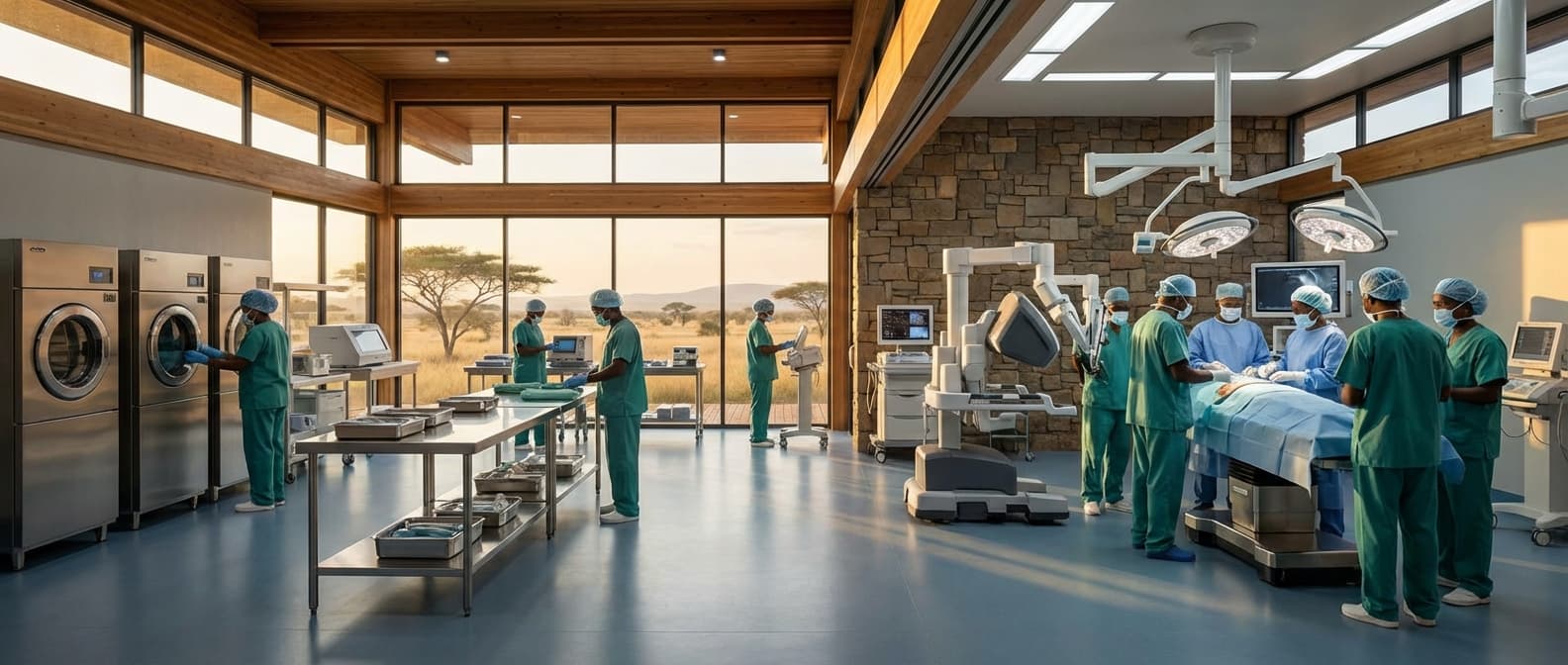
Operating Theatre Turnkey Build in Ghana
Engineering Excellence & Technical Support
Complete OR design, equipment integration and commissioning High-standard technical execution following OEM protocols and local regulatory frameworks.
Advanced Modular Theatre Suites
We deliver state-of-the-art modular operating theatre suites pre-fabricated to the highest international standards. Our solutions optimize space, enhance infection control, and integrate cutting-edge medical technologies for seamless surgical workflows in Ghana.
Integrated HVAC & Air Filtration Systems
Our turnkey builds feature advanced, hospital-grade HVAC systems with HEPA filtration, ensuring optimal air quality, temperature, and humidity control essential for sterile environments and patient safety within Ghanaian healthcare facilities.
Robust Biosecurity & Sterilization Solutions
We implement comprehensive biosecurity measures and integrate high-efficiency sterilization and disinfection technologies designed to meet the rigorous demands of modern surgical practices, protecting both patients and healthcare professionals in Ghana.
What Is Operating Theatre Turnkey Build In Ghana?
An Operating Theatre Turnkey Build in Ghana refers to a comprehensive service offering that delivers a fully functional, ready-to-use operating theatre (OT) suite from initial concept and design through to final commissioning and handover. This integrated approach encompasses all phases of construction, equipping, and operational readiness, allowing the client to bypass the complexities of managing multiple individual contractors and suppliers. The service typically involves site assessment, architectural and engineering design, civil works, specialized medical gas systems, HVAC (with HEPA filtration and pressure control), electrical infrastructure (including UPS and generator backup), lighting, specialized finishes, surgical equipment procurement and installation, sterile processing integration, and final testing and certification. This 'plug-and-play' solution aims to expedite the establishment of critical healthcare infrastructure, minimizing disruption and ensuring compliance with international and local healthcare standards.
| Beneficiary Group | Specific Need | Typical Use Case |
|---|---|---|
| New Private Hospitals and Clinics | Establishing a complete surgical facility with minimal in-house expertise or project management capacity. Rapid market entry. | A newly established private hospital seeking to offer a full spectrum of surgical services without the burden of managing construction, procurement, and installation of a highly specialized facility. |
| Existing Healthcare Facilities (Expansion/Upgrade) | Modernizing outdated surgical suites, increasing capacity, or incorporating advanced surgical technologies. Addressing critical infrastructure deficiencies. | A government-run hospital requiring the upgrade of its existing operating theatre to meet current infection control standards and accommodate new laparoscopic surgical equipment. |
| Government Health Projects | Implementing nationwide healthcare improvement initiatives, constructing new public hospitals, or renovating existing ones with advanced surgical capabilities. Achieving economies of scale and standardized quality. | The Ministry of Health in Ghana commissioning the construction of multiple regional hospitals, each requiring standardized, fully equipped operating theatres to ensure consistent quality of care across the country. |
| Specialized Surgical Centers | Developing facilities focused on specific surgical disciplines (e.g., cardiology, neurosurgery, orthopedics) requiring highly tailored and integrated equipment and infrastructure. | A private group investing in a dedicated cardiac surgery center that needs a turnkey OT solution optimized for complex cardiovascular procedures, including integrated imaging and specialized anesthesia support. |
| Non-Governmental Organizations (NGOs) and Humanitarian Organizations | Rapid deployment of surgical capacity in underserved areas or for specific medical missions. Ensuring immediate operational readiness. | An NGO responding to a humanitarian crisis requiring the swift establishment of a sterile surgical environment to provide emergency medical interventions. |
Key Components of an Operating Theatre Turnkey Build:
- Site Assessment and Feasibility Studies
- Architectural and Engineering Design (including layout, workflows, and compliance)
- Civil and Structural Construction
- Specialized HVAC Systems (laminar flow, HEPA filtration, pressure differentials)
- Medical Gas Pipeline Systems (oxygen, medical air, vacuum, nitrous oxide)
- Electrical Infrastructure (power distribution, UPS, emergency generators)
- Specialized OT Lighting (surgical luminaires, ambient lighting)
- Acoustic Design and Soundproofing
- Finishes (antimicrobial wall coatings, seamless flooring, anti-static properties)
- Surgical Equipment Procurement and Installation (tables, anesthesia machines, monitors, imaging)
- Sterile Processing Unit (CSSD) Integration
- Waste Management Systems
- IT and Communication Infrastructure
- Commissioning, Validation, and Training
- Regulatory Approvals and Certification
Who Needs Operating Theatre Turnkey Build In Ghana?
Operating theatre turnkey builds in Ghana offer a comprehensive, end-to-end solution for establishing or upgrading surgical facilities. This approach streamlines the entire process, from initial design and construction to the installation of all necessary equipment and finishing touches, ensuring a fully functional and compliant operating theatre ready for immediate use. This service is particularly valuable for entities seeking rapid deployment, specialized expertise, and a single point of accountability for a complex project.
| Department/Area | Key Features & Requirements for Turnkey Build |
|---|---|
| Main Operating Theatre | Laminar airflow systems, integrated surgical lighting, anesthesia machines, patient monitoring systems, electrosurgical units, surgical tables, sterile supply integration, specialized flooring and wall finishes, gas supply outlets (oxygen, air, vacuum, nitrous oxide), nurse call systems, communication systems. |
| Sterilization & Decontamination Area (CSSD) | Autoclaves, washer-disinfectors, sterile packaging equipment, dedicated clean and dirty zones, ventilation systems, appropriate storage for sterile instruments, material handling systems. |
| Pre-operative Holding Area | Patient beds/stretchers, monitoring equipment, privacy screens, charting stations, adequate lighting, access to medical gases. |
| Post-operative Recovery Area (PACU/Recovery Room) | Recovery beds with integrated monitoring, respiratory support equipment, medication dispensing systems, charting stations, close proximity to operating theatres, adequate lighting and ventilation. |
| Scrub-up Area | Hands-free scrub sinks, antimicrobial soap dispensers, surgical scrub brushes, gown and glove dispensers, appropriate lighting, waste disposal. |
| Anesthesia Room/Bay | Anesthesia workstations, vital signs monitors, drug preparation areas, charting stations, direct access to the operating theatre. |
| Surgeon's Lounge/Changing Rooms | Secure lockers, changing facilities, relaxation space, access to restrooms. |
| Medical Gas Pipeline System (MGPS) | Centralized medical gas storage and distribution, alarm systems, shut-off valves, appropriate outlets throughout the facility, regular testing and certification. |
| Ventilation & Air Conditioning (HVAC) | HEPA filtration, positive and negative pressure control for different areas (e.g., theatres vs. sterilization), temperature and humidity control, redundancy systems. |
| Electrical Systems & Backup Power | Surgical-grade electrical outlets, uninterruptible power supply (UPS) for critical equipment, backup generator with automatic transfer switch, lightning protection. |
| Plumbing & Waste Management | Medical waste disposal systems (sharps containers, biohazard bins), specialized drainage, accessible water supply, handwashing facilities. |
| IT & Communication Infrastructure | Network cabling, Wi-Fi, intercom systems, audio-visual equipment for training or remote consultation, integration with hospital information systems (HIS). |
Target Customers for Operating Theatre Turnkey Builds in Ghana:
- Government Hospitals & Public Healthcare Facilities
- Private Hospitals & Diagnostic Centers
- Missionary & Non-Profit Healthcare Providers
- Specialized Surgical Clinics
- Military & Security Force Medical Units
- New Healthcare Investment Projects
- Existing Facilities Undergoing Major Expansion or Modernization
Operating Theatre Turnkey Build Process In Ghana
This document outlines the typical workflow for a turnkey operating theatre build process in Ghana, from the initial inquiry stage through to project execution and handover. A turnkey solution aims to provide a complete, ready-to-use facility, encompassing design, procurement, construction, installation, and commissioning.
| Phase | Key Activities | Deliverables | Typical Duration (Indicative) |
|---|---|---|---|
| Inquiry & Initial Consultation | Client engagement, understanding requirements, site visit | Initial scope definition, preliminary needs assessment | 1-2 Weeks |
| Needs Assessment & Feasibility | Detailed requirement gathering, compliance checks, financial viability assessment | Detailed needs analysis report, feasibility study, preliminary budget | 2-4 Weeks |
| Conceptual Design & Proposal | Developing layouts, defining scope, cost estimation, proposal writing | Conceptual designs, project proposal, budget and timeline | 3-5 Weeks |
| Detailed Design & Engineering | Architectural, MEP, equipment specifications, compliance verification | Final architectural drawings, MEP schematics, equipment list, technical specifications | 6-12 Weeks |
| Procurement & Supply Chain | Sourcing materials and equipment, vendor selection, logistics planning | Purchase orders, supplier agreements, material and equipment delivery schedule | Ongoing throughout design and construction |
| Site Preparation & Civil Works | Site clearing, excavation, foundation, structural construction | Constructed building shell, compliant with structural requirements | 8-20 Weeks |
| MEP Installation & Integration | Installing HVAC, electrical, plumbing, medical gas systems | Functional MEP systems, integrated medical gas network | 10-18 Weeks |
| Operating Theatre Interior Fit-Out | Flooring, walls, ceilings, surgical lights, integration | Completed sterile environment, installed fixed theatre components | 6-10 Weeks |
| Medical Equipment Installation & Commissioning | Installing and testing all medical devices | Fully functional and calibrated medical equipment | 4-8 Weeks |
| Testing, Validation & QA | Comprehensive system and performance checks, compliance audits | Validation reports, QA certificates, compliance documentation | 2-4 Weeks |
| Training & Handover | Staff training, final inspections, documentation delivery | Trained staff, comprehensive project handover package | 1-2 Weeks |
| Post-Handover Support | Ongoing maintenance, troubleshooting, service agreements | Service level agreements, operational support | Ongoing |
Operating Theatre Turnkey Build Process in Ghana: Workflow Stages
- Inquiry & Initial Consultation: The process begins with a client (hospital, clinic, government agency) expressing interest in building or upgrading an operating theatre. This involves initial discussions to understand their needs, budget, scope of work, and desired timeline. Site visits may be conducted at this early stage.
- Needs Assessment & Feasibility Study: A detailed assessment of the client's specific requirements is performed. This includes the type of surgeries to be performed, number of theatres, required equipment, space constraints, existing infrastructure, and compliance with local and international healthcare standards (e.g., Ghana Health Service regulations, WHO guidelines). A feasibility study may be conducted to assess the viability of the project, including cost estimations and potential challenges.
- Conceptual Design & Proposal Development: Based on the needs assessment, conceptual designs are developed. This includes preliminary floor plans, space allocation, and general layout. A comprehensive proposal is then prepared, outlining the scope of services, detailed cost breakdown, project timeline, and proposed technology solutions. This proposal is presented to the client for review and approval.
- Detailed Design & Engineering: Upon agreement on the proposal, detailed architectural, mechanical, electrical, and plumbing (MEP) designs are created. This stage involves selecting specific materials, equipment specifications, ventilation systems (e.g., HEPA filtration), lighting, medical gas systems, and other critical components. Compliance with relevant building codes and healthcare facility design standards is paramount. Equipment selection often involves collaboration with manufacturers and suppliers.
- Procurement & Supply Chain Management: Once designs are finalized, a robust procurement process begins. This involves sourcing and acquiring all necessary building materials, specialized medical equipment, finishes, and fixtures. Establishing reliable supply chains and managing logistics within Ghana are crucial, considering potential import duties and customs procedures. Long lead-time items are identified and ordered early.
- Site Preparation & Civil Works: The construction site is prepared, which may involve demolition of existing structures, excavation, and foundation laying. Civil works encompass the structural construction of the operating theatre building or renovation of existing spaces. This includes wall construction, roofing, and ensuring structural integrity.
- MEP Installation & Integration: The mechanical, electrical, and plumbing systems are installed and integrated. This is a critical phase, requiring precision to ensure the functionality of ventilation, air conditioning, medical gases, power supply (including backup generators), lighting (surgical and ambient), and drainage systems. Infection control measures are carefully implemented during this stage.
- Operating Theatre Interior Fit-Out: This stage involves the installation of specialized operating theatre finishes. This includes seamless, anti-bacterial flooring, wall cladding, ceiling systems designed for cleanroom environments, and the installation of surgical lights, pendants, and other integrated systems. Antimicrobial coatings and materials are often specified.
- Medical Equipment Installation & Commissioning: All procured medical equipment (e.g., anesthesia machines, surgical tables, imaging equipment, sterilization units) is installed by qualified technicians. Commissioning involves thorough testing and calibration of all equipment to ensure it functions correctly and safely according to manufacturer specifications and clinical requirements. This also includes the testing of integrated systems.
- Testing, Validation & Quality Assurance: Comprehensive testing is conducted on all aspects of the build, from MEP systems to equipment performance. Validation processes ensure that the operating theatre meets all required standards for sterility, air quality, lighting, and safety. Quality assurance checks are performed throughout the entire process.
- Training & Handover: Training is provided to the hospital's clinical and technical staff on the operation and maintenance of the installed equipment and the facility's systems. This ensures the smooth transition and effective utilization of the new operating theatre. Final documentation, including as-built drawings, manuals, and warranty information, is handed over to the client.
- Post-Handover Support & Maintenance: After handover, ongoing support services may be provided, including maintenance contracts for medical equipment and facility systems, troubleshooting, and potential future upgrades. This ensures the long-term operational efficiency and lifespan of the operating theatre.
Operating Theatre Turnkey Build Cost In Ghana
Establishing a fully equipped operating theatre (OT) as a turnkey project in Ghana involves a complex interplay of factors that significantly influence the final cost. These costs are best understood by considering various components, from the foundational construction to the intricate medical equipment and specialized services. The pricing is highly variable, depending on the size and complexity of the theatre, the quality of materials and finishes, the chosen medical equipment brands and their specifications, and the specific location within Ghana. It's crucial to engage with reputable contractors and suppliers who have a proven track record in delivering healthcare infrastructure projects in the region to ensure compliance with local regulations and international standards.
| Cost Component | Estimated Range (GHS) | Notes |
|---|---|---|
| Basic Construction & Civil Works (per sq meter) | 5,000 - 15,000+ | Excludes specialized medical infrastructure |
| Specialized HVAC & Air Filtration System | 150,000 - 500,000+ | Critical for infection control |
| Medical Equipment (Basic Suite - 1 OT) | 800,000 - 3,000,000+ | Depends heavily on brand, specifications, and quantity |
| Medical Gas Pipeline System | 100,000 - 300,000+ | For oxygen, medical air, vacuum, etc. |
| Electrical Backup (Generator + UPS) | 150,000 - 600,000+ | Essential for uninterrupted operation |
| Finishing & Interior Fit-out (per sq meter) | 2,000 - 8,000+ | Anti-bacterial, hygienic materials |
| Consultancy & Design Fees | 50,000 - 200,000+ | Architectural, engineering, healthcare consultants |
| Permits & Approvals | 10,000 - 50,000+ | Variable based on authority and project scope |
| Project Management & Installation | 50,000 - 250,000+ | Skilled labor and oversight |
| Total Turnkey Cost (for a standard OT) | 2,000,000 - 8,000,000+ | This is a broad estimate and can vary significantly. |
Key Pricing Factors for Operating Theatre Turnkey Builds in Ghana
- Construction & Civil Works: This includes the actual building of the theatre space, encompassing excavation, foundation, walls, roofing, flooring, and finishing. The size of the theatre, the type of construction materials used (e.g., concrete, specialized wall panels), and the need for structural reinforcement all contribute to the cost. Ensuring proper ventilation, sterile air handling (HVAC), and lighting systems are critical and add to this component.
- Medical Equipment: This is often the most significant cost driver. It includes a wide range of specialized equipment such as surgical lights, operating tables, anesthesia machines, ventilators, patient monitors, electro-surgical units, sterilizers (autoclaves), imaging equipment (e.g., C-arm), and various surgical instruments. The brand, sophistication, and number of units required will heavily impact the budget.
- Specialized Systems: Beyond standard construction, OTs require specialized systems like medical gas pipelines (oxygen, medical air, vacuum), nurse call systems, integrated audio-visual systems for training or remote consultation, and robust electrical backup systems (generators, UPS).
- Finishing & Interior Design: High-grade, anti-bacterial, and easy-to-clean finishes are essential for maintaining sterility. This includes specialized wall and floor coverings, hygienic ceiling systems, and seamless joints. The design must facilitate workflow and infection control.
- Plumbing & Electrical: Beyond standard installations, OTs require precise plumbing for waste disposal and specialized water filtration systems. Electrical installations must be robust, with multiple redundant circuits and proper grounding to support sensitive medical equipment.
- HVAC & Air Filtration: Maintaining a controlled environment with specific temperature, humidity, and air changes per hour is paramount for infection prevention. This involves sophisticated HVAC systems with HEPA filtration.
- Consultancy & Design Fees: Engaging architects, engineers, and healthcare consultants to design the OT according to international standards and local regulations will incur professional fees.
- Permits & Approvals: Obtaining necessary building permits, health facility licenses, and other regulatory approvals from Ghanaian authorities is a prerequisite and adds to the overall cost.
- Project Management & Installation: The cost of experienced project managers to oversee the entire turnkey process and specialized technicians for the installation and commissioning of medical equipment.
- Contingency: It is always advisable to include a contingency fund (typically 10-20%) to account for unforeseen issues, price fluctuations, or minor scope changes during the project lifecycle.
- Location: Costs can vary depending on the specific region in Ghana. Major cities like Accra and Kumasi might have higher labor and material costs compared to more rural areas, but accessibility for specialized services and equipment delivery can also play a role.
- Brand & Quality of Equipment: Premium brands with advanced features will naturally be more expensive than mid-range or basic models. The decision between new and refurbished equipment can also significantly alter the cost.
Affordable Operating Theatre Turnkey Build Options
Building a new operating theatre is a significant investment. However, by exploring affordable turnkey build options, healthcare facilities can achieve their goals without compromising on essential functionality and safety. Turnkey solutions offer a streamlined approach, where a single contractor is responsible for the entire project, from design and construction to fitting out and commissioning. This integration often leads to cost efficiencies and faster project timelines. Value bundles typically combine multiple services and equipment into a pre-defined package, offering a predictable cost and ensuring all necessary components are included. This can encompass everything from the basic structural build and MEP (Mechanical, Electrical, Plumbing) systems to specialized surgical lighting, medical gas systems, and even integrated audiovisual technology.
| Cost-Saving Strategy | Description | Impact on Affordability |
|---|---|---|
| Standardized Design Templates | Utilizing pre-designed and proven operating theatre layouts and specifications that can be adapted, rather than creating entirely bespoke designs. | Reduces design time and engineering costs, leading to faster construction. |
| Modular Construction & Prefabrication | Constructing building modules or components off-site in a controlled environment and assembling them on-site. | Minimizes on-site disruption, reduces labor costs, and can improve quality control. |
| Bulk Purchasing & Supplier Relationships | Leveraging the turnkey contractor's established relationships and bulk purchasing power for equipment and materials. | Secures competitive pricing on essential components and fixtures. |
| Phased Implementation & Scalability | Designing the theatre with future expansion or upgrades in mind, allowing for initial lower-cost build with the option to add features later. | Spreads the capital expenditure over time, making the initial investment more manageable. |
| Energy-Efficient Systems | Incorporating energy-saving HVAC, lighting, and equipment from the outset. | Reduces long-term operational and utility costs, contributing to overall affordability. |
| Optimized Material Selection | Carefully selecting durable and cost-effective materials that meet infection control and safety standards. | Balances upfront cost with longevity and maintenance requirements. |
| Simplified Interior Finishes | Opting for practical, easy-to-clean, and compliant interior finishes that don't incur premium pricing. | Reduces material and labor costs associated with complex or high-end finishes. |
| Focus on Essential Functionality | Prioritizing core surgical requirements and avoiding unnecessary or overly sophisticated features in the initial build. | Ensures the theatre is fully functional for its intended purpose at a lower initial cost. |
Key Value Bundle Components for Affordable Operating Theatre Turnkey Builds:
- Structural & Architectural Works: Basic building shell, walls, flooring, and ceiling construction.
- MEP Systems: HVAC (Heating, Ventilation, and Air Conditioning) with HEPA filtration, electrical power distribution, emergency power backup, and medical gas infrastructure.
- Surgical Lighting: General and specialized surgical lighting systems designed for optimal illumination and shadow reduction.
- Medical Gas Systems: Installation of oxygen, medical air, vacuum, and nitrous oxide outlets and associated piping.
- Sterilization & Waste Management: Integrated solutions for instrument sterilization and medical waste disposal.
- Audiovisual & Communication Systems: Integrated screens, cameras, and communication tools for training and remote consultation.
- Integrated Control Systems: Centralized control of lighting, HVAC, and audiovisual elements for efficient operation.
- Commissioning & Validation: Thorough testing and certification to ensure all systems meet regulatory standards.
Verified Providers In Ghana
In Ghana, ensuring access to reliable and high-quality healthcare is paramount. Franance Health has emerged as a leading entity, dedicated to bridging the gap between individuals and verified healthcare providers. Their rigorous credentialing process, commitment to patient well-being, and innovative approach position them as the best choice for anyone seeking dependable medical services in Ghana. This document outlines Franance Health's credentials and the compelling reasons why they represent the optimal solution for healthcare access.
| Franance Health Credentialing Aspect | Description | Benefit to Patients |
|---|---|---|
| License and Certification Verification | Ensures all healthcare professionals hold valid and current licenses and certifications from recognized regulatory bodies in Ghana. | Guarantees that you are receiving care from qualified and legally authorized practitioners. |
| Educational Background and Experience Review | Scrutinizes the academic qualifications and professional experience of each provider. | Confirms that providers have the necessary knowledge and practical skills to address your health needs. |
| Malpractice Insurance Confirmation | Verifies that providers carry adequate malpractice insurance, demonstrating their commitment to professional accountability. | Offers an additional layer of protection and recourse in the unlikely event of a medical negligence claim. |
| Facility Accreditation and Standards Check | Assesses healthcare facilities for adherence to safety regulations, hygiene standards, and availability of essential medical equipment. | Ensures that the environment where you receive care is safe, clean, and adequately equipped for your treatment. |
| Reputation and Background Checks | Conducts checks on professional reputation and investigates any past disciplinary actions or significant complaints. | Provides assurance of ethical conduct and a track record of reliable service delivery. |
Why Franance Health is Your Best Choice for Verified Providers in Ghana:
- Rigorous Provider Vetting: Franance Health employs a multi-stage vetting process to ensure all affiliated healthcare professionals and facilities meet stringent quality and ethical standards. This includes verification of licenses, certifications, educational backgrounds, and malpractice insurance.
- Commitment to Patient Safety and Quality: Patient well-being is at the core of Franance Health's operations. They prioritize providers who demonstrate a strong commitment to patient safety, adhere to best medical practices, and consistently deliver high-quality care.
- Comprehensive Network of Specialists: Franance Health boasts an extensive network of healthcare providers across various medical disciplines, ensuring that individuals can find the specialized care they need, from general practitioners to highly specialized surgeons.
- Accessibility and Convenience: Through their user-friendly platform and dedicated customer support, Franance Health simplifies the process of finding and booking appointments with verified providers, saving patients time and reducing stress.
- Affordability and Transparency: Franance Health works to make healthcare more accessible by partnering with providers who offer transparent pricing and exploring cost-effective solutions for patients.
- Continuous Monitoring and Feedback: The credentialing process doesn't end with initial verification. Franance Health actively monitors provider performance and collects patient feedback to ensure ongoing quality assurance and address any concerns.
- Empowering Patients with Information: Franance Health provides patients with essential information about their providers, enabling informed decision-making and fostering trust.
Scope Of Work For Operating Theatre Turnkey Build
This Scope of Work (SOW) outlines the requirements for the turnkey build of an Operating Theatre (OT). It encompasses all aspects from design and construction to commissioning and handover, ensuring a fully functional and compliant OT suite. The document details the technical deliverables and standard specifications expected for each phase of the project.
| Category | Technical Deliverables | Standard Specifications |
|---|---|---|
| Design and Planning | Architectural Drawings (Layout, Elevations, Sections) Structural Drawings MEP Drawings (HVAC, Electrical, Plumbing, Medical Gases) 3D Renderings and Visualizations BOM (Bill of Materials) | Compliance with local building codes and healthcare regulations (e.g., HTM 02-01, ASHRAE Standards, local health authority guidelines). Optimized workflow and infection control considerations. Ergonomic design for surgical staff. Integration of future-proofing technologies. |
| Civil Works and Construction | Foundation and Structural Framework Walls and Ceilings (including shielding if required) Flooring (seamless, coved, anti-static) Doors (hermetic, lead-lined if required) Windows (if applicable, with specific glazing) Service Pits and Penetrations | Load-bearing capacity as per structural design. Wall and ceiling finishes to be smooth, non-porous, and easily cleanable. Flooring to be durable, chemical-resistant, and provide adequate slip resistance. Door frames and seals to ensure hermetic sealing. Shielding for radiation protection as per IAEA recommendations and local regulations. |
| MEP (Mechanical, Electrical, and Plumbing) Installation | HVAC System (air filtration, temperature/humidity control, positive pressure) Electrical Distribution System (UPS, backup generators, earthing) Plumbing System (clean water, waste water) Medical Gas Pipeline System (oxygen, vacuum, medical air, nitrous oxide) Nurse Call System | HEPA filtration to achieve ISO Class 5 or better in the OT. Differential pressure to prevent contamination. Redundant power supply with automatic changeover. Medical gas purity and pressure regulation as per standards. Corrosion-resistant piping for plumbing and medical gases. Adequate lighting levels as per healthcare standards (e.g., 1000-1500 lux at surgical field). |
| Specialized OT Systems Installation | Surgical Lighting (main and examination lights) Surgical Pendant Systems (ceiling mounted) Integrated AV and Communication Systems Anesthesia Workstations Monitoring Equipment Integration Radiation Protection (if applicable) | Adjustable intensity and color temperature for surgical lights. Ergonomic and flexible pendant systems with integrated medical gas outlets and power. High-definition video and audio capabilities. Compatibility with a wide range of anesthesia machines and ventilators. Secure and reliable data transfer for monitoring. Lead shielding and protective screens as per radiology requirements. |
| Finishing and Interior Works | Wall and Ceiling Finishes (anti-microbial coatings) Floor Coverings (e.g., vinyl, epoxy) Cabinetry and Storage Solutions (stainless steel, laminate) Integration of medical gas outlets, electrical sockets, and data ports Integration of specialized equipment mounting points | Seamless and non-porous surfaces for easy disinfection. Resistant to cleaning agents and disinfectants. Smooth, rounded edges for ease of cleaning. Adequate storage for sterile instruments and equipment. Color coding for medical gases and electrical circuits. |
| Testing, Commissioning, and Validation | Airflow and Air Change Rate (ACR) Testing Differential Pressure Testing HEPA Filter Integrity Testing Medical Gas Purity and Pressure Testing Electrical Safety Testing (PAT, RCD, etc.) Lighting Level and Uniformity Measurement Temperature and Humidity Monitoring Noise Level Measurement Validation of all integrated systems | All tests to be performed by qualified personnel using calibrated instruments. Results to meet or exceed specified performance criteria and regulatory requirements. Documentation of all test results and certificates of validation. |
| Training and Handover | Operation and Maintenance Manuals User Training Sessions (for clinical and technical staff) As-built Drawings Warranty and Guarantee Certificates Final Project Report | Comprehensive manuals covering all aspects of OT operation and maintenance. Hands-on training provided to relevant personnel. Accurate as-built documentation reflecting the final installed systems. Clear warranty periods for all equipment and workmanship. |
Key Phases of Operating Theatre Turnkey Build
- Design and Planning
- Civil Works and Construction
- MEP (Mechanical, Electrical, and Plumbing) Installation
- Specialized OT Systems Installation
- Finishing and Interior Works
- Testing, Commissioning, and Validation
- Training and Handover
Service Level Agreement For Operating Theatre Turnkey Build
This Service Level Agreement (SLA) outlines the guaranteed response times and uptime for the Operating Theatre Turnkey Build project. It establishes the expected performance standards and remedies in case of non-compliance.
| Service Component | Response Time Target | Uptime Guarantee | Definition / Scope | Remedy for Non-Compliance |
|---|---|---|---|---|
| Initial Issue Acknowledgment | 2 Business Hours | N/A | Time taken to acknowledge receipt of a reported critical issue (e.g., major delay, safety concern) via official communication channels. | Verbal acknowledgment followed by written confirmation and initial assessment within the target time. |
| Critical Issue Resolution Initiation | 8 Business Hours | N/A | Time taken to assign resources and begin active investigation and planning for resolution of a critical issue. | Formal project status update with proposed resolution plan. |
| Design & Planning Phase | N/A | 99.5% Uptime | Scheduled working hours dedicated to design, approvals, permitting, and contractor mobilization. Uptime refers to the contractor's availability to deliver milestones and resources as per the agreed schedule. | Extension of project timeline by 0.5% of the affected phase duration for every 1% shortfall in uptime. No financial penalty for minor deviations below 99.5% if rectified within the next phase. |
| Construction & Fit-out Phase | N/A | 99.0% Uptime | Scheduled working hours dedicated to site preparation, construction, equipment installation, and commissioning. Uptime refers to the contractor's availability to perform scheduled work and meet agreed milestones. | Extension of project timeline by 1% of the affected phase duration for every 1% shortfall in uptime. For shortfalls exceeding 2% in a single month, a credit of 0.1% of the monthly contract value will be applied. |
| Commissioning & Handover Phase | N/A | 99.5% Uptime | Scheduled working hours dedicated to testing, training, and final handover. Uptime refers to the contractor's availability to conduct tests, provide training, and address punch list items. | Extension of project timeline by 0.5% of the affected phase duration for every 1% shortfall in uptime. For each day of delay in handover beyond agreed date due to contractor's fault, a daily penalty of 0.05% of the final contract value will apply, capped at 5% of the total contract value. |
Key Performance Indicators (KPIs)
- Response Time: The maximum time allowed for the project team to acknowledge and begin addressing a reported issue.
- Uptime Guarantee: The minimum percentage of scheduled project time that the project will be operational and progressing towards completion without critical delays caused by the contractor.
Frequently Asked Questions

Ready when you are
Let's scope your Operating Theatre Turnkey Build in Ghana project in Ghana.

Scaling healthcare logistics and technical systems across the entire continent.