
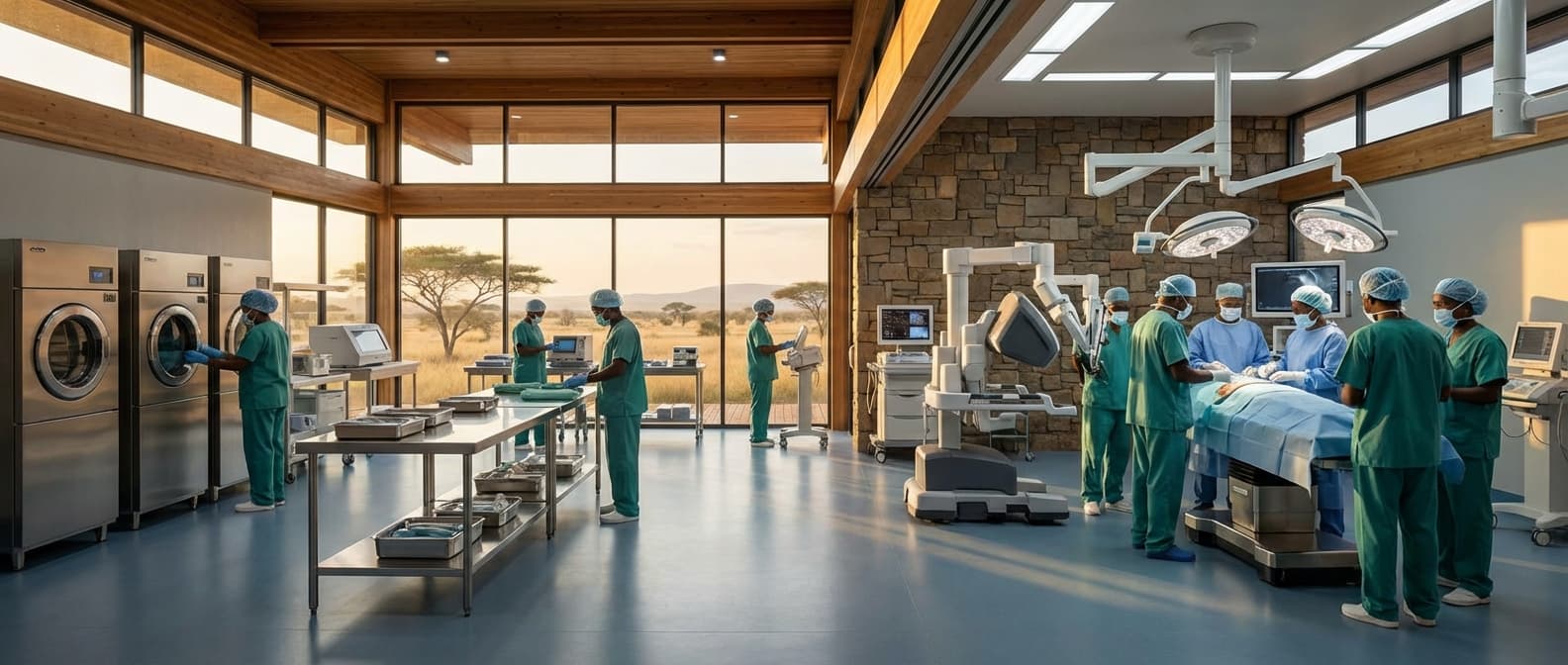
CSSD Design & Validation in Ghana
Engineering Excellence & Technical Support
CSSD workflow design, validation and process development High-standard technical execution following OEM protocols and local regulatory frameworks.
Advanced Sterilization Validation Protocols
Implementing rigorous and internationally recognized validation protocols (e.g., ISO 17665) for all sterilization methods, ensuring consistent and effective microbial inactivation. This includes detailed cycle development, performance qualification, and ongoing monitoring to guarantee patient safety and infection prevention in Ghanaian healthcare facilities.
Optimized CSSD Workflow Design
Designing and implementing lean workflow strategies within Central Sterile Supply Departments (CSSDs) tailored to the specific needs and constraints of Ghanaian hospitals. This focuses on maximizing efficiency, minimizing cross-contamination risks, and ensuring a seamless flow of instruments from decontamination to sterile storage, thereby enhancing operational effectiveness and resource utilization.
Data-Driven Performance Analytics
Establishing robust data collection and analysis systems to monitor key performance indicators (KPIs) within CSSD operations. This allows for proactive identification of trends, areas for improvement, and cost-effectiveness analysis, ensuring continuous enhancement of sterilization processes and compliance with regulatory standards in Ghana's evolving healthcare landscape.
What Is Cssd Design & Validation In Ghana?
Central Sterilization Supply Department (CSSD) design and validation in Ghana refers to the systematic planning, engineering, and verification of facilities and processes dedicated to the decontamination, sterilization, and sterile storage of reusable medical devices and equipment. This process ensures that instruments are rendered safe for patient use, adhering to international and national regulatory standards. The design phase involves conceptualizing the physical layout, workflow, equipment selection, and environmental controls (e.g., HVAC, water treatment, air filtration) necessary for efficient and safe operation. Validation is a critical, documented process demonstrating that the designed CSSD consistently performs according to predetermined specifications and quality attributes. This includes process validation (e.g., steam sterilization cycles, washer-disinfector efficacy), equipment qualification (IQ, OQ, PQ), and environmental monitoring.
| Who Needs CSSD Design & Validation? | Typical Use Cases | ||||
|---|---|---|---|---|---|
| Hospitals (Public and Private): All healthcare facilities performing surgical procedures, invasive diagnostics, or requiring sterile instrumentation. | Establishment of new hospital wings or surgical theatres requiring dedicated sterilization capacity. | Upgrading or expanding existing CSSD facilities to meet increased demand or regulatory changes. | Renovation or relocation of a CSSD to optimize workflow and enhance safety. | Introduction of new types of medical devices or sterilization technologies. | |
| Specialty Clinics (e.g., Dental, Ophthalmology, Endoscopy Centers): Facilities that sterilize their own instruments. | Ensuring compliance with infection prevention and control guidelines. | Improving the efficiency and throughput of sterilization processes. | Reducing the risk of healthcare-associated infections (HAIs) related to inadequate sterilization. | Obtaining accreditation or certification for healthcare facilities. | Commissioning of new medical equipment to be used in sterile environments. |
Key Components of CSSD Design & Validation
- Facility Layout and Workflow Optimization: Designing for unidirectional flow to prevent cross-contamination, appropriate zoning (dirty, clean, sterile), and efficient material handling.
- Equipment Specification and Selection: Identifying and sourcing appropriate sterilizers (steam, low-temperature), washer-disinfectors, ultrasonic cleaners, packaging systems, and monitoring devices.
- Environmental Control Systems: Implementing robust HVAC systems for controlled temperature, humidity, and air changes, along with purified water systems.
- Sterilization Process Validation: Documented evidence that sterilization cycles achieve the required sterility assurance level (SAL) for various device types and materials.
- Equipment Qualification (IQ, OQ, PQ): Installation Qualification (IQ) verifies correct installation, Operational Qualification (OQ) confirms the equipment operates within specified parameters, and Performance Qualification (PQ) demonstrates consistent performance under actual operating conditions.
- Routine Monitoring and Quality Control: Establishing protocols for daily, weekly, and periodic monitoring of sterilization processes and equipment functionality.
- Regulatory Compliance: Ensuring adherence to Ghanaian healthcare regulations, international standards (e.g., ISO 13485, ISO 17665, AAMI ST series), and best practices.
Who Needs Cssd Design & Validation In Ghana?
Central Sterile Supply Departments (CSSDs) are critical for infection control and patient safety within any healthcare facility. Proper design and validation of these departments are paramount to ensure the effective and safe sterilization of medical instruments and equipment. In Ghana, as healthcare infrastructure continues to develop and patient care standards rise, the need for expertly designed and validated CSSDs becomes increasingly pronounced. This ensures that sterilization processes meet international best practices and local regulatory requirements, thereby minimizing healthcare-associated infections (HAIs) and improving patient outcomes.
| Customer Segment | Key Needs Addressed by CSSD Design & Validation | Specific Departments Benefiting Most |
|---|---|---|
| Public Hospitals | Ensuring consistent infection control across multiple departments, handling high patient volumes, compliance with national health standards, cost-effectiveness through efficient workflow. | Operating Theatres, ED, ICUs, OPDs, Maternity. |
| Private Hospitals & Clinics | Enhancing patient trust and reputation, meeting international accreditation standards, optimizing space utilization, ensuring efficient turnaround of instruments for high patient throughput. | Operating Theatres, Specialty Clinics, Dental Clinics, Day Surgery Units. |
| Government Health Agencies | Setting national standards for sterile processing, overseeing quality control in public health facilities, developing guidelines and training programs. | All public health facilities, CSSD training centers. |
| NGOs & Medical Training Institutions | Establishing safe clinical environments, providing practical training facilities for healthcare professionals, ensuring ethical patient care. | Clinical training wards, laboratories, field clinics. |
| Specialty Hospitals | Meeting the specific sterilization requirements for specialized instruments and procedures, ensuring sterility of complex devices. | Operating Theatres, specialized procedural units (e.g., cardiac catheterization labs, orthopedic surgery). |
Who Needs CSSD Design & Validation in Ghana? Target Customers & Departments
- {"items":["Public Hospitals (e.g., Korle-Bu Teaching Hospital, Komfo Anokye Teaching Hospital)","Private Hospitals and Clinics (all sizes)","Specialty Hospitals (e.g., maternity, eye, orthopedic)","Government Health Agencies and Ministries","Non-Governmental Organizations (NGOs) involved in healthcare provision","Medical Training Institutions with clinical facilities","Research Institutions with laboratory facilities requiring sterilization"],"title":"Target Customers"}
- {"items":["Operating Theatres/Surgical Wards","Intensive Care Units (ICUs)","Emergency Departments","Outpatient Departments (OPDs) with procedural areas","Dental Clinics","Maternity Wards","Specialized Clinics (e.g., Endoscopy, Dialysis)","Infection Prevention and Control (IPC) Departments","Medical Records and Administration (for compliance and operational oversight)"],"title":"Key Departments Requiring CSSD Integration & Support"}
Cssd Design & Validation Process In Ghana
Designing and validating a Central Sterile Services Department (CSSD) in Ghana involves a structured process that ensures compliance with national and international standards for infection prevention and control. This workflow typically begins with an initial inquiry from a healthcare facility and culminates in a fully operational and validated CSSD. The process emphasizes meticulous planning, adherence to regulatory requirements, and rigorous testing to guarantee the safety and efficacy of sterilized medical equipment.
| Stage | Key Activities | Deliverables/Outcomes | Responsible Parties | Timeline (Indicative) |
|---|---|---|---|---|
| Healthcare facility expresses interest, outlines requirements (e.g., capacity, services). Initial consultation to understand existing infrastructure, patient volume, and specific needs. | Project brief, initial understanding of scope and budget. | Healthcare Facility Management, Potential CSSD Consultants/Suppliers. | 1-2 Weeks |
| On-site assessment of the proposed location for the CSSD. Evaluation of space, utilities (water, power, ventilation), structural integrity, and potential workflow challenges. Assessment of regulatory compliance requirements in Ghana (e.g., Ministry of Health guidelines, Ghana Standards Authority). | Feasibility report, identification of site constraints and opportunities, preliminary budget estimation. | CSSD Consultants, Biomedical Engineers, Architects. | 2-4 Weeks |
| Development of preliminary layouts based on workflow principles (dirty to clean). Zoning of the CSSD (receiving, cleaning, disinfection, packaging, sterilization, storage, dispatch). Consideration of traffic flow and segregation of contaminated and sterile items. Adherence to Good Manufacturing Practices (GMP) principles. | Conceptual floor plans, workflow diagrams, preliminary equipment list. | CSSD Consultants, Architects. | 3-5 Weeks |
| Development of detailed architectural, mechanical, electrical, and plumbing (MEP) drawings. Specification of materials, finishes, and environmental controls (temperature, humidity, air changes). Selection of appropriate sterilization technologies (e.g., autoclaves, low-temperature sterilizers). | Detailed design drawings, engineering specifications, bill of quantities (BoQ). | Architects, MEP Engineers, CSSD Consultants. | 6-10 Weeks |
| Tendering process for construction and equipment. Selection of validated and compliant sterilization equipment and associated accessories. Ensuring suppliers have local support and spare parts availability. | Procurement contracts for construction and equipment, finalized equipment list with specifications. | Healthcare Facility Procurement Department, CSSD Consultants. | 8-12 Weeks |
| Implementation of the detailed design. Construction of the CSSD space, installation of utilities, and finishing. Ensuring compliance with building codes and infection control standards. | Completed CSSD infrastructure. | Construction Contractor, Project Manager. | 12-24 Weeks (depending on scale) |
| Installation of all CSSD equipment (sterilizers, washer-disinfectors, packaging machines, etc.). Initial testing of equipment to ensure proper functioning according to manufacturer specifications. | Installed and powered-on equipment, initial equipment test reports. | Equipment Suppliers, Biomedical Engineers. | 4-8 Weeks |
| Crucial stage to ensure the CSSD meets all performance and safety standards. Includes Installation Qualification (IQ), Operational Qualification (OQ), and Performance Qualification (PQ). Testing of sterilization cycles with biological and chemical indicators. Validation of cleaning and disinfection processes. | Validation reports (IQ, OQ, PQ), calibration certificates, documented proof of effective sterilization. | Validation Engineers, Biomedical Engineers, Infection Preventionists. | 6-10 Weeks |
| Comprehensive training for CSSD staff on equipment operation, decontamination procedures, sterile processing techniques, documentation, and infection control protocols. Assessment of staff competency. | Trained and competent CSSD staff, training records. | Equipment Suppliers, CSSD Consultants, Infection Preventionists. | 2-4 Weeks |
| Official launch of the CSSD. Implementation of standard operating procedures (SOPs). Establishment of a robust quality management system for ongoing monitoring, documentation, and periodic re-validation of equipment and processes. Regular audits and continuous improvement. | Fully operational CSSD, established SOPs, quality management system in place, regular audit reports. | CSSD Manager, Healthcare Facility Management, Infection Prevention and Control Team. | Ongoing |
CSSD Design & Validation Process Workflow in Ghana
- Inquiry & Needs Assessment
- Site Survey & Feasibility Study
- Conceptual Design & Space Planning
- Detailed Design & Engineering
- Procurement & Equipment Selection
- Construction & Renovation
- Installation & Commissioning
- Validation & Performance Testing
- Training & Staff Competency
- Operationalization & Ongoing Monitoring
Cssd Design & Validation Cost In Ghana
The cost of designing and validating a Central Sterile Supply Department (CSSD) in Ghana is a significant investment, influenced by a multitude of factors. These costs can fluctuate considerably based on the size of the facility, the complexity of the design, the specific validation protocols required, and the expertise of the chosen service providers. Understanding these pricing drivers is crucial for accurate budgeting and planning in Ghanaian healthcare institutions. Key considerations include the scope of services (e.g., a new build versus a renovation), the required level of automation in the CSSD equipment, and the adherence to international and local regulatory standards. Furthermore, the geographical location within Ghana can also play a role due to varying logistical costs and the availability of specialized personnel.
| Service Component | Estimated Cost Range (GHS) | Notes |
|---|---|---|
| CSSD Design & Architectural Services | 25,000 - 150,000+ | Highly dependent on facility size and complexity. Includes layout, workflow, MEP (Mechanical, Electrical, Plumbing) integration. |
| CSSD Equipment Procurement (Excluding Installation) | 200,000 - 1,000,000+ | Varies greatly based on the number, type, and brand of sterilizers, washer-disinfectors, and related equipment. International brands will generally be more expensive. |
| Equipment Installation & Commissioning | 50,000 - 250,000+ | Includes setting up and initial testing of procured equipment. May be bundled with equipment purchase. |
| Validation Services (IQ, OQ, PQ) | 60,000 - 300,000+ | Comprehensive validation is critical. Cost depends on the number of equipment units and the depth of testing required. Often performed by specialized external companies. |
| Project Management & Consultancy | 30,000 - 100,000+ | For overseeing the entire project lifecycle, ensuring timelines and budgets are met. |
| Training of CSSD Staff | 15,000 - 50,000+ | Essential for proper operation and maintenance of the CSSD. |
| Contingency (10-15% of total) | Highly Variable | Recommended to cover unexpected costs. |
| Total Estimated Project Cost (for a medium-sized facility) | 380,000 - 1,850,000+ | This is a broad estimate. Actual costs can be significantly higher for larger, more complex, or high-end installations. |
Key Pricing Factors for CSSD Design & Validation in Ghana
- Facility Size and Capacity (Number of Beds/Surgical Suites)
- Scope of Work (New Build vs. Renovation)
- Complexity of Design and Workflow
- Type and Quantity of CSSD Equipment (Sterilizers, Washer-Disinfectors, Packaging Systems)
- Level of Automation Required
- Integration with Existing Hospital Infrastructure
- Adherence to International Standards (e.g., ISO 13485, AAMI ST79)
- Adherence to Local Regulatory Requirements (e.g., Ministry of Health guidelines)
- Validation Protocol Scope (IQ, OQ, PQ)
- Selection of Design Consultants and Engineers
- Selection of Validation Service Providers
- Cost of Materials and Construction (for new builds/renovations)
- Logistics and Transportation Costs within Ghana
- Contingency Planning and unforeseen expenses
Affordable Cssd Design & Validation Options
Designing and validating a Central Sterile Supply Department (CSSD) is crucial for patient safety and operational efficiency. Fortunately, there are numerous affordable options available that don't compromise on quality. This guide explores value bundles and cost-saving strategies to help facilities achieve optimal CSSD functionality within budget constraints. We will look at how to leverage standardized processes, smart technology choices, and phased implementation to maximize value.
| Value Bundle/Strategy | Description | Cost-Saving Impact | Validation Benefits |
|---|---|---|---|
| Standardized Workflow & Protocol Bundle | Pre-defined, evidence-based workflows for cleaning, disinfection, and sterilization, coupled with standardized documentation and training materials. | Reduces the need for custom process development, training time, and potential for errors. Streamlines equipment purchasing by defining specific needs. | Ensures consistent adherence to regulatory requirements, simplifying validation processes and demonstrating compliance. |
| Modular Equipment Package | Bundled acquisition of essential modular equipment (e.g., washer-disinfectors, sterilizers, instrument trays) from a single vendor, often with pre-negotiated pricing. | Volume discounts, reduced shipping and installation costs, and simplified procurement. Potential for leasing options. | Ensures equipment compatibility and facilitates easier validation of interconnected systems. Vendor support for validation can be included. |
| Basic IT Integration Bundle | Cost-effective software solutions for instrument tracking, inventory management, and cycle monitoring that can integrate with existing hospital IT infrastructure. | Avoids the expense of developing custom software or purchasing enterprise-level systems. Reduces manual data entry and potential for loss. | Provides robust data for validation reports, audit trails, and performance monitoring, ensuring traceability and compliance. |
| Phased Validation & Commissioning Services | Engaging validation specialists for initial commissioning and then establishing a plan for ongoing validation of equipment and processes in stages. | Spreads validation costs over time, allowing for better budget management. Focuses validation efforts on critical areas first. | Ensures that each implemented phase meets validation requirements before moving to the next, building confidence and reducing the risk of major rework. |
| Refurbished/Certified Pre-Owned Equipment Strategy | Purchasing high-quality, refurbished, and certified pre-owned CSSD equipment from reputable suppliers. | Significant capital expenditure savings compared to new equipment, often with warranties and service agreements. | Requires thorough verification of manufacturer specifications and service history during the validation process. May necessitate a more in-depth initial validation. |
| Internal Training & Development Program | Investing in comprehensive training for existing staff to manage and operate the CSSD, coupled with clear SOPs. | Reduces reliance on external training consultants and can improve staff retention and expertise. | A well-trained workforce is fundamental for consistent process execution, a cornerstone of successful and ongoing validation. |
Key Considerations for Affordable CSSD Design & Validation
- Standardization is Key: Implementing standardized workflows, cleaning protocols, and instrument tracking systems significantly reduces complexity and the need for bespoke, expensive solutions.
- Phased Implementation: Break down the CSSD project into manageable phases. Focus on essential equipment and functionalities first, and upgrade or expand as budget allows.
- Leverage Existing Infrastructure: Assess if any existing spaces or utilities can be adapted for the CSSD to minimize new construction or renovation costs.
- Smart Equipment Selection: Prioritize essential, reliable, and energy-efficient equipment. Consider refurbished or certified pre-owned equipment from reputable suppliers for significant savings.
- Modular Design Principles: Opt for modular components that can be easily reconfigured or expanded, offering flexibility and future-proofing your investment.
- Efficient Workflow Planning: Invest time in optimizing the layout and workflow to minimize instrument transit times, staff movement, and potential for errors.
- Training & Education: Well-trained staff are more efficient and less prone to errors, which can prevent costly rework or reprocessing.
- Validation as a Process, Not a One-Time Event: Integrate validation into the design and commissioning phases, and establish ongoing validation protocols to ensure continued compliance and efficacy.
- Technology Integration (Smartly): Explore cost-effective IT solutions for tracking, inventory management, and reporting that integrate with existing hospital systems where possible.
Verified Providers In Ghana
In Ghana's evolving healthcare landscape, identifying reliable and trustworthy medical providers is paramount for individuals seeking quality care. Verified providers offer a crucial layer of assurance, guaranteeing adherence to established standards of practice, ethical conduct, and patient safety. Franance Health stands out as a premier platform dedicated to credentialing and promoting these distinguished healthcare professionals. This commitment to rigorous vetting ensures that when you choose a provider listed through Franance Health, you are selecting from a pool of highly qualified and reputable practitioners. Their comprehensive credentialing process examines educational qualifications, professional experience, licensing, and adherence to best practices, making them the discerning choice for your healthcare needs in Ghana.
| Credentialing Area | Franance Health Verification Standard | Benefit to Patient |
|---|---|---|
| Educational Qualifications | Verified degrees, diplomas, and certifications from accredited institutions. | Ensures a strong theoretical and practical foundation in their medical specialty. |
| Professional Experience | Thorough review of work history, including years of practice and specialized experience. | Guarantees practical application of knowledge and proven expertise. |
| Licensing and Registration | Confirmation of valid and current licenses with relevant Ghanaian medical boards. | Confirms legal authorization to practice and adherence to regulatory requirements. |
| Continuing Professional Development (CPD) | Assessment of ongoing training and commitment to staying current with medical advancements. | Indicates a dedication to continuous learning and updated medical knowledge. |
| Professional References | Contact with peers and supervisors to assess performance and character. | Provides an objective evaluation of the provider's skills and professional conduct. |
Why Franance Health Credentials Represent the Best Choice:
- Rigorous Vetting Process: Franance Health employs a stringent verification methodology, scrutinizing every aspect of a provider's qualifications and experience.
- Commitment to Quality and Safety: Our credentials signify a provider's dedication to upholding the highest standards of medical care and patient safety.
- Ethical Practice Assurance: We ensure that our listed providers adhere to strict ethical guidelines, promoting trust and transparency in healthcare.
- Access to Top-Tier Professionals: By choosing a Franance Health verified provider, you gain access to some of Ghana's most skilled and reputable healthcare professionals.
- Peace of Mind: Our verification process provides an invaluable sense of security, allowing you to focus on your health rather than on provider assessment.
Scope Of Work For Cssd Design & Validation
This Scope of Work (SOW) outlines the design and validation requirements for a Central Sterile Supply Department (CSSD). It details the technical deliverables and the standard specifications that will govern the project. The objective is to ensure a functional, efficient, safe, and compliant CSSD that meets all relevant regulatory standards and operational needs.
| Category | Standard/Specification | Description |
|---|---|---|
| Facility Design & Layout | HTM 01-01 (UK) | Guidance on the decontamination, disinfection and sterilization of medical equipment. |
| Facility Design & Layout | AAMI ST59 (USA) | Medical Device Reprocessing – Sterilization. |
| Facility Design & Layout | ISO 14971 | Medical devices — Application of risk management to medical devices. |
| Equipment | IEC 61010 | Safety requirements for electrical equipment for measurement, control, and laboratory use. |
| Equipment | ISO 13485 | Medical devices — Quality management systems — Requirements for regulatory purposes. |
| Equipment | Manufacturer's Specifications | Specific performance and operational requirements for each piece of equipment. |
| Validation | FDA Guidance (USA) | Guidance for Industry on Process Validation. |
| Validation | ISPE Baseline Guide (various volumes) | Industry best practices for validation of pharmaceutical manufacturing processes and equipment. |
| Ventilation | ASHRAE Standards | Standards for HVAC systems, including air change rates and pressure differentials for healthcare facilities. |
| Water Quality | ISO 17665 | Sterilization of health care products — Moist heat — Requirements for the development, validation and routine control of a sterilization process for medical devices. |
| Water Quality | ASTM D1193 | Standard Specification for Reagent Water. |
| Infection Control | CDC Guidelines (USA) | Guidelines for Infection Control in Healthcare Facilities. |
Technical Deliverables
- Detailed CSSD Layout and Flow Diagrams
- Equipment Specification Sheets (including technical data, performance requirements, and utilities)
- Utility Requirements and Schematics (e.g., water, steam, electricity, drainage, ventilation)
- Material and Finishes Specifications
- Workflow and Process Documentation
- Validation Master Plan (VMP)
- Installation Qualification (IQ) Protocol and Report
- Operational Qualification (OQ) Protocol and Report
- Performance Qualification (PQ) Protocol and Report
- User Training Materials and Records
- As-Built Drawings
- Maintenance and Service Manuals
Service Level Agreement For Cssd Design & Validation
This Service Level Agreement (SLA) outlines the response times and uptime guarantees for CSSD (Central Sterile Supply Department) Design & Validation services provided by [Your Company Name] to [Client Company Name]. This SLA is effective from [Start Date] to [End Date].
| Service Component | Response Time (Business Hours) | Uptime Guarantee |
|---|---|---|
| Design Consultation & Initial Review | 4 Business Hours | N/A (Service is project-based) |
| Design Modifications & Revisions | 8 Business Hours | N/A (Service is project-based) |
| Validation Protocol Development | 2 Business Days | N/A (Service is project-based) |
| Validation Execution Support | 1 Business Day (for scheduled on-site support) | N/A (Service is project-based) |
| Post-Validation Support & Troubleshooting | 4 Business Hours (for critical issues) | N/A (Service is project-based) |
| Documentation Review & Feedback | 3 Business Days | N/A (Service is project-based) |
| General Inquiries & Technical Support | 2 Business Hours | 99.5% |
Scope of Services
- Design consultation and development for CSSD layouts and workflows.
- Validation of CSSD equipment and processes against relevant standards (e.g., ISO 13485, AAMI ST standards).
- Documentation review and creation for CSSD operations.
- Training and support for CSSD staff on designed and validated processes.
Frequently Asked Questions

Ready when you are
Let's scope your CSSD Design & Validation in Ghana project in Ghana.

Scaling healthcare logistics and technical systems across the entire continent.