
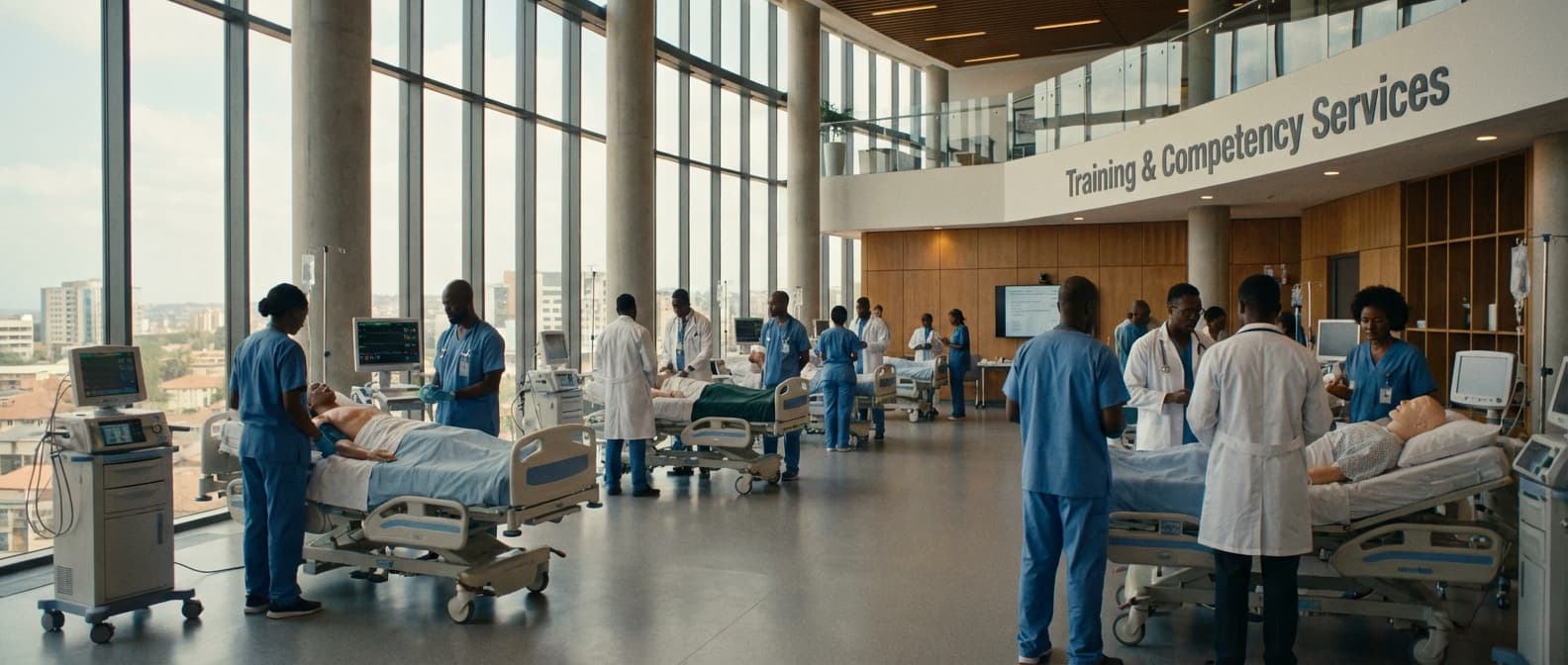
Ventilator User Training Service (Nurses) in Gambia
Engineering Excellence & Technical Support
Ventilator User Training Service (Nurses) High-standard technical execution following OEM protocols and local regulatory frameworks.
Mastering Ventilator Controls
Gain confidence in navigating and adjusting critical ventilator settings, including modes (e.g., AC, SIMV), tidal volume, respiratory rate, PEEP, and FiO2, ensuring optimal patient ventilation in diverse clinical scenarios.
Effective Alarm Management & Troubleshooting
Learn to identify, interpret, and respond promptly to common ventilator alarms. Develop systematic troubleshooting skills to address circuit leaks, disconnects, and physiological changes, maintaining patient safety and uninterrupted therapy.
Integrated Patient Monitoring & Assessment
Understand how to correlate ventilator data (waveforms, numerical values) with patient clinical signs and symptoms. Develop the ability to assess patient response to ventilation and make informed adjustments for improved outcomes.
What Is Ventilator User Training Service (Nurses) In Gambia?
Ventilator User Training Service (Nurses) in Gambia refers to the structured educational programs designed to equip registered nurses and other qualified nursing personnel with the essential knowledge and practical skills required for the safe and effective operation of mechanical ventilators within the Gambian healthcare system. This service is critical for ensuring optimal patient outcomes in critical care settings where respiratory support is a necessity. The training focuses on understanding ventilator principles, operation, monitoring, troubleshooting, and patient management protocols specific to the equipment available and common clinical scenarios encountered in The Gambia.
| Who Needs It? | Typical Use Cases | ||||
|---|---|---|---|---|---|
| Registered Nurses working in Intensive Care Units (ICUs), High Dependency Units (HDUs), and Emergency Departments. | Management of patients with acute respiratory failure (e.g., due to severe pneumonia, sepsis, trauma, drowning, anaphylaxis). | Post-operative patients requiring mechanical ventilation for respiratory support. | Patients with exacerbations of chronic respiratory diseases (e.g., COPD, asthma) requiring invasive ventilation. | Facilitation of safe and timely weaning from mechanical ventilation. | Emergency response situations requiring immediate respiratory support. |
| Nurse Anesthetists (where applicable in the Gambian context). | Midwives and nurses in specialized neonatal or pediatric units managing ventilated neonates and children. | Healthcare professionals involved in the transport of critically ill patients requiring mechanical ventilation. | Respiratory therapists (if present and integrated into the care team). |
Components of Ventilator User Training Service (Nurses) in Gambia
- Fundamental principles of mechanical ventilation (e.g., modes, breath types, pressure vs. volume control).
- Anatomy and physiology of the respiratory system relevant to mechanical ventilation.
- Detailed operational procedures for specific ventilator models commonly used in Gambian hospitals.
- Setting up and initiating mechanical ventilation: pre-use checks, patient connection, initial parameter selection.
- Monitoring patient response to ventilation: physiological parameters (SpO2, EtCO2, hemodynamics), ventilator waveforms, and alarm interpretation.
- Ventilator management strategies: weaning protocols, lung-protective ventilation, management of specific respiratory conditions (e.g., ARDS, pneumonia, COPD exacerbations).
- Troubleshooting common ventilator malfunctions and patient-ventilator dyssynchrony.
- Infection control practices related to ventilator use and circuit management.
- Emergency procedures and escalation protocols.
- Documentation of ventilator settings, patient response, and interventions.
Who Needs Ventilator User Training Service (Nurses) In Gambia?
This service targets nurses in The Gambia who require training on the operation and maintenance of ventilators. Effective ventilator management is crucial for patient care, and this training ensures healthcare professionals are competent and confident in using these life-support devices.
| Department/Setting | Specific Needs Addressed |
|---|---|
| Intensive Care Units (ICUs) | Management of critically ill patients requiring mechanical ventilation for respiratory failure, sepsis, trauma, etc. |
| High Dependency Units (HDUs) / Step-Down Units | Transitioning patients from full mechanical ventilation, weaning protocols, and managing patients requiring less intensive but still critical respiratory support. |
| Emergency Departments (EDs) | Initial stabilization and management of patients with acute respiratory distress, requiring rapid ventilator setup and operation. |
| Operating Theatres (ORs) | Anesthesia support and post-operative respiratory management, including the use of ventilators during and immediately after surgery. |
| Neonatal Intensive Care Units (NICUs) | Specialized training for ventilating premature infants and neonates with respiratory distress syndrome, congenital anomalies, etc. |
| Pediatric Wards / Units | Ventilator management for children with various respiratory illnesses and conditions. |
| Maternal and Child Health Facilities (with critical care capabilities) | Management of obstetric emergencies leading to respiratory failure and postnatal care for newborns requiring respiratory support. |
| COVID-19 Treatment Centers / Isolation Units | Specific training on ventilator use for COVID-19 patients experiencing severe respiratory complications. |
Target Customers and Departments
- {"item":"Registered Nurses (RNs)"}
- {"item":"Enrolled Nurses (ENs)"}
- {"item":"Midwives (especially those working in neonatal or critical care settings)"}
- {"item":"Nurse Managers and Supervisors"}
Ventilator User Training Service (Nurses) Process In Gambia
This document outlines the workflow for the Ventilator User Training Service specifically for nurses in The Gambia, from the initial inquiry to the successful execution of the training. The process is designed to be systematic and ensure that nurses receive comprehensive and practical training on ventilator operation and management.
| Stage | Description | Key Activities | Responsible Party |
|---|---|---|---|
| Inquiry & Needs Assessment | Initiation of the training request and understanding the specific requirements. | Receiving inquiry, initial consultation, site visit (if applicable), determining number of trainees, existing equipment, and skill gaps. | Requesting Institution, Training Provider |
| Proposal Development & Agreement | Creating a detailed plan for the training and formalizing the commitment. | Developing training curriculum, methodology, duration, resource requirements, costing, submitting proposal, negotiation, contract/agreement signing. | Training Provider, Requesting Institution |
| Scheduling & Preparation | Organizing the logistical aspects of the training. | Finalizing training dates and venue, distributing pre-training materials, preparing equipment and simulators. | Training Provider, Requesting Institution |
| Training Execution | Delivering the comprehensive ventilator training. | Conducting theoretical sessions, practical demonstrations, hands-on practice, troubleshooting exercises, case studies. | Training Provider (Trainers) |
| Assessment & Certification | Evaluating the learning outcomes and formally recognizing completion. | Administering quizzes, practical assessments, case study evaluations, issuing certificates. | Training Provider |
| Post-Training Support & Feedback | Providing ongoing assistance and gathering insights for improvement. | Answering follow-up queries, providing access to resources, collecting feedback from trainees and institution. | Training Provider, Requesting Institution |
Ventilator User Training Service (Nurses) Process in Gambia
- The process begins with an official inquiry from a healthcare institution or nursing body in The Gambia requesting ventilator user training for their nurses.
- Upon receiving the inquiry, the training provider assesses the specific needs of the requesting institution, including the number of nurses to be trained, their current skill level, the types of ventilators in use, and any specific training objectives.
- A training proposal is developed, outlining the curriculum, duration, methodology (e.g., theoretical sessions, practical demonstrations, hands-on simulations), required resources, trainers' qualifications, and associated costs.
- The proposal is submitted to the requesting institution for review and approval. Negotiations may occur to finalize the scope and terms of the training.
- Once the proposal is approved and a contract or agreement is signed, a training schedule is mutually agreed upon, considering the availability of nurses and facilities.
- Pre-training materials, if any, are distributed to the nurses to allow for preliminary familiarization with basic concepts.
- The training is delivered according to the agreed-upon schedule and curriculum. This typically involves theoretical lectures covering ventilator principles, modes, settings, patient monitoring, and troubleshooting, followed by hands-on practical sessions using actual ventilator equipment or advanced simulators.
- Assessment of learning occurs throughout the training, including quizzes, practical skill demonstrations, and case study analyses. A final evaluation is conducted to gauge the nurses' comprehension and proficiency.
- Upon successful completion of the training and evaluation, certificates of attendance and/or competency are issued to the nurses.
- Post-training support, such as a grace period for follow-up questions or access to online resources, may be provided.
- A feedback mechanism is implemented to gather input from both the nurses and the training institution to evaluate the effectiveness of the training and identify areas for improvement in future programs.
Ventilator User Training Service (Nurses) Cost In Gambia
Providing ventilator user training services for nurses in The Gambia is crucial for enhancing critical care capacity. The cost of such training is influenced by several factors, leading to a range of pricing. Understanding these factors is essential for healthcare institutions and organizations planning to invest in this vital professional development.
| Training Package Description | Estimated Price Range (GMD) | Key Inclusions |
|---|---|---|
| Basic Ventilator Operator Training (1-2 days) | 5,000 - 15,000 GMD | Introduction to ventilator principles, basic modes, patient connection, alarm management. Manuals, instructor-led sessions. |
| Intermediate Ventilator Management (3-4 days) | 12,000 - 30,000 GMD | Covers basic modes plus advanced settings, weaning protocols, ABG interpretation, troubleshooting. Simulations, case studies, potentially certification exam. |
| Advanced Ventilator & Critical Care Support (5+ days) | 25,000 - 60,000+ GMD | Comprehensive training on complex modes, specialized ventilation (e.g., HFOV, NIV), hemodynamics, ECMO basics, high-fidelity simulation. Expert trainers, extensive resources, certification. |
| Refresher/Update Training (1 day) | 3,000 - 8,000 GMD | Focus on specific updates, common challenges, or recent guideline changes. Shorter duration, targeted content. |
| Customized On-Site Training (Per Day/Cohort) | Negotiable (depending on scope and participants) | Tailored curriculum, on-site delivery, equipment utilization. Costs vary based on duration, number of participants, and specific requirements. |
Factors Influencing Ventilator User Training Cost in The Gambia:
- Training Provider: The expertise, reputation, and operational costs of the training provider significantly impact pricing. Local healthcare training institutions, international NGOs, or specialized medical training companies will have different fee structures.
- Duration and Depth of Training: A comprehensive, multi-day course covering theoretical aspects, hands-on simulation, and practical application on various ventilator models will naturally cost more than a shorter, introductory session.
- Number of Participants: Group discounts are often available. Training larger cohorts might reduce the per-nurse cost, but the overall expenditure will be higher.
- Training Modalities: In-person training with hands-on equipment and instructor-led sessions will typically be more expensive than online modules or blended learning approaches. The need for specialized simulation equipment also adds to the cost.
- Curriculum Content: The complexity and specificity of the curriculum are key. Training on basic ventilator management will differ in cost from advanced modes, troubleshooting, and specific patient populations (e.g., pediatrics, neonates).
- Trainer Qualifications and Travel: The experience and credentials of the trainers are paramount. If trainers need to travel to different regions within The Gambia or internationally, their travel, accommodation, and per diem expenses will be factored into the overall cost.
- Training Materials and Resources: The provision of high-quality training manuals, case studies, access to online resources, and certification fees contributes to the total cost.
- Location of Training: If training is conducted at the healthcare facility, costs might be lower than if participants need to travel to a dedicated training center. Venue rental, catering, and logistical support for off-site training add to the expense.
- Certification and Assessment: If the training culminates in a recognized certification, there are often associated costs for examination, grading, and certificate issuance.
- Equipment Access: The availability and maintenance of functional ventilators for hands-on practice are critical. If specialized simulation equipment needs to be rented or purchased, this will increase the training cost.
Affordable Ventilator User Training Service (Nurses) Options
This document outlines affordable ventilator user training service options specifically designed for nurses. We understand the critical need for well-trained healthcare professionals in operating and managing ventilators, especially in resource-constrained environments. Our aim is to provide accessible, high-quality training that enhances patient care while minimizing costs for healthcare facilities. We will explore value bundles, which combine multiple training components at a discounted rate, and present various cost-saving strategies.
| Value Bundle Name | Included Services | Target Audience | Estimated Cost Savings | Key Benefits |
|---|---|---|---|---|
| Basic Essentials Bundle | Core Ventilator Operation & Monitoring (Virtual)<br>Ventilator Maintenance & Infection Control (Virtual) | Newly graduated nurses, nurses new to critical care | 15-20% compared to individual modules | Foundational knowledge, cost-effective for onboarding |
| Critical Care Proficiency Bundle | Core Ventilator Operation & Monitoring (Virtual)<br>Advanced Ventilator Techniques & Troubleshooting (Virtual)<br>Ventilator Maintenance & Infection Control (Virtual) | Experienced critical care nurses, nurses transitioning to critical care | 20-25% compared to individual modules | Comprehensive skill development, improved patient management |
| Facility-Wide Impact Bundle | Core Ventilator Operation & Monitoring (On-Site for X staff)<br>Advanced Ventilator Techniques & Troubleshooting (Virtual for Y staff)<br>Ventilator Maintenance & Infection Control (On-Site workshop) | Entire nursing staff of a unit or department | Negotiable based on staff numbers and customization | Standardized training, improved team competency, on-site practical reinforcement |
| Simulation Plus Bundle | Critical Care Proficiency Bundle + Simulation-Based Training Add-on (group sessions) | Nurses requiring advanced scenario practice, team-based critical response training | 10-15% on simulation component | Enhanced decision-making, improved response to emergencies |
Key Training Service Options & Value Propositions
- {"title":"Core Ventilator Operation & Monitoring Training","description":"Essential skills for safe and effective ventilator use. Covers basic modes, settings, patient interface, alarms, and troubleshooting."}
- {"title":"Advanced Ventilator Techniques & Troubleshooting","description":"For nurses seeking to deepen their expertise. Includes weaning protocols, lung-protective ventilation strategies, and complex alarm management."}
- {"title":"Ventilator Maintenance & Infection Control","description":"Crucial for equipment longevity and patient safety. Focuses on cleaning, disinfection, and preventative maintenance procedures."}
- {"title":"On-Site Training Workshops","description":"Hands-on training delivered at your facility, tailored to your specific equipment and protocols. Maximizes practical learning."}
- {"title":"Remote/Virtual Training Modules","description":"Flexible and cost-effective training delivered online. Ideal for theoretical knowledge acquisition and refreshers. Includes live Q&A sessions."}
- {"title":"Simulation-Based Training Add-on","description":"Utilizes high-fidelity simulators for realistic practice of critical scenarios without patient risk."}
Verified Providers In Gambia
In Gambia, ensuring access to reliable and high-quality healthcare is paramount. When seeking medical services, it's crucial to identify verified providers who demonstrate a commitment to excellence and patient well-being. Franance Health stands out as a leading organization in this regard. Their stringent credentialing process and dedication to upholding the highest standards make them the premier choice for individuals and families seeking trusted healthcare solutions in The Gambia.
| Franance Health Feature | Benefit to Patients in The Gambia | Why it Matters |
|---|---|---|
| Verified Provider Network | Access to a curated list of trusted doctors, clinics, and hospitals. | Reduces the risk of encountering unqualified practitioners and ensures quality care. |
| Strict Credentialing Standards | Assurance that healthcare providers have met rigorous qualifications and ethical guidelines. | Builds confidence in the competence and integrity of the medical professionals you choose. |
| Focus on Patient Outcomes | Emphasis on achieving positive health results and patient satisfaction. | Ensures your health concerns are addressed effectively and your experience is positive. |
| Streamlined Healthcare Access | Easier navigation and booking of appointments with verified specialists. | Saves time and reduces stress in seeking necessary medical attention. |
| Commitment to Ethical Practice | Upholding the highest moral and professional standards in healthcare delivery. | Guarantees respectful and honest treatment throughout your healthcare journey. |
Why Franance Health is the Best Choice:
- Rigorous Verification Process: Franance Health employs a comprehensive vetting system to ensure all affiliated healthcare professionals and facilities meet strict quality and ethical benchmarks.
- Commitment to Patient Safety: Patient well-being and safety are at the forefront of Franance Health's operations, with a focus on best practices and continuous improvement.
- Access to Top Medical Professionals: Through their network, Franance Health connects patients with highly qualified and experienced doctors, specialists, and healthcare providers across various disciplines.
- Transparent and Accessible Services: Franance Health prioritizes clear communication and easy access to healthcare services, demystifying the process for patients.
- Dedication to Healthcare Advancement: Franance Health actively contributes to the improvement of healthcare infrastructure and services within The Gambia.
- Patient-Centric Approach: Their philosophy revolves around understanding and meeting individual patient needs with empathy and personalized care.
Scope Of Work For Ventilator User Training Service (Nurses)
This Scope of Work outlines the requirements for providing comprehensive ventilator user training services specifically tailored for registered nurses. The training aims to equip nurses with the knowledge and practical skills necessary to safely and effectively operate and manage ventilators in various clinical settings, ensuring optimal patient care and safety.
| Section | Technical Deliverables | Standard Specifications / Requirements |
|---|---|---|
| Training Curriculum Development | Comprehensive training modules covering theoretical knowledge and practical skills. | Curriculum aligned with current evidence-based guidelines and manufacturer's operating manuals. Modules to include: Basics of Respiratory Physiology, Ventilator Components and Functionality, Modes of Ventilation (e.g., AC, SIMV, PSV, BiPAP), Initial Setup and Patient Connection, Monitoring and Assessment, Alarm Management and Troubleshooting, Weaning Principles and Protocols, Infection Control and VAP Prevention, Documentation, Special Populations (e.g., pediatrics, neonates if applicable). |
| Training Delivery Method | Blended learning approach incorporating classroom instruction, hands-on simulation, and e-learning components. | Classroom sessions conducted by qualified and experienced clinical educators or respiratory therapists. Hands-on simulation using high-fidelity manikins and actual or simulated ventilators. E-learning modules for pre-training preparation and post-training reinforcement, accessible via a designated learning management system (LMS). |
| Training Materials | Participant training manuals, presentation slides, case studies, and practical assessment checklists. | Materials to be clear, concise, up-to-date, and easily accessible (digital and/or print). Include visual aids and diagrams. Manuals to serve as a reference post-training. |
| Hands-on Simulation Sessions | Practical training sessions focused on ventilator setup, mode selection, parameter adjustments, and alarm response. | Minimum of X hours of dedicated hands-on simulation per nurse. Sessions to be conducted in a controlled environment simulating a clinical setting. Scenarios to include common and critical patient situations requiring ventilator management. |
| Competency Assessment | Written examination and practical skills assessment to evaluate knowledge and skill acquisition. | Written exam to assess theoretical understanding. Practical skills assessment to evaluate the ability to perform critical tasks such as ventilator setup, patient connection, mode selection, parameter adjustment, and alarm troubleshooting. A minimum passing score of XX% for both assessments. Retraining and re-assessment to be provided for unsuccessful participants. |
| Trainer Qualifications | Certified and experienced clinical educators or respiratory therapists with expertise in mechanical ventilation. | Trainers to possess relevant clinical experience, professional certifications (e.g., RRT, RN with specialized critical care certification), and demonstrated teaching abilities. Proof of qualifications to be provided upon request. |
| Training Schedule and Logistics | Organized training sessions accommodating nursing staff schedules. | Flexible scheduling to minimize disruption to clinical operations. Training to be conducted on-site at the healthcare facility or at an approved off-site location. Provision for adequate training space, equipment, and supplies. |
| Reporting and Documentation | Attendance records, assessment results, and completion certificates for all participants. | Detailed reports to be submitted to the designated healthcare facility representative within X business days of training completion. Certificates of completion to be provided to each nurse who successfully completes the training. |
| Post-Training Support | Access to a resource person or online forum for ongoing questions and clarifications. | Designated point of contact for post-training queries. Potential for follow-up sessions or refresher courses as deemed necessary. Access to updated training materials as available. |
| Equipment and Supplies | Provision of all necessary training ventilators (or access to facility's ventilators), consumables, and simulation equipment. | Training ventilators to be functional and representative of commonly used models in the facility. All necessary tubing, filters, masks, and other consumables for simulation. High-fidelity manikins or appropriate simulation tools. |
Objectives of the Ventilator User Training Service (Nurses)
- To ensure nurses understand the fundamental principles of mechanical ventilation.
- To enable nurses to correctly set up, initiate, and monitor ventilator settings for different patient populations and clinical conditions.
- To train nurses on recognizing and responding to common ventilator alarms and troubleshooting potential issues.
- To educate nurses on patient weaning protocols and strategies.
- To promote best practices in ventilator-associated pneumonia (VAP) prevention and infection control.
- To enhance nurses' confidence and competence in managing patients requiring mechanical ventilation.
- To ensure compliance with organizational policies and manufacturer guidelines.
Service Level Agreement For Ventilator User Training Service (Nurses)
This Service Level Agreement (SLA) outlines the response times and uptime guarantees for the Ventilator User Training Service specifically for nursing staff. It is designed to ensure timely and reliable access to training resources and support, minimizing disruption to patient care.
| Service Component | Response Time Target | Uptime Guarantee |
|---|---|---|
| Access to Online Training Modules & Resources | 1 hour (business hours) | 99.5% |
| Technical Support for Online Platform Issues | 2 business hours | 99.5% |
| Support for Simulator Access & Functionality (if applicable) | 4 business hours | 99.0% |
| Request for New/Updated Training Content | 5 business days (acknowledgement) | N/A (Content development is a separate process) |
Key Performance Indicators (KPIs)
- Response Time: The maximum time it takes for the Service Provider to acknowledge and begin addressing a reported issue or request for support.
- Uptime Guarantee: The percentage of time the Ventilator User Training Service is available and functional for nurses to access training materials, simulators, and online modules.
Frequently Asked Questions

Ready when you are
Let's scope your Ventilator User Training Service (Nurses) in Gambia project in Gambia.

Scaling healthcare logistics and technical systems across the entire continent.