
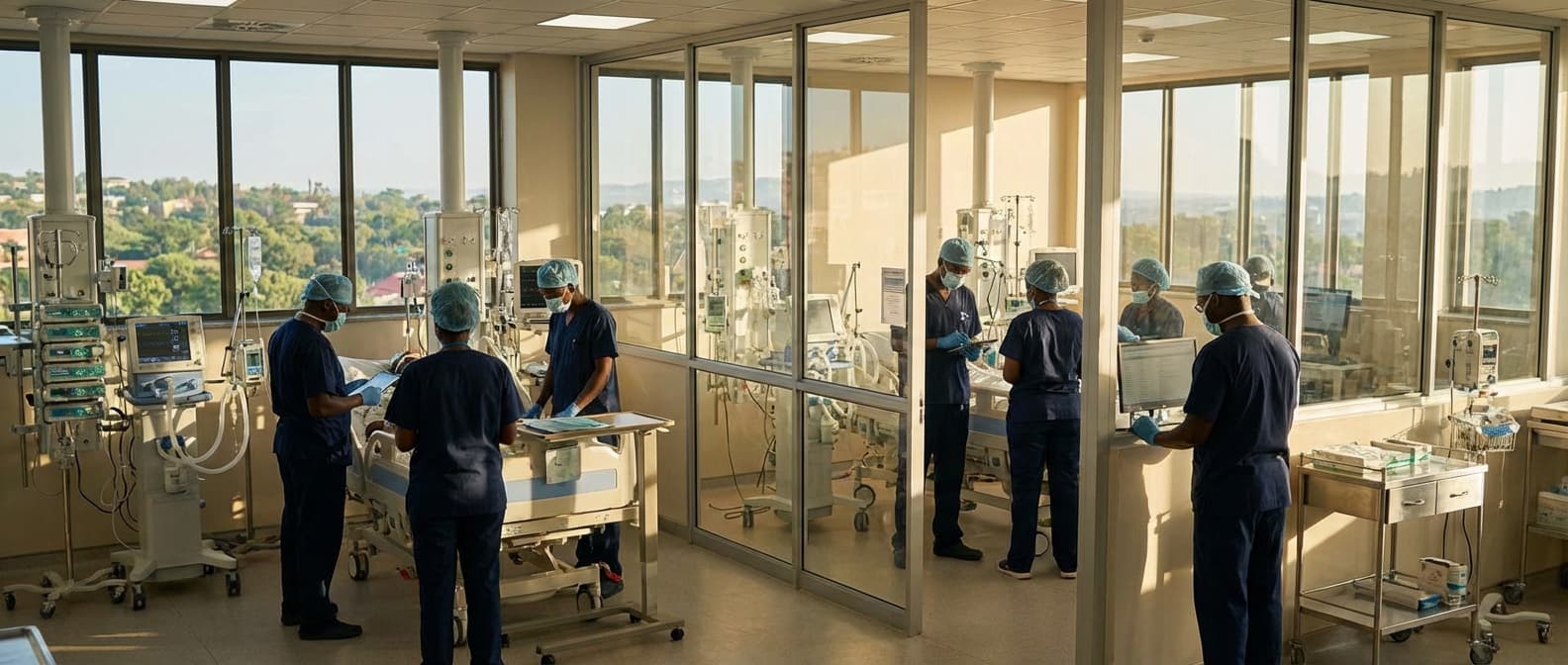
Ventilator Fleet Management & PM in Gambia
Engineering Excellence & Technical Support
Preventive maintenance and fleet management for ICU ventilators High-standard technical execution following OEM protocols and local regulatory frameworks.
Centralized Ventilator Fleet Tracking
Implemented a digital platform for real-time monitoring of all ventilators across Gambia, detailing location, status, maintenance history, and usage patterns. This enables efficient resource allocation and proactive identification of underutilized or critically needed equipment.
Predictive Maintenance Scheduling
Leveraging data analytics on historical performance and environmental factors, our system predicts potential equipment failures. This allows for scheduled preventive maintenance, minimizing downtime and ensuring critical ventilator availability during emergencies.
Remote Technical Support & Training Hub
Established a virtual hub providing remote diagnostic support and online training modules for biomedical engineers and technicians across Gambia. This empowers local staff with the latest skills for ventilator maintenance and repair, enhancing self-sufficiency and reducing reliance on external experts.
What Is Ventilator Fleet Management & Pm In Gambia?
Ventilator Fleet Management & Preventative Maintenance (PM) in The Gambia refers to the comprehensive programmatic and technical oversight of mechanical ventilator devices within healthcare facilities. This service encompasses the lifecycle management of these critical medical devices, from procurement and deployment to ongoing operational maintenance, calibration, repair, and eventual decommissioning. The objective is to ensure the continuous availability, reliability, and optimal performance of ventilators, thereby supporting patient care and improving health outcomes within the Gambian healthcare system. This involves a structured approach to inventory control, asset tracking, planned maintenance schedules, reactive repair services, and staff training. The service is crucial for maintaining a functional respiratory support infrastructure in a resource-constrained environment.
| Service Component | Description | Target Audience/Beneficiary | Typical Use Cases |
|---|---|---|---|
| Asset Inventory and Tracking | Systematic cataloging and monitoring of all ventilator devices. | Ministry of Health, Hospital Administrators, Biomedical Engineering Departments, Donor Organizations. | National health facility assessments, resource allocation planning, identifying underutilized or unserviceable assets, tracking device age and lifecycle. |
| Preventative Maintenance (PM) | Scheduled inspections, cleaning, lubrication, and calibration to ensure optimal function. | Healthcare Facilities (Hospitals, Clinics), Patients requiring mechanical ventilation, Biomedical Technicians. | Routine checks before patient use, scheduled quarterly or bi-annual PM, extending device lifespan, reducing unexpected failures during critical care. |
| Corrective Maintenance and Repair | Diagnosis and repair of malfunctioning ventilators. | Patients requiring immediate respiratory support, Clinical Staff facing device failure, Biomedical Technicians. | Responding to alarms indicating device malfunction, repairing ventilators in Intensive Care Units (ICUs), Emergency Departments, or during patient transport. |
| Staff Training | Educating clinical and technical staff on ventilator operation and maintenance. | Physicians, Nurses, Respiratory Therapists, Biomedical Engineering Technicians. | Onboarding new staff, refreshing existing staff knowledge, introducing new ventilator models, improving patient safety and device utilization. |
| Parts and Consumables Management | Ensuring availability of necessary spare parts and consumables. | Biomedical Engineering Departments, Procurement Units, Healthcare Facilities. | Stockpiling critical components for common failures, ensuring timely replacement of worn-out parts, facilitating rapid repairs. |
Key Components of Ventilator Fleet Management & PM in The Gambia
- Asset Inventory and Tracking: Establishing and maintaining a detailed registry of all ventilators, including make, model, serial number, acquisition date, location, and current operational status. This often involves the use of specialized software or databases.
- Preventative Maintenance (PM) Scheduling and Execution: Developing and implementing a systematic schedule for routine inspections, cleaning, lubrication, functional testing, and calibration of ventilators according to manufacturer specifications and best practices. This proactive approach aims to identify and address potential issues before they lead to device failure.
- Corrective Maintenance and Repair: Providing timely and effective diagnosis and repair of ventilators experiencing malfunctions or breakdowns. This requires trained biomedical technicians and access to spare parts.
- Calibration and Performance Verification: Ensuring ventilators are accurately calibrated to deliver precise ventilation parameters (e.g., tidal volume, respiratory rate, FiO2) and verifying their performance against established standards.
- Staff Training and Competency Assessment: Educating clinical staff (physicians, nurses, respiratory therapists) on the proper operation, basic troubleshooting, and safe use of ventilators. Training biomedical technicians on advanced maintenance and repair procedures is also integral.
- Parts and Consumables Management: Maintaining an adequate inventory of critical spare parts, consumables (e.g., filters, tubing), and test equipment to support maintenance and repair activities.
- Regulatory Compliance and Documentation: Adhering to national and international standards for medical device management, safety, and maintenance. Maintaining comprehensive records of all maintenance activities, repairs, and training.
- End-of-Life Management: Planning for the decommissioning, disposal, or replacement of ventilators that have reached the end of their service life, in accordance with environmental and regulatory guidelines.
Who Needs Ventilator Fleet Management & Pm In Gambia?
Ventilator fleet management and preventative maintenance (PM) are crucial for ensuring the reliable and safe operation of mechanical ventilators, particularly in healthcare settings. In Gambia, where healthcare resources can be stretched, maintaining critical equipment like ventilators is paramount for patient care, especially in intensive care units (ICUs), emergency rooms, and during public health emergencies.
| Customer/Department | Specific Needs & Importance of Fleet Management/PM | Key Stakeholders/Users |
|---|---|---|
| Government Hospitals (e.g., Edward Francis Small Teaching Hospital, Royal Victoria Teaching Hospital) | Maintaining a functional and up-to-date ventilator fleet is critical for managing critically ill patients, surgical procedures, and emergency response. Proactive PM reduces downtime, extends equipment lifespan, and ensures patient safety. Challenges include limited budgets and trained personnel. | ICU physicians, anesthesiologists, respiratory therapists, hospital administrators, biomedical engineers/technicians. |
| Public Health Institutions (e.g., regional hospitals, district health centers) | Ensuring even basic access to functional ventilators in remote areas is vital for emergency care. Fleet management helps track inventory, plan for replacements, and prioritize PM for essential equipment. | Medical officers, nurses, clinical officers, health facility managers. |
| NGO Hospitals & Clinics (e.g., those run by organizations focusing on maternal/child health, infectious diseases) | Many NGOs operate healthcare facilities that rely on donated or purchased medical equipment. Efficient fleet management ensures that these vital resources are maintained and deployed effectively to serve vulnerable populations. | Medical directors, clinical staff, project managers, equipment officers. |
| Private Healthcare Providers (e.g., clinics and hospitals in urban centers) | While often better resourced, private facilities still benefit from structured fleet management to optimize return on investment, maintain service quality, and comply with regulatory standards. PM ensures a competitive edge and patient trust. | Hospital administrators, department heads (ICU, Surgery), biomedical technicians, practice managers. |
| Central Medical Stores/Pharmacies | Responsible for procurement, storage, and distribution of medical equipment. Fleet management aids in inventory control, condition assessment, and planning for repairs or replacements of ventilators before they become obsolete or non-functional. | Procurement officers, logistics managers, inventory specialists, biomedical engineers. |
| Ministry of Health & Social Welfare | Oversees the national healthcare system. Fleet management data provides crucial insights for strategic planning, budgeting, resource allocation, and national emergency preparedness (e.g., pandemic response). | Directorates of Health Services, planning and policy units, emergency preparedness coordinators. |
Target Customers & Departments in The Gambia for Ventilator Fleet Management & PM
- Government Hospitals
- Public Health Institutions
- Non-Governmental Organization (NGO) Hospitals & Clinics
- Private Healthcare Providers
- Central Medical Stores/Pharmacies
- Ministry of Health & Social Welfare
Ventilator Fleet Management & Pm Process In Gambia
This document outlines the workflow for Ventilator Fleet Management and Preventive Maintenance (PM) processes in Gambia, covering the journey from initial inquiry to successful execution and reporting. The goal is to ensure the optimal functioning and longevity of the ventilator fleet, critical for patient care.
| Stage | Description | Key Activities | Responsible Parties | Deliverables/Outcomes |
|---|---|---|---|---|
| Initial contact or identification of a need for ventilator services (new acquisition, repair, scheduled PM). | Receive inquiry, understand requirements, assess current fleet status, identify urgency. | Healthcare Facilities (Hospitals, Clinics), Ministry of Health (MoH), Biomedical Engineering Department. | Clear understanding of the need, initial assessment of scope and urgency. |
| Formalizing the request for service or maintenance. | Submit formal request form/digital request, gather necessary documentation (e.g., equipment details, past maintenance records), obtain approval from relevant authorities. | Requesting Facility/Department, Biomedical Engineering Department, MoH Procurement/Finance. | Approved service request, work order generated. |
| Planning the execution of the PM or repair, including personnel, parts, and timing. | Assign qualified technicians, order/confirm availability of necessary spare parts, schedule maintenance visits (considering facility operational needs), coordinate with the requesting facility. | Biomedical Engineering Department, MoH Logistics/Procurement. | Scheduled maintenance date and time, confirmed technician availability, allocated spare parts. |
| Ensuring all necessary tools, consumables, and information are ready for the maintenance. | Gather tools and testing equipment, prepare checklists and standard operating procedures (SOPs), review equipment history and technical manuals. | Lead Technician, Biomedical Engineering Department. | Technician equipped with necessary resources and information. |
| Performing the scheduled maintenance tasks on the ventilators according to established protocols. | Perform thorough cleaning and disinfection, inspect all components, calibrate settings, replace worn-out parts as per PM schedule, perform safety checks. | Qualified Biomedical Technicians. | Ventilator serviced, functionality confirmed against specifications. |
| Confirming that the ventilator is functioning optimally and safely after maintenance. | Conduct performance tests (e.g., tidal volume, respiratory rate, PEEP), run diagnostic checks, ensure all alarms are functioning correctly, document test results. | Qualified Biomedical Technicians, Clinical Staff (for functional checks). | Verified and tested ventilator, sign-off by technician and clinical staff. |
| Maintaining comprehensive records of all maintenance activities. | Update equipment maintenance log, complete PM checklist, record parts used, attach test results, update asset management system/database. | Biomedical Engineering Department, Technicians. | Accurate and up-to-date maintenance records for each ventilator. |
| Summarizing maintenance activities and identifying trends or issues. | Generate reports on PM completion rates, common failure modes, spare parts usage, technician performance, and overall fleet status. Analyze data for insights. | Biomedical Engineering Department Manager, MoH Oversight Committee. | Fleet status reports, identification of areas for improvement, budget utilization reports. |
| Addressing any outstanding issues and using feedback to enhance the PM process. | Address any issues identified during reporting, review effectiveness of PM schedules, update SOPs based on lessons learned, conduct regular training for technicians. | Biomedical Engineering Department Management, MoH. | Refined PM protocols, improved fleet reliability, enhanced technician skills, optimized resource allocation. |
Ventilator Fleet Management & PM Workflow in Gambia
- Inquiry & Needs Assessment
- Request Initiation & Approval
- Scheduling & Resource Allocation
- Pre-Maintenance Preparation
- Preventive Maintenance Execution
- Post-Maintenance Verification & Testing
- Documentation & Record Keeping
- Reporting & Analysis
- Follow-up & Continuous Improvement
Ventilator Fleet Management & Pm Cost In Gambia
Managing a ventilator fleet in Gambia, like elsewhere, involves a range of costs primarily driven by the procurement, maintenance, and operational aspects of these critical medical devices. For effective Ventilator Fleet Management (VFM) and Preventive Maintenance (PM), several pricing factors come into play, influencing the overall expenditure in local currency, the Gambian Dalasi (GMD). These factors can vary significantly based on the type and age of ventilators, the service provider's expertise, the availability of spare parts, and the frequency of maintenance. Understanding these elements is crucial for budgeting and ensuring the sustained functionality of the ventilator fleet for patient care.
| Service Component | Estimated Range (GMD) | Notes |
|---|---|---|
| Annual Preventive Maintenance (Basic) | 15,000 - 30,000 | Covers routine checks, cleaning, filter replacement for standard ventilators. May vary by provider and complexity. |
| Annual Preventive Maintenance (Comprehensive) | 30,000 - 60,000+ | Includes detailed calibration, functional testing, and potential minor part replacements. More advanced ventilators will be at the higher end. |
| Emergency/Corrective Maintenance (Labor Only) | 5,000 - 15,000 per call-out | Hourly rates for skilled technicians. Does not include parts. Higher for after-hours or specialized technicians. |
| Spare Parts (per part, e.g., sensor, valve) | 10,000 - 50,000+ | Highly variable depending on the part and ventilator model. OEM parts will be more expensive. Import duties may apply. |
| Service Contract (Annual, Comprehensive) | 75,000 - 150,000+ per ventilator | Covers all PM and potentially a set number of corrective maintenance visits or a capped repair cost. Offers predictability. Volume discounts may apply. |
| On-site Training for Biomedical Staff (per course) | 50,000 - 200,000+ | Depends on the complexity of the training and the number of participants. Can be a significant upfront investment. |
Key Pricing Factors for Ventilator Fleet Management & PM in The Gambia
- Type and Age of Ventilators: Advanced, multi-mode ventilators typically have higher acquisition and PM costs due to their complexity and specialized components compared to simpler, older models. The availability of parts for older ventilators can also become a challenge, driving up repair costs.
- Service Provider Expertise & Reputation: Specialized biomedical engineering firms or authorized service centers will generally charge higher rates than general technicians. Their expertise, certified training, and quality of service justify these costs, especially for critical equipment like ventilators.
- Frequency and Scope of PM: The recommended PM schedule for ventilators often involves annual or semi-annual checks. The scope of these checks (e.g., basic cleaning vs. full calibration and part replacement) directly impacts the cost.
- Availability and Cost of Spare Parts: Genuine OEM (Original Equipment Manufacturer) parts are usually more expensive than generic or third-party alternatives. The accessibility and import costs of these parts in The Gambia also contribute to the overall pricing.
- Labor Costs: The hourly rates for trained biomedical engineers or technicians in The Gambia will influence the cost of PM and repairs. This includes their travel time to facilities if they are not on-site.
- Contractual Agreements: Service contracts often offer more predictable pricing and can include bundled services, potentially leading to cost savings compared to ad-hoc repairs. Long-term contracts may also have negotiated rates.
- Geographic Location and Accessibility: Servicing ventilators in remote areas of The Gambia might incur additional travel and logistical costs for the service provider.
- Consumables and Calibration Gases: PM often requires specific consumables (filters, tubing) and calibration gases, the cost of which is factored into the service price.
- Training and Certification: Costs associated with training local biomedical staff on specific ventilator models can be an initial investment but can reduce long-term reliance on external service providers.
Affordable Ventilator Fleet Management & Pm Options
This document outlines affordable ventilator fleet management and preventative maintenance (PM) options, focusing on value bundles and cost-saving strategies to maximize the lifespan and operational readiness of your critical respiratory equipment. We understand that budget constraints are a significant factor for healthcare facilities, and our aim is to provide flexible, cost-effective solutions without compromising on quality or patient safety.
| Value Bundle Option | Included Services | Targeted Benefit | Cost-Saving Potential | Ideal For |
|---|---|---|---|---|
| Basic Readiness Bundle | Annual Preventative Maintenance (Standard) | Ensures basic operational compliance and safety. | Moderate. Reduces unscheduled downtime by 10-15%. | Facilities with a stable fleet and predictable usage patterns. |
| Comprehensive Care Bundle | Annual Preventative Maintenance (Enhanced) | Includes critical component checks and minor calibration. | High. Reduces unscheduled downtime by 20-25% and extends device lifespan. | Facilities with high-volume usage or critical patient populations. |
| Proactive Fleet Bundle | Annual Preventative Maintenance (Enhanced) + Remote Monitoring Subscription | Early issue detection and optimized scheduling. | Very High. Minimizes emergency repairs and associated costs, potentially by 30-40%. | Facilities with large, diverse fleets or those seeking to maximize operational efficiency. |
| Training & Empowerment Bundle | Annual Preventative Maintenance + On-site/Virtual Biomedical Training | Increases in-house repair capabilities for common issues. | Significant, by reducing reliance on external technicians for minor repairs. | Facilities with a dedicated biomedical engineering department. |
| Parts & PM Bundle | Annual Preventative Maintenance + Discounted Critical Parts Kit | Ensures immediate availability of essential parts for PM and minor repairs. | Moderate to High, by avoiding premium pricing for emergency part orders. | All facilities, especially those in remote locations or with limited access to parts. |
Key Cost-Saving Strategies for Ventilator Fleet Management & PM
- Extended PM Intervals (when clinically appropriate and manufacturer-approved): Evaluating and potentially extending the recommended PM intervals for devices with lower usage or less complex systems can reduce the frequency of service calls.
- Tiered Service Agreements: Offering different levels of PM service based on device criticality, age, and usage. Basic PM for less critical devices versus comprehensive PM for high-use or complex machines.
- Bundled Services: Combining PM services with other offerings like training, repair kits, or software updates for a more economical package.
- Preventative Parts Stocking Programs: Negotiating bulk discounts on common replacement parts to have readily available for routine PM or minor repairs, avoiding emergency part orders with premium pricing.
- Remote Monitoring & Diagnostics: Utilizing technologies that allow for remote monitoring of ventilator performance, enabling early detection of issues and proactive maintenance, potentially reducing the need for on-site visits.
- In-House Training & Basic Troubleshooting: Empowering your biomedical engineering staff with advanced training for routine maintenance and troubleshooting, reducing reliance on external service providers for simpler tasks.
- Used/Refurbished Equipment Integration (with strict quality control): Strategically integrating well-maintained and certified refurbished ventilators into the fleet for less critical applications or as backups, significantly lowering acquisition costs.
- Data Analytics for Predictive Maintenance: Leveraging data from device usage, error logs, and PM history to predict potential failures and schedule maintenance before a breakdown occurs.
- Flexible Payment Options: Offering staggered payment plans or subscription models for PM services to ease immediate financial burdens.
Verified Providers In Gambia
Finding reliable and trustworthy healthcare providers is paramount for individuals and families. In Gambia, the landscape of healthcare services is continually evolving, and the importance of verified credentials cannot be overstated. This is where Franance Health emerges as a leading force, distinguishing itself through its rigorous vetting process and commitment to excellence. Franance Health meticulously verifies the qualifications, licenses, and experience of every healthcare professional on its platform, ensuring that users have access to the highest standard of care. This dedication to verification builds essential trust and provides peace of mind, allowing patients to focus on their health without compromising on quality.
| Credential Type | Franance Health Verification Process | Benefit to Patients |
|---|---|---|
| Medical Licenses | Verification with relevant Gambian medical councils and licensing bodies. | Ensures practitioners are legally authorized to practice and adhere to regulatory standards. |
| Educational Qualifications | Cross-referencing degrees and certifications with recognized institutions. | Confirms academic background and specialized training in their respective fields. |
| Professional Experience | Review of past employment records, testimonials, and peer references. | Guarantees practical experience and a proven track record of successful patient care. |
| Specializations and Certifications | Validation of any postgraduate training or specialized certifications. | Ensures access to niche expertise for specific health concerns. |
| Ethical Conduct | Background checks and adherence to a code of professional conduct. | Builds trust and assures patients of ethical treatment and confidentiality. |
Why Franance Health Credentials Matter in Gambia
- Unwavering Commitment to Quality: Franance Health prioritizes patient safety and well-being by only partnering with healthcare professionals who meet stringent criteria.
- Transparency and Trust: Our verification process ensures that patients know they are receiving care from qualified and legitimate practitioners.
- Access to Expertise: We connect you with a diverse range of specialists and general practitioners, all of whom have been thoroughly vetted.
- Streamlined Healthcare Journey: By eliminating the guesswork in finding a provider, Franance Health simplifies your path to receiving the care you need.
- Promoting Professional Standards: Our rigorous approach encourages and upholds the highest professional standards within the Gambian healthcare sector.
Scope Of Work For Ventilator Fleet Management & Pm
This Scope of Work (SOW) outlines the requirements for a comprehensive Ventilator Fleet Management and Preventive Maintenance (PM) program. The objective is to ensure the optimal performance, reliability, and longevity of the hospital's ventilator fleet, thereby supporting patient care and operational efficiency. This SOW details the technical deliverables and standard specifications required from the service provider.
| Section | Description | Technical Deliverables | Standard Specifications |
|---|---|---|---|
| Establish and maintain a centralized inventory of all ventilators, including make, model, serial number, location, acquisition date, and service history. | Digital inventory database, regular audit reports, asset tagging and tracking system. | All ventilators to be tagged with unique asset identifiers. Database to include manufacturer-specified maintenance schedules. Regular inventory audits (e.g., quarterly). |
| Develop and execute a scheduled PM program for all ventilators based on manufacturer guidelines and usage data. | Detailed PM checklists for each ventilator model, scheduled PM reports, calibration certificates. | PM to be performed at intervals recommended by the manufacturer, or more frequently based on usage. All PM tasks to be documented. Calibration to be performed using NIST-traceable equipment. |
| Provide prompt and effective repair services for ventilators that are malfunctioning or have failed. | Service request tracking system, repair reports including parts used and labor hours, turnaround time metrics. | Emergency repair response time (e.g., within 4 hours for critical equipment). Standard repair turnaround time (e.g., within 48 hours for non-critical). Use of OEM or equivalent parts. |
| Regular calibration and performance verification of all ventilators to ensure accuracy and safety. | Calibration logs, performance verification reports, updated calibration stickers. | Calibration to be performed using calibrated test equipment. Performance verification to include all essential operational parameters as per manufacturer specifications. |
| Provide regular reports on fleet status, maintenance activities, costs, and equipment performance. | Monthly fleet status reports, annual maintenance cost summaries, equipment downtime analysis, compliance reports. | Reports to be provided in a mutually agreed-upon format (e.g., PDF, Excel). Data to be accurate and comprehensive. Annual review of fleet performance and PM effectiveness. |
| Ensure all technicians performing maintenance are adequately trained and certified. | Technician training records, competency assessments, certifications. | Technicians must hold relevant certifications (e.g., CBET, CRES) and manufacturer-specific training for the covered ventilator models. |
| Implement a QA program to monitor the quality of maintenance services and ensure adherence to standards. | QA audit reports, root cause analysis of any quality issues, corrective action plans. | Regular internal QA audits. All identified issues to be addressed promptly with documented corrective actions. |
Key Objectives and Scope of Work
- Ensure high availability and reliability of all ventilators in the fleet.
- Implement a robust preventive maintenance program aligned with manufacturer recommendations and industry best practices.
- Provide efficient and timely corrective maintenance and repair services.
- Maintain accurate and up-to-date records of all fleet activities (inventory, maintenance, repairs, calibration).
- Optimize ventilator utilization and manage inventory effectively.
- Ensure compliance with all relevant regulatory requirements and standards.
- Provide comprehensive reporting on fleet status, performance, and maintenance activities.
Service Level Agreement For Ventilator Fleet Management & Pm
This Service Level Agreement (SLA) outlines the performance standards and guarantees for the management and preventive maintenance (PM) of the ventilator fleet. It defines the expected response times for incidents and the guaranteed uptime for the equipment.
| Service Component | KPI | Target | Measurement Frequency | Escalation Procedure |
|---|---|---|---|---|
| Fleet Management & Incident Response | Response Time for Critical Incidents (e.g., Equipment Failure impacting patient care) | Within 1 hour of notification | Real-time | Immediate notification to Senior Management and deployment of on-call technician. Service Manager responsible for resolution. |
| Fleet Management & Incident Response | Response Time for Non-Critical Incidents (e.g., minor operational issues, user queries) | Within 4 business hours of notification | Daily | Service Technician assigned to address the issue. Service Manager to monitor progress. |
| Preventive Maintenance (PM) | Scheduled Preventive Maintenance (PM) Completion Rate | 98% of scheduled PMs completed on time | Monthly | Review of missed PMs by Service Manager. Root cause analysis and corrective actions implemented for deviations. |
| Equipment Availability | Equipment Uptime Guarantee | 99.5% uptime for critical ventilators during operational hours | Monthly | Monthly uptime report generated by monitoring system. Service Manager to investigate dips below guarantee and implement preventative measures. Service Credit may apply (see Section X of full SLA). |
Key Performance Indicators (KPIs)
- Response Time for Critical Incidents
- Response Time for Non-Critical Incidents
- Scheduled Preventive Maintenance (PM) Completion Rate
- Equipment Uptime Guarantee
Frequently Asked Questions

Ready when you are
Let's scope your Ventilator Fleet Management & PM in Gambia project in Gambia.

Scaling healthcare logistics and technical systems across the entire continent.