
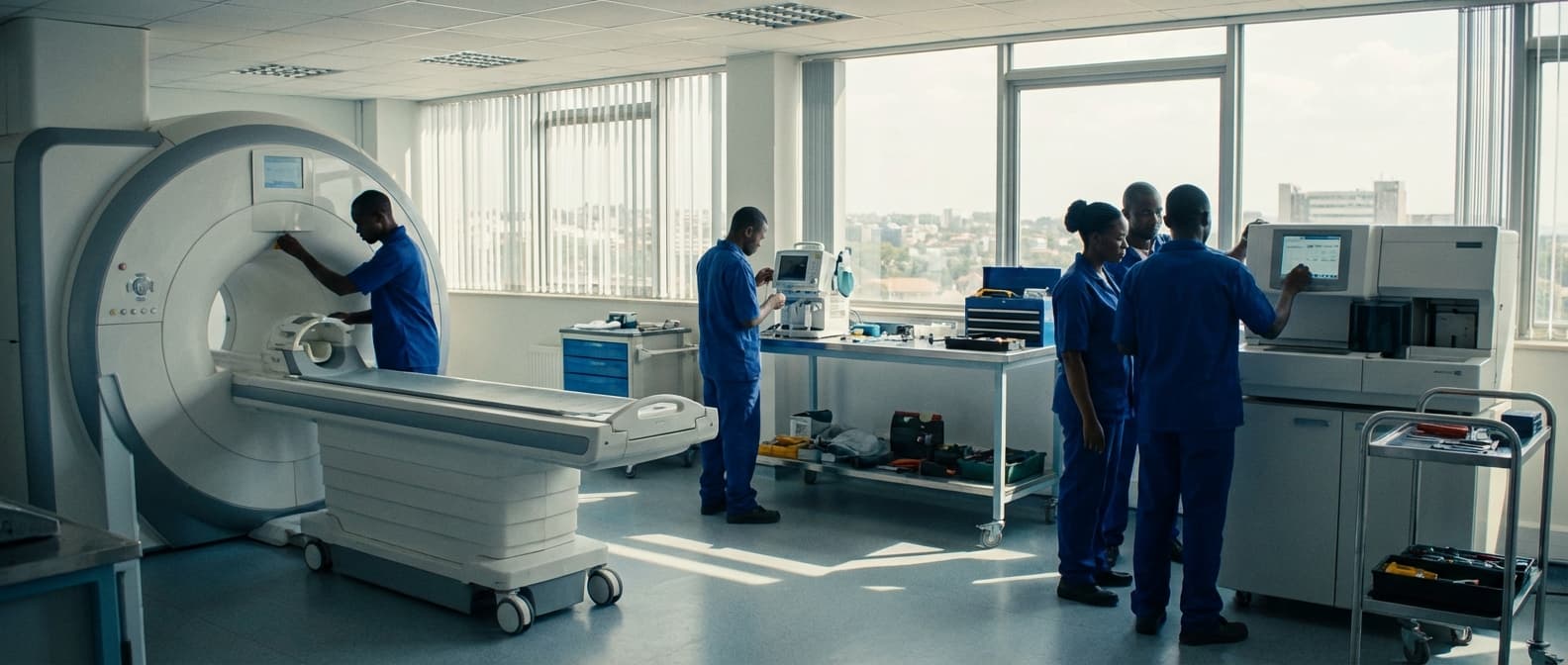
Uptime, Downtime & Root-Cause Analysis Reporting Service in Gambia
Engineering Excellence & Technical Support
Uptime, Downtime & Root-Cause Analysis Reporting Service High-standard technical execution following OEM protocols and local regulatory frameworks.
Proactive Uptime Monitoring
Leveraging advanced AI-powered agents deployed across key infrastructure points in Gambia, our service provides real-time, 24/7 monitoring of critical systems. We detect anomalies and performance degradations *before* they impact user experience, ensuring maximum service availability and minimizing potential revenue loss for your business.
Granular Downtime Identification
When downtime inevitably occurs, our platform rapidly pinpoints the exact services, applications, and geographical locations affected across Gambia. Detailed metrics, including duration, affected users, and immediate impact assessment, are generated instantly, enabling swift communication and informed decision-making.
Automated Root-Cause Analysis (RCA)
Our intelligent RCA engine analyzes a multitude of data sources – logs, network traces, performance metrics, and configuration changes – to automatically identify the root cause of incidents within minutes. This eliminates time-consuming manual troubleshooting, allowing your IT teams to focus on resolving issues and preventing recurrence, enhancing long-term system stability in Gambia.
What Is Uptime, Downtime & Root-cause Analysis Reporting Service In Gambia?
In The Gambia, Uptime, Downtime & Root-Cause Analysis (RCA) Reporting Service refers to a specialized offering focused on the continuous monitoring, measurement, and in-depth investigation of the operational availability and unavailability of IT systems, infrastructure, and critical business processes. This service aims to provide organizations with a comprehensive understanding of their system performance, identify the underlying causes of disruptions, and facilitate proactive measures to enhance reliability and minimize future incidents. The service typically involves the implementation of monitoring tools, data collection and aggregation, performance metric reporting, incident logging, and a structured RCA process.
| Who Needs This Service? | Typical Use Cases | ||||||
|---|---|---|---|---|---|---|---|
| Information Technology (IT) Departments: Responsible for the availability and performance of servers, networks, applications, and cloud services. | Financial Institutions (Banks, Insurance Companies): Critical for maintaining transactional integrity, customer access to services, and regulatory compliance. Downtime can lead to significant financial losses and reputational damage. | Telecommunications Providers: Ensuring continuous connectivity and service delivery to a large customer base. Unplanned downtime directly impacts revenue and customer satisfaction. | Government Agencies: Maintaining essential public services, citizen portals, and critical infrastructure. Unavailability can disrupt public administration and safety. | E-commerce Platforms & Online Retailers: Directly tied to revenue generation. Any downtime equates to lost sales and customer churn. | Healthcare Organizations: Essential for patient care systems, electronic health records (EHRs), and critical medical equipment. Downtime can have life-threatening consequences. | Logistics and Supply Chain Companies: Ensuring the smooth flow of goods and information. Disruptions can cause significant delays and economic impact. | Any Organization with Mission-Critical Systems: Businesses relying on digital platforms, internal applications, or customer-facing services where operational continuity is paramount. |
| Diagnosing and resolving recurring system failures: Identifying the underlying technical or procedural flaws causing repeated incidents. | Optimizing infrastructure performance: Using historical data to tune hardware, software, and network configurations for better efficiency and reliability. | Capacity planning: Understanding system load and performance limitations to forecast future resource needs. | Improving incident response: Streamlining the process of detecting, diagnosing, and resolving issues to minimize downtime duration. | Enhancing security posture: Identifying vulnerabilities or misconfigurations that may have contributed to security incidents or operational disruptions. | Justifying IT investments: Providing data-driven evidence for upgrades, replacements, or new technology adoption based on performance and reliability metrics. | Meeting Service Level Agreements (SLAs): Demonstrating adherence to contractual uptime and performance commitments with clients or internal stakeholders. | Conducting post-incident reviews (PIRs): Formally documenting lessons learned from major incidents to prevent recurrence. |
Key Components of Uptime, Downtime & RCA Reporting Service:
- Uptime Monitoring: Continuous tracking of system and service availability, often measured as a percentage over a defined period (e.g., 99.9%).
- Downtime Measurement: Quantifying the duration and frequency of system or service unavailability, including planned and unplanned outages.
- Performance Metrics Collection: Gathering data on key performance indicators (KPIs) such as response times, throughput, error rates, and resource utilization.
- Incident Logging & Tracking: A systematic process for recording all service disruptions, their impact, and resolution efforts.
- Root-Cause Analysis (RCA): A methodical investigation into the fundamental reasons behind an incident, moving beyond superficial symptoms to identify contributing factors and systemic issues.
- Reporting & Dashboards: Generation of regular reports and interactive dashboards visualizing uptime, downtime, performance trends, and RCA findings.
- Alerting Mechanisms: Proactive notification systems triggered by predefined thresholds for downtime or performance degradation.
Who Needs Uptime, Downtime & Root-cause Analysis Reporting Service In Gambia?
In today's increasingly digital landscape, reliable IT infrastructure is paramount for any organization's success. Downtime can lead to significant financial losses, reputational damage, and decreased productivity. To combat these challenges, businesses in Gambia require robust Uptime, Downtime & Root-Cause Analysis Reporting Services. These services provide critical insights into system performance, identify the sources of disruptions, and enable proactive measures to prevent future outages. This empowers organizations to maintain operational continuity, optimize resource allocation, and make informed decisions regarding their IT investments.
| Industry/Sector | Target Customer (Specific Roles) | Key Departments Involved | Why They Need the Service |
|---|---|---|---|
| Telecommunications | Network Operations Managers, IT Directors, CTOs | Network Operations Center (NOC), IT Operations, Engineering | Ensuring uninterrupted service for subscribers, minimizing revenue loss, and maintaining customer satisfaction. |
| Banking & Financial Services | Head of IT, Compliance Officers, Operations Managers | IT Department, Operations, Risk Management, Compliance | Preventing transaction failures, protecting sensitive data, meeting regulatory requirements, and maintaining customer trust. |
| Government & Public Sector | IT Directors, Agency Heads, Service Delivery Managers | IT Department, Administrative Offices, Service Delivery Units | Ensuring continuity of essential public services (e.g., healthcare, administration, utilities) and maintaining public trust. |
| E-commerce & Retail | E-commerce Managers, IT Managers, Operations Leads | IT Department, Operations, Marketing, Sales | Maximizing online sales by preventing website downtime, ensuring smooth order processing, and maintaining customer experience. |
| Healthcare | Chief Information Officers (CIO), IT Directors, Department Heads (e.g., Radiology, Pharmacy) | IT Department, Clinical Operations, Administration | Ensuring availability of patient records, diagnostic equipment, and critical medical systems for patient care. |
| Logistics & Transportation | Operations Directors, IT Managers, Fleet Managers | Operations, IT Department, Logistics Planning | Maintaining visibility of shipments, coordinating deliveries, and ensuring efficient operational flow. |
| Small & Medium-Sized Enterprises (SMEs) | Business Owners, IT Support Staff (if any), Office Managers | Management, Operations | Preventing business disruption, protecting essential business data, and ensuring productivity without dedicated IT teams. |
Target Customers & Departments in Gambia
- Businesses experiencing frequent or prolonged IT disruptions.
- Organizations with mission-critical systems that cannot tolerate downtime.
- Companies seeking to improve the efficiency and reliability of their IT operations.
- Entities requiring data-driven insights for IT budget allocation and strategic planning.
- Businesses undergoing digital transformation initiatives.
Uptime, Downtime & Root-cause Analysis Reporting Service Process In Gambia
This document outlines the process for providing Uptime, Downtime, and Root-Cause Analysis (RCA) reporting services in The Gambia. The service aims to provide clients with comprehensive insights into their system's availability, identify the causes of disruptions, and recommend corrective actions to improve reliability. The workflow begins with a client inquiry and concludes with the delivery of a detailed RCA report.
| Phase | Key Activities | Responsible Party | Deliverables/Outcomes | Typical Duration (The Gambia Context) |
|---|---|---|---|---|
| Phase 1: Inquiry & Scoping | Client expresses interest in Uptime/Downtime/RCA services. Service provider clarifies client needs, existing infrastructure, reporting requirements, and scope of service. Site visit may be required. | Client, Service Provider (Consultant/Analyst) | Understanding of client requirements, initial scope definition. | 1-3 business days |
| Phase 2: SLA & Contract Negotiation | Formal proposal submission. Discussion and negotiation of Service Level Agreements (SLAs) including uptime guarantees, response times, and reporting frequencies. Finalization of contract and pricing. | Service Provider, Client | Signed SLA and Service Contract. | 3-7 business days |
| Phase 3: Data Collection & Monitoring Setup | If required, deployment/configuration of monitoring tools (e.g., network probes, server agents, log collectors). Collection of baseline system performance data. Establishment of communication channels for incident reporting. | Service Provider (Technical Team) | Operational monitoring systems, baseline performance metrics, defined communication protocols. | 5-15 business days (depending on infrastructure complexity) |
| Phase 4: Downtime Incident Detection & Alerting | Continuous monitoring of client systems. Automatic detection of deviations from normal performance or complete system outages. Generation of immediate alerts to the service provider and client. | Monitoring System, Service Provider (24/7 Operations/NOC) | Real-time alerts on identified downtime events. | Continuous (during service period) |
| Phase 5: Incident Investigation & Data Gathering | Upon alert, the service provider's incident response team investigates the incident. This involves gathering logs, system status, network traffic, and any relevant configuration changes from the affected systems. | Service Provider (Incident Response Team) | Initial incident logs, preliminary assessment of impact. | Minutes to a few hours (depending on incident severity) |
| Phase 6: Root-Cause Analysis (RCA) | Systematic analysis of all gathered data to identify the fundamental cause of the downtime. This may involve techniques like the '5 Whys' or Fishbone diagrams. Collaboration with client's IT team may be necessary. | Service Provider (RCA Specialist/Analyst) | Identified root cause(s) of the downtime incident. | 1-2 business days (post-incident data gathering) |
| Phase 7: Report Generation | Compilation of a comprehensive report detailing the incident, timeline, impact, the identified root cause, and recommended corrective actions (short-term and long-term). Uptime/downtime statistics are also included. | Service Provider (RCA Specialist/Analyst) | Draft Uptime/Downtime & RCA Report. | 2-5 business days |
| Phase 8: Report Review & Delivery | The draft report is presented to the client for review and feedback. Any clarifications or additional information are addressed. Final report is delivered in the agreed format. | Service Provider, Client | Finalized Uptime/Downtime & RCA Report. | 2-4 business days |
| Phase 9: Post-Delivery Support & Follow-up | Service provider may offer support in implementing recommended corrective actions. Periodic follow-ups to assess system stability and address any recurring issues. Review of long-term trends. | Service Provider, Client | Improved system reliability, ongoing client satisfaction. | Ongoing (as per SLA) |
Workflow Steps
- Initial Inquiry & Scoping
- Service Level Agreement (SLA) & Contract Negotiation
- Data Collection & Monitoring Setup
- Downtime Incident Detection & Alerting
- Incident Investigation & Data Gathering
- Root-Cause Analysis (RCA)
- Report Generation
- Report Review & Delivery
- Post-Delivery Support & Follow-up
Uptime, Downtime & Root-cause Analysis Reporting Service Cost In Gambia
Providing reliable Uptime, Downtime, and Root-Cause Analysis (RCA) reporting services in Gambia involves a range of costs influenced by several key factors. These services are crucial for businesses to understand their system performance, identify and resolve issues swiftly, and ultimately improve operational efficiency and customer satisfaction. The pricing will vary based on the complexity of the systems being monitored, the volume of data processed, the level of detail in the reports, and the expertise of the service provider. It's essential for businesses in Gambia to carefully consider these factors when budgeting for such services.
| Service Component | Estimated Price Range (GMD) - Basic | Estimated Price Range (GMD) - Standard | Estimated Price Range (GMD) - Advanced |
|---|---|---|---|
| Basic Uptime/Downtime Monitoring (e.g., website availability, server ping) | 1,500 - 4,000 GMD/month | 4,000 - 8,000 GMD/month | 8,000 - 15,000+ GMD/month |
| Standard Uptime/Downtime & Basic RCA (e.g., identifying root cause of a single incident) | N/A | 6,000 - 12,000 GMD/month | 12,000 - 25,000+ GMD/month |
| Comprehensive Uptime, Downtime & In-depth RCA (e.g., proactive monitoring, trend analysis, multiple incident RCA) | N/A | N/A | 20,000 - 50,000+ GMD/month |
| Consultancy and Implementation (one-time) | 5,000 - 10,000 GMD | 10,000 - 25,000 GMD | 25,000 - 75,000+ GMD |
Key Pricing Factors for Uptime, Downtime & RCA Reporting Services in The Gambia
- System Complexity and Scope: The number and type of systems (servers, applications, networks, databases) to be monitored significantly impacts cost. More complex environments require more sophisticated monitoring tools and a higher level of expertise to analyze.
- Data Volume and Granularity: The amount of data generated by the monitored systems and the desired level of detail in the reports will affect storage, processing, and analysis costs. High-frequency monitoring or in-depth logs will increase expenses.
- Reporting Frequency and Customization: Standard, periodic reports are generally less expensive than highly customized, real-time dashboards or ad-hoc deep-dive analyses. The need for specific metrics or visualisations will also influence pricing.
- Service Level Agreements (SLAs): The guaranteed uptime and response times for reporting and analysis can affect the cost. Higher SLAs often come with premium pricing.
- Provider Expertise and Reputation: Experienced providers with a proven track record and specialized knowledge in RCA will generally command higher rates.
- Technology Stack Utilized: The cost of underlying monitoring software, cloud infrastructure, and data analytics tools used by the provider will be factored into their pricing.
- Geographic Location and Support: While the service is for The Gambia, the provider's operational base and the level of on-site support (if required) can influence costs.
- Contract Duration and Commitment: Longer-term contracts often offer discounted rates compared to month-to-month arrangements.
Affordable Uptime, Downtime & Root-cause Analysis Reporting Service Options
This service offers comprehensive Uptime, Downtime, and Root-Cause Analysis (RCA) reporting to help businesses understand and optimize their system performance. We understand that effective monitoring and analysis are crucial, but can also become costly. Therefore, we've developed flexible value bundles and cost-saving strategies to make these essential services accessible to a wide range of organizations.
| Cost-Saving Strategy | Description | Benefit |
|---|---|---|
| Tiered Pricing | Our value bundles are structured with progressively lower per-unit costs as you move up to higher tiers. This encourages adoption of more comprehensive solutions without exponential price increases. | Cost efficiency for enhanced features. |
| Annual Commitments | Opting for an annual subscription instead of monthly payments typically unlocks significant discounts (e.g., 10-20% off). | Reduced overall expenditure. |
| Automated Reporting | Our system automates report generation, eliminating the need for manual data compilation and analysis by your staff, saving valuable human resources. | Reduced labor costs and faster insights. |
| Scalable Infrastructure | We leverage cloud-based infrastructure that scales with your needs. You only pay for the resources you use, avoiding over-provisioning and associated costs. | Pay-as-you-grow flexibility. |
| Self-Service Options | For lower-tier bundles, self-service dashboards and basic troubleshooting guides are provided, empowering users to find answers quickly and reducing reliance on direct support. | Lower support overhead. |
| Bundled Services Discount | Purchasing uptime, downtime, and RCA reporting as a single service package is more cost-effective than acquiring them as separate, standalone services. | Economies of scope. |
| Feature-Based Customization | The 'Custom Bundle' option allows you to precisely define the services you need, avoiding payment for features you don't utilize. | Maximized value for investment. |
Value Bundles Explained
- {"title":"Basic Visibility Bundle","description":"Ideal for smaller businesses or those just starting with performance monitoring. Includes essential uptime tracking and basic downtime notifications. Generates monthly summary reports."}
- {"title":"Pro Performance Bundle","description":"For growing businesses requiring deeper insights. Adds automated root-cause analysis for common issues, event correlation, and weekly detailed reports. Includes trend analysis."}
- {"title":"Enterprise Optimization Bundle","description":"Comprehensive solution for large organizations with critical systems. Offers advanced RCA, predictive analytics, custom alerting, real-time dashboards, and on-demand expert consultation. Includes quarterly strategic reviews."}
- {"title":"Custom Bundle","description":"Tailor-made solutions for unique business needs. Allows you to select specific reporting modules, frequency, and levels of analysis to fit your budget and requirements."}
Verified Providers In Gambia
When seeking healthcare in Gambia, particularly for specialized or comprehensive services, identifying verified and credentialed providers is paramount. Franance Health stands out as a leading example of such a provider. Their commitment to rigorous credentialing processes ensures that patients receive care from highly qualified and ethical medical professionals. This dedication translates into superior patient outcomes, enhanced trust, and a more seamless healthcare experience. Choosing a verified provider like Franance Health offers peace of mind, knowing that you are in capable and responsible hands.
| Area of Expertise | Credential Verification Highlights | Benefits to Patients |
|---|---|---|
| General Practice | Verified medical license, verified educational background, proven patient feedback. | Reliable primary care, early diagnosis, and treatment referrals. |
| Specialty Care (e.g., Cardiology, Pediatrics, Surgery) | Verified specialty board certification, documented years of practice in specialization, hospital affiliation verification. | Access to expert diagnosis and treatment for complex conditions, reduced need for overseas travel. |
| Nursing Services | Verified nursing license, certified in relevant specialized areas (e.g., critical care, midwifery), background checks. | High-quality, compassionate patient care, medication management, and post-operative support. |
| Diagnostic Services (Labs & Imaging) | Accreditation of facilities, certification of technologists and radiologists, adherence to quality control protocols. | Accurate and timely diagnostic results, crucial for effective treatment planning. |
| Rehabilitation Services (Physiotherapy, Occupational Therapy) | Verified professional certifications, documented experience in specific rehabilitation areas, positive patient outcome tracking. | Effective recovery and management of physical and cognitive impairments. |
Why Franance Health Represents the Best Choice:
- Rigorous Vetting and Credentialing: Franance Health employs a stringent verification process for all its healthcare professionals. This includes thorough background checks, verification of medical licenses, academic qualifications, and professional experience.
- Commitment to Continuous Professional Development: The organization mandates and supports ongoing training and education for its staff, ensuring they remain up-to-date with the latest medical advancements and best practices.
- Patient-Centric Approach: Franance Health prioritizes patient well-being and satisfaction. Their credentialed providers are trained to offer compassionate, personalized care, focusing on open communication and shared decision-making.
- Adherence to International Standards: Franance Health aligns its operational and clinical standards with recognized international healthcare benchmarks, guaranteeing a high quality of service.
- Multidisciplinary Expertise: The network comprises a diverse range of medical specialists, allowing for comprehensive care across various health disciplines under one trusted umbrella.
- Ethical Practice and Integrity: All Franance Health providers are bound by a strict code of ethics, ensuring transparent and honest medical practice at all times.
Scope Of Work For Uptime, Downtime & Root-cause Analysis Reporting Service
This Scope of Work (SOW) outlines the services to be provided for Uptime, Downtime, and Root-Cause Analysis (RCA) Reporting. The objective is to deliver comprehensive and actionable reports that identify system availability, pinpoint downtime events, and determine the underlying causes for proactive mitigation and continuous improvement.
| Deliverable | Description | Standard Specifications | Frequency/Trigger |
|---|---|---|---|
| Uptime/Downtime Report | Summary of system availability over a defined period, detailing uptime percentages and total downtime duration. | Includes: Total uptime (%), Total downtime (hours/minutes), Key performance indicators (KPIs) related to availability (e.g., MTBF, MTTR), Breakdown by service/component. | Weekly |
| Downtime Event Log | Detailed record of each unplanned downtime incident, including start time, end time, duration, and impact. | Includes: Incident ID, Service/Component affected, Start Timestamp, End Timestamp, Duration (hh:mm:ss), Impact assessment (e.g., critical, major, minor), Affected users/systems. | Real-time logging, summarized in weekly/monthly reports |
| Root-Cause Analysis (RCA) Report | In-depth analysis of the underlying causes of significant downtime events, including contributing factors and recommended preventative actions. | Includes: Incident ID, Problem Statement, Timeline of events, Identified Root Cause(s) (e.g., hardware failure, software bug, human error, configuration issue), Contributing factors, Impact analysis, Recommendations for preventative measures, Action items (owner, due date, status). | Per significant downtime event (e.g., exceeding a defined duration threshold or criticality level) |
| Trend Analysis Report | Analysis of historical uptime/downtime data and RCA findings to identify recurring issues and systemic weaknesses. | Includes: Top recurring causes of downtime, Trends in downtime duration/frequency, Impact of implemented recommendations, Areas for process improvement. | Monthly/Quarterly |
| RCA Recommendations Tracking | Monitoring and reporting on the status of implemented RCA recommendations. | Includes: Action Item ID, Recommendation Description, Owner, Due Date, Current Status (e.g., Not Started, In Progress, Completed, Deferred), Verification of effectiveness. | Monthly |
Service Objectives
- Accurately monitor and report on system uptime and downtime.
- Identify and document all unplanned downtime events.
- Conduct thorough Root-Cause Analysis (RCA) for each significant downtime event.
- Provide timely and actionable RCA reports to stakeholders.
- Contribute to the reduction of future downtime through insights gained from RCA.
- Establish and maintain standardized reporting procedures.
Service Level Agreement For Uptime, Downtime & Root-cause Analysis Reporting Service
This Service Level Agreement (SLA) outlines the commitments and responsibilities regarding the Uptime, Downtime, and Root-Cause Analysis Reporting Service provided by [Your Company Name] (hereinafter referred to as "Provider") to [Client Name] (hereinafter referred to as "Customer"). This SLA ensures the availability and transparency of our critical service reporting.
| Service Component | Uptime Guarantee | Response Time (Critical Incident Notification) | RCA Report Delivery Time (Post-Incident Resolution) |
|---|---|---|---|
| Uptime, Downtime, and Root-Cause Analysis Reporting Service | 99.9% (excluding Scheduled Maintenance) | 15 minutes | Within 24 business hours of incident resolution |
Key Definitions
- Uptime: The percentage of time the Uptime, Downtime, and Root-Cause Analysis Reporting Service is operational and accessible to the Customer.
- Downtime: The percentage of time the Uptime, Downtime, and Root-Cause Analysis Reporting Service is unavailable to the Customer. Downtime excludes Scheduled Maintenance.
- Scheduled Maintenance: Pre-announced periods during which the Service may be unavailable due to planned upgrades, repairs, or maintenance activities. Customer will be notified at least [Number] days in advance.
- Emergency Maintenance: Unplanned maintenance required to address critical security vulnerabilities or service-impacting issues. The Provider will endeavor to notify the Customer as soon as reasonably possible.
- Root-Cause Analysis (RCA) Report: A detailed document provided by the Provider outlining the underlying cause of a service interruption, the impact, and the corrective actions taken or planned.
- Reporting Period: A calendar month for the purpose of calculating Uptime and Downtime.
- Critical Incident: An event that causes significant degradation or complete unavailability of the Uptime, Downtime, and Root-Cause Analysis Reporting Service, impacting the Customer's ability to access essential reporting features.
Frequently Asked Questions

Ready when you are
Let's scope your Uptime, Downtime & Root-Cause Analysis Reporting Service in Gambia project in Gambia.

Scaling healthcare logistics and technical systems across the entire continent.