
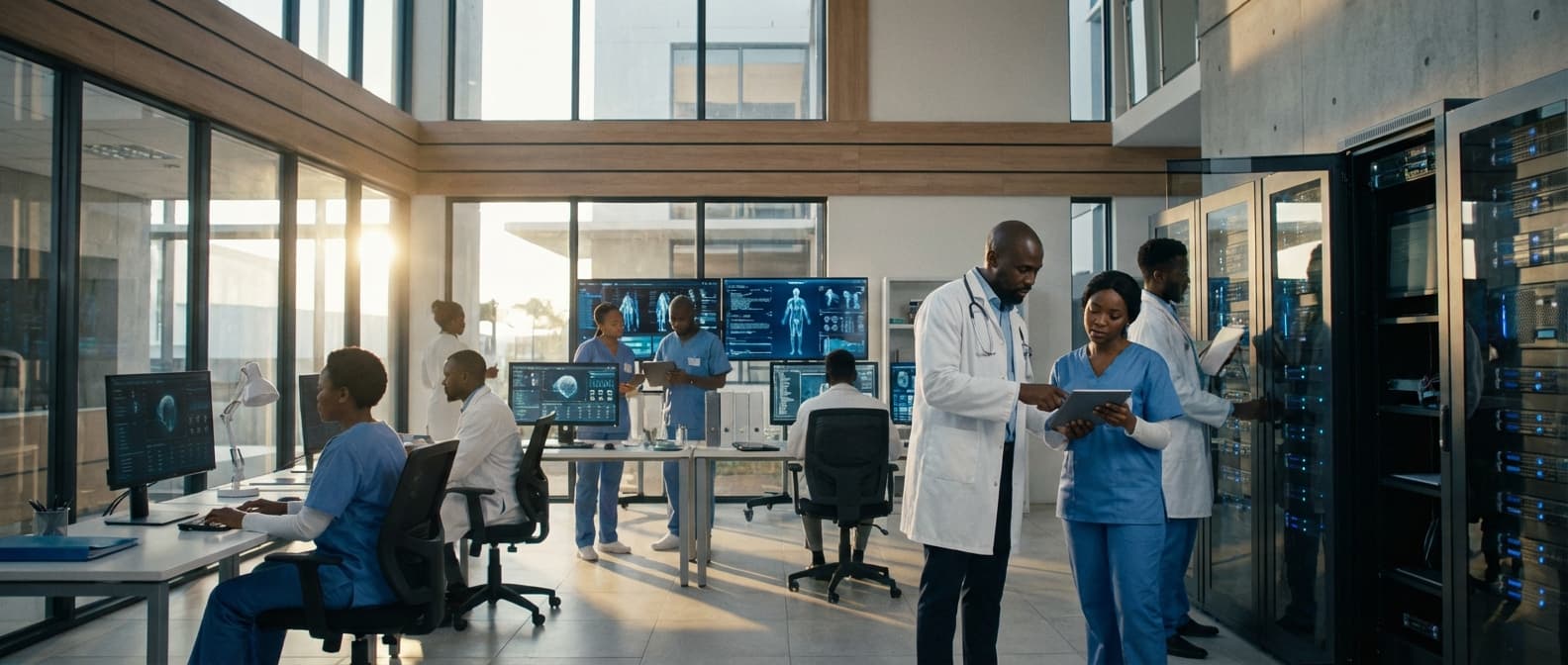
Tele-Radiology in Gambia
Engineering Excellence & Technical Support
24/7 access to certified radiologists providing rapid, accurate remote interpretation of diagnostic imaging studies. High-standard technical execution following OEM protocols and local regulatory frameworks.
Bridging Geographical Gaps
Empowering remote Gambian healthcare facilities with instant access to expert radiological interpretation, overcoming limitations of local specialist availability and complex logistical challenges for patient transfers.
AI-Assisted Diagnostics
Leveraging advanced AI algorithms to pre-screen medical images, highlighting potential anomalies and assisting local medical teams in prioritizing urgent cases, thereby improving diagnostic speed and accuracy.
Secure Digital Archiving
Implementing robust cloud-based PACS (Picture Archiving and Communication System) for secure storage and retrieval of patient imaging data, ensuring data integrity, long-term accessibility, and facilitating seamless collaboration among healthcare providers.
What Is Tele-radiology In Gambia?
Tele-radiology in The Gambia refers to the practice of transmitting radiological images (such as X-rays, CT scans, and MRIs) from one geographic location to another for the purpose of interpretation and reporting by a radiologist. This service leverages telecommunications and information technology to overcome geographical barriers and improve access to specialized diagnostic imaging services, particularly in regions with a scarcity of qualified radiologists. The core of tele-radiology involves the capture, storage, and transmission of medical images, followed by their review and interpretation by a remote expert, who then generates a diagnostic report that is sent back to the referring physician. This technology is crucial for enhancing healthcare delivery in areas where on-site radiology expertise is limited or unavailable, thereby facilitating timely and accurate diagnoses, improving patient outcomes, and optimizing resource utilization within the healthcare system.
| Who Needs Tele-radiology in The Gambia | Typical Use Cases | ||||||
|---|---|---|---|---|---|---|---|
| Patients in rural or underserved areas with limited access to diagnostic imaging facilities and radiologists. | Emergency department consultations for suspected fractures, trauma, or acute conditions where immediate interpretation is required. | Primary healthcare facilities lacking on-site radiology expertise for routine diagnostic imaging requests. | Specialized medical centers that experience high patient volumes or a shortage of radiologists. | Public health initiatives requiring large-scale screening programs (e.g., tuberculosis detection) where rapid interpretation is essential. | Cases requiring subspecialty interpretation (e.g., neuro-radiology, pediatric radiology) that may not be available locally. | Post-operative imaging follow-up and monitoring. | Teleradiology can support continuing medical education for local clinicians by providing expert interpretations and feedback. |
Components of a Tele-radiology Service in The Gambia
- Image Acquisition: Digital imaging modalities (e.g., digital X-ray, CT, MRI) within Gambian healthcare facilities.
- Image Archiving and Communication System (PACS): Secure storage and management of radiological images.
- Teleradiology Platform: Software for transmitting, viewing, and reporting on images remotely.
- Telecommunications Infrastructure: Reliable internet connectivity for image transfer.
- Remote Radiologist Network: Qualified radiologists located within or outside The Gambia.
- Referring Physician Interface: System for receiving diagnostic reports and communicating with radiologists.
Who Needs Tele-radiology In Gambia?
Tele-radiology, the practice of interpreting medical images remotely, offers a compelling solution to the challenges faced by healthcare systems in developing nations like The Gambia. While resource limitations and a scarcity of trained radiologists are prevalent, the demand for accurate and timely diagnostic imaging is ever-present. This service bridges the gap, enabling access to expert interpretation for a wide range of medical conditions, thereby improving patient care and outcomes. The need for tele-radiology in The Gambia is driven by the desire to overcome geographical barriers, enhance diagnostic capabilities, and support the professional development of local medical personnel.
| Customer Segment | Primary Need | Key Services Required | Departmental Impact |
|---|---|---|---|
| Public Hospitals (e.g., Edward Francis Small Teaching Hospital) | Limited radiologist availability, high patient volume, need for specialized interpretations. | On-demand interpretation of X-rays, CT scans, ultrasounds, MRI scans. Second opinions. Subspecialty reporting (e.g., neuroradiology, musculoskeletal). | Improved diagnostic accuracy, faster turnaround times for critical diagnoses, reduced burden on local radiologists, enhanced training opportunities. |
| Private Hospitals and Clinics | Desire for rapid and high-quality diagnostic services to compete, limited in-house expertise for certain modalities. | Prompt interpretation of various imaging modalities. Access to subspecialist reports for complex cases. Flexible service agreements. | Enhanced patient satisfaction, increased revenue generation, competitive advantage through advanced diagnostic capabilities. |
| Rural Health Posts and Community Clinics | Lack of any on-site imaging interpretation, reliance on basic diagnostics or difficult referrals. | Interpretation of essential imaging (primarily X-rays and ultrasounds). Remote consultation for diagnostic challenges. Facilitating referrals based on initial findings. | Extended reach of diagnostic services, early detection of diseases, improved management of chronic conditions, reduced unnecessary patient travel to urban centers. |
| Diagnostic Imaging Centers | Need to supplement in-house reporting capacity, ensure availability of specialized expertise for diverse imaging requests. | Overflow reading services. Niche specialty reporting (e.g., interventional radiology planning, advanced cardiac imaging). Quality assurance checks. | Increased throughput, broader service offering, improved efficiency, consistent quality of reports. |
| Ministry of Health and Public Health Initiatives | Improving national healthcare coverage, addressing workforce shortages, supporting public health programs. | Population-based screening programs (e.g., tuberculosis detection via chest X-rays). Remote diagnostics for outbreaks. Data collection and analysis for public health surveillance. | Strengthened public health infrastructure, better disease surveillance, equitable access to diagnostics across the country. |
Target Customers and Departments for Tele-Radiology in The Gambia
- Hospitals and Clinics (Public and Private)
- Diagnostic Imaging Centers
- Referral Centers
- Rural Health Posts and Community Clinics
- Emergency Departments
- Maternity and Neonatal Units
- Oncology Departments
- Surgical Departments
- Internal Medicine/General Practice
- Pediatric Departments
Tele-radiology Process In Gambia
The tele-radiology process in Gambia facilitates remote diagnostic imaging interpretation, bridging the gap between available radiology expertise and the need for timely diagnoses. This workflow typically begins with a referral or inquiry from a healthcare facility lacking on-site radiologists. The process involves several key stages, ensuring accurate and efficient image transmission, interpretation, and reporting.
| Stage | Description | Key Actors | Technology/Tools | Challenges/Considerations |
|---|---|---|---|---|
| Inquiry and Referral | A healthcare facility (e.g., a district hospital or clinic) identifies a need for radiological interpretation due to a lack of a local radiologist or specialized equipment. A patient's case is reviewed, and the need for imaging is determined. | Referring Physician/Healthcare Professional, Facility Administrator | Phone, Email, Secure Messaging App | Ensuring clear clinical information is provided with the referral. |
| Image Acquisition and Preparation | The patient undergoes the required imaging procedure (X-ray, CT, Ultrasound, MRI) at the referring facility. Images are acquired using digital modalities and prepared for transmission. | Radiographer, Technician, Nurse | Digital X-ray machines, CT scanners, Ultrasound machines, PACS (Picture Archiving and Communication System) or DICOM viewers | Ensuring proper image quality, patient positioning, and anonymization of sensitive data. Availability and maintenance of digital imaging equipment. |
| Secure Image Transmission | Acquired images are securely transferred from the referring facility to the tele-radiology service provider's platform. This often involves uploading images to a cloud-based PACS or a dedicated tele-radiology portal. | Technician, IT Support, Tele-radiology Platform Administrator | Internet Connectivity (reliable and adequate bandwidth), VPN (Virtual Private Network), Secure Cloud-based PACS, DICOM standard for image data | Internet stability and speed, data security and privacy compliance (e.g., HIPAA-equivalent), cost of data transmission. |
| Radiologist Assignment and Review | Once received, the images are assigned to an available and qualified radiologist based on their subspecialty and workload. The radiologist remotely reviews the images, analyzes the findings, and considers the clinical information provided. | Tele-radiology Platform Administrator, Radiologist | Tele-radiology Platform, DICOM viewers, AI-powered preliminary analysis tools (optional) | Radiologist workload management, ensuring appropriate expertise for complex cases, turnaround time expectations. |
| Report Generation and Communication | The radiologist dictates or types a comprehensive diagnostic report, which includes findings, impressions, and recommendations. The report is then transmitted back to the referring healthcare facility. | Radiologist, Transcriptionist (if applicable), Tele-radiology Platform | Speech recognition software, secure reporting portal, email (for less sensitive communication) | Clarity and comprehensibility of the report for the referring physician, timeliness of report delivery. |
| Integration with EMR/HIS | The final report is often integrated into the patient's Electronic Medical Record (EMR) or Hospital Information System (HIS) at the referring facility for seamless patient management and record-keeping. | Referring Facility IT Department, EMR/HIS Administrator | EMR/HIS system, interoperability standards (e.g., HL7), data import/export functionalities | Interoperability between the tele-radiology platform and the facility's existing systems, ensuring data integrity during integration. |
Tele-Radiology Workflow in Gambia
- Inquiry and Referral
- Image Acquisition and Preparation
- Secure Image Transmission
- Radiologist Assignment and Review
- Report Generation and Communication
- Integration with EMR/HIS
Tele-radiology Cost In Gambia
Tele-radiology, the practice of interpreting medical images remotely, is an emerging field in Gambia. While comprehensive, officially published pricing structures for tele-radiology services are not readily available due to its nascent stage, costs are primarily influenced by a combination of factors. These include the complexity of the imaging modality (e.g., X-ray, CT, MRI), the specific anatomical region being examined, the urgency of the report, the radiologist's expertise and specialization, and the overhead associated with the tele-radiology provider (e.g., platform costs, secure data transmission, and administrative support). The prevailing economic conditions and the demand for such specialized services within Gambia also play a significant role in price determination. Local currency, the Gambian Dalasi (GMD), is used for all transactions. Estimates suggest that a basic X-ray interpretation might range from 1,500 to 3,000 GMD, while more complex CT or MRI scans could potentially fall between 5,000 and 15,000 GMD or more, depending on the specifics. These figures are indicative and can fluctuate based on negotiations and the specific service provider.
| Service Type (Indicative) | Estimated Price Range (GMD) |
|---|---|
| Basic X-ray Interpretation | 1,500 - 3,000 |
| Standard CT Scan Interpretation | 5,000 - 10,000 |
| Standard MRI Scan Interpretation | 7,500 - 15,000 |
| Urgent/STAT Interpretations | Add 30-50% to Standard Rates (estimated) |
| Specialized Interpretations (e.g., interventional radiology) | Varies significantly, potentially higher than standard CT/MRI |
Factors Influencing Tele-Radiology Costs in The Gambia
- Complexity of Imaging Modality (X-ray, CT, MRI, Ultrasound)
- Anatomical Region of the Scan
- Urgency of the Diagnostic Report (Standard vs. STAT)
- Radiologist's Specialization and Experience
- Overhead Costs of Tele-Radiology Providers (Platform, Security, Administration)
- Local Economic Conditions and Market Demand
- Type of Service (e.g., primary interpretation, second opinion)
Affordable Tele-radiology Options
Tele-radiology offers a cost-effective solution for accessing expert diagnostic imaging interpretations without the need for in-house specialists. This can be particularly beneficial for smaller clinics, rural hospitals, and practices experiencing high patient volumes. Understanding the different service models and implementing smart strategies can further enhance cost savings. Value bundles and strategic cost-saving measures are key to maximizing the affordability of tele-radiology.
| Cost-Saving Strategy | Description | Potential Benefits |
|---|---|---|
| Volume-Based Discounts | Lower per-study cost as study volume increases. | Significant savings for high-volume practices, predictable budgeting. |
| Turnaround Time Tiering | Differentiated pricing based on report urgency (stat vs. routine). | Pay for speed only when needed, optimizing expenditure. |
| Subspecialty Matching | Aligning radiologist expertise with case complexity. | Avoids overpaying for specialized reads on simpler cases. |
| Off-Peak Hour Pricing | Reduced rates for studies interpreted during non-peak hours. | Cost reduction for practices with variable demand. |
| Contract Negotiation | Securing favorable terms for SLAs, pricing, and support. | Ensures best value and protects against underperformance. |
| Bundled Workflow Solutions | Integrating software, IT, and interpretation services. | Potential for streamlined operations and reduced IT overhead, but evaluate carefully. |
Key Tele-Radiology Value Bundles and Cost-Saving Strategies
- Turnaround Time (TAT) Driven Bundles: Services are priced based on the urgency of the report. Critical findings (e.g., stroke, acute hemorrhage) are prioritized with a faster TAT and may have a slightly higher per-study cost, while routine reads have a longer TAT and a lower cost. This allows practices to pay for speed only when necessary.
- Volume-Based Tiered Pricing: Costs per study decrease as the volume of studies submitted to the tele-radiology provider increases. This incentivizes consistent utilization and rewards larger practices.
- Specialty-Specific Bundles: Providers may offer bundled pricing for specific subspecialties (e.g., neuroimaging, musculoskeletal, mammography). This can be advantageous if a practice has a consistent need for a particular type of interpretation.
- Integrated Workflow Solutions: Some tele-radiology providers offer bundled packages that include PACS integration, teleradiology software, and basic IT support. While the upfront cost might be higher, it can reduce the need for separate IT investments and streamline operations.
- Dedicated Radiologist Allocation: For high-volume practices, a dedicated radiologist or a dedicated team of radiologists can be allocated. While this may have a higher fixed cost, it can ensure consistent quality, familiarization with practice protocols, and a more integrated clinical experience.
- Negotiating Service Level Agreements (SLAs): Clearly define expected turnaround times, report formats, and communication protocols in your contract. Negotiate penalties for missed SLAs, which can act as a cost-saving mechanism if performance is not met.
- Utilizing Off-Peak Hours: If your patient volume is not consistently high throughout the day, explore options for off-peak hour readings. Some providers offer discounted rates for studies interpreted during less busy periods.
- Choosing the Right Level of Subspecialty: Match the subspecialty expertise to the complexity of your cases. Avoid paying premium rates for subspecialty reads when general radiology or a less specialized subspecialist would suffice.
- Leveraging Existing IT Infrastructure: Assess your current IT capabilities. If you have a robust PACS and network, you might not need bundled IT support from the tele-radiology provider, allowing for negotiation on core interpretation services.
- Regular Performance Reviews and Audits: Periodically review reports and turnaround times with your tele-radiology provider. This ensures you are getting the value you are paying for and identifies areas for improvement or potential cost adjustments.
- Exploring Hybrid Models: Consider a hybrid approach where urgent or complex cases are sent to a tele-radiology provider, while more routine studies are managed in-house or by a local group. This allows for a balance of cost and control.
Verified Providers In Gambia
In the evolving landscape of healthcare in Gambia, identifying reliable and credentialed providers is paramount for individuals seeking quality medical services. Franance Health stands out as a leading entity, distinguished by its rigorous credentialing processes and commitment to excellence. This commitment ensures that patients have access to a network of healthcare professionals who meet the highest standards of competence, ethics, and patient care. Understanding the value of these verified providers is crucial for making informed healthcare decisions.
| Provider Type | Key Credentials Verified | Benefits for Patients |
|---|---|---|
| General Practitioners | Valid Medical License, Medical Degree, Experience in Primary Care, Good Standing with Medical Board | Reliable diagnosis and treatment for common ailments, preventative care advice, referrals to specialists. |
| Specialist Physicians (e.g., Cardiologists, Pediatricians) | Medical License, Specialist Degree/Residency Completion, Board Certification (where applicable), Proven clinical experience in their specialty | Expert diagnosis and management of complex conditions, access to advanced treatments. |
| Surgeons | Medical License, Surgical Residency Completion, Fellowship (if applicable), Documented surgical outcomes, Professional affiliations | Safe and effective surgical procedures, post-operative care expertise. |
| Dentists | Dental License, Dental Degree, Specialization (e.g., Orthodontics, Periodontics), Experience in dental procedures | Oral health expertise, preventative dental care, restorative and cosmetic treatments. |
| Nurses (RNs, ENs) | Nursing License, Educational Qualifications, Clinical experience, Specialized training (e.g., critical care, pediatrics) | Compassionate patient care, medication administration, health education, vital sign monitoring. |
Why Franance Health Credentials Matter:
- Rigorous Vetting Process: Franance Health employs a multi-stage vetting process that goes beyond basic qualifications. This includes verifying medical licenses, educational background, professional experience, and a thorough background check.
- Commitment to Ethical Practice: Credentialing by Franance Health involves assessing a provider's adherence to ethical guidelines and their track record in patient-provider relationships.
- Focus on Continuous Improvement: Franance Health encourages and often requires providers to engage in ongoing professional development and training, ensuring they remain up-to-date with the latest medical advancements and best practices.
- Patient Safety and Trust: The 'Franance Health Verified' seal signifies a commitment to patient safety and builds a foundation of trust, allowing individuals to feel confident in the care they receive.
- Access to Specialized Expertise: By carefully credentialing specialists, Franance Health helps patients find the right expertise for their specific health needs.
Scope Of Work For Tele-radiology
This Scope of Work (SOW) outlines the requirements for a Tele-Radiology service. It details the technical deliverables, standard specifications, and operational procedures necessary to provide remote interpretation of medical imaging studies. The primary objective is to ensure timely, accurate, and secure diagnostic reporting, enhancing patient care and operational efficiency.
| Category | Deliverable/Specification | Description | Standard/Requirement |
|---|---|---|---|
| Technical Infrastructure | Secure Data Transmission | Encrypted transmission of DICOM images and reports. | End-to-end encryption (e.g., TLS 1.2 or higher). Secure VPN tunnels. |
| Technical Infrastructure | Image Viewing Software | High-performance, DICOM-compliant workstation software for radiologists. | Must support advanced visualization tools (e.g., MPR, 3D rendering, subtraction). Cross-platform compatibility (Windows/macOS). |
| Technical Infrastructure | PACS Integration | Ability to receive DICOM images from hospital PACS and send interpreted studies back. | HL7 and DICOM conformance. Support for standard DICOM modalities (CR, DR, CT, MRI, US, XA, etc.). |
| Technical Infrastructure | EHR Integration | Ability to push finalized reports into the hospital EHR. | HL7 v2.x or FHIR conformance. Integration with specified EHR vendor. |
| Technical Infrastructure | Data Storage & Archiving | Secure storage of interpreted images and reports as per retention policies. | HIPAA-compliant data centers. Data redundancy and backup procedures. Defined retention periods. |
| Operational Procedures | Radiologist Qualifications | Board-certified radiologists with appropriate subspecialty expertise. | Active medical licenses in relevant jurisdictions. Proof of qualifications and certifications. |
| Operational Procedures | Turnaround Time (TAT) Standards | Defined TATs for routine and STAT interpretations. | e.g., Routine: 24-48 hours; STAT: 1-4 hours (depending on modality and clinical urgency). |
| Operational Procedures | Reporting Standards | Structured reporting templates, clear and concise language. | Adherence to ACR reporting guidelines. Inclusion of relevant clinical information, findings, impression, and recommendations. |
| Operational Procedures | Quality Assurance (QA) | Regular QA reviews of interpretations and reports. | Peer review process, tracking of discrepancies, and performance metrics. |
| Operational Procedures | Communication Protocols | Mechanism for radiologists to communicate critical findings to referring physicians. | Secure messaging system, direct phone calls for critical results. Clear escalation procedures. |
| Security & Compliance | HIPAA Compliance | Adherence to all HIPAA Security and Privacy Rule requirements. | Business Associate Agreement (BAA) in place. Regular security audits and training. |
| Security & Compliance | Data Encryption | Encryption of data at rest and in transit. | AES-256 encryption for data at rest. TLS 1.2+ for data in transit. |
| Security & Compliance | Access Control | Role-based access control for all users and systems. | Principle of least privilege. Audit trails of all access and system activity. |
| Support & Maintenance | Technical Support | 24/7 technical support for all systems and connectivity issues. | Defined service level agreements (SLAs) for response and resolution times. |
| Support & Maintenance | System Monitoring | Proactive monitoring of all systems for performance and security. | Real-time dashboards, automated alerts for anomalies. |
Key Objectives
- Provide high-quality, timely radiological interpretations of medical imaging studies.
- Ensure secure and reliable transmission of imaging data and reports.
- Integrate seamlessly with existing hospital Picture Archiving and Communication Systems (PACS) and Electronic Health Records (EHR).
- Maintain compliance with all relevant healthcare regulations and standards (e.g., HIPAA, ACR).
- Offer 24/7 availability for critical interpretations as required.
- Provide clear, concise, and actionable radiological reports.
- Facilitate effective communication between radiologists and referring physicians.
Service Level Agreement For Tele-radiology
This Service Level Agreement (SLA) outlines the response times and uptime guarantees provided by [Tele-Radiology Provider Name] for its tele-radiology services. This SLA is an integral part of the Master Service Agreement (MSA) between [Tele-Radiology Provider Name] and [Client Name].
| Criticality Level | Definition | Guaranteed Response Time (Initial Read) | Guaranteed Report Turnaround Time (Final Report) |
|---|---|---|---|
| STAT (Statutory/Emergency) | Life-threatening or limb-threatening conditions requiring immediate interpretation and intervention. | Within 30 minutes | Within 1 hour |
| Urgent | Conditions requiring prompt attention within a few hours to prevent significant patient harm or deterioration. | Within 2 hours | Within 4 hours |
| Routine | Standard interpretations that do not pose an immediate threat to the patient's life or limb. | Within 8 business hours | Within 24 business hours |
Key Performance Indicators (KPIs)
- Response Time: The time elapsed from the successful transmission of an image study to the Tele-Radiology Provider's system to the availability of a preliminary or final report.
- Uptime: The percentage of time that the Tele-Radiology Provider's platform is available and accessible for image transmission and report retrieval.
- Report Turnaround Time (TAT): The total time from study submission to the delivery of a final, signed report.
- Criticality Levels: Classification of studies based on their urgency and required response time.
Frequently Asked Questions

Ready when you are
Let's scope your Tele-Radiology in Gambia project in Gambia.

Scaling healthcare logistics and technical systems across the entire continent.