
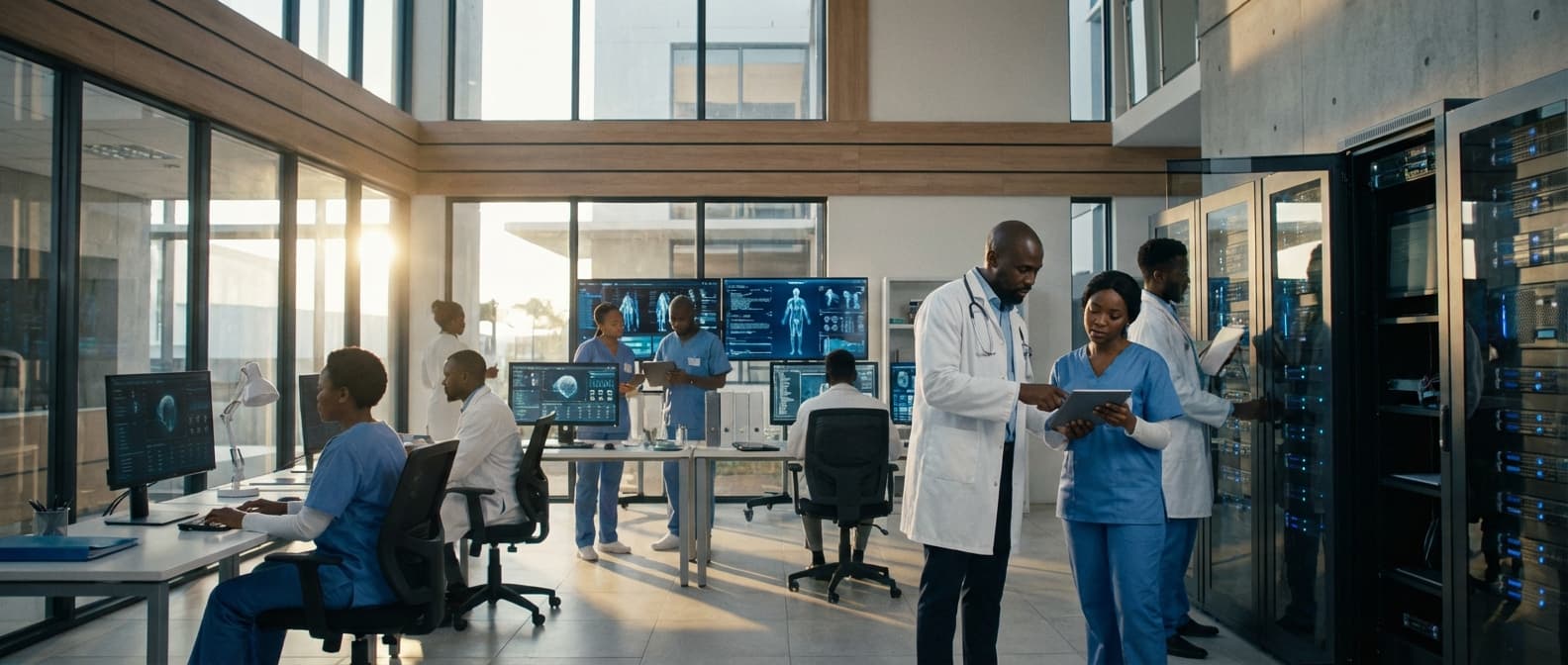
Medical IT Consultation in Gambia
Engineering Excellence & Technical Support
Strategic technology consulting to optimize healthcare operations, streamline workflows, and integrate cutting-edge medical information systems. High-standard technical execution following OEM protocols and local regulatory frameworks.
Cloud Infrastructure Modernization
Implementing secure, scalable cloud solutions for electronic health records (EHR) and data analytics, ensuring accessibility and disaster recovery for healthcare providers across The Gambia.
Cybersecurity & Data Privacy Enhancement
Establishing robust cybersecurity frameworks and data privacy protocols to safeguard sensitive patient information against emerging threats, complying with international and local regulations.
Telemedicine & Remote Access Solutions
Designing and deploying user-friendly telemedicine platforms and mobile health applications to extend healthcare services to remote and underserved populations in The Gambia, improving patient outreach and consultation efficiency.
What Is Medical It Consultation In Gambia?
Medical IT Consultation in The Gambia refers to the provision of specialized advisory and implementation services focused on leveraging Information Technology (IT) within the healthcare sector. This encompasses the strategic planning, design, deployment, and ongoing optimization of IT systems and solutions tailored to the unique challenges and opportunities present in The Gambia's healthcare landscape. The objective is to enhance the efficiency, effectiveness, and accessibility of healthcare delivery through robust technological infrastructure and applications.
| Who Needs Medical IT Consultation? | Typical Use Cases |
|---|---|
| Public Healthcare Facilities: Ministry of Health, regional hospitals, district health centers, and rural clinics seeking to modernize their operations, improve data collection, and enhance patient care delivery. | Implementing a national Electronic Health Record (EHR) system to standardize patient data across different facilities. Establishing a centralized laboratory information system (LIS) for efficient test management and reporting. Deploying telemedicine solutions to connect remote clinics with specialists in urban centers for consultations and diagnostics. Upgrading network infrastructure to support digital health initiatives and improve communication. Implementing robust cybersecurity measures to protect patient data from breaches and ensure continuity of care. |
| Private Healthcare Providers: Hospitals, clinics, diagnostic centers, and specialized medical practices aiming to improve efficiency, patient experience, and operational management through technology. | Adopting an EHR system for streamlined patient record management, billing, and scheduling. Implementing a Picture Archiving and Communication System (PACS) for digital storage and retrieval of medical images. Integrating practice management software with billing and insurance systems for administrative efficiency. Developing a secure patient portal for online appointment booking and access to health information. Exploring cloud-based IT solutions for scalability and reduced on-premise infrastructure costs. |
| Non-Governmental Organizations (NGOs) & International Health Organizations: Organizations involved in healthcare delivery, research, or public health initiatives in The Gambia. | Developing IT strategies to support health programs in remote or underserved communities. Implementing data management systems for disease surveillance and public health reporting. Setting up IT infrastructure for health research projects and clinical trials. Providing IT training and capacity building to local healthcare workers. Deploying mobile health (mHealth) solutions for data collection and health education campaigns. |
| Healthcare Training & Research Institutions: Universities, medical schools, and research centers focusing on medical education and innovation. | Establishing IT infrastructure for e-learning platforms and digital libraries. Implementing research databases and data analysis tools. Supporting the development and deployment of innovative health technologies. Providing technical expertise for IT-enabled medical simulation and training. |
Key Components of Medical IT Consultation in The Gambia
- Needs Assessment & Gap Analysis: Evaluating existing IT infrastructure, identifying functional gaps, and understanding specific organizational requirements.
- Strategic IT Planning: Developing long-term IT roadmaps aligned with healthcare objectives, including budget allocation, resource planning, and phased implementation.
- System Design & Architecture: Architecting scalable and secure IT systems, including Electronic Health Records (EHRs), Picture Archiving and Communication Systems (PACS), laboratory information systems (LIS), and telemedicine platforms.
- Technology Selection & Procurement: Advising on the selection of appropriate hardware, software, and network solutions, considering factors such as cost-effectiveness, interoperability, and local support availability.
- Implementation & Integration: Overseeing the installation, configuration, and integration of new IT systems, ensuring seamless interoperability between disparate applications and devices.
- Data Management & Security: Establishing robust data management protocols, including data integrity, backup and recovery strategies, and implementing comprehensive cybersecurity measures to protect sensitive patient information (PHI) in compliance with relevant regulations.
- Network Infrastructure Development: Designing and deploying reliable and secure network infrastructure, including wired and wireless connectivity, to support IT operations.
- User Training & Support: Providing comprehensive training programs for healthcare professionals and administrative staff on the effective use of IT systems, coupled with ongoing technical support and helpdesk services.
- Compliance & Regulatory Adherence: Ensuring IT systems and practices comply with national healthcare regulations and data privacy laws.
- Digital Health Strategy Development: Formulating strategies for the adoption of digital health tools, such as mobile health (mHealth) applications and remote patient monitoring (RPM).
- Telemedicine Infrastructure: Planning and implementing telemedicine solutions to facilitate remote consultations, diagnoses, and patient follow-ups, especially in underserved areas.
Who Needs Medical It Consultation In Gambia?
Medical IT consultation services are crucial for ensuring the efficient, secure, and compliant operation of healthcare facilities. In The Gambia, these services cater to a range of clients from individual clinics to larger hospital networks and public health organizations. The primary goal is to leverage technology to improve patient care, streamline administrative processes, and enhance data management within the healthcare sector.
| Customer Type | Primary Needs Addressed by IT Consultation | Key Departments Involved |
|---|---|---|
| Public Hospitals and Clinics | EHR/EMR implementation, network infrastructure, data security, telemedicine capabilities, system integration, user training. | IT, Administration, Clinical Departments, Health Information Management |
| Private Hospitals and Clinics | Optimizing existing systems, cloud migration, cybersecurity, patient portal development, compliance with data privacy regulations, cost-effective IT solutions. | IT, Administration, Finance, Clinical Departments |
| Specialty Medical Centers | Integration of specialized diagnostic equipment with IT systems, PACS (Picture Archiving and Communication System) implementation, data analytics for performance improvement. | IT, Radiology, Laboratory, Clinical Staff |
| NGOs in Healthcare | Setting up IT infrastructure for remote clinics, data collection and reporting tools, training local staff, ensuring sustainability of IT solutions. | IT, Program Management, Field Staff |
| Government Health Ministries/Agencies | Developing national health information systems, public health surveillance software, data security policies, interoperability standards, capacity building. | IT, Policy and Planning, Statistics, Public Health Departments |
| Medical Training Institutions | IT infrastructure for e-learning, simulation software, digital libraries, secure student record management. | IT, Academic Departments, Administration |
Target Customers and Departments Requiring Medical IT Consultation in Gambia
- {"items":["Public Hospitals and Clinics","Private Hospitals and Clinics","Specialty Medical Centers (e.g., diagnostic labs, imaging centers)","Non-Governmental Organizations (NGOs) involved in healthcare delivery","Government Health Ministries and Agencies","Medical Training Institutions","Pharmacies with integrated patient record systems"],"title":"Target Customers"}
- {"items":["Information Technology (IT) Departments","Administration and Operations","Clinical Departments (e.g., Radiology, Laboratory, Pharmacy, Wards)","Patient Records / Health Information Management","Finance and Billing","Infection Control","Research and Development (if applicable)"],"title":"Key Departments and Areas of Need"}
Medical It Consultation Process In Gambia
The Medical IT Consultation Process in Gambia is a structured approach designed to address the unique technological needs of healthcare facilities within the country. It emphasizes understanding local constraints, maximizing existing resources, and implementing sustainable IT solutions. The process typically flows from initial inquiry to the successful execution and ongoing support of IT projects.
| Phase | Description | Key Activities | Deliverables | Typical Duration (Weeks) |
|---|---|---|---|---|
| The process begins with a healthcare facility or organization in Gambia expressing a need for IT consultation or services. | Initial communication (email, phone, referral), understanding the general nature of the request. | Confirmation of contact, preliminary understanding of needs. | 0.5 - 1 |
| A detailed understanding of the current IT infrastructure, operational workflows, challenges, and specific requirements of the healthcare facility is established. | Site visits (if feasible), interviews with stakeholders (clinicians, administrators, IT staff), review of existing systems, identification of pain points and desired outcomes. | Needs assessment report, documented requirements, stakeholder analysis. | 2 - 4 |
| Based on the identified needs, appropriate IT solutions are conceptualized, designed, and presented to the client. | Developing technical specifications, identifying hardware/software requirements, considering local context (internet availability, power stability, budget), creating a detailed project proposal outlining scope, timeline, costs, and expected benefits. | Technical design documents, project proposal, cost-benefit analysis. | 3 - 5 |
| Once the proposal is approved, the focus shifts to acquiring necessary resources and meticulously planning the implementation stages. | Vendor selection (if applicable), procurement of hardware and software, development of a detailed implementation plan with task assignments, timelines, and risk mitigation strategies. | Procurement agreements, detailed implementation plan, resource allocation. | 2 - 4 |
| The designed IT solutions are installed, configured, and integrated with existing systems. | Hardware installation, software deployment and configuration, network setup, integration with existing databases or systems (e.g., Electronic Health Records - EHRs). | Installed and configured systems, integrated platforms. | 4 - 8 |
| Ensuring that healthcare staff are proficient in using the new IT systems is crucial for successful adoption. | Development of training materials, conducting training sessions (on-site or remote), providing user support during initial usage. | Trained staff, user manuals, knowledge base articles. | 2 - 3 |
| Thorough testing is performed to ensure the systems are functioning as expected and meet all requirements. | Unit testing, integration testing, user acceptance testing (UAT), bug fixing and re-testing. | Test reports, bug tracking logs, UAT sign-off. | 2 - 3 |
| The new systems are officially launched into the operational environment, and responsibility is formally transferred to the client. | Final system checks, official launch of new systems, transition of operational responsibility, providing all project documentation. | Live operational systems, comprehensive project documentation, handover report. | 0.5 - 1 |
| Ongoing support and maintenance are provided to ensure the systems remain functional and efficient. | Help desk support, troubleshooting, regular system updates and patches, proactive monitoring, performance optimization. | Service level agreements (SLAs), support tickets resolved, system performance reports. | Ongoing |
| Periodically assessing the impact of the IT solutions and planning for future enhancements or upgrades. | Gathering feedback on system performance and user satisfaction, identifying areas for improvement, discussing future IT needs and strategic planning. | Post-implementation review report, recommendations for future IT investments. | As needed (e.g., annually) |
Medical IT Consultation Workflow in Gambia
- Inquiry & Initial Contact
- Needs Assessment & Discovery
- Solution Design & Proposal
- Procurement & Implementation Planning
- System Deployment & Integration
- Training & User Adoption
- Testing & Quality Assurance
- Go-Live & Handover
- Post-Implementation Support & Maintenance
- Evaluation & Future Planning
Medical It Consultation Cost In Gambia
The cost of Medical IT consultation in The Gambia can vary significantly based on several factors. These include the complexity of the IT needs, the reputation and experience of the IT consultant or firm, the duration of the consultation, and the specific services required. Common services might range from network setup and security audits to EHR (Electronic Health Record) system implementation, software troubleshooting, hardware procurement advice, and data management strategies. As of late 2023 and early 2024, local rates are often influenced by the demand for specialized IT skills within the healthcare sector. It's important for healthcare providers to clearly define their requirements beforehand to obtain accurate quotes.
| Service Type | Estimated Range (GMD) | Notes |
|---|---|---|
| Initial IT Needs Assessment / Basic Consultation | 5,000 - 15,000 GMD | For a few hours of assessment and general advice. |
| Network Setup & Security Audit | 15,000 - 40,000 GMD | Includes network design, security policies, and initial checks. |
| EHR/EMR System Consultation (Planning & Selection) | 20,000 - 60,000 GMD | Focus on requirements gathering, vendor evaluation, and strategic planning for system adoption. Does not include implementation costs. |
| Software Troubleshooting & Support | 8,000 - 25,000 GMD (per incident/day) | Can be hourly or a project-based fee depending on the issue. |
| Hardware Procurement Advice & Integration | 10,000 - 30,000 GMD | Guidance on purchasing suitable medical IT hardware and ensuring compatibility. |
| Data Management & Backup Strategy Consultation | 15,000 - 45,000 GMD | Focus on secure data storage, retrieval, and disaster recovery planning. |
| Comprehensive IT Strategy & Planning | 30,000 - 100,000+ GMD | For larger healthcare institutions or multi-faceted IT projects, often involving a team of consultants over several weeks/months. |
Key Pricing Factors for Medical IT Consultation in The Gambia
- Scope of Services: The breadth and depth of the IT issues to be addressed directly impact the cost. Basic advice will be less expensive than a comprehensive system overhaul.
- Consultant's Expertise & Reputation: Highly experienced and reputable IT professionals or firms often command higher rates due to their proven track record and specialized knowledge in healthcare IT.
- Project Duration: Whether it's a one-time assessment, ongoing support, or a long-term project implementation, the time commitment will be a major cost driver.
- Complexity of Current Infrastructure: The more intricate and outdated a healthcare facility's existing IT systems are, the more time and effort will be required for consultation and potential solutions.
- Specific Technology Needs: Implementing new software (like EHRs), migrating data, or setting up specialized medical equipment integration will incur higher consultation fees.
- Travel and Logistics: For consultations requiring on-site visits to remote or less accessible healthcare facilities, travel expenses can add to the overall cost.
- Reporting and Documentation: The level of detailed reports, recommendations, and documentation provided by the consultant will also influence pricing.
Affordable Medical It Consultation Options
Navigating the complexities of medical IT can be daunting, especially for organizations seeking cost-effective solutions. Fortunately, various affordable medical IT consultation options exist, often centered around value bundles and strategic cost-saving approaches. These options aim to provide essential expertise and support without breaking the bank, enabling healthcare providers to leverage technology for improved patient care, operational efficiency, and compliance.
| Strategy/Bundle Type | Description | Value Proposition | Cost-Saving Aspect |
|---|---|---|---|
| Value Bundles: Tiered Service Packages | Pre-packaged IT services offered at different levels (e.g., Basic, Standard, Premium). Each tier includes a set of services at a fixed price. | Provides predictable costs and ensures essential IT needs are met. Scalable to fit evolving requirements. | Offers discounted rates compared to purchasing individual services. Simplifies budgeting and reduces the need for ad-hoc purchasing. |
| Value Bundles: IT Health Check & Roadmap | A one-time or periodic assessment of your current IT infrastructure, security posture, and compliance status, followed by a strategic IT roadmap. | Identifies critical vulnerabilities, inefficiencies, and future technology needs. Provides a clear plan for improvement and investment. | Prevents costly future issues by proactively addressing weaknesses. Helps prioritize IT spending for maximum ROI. |
| Value Bundles: Cybersecurity Essentials Bundle | Includes essential cybersecurity services like vulnerability scanning, firewall management, antivirus deployment, and basic security awareness training. | Protects sensitive patient data and ensures compliance with HIPAA and other regulations. Reduces the risk of costly data breaches. | Bundled services are typically cheaper than individual procurements. Proactive security prevents expensive incident response and fines. |
| Cost-Saving Strategy: Cloud-Based Solutions | Migrating EMRs, practice management software, and other IT infrastructure to secure cloud platforms. | Reduces the need for expensive on-premises hardware, maintenance, and IT staff. Offers scalability and accessibility. | Eliminates capital expenditure on hardware, lowers energy costs, and shifts IT costs to a predictable operational expense. |
| Cost-Saving Strategy: Outsourced IT Support / MSPs | Engaging a third-party Managed Service Provider to handle day-to-day IT operations, monitoring, and support. | Access to a team of experienced IT professionals without the overhead of hiring and training in-house staff. 24/7 support often available. | Significantly lower cost compared to employing a full IT department. Predictable monthly fees help with budgeting. |
| Cost-Saving Strategy: Open-Source Software Adoption | Utilizing reputable open-source alternatives for certain software needs where feasible (e.g., operating systems, certain security tools). | Reduces software licensing fees. Offers flexibility and a large community for support. | Eliminates direct software purchase costs. Requires careful evaluation for compatibility and support needs within a healthcare context. |
| Cost-Saving Strategy: Strategic IT Planning & Prioritization | Working with consultants to develop a phased IT investment plan based on clear business objectives and ROI analysis. | Ensures IT spending is aligned with organizational goals, avoiding unnecessary or redundant investments. | Maximizes the return on IT investments by focusing on the most impactful solutions. Prevents wasteful spending on low-priority initiatives. |
Key Affordable Medical IT Consultation Options
- Project-Based Consultations: Engaging consultants for specific, well-defined projects (e.g., EMR implementation, cybersecurity assessment) can be more budget-friendly than ongoing retainers.
- On-Demand Services: Many firms offer on-demand IT support, allowing you to access expertise as needed, avoiding the costs of a full-time IT department.
- Remote Consultations: Leveraging video conferencing and remote access tools significantly reduces travel costs for consultants, making their services more accessible.
- Specialized Boutique Firms: Smaller, niche IT consulting firms often have lower overheads than large enterprises, translating to more competitive pricing.
- Managed Service Providers (MSPs) with Healthcare Focus: MSPs can offer comprehensive IT management at a predictable monthly cost, often more affordable than in-house IT teams.
- Partnerships with EHR/Software Vendors: Some vendors offer consulting services as part of their software packages, providing integrated expertise.
Verified Providers In Gambia
In Gambia's evolving healthcare landscape, identifying reliable and qualified medical providers is paramount for ensuring quality patient care. Verified providers stand out by adhering to stringent credentialing processes, guaranteeing a certain standard of expertise and ethical practice. Franance Health has established itself as a leader in this domain, rigorously vetting its network of healthcare professionals and facilities. This commitment to verification means that when you choose a Franance Health-affiliated provider, you are selecting a professional who has undergone a thorough examination of their education, training, experience, and licensure. This meticulous approach not only builds trust but also significantly reduces the risk of encountering unqualified or fraudulent practitioners, thereby offering Gambians and visitors peace of mind when seeking medical services.
| Provider Type | Verification Benefits | Why Franance Health Excels |
|---|---|---|
| Doctors & Specialists | Guaranteed qualified expertise, reduced risk of misdiagnosis, access to certified professionals. | Franance Health's in-depth review ensures their specialists possess the necessary qualifications and experience, backed by continuous performance monitoring. |
| Hospitals & Clinics | Access to well-equipped facilities, adherence to safety protocols, standardized care. | Franance Health verifies that facilities meet international standards for hygiene, equipment, and patient safety, ensuring a reliable treatment environment. |
| Pharmacies | Authentic medications, properly stored drugs, knowledgeable dispensing staff. | Franance Health confirms that partner pharmacies source genuine pharmaceuticals and maintain appropriate storage conditions, protecting patients from counterfeit or ineffective drugs. |
| Diagnostic Centers | Accurate and reliable test results, use of calibrated equipment, skilled technicians. | Verification by Franance Health ensures diagnostic centers utilize modern, calibrated equipment and employ competent technicians, leading to trustworthy diagnostic outcomes. |
Key Aspects of Franance Health's Verification Process:
- Comprehensive Credentialing: Franance Health scrutinizes educational degrees, postgraduate training, board certifications, and residency programs.
- License and Permit Verification: Ensuring all practitioners and facilities hold valid and up-to-date licenses and permits to operate.
- Practice History Review: Investigating professional conduct, malpractice claims, and disciplinary actions.
- Skills and Competency Assessment: Evaluating practical skills and clinical judgment through various methods.
- Continuous Monitoring: Implementing ongoing checks to maintain adherence to standards and ethical guidelines.
Scope Of Work For Medical It Consultation
This Scope of Work (SOW) outlines the technical deliverables and standard specifications for Medical IT Consultation services. The primary objective is to assess, design, and implement IT solutions that enhance patient care, operational efficiency, and data security within a healthcare setting. This SOW covers a range of activities from initial assessment and planning to implementation and ongoing support, adhering to relevant healthcare regulations and best practices.
| Deliverable | Description | Key Performance Indicators (KPIs) | Standard Specifications/Compliance |
|---|---|---|---|
| Current State IT Assessment Report | Comprehensive analysis of existing IT infrastructure, software, hardware, and workflows. | Identification of critical vulnerabilities, inefficiencies, and areas for improvement. | HIPAA, HITECH, GDPR compliance review, industry best practices for healthcare IT. |
| Future State IT Architecture Design Document | Detailed blueprint for the recommended IT infrastructure, including hardware, software, networking, and security. | Scalability, interoperability, and future-proofing considerations. | Alignment with organizational goals, regulatory requirements (HIPAA, etc.), and technology roadmaps. |
| IT Security & Compliance Audit Report | Thorough review of current security measures, policies, and adherence to regulations. | Identification of security gaps, risk assessment, and recommendations for remediation. | HIPAA Security Rule, Privacy Rule, NIST Cybersecurity Framework, ISO 27001. |
| EHR/EMR System Integration Plan | Strategy and technical specifications for integrating Electronic Health Record (EHR) or Electronic Medical Record (EMR) systems with other applications and devices. | Seamless data flow, reduced manual data entry, improved data accuracy. | HL7 standards, FHIR APIs, interoperability protocols, vendor-specific APIs. |
| Network Infrastructure Upgrade/Optimization Plan | Detailed plan for upgrading or optimizing the network to support increased data traffic, new applications, and enhanced security. | Improved network speed, reliability, reduced latency, enhanced security posture. | Industry standards for wired and wireless networking (e.g., Wi-Fi 6, 10GbE), QoS implementation, network segmentation. |
| Data Migration Strategy & Plan | Comprehensive plan for migrating existing data from legacy systems to new platforms, ensuring data integrity and minimal downtime. | Successful migration of all critical data, data integrity validation, minimal service disruption. | Data backup and recovery procedures, data transformation standards, phased migration approaches. |
| Telehealth Platform Implementation Guide | Technical guidance and best practices for selecting, implementing, and managing a telehealth platform. | Secure and reliable video conferencing, patient engagement, remote monitoring capabilities. | HIPAA-compliant telehealth platforms, secure data transmission protocols (e.g., TLS), WCAG accessibility standards. |
| Medical Device Integration Plan | Technical approach for integrating medical devices with the hospital's IT systems for data acquisition and management. | Real-time data from devices, improved patient monitoring, efficient data analysis. | DICOM standards, IHE profiles, device-specific APIs, cybersecurity for connected devices. |
| Disaster Recovery & Business Continuity Plan | Development and documentation of plans to ensure business operations continue or resume quickly in the event of a disaster or disruption. | Minimized downtime, data loss prevention, rapid recovery of critical systems. | RTO (Recovery Time Objective) and RPO (Recovery Point Objective) defined, regular testing protocols. |
| IT Policy & Procedure Manual (updated) | Revision and creation of IT policies and procedures to reflect new systems, security requirements, and compliance mandates. | Clear guidelines for IT usage, security, data management, and incident response. | Alignment with organizational policies and all relevant regulatory requirements (HIPAA, etc.). |
Technical Deliverables
- Current State IT Assessment Report
- Future State IT Architecture Design Document
- IT Security & Compliance Audit Report
- EHR/EMR System Integration Plan
- Network Infrastructure Upgrade/Optimization Plan
- Data Migration Strategy & Plan
- Cloud Migration Strategy & Plan (if applicable)
- Telehealth Platform Implementation Guide
- Medical Device Integration Plan
- Disaster Recovery & Business Continuity Plan
- IT Policy & Procedure Manual (updated)
- User Training Materials & Schedule
- System Implementation & Configuration Documentation
- Post-Implementation Review Report
- Ongoing IT Support & Maintenance Framework
Service Level Agreement For Medical It Consultation
This Service Level Agreement (SLA) outlines the agreed-upon service levels for Medical IT Consultation services. It defines response times for support requests and uptime guarantees for critical IT systems supporting medical operations.
| Service Category | Priority Level | Response Time Target (Minutes) | Resolution Time Target (Hours - Best Effort) | Uptime Guarantee (%) |
|---|---|---|---|---|
| Emergency System Outage (e.g., EMR inaccessible, patient care critical) | P1 - Critical | 15 | 2 | 99.9% |
| Urgent System Issue (e.g., diagnostic imaging system slow, workflow interruption) | P2 - High | 60 | 4 | 99.5% |
| Standard Service Request (e.g., new user setup, software update request) | P3 - Medium | 180 | 24 | N/A |
| Routine Inquiry/Information Request (e.g., how-to questions, non-critical configuration) | P4 - Low | 360 | 48 | N/A |
| All Supported Medical IT Systems (e.g., EMR, PACS, Lab Systems, Network Infrastructure) | N/A | N/A | N/A | 99.8% |
Key Service Level Objectives
- Response Times: Define how quickly our IT team will acknowledge and begin working on your support requests, categorized by urgency.
- Uptime Guarantees: Specify the minimum percentage of time critical medical IT systems will be operational and accessible.
- Exclusions: Detail specific events or situations that are not covered by these guarantees (e.g., scheduled maintenance, force majeure events).
Frequently Asked Questions

Ready when you are
Let's scope your Medical IT Consultation in Gambia project in Gambia.

Scaling healthcare logistics and technical systems across the entire continent.