
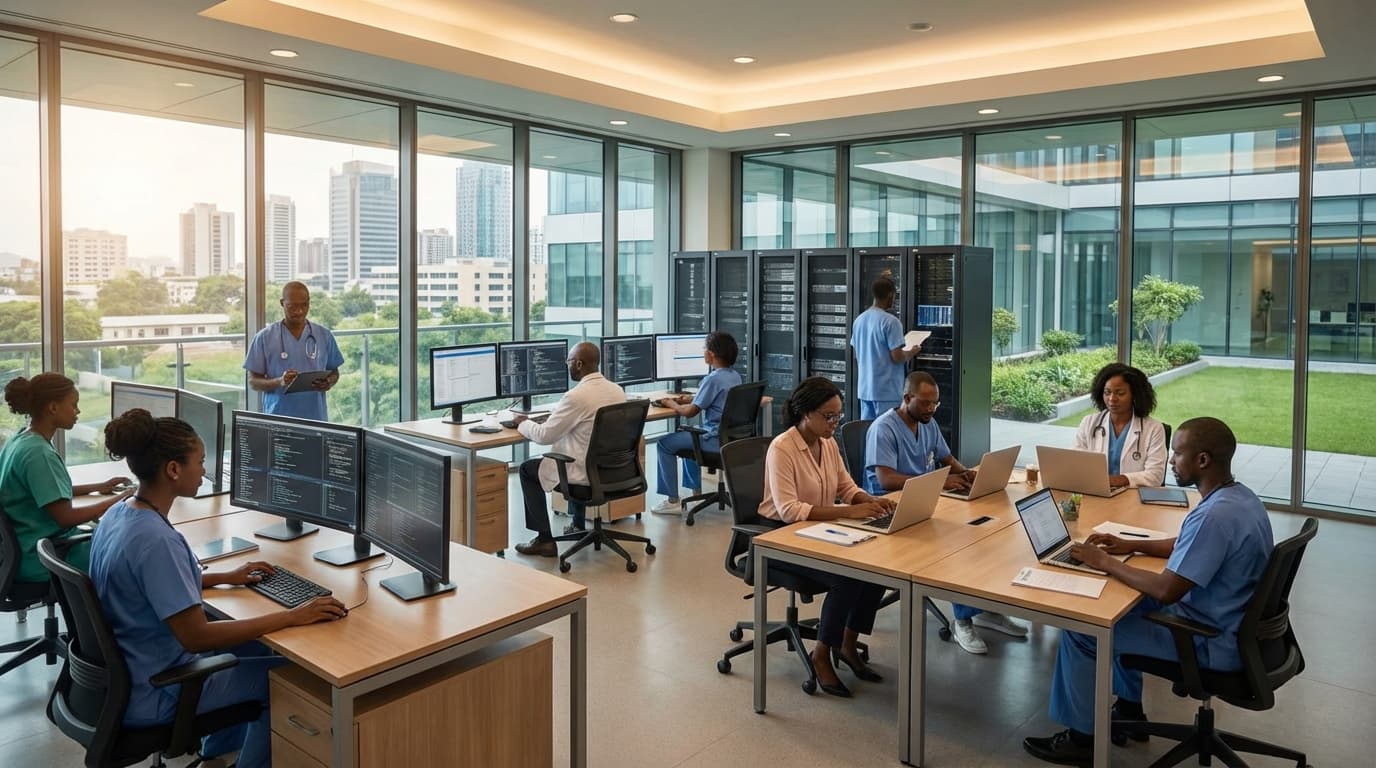
Radiology Reader & Reporting Support in Gambia
Engineering Excellence & Technical Support
Remote radiology reading and reporting services High-standard technical execution following OEM protocols and local regulatory frameworks.
AI-Powered Anomaly Detection
Leverage advanced AI algorithms to flag potential anomalies in X-rays and CT scans, significantly reducing missed diagnoses and accelerating radiologist review time. This empowers the Gambian radiology team to prioritize critical cases and improve patient outcomes.
Seamless Remote Collaboration
Facilitates secure, real-time image sharing and teleconsultation capabilities with international radiology experts. This bridges the expertise gap in Gambia, enabling access to specialized opinions and fostering continuous learning for local radiologists.
Automated Report Generation & Structuring
Streamlines the reporting process by automatically populating standardized templates with key findings and measurements. This reduces manual data entry, minimizes errors, and ensures consistent, high-quality radiology reports for better clinical decision-making.
What Is Radiology Reader & Reporting Support In Gambia?
Radiology Reader & Reporting Support in The Gambia refers to the provision of specialized expertise and technological solutions to augment the capabilities of local radiology departments. This service addresses the inherent challenges in regions with a scarcity of highly trained radiologists, limited access to advanced imaging interpretation, and the need for efficient, accurate diagnostic reporting. It encompasses a spectrum of services designed to enhance diagnostic accuracy, improve workflow efficiency, and facilitate better patient outcomes by leveraging remote or augmented human expertise, as well as AI-powered tools for preliminary analysis and quality assurance.
| Who Needs It? | Typical Use Cases | |||||
|---|---|---|---|---|---|---|
| Hospitals and Clinics in The Gambia: Especially those with limited or no in-house radiologists, particularly in rural or underserved areas. | Emergency Departments: Requiring rapid interpretation of critical imaging studies (e.g., trauma, stroke, acute abdomen) outside of standard working hours or when local expertise is unavailable. | Specialty Departments: Such as Oncology, Neurology, Cardiology, and Orthopedics, needing expert interpretation of complex cross-sectional imaging for diagnosis, treatment planning, and monitoring. | Public Health Initiatives: Supporting large-scale screening programs (e.g., tuberculosis detection via chest X-rays) where high throughput and consistent interpretation are paramount. | Training Hospitals: Augmenting the learning environment for radiology residents and fellows by providing access to a wider range of cases and expert feedback. | Primary Healthcare Centers: Facilitating access to diagnostic imaging interpretation for conditions that would otherwise require referral to specialized centers, thereby reducing patient travel and delays. | Research and Clinical Trials: Requiring standardized and accurate image analysis for data collection and outcome assessment. |
Key Components of Radiology Reader & Reporting Support
- Teleradiology Services: Remote interpretation of medical images (X-ray, CT, MRI, Ultrasound) by qualified radiologists located elsewhere, providing real-time or near real-time diagnostic reads.
- AI-Powered Image Analysis: Utilization of artificial intelligence algorithms for automated detection, segmentation, and quantification of abnormalities in medical images, acting as a 'second reader' or pre-screening tool.
- Reporting Platforms & Tools: Implementation of robust, often cloud-based, reporting systems that enable efficient report generation, standardization, templating, and integration with Picture Archiving and Communication Systems (PACS) and Electronic Health Records (EHRs).
- Quality Assurance & Peer Review: Mechanisms for reviewing diagnostic interpretations and reports to ensure accuracy, consistency, and adherence to best practices, potentially involving senior radiologists or AI-driven quality checks.
- Training & Capacity Building: Programs designed to upskill existing local healthcare professionals, including technologists and junior radiologists, in image acquisition, basic interpretation, and understanding of advanced diagnostic findings.
- Second Opinion Services: Providing an independent expert review of complex or critical cases to confirm or refine initial diagnoses.
Who Needs Radiology Reader & Reporting Support In Gambia?
Radiology Reader & Reporting Support plays a crucial role in enhancing diagnostic capabilities and improving patient care within healthcare systems. In Gambia, several key target customers and departments would significantly benefit from such services, particularly in addressing the existing challenges of radiologist shortages and the need for timely, accurate interpretations.
| Customer/Department | Specific Needs & Benefits | Key Services Required |
|---|---|---|
| Public Hospitals (e.g., Royal Victoria Teaching Hospital) | High patient volume, limited in-house radiologist expertise, need for faster turnaround times, support for diverse imaging modalities (X-ray, CT, Ultrasound, Mammography). | Remote interpretation of X-rays, CT scans, ultrasounds; second opinions; preliminary reports; specialized readings (e.g., neuroimaging, orthopedic imaging). |
| Private Hospitals & Clinics | Desire for expedited results to compete with public sector, potential for specialized patient populations, need for consistent quality reporting. | On-demand remote reading, quality assurance, standardized reporting formats, support for advanced imaging if available. |
| Diagnostic Imaging Centers | Focus on providing imaging services, reliance on external interpretation, need for efficient workflow and timely reports for referring physicians. | Primary interpretation of all imaging modalities, preliminary and final reports, integration with PACS/RIS systems. |
| Rural Health Centers (with basic imaging capabilities) | Severe radiologist shortages, reliance on general practitioners for initial assessment, critical need for remote support to avoid unnecessary patient transfers. | Remote interpretation of basic X-rays and ultrasounds, enabling earlier diagnosis and management of conditions, decision support for referring clinicians. |
| Specialty Clinics (e.g., Cardiology, Oncology, Neurology) | Need for expert interpretation of specific imaging types (e.g., cardiac CT, PET scans, MRI brain), integration of imaging findings with clinical context. | Specialized remote reading services, dictation and reporting support tailored to specific subspecialties, collaborative reporting with referring specialists. |
| Tertiary Referral Centers | Handling complex cases, need for subspecialty expertise that may not be locally available, support for rare conditions. | Advanced subspecialty interpretations (e.g., interventional radiology, pediatric radiology), second opinions on challenging cases, research support. |
| Medical Schools & Training Institutions | Need for educational case material, support for resident training and learning, access to expert reporting for teaching purposes. | Tutor-led reporting sessions, anonymized case examples for teaching, mentorship for radiology residents, quality control of resident interpretations. |
Target Customers & Departments for Radiology Reader & Reporting Support in The Gambia
- Public Hospitals
- Private Hospitals & Clinics
- Diagnostic Imaging Centers
- Rural Health Centers (with basic imaging capabilities)
- Specialty Clinics (e.g., Cardiology, Oncology, Neurology)
- Tertiary Referral Centers
- Medical Schools & Training Institutions
Radiology Reader & Reporting Support Process In Gambia
This document outlines the workflow for the Radiology Reader & Reporting Support Process in The Gambia. This process ensures that medical images are reviewed by qualified radiologists and that comprehensive reports are generated to aid in patient diagnosis and treatment. The workflow begins with an inquiry regarding a radiology service and culminates in the delivery of a final report.
| Step | Description | Responsible Party | Key Outputs/Deliverables | Notes |
|---|---|---|---|---|
| A referring clinician identifies the need for a radiological examination for a patient and initiates a request. | Referring Clinician | Completed radiology request form (physical or electronic) | Includes patient details, clinical history, and the specific imaging modality required. |
| The radiology department schedules the patient for the examination and provides necessary preparation instructions. | Radiology Department/Technologist | Scheduled appointment, patient preparation instructions | May involve fasting, contrast media administration protocols, or other specific preparations. |
| A qualified radiographer or technologist performs the requested radiological examination using appropriate equipment. | Radiology Department/Technologist | Acquired medical images (e.g., X-ray, CT, Ultrasound, MRI) | Ensures image quality meets diagnostic standards. |
| In some cases, a preliminary review might be done by a technologist or junior radiologist to identify urgent findings or assess image quality. | Radiology Department/Technologist or Junior Radiologist | Preliminary findings (if any), confirmation of image quality | Not a substitute for formal radiologist interpretation. |
| Acquired images are uploaded to the Picture Archiving and Communication System (PACS) and assigned to a radiologist for interpretation. | Radiology Department/Administrative Staff | Images accessible on PACS, assigned reading queue | Ensures efficient workload distribution. |
| A qualified radiologist carefully reviews the medical images, analyzes findings, and considers the clinical information provided. | Radiologist (Reader) | Detailed interpretation of images, identification of abnormalities | Requires in-depth knowledge of anatomy, pathology, and imaging techniques. |
| The radiologist dictates or types a comprehensive report detailing their findings, diagnosis, and any recommendations. | Radiologist (Reader) | Draft radiology report | Report should be clear, concise, and medically accurate. |
| In some settings, a senior radiologist may review and approve reports generated by junior radiologists. | Senior Radiologist | Approved radiology report | Ensures quality control and adherence to standards. |
| The final, approved report is finalized and sent to the referring clinician. | Administrative Staff or Radiology Department | Final radiology report | Distribution can be via electronic systems, fax, or secure courier. |
| The referring clinician integrates the radiology report into the patient's overall medical record. | Referring Clinician | Updated patient medical record | Facilitates comprehensive patient care and decision-making. |
| The referring clinician may consult with the radiologist for clarification or further discussion regarding the report findings. | Referring Clinician & Radiologist | Clarified findings, treatment plan adjustments | Ensures effective communication and optimal patient management. |
Key Stakeholders
- Referring Clinician
- Radiology Department/Technologist
- Radiologist (Reader)
- Administrative Staff
Radiology Reader & Reporting Support Cost In Gambia
The cost of radiology reader and reporting support services in The Gambia can vary significantly based on several factors. These include the complexity and type of imaging studies (e.g., X-ray, CT, MRI, ultrasound), the experience and specialization of the radiologist providing the interpretation, the volume of cases, and the turnaround time required for reports. Furthermore, the specific provider, whether it's a local clinic with in-house expertise, a teleradiology service operating within The Gambia, or an international teleradiology provider with local representation, will also influence pricing. For emergency or urgent reports, a premium is often applied. The ongoing development of healthcare infrastructure and the demand for specialized radiological services also play a role in price determination. It's important to note that official, publicly available pricing lists are uncommon in The Gambia for such specialized services, and most quotations are provided on a case-by-case basis.
| Service Component | Estimated Price Range (GMD - Gambian Dalasi) | Notes |
|---|---|---|
| Basic X-ray Interpretation | 1,000 - 2,500 GMD | For common fractures, chest X-rays, etc. |
| Ultrasound Scan Interpretation | 1,500 - 4,000 GMD | Abdomen, pelvis, obstetrics, musculoskeletal. |
| CT Scan Interpretation (e.g., head, abdomen) | 3,000 - 8,000 GMD | Depending on the number of slices and anatomical region. |
| MRI Scan Interpretation (e.g., brain, spine, joints) | 5,000 - 15,000 GMD | More complex and time-consuming, higher cost. |
| Urgent/Emergency Report Fee | Additional 1,000 - 3,000 GMD | Typically added on top of the base interpretation fee. |
| Dedicated Teleradiology Contract (per study) | Varies widely based on volume and service level | Can be negotiated for regular clients. |
Key Pricing Factors for Radiology Reader & Reporting Support in The Gambia
- Type of Imaging Modality (X-ray, CT, MRI, Ultrasound)
- Complexity of the Case/Study
- Radiologist's Experience and Specialization
- Volume of Reports Required
- Turnaround Time (Standard vs. Urgent/Emergency)
- Provider Type (Local Clinic, Local Teleradiology, International Teleradiology)
- Additional Services (e.g., consultations, interventional radiology support)
- Geographic Location within The Gambia (though less impactful for teleradiology)
Affordable Radiology Reader & Reporting Support Options
Radiology practices and healthcare facilities are increasingly seeking cost-effective solutions for reading and reporting on medical images. This demand has led to the emergence of various affordable radiology reader and reporting support options. These solutions aim to improve efficiency, reduce turnaround times, and manage the growing volume of imaging studies without substantial capital investment. Understanding value bundles and employing smart cost-saving strategies are crucial for optimizing these services. Value bundles typically combine multiple services, such as image interpretation, preliminary reads, final reports, peer review, and quality assurance, often at a discounted rate compared to purchasing each service individually. Cost-saving strategies include leveraging teleradiology services, exploring on-demand or subspecialty reads, negotiating flexible service agreements, and utilizing technology to streamline workflows.
| Strategy | Description | Cost-Saving Benefit | Considerations |
|---|---|---|---|
| Value Bundles | Combining multiple services (e.g., primary reads, subspecialty reads, peer review) into a single package for a bundled price. | Reduced per-service cost, predictable budgeting, streamlined vendor management. | Ensure the bundle meets specific needs; review contract terms carefully for included services and volume commitments. |
| Teleradiology (Off-Peak/Overnight) | Utilizing remote radiologists for interpretation during non-peak hours or overnight shifts. | Lower hourly rates compared to in-house radiologists for off-hours, improved turnaround times for emergent cases. | Ensure robust IT infrastructure and secure data transmission; establish clear communication protocols and quality control measures. |
| Subspecialty Teleradiology | Accessing highly specialized radiologists remotely for complex or niche imaging studies. | Avoids the need to recruit and retain expensive in-house subspecialists, provides expert opinions for challenging cases. | Verify subspecialty credentials and experience; establish turnaround time expectations for subspecialty reads. |
| Flexible Service Agreements | Negotiating contracts based on actual study volume or usage rather than fixed commitments. | Pay-as-you-go models reduce costs during lower-volume periods, scalability to match demand. | Clearly define the pricing structure, minimums, and maximums; understand any penalties for exceeding agreed-upon limits. |
| AI-Assisted Reporting | Integrating AI tools that pre-populate report sections, flag potential abnormalities, or suggest differential diagnoses. | Reduces radiologist dictation time, improves consistency, can enhance diagnostic accuracy, leading to fewer callbacks or corrections. | Carefully evaluate AI tool performance and integration with existing PACS/RIS; maintain radiologist oversight and ultimate responsibility. |
| Shared Service Models | Collaborating with other facilities to share radiology reading services or overhead costs. | Spreads the cost of reader services across multiple entities, potentially leading to bulk discounts. | Requires strong inter-organizational agreements and robust communication; ensure HIPAA compliance and data security. |
| Standardized Reporting Templates | Implementing pre-defined, structured reporting templates for common study types. | Significantly reduces dictation and editing time for radiologists, improves report clarity and consistency. | Requires initial investment in template design and integration; ensure templates are adaptable to unique findings. |
Affordable Radiology Reader & Reporting Support Options
- Teleradiology Services: Outsourcing image interpretation to remote radiologists, often available 24/7.
- On-Demand Reading: Accessing specialized radiologists for specific cases or during peak times.
- Subspecialty Interpretation: Utilizing experts in fields like neuroradiology, musculoskeletal, or cardiac imaging.
- Preliminary Read Services: Obtaining quick initial interpretations to expedite patient care.
- AI-Powered Reading Support: Augmenting human reads with artificial intelligence for enhanced accuracy and efficiency.
- Reporting Template Optimization: Standardizing report formats for faster generation and improved clarity.
- Workflow Automation Tools: Implementing software to manage image routing, dictation, and report distribution.
Verified Providers In Gambia
In Gambia, the healthcare landscape is increasingly focused on ensuring quality and reliability for patients seeking medical services. A key aspect of this is the availability of verified providers. Franance Health stands out as a leading example of such an organization, offering a robust system for credentialing and ensuring that their network of healthcare professionals meets the highest standards. This commitment to verification is crucial for patient safety, trust, and ultimately, better health outcomes. Understanding Franance Health's credentialing process and the benefits it offers to patients in Gambia reveals why they are considered the best choice for accessible and trustworthy healthcare.
| Key Aspects of Franance Health's Credentialing | Benefits for Patients in Gambia |
|---|---|
| Verification of Medical Degrees and Licenses | Ensures providers possess the fundamental legal and educational qualifications. |
| Assessment of Clinical Experience and Competency | Confirms practical skills and ability to effectively diagnose and treat patients. |
| Background Checks and Ethical Reviews | Guarantees providers adhere to professional and ethical standards, promoting patient safety and trust. |
| Ongoing Professional Development Monitoring | Keeps patients informed that their chosen providers are up-to-date with the latest medical advancements. |
| Patient Feedback Integration | Allows for continuous improvement of services based on real-world patient experiences. |
Why Franance Health is the Best Choice for Verified Providers in Gambia:
- Rigorous Vetting Process: Franance Health employs a comprehensive and multi-faceted vetting process for all healthcare providers within its network. This goes beyond basic licensing to include in-depth background checks, verification of educational qualifications, and assessment of practical skills.
- Commitment to Continuous Improvement: The credentialing isn't a one-time event. Franance Health actively monitors provider performance and encourages ongoing professional development, ensuring that their network remains at the forefront of medical best practices.
- Patient-Centric Approach: The primary goal of Franance Health's verification system is to empower patients with the confidence that they are receiving care from competent and ethical professionals.
- Access to Quality Care: By partnering with Franance Health, patients gain access to a curated list of verified providers, reducing the risk of encountering substandard or unqualified practitioners.
- Transparency and Accountability: Franance Health promotes transparency in its credentialing procedures, allowing patients to understand the measures taken to ensure the quality of care they receive. This fosters a sense of accountability within the healthcare system.
Scope Of Work For Radiology Reader & Reporting Support
This Scope of Work (SOW) outlines the requirements for Radiology Reader & Reporting Support services. The objective is to provide qualified and experienced radiologists to review medical images and generate comprehensive diagnostic reports. This document details the technical deliverables and standard specifications required to ensure high-quality and efficient service delivery.
| Deliverable | Description | Standard Specification | Quality Assurance |
|---|---|---|---|
| Radiology Image Interpretation | Review of digital medical images across all modalities. | Interpretation performed by board-certified or equivalent radiologists with relevant subspecialty expertise. Adherence to established radiological interpretation protocols and best practices. | Peer review process for a statistically significant sample of reports. Review of turnaround times and client feedback. |
| Diagnostic Reports | Generation of comprehensive written reports based on image interpretation. | Reports to be structured with findings, impression, and recommendations. Adherence to standardized reporting templates. Use of clear and unambiguous medical terminology. Inclusion of relevant clinical history. | Automated grammar and spelling checks. Spot checks for accuracy and completeness by a senior radiologist. Verification against original images and clinical data. |
| PACS/RIS Integration | Secure and reliable access to the client's PACS and RIS for image viewing and report dictation/generation. | Secure VPN or equivalent connection. Compatibility with client's PACS/RIS software versions. Adherence to client's IT security policies and procedures. | Regular system checks for connectivity and performance. Incident reporting and resolution for any integration issues. |
| Turnaround Time (TAT) | Timely delivery of interpreted reports. | Defined TATs based on modality and urgency (e.g., STAT, Urgent, Routine). For example: STAT X-rays within 15-30 minutes, Routine CT scans within 24 hours. | Automated monitoring of report generation times against defined TATs. Regular reporting on TAT compliance. |
| Communication | Effective communication with referring physicians and radiologists. | Option for direct communication for critical findings. Secure messaging system or designated point of contact. Regular status updates as required. | Documentation of all critical findings communication. Client satisfaction surveys regarding communication effectiveness. |
| Data Security & Confidentiality | Protection of all patient data and proprietary information. | Compliance with HIPAA and other relevant data protection regulations. Secure data transmission and storage practices. Non-disclosure agreements (NDAs) for all personnel. | Regular security audits. Incident response plan for data breaches. Training on data security protocols. |
Key Objectives and Scope of Services
- To provide expert interpretation of various radiological modalities (e.g., X-ray, CT, MRI, Ultrasound, Nuclear Medicine).
- To generate accurate, concise, and timely diagnostic reports in accordance with clinical requirements and established guidelines.
- To ensure seamless integration with the client's Picture Archiving and Communication System (PACS) and Radiology Information System (RIS).
- To maintain strict adherence to all patient privacy (HIPAA) and data security regulations.
- To offer flexible scheduling and on-demand support based on client needs.
Service Level Agreement For Radiology Reader & Reporting Support
This Service Level Agreement (SLA) outlines the performance standards and commitments for the Radiology Reader & Reporting Support services provided. It defines the expected response times for critical issues and the guaranteed uptime for the associated systems and personnel.
| Service Component | Priority Level | Response Time Target | Resolution Time Target | Uptime Guarantee |
|---|---|---|---|---|
| Radiology Reader Support (Critical Issue) | Critical (e.g., system outage impacting all reading, inability to access studies) | 15 minutes | 2 hours | 99.9% |
| Radiology Reader Support (High Priority Issue) | High (e.g., individual user login issues, specific workstation malfunction) | 1 hour | 4 hours | 99.9% |
| Radiology Reader Support (Medium Priority Issue) | Medium (e.g., minor display artifacts, request for report template adjustment) | 4 business hours | 8 business hours | N/A (covered by system uptime) |
| Reporting Support (Critical Issue) | Critical (e.g., transcription system down, inability to save reports) | 15 minutes | 2 hours | 99.9% |
| Reporting Support (High Priority Issue) | High (e.g., dictation device not working, specific report formatting error) | 1 hour | 4 hours | 99.9% |
| Reporting Support (Medium Priority Issue) | Medium (e.g., request for minor edits, question about reporting workflow) | 4 business hours | 8 business hours | N/A (covered by system uptime) |
| PACS/RIS System Uptime | N/A | N/A | N/A | 99.9% (excluding scheduled maintenance) |
Key Service Components
- Radiology Reader Support: On-demand assistance for interpreting medical images and generating radiology reports.
- Reporting Support: Assistance with dictation, transcription, and final report generation.
- System Uptime: Guarantee of availability for the PACS (Picture Archiving and Communication System) and RIS (Radiology Information System) platforms.
- Response Times: Defined timelines for acknowledging and initiating resolution of reported issues.
Frequently Asked Questions

Ready when you are
Let's scope your Radiology Reader & Reporting Support in Gambia project in Gambia.

Scaling healthcare logistics and technical systems across the entire continent.