
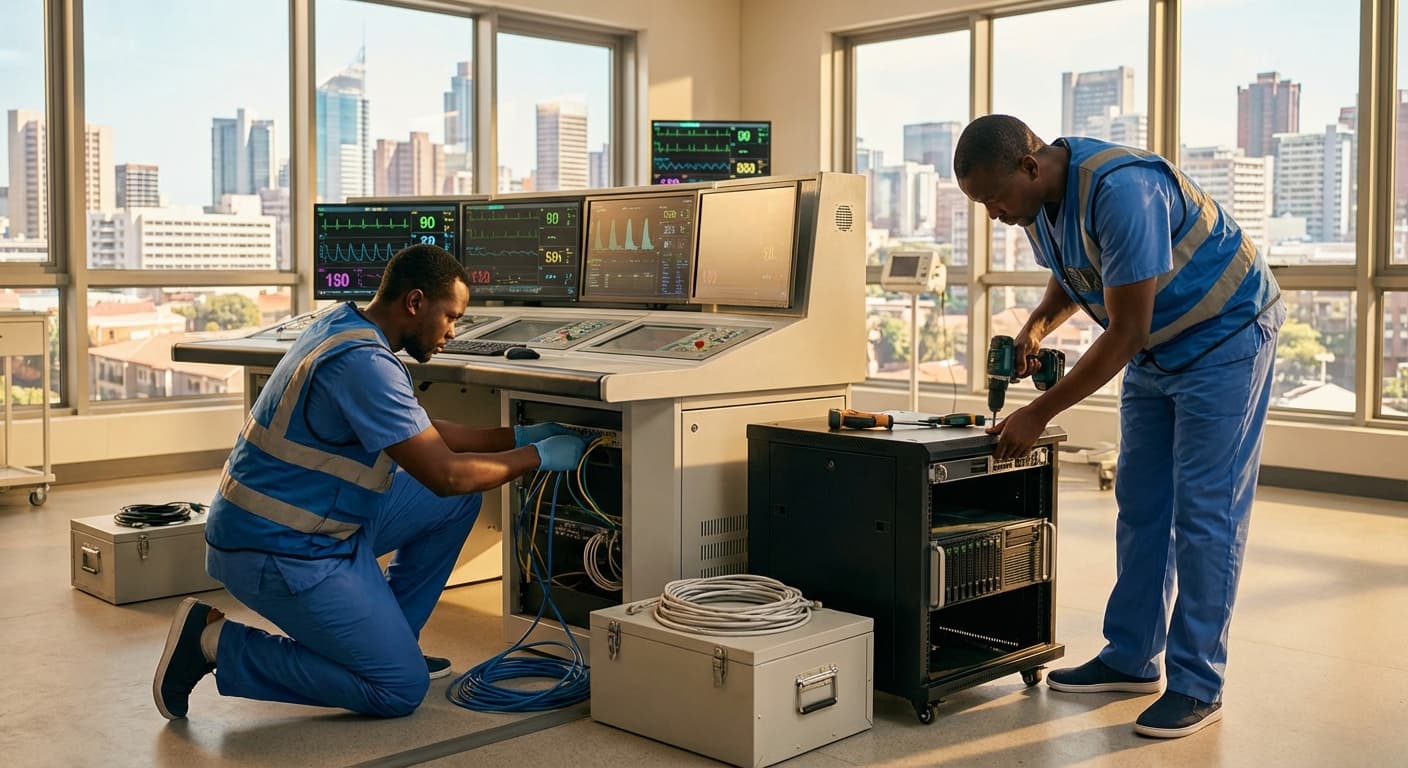
ICU Central Monitoring Station Installation Service in Gambia
Engineering Excellence & Technical Support
ICU Central Monitoring Station Installation Service High-standard technical execution following OEM protocols and local regulatory frameworks.
Robust Network Infrastructure Deployment
We architect and implement highly reliable, secure, and scalable network infrastructure essential for seamless real-time data transmission from bedside monitors to the central ICU station, ensuring uninterrupted patient monitoring in critical care environments.
Advanced Monitoring System Integration
Our expert technicians expertly integrate state-of-the-art central monitoring systems with diverse patient monitoring devices, ensuring compatibility, data accuracy, and optimized workflow for ICU staff, ultimately enhancing patient safety and clinical decision-making.
Comprehensive Training & Support
Beyond installation, we provide thorough end-user training and ongoing technical support for the ICU central monitoring station, empowering healthcare professionals in Gambia with the knowledge and resources to maximize system utilization and ensure continuous operational efficiency.
What Is Icu Central Monitoring Station Installation Service In Gambia?
ICU Central Monitoring Station Installation Service in Gambia refers to the specialized provision of hardware and software infrastructure, alongside expert deployment, configuration, and integration, for establishing a centralized hub to remotely monitor and manage critical patient vital signs and physiological parameters within Intensive Care Units (ICUs) across healthcare facilities in The Gambia. This service is integral to modern critical care, enabling a multidisciplinary team to have real-time oversight of multiple patients simultaneously from a designated station, thereby enhancing patient safety, improving response times to critical events, and optimizing resource allocation.
| Stakeholder Group | Need for Service | Typical Use Cases |
|---|---|---|
| Hospitals and Healthcare Facilities in The Gambia (Public and Private) | To enhance critical care capabilities, improve patient outcomes, and comply with modern healthcare standards. | Real-time remote surveillance of critically ill patients in ICUs, early detection of physiological deterioration, immediate alert notification for life-threatening events (e.g., cardiac arrest, respiratory distress), improved workflow efficiency for nursing staff, and facilitating timely clinical decision-making by intensivists. |
| Intensivists and Critical Care Physicians | To maintain continuous oversight of multiple patients, enabling prompt intervention and strategic management of critical cases. | Simultaneous review of vital signs, ECG waveforms, and other physiological data from a single interface, proactive identification of trends indicative of clinical decline, and coordinated response to emergent situations. |
| ICU Nursing Staff | To optimize patient monitoring, reduce alarm fatigue through intelligent alarm filtering, and efficiently manage workload. | Centralized viewing of all assigned patients' parameters, automated alerts for critical deviations, streamlined documentation, and reduced need for constant physical presence at each bedside for routine checks. |
| Hospital Information Technology (IT) Departments | To ensure the reliable operation, security, and maintenance of advanced medical monitoring systems. | Network management, system updates, cybersecurity of patient data, troubleshooting hardware and software issues, and integration with other IT infrastructure. |
| Medical Equipment Suppliers and Installers | To provide specialized expertise in the deployment and integration of complex medical technology. | End-to-end project management from assessment to commissioning, ensuring compliance with manufacturer specifications and local regulations. |
Key Components and Activities of ICU Central Monitoring Station Installation Service:
- Site Assessment and Planning: Comprehensive evaluation of existing ICU infrastructure, network capabilities, power supply, and architectural considerations to determine optimal placement and configuration of the central monitoring station and associated bedside monitoring equipment.
- Hardware Procurement and Installation: Sourcing, delivery, and physical installation of central monitoring workstations, servers, network switches, uninterruptible power supplies (UPS), and relevant display technologies (e.g., large-format monitors, touchscreen consoles).
- Bedside Monitor Integration: Connecting and configuring individual patient bedside monitors (e.g., multi-parameter physiological monitors) to the central monitoring network. This includes establishing secure data transmission pathways.
- Software Deployment and Configuration: Installation and customization of the central monitoring software platform, including patient data management systems, alarm management modules, trending and waveform display functionalities, and user access controls.
- Network Infrastructure Setup: Establishing a robust and reliable local area network (LAN) or wireless network (WLAN) to facilitate seamless data flow between bedside monitors and the central station. This may involve network cabling, Wi-Fi access point installation, and IP address management.
- System Calibration and Testing: Rigorous testing of all hardware and software components to ensure accurate data acquisition, reliable transmission, and effective alarm generation. This includes performance verification under simulated critical scenarios.
- User Training and Support: Providing comprehensive training to clinical staff (nurses, physicians, intensivists) and IT personnel on the operation, maintenance, and troubleshooting of the central monitoring system. Ongoing technical support and maintenance agreements are often included.
- Data Security and Privacy Implementation: Implementing robust security measures to protect sensitive patient health information (PHI) in compliance with relevant data protection regulations. This includes encryption, access logging, and firewall configurations.
- Integration with Existing Hospital Information Systems (HIS): Facilitating interoperability with other hospital systems, such as Electronic Health Records (EHRs), for a unified view of patient data.
Who Needs Icu Central Monitoring Station Installation Service In Gambia?
Installing and maintaining an ICU Central Monitoring Station is a critical endeavor for any healthcare facility aiming to provide advanced patient care. In Gambia, as the healthcare sector grows and seeks to enhance its critical care capabilities, the need for specialized ICU Central Monitoring Station installation services becomes increasingly apparent. These services are vital for ensuring the seamless integration, optimal performance, and ongoing support of the sophisticated technology required to monitor critically ill patients effectively.
| Target Customer Type | Specific Departments/Roles Involved |
|---|---|
| Public Hospitals | ICU Department, Biomedical Engineering Department, IT Department, Hospital Administration, Procurement Department |
| Private Hospitals/Clinics | ICU Department, Clinical Engineering Department, IT Department, Hospital Management, Purchasing Department |
| Specialty Clinics (e.g., Cardiac Centers) | Cardiac ICU, Biomedical Staff, IT Support, Clinic Management, Procurement Officers |
| Government Health Agencies | National Health Directorate, Infrastructure Planning Units, Procurement Units, Technical Support Teams |
| Medical Equipment Vendors/Distributors | Installation Teams, Technical Support Staff, Sales and Project Managers, Client Hospital's Biomedical/IT Departments |
| International Organizations | Project Managers, Healthcare Technical Advisors, Local Implementation Teams, Beneficiary Hospital Staff |
Who Needs ICU Central Monitoring Station Installation Service in Gambia?
- Hospitals and healthcare facilities in Gambia that are establishing or upgrading their Intensive Care Units (ICUs).
- Government health ministries and public hospitals looking to standardize and improve critical care infrastructure across the nation.
- Private healthcare providers investing in state-of-the-art medical technology to offer specialized services.
- International aid organizations and NGOs supporting the development of healthcare systems in Gambia.
- Medical equipment suppliers and distributors who require professional installation and integration of monitoring systems for their clients.
- Research and teaching hospitals that need reliable and advanced monitoring for clinical studies and medical education.
Icu Central Monitoring Station Installation Service Process In Gambia
This document outlines the comprehensive workflow for the ICU Central Monitoring Station Installation Service in Gambia, from the initial customer inquiry to the successful execution and handover of the installed system.
| Phase | Stage | Key Activities | Deliverables | Key Stakeholders |
|---|---|---|---|---|
| 1 | Inquiry and Initial Assessment | 1.1 Customer Inquiry: Hospital/Clinic expresses interest in ICU Central Monitoring Station. 1.2 Preliminary Requirements Gathering: Understanding existing infrastructure, number of ICU beds, desired features, and budget. 1.3 Site Visit (Optional but Recommended): Technical team assesses the physical space, power availability, network infrastructure, and potential installation challenges. 1.4 Initial Consultation: Discussing options, technical feasibility, and preliminary scope of work. | Initial understanding of customer needs, preliminary site assessment report (if applicable), basic scope definition. | Customer (Hospital/Clinic Management, IT Department, Clinical Engineering), Service Provider (Sales Team, Technical Consultants) |
| 2 | Proposal and Agreement | 2.1 Detailed Technical Design: Developing a comprehensive design based on requirements and site assessment. 2.2 Equipment Specification: Listing all hardware, software, and accessories required. 2.3 Costing and Quotation: Preparing a detailed proposal with equipment costs, installation fees, and any recurring charges. 2.4 Proposal Presentation & Negotiation: Discussing the proposal with the client, addressing concerns, and finalizing terms. 2.5 Contract Signing: Formal agreement on scope, timeline, payment terms, and responsibilities. | Detailed technical proposal, Bill of Materials (BOM), formal quotation, signed contract/agreement. | Customer (Procurement, Finance, Technical Decision Makers), Service Provider (Sales Team, Project Managers, Legal) |
| 3 | Pre-Installation Planning and Logistics | 3.1 Project Kick-off Meeting: Formal start of the project with both teams, defining roles and responsibilities. 3.2 Procurement of Equipment: Ordering and sourcing all necessary components. 3.3 Logistics and Shipping: Arranging for the transportation of equipment to Gambia, including customs clearance. 3.4 On-site Preparation: Ensuring the installation area is ready, clean, and accessible. 3.5 Scheduling Installation: Coordinating installation dates with the hospital/clinic, considering operational impact. | Project plan, confirmed equipment delivery schedule, logistics manifest, site readiness confirmation, finalized installation schedule. | Service Provider (Project Managers, Procurement, Logistics Team, Technical Installation Team), Customer (Hospital/Clinic Management, Facilities Management) |
| 4 | On-Site Installation and Configuration | 4.1 Equipment Unpacking and Inspection: Verifying all delivered items against the BOM. 4.2 Hardware Installation: Mounting servers, workstations, network devices, and cabling. 4.3 Software Installation and Configuration: Setting up the central monitoring software, patient monitoring units, and integrating with existing hospital systems (if applicable). 4.4 Network Setup and Integration: Configuring network connectivity for all devices. 4.5 System Calibration: Ensuring accurate data acquisition and display. | Physically installed hardware, configured software, integrated network, calibrated system components. | Service Provider (Installation Engineers, Network Specialists, Software Engineers), Customer (IT Department, Biomedical Engineers) |
| 5 | Testing, Training, and Handover | 5.1 System Testing: Comprehensive testing of all functionalities, alarms, data transmission, and reporting. 5.2 User Acceptance Testing (UAT): Client's technical and clinical staff verifying the system meets their requirements. 5.3 End-User Training: Training for ICU nurses, doctors, and biomedical engineers on system operation, maintenance, and troubleshooting. 5.4 Documentation Handover: Providing user manuals, technical guides, and warranty information. 5.5 Formal Handover: Official transfer of the installed system to the client. | Test reports, UAT sign-off, training materials, completed training sessions, handover documentation, signed acceptance certificate. | Service Provider (Installation Team, Training Specialists, Project Managers), Customer (Clinical Staff, Biomedical Engineers, IT Department, Management) |
| 6 | Post-Installation Support | 6.1 Warranty Period: Providing support and addressing any issues that arise during the warranty period. 6.2 Maintenance and Service Contracts (Optional): Offering ongoing maintenance, software updates, and technical support. 6.3 Performance Monitoring: Potentially remote monitoring of system performance (if agreed upon). 6.4 Follow-up Consultations: Addressing any further needs or upgrades. | Resolved issues, ongoing system performance, continued client satisfaction. | Service Provider (Technical Support Team, Service Engineers), Customer (Hospital/Clinic Management, Biomedical Engineers) |
ICU Central Monitoring Station Installation Service Workflow in Gambia
- Phase 1: Inquiry and Initial Assessment
- Phase 2: Proposal and Agreement
- Phase 3: Pre-Installation Planning and Logistics
- Phase 4: On-Site Installation and Configuration
- Phase 5: Testing, Training, and Handover
- Phase 6: Post-Installation Support
Icu Central Monitoring Station Installation Service Cost In Gambia
Installing an ICU Central Monitoring Station (CMS) in Gambia involves a range of costs influenced by several factors. These stations are critical for continuous patient observation in intensive care units, requiring specialized equipment and expertise. The pricing is not a one-size-fits-all figure and can vary significantly based on the complexity of the system, the number of beds to be monitored, the specific technologies chosen, and the installation and training services required. Local economic conditions and the availability of specialized technicians also play a role. It's essential to obtain detailed quotes from multiple reputable suppliers and installers to understand the full scope of costs.
| Cost Component | Estimated Range (GMD) | Notes |
|---|---|---|
| Central Monitoring Station Hardware (Server, Displays) | 700,000 - 2,500,000+ | Varies by brand, capacity, and features. |
| Patient Monitors (per bed) | 250,000 - 700,000+ | Depends on vital sign parameters, touch screen, etc. |
| Telemetry Units (if applicable, per bed) | 150,000 - 400,000+ | For wireless monitoring. |
| Software Licensing & Integration | 300,000 - 1,500,000+ | Can be a significant portion, especially for advanced HIS/EHR integration. |
| Installation & Configuration | 200,000 - 800,000 | Includes labor, cabling, and initial setup. |
| Training (Staff & IT) | 100,000 - 400,000 | Depends on the duration and number of trainees. |
| Shipping, Import Duties & Taxes | 15% - 30% of CIF value | Highly variable based on import regulations and equipment value. |
| Annual Maintenance & Support Contract | 10% - 20% of initial hardware cost | Often recommended for ongoing support and updates. |
| Site Preparation (if needed) | 50,000 - 300,000+ | Depends on existing infrastructure. |
| Total Estimated Installation Cost (Basic to Advanced System) | 1,750,000 - 8,000,000+ GMD | This is a broad estimate. Detailed quotes are essential. |
Key Pricing Factors for ICU Central Monitoring Station Installation in Gambia:
- System Capacity and Scope: The number of patient monitoring beds the CMS needs to support is a primary cost driver. Larger ICU units requiring monitoring of more patients will naturally incur higher expenses.
- Equipment Quality and Brand: High-end, technologically advanced monitoring equipment from well-known international brands will typically be more expensive than basic or generic alternatives. This includes vital sign monitors, telemetry units, and the central server and display systems.
- Software and Integration: The cost of the central monitoring software, its licensing fees, and the effort required to integrate it with existing hospital information systems (HIS) or electronic health records (EHR) can add to the overall price.
- Installation and Configuration Services: This includes the physical installation of the central station hardware, network cabling, power setup, and the configuration of software settings and alerts specific to the hospital's protocols.
- Training: Comprehensive training for medical staff (doctors, nurses) and IT personnel on operating and maintaining the CMS is crucial and often included in the service cost.
- Maintenance and Support Contracts: Post-installation maintenance, technical support, and potential software updates often involve ongoing costs that should be factored into the total investment.
- Site Preparation: Depending on the existing infrastructure, there might be costs associated with preparing the installation site, such as electrical upgrades, network infrastructure improvements, or dedicated server room requirements.
- Import Duties and Taxes: As most advanced medical equipment is imported into Gambia, import duties, taxes, and shipping costs will contribute significantly to the final price.
- Supplier and Installer Expertise: The reputation, experience, and service level of the company providing the installation can influence pricing. Specialized medical equipment installers may command higher fees.
- Customization: Any specific customization requirements for the system, such as custom alert thresholds, specialized data reporting, or integration with unique medical devices, will add to the cost.
Affordable Icu Central Monitoring Station Installation Service Options
Installing an ICU Central Monitoring Station (CMS) is a critical investment for any healthcare facility, but it doesn't have to break the bank. We offer a range of affordable installation service options designed to meet your budget and operational needs. Understanding value bundles and employing cost-saving strategies are key to maximizing your investment. This guide outlines how we can help you achieve a robust and reliable CMS system without compromising on quality.
| Value Bundle | Description | Cost-Saving Strategies Included |
|---|---|---|
| Essential CMS Starter Pack | Ideal for smaller ICUs or those with a limited initial budget. Includes core monitoring hardware, central station software, and basic installation services. | • Standardized hardware package • Streamlined installation process • Basic staff training modules |
| Scalable CMS Solution | Designed for growing ICUs. Offers flexibility to add more monitoring points and features as your needs evolve. Includes robust network infrastructure and advanced integration capabilities. | • Phased hardware procurement • Modular software licensing • Comprehensive network planning |
| Integrated Workflow Bundle | Focuses on seamless integration with your existing Electronic Health Record (EHR) system. Maximizes data efficiency and reduces manual entry, leading to long-term operational savings. | • Pre-configured EHR integration • Workflow optimization consultation • Advanced data analytics setup |
| Comprehensive Support & Training Package | Includes extended warranty, proactive maintenance plans, and in-depth, multi-level staff training. Ensures maximum uptime and staff proficiency. | • Reduced downtime through preventive maintenance • Extended hardware lifecycle • Reduced need for external support |
Key Components of an Affordable ICU CMS Installation
- Needs Assessment & Planning: Thoroughly understanding your ICU's patient volume, existing infrastructure, and future expansion plans to design the most efficient and cost-effective system.
- Hardware Selection & Procurement: Recommending and sourcing high-quality, reliable monitoring equipment from reputable manufacturers, potentially exploring refurbished or certified pre-owned options where appropriate.
- Software Integration & Configuration: Seamlessly integrating monitoring software with existing hospital IT systems (EMR/EHR) to ensure data flow and streamline workflows.
- Network Infrastructure Setup: Designing and implementing a secure and robust network capable of handling real-time data transmission from multiple patient monitors to the central station.
- On-site Installation & Cabling: Professional installation of all hardware, including cabling, ensuring proper placement for optimal accessibility and minimal disruption.
- System Testing & Calibration: Rigorous testing and calibration of all components to guarantee accuracy, reliability, and adherence to medical device standards.
- Staff Training: Comprehensive training for your ICU staff on operating and maintaining the new CMS, empowering them to utilize its full capabilities.
- Post-Installation Support & Maintenance: Ongoing support to address any issues and proactive maintenance to ensure long-term system performance.
Verified Providers In Gambia
In the burgeoning healthcare landscape of Gambia, identifying trusted and accredited medical facilities is paramount for individuals seeking quality care. 'Verified Providers in Gambia' highlights the critical importance of understanding medical credentials and explains why partnering with such providers, particularly those with Franance Health's accreditation, offers unparalleled advantages. Franance Health's rigorous vetting process ensures that accredited institutions meet the highest international standards for patient safety, clinical expertise, and ethical practices. This accreditation is not merely a badge; it's a guarantee of competence, transparency, and a patient-centric approach, making Franance Health-certified providers the optimal choice for all your healthcare needs in Gambia.
| Aspect of Credentialing | Franance Health's Impact | Benefit to Patients |
|---|---|---|
| Facility Standards | Ensures modern infrastructure, adequate equipment, and hygienic environments. | Provides access to safe and well-equipped medical facilities. |
| Staff Qualifications | Verifies medical professionals' education, training, and licensure. | Guarantees treatment from competent and experienced healthcare providers. |
| Clinical Protocols | Assesses adherence to evidence-based treatment guidelines and best practices. | Ensures accurate diagnoses and effective, up-to-date medical interventions. |
| Patient Rights and Grievances | Confirms clear policies for patient consent, privacy, and accessible complaint resolution. | Empowers patients and ensures their rights are protected during treatment. |
| Infection Control | Mandates strict protocols to prevent healthcare-associated infections. | Minimizes the risk of contracting infections while receiving medical care. |
| Resource Management | Evaluates efficient use of medical supplies, pharmaceuticals, and personnel. | Contributes to the sustainability and accessibility of quality healthcare services. |
Why Franance Health Credentials Matter for Gambian Healthcare Providers
- International Standards Adherence: Franance Health accreditation signifies that providers meet globally recognized benchmarks for quality and safety.
- Rigorous Vetting Process: Institutions undergo extensive evaluations of their facilities, equipment, staff qualifications, and operational procedures.
- Enhanced Patient Safety: Accreditation focuses on minimizing risks and ensuring the highest levels of patient care and well-being.
- Clinical Excellence and Expertise: Certified providers demonstrate a commitment to employing highly skilled medical professionals and utilizing advanced medical technologies.
- Ethical Practice Assurance: Franance Health upholds strict ethical guidelines, ensuring transparent and responsible medical conduct.
- Improved Patient Outcomes: Access to accredited facilities correlates with better diagnostic accuracy, effective treatment, and positive recovery rates.
- Trust and Reliability: The Franance Health mark provides a clear indicator of a provider's commitment to excellence, fostering patient confidence.
- Reduced Healthcare Navigation Burden: Patients can more easily identify reliable healthcare options, saving time and reducing stress.
Scope Of Work For Icu Central Monitoring Station Installation Service
This Scope of Work (SOW) outlines the requirements for the installation of an Intensive Care Unit (ICU) Central Monitoring Station (CMS). The service includes the complete setup, configuration, testing, and commissioning of the CMS hardware and software, ensuring seamless integration with existing or new patient monitoring devices within the ICU. The objective is to provide a robust and reliable system for real-time surveillance, data acquisition, and alarm management of critically ill patients.
| Technical Deliverable | Description | Standard Specification/Reference |
|---|---|---|
| CMS Server(s) | High-performance servers to host the CMS software, database, and manage data processing. | Server hardware meeting or exceeding manufacturer's recommended specifications for real-time medical data processing. Redundant configurations (e.g., RAID, dual power supplies) are preferred. Operating system: Windows Server or equivalent, compatible with CMS software. |
| CMS Workstation(s) | Client workstations for viewing patient data, alarms, and system management. | High-resolution displays (minimum 24-inch, 1920x1080 resolution), powerful CPUs, sufficient RAM, and graphics cards. Operating system: Windows 10/11 Pro or equivalent, compatible with CMS software. |
| Display Monitors | High-resolution monitors for the central monitoring console, displaying vital signs and alarms. | Medical-grade displays with high contrast ratios, wide viewing angles, and fast refresh rates. Resolution: Minimum 1920x1080 (Full HD) or higher. Size: Minimum 24 inches. |
| Network Infrastructure | All necessary network cabling, switches, routers, and firewalls to ensure reliable data communication. | Gigabit Ethernet (1000 Mbps) for intra-room connectivity. Fiber optic cabling for backbone connections where required. Network switches with Quality of Service (QoS) capabilities to prioritize critical medical data. Secure network design with appropriate firewall rules. |
| Uninterruptible Power Supply (UPS) | Battery backup systems for all CMS hardware to ensure continuous operation during power outages. | Sufficient capacity to provide at least 30 minutes of runtime for all connected CMS equipment. Medical-grade UPS with surge protection. |
| CMS Software Suite | The core software application for central monitoring, alarm management, and data archiving. | Version specified by the hospital, compliant with relevant medical device software standards (e.g., IEC 62304). Includes features for real-time data display, waveform scrolling, trend analysis, alarm logging, and reporting. |
| Patient Monitoring Device Interfaces | Software or hardware modules for connecting and acquiring data from various patient monitoring devices. | Compatibility with specific device models and communication protocols (e.g., HL7, proprietary protocols). Data acquisition rates and accuracy as per device specifications. |
| Alarm Management System | The component of the CMS responsible for setting, triggering, and notifying alarms. | Configurable alarm thresholds for each vital sign. Multiple alarm notification methods (audible, visual, network-based). Prioritization of alarms based on severity. Compliance with alarm management best practices. |
| System Documentation | All documentation related to the installation, configuration, and operation of the CMS. | Includes installation guides, configuration manuals, user manuals, training materials, as-built drawings, and test reports. Adherence to IT and medical equipment documentation standards. |
| Training Materials | Comprehensive training curriculum and materials for end-users and administrators. | Hands-on training sessions, user guides, cheat sheets, and online resources. Content tailored to different user roles. |
Project Phases and Key Activities
- Phase 1: Planning and Design
- Site assessment and survey of the ICU environment.
- Review of existing network infrastructure and power availability.
- Finalization of CMS hardware and software requirements based on hospital specifications.
- Development of a detailed installation plan, including cabling routes and equipment placement.
- Creation of a network diagram and IP address allocation plan.
- Obtain necessary approvals and permits.
- Phase 2: Hardware Installation
- Unpacking, inspection, and staging of all CMS hardware components (servers, workstations, displays, network switches, UPS).
- Physical installation of server racks, workstations, and display units in designated locations.
- Installation and termination of all necessary network cabling (Ethernet, fiber optic) and power cables.
- Connection of UPS systems and verification of power supply.
- Installation of any specialized hardware interfaces for patient monitoring devices.
- Phase 3: Software Installation and Configuration
- Installation of the CMS operating system and core software applications.
- Configuration of network settings, including IP addresses, subnets, and DNS.
- Setup of user accounts, roles, and permissions.
- Configuration of patient data acquisition modules and interfaces.
- Customization of alarm parameters, thresholds, and notification rules.
- Integration with existing hospital information systems (HIS) or electronic health records (EHR) if applicable.
- Phase 4: System Integration and Testing
- Connection of patient monitoring devices (e.g., ventilators, ECG monitors, NIBP) to the CMS.
- Verification of data streams from all connected devices.
- Comprehensive system testing, including functionality, performance, and reliability tests.
- Alarm testing to ensure timely and accurate notification.
- Stress testing to evaluate system performance under load.
- User Acceptance Testing (UAT) with hospital clinical staff.
- Phase 5: Commissioning and Training
- Final system commissioning and handover to the hospital.
- Development and delivery of comprehensive training programs for clinical and IT staff.
- Provision of user manuals and technical documentation.
- Establishment of a post-installation support plan.
- Phase 6: Documentation and Closeout
- Finalization of all project documentation, including as-built drawings and test reports.
- Project closure and final invoicing.
Service Level Agreement For Icu Central Monitoring Station Installation Service
This Service Level Agreement (SLA) outlines the guaranteed response times and uptime for the installation of the ICU Central Monitoring Station (CMS) service. It is intended to ensure timely and reliable deployment of critical patient monitoring infrastructure.
| Service Component/Activity | Uptime Guarantee (During Installation) | Response Time Guarantee (Critical Issues) | Notes |
|---|---|---|---|
| CMS Software Installation & Configuration | 99.5% (Scheduled maintenance excluded) | 2 Business Hours | Applies to critical software bugs preventing installation progress. |
| Network Connectivity Setup (CMS to Bedside Monitors) | 99.5% (Scheduled maintenance excluded) | 1 Business Hour | Focuses on ensuring data flow for installation validation. |
| Server/Workstation Deployment & Configuration | 99.5% (Scheduled maintenance excluded) | 2 Business Hours | Ensures core system infrastructure is operational. |
| Integration with Existing Hospital IT Infrastructure | N/A (Dependent on Client's existing infrastructure) | 4 Business Hours | Service Provider will respond within this time to diagnose and attempt resolution of integration challenges. |
| Testing and Validation of System Functionality | 99.5% (Scheduled maintenance excluded) | 1 Business Hour | Critical for ensuring data accuracy and display before handover. |
| On-site Support during Installation Hours | 100% (During scheduled installation windows) | Immediate | Refers to the availability of Service Provider's technical personnel on-site as per the agreed installation schedule. |
Key Definitions
- Installation Service: Refers to the end-to-end process of setting up, configuring, and testing the ICU Central Monitoring Station, including all associated hardware and software, within a designated ICU environment.
- CMS: Central Monitoring Station, the system responsible for aggregating and displaying patient vital signs from bedside monitors.
- Downtime: Any period during the Installation Service where the CMS is non-operational or inaccessible due to reasons attributable to the Service Provider, preventing the completion of scheduled installation tasks.
- Response Time: The maximum time allowed for the Service Provider to acknowledge a reported issue or commence work on a critical task during the Installation Service.
- Service Provider: The entity responsible for delivering the ICU CMS Installation Service.
- Client: The healthcare facility receiving the ICU CMS Installation Service.
Frequently Asked Questions

Ready when you are
Let's scope your ICU Central Monitoring Station Installation Service in Gambia project in Gambia.

Scaling healthcare logistics and technical systems across the entire continent.