
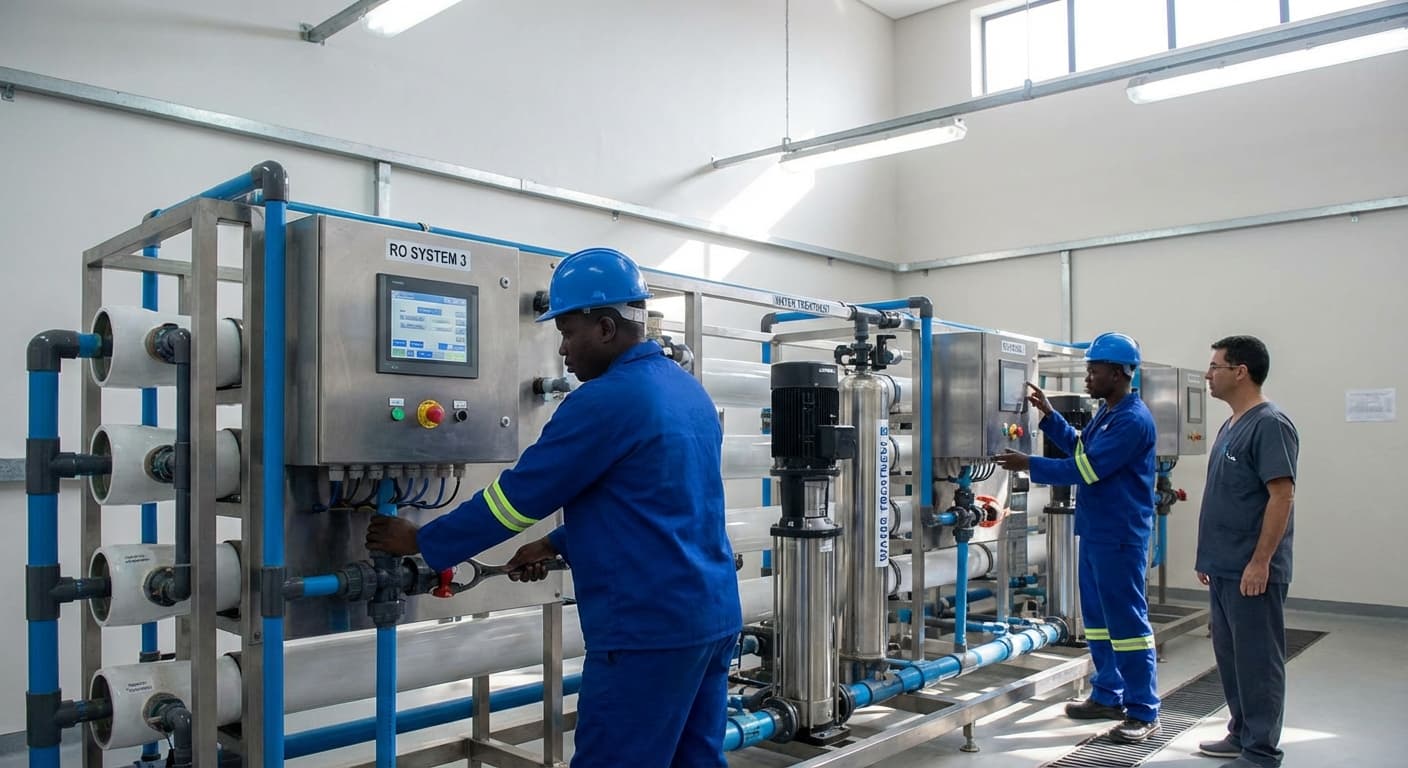
Dialysis RO/Water Treatment Plant Installation Service in Gambia
Engineering Excellence & Technical Support
Dialysis RO/Water Treatment Plant Installation Service High-standard technical execution following OEM protocols and local regulatory frameworks.
Advanced RO Technology for Purity
We implement state-of-the-art Reverse Osmosis (RO) systems specifically designed for medical-grade water purification, ensuring the highest levels of purity and safety for dialysis treatments in Gambia.
Robust Installation & Commissioning
Our expert technicians provide comprehensive installation and rigorous commissioning of dialysis water treatment plants, guaranteeing optimal performance, reliability, and compliance with international standards.
Localized Support & Training
We offer dedicated local support and comprehensive training programs for plant operators in Gambia, empowering healthcare facilities with the knowledge to maintain and manage their water treatment systems effectively.
What Is Dialysis Ro/water Treatment Plant Installation Service In Gambia?
Dialysis Reverse Osmosis (RO)/Water Treatment Plant Installation Service in The Gambia refers to the specialized process of designing, supplying, constructing, and commissioning water purification systems specifically for hemodialysis units. These plants are engineered to produce ultra-pure water that meets stringent international medical standards (e.g., AAMI, ISO) required for patient dialysis, thereby mitigating risks of infection, pyrogenic reactions, and electrolyte imbalances. The service encompasses the entire lifecycle from initial site assessment and water quality analysis to the final handover and ongoing maintenance support for the installed RO system.
| Who Needs Dialysis RO/Water Treatment Plant Installation Service? | Typical Use Cases | |||
|---|---|---|---|---|
| Renal Dialysis Centers: Both public and private healthcare facilities offering hemodialysis treatment. | Hospitals with Nephrology Departments: In-house dialysis units within larger medical institutions. | Mobile Dialysis Units: Temporary or mobile facilities requiring dedicated water purification. | NGOs and Humanitarian Organizations: Establishing or upgrading dialysis services in underserved regions. | New Healthcare Infrastructure Development: Projects involving the construction of new hospitals or clinics equipped with dialysis capabilities. |
| Production of Dialysate: The primary function is to generate medical-grade purified water for mixing with dialysate concentrate in hemodialysis machines. | Preventing Patient Complications: Ensuring water purity is critical to avoid infections, pyrogenic reactions, and electrolyte imbalances in dialysis patients. | Compliance with Health Regulations: Meeting national and international standards for medical water quality. | Enhancing Treatment Efficacy: High-quality water contributes to more effective and safer dialysis procedures. | Operational Continuity: Reliable water supply is essential for uninterrupted dialysis sessions. |
Key Components and Stages of Dialysis RO/Water Treatment Plant Installation:
- Pre-Installation Assessment: Detailed analysis of the source water quality (e.g., municipal water, well water), flow rate requirements, electrical infrastructure, and space availability at the dialysis facility.
- System Design and Engineering: Customization of the RO system configuration based on the assessment, including pre-treatment stages (e.g., sediment filtration, activated carbon filters), RO membranes, post-treatment (e.g., UV sterilization, bacterial filters), and storage/distribution loops.
- Equipment Procurement and Supply: Sourcing and delivery of all necessary components, including pumps, filters, membranes, tanks, piping, control panels, and monitoring instruments.
- On-site Installation and Plumbing: Professional installation of the RO plant, connecting all modules, ensuring leak-free plumbing with appropriate medical-grade materials, and integrating with existing facility infrastructure.
- Electrical Integration and Control System Setup: Connecting the RO plant to the power supply, configuring control panels, and setting up automation for system operation, monitoring, and alarms.
- Commissioning and Validation: Rigorous testing of the installed system to ensure it operates according to design specifications and produces water meeting all medical purity standards. This often includes bacteriologic, chemical, and endotoxin testing.
- Operator Training: Comprehensive training for facility staff on the operation, routine maintenance, troubleshooting, and basic servicing of the RO plant.
- Documentation and Handover: Provision of detailed technical manuals, schematics, validation reports, and warranty information.
- Post-Installation Support and Maintenance: Ongoing technical support, scheduled preventive maintenance, and emergency repair services to ensure continuous optimal performance of the water treatment system.
Who Needs Dialysis Ro/water Treatment Plant Installation Service In Gambia?
The installation of a Dialysis RO/Water Treatment Plant is crucial for ensuring the safety and efficacy of dialysis treatments. In Gambia, where access to reliable and high-quality water is essential for healthcare facilities, these plants play a vital role in preventing complications and maintaining patient health. This service is specifically designed for institutions that perform hemodialysis and require a consistent supply of ultrapure water, free from contaminants that could be detrimental to patients undergoing this life-sustaining procedure.
| Target Customer | Relevant Departments/Units | Specific Needs |
|---|---|---|
| Public Hospitals | Nephrology Department, Dialysis Unit, Biomedical Engineering Department | Ensuring consistent supply of Type 1 (ultrapure) water for hemodialysis machines, compliance with international water quality standards, cost-effective solutions for public health. |
| Private Hospitals | Nephrology Department, Dialysis Unit, Facilities Management, Procurement Department | High-quality water for patient safety and satisfaction, reliable operation to minimize downtime, advanced technology for efficiency and compliance. |
| Specialized Dialysis Clinics | Clinic Management, Clinical Director, Biomedical Technician, Procurement Officer | Dedicated and advanced water treatment solutions, meeting the specific demands of high-volume dialysis, maintaining patient trust through consistent service. |
| NGOs with Healthcare Facilities | Project Management, Medical Director, Operations Manager, Technical Support Team | Sustainable and reliable water purification systems, potentially tailored to specific project budgets and remote locations, training for local staff. |
| Government Health Ministries | Public Health Department, Planning and Infrastructure Division, Procurement Unit | Standardization of water quality across public health facilities, oversight of national healthcare infrastructure development, ensuring public safety and access to quality dialysis. |
Target Customers for Dialysis RO/Water Treatment Plant Installation Service in Gambia
- Public Hospitals
- Private Hospitals
- Specialized Dialysis Clinics
- Non-Governmental Organizations (NGOs) operating healthcare facilities with dialysis units
- Government health ministries overseeing public healthcare infrastructure
Dialysis Ro/water Treatment Plant Installation Service Process In Gambia
This document outlines the comprehensive workflow for installing Dialysis Reverse Osmosis (RO)/Water Treatment Plants in Gambia. The process is designed to be transparent, efficient, and ensure the highest quality of water for dialysis patients. From the initial inquiry to the final handover and ongoing support, each stage is critical for a successful installation.
| Phase | Key Activities | Responsible Parties | Deliverables/Outcomes | Typical Timeline |
|---|---|---|---|---|
| Receive initial contact from client (hospital, clinic, government agency). Understand basic needs and project scope. Provide preliminary information about services and capabilities. | Client, Service Provider Sales/Consultant | Initial understanding of project requirements. Client's awareness of service offerings. | 1-3 Days |
| Conduct a detailed on-site visit to assess existing infrastructure (space, power, plumbing, water source). Gather specific water quality requirements, patient volume, and future expansion plans. Identify potential challenges. | Service Provider Technical Team, Client Representative | Detailed site survey report. Documented water quality analysis (if needed). Comprehensive list of client requirements. | 3-7 Days |
| Develop a customized proposal outlining the recommended RO/water treatment system, technical specifications, scope of work, project timeline, and detailed cost breakdown. Include warranty and support information. | Service Provider Engineering/Sales Team | Formal proposal and quotation document. | 5-10 Days |
| Review and negotiate the proposal. Upon agreement, finalize and sign a formal contract detailing terms, conditions, payment schedule, and responsibilities. | Client, Service Provider Management | Signed contract. Agreed payment milestones. | 3-7 Days |
| Based on site assessment and requirements, create detailed engineering drawings, system schematics, and equipment specifications. Ensure compliance with relevant health and safety standards. | Service Provider Engineering Team | Finalized system design. Bill of materials. Manufacturing/assembly drawings. | 7-14 Days |
| Source and procure all necessary equipment, components, and materials from trusted suppliers. Arrange for safe and timely transportation of equipment to Gambia, including customs clearance and local delivery. | Service Provider Procurement & Logistics Team | All equipment and materials delivered to the project site. | 4-8 Weeks (depending on global supply chain and shipping) |
| Prepare the installation site, including any necessary civil works, power supply upgrades, or plumbing modifications as identified during the site assessment. Ensure access for equipment delivery. | Client, Service Provider Installation Team | Site fully prepared for installation. All necessary utilities available. | 1-2 Weeks (concurrent with delivery) |
| Unpack and assemble the RO/water treatment plant components according to the engineered design. Install piping, electrical connections, and control systems. Perform initial structural checks. | Service Provider Installation Technicians | Physically installed RO/water treatment plant system. | 2-4 Weeks |
| Conduct comprehensive system testing, including flushing, sanitization, and operational checks. Verify water quality parameters against specified standards using calibrated testing equipment. Troubleshoot and resolve any issues. | Service Provider Commissioning Engineers, Client Representative | Validated water quality. Fully operational and tested system. Commissioning report. | 5-10 Days |
| Provide thorough training to the client's designated personnel on the operation, routine maintenance, troubleshooting, and safety procedures for the RO/water treatment plant. | Service Provider Training Specialist, Client's Technical Staff | Trained and competent operational staff. Training materials and manuals. | 2-3 Days |
| Formally hand over the installed and commissioned system to the client. Provide all relevant documentation, including operation and maintenance manuals, warranty certificates, test reports, and as-built drawings. | Service Provider Project Manager, Client Representative | Accepted system. Complete project documentation package. | 1-2 Days |
| Offer ongoing technical support, preventive maintenance services, and spare parts availability as per the agreed service contract. Respond to any operational issues promptly. | Service Provider Technical Support & Maintenance Team | Continued reliable operation of the system. Proactive system upkeep. | Ongoing (as per contract) |
Dialysis RO/Water Treatment Plant Installation Service Process in Gambia
- Initial Inquiry & Consultation
- Site Assessment & Requirement Gathering
- Proposal & Quotation
- Contract Agreement
- System Design & Engineering
- Procurement & Logistics
- Pre-Installation Preparation
- On-site Installation & Assembly
- System Testing & Commissioning
- Operator Training
- Handover & Documentation
- Post-Installation Support & Maintenance
Dialysis Ro/water Treatment Plant Installation Service Cost In Gambia
The cost of installing a dialysis Reverse Osmosis (RO) and water treatment plant in The Gambia can vary significantly depending on several key factors. These factors influence the initial purchase price of the equipment, the complexity of the installation, and the ongoing operational needs. Understanding these elements is crucial for healthcare facilities and investors budgeting for such critical infrastructure. The Gambia, like many developing nations, faces unique challenges and opportunities in its healthcare infrastructure development, making accurate cost estimation paramount. The demand for reliable, high-quality water for dialysis is non-negotiable to ensure patient safety and effective treatment. Therefore, investing in a robust and well-installed water treatment system is a primary concern for any dialysis center. Local currency considerations, availability of specialized technicians, and logistical challenges all play a role in the final expenditure.
| Service Component | Estimated Cost Range (GMD - Gambian Dalasi) | Notes |
|---|---|---|
| Small-Scale Dialysis RO System (e.g., 2-4 Dialysis Machines) | 150,000 - 400,000 GMD | Covers basic pre-treatment, single-pass RO, storage tank. Assumes relatively good incoming water quality. |
| Medium-Scale Dialysis RO System (e.g., 5-10 Dialysis Machines) | 300,000 - 800,000 GMD | May include more robust pre-treatment, potentially double-pass RO for higher purity, larger storage. Suitable for moderately sized units. |
| Large-Scale/Hospital-Grade Dialysis RO System (e.g., 10+ Dialysis Machines) | 700,000 - 2,500,000+ GMD | Comprehensive multi-stage pre-treatment, double-pass RO, advanced monitoring, redundancy, larger capacities. For major healthcare facilities. |
| Installation Labor & Project Management (Local) | 50,000 - 200,000 GMD | Varies based on complexity, duration, and number of technicians. May be bundled with equipment. |
| Transportation & Logistics (Local) | 10,000 - 50,000 GMD | Depends on distance from port/supplier to site. Can be higher for remote areas. |
| Civil Works & Site Preparation (if needed) | 20,000 - 150,000 GMD | Includes minor modifications, platform construction, plumbing, electrical connections. |
| Training & Commissioning (Local Staff) | 20,000 - 75,000 GMD | Essential for proper operation and maintenance. Can be a significant portion of the cost. |
| Import Duties & Taxes (Estimate) | (Varies significantly, typically 10-25% of CIF value) | This is a crucial factor and can add substantially to the overall cost. Consult with customs brokers. |
| Contingency (10-15%) | (Calculated on subtotal) | Recommended to cover unforeseen expenses or design changes. |
Key Pricing Factors for Dialysis RO/Water Treatment Plant Installation in The Gambia
- System Capacity and Type: The volume of water the plant needs to produce per hour (liters per minute/hour) directly impacts the size and cost of the RO membranes, pumps, and storage tanks. Larger capacities for busy centers or those serving multiple units will naturally be more expensive. The type of RO system (e.g., single-pass, double-pass) also affects cost, with double-pass systems offering higher purity but at a greater expense.
- Water Source Quality: The initial quality of the raw water source (e.g., well water, municipal supply) dictates the complexity of the pre-treatment stages. Water with high levels of suspended solids, minerals, or contaminants will require more advanced filtration, softening, and potentially UV sterilization, increasing the overall system cost.
- Installation Complexity and Site Requirements: This includes factors like the available space for the plant, the need for specialized plumbing and electrical work, access for equipment delivery, and any necessary civil works (e.g., building modifications, foundation preparation). Remote locations might incur higher transportation and labor costs.
- Brand and Manufacturer: Reputable brands with proven reliability in healthcare settings often come with a higher price tag but may offer better long-term performance, warranties, and support. The availability of genuine spare parts locally can also be a consideration.
- Additional Features and Technologies: Options like advanced monitoring systems, remote diagnostics, redundant pumps, or specialized disinfection methods (e.g., ozone generation) will add to the initial investment.
- Local Labor and Expertise: The availability of skilled technicians for installation and commissioning in The Gambia can influence labor costs. Importing specialized expertise from abroad will significantly increase expenses.
- Permits and Regulatory Approvals: Obtaining necessary permits and ensuring compliance with local health and environmental regulations may involve fees and potentially delays.
- Training and Commissioning: Comprehensive training for local staff on operation and maintenance is essential for long-term sustainability and is usually factored into the installation package.
- Warranty and After-Sales Support: The duration and scope of the warranty, along with the availability and responsiveness of after-sales technical support and maintenance services, are critical for operational continuity and can influence the initial price.
Affordable Dialysis Ro/water Treatment Plant Installation Service Options
Our affordable dialysis RO/Water Treatment Plant Installation Service offers comprehensive solutions designed to meet the critical water quality needs of healthcare facilities while keeping costs manageable. We understand the importance of reliable, pure water for patient safety and operational efficiency. Our service focuses on providing value through optimized system design, efficient installation, and ongoing support. We achieve affordability by leveraging strategic sourcing, modular system configurations, and by offering transparent pricing structures that allow for informed decision-making. Our aim is to deliver high-quality water treatment without compromising on essential features or patient care.
| Service Component | Standard Offering | Value Bundle Advantage | Cost-Saving Strategy |
|---|---|---|---|
| Initial Consultation & Site Assessment | Basic review of water needs and site suitability. | Extended, in-depth analysis with system recommendations. | Included in bundle, saves time and prevents costly design errors. |
| RO/Water Treatment System Design | Standard system configuration based on typical needs. | Customized design considering flow rates, water quality, and future expansion. | Optimized capacity reduces upfront cost and future upgrade expenses. |
| Component Sourcing | Standard grade components. | Selection of high-quality, durable, and energy-efficient components. | Bulk purchasing discounts, reduced energy consumption, longer equipment life. |
| Installation & Commissioning | Basic installation services. | Professional, certified installation with comprehensive commissioning and testing. | Efficient installation minimizes labor costs and ensures optimal performance from day one. |
| Post-Installation Support | Limited warranty period. | Extended warranty and optional service contract. | Preventative maintenance reduces breakdowns and expensive emergency repairs. |
| Staff Training | Basic operational overview. | In-depth training on operation, basic troubleshooting, and routine maintenance. | Empowered staff handle minor issues, reducing service call frequency. |
Value Bundles and Cost-Saving Strategies
- Integrated Design & Installation Package: Bundles the initial consultation, system design tailored to your specific needs, and professional installation into a single, often discounted, package.
- Modular System Options: Offers scalable RO/water treatment systems that can be sized precisely to current needs, with options for easy expansion as demand grows, avoiding overspending on unnecessary capacity.
- Energy-Efficient Component Selection: Prioritizes the use of energy-efficient pumps, membranes, and control systems to reduce long-term operational electricity costs.
- Strategic Sourcing & Bulk Purchasing: Leverages our strong relationships with reputable manufacturers to source high-quality components at competitive prices, passing these savings onto our clients.
- Phased Installation & Upgrade Paths: For larger facilities or those with budget constraints, we offer phased installation options, allowing for critical components to be installed first and expanded upon later.
- Preventative Maintenance & Service Contracts: While an upfront cost, bundled preventative maintenance plans significantly reduce the risk of costly emergency repairs and extend the lifespan of the equipment.
- Remote Monitoring & Diagnostics: Implementing systems that allow for remote monitoring of performance and early detection of issues, minimizing the need for on-site visits for minor adjustments.
- Training & Knowledge Transfer: Providing comprehensive training for your on-site staff on basic operation and maintenance, empowering them to handle minor tasks and reducing reliance on external support.
- Financing & Payment Plan Options: Collaborating with financial partners to offer flexible payment plans or financing options that can spread the initial investment over time.
- Certified Refurbished Equipment (where applicable): For non-critical ancillary systems or as part of an upgrade path, we can explore certified refurbished equipment options that meet all quality and performance standards at a reduced price.
Verified Providers In Gambia
In Gambia's healthcare landscape, identifying reliable and skilled medical practitioners is paramount for individuals seeking quality care. Franance Health has emerged as a beacon of trust, distinguished by its rigorous credentialing process and unwavering commitment to patient well-being. This dedication translates into a network of healthcare professionals who not only possess the necessary qualifications but also embody the highest ethical standards and a patient-centered approach. Choosing a verified provider through Franance Health ensures access to competent and compassionate medical services, offering peace of mind and superior health outcomes.
| Credential Type | Verification Standard | Significance for Patients |
|---|---|---|
| Medical Licenses & Registrations | Up-to-date and valid with Gambian Medical and Dental Council | Confirms legal authorization to practice medicine. |
| Educational Qualifications | Verified degrees and certifications from accredited institutions | Ensures foundational medical knowledge and training. |
| Professional Experience | Documented history of practice, including specialties and patient volume | Demonstrates practical application of skills and expertise. |
| Continuing Medical Education (CME) | Evidence of ongoing participation in medical training and conferences | Guarantees providers are current with the latest medical knowledge and techniques. |
| Peer Reviews & Reputation Checks | Positive feedback and absence of significant disciplinary actions | Indicates consistent quality of care and patient satisfaction. |
| Specialty Board Certifications | Where applicable, verified certifications in specific medical fields | Confirms advanced knowledge and skill in a particular area of medicine. |
Why Franance Health Verified Providers Stand Out
- Rigorous Verification Process: Franance Health employs a multi-faceted verification system that goes beyond basic licensing. This includes in-depth background checks, review of educational qualifications and certifications, assessment of clinical experience, and confirmation of good standing with relevant professional bodies.
- Commitment to Excellence: Verified providers are chosen for their demonstrated commitment to continuous professional development, staying abreast of the latest medical advancements and best practices.
- Patient-Centric Care: Franance Health prioritizes providers who exhibit strong communication skills, empathy, and a genuine dedication to understanding and addressing patient needs.
- Ethical Practice and Integrity: A core component of Franance Health's verification is the assurance of ethical conduct and unwavering integrity in all aspects of medical practice.
- Access to Specialized Expertise: Franance Health's network includes a diverse range of specialists, ensuring that patients can find the right expertise for their specific health concerns.
Scope Of Work For Dialysis Ro/water Treatment Plant Installation Service
This Scope of Work (SOW) outlines the requirements for the installation services of a Dialysis Reverse Osmosis (RO) and Water Treatment Plant. It details the technical deliverables, standard specifications, and responsibilities of the service provider to ensure a fully functional and compliant water treatment system for a dialysis facility. The project encompasses the delivery, installation, commissioning, and initial training related to the RO/Water Treatment Plant.
| Technical Deliverable | Description | Standard Specifications / Compliance |
|---|---|---|
| RO/Water Treatment Plant Unit | Complete skid-mounted Reverse Osmosis and Water Treatment system including pre-treatment, RO membranes, post-treatment, and storage. | ISO 13485 compliant manufacturing (if applicable for medical devices), ANSI/AAMI standards for hemodialysis water, NSF/ANSI 58 for RO performance, local building codes, and electrical safety standards. |
| Pre-treatment Module | Includes sediment filters, activated carbon filters, water softener, and any other necessary components to protect RO membranes. | Removal of suspended solids, chlorine, chloramines, hardness, and other contaminants as per water analysis and system design. |
| Reverse Osmosis (RO) Unit | High-efficiency RO membranes, high-pressure pump, and associated piping and instrumentation. | Achieves a minimum of 98% salt rejection, producing water that meets AAMI standards for hemodialysis (e.g., <2 ppm TOC, <0.1 mS/cm conductivity, absence of endotoxins and pyrogens). |
| Post-treatment Module | Includes UV disinfection and/or bacterial filters to ensure microbial purity. | Effective microbial control to meet AAMI standards for hemodialysis water. |
| Storage Tank(s) | Food-grade material storage tanks for treated water, equipped with level sensors and overflow protection. | Adequate capacity for facility demand, designed to prevent recontamination, and meeting local health regulations. |
| Piping and Fittings | All necessary plumbing, valves, and fittings for water inlet, treated water distribution, and waste water discharge. | Medical-grade or NSF-certified materials (e.g., CPVC, stainless steel), properly insulated where required, leak-free connections. |
| Electrical Panel and Wiring | Dedicated electrical panel, wiring, and connection points for the RO/Water Treatment Plant. | Compliant with local electrical codes (e.g., NEC), proper grounding, surge protection, and appropriate circuit breakers. |
| Control System and Instrumentation | PLC-based control system with user-friendly interface, pressure gauges, flow meters, conductivity meters, and alarms. | Real-time monitoring of key parameters, automatic shutdown for critical failures, and data logging capabilities. |
| Installation Drawings and Schematics | Detailed drawings showing the plant layout, piping, electrical connections, and control system logic. | Clear, accurate, and comprehensive documentation for maintenance and troubleshooting. |
| Commissioning Report | Document detailing the successful testing and calibration of all system components and functionalities. | Verification of all parameters against design specifications and regulatory standards. |
| Water Quality Test Results | Independent laboratory test results confirming the treated water quality meets or exceeds specified standards. | Testing for all parameters outlined in AAMI standards for hemodialysis water, including microbial, chemical, and endotoxin levels. |
| Operations and Maintenance Manual | Comprehensive manual covering daily operation, routine maintenance procedures, troubleshooting guide, and parts list. | Easy-to-understand language, clearly illustrated procedures, and manufacturer's recommendations. |
| Training Session(s) | On-site training for facility staff on the operation, basic maintenance, and troubleshooting of the RO/Water Treatment Plant. | Hands-on demonstration, Q&A sessions, and provision of training materials. |
Key Stages and Responsibilities
- Project Planning and Mobilization
- Site Preparation and Infrastructure Assessment
- Equipment Delivery and Unpacking
- Installation and Plumbing
- Electrical Connections and Integration
- System Testing and Commissioning
- Performance Validation and Handover
- Training and Documentation
Service Level Agreement For Dialysis Ro/water Treatment Plant Installation Service
This Service Level Agreement (SLA) outlines the response times and uptime guarantees for the installation service of Dialysis Reverse Osmosis (RO) and Water Treatment Plants. This agreement is between [Client Name] (hereinafter referred to as "Client") and [Service Provider Name] (hereinafter referred to as "Provider").
| Service | Response Time | Resolution Target | Uptime Guarantee |
|---|---|---|---|
| Emergency Installation Support (Critical System Failure during installation) | Within 2 hours of notification | Within 8 business hours (dependent on parts availability) | N/A (Installation phase) |
| Standard Installation Support (Non-critical issues during installation) | Within 4 business hours of notification | Within 2 business days (dependent on complexity) | N/A (Installation phase) |
| Post-Installation System Uptime (following successful commissioning) | N/A (Installation phase) | N/A (Installation phase) | 99.5% during the warranty period (defined separately) |
Scope of Service
- Installation of new Dialysis RO/Water Treatment Plant systems.
- Configuration and testing of installed systems.
- Initial user training on system operation and basic maintenance.
- Troubleshooting and resolution of installation-related issues.
Frequently Asked Questions

Ready when you are
Let's scope your Dialysis RO/Water Treatment Plant Installation Service in Gambia project in Gambia.

Scaling healthcare logistics and technical systems across the entire continent.