
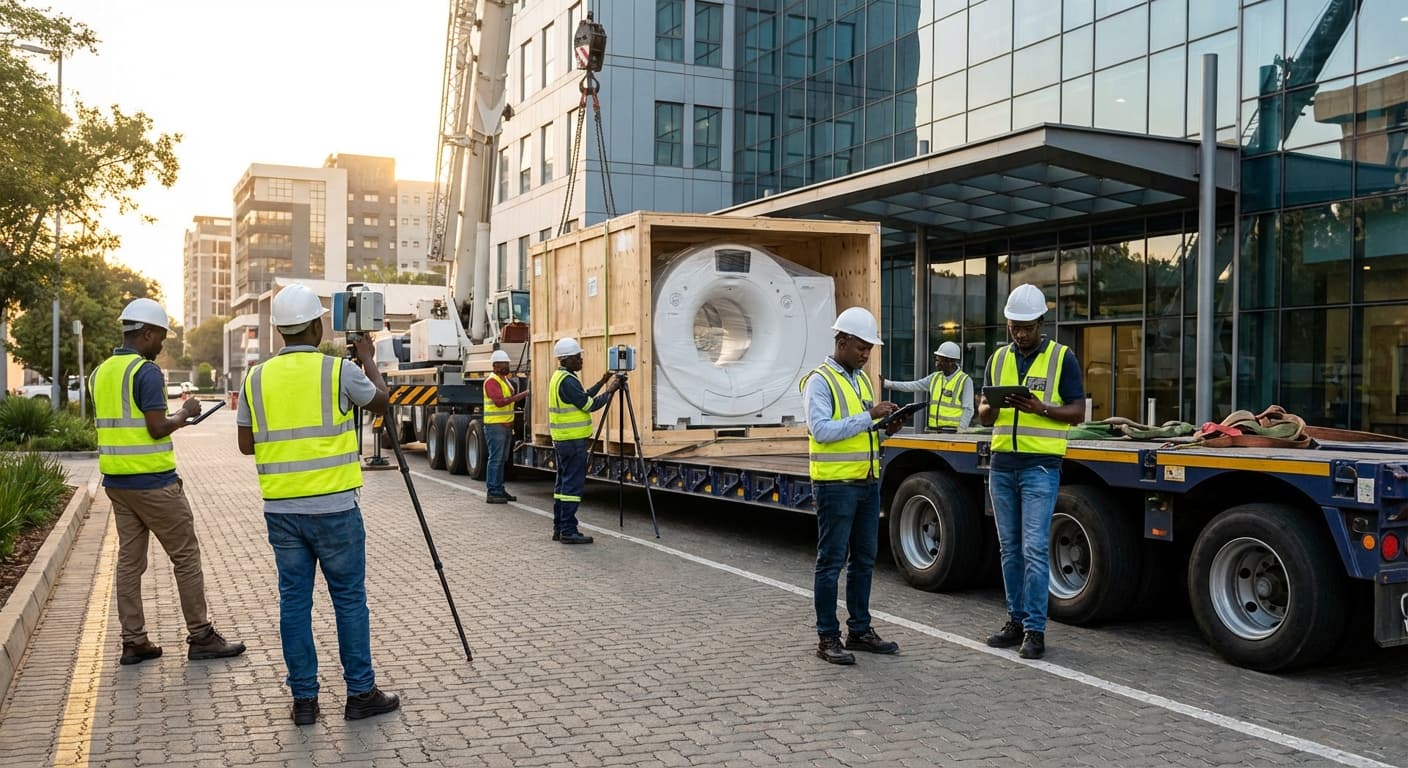
Route Survey & Rigging Plan Service for Heavy Medical Equipment in Gambia
Engineering Excellence & Technical Support
Route Survey & Rigging Plan Service for Heavy Medical Equipment High-standard technical execution following OEM protocols and local regulatory frameworks.
Precise Route Mapping & Obstacle Mitigation
Leveraging advanced surveying techniques and LiDAR scanning to meticulously map the optimal transport route for heavy medical equipment in Gambia, identifying and planning for the mitigation of all potential obstacles including narrow streets, low bridges, and uneven terrain.
Customized Rigging & Load Securement Strategy
Developing bespoke rigging plans that account for the unique weight, dimensions, and center of gravity of each medical unit, ensuring safe and secure lifting, lashing, and transportation utilizing specialized equipment and techniques suited for the Gambian context.
Comprehensive Risk Assessment & Contingency Planning
Conducting thorough site-specific risk assessments and developing robust contingency plans to address unforeseen challenges during transport and installation, including weather, traffic, and equipment malfunctions, ensuring minimal downtime and maximum safety.
What Is Route Survey & Rigging Plan Service For Heavy Medical Equipment In Gambia?
Route Survey & Rigging Plan Service for Heavy Medical Equipment in Gambia is a specialized logistical undertaking focused on the safe and efficient transportation, installation, and commissioning of oversized, heavy-lift, and sensitive medical apparatus within The Gambia. This service encompasses a comprehensive assessment of the entire journey from port of entry or manufacturing site to the final operational location, as well as the precise methodologies required for its physical placement and setup. It addresses the unique challenges posed by the country's infrastructure, climate, and specific site conditions to mitigate risks associated with damage to equipment, personnel, and public property, while ensuring minimal disruption to ongoing healthcare services.
| Who Needs This Service? | Typical Use Cases | ||||||
|---|---|---|---|---|---|---|---|
| Healthcare Facilities: Hospitals (public and private), specialized clinics, diagnostic centers, and medical research institutions in The Gambia requiring the import and installation of advanced medical imaging, radiation therapy, surgical, or laboratory equipment. | Installation of Magnetic Resonance Imaging (MRI) scanners, Computed Tomography (CT) scanners, Positron Emission Tomography (PET) scanners. | Deployment of Linear Accelerators (LINACs) for radiotherapy. | Placement of large-scale X-ray machines and angiography suites. | Installation of advanced surgical robots and associated infrastructure. | Setup of high-capacity laboratory analysers and sample handling systems. | Relocation of existing heavy medical equipment within or between facilities. | Upgrading or replacing outdated heavy medical apparatus. |
| Equipment Manufacturers and Distributors: Companies exporting or supplying heavy medical equipment to The Gambia, requiring expert logistical support to ensure successful delivery and installation at the client's site. | Project management for turnkey medical equipment installations. | Site surveys for pre-installation planning and feasibility studies. | Ensuring compliance with international shipping and local handling regulations. | ||||
| Government Health Ministries and Agencies: National bodies responsible for public health infrastructure development, procurement, and management of medical equipment for government-funded facilities. | Facilitating the introduction of new medical technologies into the national healthcare system. | Overseeing the safe deployment of donated or procured medical equipment. | |||||
| Logistics and Project Management Companies: Third-party providers engaged in complex project deployments requiring specialized heavy-lift and oversized cargo handling capabilities within The Gambia. |
Key Components of Route Survey & Rigging Plan Service
- Route Reconnaissance and Analysis: Detailed examination of transportation pathways, including but not limited to port facilities, public roadways (widths, clearances, load-bearing capacity of bridges/culverts, gradient), and potential off-road access. Identification and mitigation of all potential obstructions (e.g., overhead power lines, traffic signals, building overhangs, narrow passages, sharp turns).
- Infrastructure Assessment: Evaluation of site access points, doorway dimensions, floor load capacities, internal circulation routes, and the structural integrity of the intended installation area. This includes verifying space availability for operation and maintenance.
- Equipment Characterization: Thorough understanding of the dimensions, weight, center of gravity, fragility, and specific handling requirements of the medical equipment (e.g., MRI scanners, CT scanners, linear accelerators, large-scale laboratory equipment).
- Risk Assessment and Mitigation Strategies: Proactive identification of potential hazards during transit and rigging (e.g., weather conditions, traffic management, ground stability, seismic considerations, security) and development of comprehensive mitigation plans.
- Rigging Methodologies and Equipment Selection: Determination of appropriate lifting techniques, selection of suitable cranes, dollies, skidding systems, and other specialized rigging hardware. Calculation of load capacities and rigging configurations.
- Transportation Planning: Development of detailed logistical plans, including vehicle selection, route optimization, escort requirements, traffic management coordination with local authorities, and permits acquisition.
- Site Preparation Recommendations: Specification of any necessary modifications to the site, such as temporary road improvements, reinforced flooring, or removal of obstacles.
- Installation and Commissioning Support: On-site supervision and guidance during the physical placement, connection, and initial testing phases of the equipment, ensuring adherence to manufacturer specifications and safety protocols.
- Contingency Planning: Development of alternative routes, backup equipment, and emergency response procedures to address unforeseen circumstances.
Who Needs Route Survey & Rigging Plan Service For Heavy Medical Equipment In Gambia?
For any organization in Gambia involved in the procurement, installation, or relocation of heavy medical equipment, a comprehensive Route Survey & Rigging Plan Service is indispensable. This specialized service ensures the safe, efficient, and compliant movement of sensitive and oversized medical machinery from its point of arrival to its final installation site. This process involves detailed planning of transport routes, assessing structural integrity of pathways, calculating load capacities, and designing precise rigging and lifting procedures. Without expert planning, the risks of damage to the equipment, infrastructure, and personnel are significantly elevated, leading to costly delays, repairs, and potential legal liabilities.
| Customer Type | Relevant Departments | Specific Needs for Route Survey & Rigging Plan |
|---|---|---|
| Hospitals (Public & Private) | Procurement Department, Facilities Management, Biomedical Engineering, IT Department (for network infrastructure) | Moving MRI machines, CT scanners, linear accelerators, large X-ray units, patient beds, and specialized surgical equipment. Ensuring accessibility to installation rooms, assessing floor load capacity, planning cable management, and safe removal of old equipment. |
| Specialized Medical Centers (e.g., Oncology, Cardiology) | Administration, Technical Services, Department Heads | Handling high-precision, heavy equipment like radiation therapy machines, cardiac catheterization labs, and advanced diagnostic systems. Requires meticulous route planning to avoid vibration-sensitive areas and precise rigging for safe placement. |
| Diagnostic Imaging Facilities | Operations Management, Technical Staff | Transporting and installing large, sensitive imaging equipment such as CT scanners, MRI scanners, and PET scanners. Needs route surveys to ensure clearance through doorways, corridors, and elevators, and rigging plans for precise positioning. |
| Surgical Centers | Clinical Management, Facilities Management | Moving surgical tables, large operating microscopes, anesthesia machines, and sterilization units. Focus on minimizing disruption to surgical schedules and ensuring safe passage through sterile environments. |
| Medical Equipment Suppliers & Distributors | Logistics & Operations, Installation & Service Teams | Responsible for delivering and installing new equipment for clients. Requires route surveys from port/warehouse to client site and rigging plans for safe unloading and installation, often on behalf of their clients. |
| Government Health Ministries & Agencies | Procurement, Public Health Infrastructure, Planning Department | Overseeing the acquisition and distribution of heavy medical equipment to public hospitals and clinics across Gambia. Needs comprehensive planning for remote and challenging locations, ensuring compliance with national standards. |
| NGOs & International Aid Organizations | Program Management, Logistics, Medical Coordinators | Deploying significant medical equipment to support healthcare initiatives in various regions of Gambia. Often dealing with less developed infrastructure, requiring robust route surveys and adaptable rigging solutions. |
| Research Institutions | Research Department, Facilities & Operations | Acquiring and installing advanced research equipment, which can be heavy and highly sensitive. Requires specialized rigging and route planning to protect delicate scientific instruments. |
| Logistics & Transportation Companies (specializing in heavy haulage) | Operations, Project Management, Safety & Compliance Teams | While they may perform the physical transport, they often subcontract route survey and rigging plan services to ensure they have expert guidance and liability coverage for complex medical equipment moves. |
Target Customers & Departments in Gambia Requiring Route Survey & Rigging Plan Services for Heavy Medical Equipment:
- Hospitals (Public & Private)
- Specialized Medical Centers
- Diagnostic Imaging Facilities
- Surgical Centers
- Medical Equipment Suppliers & Distributors
- Government Health Ministries & Agencies
- NGOs & International Aid Organizations
- Research Institutions
- Logistics & Transportation Companies (specializing in heavy haulage)
Route Survey & Rigging Plan Service For Heavy Medical Equipment Process In Gambia
This document outlines the comprehensive workflow for our Route Survey & Rigging Plan Service for the process of heavy medical equipment delivery and installation in Gambia. Our service ensures the safe, efficient, and compliant movement and placement of critical medical infrastructure. The workflow is designed to be transparent, collaborative, and results-oriented, minimizing risks and maximizing operational readiness.
| Stage | Key Activities | Deliverables | Timeline (Est.) | Involved Parties |
|---|---|---|---|---|
| Initial Inquiry & Information Gathering | Client submits an inquiry detailing equipment specifications (dimensions, weight, center of gravity), origin, destination (including specific site within Gambia), any known site constraints, and desired timelines. Our team reviews the provided information. | Acknowledgement of Inquiry, Request for Additional Information (if needed). | 1-2 Business Days | Client, Service Provider (Sales/Project Management) |
| Pre-Survey Planning & Risk Assessment | Based on initial data, preliminary assessment of potential route challenges (e.g., road conditions, bridge capacities, urban congestion, port access). Development of a detailed survey plan, including necessary permits, specialized equipment, and personnel. Identification of potential safety hazards. | Preliminary Route Assessment Report, Detailed Survey Plan, Risk Assessment Matrix. | 2-4 Business Days | Service Provider (Survey Team Lead, Project Manager) |
| On-Site Route Survey | Deployment of our experienced survey team to Gambia. Physical inspection and measurement of the entire proposed route from port/entry point to the final installation site. Verification of road widths, turning radii, overhead clearances, bridge load capacities, and any temporary obstacles. Data collection includes GPS coordinates, photographic evidence, and video recordings. | Detailed Route Survey Report (including maps, dimensions, clearances, load capacities), Photographic & Video Evidence Log. | 3-7 Business Days (depending on route complexity and geographical spread) | Service Provider (Survey Team), Client Representatives (optional) |
| Rigging & Installation Plan Development | Synthesis of survey data with equipment specifications. Detailed plan for lifting, moving, and placing the equipment. This includes selecting appropriate lifting equipment (cranes, forklifts), rigging gear (slings, shackles), transport vehicles, and defining precise lifting points, safe working loads, and exclusion zones. Contingency planning for unforeseen issues. | Comprehensive Rigging & Installation Plan (including schematics, equipment specifications, step-by-step procedures, safety protocols). | 3-5 Business Days | Service Provider (Rigging Engineers, Project Manager) |
| Client Review & Approval | Presentation of the Route Survey Report and Rigging & Installation Plan to the client. Discussion of findings, proposed solutions, and any client-specific requirements. Formal client sign-off on the approved plan. | Minutes of Meeting, Approved Route Survey & Rigging Plan. | 2-3 Business Days | Client, Service Provider (Project Manager, Senior Management) |
| Pre-Execution Preparations | Securing all necessary permits and authorizations from local authorities. Mobilization of specialized rigging and transport equipment to the site. Pre-briefing of the execution team on the approved plan and safety procedures. Site preparation (e.g., temporary road improvements, securing the installation area). | Permits & Authorizations, Mobilized Equipment List, Pre-Execution Briefing Records. | 2-5 Business Days (varies based on permit acquisition) | Service Provider (Logistics Team, Site Supervisor), Client Representatives |
| Execution of Rigging & Placement | Implementation of the approved rigging and installation plan. Safe and precise lifting, transportation, and placement of the heavy medical equipment at its designated location. Continuous monitoring of safety parameters and adherence to the plan. | Successful Rigging and Placement of Equipment. | 1-3 Business Days (depending on complexity) | Service Provider (Execution Team, Safety Officers), Client Representatives |
| Post-Execution Verification & Handover | Final inspection of the installed equipment to confirm it is correctly positioned and secured. Verification that no damage occurred during transit or installation. Formal handover of the site and equipment to the client, confirming successful completion of the service. | Post-Installation Inspection Report, Handover Certificate. | 1 Business Day | Service Provider (Project Manager, Site Supervisor), Client Representatives |
| Documentation & Reporting | Compilation of all project documentation, including final reports, survey data, photos, videos, permits, and client sign-offs. Archiving of project records for future reference. Issuance of a final comprehensive project report to the client. | Final Project Report, Project Archives. | 2-3 Business Days | Service Provider (Project Administrator, Project Manager) |
Service Workflow Stages
- Initial Inquiry & Information Gathering
- Pre-Survey Planning & Risk Assessment
- On-Site Route Survey
- Rigging & Installation Plan Development
- Client Review & Approval
- Pre-Execution Preparations
- Execution of Rigging & Placement
- Post-Execution Verification & Handover
- Documentation & Reporting
Route Survey & Rigging Plan Service For Heavy Medical Equipment Cost In Gambia
Estimating the cost for a Route Survey & Rigging Plan Service for heavy medical equipment in The Gambia requires a detailed understanding of several influencing factors. These services are crucial for ensuring the safe and efficient transport and installation of sensitive and high-value medical machinery. The pricing in The Gambian Dalasi (GMD) will fluctuate based on the complexity of the route, the specific equipment, the required rigging expertise, and the overall project scope. This document outlines the key pricing factors and provides a general cost range in GMD.
| Service Component | Description | Estimated Cost Range (GMD) |
|---|---|---|
| Route Survey (Basic) | Initial assessment of primary routes, identification of major obstacles, basic road condition evaluation. | 15,000 - 30,000 |
| Route Survey (Comprehensive) | Detailed GPS mapping, photographic documentation, obstacle analysis (including overhead clearances and width restrictions), traffic assessment, risk identification. | 30,000 - 75,000 |
| Rigging Plan Development | Detailed plan for lifting, moving, and positioning of equipment, including equipment selection, load calculations, and safety protocols. | 20,000 - 60,000 |
| Specialized Rigging Equipment Hire (Daily) | Cost for cranes, forklifts, hydraulic jacks, etc. (excluding operator). Varies greatly with size and capacity. | 10,000 - 50,000+ |
| Skilled Labor (Per Rigger, Per Day) | Cost for experienced riggers, supervisors, and potentially engineers. | 5,000 - 15,000 |
| Permits & Administration | Costs associated with obtaining necessary permits for oversized loads, road closures, etc. | 5,000 - 20,000 |
| Contingency & Risk Management | Buffer for unforeseen issues, insurance considerations. | 10% - 20% of total service cost |
| Full Service Package (Example - Moderate Complexity) | Comprehensive route survey, detailed rigging plan, basic rigging equipment hire, and skilled labor for a typical medium-sized medical device. | 75,000 - 200,000+ |
| Full Service Package (Example - High Complexity) | Extensive route survey, complex rigging plan, specialized equipment, significant labor for large/delicate equipment in challenging locations. | 200,000 - 500,000+ |
Key Pricing Factors for Route Survey & Rigging Plan Services:
- Equipment Specifications: The size, weight, fragility, and specific handling requirements of the medical equipment are paramount. Larger, heavier, or more delicate equipment will necessitate more extensive planning and specialized rigging techniques, increasing costs.
- Route Complexity: This includes the distance to be traveled, the condition of roads (paved, unpaved, potential for damage), the presence of obstacles (low bridges, narrow streets, sharp turns, overhead power lines), and traffic density. Complex routes require detailed mapping, risk assessment, and potential temporary infrastructure modifications.
- Site Accessibility: The ease of access to both the delivery and installation sites is critical. Narrow doorways, staircases, limited maneuvering space, and multi-story buildings will significantly impact rigging plans and increase labor and equipment needs.
- Rigging Requirements: The type of rigging equipment needed (cranes, forklifts, specialized dollies, gantries), the number of personnel required, and the expertise of the rigging team (certified riggers, engineers) directly influence the cost.
- Survey Scope: The extent of the route survey is a major driver. This can include initial desktop surveys, on-site reconnaissance, detailed GPS mapping, photographic documentation, and traffic management planning.
- Permits and Approvals: Obtaining necessary permits from local authorities for oversized loads or road closures adds administrative costs and can influence timelines.
- Time Sensitivity: Urgent projects may incur premium charges for expedited services.
- Insurance and Risk Mitigation: The cost of insurance to cover potential damage to equipment or property, as well as contingency planning, is factored in.
- Provider Expertise and Reputation: Experienced and reputable service providers, particularly those with a track record in handling heavy medical equipment, may command higher fees due to their proven reliability and specialized knowledge.
- Location within The Gambia: While Banjul and surrounding areas might have more established infrastructure and potentially more competitive pricing, remote or less accessible regions could incur higher transportation and logistical costs for the survey and rigging teams.
- Additional Services: This could include temporary road improvements, traffic management personnel, or specialized packaging and protection for the equipment.
Affordable Route Survey & Rigging Plan Service For Heavy Medical Equipment Options
Navigating the complex logistics of moving heavy medical equipment requires a specialized approach. Our Affordable Route Survey & Rigging Plan Service ensures a safe, efficient, and cost-effective transition, minimizing risks and potential disruptions to your operations. We understand that budget is a key consideration, which is why we offer flexible value bundles and strategic cost-saving measures to make this essential service accessible to a wider range of healthcare providers and medical equipment suppliers.
| Value Bundle | What's Included | Ideal For | Estimated Price Range (USD) |
|---|---|---|---|
| Essential Survey & Plan | Standard route survey (up to 2 locations), preliminary rigging assessment, basic equipment specifications, and a foundational rigging plan. | Smaller clinics, single-item moves, standard equipment (e.g., basic X-ray units, patient beds). | $800 - $1,500 |
| Comprehensive Bundle | Detailed route survey (multiple locations), in-depth rigging feasibility study, specialized equipment handling considerations, comprehensive rigging plan with detailed diagrams, and on-site pre-move consultation. | Hospitals, larger medical centers, multiple equipment moves, complex equipment (e.g., MRI machines, CT scanners, linear accelerators). | $1,800 - $3,500 |
| Premium Plus Service | All features of the Comprehensive Bundle, plus: dedicated project manager, 24/7 emergency consultation, detailed risk assessment and mitigation strategy, insurance coordination assistance, and post-move site verification. | High-value or extremely critical equipment moves, facilities with stringent operational requirements, nationwide or international relocations. | $4,000+ |
Key Benefits of Our Service
- Risk Mitigation: Expert route planning and rigging strategies significantly reduce the likelihood of damage to sensitive equipment and facilities.
- Cost Efficiency: Proactive planning identifies potential cost overruns and allows for implementation of cost-saving measures from the outset.
- Operational Continuity: Minimized downtime ensures your medical equipment is operational when and where you need it.
- Regulatory Compliance: Adherence to all relevant safety regulations and best practices.
- Peace of Mind: Our experienced team handles the complexities, allowing you to focus on patient care.
- Customized Solutions: Tailored plans to meet the unique specifications of each piece of equipment and each location.
Verified Providers In Gambia
In Gambia, the availability of verified healthcare providers is paramount for ensuring quality and safe medical care. Franance Health stands out as a leading organization dedicated to credentialing and verifying healthcare professionals, guaranteeing that patients have access to competent and trustworthy medical services. Their rigorous vetting process ensures that all listed providers meet high standards of education, training, and ethical practice. This commitment to verification not only builds patient confidence but also contributes to the overall improvement of the healthcare landscape in Gambia.
| Provider Type | Franance Health Verification Benefits | Why They Are the Best Choice |
|---|---|---|
| Doctors (General Practitioners & Specialists) | Confirms medical degrees, licenses, and specialization certifications. Ensures adherence to ethical medical practices. | Access to skilled physicians with proven expertise, reducing the risk of misdiagnosis or improper treatment. Peace of mind for complex medical needs. |
| Nurses and Midwives | Verifies nursing diplomas, registration with the national council, and specialized training (e.g., midwifery, critical care). | Ensures compassionate and competent care during crucial moments, especially in maternal and child health. Reliable support for patient recovery. |
| Pharmacists | Confirms pharmacy degrees and licenses. Verifies knowledge of drug interactions and safe dispensing practices. | Ensures accurate dispensing of medications, proper patient counseling on usage, and prevention of adverse drug events. |
| Laboratory Technicians | Verifies relevant certifications and training in diagnostic procedures and quality control. | Guarantees accurate and reliable diagnostic test results, essential for effective treatment planning and monitoring. |
| Therapists (Physiotherapists, etc.) | Confirms professional degrees and licenses. Assesses practical skills and adherence to therapeutic protocols. | Provides access to qualified professionals who can aid in rehabilitation and recovery from injuries or illnesses, improving quality of life. |
Why Franance Health Credentials Matter for Gambian Healthcare:
- Ensured Quality of Care: Franance Health's verification process confirms that providers possess the necessary qualifications and expertise to deliver effective medical treatments.
- Patient Safety: By vetting professionals, Franance Health minimizes risks associated with unqualified or unethical practitioners, prioritizing patient well-being.
- Trust and Reliability: Patients can trust that healthcare providers listed by Franance Health have undergone thorough background checks and professional assessments.
- Promoting Professional Standards: The credentialing process encourages healthcare professionals to maintain high standards in their practice, fostering continuous improvement.
- Accessibility to Competent Professionals: Franance Health's platform simplifies the process for individuals seeking reliable medical assistance in Gambia.
Scope Of Work For Route Survey & Rigging Plan Service For Heavy Medical Equipment
This Scope of Work (SOW) outlines the services required for a comprehensive route survey and rigging plan for the transportation and installation of heavy medical equipment. The objective is to ensure the safe, efficient, and timely movement and placement of sensitive and high-value medical machinery from its point of origin to its final installation site, minimizing risks and potential damage.
| Section | Description | Technical Deliverables | Standard Specifications/References |
|---|---|---|---|
| Comprehensive assessment of the entire transportation route, including access roads, entry/exit points to facilities, and internal pathways. |
|
|
| Detailed engineering plan for all lifting, moving, and positioning operations of the heavy medical equipment. |
|
|
| Identification and evaluation of potential risks associated with the route and rigging operations, along with proposed mitigation strategies. |
|
|
| Provision of all necessary documentation and reports to the client and relevant authorities. |
|
|
| Requirement for qualified and experienced personnel to perform the survey and develop the rigging plan. |
|
|
Key Objectives:
- To identify and mitigate all potential route hazards.
- To develop a detailed and feasible rigging plan for all lifting and movement operations.
- To ensure compliance with all relevant safety regulations and industry standards.
- To provide clear and actionable documentation for all stakeholders.
- To minimize downtime and disruption during equipment transfer and installation.
Service Level Agreement For Route Survey & Rigging Plan Service For Heavy Medical Equipment
This Service Level Agreement (SLA) outlines the guaranteed response times and uptime for the Route Survey & Rigging Plan Service provided for the delivery and installation of heavy medical equipment. This SLA aims to ensure minimal disruption and prompt resolution of any service-related issues, thereby supporting the critical operations of healthcare facilities.
| Service Component | Response Time Target (Business Hours) | Resolution Time Target (Business Hours) | Uptime Guarantee |
|---|---|---|---|
| Initial Route Survey Request & Site Assessment | 4 Business Hours | 2 Business Days (for preliminary assessment and survey commencement) | N/A (Service is project-based, not continuous uptime) |
| Rigging Plan Development & Submission | N/A (Integrated into project timeline) | 3 Business Days (after completion of route survey and equipment data submission) | N/A |
| Urgent Support Request (e.g., unexpected site condition during rigging, plan clarification) | 2 Business Hours | 8 Business Hours (for critical on-site issues requiring immediate expert consultation) | N/A |
| Non-Urgent Support Request (e.g., clarification of plan details, minor adjustments) | 8 Business Hours | 2 Business Days | N/A |
Key Service Components & Definitions
- Route Survey: The process of assessing and documenting the optimal path for transporting heavy medical equipment from the delivery point to its final installation location, including identification of any physical or logistical challenges.
- Rigging Plan: A detailed document outlining the procedures, equipment, and safety protocols required for lifting, moving, and positioning heavy medical equipment.
- Response Time: The maximum allowable time from the initiation of a support request to the first acknowledgement and assessment by the service provider.
- Resolution Time: The maximum allowable time from the initiation of a support request to the satisfactory resolution of the issue, as agreed upon by both parties.
- Uptime Guarantee: The percentage of time the service is available and fully functional, excluding scheduled maintenance windows.
- Service Interruption: Any event that prevents the continuous provision of the Route Survey & Rigging Plan Service, impacting the ability to proceed with planned activities.
Frequently Asked Questions

Ready when you are
Let's scope your Route Survey & Rigging Plan Service for Heavy Medical Equipment in Gambia project in Gambia.

Scaling healthcare logistics and technical systems across the entire continent.