
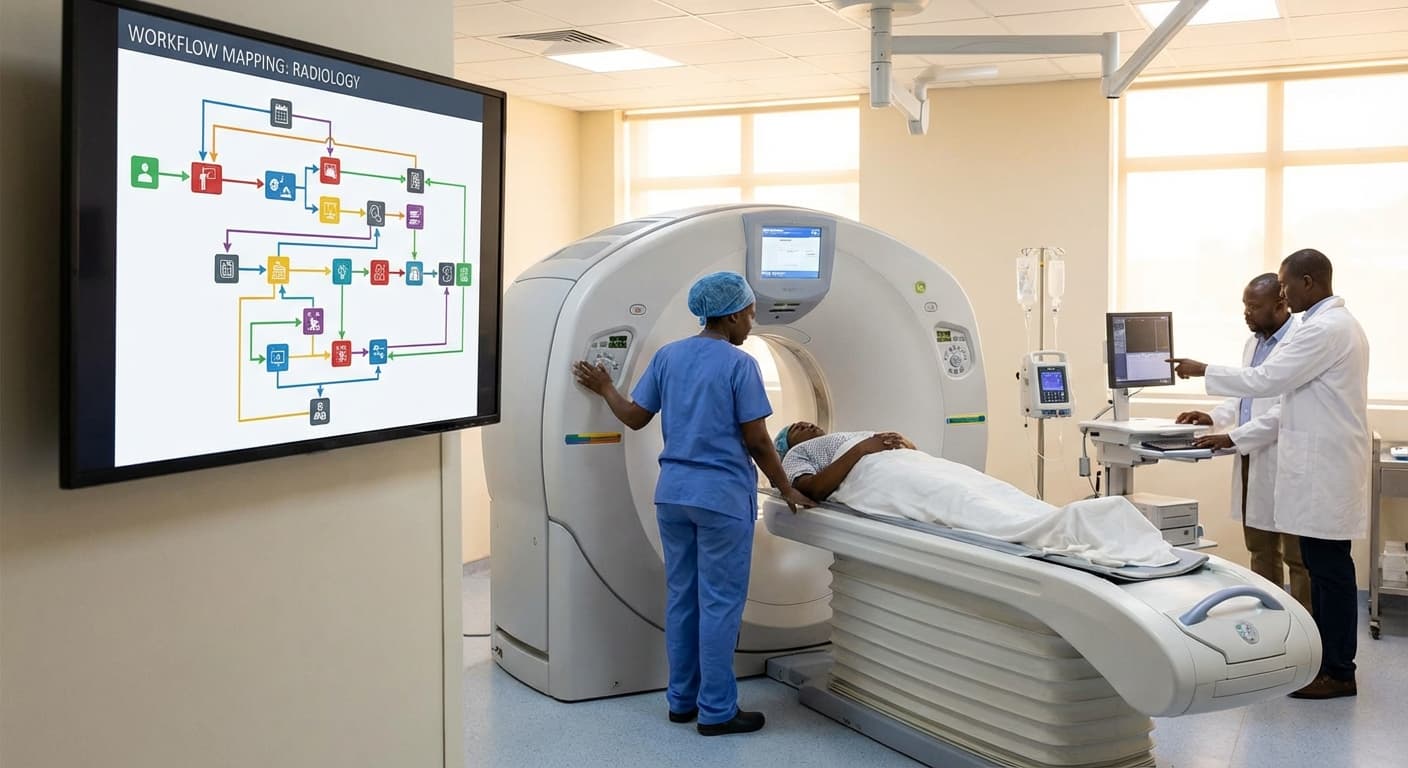
Department Workflow Mapping Service (Radiology/ICU/OT/Lab/Dialysis) in Gambia
Engineering Excellence & Technical Support
Department Workflow Mapping Service (Radiology/ICU/OT/Lab/Dialysis) High-standard technical execution following OEM protocols and local regulatory frameworks.
Optimized Radiology Workflow
Streamlined patient imaging requests, report generation, and distribution in Gambian hospitals, reducing turnaround times and improving diagnostic efficiency. This ensures faster and more accurate patient care.
Enhanced ICU Patient Flow
Mapped critical patient pathways within intensive care units, from admission to discharge, identifying bottlenecks and implementing solutions to optimize resource allocation and patient monitoring for critical conditions.
Efficient Operating Theatre Scheduling
Developed clear and actionable workflows for Operating Theatre scheduling and management, improving resource utilization, minimizing patient wait times, and ensuring seamless surgical procedures within Gambian healthcare facilities.
What Is Department Workflow Mapping Service (Radiology/icu/ot/lab/dialysis) In Gambia?
Department Workflow Mapping Service (Radiology/ICU/OT/Lab/Dialysis) in Gambia refers to the systematic analysis, documentation, and optimization of the operational processes within critical hospital departments. This service aims to identify inefficiencies, bottlenecks, and areas for improvement to enhance patient care delivery, resource utilization, and operational effectiveness. It involves a comprehensive examination of all steps, from patient admission or requisition to final reporting or discharge, including the roles of personnel, equipment, information flow, and material movement. The objective is to create a clear, standardized, and efficient workflow that aligns with best practices and regulatory requirements prevalent in The Gambia's healthcare landscape.
| Department | Who Needs the Service | Typical Use Cases |
|---|---|---|
| Radiology | Hospital administration, Radiology department heads, IT departments, Quality assurance teams. | Optimizing patient throughput for imaging procedures, reducing scan turnaround times, improving radiologist report turnaround, enhancing equipment utilization, streamlining referral processes, ensuring compliance with imaging protocols. |
| Intensive Care Unit (ICU) | Hospital administration, ICU department heads, Nursing supervisors, Medical directors, Infection control teams. | Improving patient handover processes, optimizing nurse-to-patient ratios, standardizing critical care protocols, reducing medication errors, enhancing communication among multidisciplinary teams, streamlining patient monitoring and data entry. |
| Operating Theatre (OT) | Hospital administration, Surgical department heads, Anesthesiology department heads, Theatre managers, Sterilization unit heads. | Optimizing surgical scheduling, improving instrument and equipment availability, reducing surgical site infections, enhancing patient safety during surgical procedures, streamlining post-operative care handoffs, maximizing OR utilization. |
| Laboratory | Hospital administration, Laboratory directors, Pathologists, Lab technologists, Phlebotomy supervisors. | Reducing specimen processing and analysis turnaround times, improving sample integrity and tracking, optimizing test ordering and reporting, enhancing quality control measures, managing reagent inventory and utilization, streamlining laboratory information system (LIS) integration. |
| Dialysis | Hospital administration, Nephrology department heads, Dialysis unit managers, Nursing staff, Biomedical engineers. | Optimizing patient scheduling for dialysis sessions, improving vascular access management, ensuring efficient machine preparation and sterilization, standardizing treatment protocols, reducing patient wait times, enhancing staff allocation and training. |
Key Components of Department Workflow Mapping Service
- Process Identification and Definition: Deconstructing existing departmental processes into discrete steps.
- Data Collection and Analysis: Gathering quantitative and qualitative data on process duration, resource allocation, error rates, and patient wait times.
- Stakeholder Engagement: Involving clinicians, technicians, administrative staff, and management in the mapping process.
- Visual Representation: Creating process maps (e.g., flowcharts, swimlane diagrams) to illustrate current workflows.
- Bottleneck and Inefficiency Identification: Pinpointing areas causing delays, redundancy, or increased costs.
- Root Cause Analysis: Investigating the underlying reasons for identified inefficiencies.
- Optimization and Redesign: Developing proposed improved workflows and standard operating procedures (SOPs).
- Technology Integration Assessment: Evaluating the potential for incorporating relevant digital tools and systems.
- Implementation Planning: Outlining strategies for adopting the redesigned workflows.
- Monitoring and Evaluation: Establishing metrics for tracking the performance of the new workflows.
Who Needs Department Workflow Mapping Service (Radiology/icu/ot/lab/dialysis) In Gambia?
Department workflow mapping services are crucial for optimizing operations, improving efficiency, and ensuring patient safety within healthcare facilities. In Gambia, where healthcare resources are vital, understanding and streamlining processes in critical departments like Radiology, Intensive Care Unit (ICU), Operating Theatre (OT), Laboratory, and Dialysis is paramount. This service helps identify bottlenecks, reduce errors, enhance communication, and ultimately improve patient outcomes.
| Department | Target Customers/Users | Key Benefits of Workflow Mapping |
|---|---|---|
| Radiology | Radiologists, Radiographers, Technicians, Nurses, Administrative Staff, Referring Physicians | Faster image acquisition and reporting, reduced patient wait times, optimized equipment utilization, improved radiation safety protocols, enhanced communication with referring physicians. |
| Intensive Care Unit (ICU) | Intensivists, Critical Care Nurses, Respiratory Therapists, Pharmacists, Medical Technologists, Patient Families | Improved patient monitoring and intervention, reduced risk of medical errors, efficient resource allocation (beds, ventilators), streamlined communication among multidisciplinary teams, enhanced patient safety and infection control. |
| Operating Theatre (OT) | Surgeons, Anesthesiologists, Surgical Nurses, Scrub Nurses, Sterilization Technicians, Biomedical Engineers | Optimized surgical scheduling, reduced operating room turnaround times, improved instrument and equipment management, enhanced patient safety during surgery, streamlined communication between surgical teams and support staff. |
| Laboratory | Pathologists, Medical Laboratory Scientists, Phlebotomists, Administrative Staff, Referring Clinicians | Faster and more accurate test results, reduced sample processing delays, improved quality control, optimized reagent and supply management, enhanced communication with clinical departments. |
| Dialysis | Nephrologists, Dialysis Nurses, Biomedical Engineers, Patient Care Technicians, Administrative Staff | Efficient patient scheduling and flow, optimized machine utilization, improved patient safety and comfort, streamlined medication administration, enhanced communication with patients and their families. |
Who Needs Department Workflow Mapping Service (Radiology/ICU/OT/Lab/Dialysis) in Gambia?
- Public Hospitals and Tertiary Referral Centers
- Private Hospitals and Clinics
- Specialty Medical Centers
- Government Health Ministries and Agencies
- Healthcare Consulting Firms (offering these services)
Department Workflow Mapping Service (Radiology/icu/ot/lab/dialysis) Process In Gambia
This document outlines the Department Workflow Mapping Service process for Radiology, Intensive Care Unit (ICU), Operating Theatre (OT), Laboratory, and Dialysis departments in Gambia. The service aims to analyze, document, and optimize existing workflows within these critical healthcare units to enhance efficiency, patient care, and resource utilization. The process begins with an initial inquiry and culminates in the delivery of a comprehensive workflow map and recommendations for improvement.
| Stage | Description | Key Activities | Deliverables/Outcomes | Department Focus |
|---|---|---|---|---|
| Initial Inquiry & Needs Assessment | The process begins when a hospital or department expresses interest in workflow mapping. | Contact initiation, preliminary discussion of departmental challenges, understanding of desired outcomes. | Confirmation of interest, initial understanding of project scope and objectives. | All Departments (Radiology, ICU, OT, Lab, Dialysis) |
| Scope Definition & Proposal | A detailed understanding of the specific workflows to be mapped and the project's boundaries is established. | Detailed discussions with department heads and key personnel, identification of specific processes for mapping, defining the project timeline, resources, and expected outcomes. | Formal project proposal, including scope, objectives, methodology, timeline, budget, and team roles. | All Departments (Radiology, ICU, OT, Lab, Dialysis) |
| Data Gathering & Analysis | Information about the current state of the workflows is collected and analyzed. | Observation of daily operations, interviews with staff at all levels, review of existing Standard Operating Procedures (SOPs), patient flow analysis, time studies, collection of relevant data (e.g., patient wait times, equipment utilization). | Raw data, interview notes, observation logs, preliminary insights into current processes. | All Departments (Radiology, ICU, OT, Lab, Dialysis) |
| Workflow Mapping & Documentation | The gathered information is transformed into visual representations of the current workflows. | Creation of detailed process flow diagrams (using standardized notation like BPMN), documenting each step, decision point, role, and system involved in the workflow. | Comprehensive current-state workflow maps for each targeted department. | All Departments (Radiology, ICU, OT, Lab, Dialysis) |
| Gap Analysis & Recommendation Development | The documented workflows are analyzed to identify inefficiencies, bottlenecks, and areas for improvement. | Comparison of current-state maps with best practices, identification of redundant steps, delays, communication breakdowns, and resource misallocations. Development of actionable recommendations for process optimization. | List of identified gaps, bottlenecks, and inefficiencies. Proposed solutions and recommendations for improving the workflows. | All Departments (Radiology, ICU, OT, Lab, Dialysis) |
| Presentation & Validation | The findings and recommendations are presented to key stakeholders for feedback and validation. | Presentation of workflow maps, gap analysis, and recommendations to department heads, hospital administration, and relevant staff. Facilitation of discussions to gather feedback and ensure alignment. | Validated workflow maps and agreed-upon recommendations. | All Departments (Radiology, ICU, OT, Lab, Dialysis) |
| Final Report & Implementation Support | A comprehensive report is generated, and support for implementation is provided. | Compilation of the final report, including executive summary, methodology, current-state maps, gap analysis, recommendations, and implementation roadmap. Optional: providing guidance or training for implementing the recommended changes. | Final Workflow Mapping Report, implementation plan, and ongoing support (if agreed upon). | All Departments (Radiology, ICU, OT, Lab, Dialysis) |
Workflow Mapping Service Stages
- Initial Inquiry & Needs Assessment
- Scope Definition & Proposal
- Data Gathering & Analysis
- Workflow Mapping & Documentation
- Gap Analysis & Recommendation Development
- Presentation & Validation
- Final Report & Implementation Support
Department Workflow Mapping Service (Radiology/icu/ot/lab/dialysis) Cost In Gambia
The cost of Department Workflow Mapping Services for specialized units like Radiology, Intensive Care Units (ICU), Operating Theatres (OT), Laboratories, and Dialysis in The Gambia is influenced by several key factors. These services are crucial for optimizing efficiency, patient safety, and resource utilization within these high-demand and complex departments. The pricing is typically bespoke, reflecting the unique needs and scale of each facility.
| Service Area | Potential Cost Range (GMD) | Notes |
|---|---|---|
| Radiology Department Workflow Mapping | 25,000 - 75,000 GMD | Covers patient flow from appointment scheduling, imaging procedures, reporting, to record keeping. Factors include imaging modalities and report turnaround times. |
| ICU (Intensive Care Unit) Workflow Mapping | 30,000 - 90,000 GMD | Focuses on patient admission, monitoring, treatment protocols, interdisciplinary team communication, and discharge processes. High complexity due to critical care nature. |
| OT (Operating Theatre) Workflow Mapping | 35,000 - 100,000 GMD | Includes pre-operative patient preparation, surgical scheduling, room turnover, intra-operative procedures, post-operative recovery, and instrument sterilization. Critical for safety and efficiency. |
| Laboratory Workflow Mapping | 20,000 - 60,000 GMD | Covers specimen collection, transportation, processing, analysis, quality control, and result reporting. Volume and complexity of tests are key factors. |
| Dialysis Department Workflow Mapping | 25,000 - 70,000 GMD | Focuses on patient scheduling, preparation, dialysis treatment procedures, post-treatment care, and machine maintenance. Repetitive nature of procedures is a consideration. |
Key Pricing Factors for Department Workflow Mapping Services in The Gambia:
- Scope of the Mapping Project: The breadth and depth of the workflow analysis (e.g., end-to-end patient journey, specific process optimization, integration with existing systems) directly impacts the effort and time required.
- Department Size and Complexity: Larger departments with more intricate processes and a higher volume of activity will naturally incur higher mapping costs.
- Number of Departments to be Mapped: Engaging the service for multiple departments simultaneously can sometimes lead to volume discounts.
- Level of Detail Required: High-fidelity mapping requiring granular step-by-step analysis, identification of all stakeholders, and detailed documentation will be more expensive than a broader overview.
- Consultant Expertise and Experience: Highly specialized consultants with proven track records in healthcare workflow optimization command higher fees.
- Data Collection Methods: The methods employed for data gathering (e.g., direct observation, interviews, surveys, system log analysis) influence resource allocation and cost.
- Reporting and Deliverable Format: The complexity and comprehensiveness of the final reports, including recommendations, visualizations, and implementation roadmaps, affect the cost.
- Technology and Tools Used: If specialized software or technology is required for data analysis and visualization, this can add to the overall cost.
- Project Duration: Longer engagement periods will naturally translate to higher overall costs.
- Location within The Gambia: While less of a primary driver, significant travel and accommodation costs for consultants to remote areas might be factored in.
- Urgency of the Project: Rush projects may incur premium charges.
Affordable Department Workflow Mapping Service (Radiology/icu/ot/lab/dialysis) Options
Our Affordable Department Workflow Mapping Service offers comprehensive analysis and optimization for critical hospital departments, including Radiology, Intensive Care Units (ICU), Operating Theatres (OT), Laboratories, and Dialysis Units. We aim to streamline processes, reduce waste, improve efficiency, and ultimately enhance patient care while controlling costs.
| Value Bundle | Included Services | Target Departments | Estimated Cost Range (USD) | Key Benefits |
|---|---|---|---|---|
| Essential Efficiency Bundle | Core Workflow Mapping, Basic Process Re-engineering, Performance Metrics Development | Radiology, Lab | $5,000 - $15,000 | Reduced wait times, improved throughput, clearer task delegation. |
| Critical Care Optimization Bundle | Core Workflow Mapping, Advanced Process Re-engineering, Technology Integration Assessment, Performance Metrics Development | ICU, OT | $10,000 - $25,000 | Enhanced patient safety, faster response times, optimized resource allocation, reduced medical errors. |
| Specialized Operations Bundle | Core Workflow Mapping, Process Re-engineering, Staff Training & Change Management, Performance Metrics Development | Dialysis | $8,000 - $20,000 | Improved patient comfort, efficient scheduling, reduced administrative burden, consistent service delivery. |
| Comprehensive Transformation Bundle | All services (Core Mapping, Advanced Re-engineering, Tech Assessment, Training, KPIs) | All Departments (Customizable) | $15,000 - $40,000+ | Holistic operational improvement, significant cost savings, enhanced patient outcomes, long-term sustainability. |
Value Bundles & Services
- Core Workflow Mapping: Detailed documentation of current processes, identifying bottlenecks, redundancies, and areas for improvement.
- Process Re-engineering: Development of optimized workflows based on best practices and identified inefficiencies.
- Technology Integration Assessment: Evaluation of existing and potential technology solutions to enhance workflow automation and data management.
- Staff Training & Change Management: Facilitating smooth adoption of new workflows through comprehensive training and communication strategies.
- Performance Metrics Development: Defining key performance indicators (KPIs) to track and measure the impact of workflow changes.
- Department-Specific Modules: Tailored solutions focusing on the unique demands and challenges of Radiology, ICU, OT, Lab, and Dialysis.
Verified Providers In Gambia
In the realm of healthcare, especially when seeking specialized services or treatments, identifying and trusting verified providers is paramount. In Gambia, the landscape of healthcare services is evolving, and it's crucial for patients to understand what makes a provider 'verified' and why certain credentials, like those of Franance Health, stand out as the best choice for quality and reliable care.
| Credential/Aspect | Franance Health's Commitment | Why it's the Best Choice |
|---|---|---|
| Medical Expertise & Specialization | Franance Health boasts a team of highly qualified and experienced medical professionals, including specialists in various fields. They prioritize continuous learning and staying abreast of the latest medical advancements. | Ensures access to knowledgeable practitioners who can accurately diagnose and treat a wide range of conditions, leading to better health outcomes. |
| State-of-the-Art Facilities & Technology | The facilities at Franance Health are equipped with modern diagnostic tools and treatment technologies, adhering to international healthcare standards. | Provides accurate diagnoses and effective treatments, minimizing the need for patients to seek care abroad for advanced procedures. |
| Patient-Centric Approach | Franance Health places a strong emphasis on patient comfort, clear communication, and personalized care plans. They strive to create a supportive and reassuring environment. | Promotes a positive healthcare experience, empowering patients with understanding and confidence in their treatment journey. |
| Adherence to Ethical Practices & Transparency | Upholding the highest ethical standards, Franance Health is committed to transparent pricing, informed consent, and respecting patient privacy. | Builds trust and ensures patients receive fair, honest, and respectful treatment throughout their interaction with the healthcare provider. |
| Comprehensive Service Offering | From primary care to specialized diagnostics and treatments, Franance Health aims to be a one-stop solution for a broad spectrum of healthcare needs. | Offers convenience and continuity of care, reducing the fragmentation often experienced when seeking healthcare services from multiple disparate providers. |
What Constitutes a Verified Provider in Gambia?
- Official Registration and Licensing: Verified providers have undergone rigorous checks by Gambian health authorities, ensuring they meet all legal and operational requirements.
- Professional Qualifications: Clinicians and staff possess recognized degrees, certifications, and ongoing professional development to demonstrate their expertise.
- Adherence to Standards: Verified facilities and practitioners consistently follow established medical protocols, hygiene standards, and ethical guidelines.
- Patient Feedback and Reputation: A proven track record of positive patient experiences and a strong reputation within the community are indicators of verified quality.
- Specialized Accreditations (if applicable): For specific medical fields, further accreditations from relevant professional bodies signal advanced expertise and specialized care.
Scope Of Work For Department Workflow Mapping Service (Radiology/icu/ot/lab/dialysis)
This Scope of Work (SOW) outlines the services to be provided for a comprehensive workflow mapping initiative across key hospital departments: Radiology, Intensive Care Unit (ICU), Operating Theatre (OT), Laboratory, and Dialysis. The objective is to document, analyze, and optimize existing workflows to improve efficiency, patient safety, and resource utilization. This SOW details the deliverables and standard specifications for the workflow mapping service.
| Phase | Key Activities | Deliverables | Standard Specifications |
|---|---|---|---|
| Phase 1: Planning & Kick-off | Project initiation and stakeholder identification. Define scope and objectives for each department. Establish communication protocols and meeting schedules. Develop project plan and timeline. | Project Charter Stakeholder Register Initial Project Plan Kick-off Meeting Minutes | All documents to be reviewed and approved by the Client's Project Manager. Timeline to be realistic and achievable, considering departmental availability. |
| Phase 2: Data Gathering & Documentation | Conduct interviews with key personnel in each department (clinicians, technicians, administrators). Observe workflow processes in real-time. Gather relevant existing documentation (SOPs, guidelines, forms). Map current state workflows using process mapping notation (e.g., BPMN). Document key data points (inputs, outputs, decision points, roles, systems used). | Current State Workflow Maps (BPMN 2.0 compliant) Interview Notes Observed Process Logs Data Dictionaries for key process elements | Workflow maps to be clear, concise, and easily understandable. Consistent notation and labeling across all maps. Data gathered to be objective and verified with multiple sources. |
| Phase 3: Analysis & Identification of Improvement Opportunities | Analyze documented workflows to identify bottlenecks, inefficiencies, and non-value-adding activities. Benchmarking against industry best practices (where applicable). Facilitate workshops with departmental stakeholders to validate findings and brainstorm solutions. Prioritize identified improvement opportunities based on impact and feasibility. | Analysis Report detailing identified issues and root causes List of prioritized improvement opportunities Workshop Summary Reports | Analysis to be data-driven and objective. Improvement opportunities to be actionable and aligned with organizational goals. Prioritization criteria to be agreed upon with the client. |
| Phase 4: Future State Design (Optional, based on contract) | Develop proposed future state workflows incorporating identified improvements. Define required changes to processes, roles, and technology. Model potential impact of proposed changes. | Future State Workflow Maps Gap Analysis Report Recommendations for process changes and technology adoption | Future state maps to represent a feasible and beneficial evolution of current processes. Impact analysis to be quantitative where possible. |
| Phase 5: Reporting & Handover | Compile all findings, analysis, and recommendations into a comprehensive final report. Present findings and recommendations to senior management and departmental leadership. Provide all project documentation and deliverable in a digital format. | Final Project Report Executive Summary Presentation Slides Archived Project Documentation | Final report to be professionally formatted, well-structured, and free of errors. All deliverables to be provided in agreed-upon digital formats (e.g., PDF, Visio, Lucidchart). |
Objectives of Workflow Mapping
- To visually represent current operational processes within each specified department.
- To identify bottlenecks, redundancies, and areas for improvement in existing workflows.
- To standardize processes across similar functions within and potentially between departments.
- To provide a baseline for future process re-engineering and technology implementation.
- To enhance communication and understanding of departmental operations among stakeholders.
- To identify opportunities for improved patient flow and reduced wait times.
- To ensure compliance with relevant regulations and best practices.
Service Level Agreement For Department Workflow Mapping Service (Radiology/icu/ot/lab/dialysis)
This Service Level Agreement (SLA) outlines the guaranteed response times and uptime for the Department Workflow Mapping Service, critical for efficient operations within Radiology, Intensive Care Unit (ICU), Operating Theatre (OT), Laboratory, and Dialysis departments. The Service aims to provide timely identification and documentation of departmental workflows to support process improvement, training, and operational efficiency. This SLA defines the standards of performance that the Service Provider commits to delivering.
| Service Component | Response Time Target | Uptime Guarantee | Notes |
|---|---|---|---|
| Initial Workflow Consultation & Scoping Request Received | 4 Business Hours | N/A (Service is personnel-driven) | Acknowledgement of request and scheduling of initial meeting. |
| On-site Workflow Observation Scheduled | 3 Business Days | N/A (Service is personnel-driven) | Confirmation of date and time for on-site visit. |
| Draft Workflow Diagram & Documentation Delivered | 7 Business Days (Post-observation completion) | N/A (Service is personnel-driven) | Time may vary based on complexity and departmental cooperation. Any potential delays will be communicated proactively. |
| Workflow Review & Feedback Session Scheduled | 5 Business Days (Post-draft delivery) | N/A (Service is personnel-driven) | To facilitate timely feedback and revisions. |
| Finalized Workflow Maps Delivered | 3 Business Days (Post-feedback incorporation) | N/A (Service is personnel-driven) | Includes all agreed-upon revisions. |
| Dedicated Workflow Mapping Service Portal/Tool (if applicable) | 99.5% | 99.5% | Applies to the availability of any digital platform used for collaboration, documentation storage, or request submission. Maintenance windows will be scheduled with prior notification. |
| Urgent Workflow Revision Request (Critical Process Impact) | 2 Business Hours | N/A (Service is personnel-driven) | For critical issues identified post-implementation that require immediate workflow adjustment. Prioritization based on impact assessment. |
Service Components Covered
- Initial workflow consultation and scoping
- On-site workflow observation and data collection
- Workflow diagramming and documentation (using agreed-upon standards)
- Review and feedback sessions on drafted workflows
- Finalization and delivery of mapped workflows
- Updates and revisions to existing workflow maps (as per agreed change management process)
Frequently Asked Questions

Ready when you are
Let's scope your Department Workflow Mapping Service (Radiology/ICU/OT/Lab/Dialysis) in Gambia project in Gambia.

Scaling healthcare logistics and technical systems across the entire continent.