
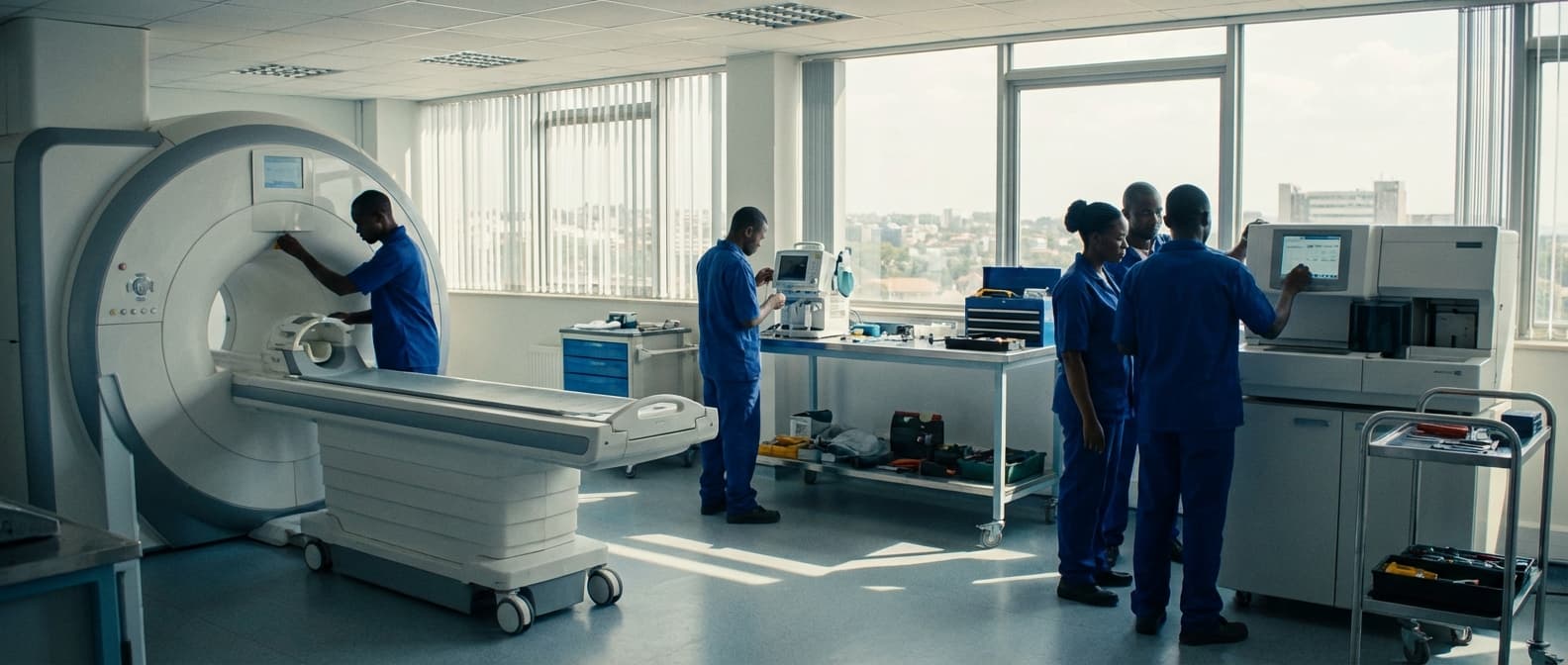
Uptime, Downtime & Root-Cause Analysis Reporting Service in Gabon
Engineering Excellence & Technical Support
Uptime, Downtime & Root-Cause Analysis Reporting Service High-standard technical execution following OEM protocols and local regulatory frameworks.
Real-time Uptime Monitoring & SLA Compliance
Gain immediate visibility into your system's availability across Gabon. Our service provides continuous uptime tracking, alerting you to deviations and ensuring your Service Level Agreements (SLAs) are met or exceeded with precise, actionable data.
Proactive Downtime Detection & Rapid Notification
Minimize business disruption with our intelligent downtime detection. We leverage advanced anomaly detection algorithms to identify outages the moment they occur, sending instant, detailed alerts to designated personnel across Gabon, enabling swift remediation.
Automated Root-Cause Analysis & Historical Trend Reports
Move beyond simply identifying problems. Our reporting service automatically performs root-cause analysis, pinpointing the origin of downtime incidents. Generate comprehensive historical reports to identify recurring issues and drive long-term system stability and performance improvements in Gabon.
What Is Uptime, Downtime & Root-cause Analysis Reporting Service In Gabon?
Uptime, Downtime & Root-Cause Analysis Reporting Service in Gabon refers to a comprehensive offering focused on monitoring, documenting, and investigating the availability and unavailability of critical IT systems and infrastructure within organizations operating in Gabon. This service aims to provide stakeholders with clear, actionable insights into system performance, identify the underlying causes of disruptions, and facilitate the implementation of preventative measures to enhance reliability and reduce future incidents.
Uptime signifies the period during which a system or service is operational and accessible to users. Metrics such as Service Level Agreement (SLA) compliance and Mean Time Between Failures (MTBF) are critical in quantifying uptime.
Downtime represents the period when a system or service is non-operational, inaccessible, or performing below acceptable thresholds, leading to service interruption and potential business impact. Key metrics include Mean Time To Repair (MTTR) and the frequency and duration of outages.
Root-Cause Analysis (RCA) is a systematic process used to identify the fundamental reasons for a problem or incident, rather than just addressing the immediate symptoms. In the context of this service, RCA is applied to understand why downtime occurred, enabling the development of long-term solutions to prevent recurrence.
| Typical Use Cases | Description | Key Deliverables/Outcomes |
|---|---|---|
| Proactive Performance Monitoring & Alerting | Continuous observation of system health, resource utilization, and network traffic to detect anomalies indicative of potential future failures. | Real-time alerts for critical events, performance degradation, and security threats. Uptime percentage tracking. |
| Incident Management & Response | Structured procedures for reporting, categorizing, and resolving unplanned downtime incidents. | Downtime duration tracking (MTTR), incident severity classification, and communication protocols. |
| Post-Incident Root-Cause Analysis (RCA) | Detailed investigation following a downtime event to identify the contributing factors, whether they be hardware failures, software bugs, human error, network issues, or external attacks. | Comprehensive RCA reports detailing incident timeline, contributing factors, impact assessment, and recommended corrective/preventative actions. |
| SLA Compliance Reporting | Regular generation of reports demonstrating adherence to agreed-upon uptime and performance metrics as per SLAs. | Uptime/downtime reports against SLA targets, penalty avoidance, and client satisfaction metrics. |
| Capacity Planning & Optimization | Analysis of historical uptime and resource utilization data to forecast future needs and identify areas for infrastructure optimization. | Recommendations for hardware upgrades, software patches, network enhancements, and resource allocation adjustments. |
| Security Incident Investigation | Investigating downtime caused by security breaches, malware infections, or denial-of-service (DoS) attacks to understand the attack vector and impact. | Security RCA reports, vulnerability identification, and remediation strategies. |
| Disaster Recovery (DR) & Business Continuity Planning (BCP) Validation | Using historical downtime data to inform and validate DR/BCP strategies and test their effectiveness. | Data-driven insights for refining DR/BCP plans and improving recovery times. |
Who Needs This Service?
- Organizations reliant on IT infrastructure: Any entity whose operations, revenue, or service delivery are dependent on the continuous availability of their IT systems, including servers, networks, applications, and cloud services.
- Businesses with Service Level Agreements (SLAs): Companies that have contractual obligations with clients or partners regarding system uptime and performance, where failure to meet these SLAs incurs penalties.
- Critical Infrastructure Operators: Sectors such as telecommunications, energy, finance, healthcare, and government that require uninterrupted service delivery.
- IT Operations and Support Teams: Departments responsible for maintaining system availability, troubleshooting issues, and ensuring optimal performance.
- Management and Executive Leadership: Decision-makers who need to understand the financial and operational impact of system downtime and require data-driven insights for strategic planning and investment in IT resilience.
Who Needs Uptime, Downtime & Root-cause Analysis Reporting Service In Gabon?
In Gabon's burgeoning economy, ensuring the continuous operation of critical systems is paramount. Downtime can lead to significant financial losses, reputational damage, and disruptions in essential services. A robust Uptime, Downtime & Root-Cause Analysis Reporting Service is therefore indispensable for a wide range of businesses and government entities.
| Customer Type | Key Departments Benefiting | Primary Concerns |
|---|---|---|
| Telecommunications Providers | Network Operations Center (NOC), IT Operations, Customer Support, Engineering | Network availability, service continuity, customer satisfaction, impact on revenue |
| Oil and Gas Companies | Operations Management, IT Infrastructure, Process Control Engineering, Safety & Compliance | Production uptime, process safety, asset integrity, environmental compliance, data integrity |
| Financial Institutions | IT Operations, Risk Management, Compliance, Business Continuity Planning, Customer Service | Transaction processing, data security, regulatory compliance, customer trust, fraud prevention |
| Government Agencies | IT Department, Public Service Delivery Units, Infrastructure Management | Essential service delivery (e.g., power, water), citizen data protection, operational efficiency, budget adherence |
| Healthcare Providers | IT Department, Clinical Operations, Biomedical Engineering, Patient Administration | Patient care continuity, medical equipment functionality, electronic health record (EHR) availability, data privacy |
| Transportation and Logistics | Operations Management, Fleet Management, IT Infrastructure, Supply Chain Management | Shipment tracking, vehicle availability, logistics optimization, on-time delivery, regulatory adherence |
| Mining Operations | Mine Operations, Industrial IT, Maintenance Departments, Safety & Environmental | Equipment uptime, production targets, safety systems, environmental monitoring, data acquisition |
| Manufacturing and Industrial | Production Management, Plant Operations, Maintenance & Reliability, IT Operations | Production line continuity, equipment efficiency, quality control, supply chain integration |
Target Customers and Departments in Gabon
- Telecommunications Providers
- Oil and Gas Companies (Exploration, Production, Refining)
- Financial Institutions (Banks, Insurance Companies)
- Government Agencies (Ministries, Public Utilities)
- Healthcare Providers (Hospitals, Clinics)
- Transportation and Logistics Companies
- Mining Operations
- Manufacturing and Industrial Facilities
- Internet Service Providers (ISPs)
- Data Centers and Cloud Service Providers
- Large Retail Chains
- Hospitality Sector (Major Hotels)
Uptime, Downtime & Root-cause Analysis Reporting Service Process In Gabon
This document outlines the typical workflow for an Uptime, Downtime & Root-Cause Analysis (RCA) Reporting Service offered in Gabon. This service is crucial for businesses to understand and improve the reliability and performance of their systems, applications, or infrastructure. The process is designed to be comprehensive, starting from an initial client inquiry and culminating in the delivery of a detailed RCA report.
| Phase | Description | Key Activities | Deliverables | Responsible Party (Gabon Context) |
|---|---|---|---|---|
| The client expresses interest in understanding system uptime, downtime events, and their underlying causes. The scope of services is defined. | Initial contact, needs assessment, discussion of reporting requirements, system/service identification, defining SLAs/OLAs. | Initial consultation notes, defined service scope. | Client, Service Provider Account Manager |
| The service provider presents a formal proposal outlining the scope, methodology, pricing, and timelines. Once accepted, a formal agreement is established. | Proposal generation, cost estimation, contract negotiation, service level agreement (SLA) finalization. | Formal proposal, signed service agreement/contract. | Service Provider Sales/Account Management, Client Procurement/Management |
| If not already in place, the service provider configures or integrates with existing monitoring tools to collect relevant uptime and downtime data. | Reviewing client's IT infrastructure, identifying critical systems, deploying/configuring monitoring agents, setting up data collection parameters, establishing baseline performance metrics. | Monitoring architecture design, data collection configuration, baseline performance reports. | Service Provider Technical Team (System Administrators, Network Engineers), Client IT Department |
| Proactive monitoring identifies deviations from expected uptime or performance, triggering an alert. | Real-time system monitoring, anomaly detection, automated alert generation (email, SMS, ticketing system). | Incident alerts, initial notifications. | Service Provider Monitoring System, Automated Alerting System |
| The service provider's incident response team acknowledges the incident and performs an initial assessment to understand the immediate impact and nature of the issue. | Alert acknowledgement, initial assessment of impact, severity classification, determining if the incident falls within SLA/OLA definitions. | Incident ticket creation, initial incident assessment report. | Service Provider Incident Response Team (L1/L2 Support), Client IT Operations |
| A dedicated RCA team thoroughly investigates the incident, gathering all relevant data from various sources. | Collecting logs (system, application, network), analyzing performance metrics, interviewing stakeholders, reviewing change logs, examining configuration files, using diagnostic tools. | Raw data logs, performance graphs, configuration details, interview summaries. | Service Provider RCA Team (Senior Engineers, Analysts), Client Technical Staff |
| The team synthesizes the collected data to pinpoint the fundamental reason(s) for the downtime event. | Correlation of events, identifying contributing factors, determining the 'why' behind the incident, distinguishing between symptoms and root causes. | Identified root cause(s), documented evidence supporting the findings. | Service Provider RCA Team |
| A comprehensive report is generated detailing the incident, the RCA process, identified root causes, and actionable recommendations for prevention and improvement. | Drafting the RCA report, including executive summary, incident timeline, impact assessment, root cause analysis, and corrective/preventive actions. Presenting findings. | Comprehensive Uptime/Downtime & RCA Report, presentation slides. | Service Provider RCA Team, Service Provider Account Manager |
| The client reviews the report, and the service provider discusses the findings and recommendations to ensure understanding and alignment. | Report review meeting, discussion of recommendations, clarifying any ambiguities, defining action plans for implementing recommendations. | Meeting minutes, agreed-upon action plan. | Client Management & Technical Teams, Service Provider Account Manager & RCA Team Lead |
| Once the reporting and initial review are complete, the specific incident RCA service is closed, with potential for ongoing monitoring or future engagements. | Confirmation of report acceptance, final invoicing, knowledge transfer (if applicable), archiving of incident data. | Project closure documentation, final invoice. | Service Provider Finance & Account Management, Client Finance & Project Management |
Uptime, Downtime & Root-Cause Analysis Reporting Service Workflow in Gabon
- Client Inquiry & Scoping
- Proposal & Agreement
- Data Collection & Monitoring Setup
- Incident Detection & Notification
- Initial Response & Triage
- Deep Dive Investigation & Data Analysis
- Root Cause Identification
- Reporting & Recommendations
- Review & Follow-up
- Service Closure
Uptime, Downtime & Root-cause Analysis Reporting Service Cost In Gabon
This report outlines the typical cost of Uptime, Downtime, and Root-Cause Analysis (RCA) reporting services in Gabon. Understanding these costs is crucial for businesses seeking to enhance their operational resilience, identify performance bottlenecks, and minimize the impact of service disruptions. The pricing for these services is influenced by several key factors, leading to a range of costs in local currency, the West African CFA franc (XAF).
| Service Type | Typical Monthly Cost Range (XAF) | Notes |
|---|---|---|
| Basic Uptime/Downtime Monitoring & Reporting | 150,000 - 450,000 | Covers essential monitoring of key systems, regular summary reports on availability. Suitable for small to medium businesses. |
| Intermediate Uptime/Downtime & Performance Monitoring | 400,000 - 900,000 | Includes detailed performance metrics, trending analysis, and more frequent reporting. Addresses a wider range of IT infrastructure. |
| Advanced Uptime/Downtime, Performance & User Experience Monitoring | 800,000 - 2,500,000+ | Comprehensive monitoring, synthetic transaction testing, end-user experience simulation, proactive issue detection, and detailed performance insights. |
| Basic Root-Cause Analysis (RCA) Reporting (per incident) | 100,000 - 300,000 | Focuses on identifying the immediate cause of a specific downtime event. Suitable for occasional, less complex incidents. |
| Standard Root-Cause Analysis (RCA) Reporting (per incident) | 250,000 - 750,000 | In-depth analysis of recurring or moderately complex incidents, including contributing factors and initial remediation recommendations. |
| Comprehensive/Proactive Root-Cause Analysis (RCA) & Prevention (monthly retainer) | 1,000,000 - 5,000,000+ | Continuous RCA for all significant incidents, proactive threat identification, strategic recommendations for long-term resilience, and detailed post-mortem analysis. |
| Combined Uptime/Downtime Monitoring & Proactive RCA Service (Monthly Subscription) | 700,000 - 4,000,000+ | Bundles ongoing monitoring with a proactive approach to RCA, offering a holistic view of system health and resilience. |
Key Pricing Factors for Uptime, Downtime, and RCA Reporting Services in Gabon
- {"title":"Scope of Services","description":"The complexity and breadth of the services required are primary cost drivers. This includes the number of systems monitored, the depth of analysis (e.g., simple uptime/downtime tracking vs. in-depth performance metrics and user experience monitoring), and the level of detail in RCA reports."}
- {"title":"Technology and Tools Used","description":"The sophistication of the monitoring and analytics tools employed by the service provider impacts cost. Advanced platforms with AI-driven insights, real-time dashboards, and automated reporting capabilities will generally be more expensive."}
- {"title":"Data Volume and Retention","description":"The amount of data generated by the monitored systems and the required data retention period influence storage and processing costs, which are passed on to the client."}
- {"title":"Frequency and Timeliness of Reporting","description":"Real-time or near real-time reporting, urgent downtime alerts, and rapid RCA turnaround times often command higher fees due to the dedicated resources and infrastructure required."}
- {"title":"Level of Expertise and Experience","description":"Service providers with highly skilled engineers, experienced RCA specialists, and a proven track record in Gabon's specific IT landscape may charge a premium for their expertise."}
- {"title":"Customization and Integration","description":"The need for custom reporting formats, integration with existing IT service management (ITSM) tools, or bespoke alert configurations will add to the overall cost."}
- {"title":"Service Level Agreements (SLAs)","description":"The promised uptime guarantees and response times stipulated in the SLA will influence the pricing structure. More stringent SLAs typically come with higher costs."}
- {"title":"Support Level","description":"The availability and responsiveness of customer support, including 24/7 support and dedicated account management, will affect pricing."}
Affordable Uptime, Downtime & Root-cause Analysis Reporting Service Options
Ensuring application and system uptime is crucial for business continuity and customer satisfaction. However, comprehensive monitoring and root-cause analysis (RCA) can be expensive. This service aims to provide affordable options for uptime monitoring, downtime alerts, and detailed RCA reporting, empowering businesses of all sizes to proactively manage their infrastructure and minimize disruptions. We offer flexible value bundles and cost-saving strategies designed to deliver maximum ROI.
| Value Bundle Tier | Included Services | Target Business Size | Base Monthly Cost (USD) | Cost-Saving Strategies | |||
|---|---|---|---|---|---|---|---|
| Starter Uptime | Basic Uptime Monitoring (5 endpoints) | Small Businesses / Startups | $29 | Annual pre-payment discount (5%) | Community support forum access | ||
| Essential Insights | Uptime Monitoring (20 endpoints) | Small to Medium Businesses (SMBs) | $79 | Annual pre-payment discount (10%) | Tiered pricing based on endpoint volume | Self-service RCA template library | |
| Comprehensive Analysis | Uptime Monitoring (50 endpoints) | Growing SMBs / Enterprise Departments | $199 | Annual pre-payment discount (15%) | Dedicated account manager for cost optimization | Customizable reporting frequency | Integration with existing ticketing systems |
| Enterprise Guardian | Unlimited Uptime Monitoring | Large Enterprises / Mission-Critical Systems | Custom Quote | Volume-based discounts | Long-term contract incentives | On-demand expert RCA consultation at reduced rates | Tailored SLA reporting and proactive threat intelligence |
Key Service Components
- Real-time Uptime Monitoring: Continuous checks on your critical systems and applications.
- Downtime Alerting: Instant notifications via email, SMS, or integrated platforms when issues arise.
- Automated Incident Logging: Detailed records of every downtime event, including start/end times and duration.
- Root-Cause Analysis (RCA) Reporting: In-depth investigations to identify the underlying causes of downtime.
- Performance Metrics Tracking: Monitoring key performance indicators (KPIs) to identify potential issues before they cause downtime.
- SLA Compliance Reporting: Verification and reporting against your Service Level Agreements.
- Proactive Health Checks: Regular assessments of your infrastructure's health and potential vulnerabilities.
Verified Providers In Gabon
In Gabon's evolving healthcare landscape, identifying trusted and accredited medical professionals is paramount for ensuring quality care and peace of mind. Franance Health stands out as a leading entity in verifying healthcare providers, offering a robust credentialing process that assures patients of competence, ethical practice, and adherence to the highest standards. Choosing a Franance Health-verified provider means opting for a professional who has undergone rigorous scrutiny, guaranteeing a higher level of trust and expertise in their field. This commitment to verification not only benefits patients by streamlining their search for reliable care but also elevates the reputation of the healthcare professionals themselves, fostering a more transparent and dependable medical ecosystem in Gabon.
| Credential Aspect | Franance Health Verification Focus | Patient Benefit |
|---|---|---|
| Educational Background | Verification of accredited medical schools, degrees, and specialized training. | Ensures providers have foundational knowledge and relevant qualifications. |
| Professional Licensing | Confirmation of current and valid medical licenses issued by regulatory bodies. | Guarantees providers are legally authorized to practice. |
| Clinical Experience | Assessment of practical experience, surgical skills (where applicable), and patient management history. | Indicates a proven track record in delivering care. |
| Ethical Conduct | Review of professional conduct, absence of disciplinary actions, and adherence to ethical codes. | Reassures patients of trustworthy and responsible medical practice. |
| Continuing Education | Confirmation of ongoing professional development and participation in training programs. | Ensures providers are up-to-date with the latest medical advancements. |
Why Franance Health Credentials Represent the Best Choice in Gabon:
- Rigorous Vetting Process: Franance Health employs a comprehensive evaluation that examines educational qualifications, professional licenses, clinical experience, and adherence to ethical guidelines.
- Commitment to Quality: Their verification process is designed to identify providers who consistently deliver high-quality patient care and maintain up-to-date knowledge and skills.
- Enhanced Patient Trust: A Franance Health credential serves as a clear indicator of a provider's reliability and competence, empowering patients to make informed decisions about their healthcare.
- Promoting Excellence: By setting a high bar for accreditation, Franance Health encourages a culture of continuous improvement and professional development within Gabon's healthcare sector.
- Access to Competent Professionals: Patients can be confident that Franance Health-verified providers possess the necessary expertise to address a wide range of health needs.
- International Standards Alignment: The verification process often aligns with international best practices, ensuring a global perspective on healthcare quality.
Scope Of Work For Uptime, Downtime & Root-cause Analysis Reporting Service
This Scope of Work (SOW) outlines the requirements for a Uptime, Downtime & Root-Cause Analysis (RCA) Reporting Service. The service aims to provide comprehensive and actionable insights into system availability, identifying reasons for downtime, and detailing the steps taken to resolve issues and prevent recurrence. The technical deliverables will adhere to standard specifications for clarity, consistency, and ease of integration.
| Deliverable | Description | Standard Specifications | Frequency |
|---|---|---|---|
| Uptime/Downtime Report | A summary of system availability, detailing periods of operational and non-operational status. | Includes total uptime percentage, total downtime duration (in hours/minutes), and a breakdown by system/service component. Dates and timestamps for all events are mandatory. | Daily, Weekly, Monthly (configurable) |
| Downtime Incident Report | A detailed account of each downtime event, including its impact and affected systems. | Each report must include: Incident ID, Start Time, End Time, Duration, Affected Systems/Services, Impact Description (e.g., number of users affected, business functions impacted), Severity Level (e.g., Critical, High, Medium, Low). | Per Incident (generated within 24 hours of incident resolution) |
| Root Cause Analysis (RCA) Report | A thorough investigation into the underlying cause of a downtime incident. | Each RCA report must include: Incident ID, Root Cause (clearly identified using methodologies like 5 Whys or Fishbone diagram), Contributing Factors, Timeline of Events leading to the incident, Impact Analysis, Remediation Actions Taken (with timestamps and responsible parties), Lessons Learned, and Preventative Measures (with owners and target dates). | Per Incident (generated within 48 hours of incident resolution) |
| Preventative Measures Tracker | A summary of all identified preventative measures from RCA reports and their implementation status. | Includes: Preventative Measure Description, RCA Report ID, Owner, Target Implementation Date, Actual Implementation Date, Status (e.g., Not Started, In Progress, Completed, Deferred). | Monthly |
| Executive Summary Report | A high-level overview of system availability, key incidents, and trends. | Includes: Overall Uptime Percentage (e.g., for the reporting period), Number of Critical/High Incidents, Top Downtime Contributors, Summary of Key Preventative Actions. | Monthly, Quarterly (configurable) |
Service Objectives
- Accurately track and report on system uptime and downtime.
- Identify the root cause of all reported downtime incidents.
- Document all remediation efforts and their effectiveness.
- Provide actionable recommendations for preventing future downtime.
- Maintain a consistent and standardized reporting format.
Service Level Agreement For Uptime, Downtime & Root-cause Analysis Reporting Service
This Service Level Agreement (SLA) outlines the guaranteed uptime, response times for incidents, and the process for root-cause analysis reporting for the Uptime, Downtime & Root-Cause Analysis Reporting Service (hereinafter referred to as "the Service").
| Service Component | Guaranteed Uptime | Downtime Window (per month, excluding Scheduled Maintenance) |
|---|---|---|
| Core Service Availability | 99.9% | Approximately 43.2 minutes |
| Data Ingestion & Processing | 99.5% | Approximately 3.6 hours |
| Reporting & Analytics Dashboard | 99.8% | Approximately 1 hour and 26 minutes |
Definitions
- Uptime: The percentage of time the Service is available and operational for the customer to access and utilize its intended functionalities.
- Downtime: The period during which the Service is unavailable or not operational for the customer.
- Scheduled Maintenance: Pre-announced periods where the Service may be temporarily unavailable for updates, upgrades, or essential maintenance. Scheduled Maintenance is excluded from Uptime calculations.
- Emergency Maintenance: Unplanned downtime required to address critical issues that pose a significant risk to the Service's stability or security.
- Incident: Any event that causes or may cause disruption to the Service, resulting in Downtime.
- Root-Cause Analysis (RCA): A process of identifying the underlying causes of an Incident to prevent recurrence.
- Reporting Period: A calendar month for which Uptime and Downtime are measured and reported.
Frequently Asked Questions

Ready when you are
Let's scope your Uptime, Downtime & Root-Cause Analysis Reporting Service in Gabon project in Gabon.

Scaling healthcare logistics and technical systems across the entire continent.