
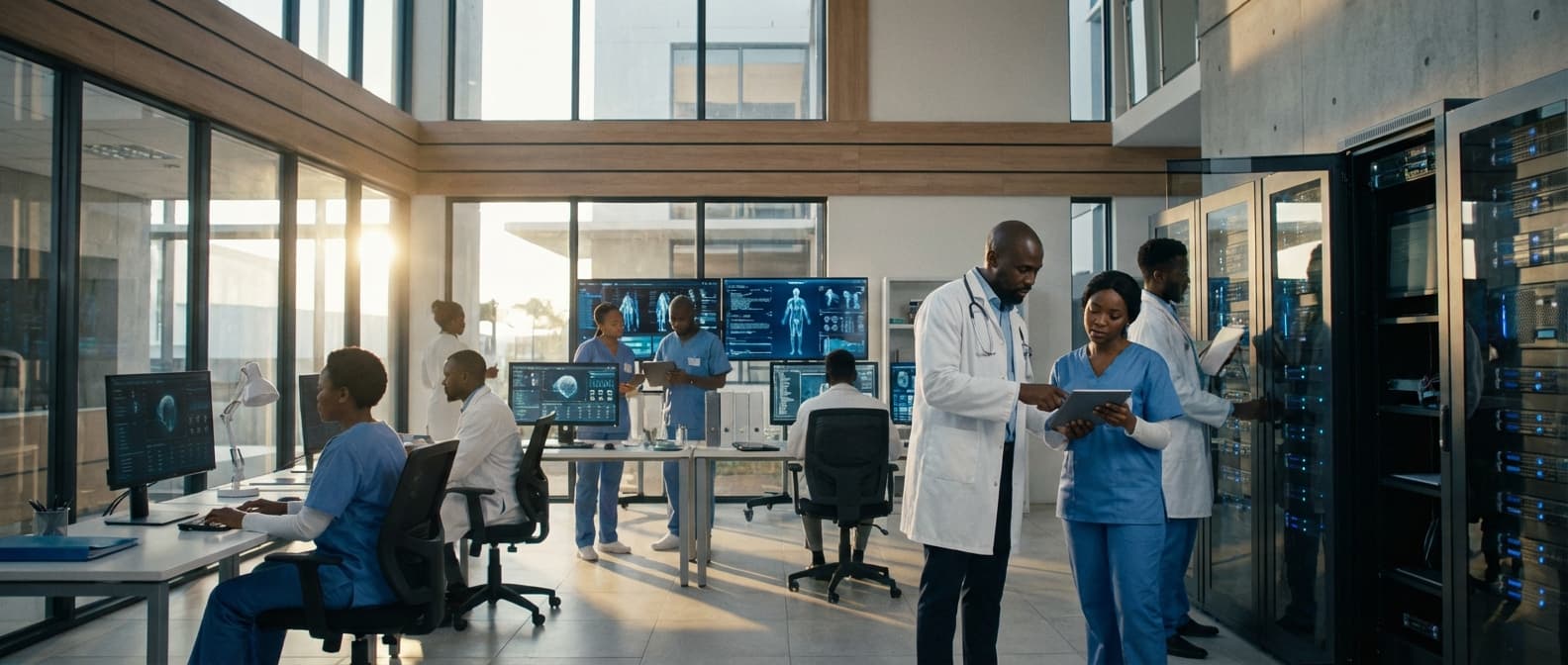
Tele-Radiology in Gabon
Engineering Excellence & Technical Support
24/7 access to certified radiologists providing rapid, accurate remote interpretation of diagnostic imaging studies. High-standard technical execution following OEM protocols and local regulatory frameworks.
Remote Expert Interpretation
Bridging the geographical divide, tele-radiology enables Gabon's healthcare facilities to access specialized radiology expertise on demand. Our platform securely transmits medical images for interpretation by board-certified radiologists globally, ensuring timely and accurate diagnoses regardless of local resource limitations.
Digital Archiving & Accessibility
Leveraging secure cloud infrastructure, we provide a robust digital archiving solution for all radiological studies in Gabon. This ensures easy retrieval of patient history, facilitates multi-disciplinary consultations, and supports long-term research and quality improvement initiatives, all while maintaining stringent data privacy standards.
Optimized Data Transmission
Understanding Gabon's diverse connectivity landscape, our tele-radiology solution incorporates intelligent data compression and optimized transmission protocols. This ensures reliable and efficient transfer of large imaging files, even over lower bandwidth networks, minimizing turnaround times and maximizing diagnostic throughput.
What Is Tele-radiology In Gabon?
Tele-radiology in Gabon refers to the practice of transmitting radiological images (such as X-rays, CT scans, MRIs, and ultrasounds) from a healthcare facility in Gabon to a radiologist located remotely, often in a different geographical location, for interpretation and reporting. This service leverages digital imaging technology and secure telecommunications networks to overcome geographical barriers and improve access to specialist radiological expertise. The core of the service involves the acquisition of medical images, their secure digital transmission, and the subsequent interpretation and generation of a diagnostic report by a qualified radiologist. This enables timely and accurate diagnosis, particularly in areas where local radiological expertise is limited or unavailable.
| Who Needs Tele-Radiology in Gabon? | Typical Use Cases | |||||||
|---|---|---|---|---|---|---|---|---|
| Healthcare facilities in remote or underserved areas of Gabon lacking on-site radiologists. | Emergency departments requiring urgent interpretation of critical imaging findings (e.g., stroke, trauma, acute abdomen). | Hospitals and clinics with limited or intermittent access to specialist radiologists. | Specialized medical centers (e.g., cardiology, neurology, oncology) needing expert interpretation of complex imaging studies. | Public health initiatives and screening programs where broad reach is required. | Situations where local radiologists are unavailable due to leave, illness, or staffing shortages. | Post-operative imaging assessment to monitor patient recovery. | Screening for diseases such as tuberculosis or certain types of cancer in population-wide initiatives. | Second opinion consultations for complex or ambiguous cases. |
Key Components of Tele-Radiology in Gabon:
- Image Acquisition: Digital imaging equipment (CR, DR, CT, MRI, Ultrasound) at the local healthcare facility.
- Image Archiving and Communication System (PACS): A system for storing, retrieving, and managing medical images.
- Telecommunications Network: Secure and reliable internet or satellite connectivity for image transmission.
- Workstation for Radiologist: A remote workstation equipped with advanced imaging software for interpretation.
- Reporting System: A platform for generating and delivering diagnostic reports back to the referring physician.
Who Needs Tele-radiology In Gabon?
Tele-radiology offers a crucial solution for improving diagnostic imaging accessibility and quality in Gabon, a nation facing challenges in specialized medical personnel and infrastructure. This innovative approach connects radiologists remotely to interpret medical images, bridging geographical gaps and enhancing healthcare delivery. The primary need for tele-radiology stems from the scarcity of on-site radiologists, especially in remote or underserved areas, and the limited availability of advanced imaging equipment and maintenance in many facilities. By leveraging tele-radiology, Gabon can ensure that patients receive timely and accurate diagnoses, leading to better treatment outcomes and overall public health.
| Customer Segment | Description of Need | Key Departments Benefiting | Specific Use Cases |
|---|---|---|---|
| Public Hospitals and Healthcare Centers | Limited availability of on-site radiologists for 24/7 coverage, backlogs in image interpretation, need for subspecialty expertise. | Radiology, Emergency Medicine, Internal Medicine, Surgery, Pediatrics, Neurology, Oncology. | Routine X-rays, CT scans, MRI interpretations; urgent case review; second opinions for complex diagnoses; training and capacity building for local technicians. |
| Private Clinics and Diagnostic Centers | Need to expand service offerings without significant investment in full-time specialists, desire for faster turnaround times, competitive advantage through advanced diagnostics. | Radiology, General Practice, Cardiology, Gastroenterology, Orthopedics. | Interpretation of mammograms, ultrasounds, and interventional radiology procedures; provision of specialized interpretations (e.g., neuroradiology, musculoskeletal radiology). |
| Remote and Rural Health Posts | Complete lack of radiologist presence, reliance on basic imaging modalities with no interpretation capacity, long travel distances for patients to access diagnostics. | General Medicine, Emergency Medicine, Public Health. | Remote interpretation of essential imaging (e.g., chest X-rays for tuberculosis screening, basic trauma imaging); enabling basic diagnostic capabilities in underserved areas. |
| Emergency Departments (ED) | High volume of acute cases requiring immediate interpretation of imaging (trauma, stroke, acute abdomen), need for rapid decision-making. | Radiology, Emergency Medicine, Trauma Surgery, Neurosurgery. | Stat interpretation of CT scans for head injuries, CVA, and abdominal trauma; prompt review of chest X-rays for pneumothorax or hemothorax. |
| Intensive Care Units (ICUs) | Frequent imaging needs for critically ill patients (e.g., ventilator-associated pneumonia on CXR, line placement confirmation), close monitoring of patient status. | Radiology, Critical Care Medicine, Anesthesiology. | Routine chest X-ray interpretation for ventilator management; ultrasound for fluid assessment; imaging to guide interventions. |
| Maternity and Pediatric Wards | Specialized interpretation required for fetal anomalies, neonatal imaging, and pediatric imaging which often demands subspecialist expertise. | Radiology, Obstetrics, Gynecology, Pediatrics, Neonatology. | Fetal ultrasound interpretation; neonatal brain ultrasound; pediatric fracture assessment; interpretation of appendicitis or other pediatric surgical emergencies. |
| Specialty Clinics (e.g., Oncology, Neurology) | Need for expert interpretation of complex oncologic staging scans, neuroimaging for stroke, tumors, and degenerative diseases, requiring subspecialty knowledge. | Radiology, Oncology, Neurology, Neurosurgery, Cardiology. | Staging and response assessment imaging for cancer; interpretation of MRI/CT for brain tumors, epilepsy, MS; cardiac MRI for complex heart conditions. |
Target Customers and Departments for Tele-Radiology in Gabon
- Public Hospitals and Healthcare Centers
- Private Clinics and Diagnostic Centers
- Remote and Rural Health Posts
- Emergency Departments
- Intensive Care Units (ICUs)
- Maternity and Pediatric Wards
- Specialty Clinics (e.g., Oncology, Neurology)
Tele-radiology Process In Gabon
Tele-radiology in Gabon involves a streamlined process to connect healthcare facilities in remote or underserved areas with radiologists for expert image interpretation. This process is crucial for improving diagnostic accuracy and patient care where specialized radiologists are scarce. The workflow typically begins with an inquiry from a referring physician, followed by image transmission, radiologist interpretation, report generation, and finally, feedback to the referring physician.
| Step | Description | Key Stakeholders | Technology Involved | Output/Outcome |
|---|---|---|---|---|
| A referring physician at a local clinic or hospital identifies a need for radiological interpretation. | Referring Physician, Local Healthcare Facility Staff | Phone, Secure Messaging Platform, Web Portal | Request for interpretation logged, patient information gathered. |
| Radiological images (X-rays, CT scans, MRI, etc.) are acquired using available equipment at the local facility and then securely transmitted. | Radiology Technologist, Local Healthcare Facility Staff, IT Support | Digital Imaging and Communications in Medicine (DICOM) compatible imaging equipment, PACS (Picture Archiving and Communication System) or specialized tele-radiology software, Secure internet connection (e.g., VPN, encrypted channels) | Digital radiological images securely transmitted to the tele-radiology platform. |
| The transmitted study is received by the tele-radiology platform, where it's assigned to an available and qualified radiologist based on subspecialty and workload. | Tele-radiology Platform Administrator, Radiologist | Tele-radiology Platform/Workflow Software | Study queued for interpretation, radiologist identified. |
| The assigned radiologist reviews the images, correlates them with clinical information provided, and formulates a diagnosis. | Radiologist | High-resolution medical displays, PACS viewer, DICOM viewers | Preliminary findings and diagnosis. |
| The radiologist dictates or types a comprehensive diagnostic report. This report is then securely transmitted back to the referring physician. | Radiologist, Medical Transcriptionist (if applicable), Tele-radiology Platform | Voice recognition software, Report generation software, Secure email, Secure portal | Final diagnostic report delivered to the referring physician. |
| The referring physician receives and reviews the report, integrates it into patient management, and may provide feedback or request clarification. | Referring Physician, Patient | EHR (Electronic Health Record) system, Phone, Secure Messaging | Improved patient diagnosis and treatment plan, potential for ongoing communication and case discussion. |
Tele-Radiology Workflow in Gabon
- Inquiry and Case Submission
- Image Acquisition and Transmission
- Radiologist Assignment and Review
- Image Interpretation and Diagnosis
- Report Generation and Secure Transmission
- Feedback and Follow-up
Tele-radiology Cost In Gabon
Tele-radiology offers a promising solution for improving diagnostic imaging access in Gabon, a nation facing challenges with a scarcity of qualified radiologists and specialized equipment. However, the cost of implementing and utilizing tele-radiology services is a crucial consideration for healthcare providers and policymakers. This discussion outlines the key factors influencing tele-radiology costs in Gabon and provides estimated price ranges in the local currency, the Central African CFA franc (XAF).
| Service/Component | Estimated Range (XAF per month/study) | Notes |
|---|---|---|
| Tele-Radiology Platform Subscription (Basic) | 500,000 - 2,000,000 XAF/month | Covers software access, cloud storage for a moderate volume of studies. |
| Tele-Radiology Platform Subscription (Advanced/AI Features) | 1,500,000 - 5,000,000+ XAF/month | Includes AI-powered analysis tools, higher storage capacity, and advanced reporting features. |
| Per-Study Reading Fee (General X-ray) | 15,000 - 40,000 XAF/study | Varies based on radiologist's location (local vs. international) and turnaround time requirements. |
| Per-Study Reading Fee (CT/MRI Scan) | 50,000 - 150,000 XAF/study | More complex studies command higher fees due to specialized interpretation. |
| PACS/RIS Software Licensing (Annual) | 2,000,000 - 10,000,000+ XAF/year | Depends on the vendor, number of users, and modules included. May be a one-time purchase or ongoing license. |
| Internet Connectivity (Dedicated High-Speed) | 100,000 - 500,000 XAF/month | Crucial for reliable image transmission; costs vary significantly by region. |
| Hardware Lease/Purchase (Workstation/Scanner - initial) | Varies widely, potentially millions of XAF | Significant upfront investment. Leasing can spread costs over time. |
| Training (Per Staff Member) | 200,000 - 1,000,000 XAF (one-time) | Covers technical and operational training for a few days. |
| IT Support (Retainer) | 300,000 - 1,500,000 XAF/month | For ongoing system maintenance and troubleshooting. |
Key Factors Influencing Tele-Radiology Costs in Gabon
- {"title":"Technology Infrastructure","description":"This includes the cost of acquiring or leasing PACS (Picture Archiving and Communication System) and RIS (Radiology Information System) software, high-speed internet connectivity, and secure data storage solutions. The reliability and bandwidth of internet infrastructure in different regions of Gabon can significantly impact these costs."}
- {"title":"Hardware Acquisition and Maintenance","description":"Investment in imaging equipment (X-ray machines, CT scanners, MRI machines), workstations for radiologists, and communication devices. Ongoing maintenance, repairs, and potential upgrades of this hardware contribute to the overall cost."}
- {"title":"Software Licensing and Subscription Fees","description":"Annual or monthly fees for tele-radiology platforms, image viewing software, and any associated artificial intelligence (AI) tools for preliminary analysis. These fees can vary based on the vendor, features offered, and the volume of studies processed."}
- {"title":"Radiologist Fees and Expertise","description":"The primary cost driver is often the remuneration for qualified radiologists, whether they are local or remote. Pricing models can be per-study, hourly, or based on a fixed monthly retainer. The scarcity of local radiologists can drive up costs, necessitating the engagement of international expertise which may incur additional travel or remote access fees."}
- {"title":"Training and Personnel","description":"Costs associated with training local technicians and administrative staff to operate the tele-radiology system and manage workflows. This also includes the salaries of IT support personnel."}
- {"title":"Security and Data Privacy","description":"Implementing robust cybersecurity measures to protect patient data is essential and can involve additional costs for encryption, firewalls, and compliance with data protection regulations."}
- {"title":"Implementation and Integration Costs","description":"One-time costs for setting up the tele-radiology system, integrating it with existing hospital information systems (HIS), and initial configuration."}
- {"title":"Operational Expenses","description":"Ongoing costs such as electricity, consumables for imaging equipment, and potential administrative overheads."}
Affordable Tele-radiology Options
Tele-radiology, the remote interpretation of medical images, has become increasingly vital for healthcare providers seeking to expand access, improve turnaround times, and manage costs. Affordable tele-radiology options are crucial for practices and hospitals of all sizes. This involves understanding how services are priced and implementing smart strategies to maximize value and minimize expenditure. Key to affordability are 'value bundles' and various 'cost-saving strategies'.
| Cost-Saving Strategy | Description | Impact on Affordability |
|---|---|---|
| Negotiate Long-Term Contracts | Committing to longer-term contracts (e.g., 1-3 years) often provides leverage for negotiating lower per-study rates or more favorable bundle terms. | Reduces per-study cost over time and offers price stability. |
| Optimize Study Volume & Type | Accurately forecasting your imaging volume and understanding the mix of study types (e.g., simple X-rays vs. complex MRIs) allows for the selection of the most cost-effective bundle or negotiation of tailored pricing. | Ensures you're not overpaying for studies you don't consistently need or underpaying for high-demand specialized services. |
| Leverage Technology & Workflow Integration | Investing in or utilizing tele-radiology platforms that seamlessly integrate with your PACS and EMR systems can reduce manual work, errors, and turnaround times. Some vendors may offer bundled pricing that includes platform access. | Improves efficiency, reduces operational overhead, and can lead to bundled platform/interpretation costs. |
| Consider Off-Peak or Tiered Service Models | If your needs are not strictly 24/7, inquire about options for non-urgent reads or off-peak hours that may come at a reduced cost. | Provides cost savings for less time-sensitive interpretations. |
| Evaluate Radiologist Subspecialty Needs | Understand if you truly need 24/7 access to every subspecialist. Bundling general radiology coverage with on-demand subspecialty reads can be more cost-effective than a blanket subspecialty bundle. | Aligns costs with actual service requirements, avoiding unnecessary expenditure on specialized coverage. |
| Compare Multiple Vendors | Obtain quotes from several reputable tele-radiology providers. Different vendors have different pricing models, economies of scale, and service offerings. | Facilitates finding the most competitive pricing and best value proposition. |
| Explore 'Hybrid' Models | Consider a model where you handle routine reads in-house (if feasible) and outsource only complex cases, after-hours reads, or those requiring specific subspecialties. Some vendors offer flexible solutions for this. | Optimizes resource allocation and cost, leveraging in-house capabilities where efficient. |
| Seek Bundled IT & Tele-radiology Services | Some providers offer integrated solutions that include teleradiology reading services alongside PACS viewing stations, IT support, and network infrastructure. Bundling these can sometimes lead to discounts. | Simplifies vendor management and can unlock bundled pricing advantages for IT and reading services. |
Understanding Value Bundles in Tele-Radiology
- {"title":"What are Value Bundles?","description":"Value bundles in tele-radiology are pre-packaged service offerings that combine multiple radiologist interpretations and/or related services at a predictable, often discounted, price. Instead of paying per-image or per-study, clients purchase a set number of studies, a specific service level, or a combination of both over a defined period."}
- {"title":"Common Bundle Structures","description":"Bundles can be structured in various ways, including:\n- Volume-Based Bundles: A fixed price for a predetermined number of studies (e.g., 100 CT scans per month).\n- Service-Level Bundles: Different tiers of service based on turnaround time guarantees or radiologist subspecialty coverage (e.g., 'Standard Coverage' vs. 'Subspecialty 24/7').\n- Service-Type Bundles: Specific types of imaging studies bundled together (e.g., a bundle for all X-rays, or a bundle for all MRIs).\n- Hybrid Bundles: Combinations of the above, offering flexibility."}
- {"title":"Benefits of Value Bundles","description":"Bundles offer several advantages, including:\n- Predictable Costs: Easier budgeting and financial planning.\n- Cost Savings: Often provide a lower per-study cost compared to pay-per-study models.\n- Simplified Billing: Streamlined invoicing and payment processes.\n- Guaranteed Capacity: Ensures access to interpreting radiologists when needed.\n- Potential for Service Enhancements: Some bundles may include additional support services."}
Verified Providers In Gabon
In the pursuit of reliable healthcare in Gabon, identifying verified providers is paramount. Franance Health stands out as a leading entity, offering a comprehensive network of accredited healthcare professionals and facilities. Their rigorous credentialing process ensures that every provider within their network meets the highest standards of quality, ethics, and professionalism. This commitment to verification translates into a more secure and trusted healthcare experience for individuals and families across Gabon. By choosing Franance Health, you are opting for a system that prioritizes patient well-being through meticulous selection and continuous evaluation of its medical partners.
| Credential Type | Verification Standard | Benefit to Patient |
|---|---|---|
| Medical Licenses & Certifications | Up-to-date, government-issued and recognized professional qualifications | Ensures providers possess the fundamental legal and educational requirements to practice. |
| Professional Experience & Track Record | Verified work history, peer recommendations, and patient feedback | Confirms practical competence and a history of positive patient outcomes. |
| Specialty Board Certifications | Accredited by recognized medical boards for specific fields of practice | Guarantees advanced knowledge and skills in specialized areas of medicine. |
| Continuing Medical Education (CME) | Proof of ongoing professional development and learning | Ensures providers are up-to-date with the latest medical advancements and techniques. |
| Ethical Conduct & Disciplinary History | Background checks and review of any past disciplinary actions | Safeguards against providers with a history of malpractice or unethical behavior. |
Why Franance Health Credentials Matter
- Rigorous Vetting Process: Franance Health employs a multi-stage verification process for all providers, encompassing educational background, professional licenses, certifications, and peer reviews.
- Commitment to Ethical Practices: Providers are assessed for adherence to ethical guidelines and patient care standards, ensuring a trustworthy medical experience.
- Access to Specialized Expertise: Their network includes a diverse range of specialists, allowing for access to targeted and expert medical advice.
- Enhanced Patient Safety: The verification process directly contributes to improved patient safety by filtering out unqualified or underperforming practitioners.
- Streamlined Access to Quality Care: Franance Health simplifies the process of finding and accessing high-quality healthcare, reducing stress and uncertainty for patients.
Scope Of Work For Tele-radiology
This Scope of Work (SOW) outlines the requirements for implementing a Tele-Radiology service. It details the technical deliverables and standard specifications necessary for the successful deployment and operation of the tele-radiology solution. The objective is to establish a robust and efficient system for remote radiological image interpretation and reporting, enhancing diagnostic capabilities and patient care.
| Category | Technical Deliverable | Description | Standard Specifications/Requirements |
|---|---|---|---|
| Platform & Infrastructure | Tele-Radiology Platform Software | Centralized software for image acquisition, transmission, storage, viewing, and reporting. | Cloud-based or on-premise deployment, DICOM compliance, HL7 integration, PACS integration capabilities, robust security features (HIPAA/GDPR compliant), user-friendly interface, audit trails, scalability. |
| Platform & Infrastructure | Picture Archiving and Communication System (PACS) Integration | Seamless integration with existing or new PACS for image retrieval and storage. | Bi-directional HL7 messaging, DICOM send/receive capabilities, modality worklist integration, robust data synchronization mechanisms. |
| Platform & Infrastructure | Vendor Neutral Archive (VNA) Compatibility | Ability to store and retrieve images from a VNA, if applicable. | DICOM and non-DICOM data handling, standardized metadata management. |
| Platform & Infrastructure | Network Infrastructure | Reliable and secure network connectivity for image transmission. | Sufficient bandwidth, low latency, secure VPN or encrypted connections, redundant network pathways. |
| Platform & Infrastructure | Workstations (Client-side) | High-performance workstations at referring sites for image viewing and consultation. | High-resolution medical-grade displays (minimum 2MP for general radiology, 5MP for mammography/neurology), adequate processing power, calibrated displays, ergonomic setup. |
| Platform & Infrastructure | Workstations (Radiologist-side) | High-performance workstations for remote radiologists for image interpretation and reporting. | Medical-grade displays (dual 3MP or 5MP recommended), advanced viewing tools (magnification, windowing, manipulation), ergonomic setup, integrated dictation software. |
| Image Acquisition & Transmission | DICOM Compliance | All imaging modalities must be DICOM compliant. | Adherence to current DICOM standards for image acquisition, storage, and transmission. |
| Image Acquisition & Transmission | Image Compression Standards | Support for lossless and lossy compression standards as appropriate. | JPEG 2000 (lossless and lossy), RLE. Choice of compression to balance image quality and transmission speed. |
| Image Acquisition & Transmission | Secure Image Transfer Protocol | Secure and reliable method for transferring radiological images. | HTTPS, SFTP, or dedicated secure protocols with encryption (e.g., TLS 1.2+). |
| Reporting & Dictation | Integrated Reporting Module | Software module for creating, editing, and finalizing radiology reports. | Structured reporting templates, free-text entry, integration with voice recognition software, digital signature capabilities, report version control. |
| Reporting & Dictation | Voice Recognition Software | High-accuracy speech recognition for radiologist dictations. | Medical vocabulary support, customizable macros, integration with reporting module, real-time feedback, offline dictation capabilities. |
| Reporting & Dictation | Digital Signature Module | Mechanism for digitally signing and authenticating radiology reports. | Compliance with e-signature regulations, audit trails for signature events. |
| Security & Compliance | Data Encryption | Encryption of data both in transit and at rest. | AES-256 encryption or equivalent for data in transit (TLS/SSL) and data at rest (e.g., full disk encryption, database encryption). |
| Security & Compliance | Access Control & User Authentication | Robust mechanisms for managing user access and verifying identities. | Role-based access control (RBAC), multi-factor authentication (MFA), strong password policies, audit logs of all access and actions. |
| Security & Compliance | Audit Trails & Logging | Comprehensive logging of all system activities, including image access, report generation, and user actions. | Tamper-proof logs, detailed event information (user, time, action, resource), retention policies. |
| Security & Compliance | Compliance with Regulations | Adherence to relevant healthcare data privacy and security regulations. | HIPAA (Health Insurance Portability and Accountability Act) in the US, GDPR (General Data Protection Regulation) in Europe, and other local/national regulations as applicable. |
| Support & Maintenance | Technical Support | Ongoing technical assistance and troubleshooting for the tele-radiology platform. | 24/7 availability for critical issues, defined response and resolution times, skilled support personnel. |
| Support & Maintenance | System Updates & Patching | Regular updates and patching of the tele-radiology software and associated components. | Scheduled maintenance windows, thorough testing of updates before deployment, rollback procedures. |
| Support & Maintenance | Disaster Recovery & Business Continuity Plan | Procedures to ensure service continuity in case of system failures or disasters. | Regular data backups, redundant infrastructure, tested DR/BCP plan with defined Recovery Time Objective (RTO) and Recovery Point Objective (RPO). |
| Interoperability | Integration with EMR/EHR Systems | Ability to integrate with Electronic Medical Record (EMR) or Electronic Health Record (EHR) systems. | HL7 v2.x or FHIR (Fast Healthcare Interoperability Resources) interfaces for patient demographics, order management, and report delivery. |
Key Objectives of the Tele-Radiology Service
- To provide timely and accurate radiological interpretations by remote specialists.
- To expand access to specialized radiological expertise, particularly in underserved areas.
- To improve turnaround times for diagnostic reports.
- To reduce the need for on-site radiologist presence for certain examinations.
- To enhance collaboration and consultation among healthcare professionals.
- To ensure data security, patient privacy, and compliance with regulatory standards.
Service Level Agreement For Tele-radiology
This Service Level Agreement (SLA) outlines the guaranteed response times and uptime for the Tele-Radiology services provided by [Your Company Name] to [Client Name]. This agreement is intended to ensure the reliable and efficient delivery of diagnostic imaging interpretation services.
| Service | Uptime Guarantee | Response Time (Critical Studies) | Response Time (Routine Studies) | Report Availability |
|---|---|---|---|---|
| Tele-Radiology Platform Access | 99.9% | N/A | N/A | N/A |
| Critical Study Interpretation | N/A | Within 60 minutes | N/A | Within 30 minutes of completion |
| Routine Study Interpretation | N/A | Within 24 hours | Within 48 hours | Within 30 minutes of completion |
Key Performance Indicators (KPIs)
- Response Time: The time from the moment a critical imaging study is submitted to the Tele-Radiology platform until the initial preliminary report is delivered.
- Uptime Guarantee: The percentage of time the Tele-Radiology platform and associated services are operational and accessible to the client.
- Report Availability: The time from the completion of the final interpreted report until it is accessible within the client's PACS or designated viewing portal.
Frequently Asked Questions

Ready when you are
Let's scope your Tele-Radiology in Gabon project in Gabon.

Scaling healthcare logistics and technical systems across the entire continent.