
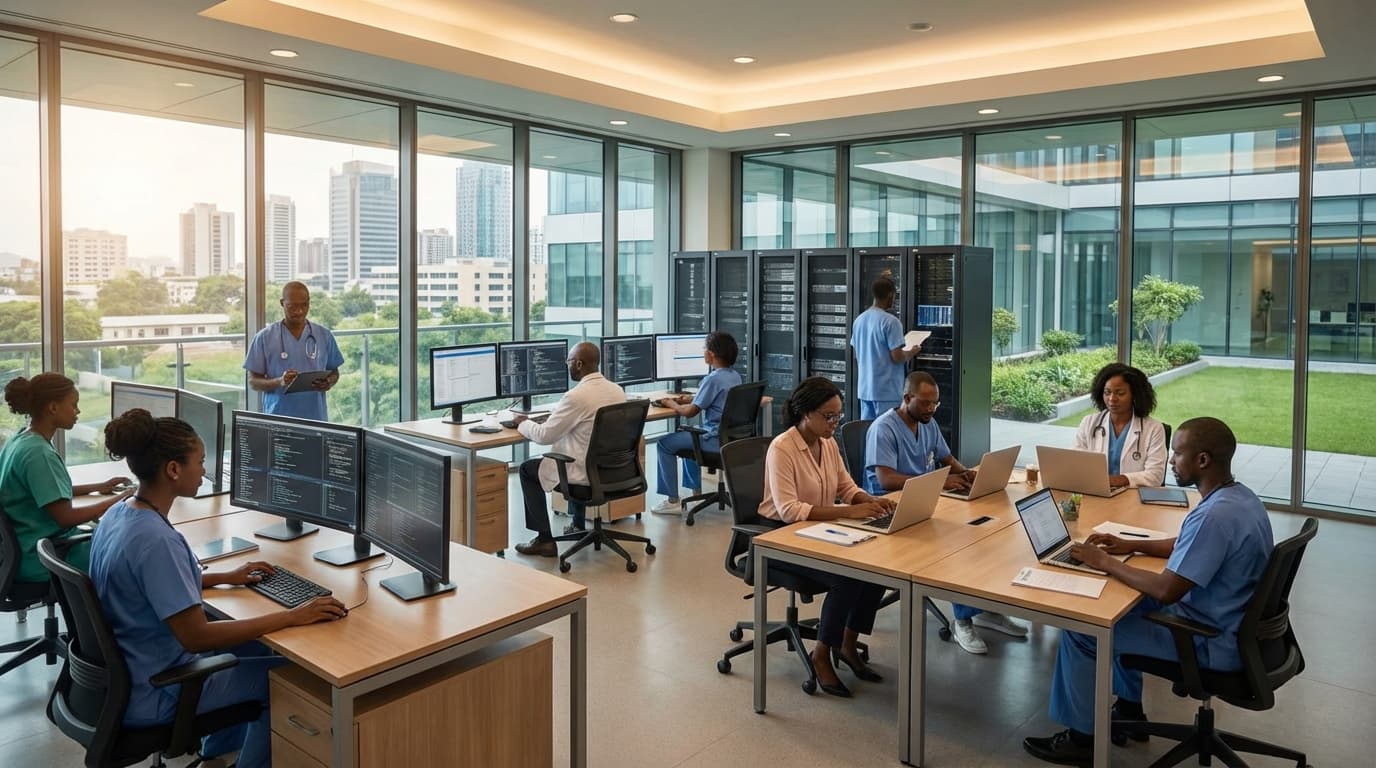
Radiology Reader & Reporting Support in Gabon
Engineering Excellence & Technical Support
Remote radiology reading and reporting services High-standard technical execution following OEM protocols and local regulatory frameworks.
Advanced AI-Powered Image Analysis
Leveraging cutting-edge AI algorithms to automatically detect and highlight potential anomalies in radiological images, significantly improving diagnostic accuracy and reducing reader fatigue for radiologists in Gabon.
Seamless Tele-Radiology Collaboration
Facilitating real-time communication and secure image sharing between reporting radiologists and referring clinicians across Gabon, enabling faster second opinions and improved patient care pathways.
Robust Cloud-Based Reporting Platform
Providing a secure, scalable, and accessible cloud platform for generating, storing, and retrieving radiology reports, ensuring data integrity and efficient workflow management for healthcare facilities in Gabon.
What Is Radiology Reader & Reporting Support In Gabon?
Radiology Reader & Reporting Support in Gabon refers to the provision of specialized expertise for the interpretation of medical imaging studies and the generation of comprehensive diagnostic reports. This service leverages remote or on-site radiologists and reporting specialists to augment the capabilities of healthcare facilities, particularly in regions where access to qualified local personnel is limited. The service encompasses the entire workflow from image acquisition to final report dissemination, ensuring accurate and timely diagnoses to inform patient care pathways.
This service is critical for healthcare providers in Gabon seeking to overcome challenges related to:
- Scarcity of Subspecialized Radiologists: Gabon, like many developing nations, faces a deficit of radiologists, especially those with expertise in niche areas such as neuroradiology, musculoskeletal radiology, or pediatric radiology.
- High Workload: Existing radiology departments may be overwhelmed by the volume of imaging studies, leading to delays in interpretation and reporting.
- Technological Gaps: While advanced imaging modalities may be available, the lack of trained personnel to effectively utilize and interpret the data can limit their impact.
- Geographic Accessibility: Remote areas may lack access to diagnostic imaging services altogether, or have limited access to expert interpretation.
| Typical Use Cases | Description | Impact on Patient Care |
|---|---|---|
| Overnight/After-Hours Coverage: | Providing 24/7 interpretation of urgent imaging studies (e.g., CT scans for stroke, trauma imaging) when local radiologists are unavailable. | Enables prompt diagnosis and intervention for critical conditions, reducing morbidity and mortality. |
| Subspecialty Consultations: | Offering expert interpretation of complex cases requiring specialized knowledge (e.g., advanced MRI sequences for neurological disorders, mammography for breast cancer screening). | Ensures accurate diagnosis and appropriate treatment planning for complex diseases, improving outcomes. |
| Second Opinions and Quality Assurance: | Providing an independent review of radiology reports to ensure accuracy, consistency, and adherence to best practices. | Minimizes diagnostic errors and enhances the reliability of imaging findings. |
| Teleradiology for Rural/Remote Areas: | Facilitating the transmission of medical images from remote clinics to expert readers for interpretation, bridging geographic barriers. | Extends access to essential diagnostic services for underserved populations. |
| Workload Management and Efficiency: | Assisting local radiology departments in managing high volumes of routine imaging studies, thereby reducing turnaround times for reports. | Improves patient throughput and reduces waiting times for diagnostic information. |
| Training and Skill Development: | Some services may offer opportunities for local radiologists to collaborate with remote experts, facilitating knowledge transfer and skill enhancement. | Contributes to the long-term development of local radiology expertise. |
Who Needs Radiology Reader & Reporting Support in Gabon?
- Hospitals (public and private)
- Clinics and diagnostic imaging centers
- Rural health posts and remote medical facilities
- Specialty medical centers (e.g., oncology, cardiology)
- Emergency medical services requiring rapid diagnostic input
- Research institutions utilizing medical imaging data
Who Needs Radiology Reader & Reporting Support In Gabon?
In Gabon, the demand for radiology reader and reporting support is driven by a critical need to improve diagnostic accuracy, efficiency, and access to expert interpretation of medical imaging. This support is crucial for enhancing patient care across various healthcare settings. The primary beneficiaries are healthcare providers who may face challenges due to a shortage of specialized radiologists, high workloads, or the need for subspecialty expertise.
| Target Customer Segment | Key Departments Benefiting | Primary Needs Addressed | Example Scenarios |
|---|---|---|---|
| Hospitals (Public & Private) | Radiology Department, Emergency Department, Oncology, Cardiology, Neurology, Surgery, Internal Medicine | Workload management, access to subspecialty expertise (e.g., neuro-radiology, pediatric radiology), second opinions, improved turnaround times, quality assurance | A busy hospital in Libreville needs urgent interpretation of complex head CT scans to reduce ER wait times. A private clinic in Pointe-Noire wants to offer advanced MRI interpretations for orthopedic cases. |
| Diagnostic Imaging Centers & Clinics | Radiology Department (if internal), Referring Physicians' Offices | Scalability of services, consistent quality across a high volume of studies, cost-effectiveness, expanded service offerings | A large imaging center in Port-Gentil needs to handle an overflow of mammography readings. A smaller clinic wants to offer musculoskeletal ultrasound interpretation. |
| Rural/Remote Healthcare Facilities | General Practice, Primary Care Clinics, District Hospitals | Access to basic and specialized radiology interpretation, improved diagnostic capabilities for common conditions, timely referral decisions | A health post in a remote region needs chest X-ray readings for suspected tuberculosis. A district hospital needs basic ultrasound interpretation for abdominal complaints. |
| Government Health Ministries/Public Health Programs | Public Health Departments, Disease Surveillance Units, National Health Insurance Providers | Standardization of reporting protocols, quality control for national health initiatives, data for public health research and planning | Supporting a national tuberculosis screening program with consistent X-ray interpretation. Assessing the impact of a new diagnostic imaging initiative. |
| Medical Schools & Training Institutions | Radiology Residency Programs, Medical Education Departments | Educational case material, access to real-world interpreted studies for learning, potential for supervised remote reporting | Providing residency programs with a wider variety of complex cases for training. Facilitating learning for junior radiologists. |
Target Customers and Departments in Gabon for Radiology Reader & Reporting Support
- {"title":"Hospitals (Public and Private)","description":"These are the primary consumers of radiology services. Both large referral centers and smaller community hospitals can benefit significantly. Public hospitals, often facing resource constraints, can leverage external support to augment their existing capabilities. Private hospitals, aiming for premium patient care and faster turnaround times, can also enhance their service offerings."}
- {"title":"Diagnostic Imaging Centers & Clinics","description":"Independent imaging facilities and specialized clinics that perform a high volume of diagnostic tests will find outsourced reading and reporting invaluable for managing workloads and ensuring consistent quality. This also helps them offer a wider range of specialized interpretations without needing to hire full-time subspecialists."}
- {"title":"Rural and Remote Healthcare Facilities","description":"Facilities in underserved areas often lack on-site radiology expertise. Tele-radiology solutions providing remote reading and reporting can bridge this gap, ensuring that patients in remote locations receive timely and accurate diagnoses, improving equity in healthcare access."}
- {"title":"Government Health Ministries & Public Health Programs","description":"These entities can utilize reader and reporting support for national screening programs, epidemiological studies, and to ensure standardized quality of radiology services across the country. They may also use it to assess the capacity of the national radiology workforce and identify training needs."}
- {"title":"Medical Schools & Training Institutions","description":"While not direct consumers of patient-facing reporting, these institutions can benefit from access to a diverse pool of interpreted cases for educational purposes and for training future radiologists. Partnerships could be established for supervised reporting experiences."}
Radiology Reader & Reporting Support Process In Gabon
This document outlines the standard operating procedure for the Radiology Reader & Reporting Support Process in Gabon. This workflow ensures efficient and accurate interpretation and reporting of radiological examinations, from the initial inquiry to the final report dissemination. The process involves multiple stakeholders, including referring physicians, radiologists, reporting specialists, and administrative staff.
| Stage | Description | Key Activities | Responsible Parties | Inputs | Outputs | Tools/Systems |
|---|---|---|---|---|---|---|
| The process begins when a referring physician identifies a need for a radiological examination. | Patient identification, clinical history collection, examination request submission, scheduling. | Referring Physician, Patient, Scheduling Staff | Patient information, clinical question, examination type. | Completed examination request form, scheduled appointment. | Hospital Information System (HIS), Electronic Health Record (EHR). |
| The requested radiological examination is performed, and images are captured and transferred to the PACS. | Performing the radiological procedure, ensuring image quality, transferring images to PACS. | Radiology Technologist/Technician | Patient, examination protocol, imaging equipment. | Digital radiological images, patient demographics linked to images. | Picture Archiving and Communication System (PACS), imaging modalities (X-ray, CT, MRI, Ultrasound). |
| The acquired images are assigned to a qualified radiologist for interpretation. | Review of incoming studies in PACS, assignment to available radiologists based on subspecialty, workload, or urgency. | PACS Administrator, Lead Radiologist, Reporting Coordinator | Unread studies in PACS queue. | Assigned study for interpretation. | PACS, RIS (Radiology Information System). |
| The assigned radiologist meticulously examines the radiological images to identify abnormalities and formulate a diagnosis. | Image review, comparison with prior studies, identification of findings, preliminary diagnosis. | Radiologist | Assigned radiological images, patient clinical history. | Preliminary findings, diagnostic impression. | PACS workstation, visualization software, EHR. |
| The radiologist dictates their findings and diagnostic impressions, which are then transcribed into a formal report. | Dictating findings, impressions, and recommendations; ensuring clarity and conciseness. | Radiologist | Preliminary findings, diagnostic impression. | Dictated audio file, preliminary report draft. | Digital dictation system, speech recognition software. |
| A designated individual (often a reporting specialist or another radiologist) reviews and edits the transcribed report for accuracy, completeness, and adherence to established standards. | Reviewing the transcribed report against the dictated audio, correcting errors, ensuring logical flow and clarity, checking for any missing information or inconsistencies. | Reporting Specialist, Radiologist (for second read/quality control) | Transcribed report, dictated audio file. | Edited and corrected report draft. | Reporting software, EHR. |
| The reviewed and edited report is finalized and then distributed to the referring physician. | Approving the final report, electronic signing, sending the report to the referring physician and patient's record. | Radiologist (final approval), Administrative Staff | Edited and corrected report draft. | Finalized radiology report. | RIS, EHR, secure messaging platforms. |
| All radiological images and associated reports are securely archived for future reference and retrieval. | Long-term storage of images and reports, ensuring data integrity and accessibility for audits, research, or subsequent patient care. | PACS Administrator, IT Department | Finalized reports, original images. | Archived data. | PACS, long-term storage solutions (e.g., cloud storage, tape backups). |
Key Stages of the Radiology Reader & Reporting Support Process
- Inquiry & Request Initiation
- Image Acquisition & Data Transfer
- Radiology Read Assignment
- Radiological Interpretation
- Reporting & Dictation
- Report Review & Editing
- Report Finalization & Distribution
- Archiving & Retrieval
Radiology Reader & Reporting Support Cost In Gabon
Radiology reading and reporting support services are crucial for healthcare providers in Gabon, especially in areas with a shortage of specialized radiologists. The cost of these services is influenced by several factors, including the complexity and type of imaging modality, the urgency of the report, the experience and qualifications of the reporting radiologist, and the provider's pricing structure. Services can range from preliminary reads to comprehensive diagnostic reports with detailed interpretations. The demand for these services, particularly in remote or underserved regions, also plays a role in pricing.
| Service Type | Estimated Price Range (XAF - Central African CFA Franc) | Notes |
|---|---|---|
| Basic X-ray Interpretation (e.g., chest X-ray) | 15,000 - 40,000 XAF | Standard turnaround time, uncomplicated cases. |
| Ultrasound Interpretation (e.g., abdominal, obstetric) | 20,000 - 60,000 XAF | Depends on the area scanned and complexity. |
| CT Scan Interpretation (e.g., head, abdomen) | 40,000 - 150,000 XAF | Complex scans, contrast-enhanced studies, and multi-slice CT will be at the higher end. |
| MRI Interpretation (e.g., brain, spine, joint) | 70,000 - 300,000+ XAF | MRI is generally the most expensive due to equipment and interpretation complexity. Specialized sequences increase cost. |
| Urgent/STAT Reporting Surcharge | 10,000 - 50,000+ XAF | Added to the base interpretation fee, depending on urgency. |
| Comprehensive/Detailed Reporting | Variable (additional 10-25% of base fee) | For cases requiring extensive correlation or detailed narrative. |
| Teleradiology Platform Access (Subscription) | Variable (per study or monthly/annual plans) | Often an additional cost for platform usage, not just interpretation. |
Factors Influencing Radiology Reader & Reporting Support Costs in Gabon
- Imaging Modality: Costs vary significantly based on whether the scan is X-ray, Ultrasound, CT scan, or MRI. More complex modalities like CT and MRI typically command higher fees due to specialized equipment and interpretation expertise required.
- Report Complexity and Urgency: Standard reports are generally less expensive than urgent or STAT (immediate) reports. Reports requiring detailed analysis, comparison with previous studies, or consultation with other specialists will also incur higher costs.
- Radiologist's Expertise and Experience: Highly specialized radiologists (e.g., neuroradiologists, interventional radiologists) or those with extensive experience will often charge more for their services.
- Service Provider Model: Costs can differ between independent teleradiology providers, hospital-based departments, and contracted services. Some providers offer tiered pricing based on turnaround time and report detail.
- Volume and Contractual Agreements: Larger healthcare institutions or those with long-term contracts may negotiate volume-based discounts.
- Geographic Location: While less of a factor for teleradiology, local service providers might adjust pricing based on operational costs in specific regions within Gabon.
- Ancillary Services: Additional services such as follow-up consultations, interventional procedure guidance, or multi-disciplinary team meetings can add to the overall cost.
Affordable Radiology Reader & Reporting Support Options
Finding cost-effective solutions for radiology reading and reporting support is crucial for healthcare providers seeking to optimize operations and manage expenses. This includes exploring options that offer flexibility and scalability. Value bundles and smart cost-saving strategies can significantly reduce overhead while maintaining high-quality diagnostic services. Consider partnerships with teleradiology providers that offer comprehensive packages, leverage advanced AI-powered tools for preliminary reads, and implement efficient workflow management systems. Negotiating long-term contracts and focusing on service-level agreements that align with your specific needs are also key.
| Strategy | Description | Cost-Saving Benefit | Considerations |
|---|---|---|---|
| Value Bundles | Pre-packaged services combining reading, reporting, and sometimes IT support from a single vendor. | Streamlined billing, potential volume discounts, reduced administrative overhead. | Ensure bundle includes services you actually need; flexibility in customization is important. |
| On-Demand Teleradiology | Accessing radiology reads and reports as needed, without long-term commitments. | Pay-per-study model avoids fixed costs; scales easily with fluctuating workloads. | Response times can vary; requires robust communication protocols. |
| AI Integration | Utilizing AI for initial image analysis and flagging potential abnormalities for radiologist review. | Reduces radiologist workload on routine cases, potentially speeding up turnaround times and lowering per-study costs. | Requires validation and oversight; AI accuracy can vary by modality and pathology. |
| Dedicated Teleradiology Teams | Securing a dedicated team of radiologists for consistent coverage and specialized reads. | Predictable costs, improved quality control, and familiarization with your specific protocols. | Higher upfront commitment; ensure alignment on scheduling and turnaround times. |
| Hybrid Teleradiology Models | Combining in-house radiologists with teleradiology support for peak times or subspecialty coverage. | Optimizes internal resources, provides flexibility, and ensures comprehensive coverage without overstaffing. | Requires careful coordination between internal and external teams. |
| Volume-Based Pricing | Negotiating lower per-study rates for higher volumes of radiology reads. | Direct cost reduction based on increased utilization of services. | Requires accurate volume forecasting and a commitment to sustained usage. |
| Service Level Agreements (SLAs) | Formal agreements specifying turnaround times, quality metrics, and communication standards. | Ensures service quality and accountability, preventing costly delays or errors. | SLAs must be clearly defined and regularly monitored. |
| Outsourced Reporting Platforms | Utilizing external services for report generation, potentially using templates and structured reporting. | Reduces in-house transcription and reporting staff costs; improves report consistency. | Ensure platform integrates with your PACS/RIS and meets compliance standards. |
Affordable Radiology Reader & Reporting Support Options
- Teleradiology Services (on-demand, dedicated, or hybrid models)
- AI-Powered Preliminary Reading Tools
- Radiology Workflow Optimization Software
- Outsourced Reporting Services
- Partnerships with Radiology Groups
Verified Providers In Gabon
When seeking healthcare services in Gabon, particularly those involving specialized treatments or foreign-based medical providers, verifying credentials is paramount. Franance Health has emerged as a trusted entity, facilitating access to a network of highly qualified and accredited medical professionals and facilities operating within or in connection with Gabon. Their rigorous vetting process ensures that all listed providers meet international standards of quality, safety, and ethical practice, offering peace of mind to patients navigating complex healthcare decisions.
| Provider Type | Verification Standard | Benefit to Patient |
|---|---|---|
| Foreign-Trained Specialists | Verification of foreign medical degrees, board certifications, and licenses. | Access to world-class expertise and advanced treatment methodologies. |
| Local Accredited Hospitals/Clinics | Confirmation of national accreditation, adherence to health regulations, and quality management systems. | Assurance of safe and compliant medical facilities with established operational protocols. |
| International Medical Partnerships | Due diligence on partner institutions regarding their accreditation, patient outcomes, and ethical practices. | Facilitated access to specialized treatments and potentially remote consultations with international experts. |
| Ancillary Healthcare Services (e.g., Labs, Imaging) | Verification of equipment calibration, staff qualifications, and adherence to diagnostic standards. | Reliable and accurate diagnostic support for medical treatments. |
Why Franance Health Credentials Represent the Best Choice:
- Rigorous Accreditation & Verification: Franance Health partners only with providers who have undergone extensive background checks and hold valid accreditations from reputable national and international medical bodies.
- Commitment to Patient Safety & Quality: Their focus is on ensuring that all associated healthcare services adhere to the highest standards of patient care, utilizing modern medical technology and evidence-based practices.
- Specialized Expertise: Franance Health connects patients with specialists across a wide range of medical fields, ensuring that complex health needs can be addressed by experienced professionals.
- Transparency and Trust: By providing verified credentials, Franance Health fosters transparency in the healthcare landscape, allowing patients to make informed choices with confidence.
- Facilitation of International Standards: Their network often includes providers trained or affiliated with international medical institutions, bringing global best practices to Gabon.
Scope Of Work For Radiology Reader & Reporting Support
This Scope of Work (SOW) outlines the requirements for Radiology Reader & Reporting Support services. The services are designed to assist radiology departments by providing expert interpretation of medical images and comprehensive reporting, thereby enhancing diagnostic accuracy, turnaround times, and overall departmental efficiency. The technical deliverables are structured to integrate seamlessly with existing Picture Archiving and Communication Systems (PACS) and Radiology Information Systems (RIS), ensuring data integrity and accessibility. Standard specifications are defined to guarantee the quality and consistency of all provided reports and interpretations.
| Technical Deliverable | Description | Standard Specifications | Integration Method |
|---|---|---|---|
| Radiology Image Interpretation | Remote or on-site interpretation of various medical imaging modalities (X-ray, CT, MRI, Ultrasound, Nuclear Medicine, Mammography). | Interpretation adheres to established radiological guidelines and best practices. Sub-specialty expertise provided as required. | Secure VPN, dedicated network connection, or cloud-based PACS integration. |
| Radiology Report Generation | Creation of comprehensive, detailed, and actionable radiology reports based on image interpretations. | Reports conform to ACR standards, institutional templates, and specific clinical requirements. Includes findings, impressions, and recommendations. | Integration with RIS/EHR via HL7 messaging, direct EHR data entry, or secure report portal. |
| Quality Assurance & Review | Internal review process for all interpretations and reports to ensure accuracy and consistency. | Minimum of X% of reports undergo secondary peer review. Root cause analysis for discrepancies. | Utilizes internal QA modules within the reporting platform or designated QA personnel. |
| Turnaround Time (TAT) Metrics | Monitoring and reporting on key TAT metrics for different imaging types and urgency levels. | Predefined TAT targets (e.g., STAT reads within X hours, routine reads within Y hours). Performance reporting shared with the client. | Real-time tracking via RIS/PACS integration and reporting dashboard. |
| Data Security & Compliance | Adherence to all relevant data privacy regulations (e.g., HIPAA, GDPR). | HIPAA/GDPR compliant platform and workflows. Data encryption in transit and at rest. Regular security audits. | Secure data transmission protocols (e.g., TLS/SSL), secure storage solutions. |
| Reporting Platform Access | Secure web-based platform for accessing reports, managing worklists, and communication. | User-friendly interface, role-based access control, audit trails. Available 24/7. | Web browser access via secure login credentials. |
| Sub-specialty Consultations | On-demand consultation and interpretation by sub-specialist radiologists. | Access to board-certified radiologists in neuro-radiology, musculoskeletal, body imaging, breast imaging, etc. | Direct request routing via the reporting platform. |
Key Objectives
- Improve diagnostic accuracy through expert radiological interpretations.
- Reduce report turnaround times, enabling faster patient management.
- Increase radiology department capacity and workflow efficiency.
- Provide high-quality, standardized radiological reports.
- Ensure secure and compliant data handling and reporting.
- Offer flexible support models to adapt to varying departmental needs.
Service Level Agreement For Radiology Reader & Reporting Support
This Service Level Agreement (SLA) outlines the performance standards and guarantees for the Radiology Reader & Reporting Support services provided by [Your Company Name] to [Client Name]. This agreement covers response times for critical issues and uptime guarantees for the reporting platform.
| Issue Severity | Response Time Target | Resolution Target (Best Effort) | Uptime Guarantee |
|---|---|---|---|
| Critical Issue | 15 minutes | 4 hours | 99.9% monthly |
| Major Issue | 1 hour | 8 business hours | 99.5% monthly |
| Minor Issue | 4 business hours | 3 business days | N/A (covered under general service availability) |
Key Service Commitments
- Scope of Service: This SLA applies to the radiology reading and reporting support services, including but not limited to the digital platform used for image access, interpretation, and report generation.
- Service Hours: Support services are available 24 hours a day, 7 days a week, 365 days a year, unless otherwise specified.
- Definitions:
- Critical Issue: A service interruption or malfunction that prevents radiologists from accessing images, dictating reports, or submitting completed reports. This includes system outages, severe performance degradation, or data accessibility problems.
- Major Issue: A problem that significantly impacts the ability to perform core reading and reporting functions but does not entirely prevent them. Examples include intermittent system slowness, minor functional defects, or issues with specific reporting templates.
- Minor Issue: A problem that does not impede core reading and reporting functions but affects user experience or non-essential features. Examples include cosmetic glitches, documentation errors, or requests for minor configuration changes.
- Uptime: The percentage of time the reporting platform is operational and accessible to authorized users. Scheduled maintenance windows are excluded from uptime calculations.
- Response Time: The maximum time allowed from the initial report of an issue to the commencement of active investigation and troubleshooting by the support team.
Frequently Asked Questions

Ready when you are
Let's scope your Radiology Reader & Reporting Support in Gabon project in Gabon.

Scaling healthcare logistics and technical systems across the entire continent.