
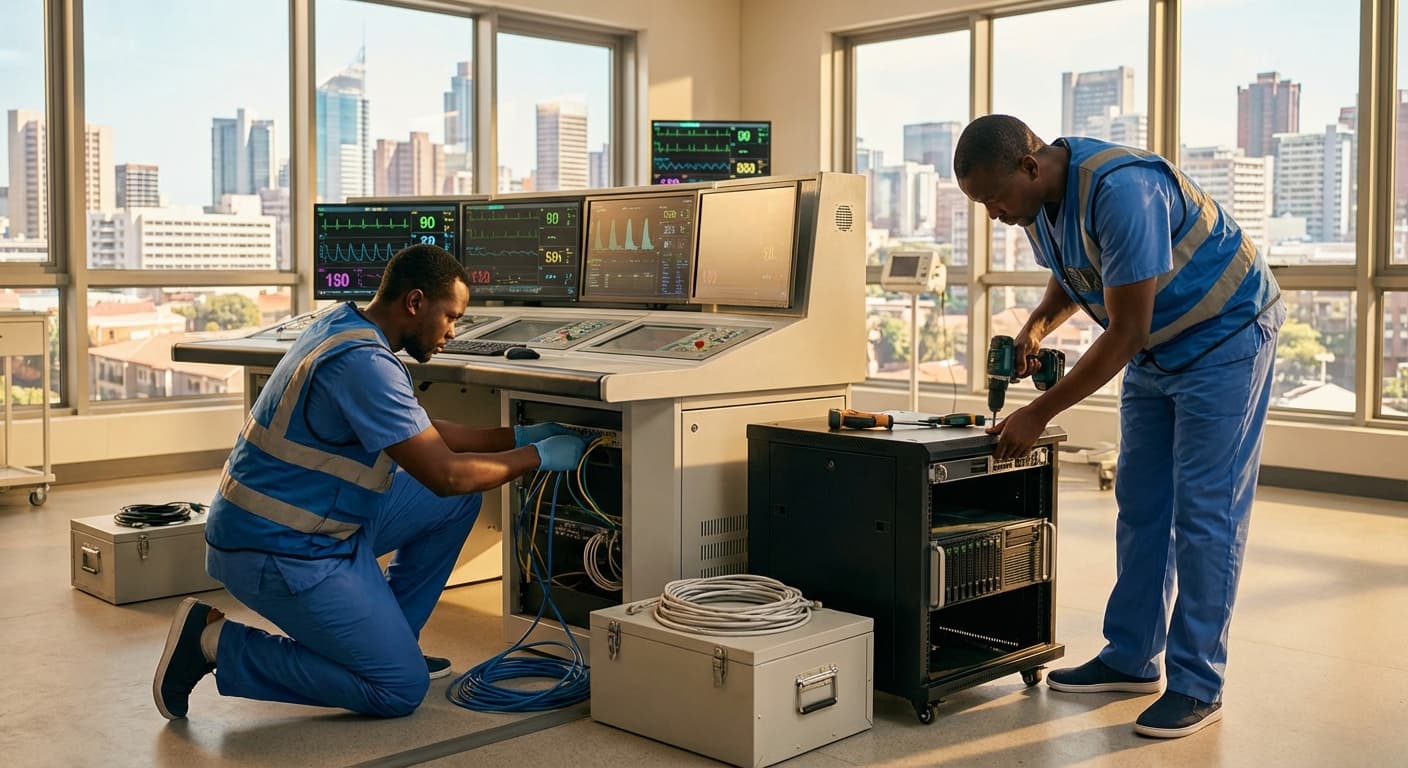
ICU Central Monitoring Station Installation Service in Gabon
Engineering Excellence & Technical Support
ICU Central Monitoring Station Installation Service High-standard technical execution following OEM protocols and local regulatory frameworks.
Robust Network Infrastructure
We engineer and deploy high-availability, secure network infrastructure specifically designed for the critical demands of ICU monitoring. Our installations in Gabon ensure reliable data transmission and low latency between patient monitoring devices and the Central Monitoring Station, utilizing industry-leading cabling, switches, and firewalls to guarantee uninterrupted operation.
Scalable Server & Software Deployment
Our service includes the precise installation and configuration of high-performance server hardware and specialized ICU monitoring software. In Gabon, we ensure seamless integration of patient data streams, offering scalable solutions that can grow with your facility's needs, from initial setup to future expansion, all within a secure and optimized environment.
Seamless Device Integration & Calibration
We specialize in the expert integration and calibration of diverse patient monitoring devices (ECG, SpO2, NIBP, etc.) with your Central Monitoring Station. Our Gabonese-based technicians guarantee accurate data acquisition and display, minimizing the risk of errors and ensuring healthcare professionals have real-time, precise patient vital signs at their fingertips.
What Is Icu Central Monitoring Station Installation Service In Gabon?
ICU Central Monitoring Station Installation Service in Gabon refers to the comprehensive process of designing, procuring, installing, configuring, integrating, and commissioning a centralized monitoring system for Intensive Care Units (ICUs) within healthcare facilities in Gabon. This service ensures that critical patient physiological data from multiple ICU beds can be continuously collected, displayed, analyzed, and alerted from a single, dedicated location, thereby enhancing patient safety, optimizing clinical workflows, and improving the efficiency of critical care delivery. The installation encompasses the deployment of patient monitoring devices, networking infrastructure, central workstation hardware and software, alarm management systems, and data archival solutions, all tailored to meet the specific requirements and regulatory standards applicable in Gabon.
| Service Recipient | Rationale | Typical Use Cases |
|---|---|---|
| Hospitals and Healthcare Facilities in Gabon with Intensive Care Units (ICUs) | To enhance patient safety, enable real-time surveillance of critically ill patients, facilitate early detection of deterioration, optimize nurse-to-patient ratios, improve clinical decision-making, and streamline critical care operations. | Continuous, simultaneous monitoring of multiple ICU patients, proactive identification of critical events (e.g., arrhythmias, desaturation), remote oversight by intensivists and specialized nurses, data logging for trend analysis and clinical audits, and efficient management of alarm fatigue. |
| New Hospital Constructions or Renovations in Gabon requiring state-of-the-art critical care infrastructure | To ensure the integrated design and implementation of a centralized monitoring system from the foundational stages, optimizing space utilization, network planning, and system interoperability. | Establishing a new, advanced ICU with comprehensive patient monitoring capabilities, retrofitting existing ICUs with modern central monitoring technology. |
| Existing Healthcare Providers in Gabon seeking to upgrade or replace outdated monitoring systems | To benefit from advancements in monitoring technology, improve data accuracy, enhance alarm management, and ensure compliance with current healthcare standards and potential future interoperability requirements. | Replacing legacy central monitoring systems, integrating disparate patient monitoring devices into a unified platform, enhancing data security and accessibility. |
Key Components and Scope of ICU Central Monitoring Station Installation Service:
- System Design & Planning: Site surveys, needs assessment, network topology design, hardware/software specification, and integration planning with existing hospital IT infrastructure.
- Hardware Procurement & Deployment: Sourcing and installation of central monitoring workstations, network switches, cabling, servers, and related peripheral devices.
- Patient Monitor Integration: Connecting existing or newly procured bedside patient monitors (e.g., for ECG, SpO2, NIBP, respiration, temperature, invasive pressures, EtCO2) to the central station via wired or wireless networks.
- Software Installation & Configuration: Deployment of central monitoring software, setting up user interfaces, alarm parameters, data display formats, and patient demographic integration.
- Network Infrastructure Setup: Establishing a secure and reliable network connection between bedside monitors and the central station, ensuring data integrity and minimal latency.
- Alarm Management System Configuration: Defining alarm thresholds, prioritizing alerts, configuring audible and visual alarm notifications, and integrating with potential nurse call systems.
- Data Archival & Retrieval: Implementing solutions for storing historical patient data and configuring mechanisms for efficient data retrieval for clinical review and research.
- System Testing & Validation: Comprehensive functional testing, performance validation, and user acceptance testing to ensure the system operates as per specifications.
- Training & Handover: Providing training to clinical staff and IT personnel on system operation, maintenance, and troubleshooting.
- Post-Installation Support & Maintenance: Offering ongoing technical support, software updates, and hardware maintenance services.
Who Needs Icu Central Monitoring Station Installation Service In Gabon?
This document outlines the target customers and departments in Gabon who require ICU Central Monitoring Station Installation Services. Such services are crucial for healthcare facilities aiming to enhance patient care, improve clinical efficiency, and leverage advanced technology for critical care management.
| Customer Segment | Key Needs & Drivers | Specific Departments Benefiting |
|---|---|---|
| Public Hospitals | Improving quality of critical care, expanding capacity, adhering to national healthcare standards, patient safety. | Main ICU, Emergency Department, Post-operative recovery wards. |
| Private Hospitals & Clinics | Competitive advantage, advanced patient care offerings, attracting specialist physicians, operational efficiency, revenue generation. | ICU, HDU, Cardiac Units, Surgical recovery areas. |
| Specialized Medical Centers | Specific disease management, advanced diagnostics, research capabilities, catering to niche patient populations. | Dedicated Cardiac ICU, Neuro ICU, Transplant ICU. |
| International Healthcare Providers | Global standards of care, seamless integration with international protocols, patient safety, risk management. | All critical care units, including general ICUs and specialized units. |
Target Customers & Departments for ICU Central Monitoring Station Installation Service in Gabon
- {"items":["Public Hospitals (Government-funded)","Private Hospitals & Clinics","Specialized Medical Centers (e.g., Cardiac Centers, Neurological Centers)","International Healthcare Providers operating in Gabon"],"title":"Primary Target Customers"}
- {"items":["Intensive Care Units (ICUs): The core department requiring these services.","High Dependency Units (HDUs) / Step-down Units: Often benefit from similar monitoring capabilities.","Emergency Departments (EDs): For immediate, high-acuity patient monitoring.","Operating Rooms (ORs): For post-operative critical care monitoring.","Cardiac Catheterization Labs: For real-time hemodynamic monitoring.","Neurology/Neurosurgery Units: For monitoring neurological critical patients.","Pediatric ICUs (PICUs) / Neonatal ICUs (NICUs): Requiring specialized monitoring equipment."],"title":"Key Departments within Target Facilities"}
Icu Central Monitoring Station Installation Service Process In Gabon
This document outlines the standard workflow for the installation of an ICU Central Monitoring Station Service in Gabon, from initial inquiry to final project execution. The process is designed to ensure a smooth, efficient, and compliant installation that meets the specific needs of healthcare facilities.
| Phase | Description | Key Activities | Deliverables | Timeline (Estimated) |
|---|---|---|---|---|
| Initial contact from the client to express interest and define their requirements. | Client communicates needs, desired features, number of beds, existing infrastructure. Service provider gathers preliminary information. | Initial needs assessment report, preliminary understanding of scope. | 1-3 business days |
| Formalizing the proposed solution and associated costs. | Detailed technical proposal outlining hardware, software, installation services, and training. Cost quotation based on scope and complexity. Compliance with Gabonese regulations is considered. | Comprehensive technical proposal, detailed cost quotation, project timeline estimate. | 3-7 business days |
| Formalizing the agreement between the client and the service provider. | Review and negotiation of terms and conditions, payment schedules, warranty, and service level agreements. Contract signing. | Signed service contract, purchase order. | 5-10 business days |
| Detailed planning and assessment of the installation site. | Development of a detailed project plan, including resource allocation, installation schedule, and risk management. On-site visit to assess the physical space, power, network infrastructure, and any specific environmental requirements for the ICU and central monitoring station. | Detailed project plan, site survey report with recommendations, confirmed installation schedule. | 5-7 business days |
| Acquisition and transportation of all necessary equipment and materials. | Ordering of hardware (servers, monitors, network devices, cabling) and software. Arranging for customs clearance and transportation of equipment to Gabon, adhering to import regulations. | Procurement orders, shipping manifests, customs documentation, received equipment at destination. | 2-6 weeks (depending on lead times and customs) |
| Ensuring the site is ready for installation. | Preparing the installation area (e.g., power outlets, network drops, structural considerations). Finalizing any infrastructure upgrades required based on the site survey. | Site readiness confirmation, any necessary minor infrastructure modifications completed. | 1-2 weeks (concurrent with logistics) |
| Physical installation and setup of the monitoring system. | Installation of all hardware components, cabling network connections. Software installation and configuration, including network integration, user profile setup, and alarm parameter configuration. | Installed hardware, functional network connectivity, configured monitoring software. | 1-3 weeks (depending on scale and complexity) |
| Verifying the system's functionality and performance. | Thorough testing of all system components, including data acquisition, alarm generation, data display, and reporting. System integration testing with existing medical devices. Calibration and validation. | System test reports, commissioning certificate, confirmation of successful integration. | 3-5 business days |
| Ensuring the client's staff can effectively operate the system. | Comprehensive training for ICU staff (nurses, doctors, IT personnel) on system operation, maintenance, and troubleshooting. Formal handover of the installed system and documentation. | Trained personnel, user manuals, system documentation, training completion certificates. | 2-4 business days |
| Ongoing support and maintenance to ensure system longevity. | Provision of warranty support, remote monitoring, regular system updates, and on-site technical assistance as per the service contract. Preventive maintenance checks. | Ongoing technical support, maintenance reports, system performance logs. | Continuous (as per contract) |
ICU Central Monitoring Station Installation Service Workflow in Gabon
- Inquiry & Needs Assessment
- Proposal Development & Quotation
- Contract Negotiation & Signing
- Project Planning & Site Survey
- Procurement & Logistics
- Pre-Installation Preparation
- On-site Installation & Configuration
- Testing & Commissioning
- Training & Handover
- Post-Installation Support & Maintenance
Icu Central Monitoring Station Installation Service Cost In Gabon
Installing an ICU Central Monitoring Station in Gabon involves a range of costs influenced by several critical factors. These factors encompass the complexity of the system, the brand and quality of the equipment, the size and existing infrastructure of the healthcare facility, and the expertise of the installation service provider. The primary components of the cost include the central monitoring unit itself, patient bedside monitors, network infrastructure (cabling, switches), software licenses, and the professional installation and configuration services. Additional considerations can include ongoing maintenance contracts, training for hospital staff, and potential upgrades to existing IT systems. The pricing can vary significantly depending on whether the hospital opts for basic monitoring capabilities or advanced features such as integrated diagnostic tools, telemedicine support, and sophisticated data analytics. The reputation and experience of the installation company, as well as their geographical location within Gabon, can also impact the overall service cost.
| Service Component | Estimated Cost Range (XAF) | Notes |
|---|---|---|
| Central Monitoring Unit (Hardware & Software) | 5,000,000 - 25,000,000+ | Varies greatly by brand (e.g., Philips, GE, Mindray), features, and capacity. |
| Patient Bedside Monitors (per unit) | 1,500,000 - 7,000,000+ | Dependent on the number of parameters monitored and brand. |
| Network Infrastructure (Cabling, Switches, Routers) | 1,000,000 - 5,000,000+ | Depends on the size of the ICU and the extent of new cabling required. |
| Installation & Configuration Labor | 2,000,000 - 10,000,000+ | Hourly rates or fixed project fees, influenced by complexity and duration. |
| Software Licenses & Integration | 500,000 - 3,000,000+ | For central station software, data archiving, and potential EMR integration. |
| Staff Training | 500,000 - 2,000,000 | For clinical staff and IT personnel on system operation and maintenance. |
| Project Management & Consulting | 500,000 - 3,000,000 | For overseeing the entire installation process. |
| Contingency (10-15%) | Variable | Recommended for unforeseen issues or scope changes. |
| Total Estimated Project Cost | 11,000,000 - 55,000,000+ XAF | This is a broad range and a detailed quote is essential. |
Key Pricing Factors for ICU Central Monitoring Station Installation in Gabon
- System Complexity and Features (Basic vs. Advanced)
- Brand and Quality of Monitoring Equipment
- Number of Patient Monitors Required
- Existing Infrastructure and Renovation Needs
- Network Cabling and IT Integration
- Software Licensing and Data Management
- Installation and Configuration Expertise
- Training for Hospital Staff
- Ongoing Maintenance and Support Contracts
- Geographical Location within Gabon
- Reputation and Experience of the Installation Provider
Affordable Icu Central Monitoring Station Installation Service Options
Setting up an Intensive Care Unit (ICU) central monitoring station is a critical investment for any healthcare facility. The goal is to provide real-time patient data to a centralized location, enabling faster response times and improved patient outcomes. This service focuses on the installation of these vital systems, offering options that balance cost-effectiveness with essential functionality. Understanding value bundles and implementing cost-saving strategies are key to making this essential technology accessible.
| Value Bundle | Description | Typical Cost-Saving Features | Ideal For |
|---|---|---|---|
| Essential Essentials Bundle | Includes core hardware, software, and standard installation for a foundational monitoring system. | Pre-configured software, streamlined installation process, basic training. | Smaller ICUs, facilities with budget constraints, or those prioritizing immediate deployment. |
| Integrated Intelligence Bundle | Builds on the Essential Essentials, adding advanced analytics, EMR integration capabilities, and extended training. | Bundled software licenses for enhanced features, remote support options, bulk hardware discounts. | Medium to large ICUs, facilities aiming for comprehensive data analysis and seamless workflow integration. |
| Scalable Growth Bundle | Designed for future expansion, offering modular components and robust infrastructure for easy upgrades. | Flexible hardware options, phased installation approach, dedicated project management. | Facilities anticipating future growth, research-oriented ICUs, or those planning for major system overhauls. |
Key Components of an ICU Central Monitoring Station Installation
- Centralized Server/Workstation: The core of the system, housing software for data aggregation and display.
- Network Infrastructure: Robust cabling and network switches to ensure reliable data transmission.
- Patient Monitors: Devices at each bedside that collect vital signs.
- Display Consoles: Screens at the central station for viewing patient data.
- Software Licenses: For the central monitoring system, data management, and potential EMR integration.
- Installation & Configuration: Professional setup, wiring, and software setup by certified technicians.
- Training: For nursing staff and IT personnel on system operation and maintenance.
- Ongoing Support & Maintenance: Optional service contracts for continued system performance.
Verified Providers In Gabon
In Gabon's evolving healthcare landscape, identifying reliable and competent medical professionals is paramount. Franance Health has emerged as a leading authority, meticulously verifying healthcare providers to ensure the highest standards of care. Their rigorous credentialing process goes beyond basic qualifications, encompassing experience, ethical conduct, and commitment to patient well-being. Choosing a Franance Health-verified provider means entrusting your health to a professional who has met stringent benchmarks, offering peace of mind and confidence in the quality of medical services received. This dedication to excellence makes Franance Health-verified providers the optimal choice for individuals seeking trusted healthcare in Gabon.
| Verification Aspect | Franance Health Standard | Benefit to Patient |
|---|---|---|
| Medical Licenses & Certifications | Valid and current, recognized by Gabonese authorities | Ensures legal and professional authorization to practice |
| Professional Experience | Demonstrated history of practical application of medical knowledge | Indicates hands-on skill and practical problem-solving abilities |
| Continuing Medical Education (CME) | Proof of ongoing learning and staying updated with medical advancements | Guarantees access to current and evidence-based treatments |
| Specialization & Expertise | Clear identification and validation of specific areas of medical focus | Facilitates finding the right specialist for specific health needs |
| Ethical Conduct & Reputation | Review of professional conduct and adherence to medical ethics | Promotes trust and a patient-centered approach to care |
| Patient Feedback & Outcomes (where applicable) | Consideration of patient experiences and reported outcomes | Provides insight into a provider's effectiveness and patient satisfaction |
Why Franance Health Credentials Matter
- Rigorous Vetting Process: Franance Health employs a comprehensive evaluation of a provider's qualifications, experience, and ethical standing.
- Commitment to Quality: Verified providers demonstrate a dedication to maintaining high standards of medical practice.
- Patient Safety First: Credentials ensure that providers adhere to best practices, prioritizing patient safety and positive outcomes.
- Trust and Reliability: Franance Health verification offers a trusted mark of competence, reducing the risk of inadequate care.
- Access to Expertise: It helps patients identify specialists and practitioners with proven expertise in their respective fields.
- Peace of Mind: Knowing your provider is verified by a reputable organization provides significant reassurance.
Scope Of Work For Icu Central Monitoring Station Installation Service
This Scope of Work (SOW) outlines the requirements for the installation of an Intensive Care Unit (ICU) Central Monitoring Station (CMS) service. The objective is to provide a robust, reliable, and user-friendly system that enables continuous, real-time monitoring of all ICU patients from a centralized location. This document details the technical deliverables, standard specifications, and project phases involved in the successful implementation of the ICU CMS. The service provider will be responsible for the end-to-end installation, configuration, testing, and commissioning of the CMS, ensuring seamless integration with existing or new ICU bedside monitoring equipment.
| Technical Deliverable | Description | Standard Specification |
|---|---|---|
| Central Monitoring Workstations | High-performance computer workstations equipped with specialized monitoring software for displaying patient data. | Minimum Intel Core i7 processor (or equivalent), 16GB RAM, 512GB SSD, dual 24-inch Full HD (1920x1080) monitors, integrated keyboard and mouse. Operating System: Windows 10 Pro (or latest stable enterprise version). Medical-grade components where applicable. |
| Central Monitoring Software (CMS Software) | The core software application responsible for receiving, processing, displaying, and alarming patient vital signs and waveforms. | Supports simultaneous monitoring of up to X number of patients (specify actual number based on ICU bed count). Real-time data display, configurable alarm limits, trend analysis capabilities, event logging, remote access (secure, role-based), audit trails. Must comply with relevant medical device software standards (e.g., IEC 62304). |
| Network Infrastructure | Dedicated, high-speed, and reliable network connectivity for transmitting patient data from bedside monitors to the CMS. | Gigabit Ethernet (1000 Mbps) or higher, using Cat 6a or superior cabling. Redundant network paths recommended. Implementation of Quality of Service (QoS) protocols to prioritize patient data. Secure network segmentation (VLANs) for medical devices. |
| Data Storage and Archiving Solution | Secure storage for historical patient data, trends, and alarms for a defined retention period. | Minimum 10TB of secure, redundant storage (RAID configuration). Compliant with data privacy regulations (e.g., HIPAA, GDPR). Automated backup and disaster recovery procedures. Archival format compatible with future data retrieval and analysis. |
| Bedside Monitor Connectivity Modules/Adapters | Hardware and software components that enable bedside monitors to transmit data to the CMS network. | Compatibility with existing ICU bedside monitor models (specify models and manufacturers). Secure data transmission protocols (e.g., HL7, FHIR, DICOM where applicable). Devices must be certified for medical use. |
| Alarm Management System | Integrated system for managing, prioritizing, and acknowledging alarms generated by bedside monitors. | Audible and visual alarm notifications at workstations. Customizable alarm sound profiles. Remote silencing and acknowledgment capabilities. Integration with nurse call systems (optional, if required). |
| User Interface (UI) and User Experience (UX) Design | Intuitive and efficient interface for clinicians to interact with the CMS. | Clear and concise display of patient data. Customizable screen layouts. Easy navigation. Minimal clicks for critical functions. Adherence to usability standards for medical devices. |
| System Documentation | Comprehensive documentation covering installation, configuration, operation, and maintenance. | Installation manuals, configuration guides, user manuals, troubleshooting guides, network diagrams, as-built drawings. All documentation to be provided in electronic format (PDF). |
| Integration with EMR/HIS (Optional) | If specified, integration with the hospital's Electronic Medical Record (EMR) or Hospital Information System (HIS). | Bi-directional data flow for patient demographics, vital signs, and alarms. Adherence to relevant interoperability standards (e.g., HL7 v2.x, FHIR). Secure API integration. |
Key Project Phases
- Phase 1: Planning and Design
- Phase 2: Procurement and Staging
- Phase 3: Installation and Cabling
- Phase 4: System Configuration and Integration
- Phase 5: Testing and Commissioning
- Phase 6: Training and Handover
- Phase 7: Post-Installation Support
Service Level Agreement For Icu Central Monitoring Station Installation Service
This Service Level Agreement (SLA) outlines the response times and uptime guarantees for the Installation Service of an ICU Central Monitoring Station. This SLA applies to all clients who have contracted for this specific service.
| Incident Severity | Response Time Guarantee | Target Resolution Time | Uptime Guarantee (during installation period) |
|---|---|---|---|
| Critical Incident | 1 hour | 4 hours | N/A (Installation in progress - focus on rapid resolution) |
| Major Incident | 2 hours | 8 hours | N/A (Installation in progress - focus on rapid resolution) |
| Minor Incident | 4 business hours | 2 business days | N/A (Installation in progress - focus on rapid resolution) |
| Scheduled Downtime | N/A (Requires prior client approval) | As per agreed maintenance window | N/A (Not applicable during Scheduled Downtime) |
Key Definitions
- Installation Service: The complete process of setting up, configuring, and testing the ICU Central Monitoring Station hardware and software at the client's facility.
- Critical Incident: A failure or malfunction of the ICU Central Monitoring Station that directly impacts patient monitoring capabilities and requires immediate attention to restore full functionality.
- Major Incident: A significant degradation in the performance of the ICU Central Monitoring Station that impairs patient monitoring but does not completely halt its operation.
- Minor Incident: A non-critical issue or cosmetic defect that does not affect the core functionality of the ICU Central Monitoring Station.
- Scheduled Downtime: Planned periods of unavailability for maintenance, upgrades, or testing, communicated in advance to the client.
- Unscheduled Downtime: Any period of unavailability not classified as Scheduled Downtime.
- Response Time: The maximum time allowed from the moment a support request is logged by the client until a qualified technician begins working on the issue.
- Resolution Time: The maximum time allowed from the moment a support request is logged until the issue is resolved and full functionality is restored.
Frequently Asked Questions

Ready when you are
Let's scope your ICU Central Monitoring Station Installation Service in Gabon project in Gabon.

Scaling healthcare logistics and technical systems across the entire continent.