
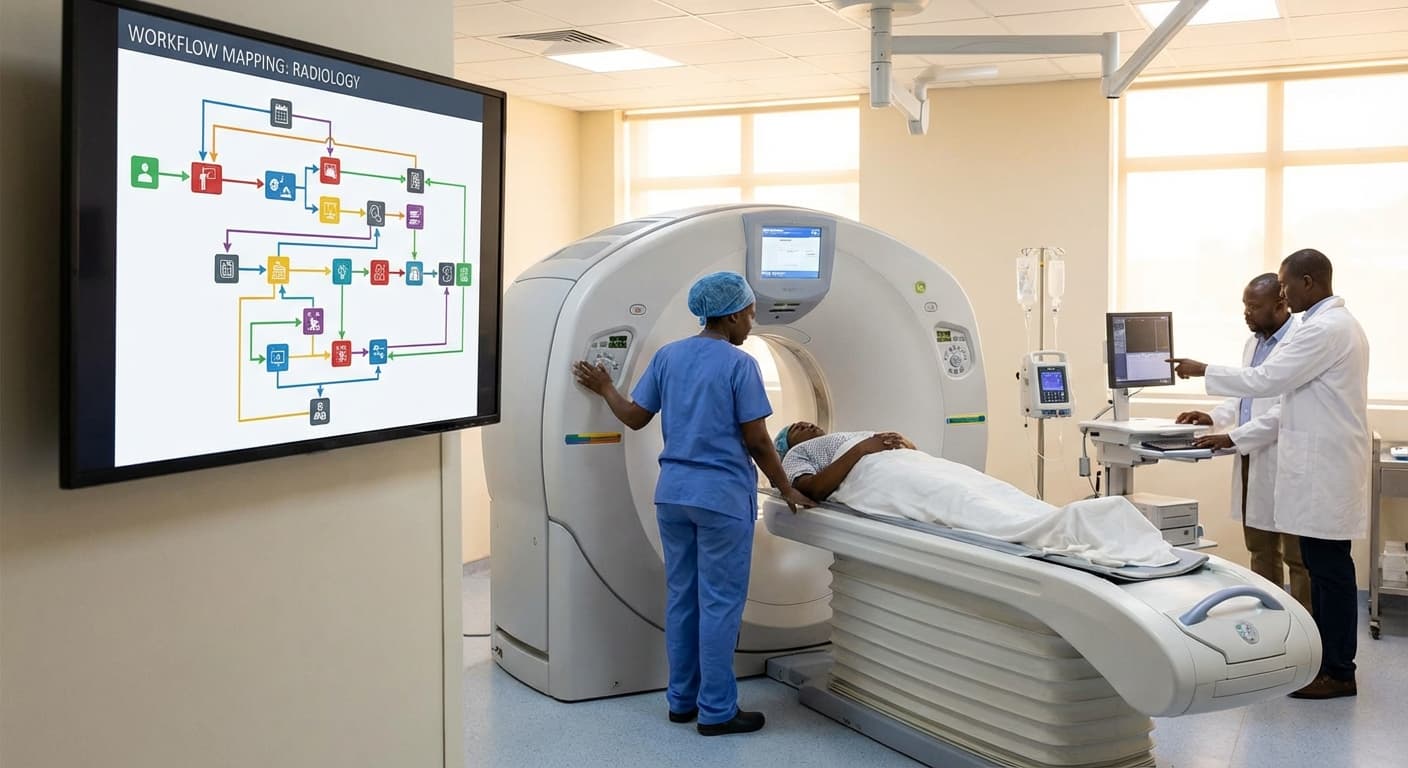
Department Workflow Mapping Service (Radiology/ICU/OT/Lab/Dialysis) in Gabon
Engineering Excellence & Technical Support
Department Workflow Mapping Service (Radiology/ICU/OT/Lab/Dialysis) High-standard technical execution following OEM protocols and local regulatory frameworks.
Streamlined Patient Pathways & Reduced Bottlenecks
Our workflow mapping service meticulously analyzes and visualizes patient journeys across critical departments (Radiology, ICU, OT, Lab, Dialysis) in Gabon. We identify inefficiencies, communication gaps, and resource constraints, leading to optimized patient flow, reduced wait times, and improved care delivery in high-acuity settings.
Enhanced Interdepartmental Collaboration & Resource Allocation
By mapping the intricate workflows between Radiology, ICU, OT, Lab, and Dialysis, we foster seamless interdepartmental collaboration. This enables more effective resource allocation, timely access to diagnostic imaging, surgical interventions, critical care, and laboratory results, ultimately enhancing patient safety and operational efficiency within Gabonese healthcare facilities.
Data-Driven Process Improvement & Quality Assurance
Our service provides comprehensive, visual representations of existing workflows in key departments. This data-driven approach empowers Gabonese hospitals to identify areas for process improvement, implement standardized protocols, and establish robust quality assurance mechanisms across Radiology, ICU, OT, Lab, and Dialysis services, ensuring consistent and high-quality patient care.
What Is Department Workflow Mapping Service (Radiology/icu/ot/lab/dialysis) In Gabon?
Department Workflow Mapping Service, within the healthcare context of Gabon, refers to the systematic analysis, documentation, and optimization of processes and information flow within specific clinical departments such as Radiology, Intensive Care Units (ICUs), Operating Theatres (OTs), Laboratories, and Dialysis Centers. This service aims to identify inefficiencies, bottlenecks, redundancies, and areas for improvement in patient care pathways, resource utilization, and operational management. It employs methodologies like process mapping, value stream mapping, and discrete event simulation to visualize and quantify current workflows, facilitating informed decision-making for enhancements. The ultimate objective is to improve patient outcomes, reduce operational costs, enhance staff productivity, and ensure regulatory compliance.
| Department | Typical Use Cases | Key Objectives |
|---|---|---|
| Radiology | Mapping patient flow from referral to reporting, optimizing equipment utilization, streamlining image archiving and retrieval, improving report turnaround times. | Reduced patient wait times, enhanced diagnostic accuracy, improved radiologist productivity, efficient resource allocation. |
| Intensive Care Unit (ICU) | Analyzing patient admission, transfer, and discharge processes, optimizing staff allocation based on patient acuity, mapping medication administration pathways, improving communication protocols between care teams. | Improved patient safety, reduced length of stay, enhanced interdisciplinary collaboration, optimized critical care resource utilization. |
| Operating Theatre (OT) | Mapping surgical case scheduling, instrument sterilization and availability, operating room turnaround times, post-anesthesia care unit (PACU) flow, and supply chain management. | Maximized OR utilization, reduced surgical cancellations, improved patient safety during surgical procedures, optimized surgical team efficiency. |
| Laboratory | Analyzing specimen collection, transport, processing, analysis, and reporting workflows, optimizing automation integration, improving quality control procedures. | Reduced testing turnaround times, enhanced diagnostic reliability, improved laboratory throughput, optimized reagent and consumable management. |
| Dialysis | Mapping patient scheduling, treatment initiation and completion, staff-to-patient ratios, inventory management for consumables, and infection control protocols. | Improved patient comfort and satisfaction, optimized dialysis machine utilization, reduced treatment delays, enhanced staff efficiency and safety. |
Who Needs Department Workflow Mapping Service?
- Hospital Administrators and Management
- Department Heads (Radiology, ICU, OT, Lab, Dialysis)
- Clinical Directors and Chief Medical Officers
- Healthcare Quality Improvement Teams
- IT and Information Management Departments
- Healthcare Consultants and Project Managers
- Regulatory and Accreditation Bodies
- Government Health Ministries and Agencies
Who Needs Department Workflow Mapping Service (Radiology/icu/ot/lab/dialysis) In Gabon?
In Gabon, the implementation of a robust Department Workflow Mapping Service is crucial for optimizing efficiency, enhancing patient care, and ensuring resource judiciousness across critical healthcare departments. This service benefits organizations that are experiencing bottlenecks, communication breakdowns, or seeking to standardize and improve their operational processes. The primary goal is to visually represent and analyze the intricate steps involved in patient journeys and departmental operations, leading to actionable insights and targeted improvements.
| Target Customer Segment | Specific Departments Benefiting | Key Challenges Addressed | Benefits of Workflow Mapping |
|---|---|---|---|
| Public Hospitals | Radiology, Intensive Care Unit (ICU), Operating Theatre (OT), Laboratory, Dialysis Unit | Long patient wait times, resource underutilization, inconsistent quality of care, communication silos, staff burnout. | Improved patient throughput, reduced errors, enhanced resource allocation, standardized procedures, better staff collaboration, increased patient satisfaction. |
| Private Hospitals & Clinics | Radiology, ICU, OT, Laboratory, Dialysis Unit | Competitive pressures, need for premium service delivery, optimizing revenue cycles, ensuring patient comfort and privacy. | Streamlined patient experience, increased operational efficiency, competitive advantage, enhanced service quality, optimized profitability. |
| Specialized Medical Centers | Radiology, ICU, OT, Laboratory, Dialysis Unit | Focus on specific complex procedures, high-tech equipment utilization, specialized staff training, integration of advanced diagnostics. | Optimized utilization of specialized equipment, improved diagnostic accuracy, enhanced surgical outcomes, efficient management of critical care, tailored patient treatment pathways. |
| Government Health Initiatives & Public Health Agencies | Public Hospital Departments (as listed above) | Public health resource management, equitable access to services, disease outbreak response, capacity building. | Effective allocation of public health funds, standardized service delivery across public facilities, improved response to public health emergencies, enhanced training programs for healthcare professionals. |
Who Needs Department Workflow Mapping Service in Gabon?
- Hospitals and healthcare facilities aiming to improve patient flow and reduce wait times.
- Departments struggling with inefficiencies, redundant processes, or communication gaps.
- Organizations seeking to implement new technologies or protocols and require a clear understanding of existing workflows.
- Healthcare providers focused on quality improvement initiatives and patient safety.
- Institutions needing to train new staff effectively on departmental procedures.
- Facilities undergoing accreditation or seeking to meet specific regulatory standards.
- Departments with high patient volume or complex, multi-step processes.
- Healthcare organizations looking to identify cost-saving opportunities through process optimization.
Department Workflow Mapping Service (Radiology/icu/ot/lab/dialysis) Process In Gabon
This document outlines the workflow for the Department Workflow Mapping Service, specifically tailored for key departments in healthcare facilities in Gabon, including Radiology, Intensive Care Unit (ICU), Operating Theatre (OT), Laboratory, and Dialysis. The service aims to analyze, document, and optimize existing processes within these critical departments to enhance efficiency, reduce errors, and improve patient care delivery. The workflow is structured to be comprehensive and client-centric, ensuring all aspects of the department's operations are considered.
| Stage | Phase | Key Activities | Deliverables | Responsible Party |
|---|---|---|---|---|
| 1 | Inquiry & Initial Consultation | Receive inquiry from client institution (Gabon). Conduct initial needs assessment and define scope of work. Discuss objectives, challenges, and desired outcomes. Provide service overview and preliminary proposal. | Needs Assessment Report, Preliminary Proposal, Service Agreement Framework | Service Provider |
| 2 | Proposal Development & Contract Finalization | Develop a detailed proposal outlining methodology, timelines, resource allocation, and cost. Present proposal to the client. Negotiate terms and finalize the service contract. | Detailed Project Proposal, Signed Service Contract | Service Provider & Client |
| 3 | Project Kick-off & Data Gathering | Hold a formal project kick-off meeting. Identify key stakeholders within the department. Conduct in-depth interviews with staff, observe processes, and review existing documentation (SOPs, forms, etc.). | Project Charter, Stakeholder List, Raw Data (Interview Notes, Observation Logs, Document Copies) | Service Provider |
| 4 | Workflow Analysis & Mapping | Analyze gathered data to identify current workflows, bottlenecks, inefficiencies, and areas of risk. Visually map existing processes using standardized notation (e.g., BPMN). Document decision points, roles, and information flow. | Current State Workflow Maps (Visual Diagrams), Process Flow Narratives, Bottleneck Identification Report | Service Provider |
| 5 | Gap Analysis & Optimization Strategy Development | Compare current state workflows with best practices and client objectives. Identify gaps and opportunities for improvement. Develop a list of recommended optimizations (e.g., technology integration, role realignment, SOP revisions). | Gap Analysis Report, Optimization Recommendations List | Service Provider |
| 6 | Future State Workflow Design | Collaborate with client stakeholders to design optimized future state workflows based on recommendations. Ensure new workflows are practical, efficient, and align with regulatory requirements in Gabon. | Future State Workflow Maps (Visual Diagrams), Proposed SOPs, Training Needs Assessment | Service Provider & Client |
| 7 | Validation & Refinement | Present proposed future state workflows and optimization strategies to client. Gather feedback and make necessary revisions. Validate the proposed workflows with the department staff to ensure feasibility. | Validated Future State Workflow Maps, Refined Optimization Plan | Service Provider & Client |
| 8 | Documentation & Reporting | Compile a comprehensive final report detailing current state analysis, identified issues, proposed future state workflows, implementation roadmap, and expected benefits. Document all final workflows, SOPs, and guidelines. | Final Project Report, Comprehensive Workflow Documentation (Digital & Print), Implementation Roadmap | Service Provider |
| 9 | Implementation Support (Optional/As per Contract) | Provide guidance and support during the implementation of the new workflows. This may include training, change management, and monitoring. | Training Materials, Implementation Progress Reports, Change Management Plans | Service Provider & Client |
| 10 | Project Closure & Handover | Conduct a final review meeting with the client. Formally close the project. Hand over all project deliverables and documentation. Seek client feedback on the service provided. | Project Closure Document, Final Client Feedback | Service Provider & Client |
Key Departments Served
- Radiology Department
- Intensive Care Unit (ICU)
- Operating Theatre (OT)
- Laboratory
- Dialysis Department
Department Workflow Mapping Service (Radiology/icu/ot/lab/dialysis) Cost In Gabon
Understanding the cost of Department Workflow Mapping services in Gabon, specifically for departments like Radiology, ICU, OT (Operating Theatre), Lab, and Dialysis, requires an examination of various pricing factors. These services are crucial for optimizing efficiency, reducing errors, and improving patient care within these critical hospital units. The cost is not fixed and depends on the scope of work, the complexity of the department, the experience of the consulting firm, and the duration of the engagement.
Key Pricing Factors:
- Scope and Complexity of Department: A highly specialized department like an ICU or OT with intricate patient pathways and numerous interconnected processes will naturally incur higher mapping costs than a more straightforward laboratory setup. The number of sub-processes, patient types, and equipment involved significantly influences the effort required.
- Size of the Department/Institution: Larger hospitals or departments with a higher volume of activity and more staff will require more extensive data collection, analysis, and stakeholder engagement, leading to increased costs.
- Depth of Analysis and Deliverables: The level of detail in the workflow mapping, the types of analyses performed (e.g., bottleneck identification, time-motion studies, resource utilization analysis), and the format of the final deliverables (e.g., detailed process maps, strategic recommendations, implementation plans) will impact the pricing.
- Consulting Firm's Expertise and Reputation: Established firms with a proven track record in healthcare workflow optimization, particularly in the Gabonese context or similar African healthcare systems, will generally command higher fees due to their specialized knowledge and demonstrated success.
- Duration of the Project: Longer projects involving extensive observation, data collection, stakeholder interviews, and iterative refinement will naturally be more expensive than shorter, more focused engagements.
- On-site vs. Remote Engagement: While some aspects can be conducted remotely, in-depth workflow mapping often requires significant on-site presence for accurate observation and data gathering. Travel and accommodation costs for consultants will be factored into the overall price if on-site work is necessary.
- Customization and Integration Needs: If the workflow mapping needs to be integrated with existing IT systems or requires bespoke solutions, this will add to the complexity and cost.
- Regulatory and Compliance Requirements: Specific departmental workflows may be subject to national healthcare regulations or international standards, which the mapping process must consider, potentially adding to the analytical effort.
Cost Ranges in local currency (Gabonese CFA Franc - XAF):
It is challenging to provide precise figures without a detailed scope of work. However, based on general industry standards and the factors mentioned above, the cost for Department Workflow Mapping services in Gabon can vary significantly. For a comprehensive mapping of a single specialized department (e.g., ICU, OT), a project could range from 3,000,000 XAF to 15,000,000 XAF or more.
| Department Type | Estimated Cost Range (XAF) |
|---|---|
| Radiology | 3,500,000 - 12,000,000 |
| ICU (Intensive Care Unit) | 4,500,000 - 15,000,000 |
| OT (Operating Theatre) | 5,000,000 - 15,000,000 |
| Lab (Laboratory) | 3,000,000 - 10,000,000 |
| Dialysis | 4,000,000 - 12,000,000 |
Department Workflow Mapping Service Costs in Gabon: Key Considerations
- Scope and Complexity of the Department (e.g., ICU vs. Lab)
- Size of the Department and Institution
- Depth of Analysis and Types of Deliverables
- Consulting Firm's Expertise and Reputation
- Project Duration (Days/Weeks/Months)
- On-site Presence and Consultant Travel Costs
- Customization and Integration Requirements
- Applicable Regulatory and Compliance Standards
Affordable Department Workflow Mapping Service (Radiology/icu/ot/lab/dialysis) Options
Our Affordable Department Workflow Mapping Service offers a comprehensive solution to optimize efficiency and reduce costs across critical hospital departments. We specialize in analyzing and redesigning workflows for Radiology, Intensive Care Units (ICU), Operating Theaters (OT), Laboratories, and Dialysis Centers. Our service focuses on identifying bottlenecks, eliminating redundancies, and implementing best practices to enhance patient care, staff productivity, and resource utilization.
| Cost-Saving Strategy | Description | Example Application (Radiology/ICU/OT/Lab/Dialysis) |
|---|---|---|
| Process Standardization | Developing and enforcing consistent procedures reduces errors, training time, and variability, leading to predictable outcomes and reduced rework. | Standardizing imaging protocols (Radiology), patient admission/discharge checklists (ICU), surgical instrument sterilization processes (OT), sample handling and testing workflows (Lab), or dialysis session scheduling and machine preparation (Dialysis). |
| Bottleneck Elimination | Identifying and removing constraints in the workflow frees up resources and speeds up service delivery. | Optimizing the scheduling of imaging equipment (Radiology), improving patient transfer times between units (ICU), reducing downtime between surgeries (OT), expediting sample processing and reporting (Lab), or minimizing patient wait times for dialysis treatments (Dialysis). |
| Technology Integration & Automation | Leveraging appropriate technology to automate repetitive tasks, improve data flow, and enhance communication. | Implementing PACS integration for faster image retrieval (Radiology), utilizing automated vital sign monitoring and alerts (ICU), employing robotic assistance or advanced scheduling software (OT), automating laboratory information systems (LIS) for test ordering and result reporting (Lab), or using smart dialysis machines with automated monitoring (Dialysis). |
| Resource Optimization | Ensuring optimal utilization of staff, equipment, and materials to minimize waste and unnecessary expenditure. | Optimizing radiographer scheduling and equipment maintenance (Radiology), efficient staffing models based on patient acuity (ICU), effective surgical team allocation and instrument inventory management (OT), strategic reagent and consumable procurement (Lab), or maximizing dialysis machine utilization and staff assignments (Dialysis). |
| Lean Principles Implementation | Applying lean methodologies to identify and eliminate waste (e.g., waiting, defects, overproduction) in all aspects of the workflow. | Reducing patient waiting times for scans (Radiology), minimizing patient room turnaround time (ICU), streamlining surgical setup and cleanup (OT), reducing inventory holding costs for lab supplies (Lab), or improving patient flow through the dialysis unit (Dialysis). |
Value Bundles
- {"title":"Essential Efficiency Bundle","description":"Ideal for departments seeking foundational workflow improvements. Includes initial assessment, bottleneck identification, and basic process redesign with documentation."}
- {"title":"Optimized Operations Bundle","description":"A more comprehensive package for departments aiming for significant efficiency gains. Includes all features of the Essential Bundle plus advanced process optimization, technology integration recommendations, and initial staff training outline."}
- {"title":"Integrated Excellence Bundle","description":"Our premium offering for a holistic approach to departmental workflow. Encompasses all features of the Optimized Operations Bundle, plus in-depth data analysis, change management strategies, and follow-up performance monitoring suggestions."}
- {"title":"Department-Specific Solutions","description":"Tailored packages for individual departments (Radiology, ICU, OT, Lab, Dialysis) addressing their unique challenges and regulatory requirements."}
Verified Providers In Gabon
In the quest for reliable and high-quality healthcare services in Gabon, identifying verified providers is paramount. Franance Health has emerged as a leading name, consistently demonstrating a commitment to excellence, patient-centered care, and adherence to stringent international standards. Their credentials are not merely certifications; they represent a deep-seated dedication to providing the best possible health outcomes for their patients. This section outlines why choosing Franance Health is the optimal decision for individuals and families seeking trusted medical assistance in Gabon.
| Credential/Attribute | Significance for Patients | Franance Health's Commitment |
|---|---|---|
| International Accreditation | Assures adherence to global standards of quality, safety, and patient care. | Actively pursues and maintains accreditations from reputable international health organizations. |
| Board-Certified Staff | Guarantees that medical professionals have met rigorous standards of training and expertise. | Employs a team of highly qualified and experienced doctors, nurses, and specialists. |
| Advanced Technology | Enables accurate diagnostics, effective treatments, and access to the latest medical advancements. | Continuously invests in and upgrades medical equipment and infrastructure. |
| Quality Management Systems | Ensures consistent delivery of high-quality care and a commitment to patient safety. | Implements comprehensive quality assurance protocols and patient feedback mechanisms. |
| Patient-Focused Care | Promotes patient well-being through effective communication, empathy, and respect. | Fosters a culture of compassionate care and patient empowerment. |
| Ethical Medical Standards | Upholds patient rights, privacy, and fair treatment in all healthcare interactions. | Adheres strictly to medical ethics and professional conduct guidelines. |
Key Credentials and Guarantees Offered by Franance Health:
- International Accreditation: Franance Health facilities often hold accreditations from internationally recognized bodies. These accreditations signify that their operational processes, medical protocols, and patient safety measures meet or exceed global benchmarks.
- Highly Qualified Medical Professionals: The organization prioritizes the recruitment and retention of board-certified physicians, specialists, nurses, and allied health professionals. Many of their staff possess international training and experience, bringing a wealth of knowledge and diverse perspectives to patient care.
- State-of-the-Art Technology and Equipment: Franance Health invests in advanced medical technology and diagnostic equipment, ensuring accurate diagnoses and effective treatments. This commitment to innovation allows them to offer a comprehensive range of services, from routine check-ups to complex procedures.
- Rigorous Quality Assurance Programs: The health group implements robust quality assurance and continuous improvement programs. This involves regular audits, performance monitoring, and a commitment to learning and adapting to the latest advancements in medical science and practice.
- Patient-Centric Approach: Beyond technical expertise, Franance Health is renowned for its empathetic and patient-centric approach. They emphasize clear communication, shared decision-making, and a supportive environment, ensuring patients feel informed, respected, and comfortable throughout their healthcare journey.
- Adherence to Ethical Medical Practices: Franance Health operates with the highest ethical standards, ensuring patient confidentiality, informed consent, and equitable access to care for all individuals.
- Specialized Centers of Excellence: The organization often boasts specialized departments or centers of excellence, focusing on areas such as cardiology, oncology, maternal health, and pediatrics, providing concentrated expertise in critical medical fields.
Scope Of Work For Department Workflow Mapping Service (Radiology/icu/ot/lab/dialysis)
This Scope of Work outlines the services to be provided for a comprehensive workflow mapping initiative across key hospital departments: Radiology, Intensive Care Unit (ICU), Operating Theatre (OT), Laboratory, and Dialysis. The objective is to meticulously document current operational processes, identify bottlenecks, inefficiencies, and areas for improvement, and propose optimized workflows. The service will encompass data gathering, analysis, documentation, and the delivery of actionable recommendations and updated process maps.
| Phase | Activities | Deliverables | Standard Specifications / Tools |
|---|---|---|---|
| Phase 1: Project Initiation & Planning | Define project scope, objectives, and success criteria. Establish communication protocols and stakeholder engagement plan. Develop project timeline and resource allocation. Conduct initial stakeholder interviews to understand existing knowledge and expectations. | Project Charter, Stakeholder Register, Communication Plan, Project Timeline. | Microsoft Project, Jira, Confluence, Stakeholder Interview Guides. |
| Phase 2: Current State Assessment & Data Gathering | Conduct detailed observations, interviews with frontline staff, and review existing documentation (SOPs, protocols). Map current workflows using standard notation (e.g., BPMN 2.0). Gather data on cycle times, resource utilization, error rates, and patient wait times where applicable. | Current State Workflow Maps (e.g., patient journey maps, process flowcharts), Data Collection Forms, Interview Transcripts, Initial Findings Report. | BPMN 2.0 modeling tools (e.g., Visio, Lucidchart, Bizagi), Data Analysis Software (e.g., Excel, Tableau), Observation Checklists. |
| Phase 3: Analysis & Identification of Improvement Areas | Analyze collected data to identify bottlenecks, redundancies, non-value-added steps, and potential failure points. Quantify the impact of identified issues. Conduct root cause analysis for key problems. Benchmark against best practices where feasible. | Bottleneck Analysis Report, Root Cause Analysis Findings, Gap Analysis Report, List of Potential Improvement Opportunities. | Fishbone Diagrams, Pareto Charts, SWOT Analysis, Lean/Six Sigma tools. |
| Phase 4: Future State Design & Recommendation Development | Collaborate with stakeholders to brainstorm and design optimized future state workflows. Develop specific, measurable, achievable, relevant, and time-bound (SMART) recommendations for process improvements. Prioritize recommendations based on impact and feasibility. | Proposed Future State Workflow Maps, Detailed Recommendations Report, Prioritized Action Plan. | Brainstorming sessions, Prototyping tools, Decision Matrix Analysis. |
| Phase 5: Documentation & Final Reporting | Finalize all workflow maps (current and future state) and supporting documentation. Compile a comprehensive final project report outlining methodology, findings, recommendations, and implementation roadmap. Present findings and recommendations to key stakeholders. | Final Current State Workflow Maps, Final Future State Workflow Maps, Final Project Report, Presentation Deck. | Professional report writing, Presentation software (e.g., PowerPoint), PDF generation. |
Key Deliverables
- Detailed Current State Workflow Maps for each designated department.
- Identified Bottlenecks, Inefficiencies, and Risks within existing workflows.
- Recommendations for Process Improvement and Optimization.
- Proposed Future State Workflow Maps.
- Standardized Documentation Templates for workflow mapping.
- Final Project Report summarizing findings and recommendations.
Service Level Agreement For Department Workflow Mapping Service (Radiology/icu/ot/lab/dialysis)
This Service Level Agreement (SLA) outlines the performance expectations and guarantees for the Department Workflow Mapping Service provided to Radiology, Intensive Care Unit (ICU), Operating Theater (OT), Laboratory, and Dialysis departments. This SLA defines response times for incidents and service requests, as well as uptime guarantees for the workflow mapping platform.
| Service Component | Response Time Target | Resolution Time Target | Uptime Guarantee |
|---|---|---|---|
| Workflow Mapping Platform Access (if applicable) | 2 hours (for critical access issues) | 4 business hours (for critical access issues) | 99.5% |
| New Workflow Mapping Request | 1 business day | 5 business days (initial draft) | N/A (project-based) |
| Modification/Update to Existing Workflow Map | 2 business days | 3 business days | N/A (project-based) |
| Consultation on Workflow Analysis | 1 business day | N/A (scheduled meeting) | N/A |
| Urgent Workflow Disruption Support (e.g., system outage affecting mapping) | 1 hour | 2 business hours | N/A (incident management) |
Scope of Service
- The service includes the creation, maintenance, and analysis of detailed workflow maps for the specified departments.
- Workflow maps will document patient flow, equipment utilization, staff allocation, and communication pathways.
- The service will be delivered through a dedicated platform or consultation services as agreed upon.
- Departments covered: Radiology, Intensive Care Unit (ICU), Operating Theater (OT), Laboratory, Dialysis.
Frequently Asked Questions

Ready when you are
Let's scope your Department Workflow Mapping Service (Radiology/ICU/OT/Lab/Dialysis) in Gabon project in Gabon.

Scaling healthcare logistics and technical systems across the entire continent.