
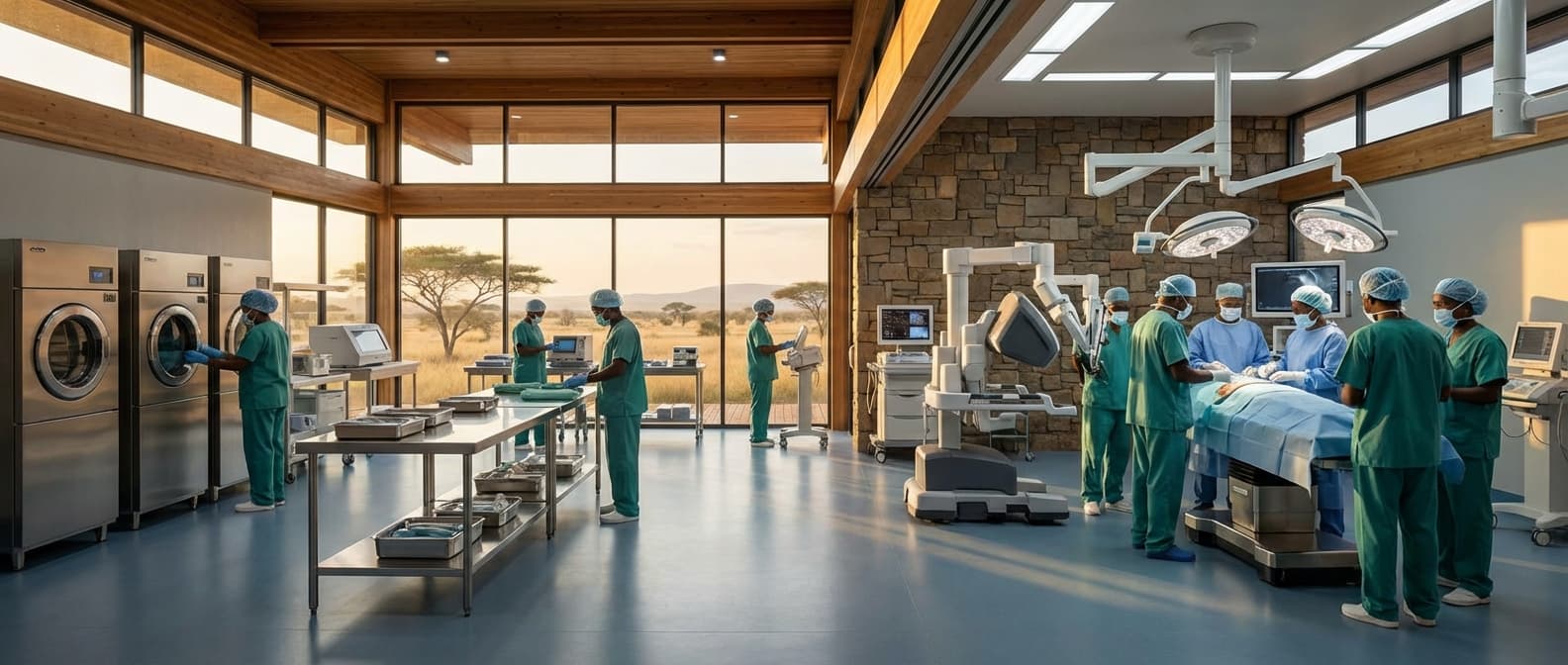
Medical Gas System Design & Installation in Gabon
Engineering Excellence & Technical Support
Medical gas pipeline systems: O2, N2O, air, vacuum High-standard technical execution following OEM protocols and local regulatory frameworks.
Robust Medical Gas Distribution Networks
Designed and installed a resilient medical gas distribution network for [Hospital Name] in Libreville, ensuring reliable and uninterrupted supply of oxygen, medical air, and vacuum to critical care units, operating theaters, and patient rooms, adhering to international standards (e.g., NFPA 99, ISO 7396).
Advanced Safety & Alarm Systems
Implemented state-of-the-art medical gas alarm systems with remote monitoring capabilities for the new [Clinic Name] in Port-Gentil, providing real-time alerts for pressure fluctuations, leaks, and system malfunctions, thereby enhancing patient safety and operational efficiency.
Optimized Gas Generation & Storage Solutions
Engineered and deployed a custom-designed medical air generation plant and integrated cryogenic liquid oxygen storage solution for [Health Center Name] in Franceville, ensuring a self-sufficient and cost-effective supply of essential medical gases, reducing reliance on imported cylinders and improving supply chain resilience.
What Is Medical Gas System Design & Installation In Gabon?
Medical Gas System Design & Installation in Gabon refers to the comprehensive process of planning, engineering, and constructing specialized piping networks and associated equipment for the safe and efficient delivery of medical gases to healthcare facilities. This service is critical for the operation of modern hospitals, clinics, and other medical establishments, ensuring reliable access to life-sustaining and therapeutic gases. The design phase involves detailed schematics, adherence to international and national standards (e.g., NFPA 99, ISO 7396, and Gabonese health regulations), selection of appropriate materials (e.g., medical-grade copper tubing, inert piping materials), and consideration of redundancy, alarm systems, and user interfaces. Installation encompasses the precise layout of the piping, Brazing and welding of joints to ensure leak-proof integrity, installation of regulators, flowmeters, outlets at patient points-of-care, and connection to central gas sources (bulk storage tanks, manifolds). Maintenance and commissioning are integral components, ensuring the system's performance, safety, and compliance before and after handover. This service is fundamentally about creating a safe, reliable, and compliant infrastructure for medical gas delivery, directly impacting patient care and operational efficiency.
| Service Component | Description | Typical Applications in Gabon |
|---|---|---|
| Design & Engineering | Involves detailed planning of gas pathways, pressure requirements, and adherence to safety standards. Utilizes CAD software for accurate schematics. | Hospitals (new constructions and renovations), specialized surgical centers, intensive care units (ICUs), emergency departments. |
| Material Selection | Specifying medical-grade copper, stainless steel, or specific polymers that are inert and do not react with medical gases. Crucial for preventing contamination. | Operating theaters, recovery rooms, general wards, diagnostic imaging facilities (e.g., MRI rooms requiring oxygen for emergency procedures). |
| Installation & Fabrication | The physical laying and connecting of medical gas lines, including rigorous joint preparation (brazing/welding) to ensure leak-proof integrity. | Ventilation systems for patient rooms, portable gas supply lines, central supply systems for piped gases. |
| Central Supply Systems | Designing and installing bulk liquid oxygen tanks, nitrous oxide systems, and compressed air plants, along with automated manifold systems for cylinder backup. | Large public and private hospitals, facilities with high demand for medical gases, remote healthcare centers relying on stored gases. |
| Gas Outlets & Terminal Units | Installation of specialized quick-connect or keyed outlets at patient bedsides, operating tables, and other points of care, ensuring correct gas identification. | Intensive care units, surgical suites, neonatal intensive care units (NICUs), anesthetic workstations. |
| Alarm & Monitoring | Implementing systems to detect pressure fluctuations, leaks, or depletion of gas supplies, providing audible and visual alerts to staff. | All healthcare facilities to ensure patient safety and prevent service interruptions. |
| Commissioning & Testing | Thorough testing of the entire system for leaks, flow rates, pressure accuracy, and purity of gases before patient use. | Essential for all newly installed or significantly modified medical gas systems. |
Key Components of Medical Gas System Design & Installation
- Site Assessment and Needs Analysis
- System Design and Engineering (Piping Layout, Material Specification, Pressure Calculations)
- Compliance with Standards (NFPA 99, ISO 7396, Gabonese Regulations)
- Equipment Selection (Regulators, Flowmeters, Manifolds, Alarms, Outlets, Valves)
- Pipe Installation (Medical-Grade Tubing, Brazing, Welding, Pressure Testing)
- Central Gas Source Integration (Bulk Storage, Cylinder Manifolds)
- Alarm and Monitoring System Installation
- Purging and Commissioning
- System Testing and Certification
- Training for Facility Personnel
- As-Built Drawings and Documentation
Who Needs Medical Gas System Design & Installation In Gabon?
Ensuring a safe and reliable supply of medical gases is paramount in healthcare facilities. The design and installation of a robust medical gas system are critical for patient care, surgical procedures, and emergency response. This service is essential for a range of healthcare providers in Gabon, from large public hospitals to specialized private clinics.
| Target Customer Type | Key Departments/Areas Requiring Medical Gas Systems | Primary Needs/Applications |
|---|---|---|
| Public Hospitals | Operating Theaters, ICUs, ER, Wards (General & Specialized), NICU, Respiratory Therapy | Comprehensive central supply, backup systems, high-volume demand for critical care and routine oxygenation. |
| Private Hospitals & Clinics | Operating Rooms, Recovery Rooms, ICUs, Emergency Services, Outpatient Procedure Rooms | High-quality and reliable systems for elective surgeries, specialized treatments, and patient comfort. |
| Surgical Centers | Operating Suites, Anesthesia Bays, Recovery Areas | Precise gas delivery for anesthesia, ventilation, and post-operative care. |
| Specialized Medical Facilities (e.g., Cardiac Centers, Oncology Centers) | Diagnostic Imaging (e.g., MRI - for cryogens), Treatment Rooms, Intensive Care Units | Specific gas requirements for advanced diagnostic equipment and critical patient management. |
| Government Health Bodies | National Health Infrastructure Planning & Oversight | Ensuring compliance with national and international standards for medical gas safety and availability. |
| NGOs & Aid Organizations | Temporary/Mobile Healthcare Units, Rural Clinics, Disaster Relief Facilities | Portable and robust systems for diverse and often challenging environments, ensuring basic life support. |
Target Customers and Departments in Gabon Requiring Medical Gas System Design & Installation
- Hospitals (Public & Private): The primary beneficiaries, requiring comprehensive systems for various departments.
- Surgical Centers & Operating Theaters: Critical for anesthesia delivery, patient ventilation, and lifesaving interventions.
- Intensive Care Units (ICUs) & Critical Care Units (CCUs): Essential for respiratory support, ventilation, and monitoring of critically ill patients.
- Emergency Rooms & Trauma Centers: Vital for immediate resuscitation, oxygen therapy, and emergency procedures.
- Maternity Wards & Neonatal Intensive Care Units (NICUs): Crucial for providing breathable air and oxygen to newborns and mothers.
- Rehabilitation Centers: May require oxygen for patients undergoing specific therapies.
- Dialysis Centers: Some patients may require oxygen during treatment.
- Outpatient Clinics (with minor surgical capabilities): For procedures requiring localized medical gas supply.
- Research & Development Facilities (Medical Focus): May need specialized gas mixtures for experiments.
- Government Health Ministries & Public Health Agencies: Responsible for setting standards and overseeing public healthcare infrastructure.
- Private Healthcare Groups & Investors: Developing new facilities or upgrading existing ones.
- International Aid Organizations & NGOs: Implementing healthcare projects in Gabon.
Medical Gas System Design & Installation Process In Gabon
The design and installation of medical gas systems in Gabon follow a structured workflow to ensure compliance with national regulations, international standards, and client-specific requirements. This process typically begins with an initial inquiry and culminates in the successful commissioning and handover of the system. Key stages include understanding project needs, detailed design, procurement, installation, rigorous testing, and final handover, with a strong emphasis on safety and quality at every step.
| Stage | Description | Key Activities | Deliverables | Key Stakeholders |
|---|---|---|---|---|
| Receiving the client's request and understanding their basic requirements for a medical gas system. | Initial project scope discussion, budget estimation, and preliminary timeline discussion. | Project brief, preliminary scope document. | Client (Hospital/Clinic Management), Project Manager. |
| Detailed evaluation of the facility's current and future medical gas needs, and assessment of the physical site. | Interviewing clinical staff, analyzing patient load, reviewing architectural plans, site inspection for pipeline routes, plant room location, and existing infrastructure. | Needs assessment report, site survey report, preliminary pipeline layout. | Client (Medical Staff, Facilities Management), Design Engineer, Site Surveyor. |
| Developing initial system concepts and evaluating their technical and economic feasibility. | Defining system types (e.g., piped gas, cylinders), gas requirements, preliminary sizing of components, cost-benefit analysis. | Conceptual design report, feasibility study report. | Design Engineer, Project Manager, Client. |
| Producing comprehensive engineering drawings, specifications, and documentation for the entire system. | Creating P&ID (Piping and Instrumentation Diagrams), layout drawings, schematics, equipment specifications, bill of quantities (BOQ), safety protocols. | Detailed design drawings, technical specifications, BOQ, risk assessment report. | Design Engineers (Mechanical, Electrical), CAD Technicians, Client's Technical Advisor. |
| Obtaining necessary permits and approvals from Gabonese authorities. | Submitting design documents to relevant ministries (e.g., Ministry of Health, Ministry of Environment), addressing any queries or requirements. | Approved permits and licenses. | Design Team, Project Manager, Legal/Compliance Officer, Gabonese Government Agencies. |
| Sourcing and purchasing all required medical gas equipment, piping, and accessories. | Issuing tender documents, evaluating bids, selecting suppliers, placing orders, quality control of incoming materials. | Procurement orders, material submittals, quality inspection reports. | Procurement Department, Project Manager, Site Manager, Suppliers. |
| Preparing the installation site, including any necessary civil engineering work. | Clearing installation areas, constructing plant rooms, trenching for underground piping, modifications to building structure. | Prepared installation sites, completed civil works. | Construction Team, Site Manager, Civil Engineers. |
| Physically installing the medical gas pipelines, plant equipment, and terminal units. | Welding and joining pipes, installing gas manifolds, compressors, vacuum pumps, alarms, terminal outlets, pressure testing sections of the system. | Installed pipeline network, functional plant equipment, integrated system components. | Installation Technicians, Site Supervisor, Project Manager, Quality Inspector. |
| Rigorously testing the system to ensure it meets all performance and safety standards. | Pressure testing, leak detection, purity analysis of gases, flow rate verification, alarm system testing, functionality tests, performance validation against design specifications. | Test reports, commissioning certificates, validation reports, as-built drawings. | Commissioning Engineers, Quality Assurance Team, Client Representatives, Third-Party Inspectors. |
| Training the client's personnel on system operation and maintenance, and officially transferring ownership. | Conducting user and maintenance training sessions, providing comprehensive operation and maintenance manuals, final inspection and sign-off. | Training materials, operation and maintenance manuals, handover certificate. | Training Specialists, Site Manager, Client (Facilities Management, Medical Staff). |
| Providing ongoing support and maintenance services after the system is operational. | Warranty support, scheduled preventative maintenance, emergency repair services, spare parts management. | Maintenance contracts, service reports, spare parts inventory. | Maintenance Department, Client (Facilities Management). |
Medical Gas System Design & Installation Workflow in Gabon
- Inquiry & Initial Consultation
- Needs Assessment & Site Survey
- Conceptual Design & Feasibility Study
- Detailed Design & Engineering
- Regulatory Approvals & Permitting
- Procurement of Materials & Equipment
- Site Preparation & Civil Works
- Installation & Integration
- Testing, Commissioning & Validation
- Training & Handover
- Post-Installation Support & Maintenance
Medical Gas System Design & Installation Cost In Gabon
Designing and installing a medical gas system in Gabon involves a complex interplay of factors that directly influence the overall cost. These systems are critical for patient care, requiring specialized equipment, materials, and expertise that adhere to stringent safety and regulatory standards. The pricing can vary significantly based on the scale of the project, the specific medical gases required (e.g., oxygen, medical air, vacuum, nitrous oxide, nitrogen), the complexity of the installation, and the geographical location within Gabon. Local availability of skilled labor and imported materials also plays a crucial role in determining the final price.
| Service/Component | Estimated Cost Range (XAF) | Notes |
|---|---|---|
| Medical Gas System Design (Conceptual & Detailed) | 2,000,000 - 15,000,000+ | Varies based on facility size and complexity. Includes engineering, schematics, and specifications. |
| Medical Gas Piping Installation (per linear meter) | 15,000 - 60,000+ | Depends on gas type, material (copper typically), and installation difficulty (e.000g., wall penetration). |
| Medical Gas Outlets & Valves (per unit) | 50,000 - 200,000+ | Includes the wall outlet, shut-off valve, and installation. Prices vary by gas type and brand. |
| Medical Gas Alarm Systems (per zone) | 300,000 - 1,500,000+ | Covers central and local alarms, monitoring pressure and flow for critical gases. |
| Oxygen Manifold/Generator Systems (for smaller facilities/backup) | 5,000,000 - 30,000,000+ | Ranges from cylinder manifolds to PSA (Pressure Swing Adsorption) generators. |
| **Medical Air Compressor Systems | 3,000,000 - 20,000,000+ | Includes compressors, dryers, filters, and storage tanks. |
| Vacuum Systems (pumps, tanks, filters) | 2,000,000 - 15,000,000+ | Essential for surgical and post-operative care. |
| Nitrous Oxide Systems (manifold, piping, outlets) | 8,000,000 - 40,000,000+ | Typically for operating rooms; higher cost due to specialized handling. |
| **System Testing & Certification | 1,000,000 - 5,000,000+ | Pressure testing, leak detection, flow rate verification, and final certification. |
| **Contingency & Project Management | 10% - 20% of total project cost | Recommended for unforeseen issues and professional oversight. |
Key Pricing Factors for Medical Gas System Design & Installation in Gabon
- System Scope and Size: The number of beds, departments, and the overall capacity of the healthcare facility are primary drivers of cost. Larger hospitals with more comprehensive medical gas needs will naturally incur higher expenses.
- Medical Gases Required: Different gases have varying production/purification costs and require specific infrastructure. Oxygen is standard, but systems incorporating specialized gases like nitrous oxide or high-purity nitrogen will add to the overall expense.
- Complexity of Installation: The layout of the facility, the age of the building, and the need for extensive piping, outlets, alarms, and shut-off valves all contribute to installation complexity and cost.
- Equipment Quality and Brand: The choice of medical gas equipment, including regulators, manifolds, compressors, vacuum pumps, and alarm systems, significantly impacts price. Reputable international brands often come with a higher price tag but offer greater reliability and longevity.
- Materials and Piping: The type and quality of piping material (e.g., copper, stainless steel) and the length of piping required are direct cost components. Compliance with medical gas standards dictates specific material requirements.
- Labor Costs: The availability of skilled technicians and engineers experienced in medical gas system installation in Gabon will influence labor rates. If specialized international expertise is required, this will add to the cost.
- Regulatory Compliance and Certification: Adhering to local and international standards for medical gas systems (e.g., NFPA 99, ISO) necessitates proper design, installation, and rigorous testing, which involves certification costs.
- Geographical Location: Accessibility of the construction site within Gabon can affect transportation costs for materials and equipment, as well as the logistics of bringing in specialized labor.
- Ancillary Systems: The cost can also be influenced by the integration of ancillary systems such as gas generation plants, storage tanks, and advanced monitoring systems.
- Project Management and Consultancy Fees: Professional project management and consultancy services for the design and oversight of the installation are essential and represent an additional cost.
Affordable Medical Gas System Design & Installation Options
Designing and installing a medical gas system is a critical investment for healthcare facilities. Fortunately, there are several affordable options available that prioritize both functionality and cost-effectiveness. Understanding value bundles and implementing smart cost-saving strategies can significantly reduce the overall expense without compromising safety or compliance.
| Value Bundle Option | Description | Cost-Saving Potential |
|---|---|---|
| Standard System Package | Includes essential medical gases, core components, and basic installation services. Often a pre-defined package for common healthcare settings. | Predictable pricing, reduced negotiation time, streamlined procurement. |
| Modular Expansion Design | A system designed with easily addable modules for future gas lines or outlets. The initial installation is optimized, with future additions being less disruptive and costly. | Lower initial upfront cost, delayed investment in future needs, avoids costly major modifications. |
| Turnkey Solution (Basic) | Covers design, procurement, installation, and initial testing for a standard set of medical gases and essential equipment. Focuses on core functionality. | Single point of contact, reduced project management overhead, often bundled pricing offers savings. |
| Pre-Fabricated Components & Skids | Utilizing pre-assembled gas source equipment (e.g., manifolds, regulators) and piping sections that are fabricated off-site. | Faster installation on-site, reduced labor costs, improved quality control due to controlled manufacturing environment. |
Key Considerations for Affordable Medical Gas Systems
- System Requirements Assessment: Accurately determining the specific medical gases needed (e.g., oxygen, medical air, vacuum, nitrous oxide) and the required flow rates for each outlet is crucial to avoid overspending on unnecessary capacity.
- Scalability & Future-Proofing: Designing a system that can be easily expanded or upgraded in the future can prevent costly retrofits down the line. This often involves planning for additional outlets or future gas types.
- Material Selection: While quality is paramount, exploring durable and cost-effective material options for piping and components can lead to significant savings. Considerations include copper grades, fitting types, and insulation.
- Regulatory Compliance: Thoroughly understanding and adhering to all relevant national and local codes (e.g., NFPA 99, CSA Z305.1) from the outset is vital to avoid expensive rework and fines.
- Phased Installation: For new builds or major renovations, consider a phased installation approach if budget constraints are severe. This allows for spreading costs over time while still meeting immediate needs.
- Choosing the Right Vendor: Partnering with experienced and reputable medical gas system designers and installers who offer competitive pricing and transparent proposals is essential.
Verified Providers In Gabon
Navigating healthcare in a foreign country can be a daunting task. Ensuring you receive quality care from trusted professionals is paramount. In Gabon, identifying verified healthcare providers is crucial for your well-being. Franance Health stands out as a premier credentialing body, rigorously vetting medical professionals and facilities to guarantee adherence to international standards of care and ethical practice. This commitment to quality assurance makes Franance Health-certified providers the optimal choice for anyone seeking medical services in Gabon.
| Provider Type | Franance Health Benefits | Why They Are the Best Choice |
|---|---|---|
| Hospitals & Clinics | Ensured adherence to hygiene and safety protocols, access to advanced medical technology. | Offer a higher degree of patient safety, better equipped for a wider range of medical needs, and provide a more comfortable healing environment. |
| Specialist Physicians | Verification of board certifications, continuous medical education, and positive patient feedback. | Provide expert diagnosis and treatment, ensuring you are in the hands of highly skilled professionals in your specific medical field. |
| General Practitioners | Confirmation of licensure, clinical competence, and patient-centric approach. | Offer reliable primary care services, acting as your first point of contact for health concerns and referrals to specialists when needed. |
| Diagnostic Laboratories | Validation of equipment calibration, quality control measures, and experienced technicians. | Deliver accurate and timely diagnostic results, crucial for effective medical treatment and management. |
Why Franance Health Credentials Matter
- Rigorous Vetting Process: Franance Health employs a comprehensive evaluation of medical practitioners' qualifications, experience, and regulatory compliance.
- Adherence to International Standards: Certified providers meet or exceed global benchmarks for medical excellence and patient safety.
- Ethical Practice Verification: Franance Health ensures that all accredited professionals uphold the highest ethical standards in their practice.
- Enhanced Patient Trust: The Franance Health seal provides patients with confidence and peace of mind regarding the quality of care they will receive.
- Improved Healthcare Access: By identifying reputable providers, Franance Health facilitates access to reliable medical services for residents and visitors alike.
Scope Of Work For Medical Gas System Design & Installation
This Scope of Work (SOW) outlines the requirements for the design and installation of a new medical gas system, as well as the technical deliverables and standard specifications to be adhered to. The project encompasses the complete lifecycle from conceptualization and detailed design through to final commissioning and handover. The system will serve [Specify Facility Name/Type, e.g., a new hospital wing, an existing clinic expansion, a specialized surgical center] and will include outlets for [List Medical Gases, e.g., Medical Air, Oxygen, Vacuum, Nitrous Oxide, Carbon Dioxide, Nitrogen].
| Category | Technical Deliverables | Standard Specifications/Requirements |
|---|---|---|
| System Design | Detailed P&ID (Piping and Instrumentation Diagrams) for all medical gas systems. Layout drawings indicating pipe routing, valve locations, pressure regulators, alarms, and other components. Equipment schedules for all major components (compressors, vacuum pumps, manifolds, cylinders, etc.). Single-line diagrams for system overview. Material take-off (MTO) for all piping, fittings, and valves. Schematic diagrams of the alarm and monitoring system. Calculations for pipe sizing, pressure drops, and flow rates. | NFPA 99: Health Care Facilities Code (latest edition). ASME B31.3: Process Piping. Local building codes and regulations. Manufacturer's installation and operation manuals. Facility-specific design guidelines (if applicable). Compliance with all relevant national and international standards for medical gas systems. |
| Equipment & Components | Submittal data for all medical gas equipment (compressors, vacuum pumps, manifolds, regulators, alarms, outlets, valves, etc.). Certificates of conformance and test reports for all equipment. Quality control plans for equipment manufacturing and testing. | Certified for medical gas service (e.g., CGA, ISO). Material traceability documentation. Designed for continuous operation and reliability. Fail-safe mechanisms for critical components. |
| Installation | Detailed installation drawings and method statements. Welding procedures and welder certifications. Pressure testing reports (hydrostatic and/or pneumatic). Leak testing reports for all joints and connections. Installation progress reports and site inspection records. | All installation work to be performed by qualified and certified technicians. Adherence to NFPA 99, ASME B31.3, and other applicable codes. Proper cleaning and purging of all piping before connection. Color-coding of all medical gas piping as per NFPA 99. Segregation of medical gas piping from other services. |
| Testing & Commissioning | System performance test reports (pressure, flow, purity). Alarm system functionality test reports. Gas purity analysis reports from an accredited laboratory. Final system commissioning report. As-built drawings reflecting actual installation. | All testing to be conducted in accordance with NFPA 99 and manufacturer recommendations. System must achieve and maintain specified pressure and purity levels for all gases. Alarm setpoints to be verified and documented. Operational readiness confirmation. |
| Documentation & Handover | Operations and Maintenance (O&M) manuals for all installed systems and equipment. Training manuals and records of training provided to facility staff. Warranty certificates for all equipment and workmanship. Final acceptance documentation. | Comprehensive and accurate O&M manuals. Well-trained facility staff capable of operating and maintaining the system. Clearly defined warranty periods and coverage. Formal sign-off by the facility representative. |
Key Project Phases and Activities
- Phase 1: Design & Engineering
- Phase 2: Procurement & Manufacturing
- Phase 3: Installation & Construction
- Phase 4: Testing, Commissioning & Validation
- Phase 5: Documentation & Handover
Service Level Agreement For Medical Gas System Design & Installation
This Service Level Agreement (SLA) outlines the response times and uptime guarantees for the design and installation services of medical gas systems provided by [Your Company Name] (hereinafter referred to as 'Provider') to [Client Name] (hereinafter referred to as 'Client'). This SLA is an addendum to the Master Services Agreement (MSA) between the Provider and the Client.
| Service Component | Response Time (Business Hours) | Uptime Guarantee | Notes |
|---|---|---|---|
| Initial Design Consultation & Proposal Submission | Within 3 business days of confirmed project scope | N/A | Covers initial meeting and delivery of preliminary design concepts and cost estimates. |
| Detailed Design Documentation Submission | Within 10 business days of approved preliminary design | N/A | Includes detailed blueprints, specifications, and Bill of Materials (BOM). |
| Material & Equipment Procurement Commencement | Within 2 business days of approved detailed design and PO issuance | N/A | Initiation of ordering necessary components. |
| On-site Installation Commencement (Post Material Availability) | Within 5 business days of material/equipment delivery to site | N/A | Subject to site readiness and necessary permits. |
| System Testing & Certification | Within 2 business days of completion of installation | N/A | Performance of leak testing, pressure testing, and purity analysis. |
| Post-Installation Support (During Warranty Period) | Critical Issue: 4 business hours; Non-Critical Issue: 8 business hours | 99.5% Uptime of Operational System | Applies to issues arising from the design and installation. Critical issues are defined as those preventing patient care delivery or posing an immediate safety risk. Non-critical issues are those that do not directly impact patient care or safety but require resolution. |
| Emergency Response (During Warranty Period) | On-site within 12 business hours | N/A | For critical system failures requiring immediate intervention. This may incur additional charges as per the MSA if deemed outside of design/installation defect. |
Scope of Services
- Design of medical gas systems, including but not limited to: pipeline design, outlet specifications, manifold selection, alarm systems, and compliance with relevant standards (e.g., NFPA 99, local building codes).
- Procurement of materials and equipment for the medical gas system.
- Installation of all medical gas piping, outlets, alarms, central gas sources (manifolds/compressors/vacuum pumps), and related infrastructure.
- Testing and certification of the installed medical gas system.
- Project management and coordination related to the design and installation process.
Frequently Asked Questions

Ready when you are
Let's scope your Medical Gas System Design & Installation in Gabon project in Gabon.

Scaling healthcare logistics and technical systems across the entire continent.