
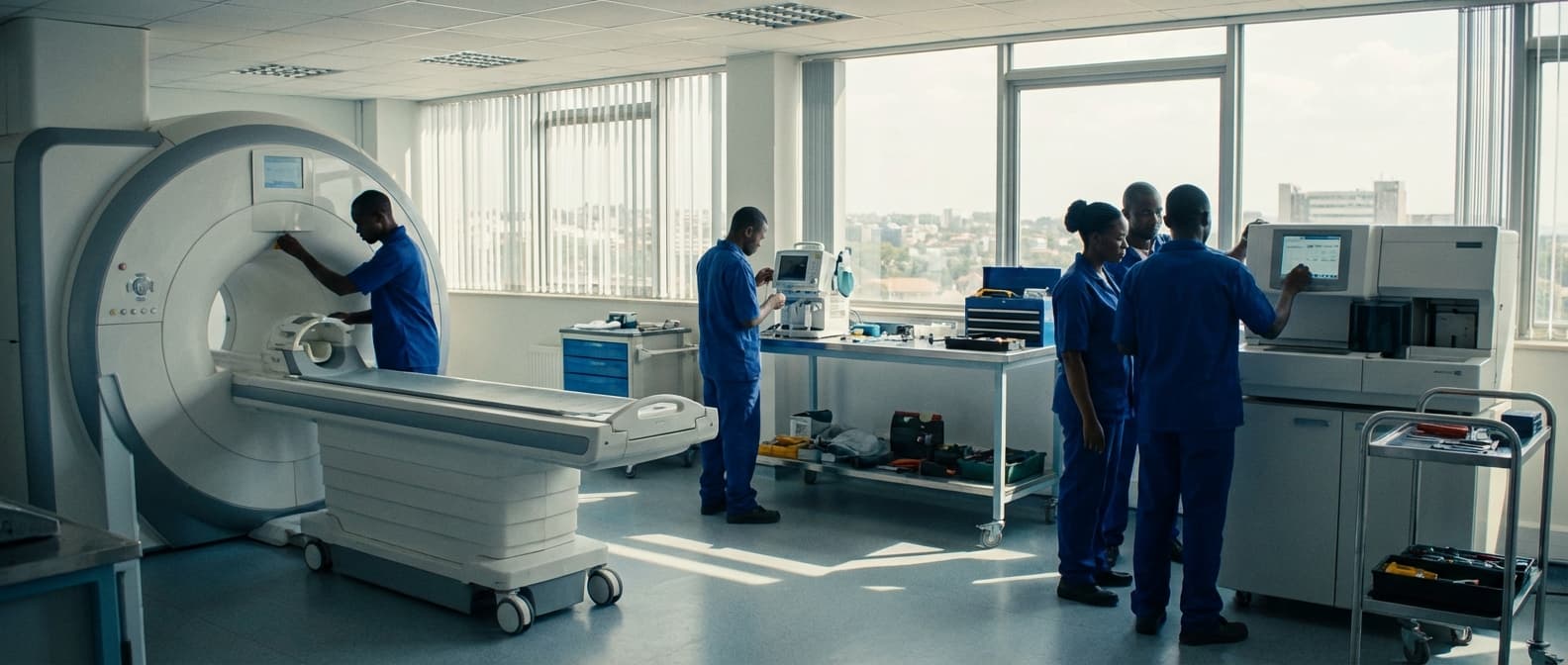
Preventive Maintenance Visit Service (On-Demand) in Ethiopia
Engineering Excellence & Technical Support
Preventive Maintenance Visit Service (On-Demand) High-standard technical execution following OEM protocols and local regulatory frameworks.
Proactive Equipment Health Monitoring
Leverage our advanced diagnostic tools and expert technicians for on-demand preventive maintenance visits in Ethiopia. We identify potential issues before they cause downtime, ensuring your critical assets operate at peak performance and extending their lifespan.
Rapid On-Demand Service & Parts
Experience minimized disruptions with our agile, on-demand preventive maintenance services across Ethiopia. Our technicians arrive equipped with the necessary tools and common replacement parts, facilitating swift and efficient resolutions to keep your operations running smoothly.
Scheduled & Emergency PM Support
Secure your operational continuity with our flexible preventive maintenance solutions in Ethiopia. Whether it's scheduled servicing or an urgent need, our on-demand visits are designed to adapt to your business rhythm, safeguarding against unexpected breakdowns and optimizing resource allocation.
What Is Preventive Maintenance Visit Service (On-demand) In Ethiopia?
Preventive Maintenance Visit Service (On-Demand) in Ethiopia refers to a proactive, scheduled or ad-hoc maintenance service for critical equipment and infrastructure, conducted by qualified technicians, to mitigate potential failures, optimize performance, and extend asset lifespan. This service operates on a 'pay-as-you-go' or subscription model, allowing asset owners to access expert maintenance expertise without the commitment of a full-time in-house team. It is distinct from reactive maintenance, which addresses issues only after they have occurred.
| Who Needs It | Typical Use Cases | ||
|---|---|---|---|
| Manufacturing facilities with production machinery (e.g., assembly lines, CNC machines). | Scheduled checks on conveyor belts, gearboxes, and electrical panels to prevent production downtime. | Annual servicing of industrial pumps and motors to ensure efficient operation. | |
| Healthcare institutions with medical equipment (e.g., imaging machines, laboratory instruments). | Routine calibration and performance checks on MRI scanners and X-ray machines to ensure diagnostic accuracy and patient safety. | Preventive maintenance on sterilization equipment to prevent contamination. | |
| Commercial buildings and infrastructure (e.g., HVAC systems, elevators, power generators). | Quarterly inspections and servicing of HVAC units to maintain optimal indoor climate control and energy efficiency. | Testing and inspection of backup power generators for critical facilities during power outages. | Elevator safety checks and lubrication to prevent operational failures. |
| Agricultural operations with heavy machinery and processing equipment. | Pre-season servicing of tractors, harvesters, and irrigation systems to ensure readiness for planting and harvesting. | Maintenance of food processing machinery to ensure product quality and safety. | |
| Telecommunications and IT infrastructure (e.g., data centers, network equipment). | Regular checks on cooling systems and power supplies in data centers to prevent overheating and data loss. | Preventive maintenance on network routers and switches to ensure network stability. | |
| Small and Medium Enterprises (SMEs) lacking dedicated maintenance personnel. | Outsourcing of regular maintenance for office equipment, specialized machinery, or fleet vehicles. | On-demand service for critical equipment failures that could halt operations. |
Key Components of Preventive Maintenance Visit Service (On-Demand)
- Scheduled Inspections: Regular, pre-defined checks of equipment and systems for wear and tear, calibration, and operational anomalies.
- Lubrication and Cleaning: Application of lubricants to reduce friction and wear, and thorough cleaning to prevent dust accumulation and overheating.
- Component Testing and Calibration: Verification of critical component functionality and recalibration to ensure adherence to manufacturer specifications.
- Minor Repairs and Adjustments: Addressing minor issues identified during inspections before they escalate into major failures.
- Performance Monitoring: Utilization of diagnostic tools and software to track operational parameters and identify deviations.
- Record Keeping and Reporting: Documentation of all maintenance activities, findings, and recommendations for future reference and analysis.
- On-Demand Access: Availability of technicians and expertise upon request, for both scheduled and emergent preventive tasks.
Who Needs Preventive Maintenance Visit Service (On-demand) In Ethiopia?
Preventive maintenance visit services on-demand in Ethiopia are crucial for a wide range of businesses and organizations to ensure the optimal performance, longevity, and safety of their critical equipment and infrastructure. These services are not just for large corporations; small and medium-sized enterprises (SMEs) and even individual asset owners can benefit significantly from proactive maintenance, preventing costly breakdowns and production downtime. The need arises when regular, scheduled maintenance is not feasible due to operational demands, specialized equipment requiring immediate attention, or a desire for flexible, as-needed support.
| Target Customer Segment | Industries | Key Departments / Roles |
|---|---|---|
| Manufacturing & Production | Food & Beverage, Textiles, Pharmaceuticals, Automotive, Cement, Chemicals | Production Management, Plant Operations, Maintenance Department, Quality Control |
| Energy & Utilities | Power Generation (Hydro, Thermal, Solar), Water Treatment Plants, Distribution Networks | Operations Management, Engineering Department, Plant Maintenance, Safety Officers |
| Agriculture & Agribusiness | Large-scale Farms, Food Processing Units, Irrigation Systems | Farm Managers, Operations Managers, Processing Plant Supervisors, Irrigation Supervisors |
| Mining & Construction | Mining Operations, Construction Sites, Equipment Rental Companies | Site Managers, Operations Managers, Fleet Managers, Equipment Supervisors |
| Transportation & Logistics | Fleet Operators (Trucking, Buses), Warehousing & Distribution Centers | Fleet Managers, Operations Managers, Maintenance Supervisors, Logistics Managers |
| Healthcare | Hospitals, Clinics, Diagnostic Centers (for specialized medical equipment) | Facility Management, Biomedical Engineering Department, Hospital Administrators |
| Hospitality | Hotels, Resorts, Conference Centers (for HVAC, kitchen equipment, elevators) | Facility Managers, Chief Engineers, Operations Managers |
| Telecommunications | Mobile Network Operators, Internet Service Providers (for tower infrastructure, data centers) | Network Operations Center (NOC), Site Maintenance Teams, Infrastructure Management |
| SMEs & Small Businesses | Various sectors requiring specific equipment maintenance | Business Owners, Operations Managers |
| Government & Public Sector | Municipalities, Public Works Departments, Embassies (for buildings & facilities) | Facility Management Officers, Public Works Directors, Estate Managers |
Target Customers and Departments for On-Demand Preventive Maintenance Services in Ethiopia
- Businesses with critical operational uptime requirements
- Organizations operating specialized or high-value equipment
- SMEs lacking dedicated in-house maintenance teams
- Sectors with seasonal or fluctuating operational demands
- Government agencies responsible for public infrastructure
- Service providers offering equipment leasing or rental
Preventive Maintenance Visit Service (On-demand) Process In Ethiopia
This document outlines the typical workflow for an On-Demand Preventive Maintenance Visit Service in Ethiopia, covering the process from initial inquiry to the completion of the service. The aim is to ensure efficient and effective execution of preventive maintenance tasks for various equipment and systems.
| Phase | Step | Description | Key Actions | Responsible Party | Considerations (Ethiopia Specific) |
|---|---|---|---|---|---|
| Phase 1: Inquiry and Initial Assessment |
| The customer contacts the service provider to request a preventive maintenance visit. | • Customer calls, emails, or uses a web portal. • Customer describes the equipment/system needing service and the nature of the request (e.g., routine check, specific issue observed). | Customer | • Language barriers (Amharic is common, but other local languages exist). • Availability of reliable communication channels (internet, phone). • Urgency of the request. |
| The service provider acknowledges the inquiry and gathers necessary details. | • Confirm receipt of inquiry. • Ask clarifying questions about the equipment, its location, past maintenance history, and any specific concerns. | Service Provider (Customer Service/Sales) | • Understanding local business hours and public holidays. • Accessing customer's existing service history (if available). | |
| Based on the gathered information, a preliminary assessment is made, and a quote is prepared. | • Determine the scope of work (e.g., basic inspection, detailed check, minor repairs). • Estimate parts and labor costs. • Provide a provisional quotation to the customer. | Service Provider (Technical/Sales) | • Availability and cost of spare parts locally. • Standard service charges and labor rates in Ethiopia. • Currency fluctuations (ETB). | |
| Phase 2: Scheduling and Confirmation |
| The customer reviews the quotation and schedules the visit. | • Customer accepts the quote. • Negotiate and agree on a suitable date and time for the service visit. | Customer & Service Provider | • Customer's operational schedule and potential business disruption. • Technician availability and travel time. |
| A formal service order is created and confirmed with the customer. | • Generate a unique service order number. • Send a formal confirmation of the scheduled visit, including date, time, scope of work, and estimated costs. | Service Provider (Administration/Operations) | • Clear documentation practices. • Confirmation via SMS or email. | |
| Phase 3: Technician Dispatch and Site Preparation |
| A qualified technician is assigned to the service visit. | • Select technician based on expertise with the specific equipment/system. • Ensure the technician has the necessary tools and parts (if pre-determined). | Service Provider (Operations/Dispatch) | • Availability of skilled technicians across different regions. • Technician's knowledge of local geography for efficient travel. |
| The technician or dispatch team may contact the customer for final confirmation and site access details. | • Reconfirm appointment time. • Inquire about any specific site access requirements or safety protocols. | Service Provider (Technician/Dispatch) | • Local contact person's availability. • Site access procedures for secure facilities. | |
| The assigned technician travels to the customer's location. | • Follow planned route, considering traffic and road conditions. | Technician | • Quality of road infrastructure. • Safety during travel, especially in remote areas. • Potential for checkpoints or permits required for travel. | |
| Phase 4: Service Execution |
| The technician arrives at the site, checks in, and conducts an initial assessment of the equipment. | • Report to designated contact person. • Visually inspect the equipment for obvious damage or issues. • Review the service order and customer's concerns. | Technician | • Site induction and safety briefing. • Understanding of local security protocols. |
| The technician performs the scheduled preventive maintenance tasks. | • Follow established checklists and procedures. • Clean, lubricate, inspect, test, and adjust components as per manufacturer's recommendations. • Document all actions taken, including measurements and observations. | Technician | • Availability of necessary spare parts and consumables on-site or readily accessible. • Adherence to international standards vs. local adaptations. | |
| Any issues or potential problems identified during the maintenance are documented and communicated. | • Note down any deviations from normal operation or wear and tear. • Take photos or videos if necessary. • Discuss findings with the customer's representative. | Technician | • Clarity of communication with customer representatives. • Willingness of customer to address identified issues immediately or schedule further work. | |
| Phase 5: Post-Service Procedures and Closure |
| The technician tests the equipment to ensure it is functioning correctly after the maintenance. | • Perform functional tests and performance checks. • Verify that all maintenance tasks have been completed. | Technician | • Availability of test equipment and qualified personnel for testing complex systems. |
| A detailed service report is generated by the technician. | • Document all work performed, parts used, findings, recommendations, and test results. • Include date, time, technician's name, and customer signature. | Technician | • Use of standardized report templates. • Digital or physical report submission. | |
| The customer reviews the service report and signs off on the completion of the visit. | • Customer representative reviews the report. • Customer provides feedback on the service received. | Customer & Technician | • Customer's understanding and agreement with the report. • Providing feedback mechanisms (e.g., satisfaction surveys). | |
| The service provider generates an invoice and processes payment. | • Submit the service report and invoice to the customer. • Follow up on payment as per agreed terms. | Service Provider (Finance/Administration) | • Payment terms and methods common in Ethiopia (e.g., bank transfer, cash). • Tax regulations and invoicing requirements. | |
| The service visit is officially closed, and all relevant records are updated. | • Archive the service report and associated documents. • Update the customer's service history in the system. | Service Provider (Administration) | • Data management and security. • Maintaining historical data for future reference and analysis. |
Preventive Maintenance Visit Service (On-Demand) Process Workflow in Ethiopia
- Phase 1: Inquiry and Initial Assessment
- Phase 2: Scheduling and Confirmation
- Phase 3: Technician Dispatch and Site Preparation
- Phase 4: Service Execution
- Phase 5: Post-Service Procedures and Closure
Preventive Maintenance Visit Service (On-demand) Cost In Ethiopia
Preventive maintenance visits are crucial for ensuring the longevity and optimal performance of various assets, from vehicles and machinery to household appliances and industrial equipment in Ethiopia. The cost of these on-demand services can vary significantly due to several factors. Understanding these elements helps individuals and businesses budget effectively and choose the most suitable service providers. The pricing is typically determined by the complexity of the service, the type of equipment, the brand and model, the location of the service, the urgency of the request, and the reputation and expertise of the service provider. For instance, a routine check-up for a car will be less expensive than a specialized maintenance for complex industrial machinery. Similarly, services in major cities like Addis Ababa might have slightly higher rates due to operational costs.
| Service Type (Examples) | Estimated Cost Range (ETB) | Notes |
|---|---|---|
| Routine Car Check-up (Oil Change, Filter Replacement, Basic Inspection) | 2,000 - 5,000 | Varies by car model and parts used. Includes labor and basic consumables. |
| Generator Maintenance (e.g., 10-20 kVA) | 3,000 - 7,000 | Includes filter changes, fluid checks, and basic inspection. May exclude major part replacements. |
| HVAC System Check-up (Residential) | 1,500 - 4,000 | Covers cleaning, refrigerant checks, and basic operational tests. |
| Industrial Machinery Basic Service (e.g., lubrication, visual inspection) | 5,000 - 15,000+ | Highly dependent on machine size and complexity. Excludes specialized repairs. |
| Specialized Equipment Diagnostics (e.g., medical equipment, advanced manufacturing) | 10,000 - 50,000+ | Requires highly trained technicians and specialized tools. Costs can escalate rapidly. |
| On-Demand Emergency Call-out Fee (after hours/weekends) | 1,000 - 3,000 (additional to service cost) | Covers immediate dispatch and urgent service. |
Key Pricing Factors for Preventive Maintenance Visits in Ethiopia:
- Type of Equipment/Asset: The nature of the item requiring maintenance is a primary driver. (e.g., vehicles, industrial machinery, HVAC systems, generators, home appliances).
- Complexity of the Service: Simple visual inspections and lubrication will be cheaper than detailed diagnostics, part replacements, or software updates.
- Brand and Model: Some brands have proprietary parts or require specialized knowledge, potentially increasing costs. High-end or specialized equipment often incurs higher maintenance expenses.
- Parts and Consumables: The cost of any replacement parts (filters, belts, fluids, etc.) will be added to the service fee.
- Technician's Expertise and Certification: Highly skilled and certified technicians, especially for specialized equipment, will command higher rates.
- Location of Service: On-site visits, particularly those requiring travel to remote areas, will incur additional transportation and potentially accommodation costs.
- Urgency of the Request: Emergency or same-day service calls are usually priced at a premium compared to scheduled appointments.
- Service Provider's Reputation and Overhead: Established companies with good reputations and comprehensive warranties may charge more than independent technicians.
- Diagnostic Tools and Software: The use of advanced diagnostic equipment can add to the overall cost.
- Frequency and Contractual Agreements: Some providers offer discounts for regular, scheduled maintenance contracts.
Affordable Preventive Maintenance Visit Service (On-demand) Options
Our Affordable Preventive Maintenance Visit Service (On-Demand) is designed to keep your equipment running smoothly and efficiently, preventing costly breakdowns and maximizing its lifespan. We offer flexible options to suit your needs and budget, emphasizing value through smart service bundles and proactive cost-saving strategies. Investing in regular maintenance is significantly cheaper than reacting to unexpected repairs.
| Value Bundle Name | What's Included | Cost-Saving Benefits | Ideal For |
|---|---|---|---|
| Basic Tune-Up Bundle | Standard inspection, lubrication, basic cleaning, and safety check. | Reduces energy consumption, extends component life by up to 15%. | Single piece of equipment, less complex systems, or infrequent users. |
| Comprehensive Check-Up Bundle | Includes Basic Tune-Up plus detailed diagnostics, minor part inspection, and performance optimization. | Prevents minor issues from escalating into costly repairs, improves operational efficiency by up to 10%. | Multiple pieces of equipment, moderate usage, or older systems. |
| Proactive Care Package (Best Value) | Includes Comprehensive Check-Up, priority scheduling for future on-demand visits, and a discount on parts for any follow-up repairs within 6 months. | Significant reduction in unexpected downtime, potential savings of 20-30% on repair costs compared to non-bundled services. | Businesses with critical equipment, high usage, or those prioritizing maximum uptime and long-term cost control. |
Our On-Demand Preventive Maintenance Service Offers:
- Convenient Scheduling: Book a visit when it's most convenient for you, with no long-term commitments required for on-demand services.
- Expert Technicians: Our certified technicians have the knowledge and experience to identify potential issues before they become major problems.
- Comprehensive Inspections: Thorough checks of all critical components, lubrication, adjustments, and cleaning as needed.
- Minor Part Replacements: Includes the replacement of common wear-and-tear parts (filters, belts, etc.) within the service scope.
- Priority Service: On-demand customers receive priority scheduling in case of urgent needs (additional fees may apply for emergency calls).
- Detailed Service Reports: Receive a comprehensive report after each visit, outlining performed tasks, findings, and recommendations.
Verified Providers In Ethiopia
In the complex landscape of healthcare in Ethiopia, identifying reliable and credentialed providers is paramount for individuals seeking quality medical services. Franance Health has emerged as a leading organization, distinguished by its rigorous credentialing process and unwavering commitment to patient well-being. This commitment translates into a network of healthcare professionals and facilities that consistently meet the highest standards of care, making them the optimal choice for your health needs.
| Credentialing Aspect | Franance Health's Rigorous Approach | Benefit to Patients |
|---|---|---|
| Educational and Professional Qualifications | Verification of degrees, diplomas, and certifications from accredited institutions. | Ensures providers possess the foundational knowledge and expertise required for effective practice. |
| Licensing and Regulatory Compliance | Confirmation of active and valid medical licenses from relevant Ethiopian authorities. | Guarantees that providers are legally authorized to practice and adhere to professional regulations. |
| Specialized Training and Certifications | Validation of advanced training and certifications in specific medical fields. | Provides access to specialists with in-depth knowledge and skills for complex medical needs. |
| Practice History and Reputation | Scrutiny of past professional conduct, including any disciplinary actions or malpractice claims. | Minimizes the risk of encountering substandard or unethical care. |
| Continuous Professional Development | Encouragement and verification of ongoing training and participation in medical conferences. | Ensures providers are up-to-date with the latest medical research, technologies, and treatment protocols. |
| Facility Standards (if applicable) | Assessment of healthcare facilities for hygiene, equipment, and operational efficiency. | Contributes to a safe, clean, and well-equipped environment for medical procedures. |
Why Franance Health Providers Are the Best Choice:
- Uncompromising Credential Verification: Franance Health employs a multi-faceted and stringent verification process for all its providers. This includes scrutinizing educational qualifications, professional licenses, specialized training, and practice history. Unlike many other networks, Franance Health goes above and beyond to ensure every associated provider is legitimate, competent, and up-to-date with the latest medical advancements.
- Focus on Patient Safety and Quality: The core of Franance Health's mission is to elevate the standard of healthcare in Ethiopia. Their credentialing criteria prioritize patient safety, ethical practice, and the delivery of evidence-based treatments. This means you can trust that Franance Health providers are not only skilled but also dedicated to providing care that is both effective and compassionate.
- Access to Diverse Medical Expertise: Through their extensive network, Franance Health offers access to a wide range of medical specialists and general practitioners across various disciplines. Whether you require routine check-ups, specialized consultations, or complex surgical procedures, you can be confident that Franance Health can connect you with a verified expert.
- Commitment to Continuous Improvement: Franance Health actively monitors the performance of its affiliated providers and facilities. This includes collecting patient feedback and conducting regular audits to ensure ongoing adherence to their high standards. This commitment to continuous improvement guarantees that the quality of care within the Franance Health network remains consistently excellent.
- Enhanced Patient Experience: By choosing a Franance Health-verified provider, patients benefit from a streamlined and more trustworthy healthcare experience. The peace of mind that comes with knowing your healthcare provider has undergone thorough vetting is invaluable, allowing you to focus on your recovery and well-being.
Scope Of Work For Preventive Maintenance Visit Service (On-demand)
This Scope of Work (SOW) outlines the requirements for an on-demand preventive maintenance (PM) visit service. The service aims to ensure optimal performance, reliability, and longevity of specified equipment through scheduled inspections, cleaning, lubrication, calibration, and minor repairs. This document details the technical deliverables and standard specifications for each PM visit.
| Technical Deliverable | Standard Specification | Description |
|---|---|---|
| Visual Inspection | Comprehensive external and internal (where accessible) examination. | Check for any visible signs of wear, damage, corrosion, leaks, loose connections, or abnormal conditions. |
| Cleaning | Removal of dust, dirt, debris, and contaminants. | Utilize approved cleaning agents and methods to prevent damage to components. |
| Lubrication | Application of specified lubricants to moving parts. | Ensure proper type, quantity, and frequency of lubrication as per manufacturer guidelines. |
| Calibration & Adjustment | Verification and adjustment of critical operating parameters. | Ensure sensors, actuators, and controls are within specified tolerance ranges. |
| Functional Testing | Operation of equipment through its standard cycles. | Verify smooth operation, proper sequence, and absence of unusual noises or vibrations. |
| Electrical & Mechanical Checks | Inspection of wiring, connections, belts, bearings, and other mechanical components. | Check for tightness, wear, insulation integrity, and proper tension. |
| Filter Replacement | Replacement of air, oil, fuel, or other specified filters. | Utilize OEM-equivalent or superior quality filters. |
| Performance Measurement | Recording of key performance indicators (KPIs). | Measure and document relevant parameters (e.g., temperature, pressure, flow rate, voltage, amperage) against baseline or manufacturer specifications. |
| Minor Component Replacement | Replacement of small, non-critical components. | Includes items like O-rings, gaskets, small seals, or worn buttons, as identified during inspection and within the agreed value limit. |
| Safety Check | Verification of all safety features and interlocks. | Ensure emergency stops, guards, and warning labels are in place and functional. |
| Preventive Maintenance Report | Detailed documentation of the visit. | Includes date, technician name, equipment details, tasks performed, readings taken, findings, recommendations for further action, and photographic evidence if applicable. |
Scope of Work for On-Demand Preventive Maintenance Visit Service
- Objective: To proactively identify and address potential issues, prevent unexpected breakdowns, and maintain equipment within specified operational parameters.
- Service Trigger: PM visits will be scheduled upon request or as per a mutually agreed-upon frequency (e.g., quarterly, semi-annually, annually) based on equipment usage and manufacturer recommendations.
- Service Area: The service will be performed at the Client's designated location(s).
- Personnel: Qualified and experienced technicians will perform all maintenance tasks.
- Materials & Consumables: Unless otherwise specified, the Vendor will provide all necessary lubricants, cleaning agents, filters, and minor replacement parts (up to a pre-defined value per visit) required for standard PM tasks.
- Reporting: A comprehensive report will be provided after each PM visit, detailing performed tasks, observations, measurements, recommendations, and any required follow-up actions.
Service Level Agreement For Preventive Maintenance Visit Service (On-demand)
This Service Level Agreement (SLA) outlines the terms and conditions governing the on-demand preventive maintenance visit service provided by [Your Company Name] to [Client Name]. It specifically addresses response times for service requests and guarantees for the uptime of the serviced equipment following the preventive maintenance visit.
1. Definitions
- Preventive Maintenance Visit Service (On-Demand): A scheduled or requested visit by [Your Company Name] technicians to perform routine checks, cleaning, lubrication, adjustments, and minor part replacements on the Client's equipment, aimed at preventing failures.
- Service Request: A formal communication from the Client to [Your Company Name] requesting a preventive maintenance visit.
- Equipment: The specific machinery or systems covered by this SLA as detailed in the attached Schedule A.
- Downtime: The period during which the Equipment is not operational and available for its intended use due to a failure that occurred after a completed preventive maintenance visit and is not caused by user error, external factors, or scheduled maintenance.
- Response Time: The maximum time within which [Your Company Name] will acknowledge and begin actively working on a Service Request.
- Uptime Guarantee: The percentage of time the Equipment is expected to be operational following a completed preventive maintenance visit.
2. Service Scope
This SLA covers the on-demand preventive maintenance visit service for the Equipment listed in Schedule A. It does not cover emergency repairs, corrective maintenance for pre-existing issues, or damage caused by misuse or external events.
3. Response Times
[Your Company Name] commits to the following response times for on-demand preventive maintenance Service Requests, measured from the time the Service Request is officially logged by [Your Company Name]'s support system:
| Priority Level | Description | Response Time Target (Business Hours) |
|----------------|----------------------------------------------------------------------------------------------------------------------------------------------------|-------------------------------------|
| High | Service Request related to equipment failure that significantly impacts core business operations or poses a safety risk. | 2 Business Hours |
| Medium | Service Request related to equipment issues that reduce performance or cause minor operational disruptions. | 4 Business Hours |
| Low | Service Request for routine preventive maintenance scheduling or minor non-critical issues. | 8 Business Hours |
Business Hours are defined as Monday to Friday, 9:00 AM to 5:00 PM [Client's Time Zone], excluding public holidays.
4. Uptime Guarantees
Following the completion of a preventive maintenance visit by [Your Company Name], the Client is guaranteed a minimum uptime for the serviced Equipment. This guarantee applies for a period of [e.g., 30] days from the date of the completed preventive maintenance visit.
- Uptime Guarantee: [e.g., 98.0]% of the operational time during the [e.g., 30]-day guarantee period.
- Exclusions from Uptime Guarantee: This guarantee does not apply to Downtime caused by:
* User error or misuse of the Equipment.
* External factors beyond [Your Company Name]'s reasonable control (e.g., power outages, natural disasters, acts of war).
* Unauthorized modifications or repairs to the Equipment.
* Failure to adhere to recommended operating procedures.
* Issues arising from components not covered by the preventive maintenance scope.
5. Service Credits
In the event that [Your Company Name] fails to meet the Uptime Guarantee, and the Downtime is not due to any of the exclusions listed in Section 4, the Client shall be eligible for service credits. The calculation and application of service credits will be as follows:
- Service Credit Calculation: [Specify calculation, e.g., A pro-rata credit equivalent to a percentage of the monthly maintenance fee for the affected equipment, or a fixed credit amount per hour of unexplained downtime beyond the guarantee.]
- Claiming Service Credits: The Client must submit a written claim for service credits within [e.g., 15] days of the end of the guarantee period, providing detailed documentation of the Downtime.
6. Reporting and Review
[Your Company Name] will provide the Client with a summary report of all preventive maintenance visits performed, including dates, services rendered, and any findings, within [e.g., 5] business days of each visit. A quarterly review meeting will be held to discuss service performance, uptime metrics, and any potential improvements.
7. Termination
This SLA will remain in effect for the duration of the service contract and will automatically renew unless [notice period, e.g., 30] days written notice of termination is provided by either party.
8. Governing Law
This SLA shall be governed by and construed in accordance with the laws of [Your Country/State].
9. Amendments
Any amendments to this SLA must be made in writing and signed by authorized representatives of both parties.
Schedule A: Equipment Covered
[Details of the equipment to be serviced, including serial numbers, model numbers, and locations.]
| Priority Level | Description | Response Time Target (Business Hours) |
|---|---|---|
| High | Service Request related to equipment failure that significantly impacts core business operations or poses a safety risk. | 2 Business Hours |
| Medium | Service Request related to equipment issues that reduce performance or cause minor operational disruptions. | 4 Business Hours |
| Low | Service Request for routine preventive maintenance scheduling or minor non-critical issues. | 8 Business Hours |
Key Provisions of the Service Level Agreement
- Definition of Preventive Maintenance Visit Service (On-Demand)
- Definition of Service Request, Equipment, and Downtime
- Scope of Service
- Response Times for Service Requests (High, Medium, Low Priority)
- Uptime Guarantee (Percentage and Guarantee Period)
- Exclusions from Uptime Guarantee
- Service Credit Policy for SLA Breaches
- Reporting and Review Schedule
- Termination Clause
- Governing Law
- Amendment Process
Frequently Asked Questions

Ready when you are
Let's scope your Preventive Maintenance Visit Service (On-Demand) in Ethiopia project in Ethiopia.

Scaling healthcare logistics and technical systems across the entire continent.