
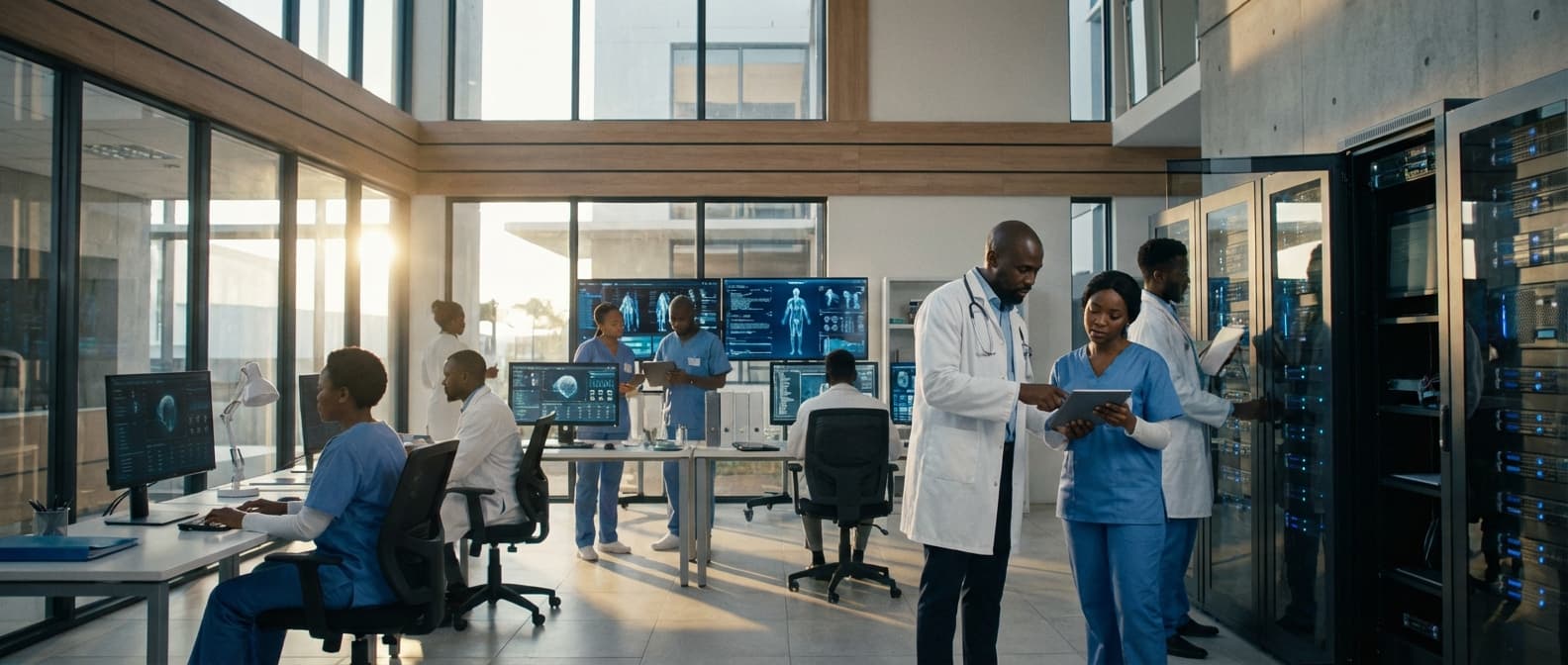
Medical IT Consultation in Ethiopia
Engineering Excellence & Technical Support
Strategic technology consulting to optimize healthcare operations, streamline workflows, and integrate cutting-edge medical information systems. High-standard technical execution following OEM protocols and local regulatory frameworks.
EHR Implementation & Interoperability
We specialize in deploying and customizing Electronic Health Record (EHR) systems tailored to the Ethiopian healthcare landscape. Our expertise ensures seamless data exchange between public and private facilities, enabling a unified patient view and improved health outcomes through adherence to national interoperability standards.
Cybersecurity & Data Protection
Protecting sensitive patient data is paramount. We implement robust cybersecurity frameworks, including data encryption, access controls, and regular vulnerability assessments, to safeguard against breaches and ensure compliance with Ethiopian data privacy regulations, fostering trust and operational resilience.
Telemedicine & Remote Patient Monitoring Solutions
Bridging geographical gaps, we design and deploy scalable telemedicine platforms, connecting remote communities with specialist care and enabling continuous remote patient monitoring. This enhances accessibility, reduces healthcare costs, and empowers patients with timely interventions across Ethiopia.
What Is Medical It Consultation In Ethiopia?
Medical IT Consultation in Ethiopia refers to the specialized advisory services provided to healthcare organizations and professionals within Ethiopia, focusing on the strategic planning, implementation, optimization, and management of information technology systems and solutions within their clinical and administrative operations. This service bridges the gap between evolving healthcare needs and available technological capabilities, ensuring that IT investments yield tangible improvements in patient care, operational efficiency, data security, and regulatory compliance within the Ethiopian context. It encompasses a broad spectrum of technical expertise, from foundational infrastructure assessment to advanced digital health solutions like Electronic Health Records (EHRs), Picture Archiving and Communication Systems (PACS), telemedicine platforms, and data analytics.
| Who Needs Medical IT Consultation | Typical Use Cases |
|---|---|
| Public Hospitals and Clinics: | Implementing EHR systems to improve patient record management, reduce medical errors, and enable data-driven decision-making. Upgrading network infrastructure to support telemedicine for remote consultations in rural areas. Developing data security protocols to comply with national health information standards. |
| Private Healthcare Providers (Hospitals, Clinics, Diagnostic Centers): | Selecting and implementing specialized software for practice management, billing, and inventory. Integrating diagnostic imaging systems (PACS) for faster radiologist review. Enhancing cybersecurity to protect sensitive patient data and maintain patient trust. |
| Non-Governmental Organizations (NGOs) and Humanitarian Health Initiatives: | Deploying mobile health (mHealth) solutions for disease surveillance and data collection in remote or disaster-affected regions. Establishing secure data sharing mechanisms for inter-organizational collaboration. Implementing cost-effective IT solutions for resource-constrained settings. |
| Medical Training and Research Institutions: | Setting up robust IT infrastructure to support advanced research, data analysis, and digital learning platforms. Implementing simulation software and virtual reality for medical education. Ensuring secure access to research databases. |
| Government Ministry of Health and Regional Health Bureaus: | Developing national health information system strategies. Advising on the procurement and deployment of IT for public health programs. Establishing data standards and interoperability frameworks across the national healthcare system. Enhancing national cybersecurity posture for health data. |
| Start-ups and Emerging Healthcare Technology Companies: | Consulting on the technical architecture and scalability of new digital health platforms. Advising on regulatory compliance and data privacy for innovative health solutions. Assisting in pilot program design and implementation. |
Key Components of Medical IT Consultation in Ethiopia
- Needs Assessment and Gap Analysis: Evaluating existing IT infrastructure, workflows, and identifying areas for technological enhancement to meet current and future healthcare demands.
- Strategic IT Planning and Roadmapping: Developing long-term IT strategies aligned with the healthcare facility's mission, vision, and financial constraints, including technology adoption timelines and budget allocation.
- System Selection and Procurement: Assisting in the evaluation, selection, and acquisition of appropriate IT hardware, software, and network solutions, considering vendor viability and compatibility.
- Implementation and Integration: Overseeing the deployment, configuration, and seamless integration of new IT systems with existing infrastructure and workflows, minimizing disruption.
- EHR/EMR Implementation and Optimization: Guiding the adoption, customization, and continuous improvement of Electronic Health Records (EHR) or Electronic Medical Records (EMR) systems for enhanced patient data management and clinical decision support.
- Data Security and Privacy: Ensuring compliance with national and international data protection regulations (e.g., patient confidentiality laws), implementing robust cybersecurity measures, and developing disaster recovery plans.
- Telemedicine and Remote Healthcare Solutions: Advising on the deployment and utilization of technologies that facilitate remote patient consultations, monitoring, and specialist access, crucial for expanding healthcare reach in underserved areas.
- PACS and Digital Imaging Integration: Facilitating the adoption and integration of systems for managing medical images, improving diagnostic workflows and accessibility.
- IT Infrastructure Modernization: Recommending and guiding the upgrade of networks, servers, storage, and other foundational IT components to support advanced medical applications.
- Training and Change Management: Developing and delivering comprehensive training programs for healthcare staff to ensure effective adoption and utilization of new technologies, coupled with strategies to manage organizational change.
- Regulatory Compliance: Ensuring IT systems and practices adhere to relevant Ethiopian healthcare regulations, licensing requirements, and international standards (e.g., HIPAA where applicable for international partnerships).
- IT Governance and Policy Development: Establishing clear IT policies, procedures, and governance frameworks for efficient and secure IT operations.
- Performance Monitoring and Optimization: Continuously assessing the performance of IT systems and recommending adjustments for optimal efficiency, reliability, and cost-effectiveness.
- Budgeting and Cost Management: Assisting in developing and managing IT budgets, identifying cost-saving opportunities, and ensuring a strong return on IT investments.
Who Needs Medical It Consultation In Ethiopia?
Medical IT consultation is crucial for healthcare organizations in Ethiopia looking to enhance efficiency, improve patient care, and navigate the complexities of modern healthcare technology. From optimizing electronic health record (EHR) systems to ensuring data security and compliance, expert IT guidance can transform operations and drive better health outcomes.
| Target Customer | Key Departments/Areas Benefiting from Consultation |
|---|---|
| Hospitals (Public & Private) | Information Technology (IT) Department, Clinical Departments (e.g., Cardiology, Oncology, Pediatrics), Administration, Finance, Pharmacy, Radiology, Laboratory, Patient Records Management, Quality Assurance. |
| Clinics & Health Centers | Front Desk/Reception, Nursing Station, Physician's Office, Pharmacy, Administration, Data Management. |
| Diagnostic Laboratories | Laboratory Information System (LIS) Management, Quality Control, Data Analysis, IT Support, Administration. |
| Pharmacies | Pharmacy Management Software, Inventory Control, Point of Sale (POS) Systems, Data Security, Patient Record Integration. |
| Medical Research Institutions | Data Management, Research Information Systems, Cybersecurity for sensitive data, IT Infrastructure, Collaboration Tools. |
| Government Health Ministries & Agencies | Health Information Systems (HIS), National E-health Strategy Implementation, Data Standardization, Public Health Surveillance Systems, IT Policy and Governance, Cybersecurity. |
| NGOs in the Health Sector | Program Management IT Support, Data Collection and Reporting Systems, Mobile Health (mHealth) initiatives, Communication Infrastructure, Grant Management Software. |
Who Needs Medical IT Consultation in Ethiopia?
- Hospitals (public and private)
- Clinics and Health Centers
- Diagnostic Laboratories
- Pharmacies
- Medical Research Institutions
- Government Health Ministries and Agencies
- Non-Governmental Organizations (NGOs) in the health sector
Medical It Consultation Process In Ethiopia
The Medical IT consultation process in Ethiopia, from initial inquiry to project execution, is a structured approach designed to ensure effective implementation of technology solutions within the healthcare sector. This workflow typically involves several key stages, each with specific activities and deliverables. The process is often driven by a need to improve patient care, streamline administrative tasks, enhance data management, and leverage technological advancements for better healthcare outcomes. Understanding this workflow is crucial for healthcare providers, IT vendors, and government bodies involved in medical IT projects in Ethiopia.
| Stage | Key Activities | Deliverables/Outcomes | Key Stakeholders |
|---|---|---|---|
| Inquiry and Initial Contact | Healthcare facility or organization expresses interest in IT solutions. Initial discussions about potential needs and services. | Understanding of the client's general interest. Preliminary identification of potential IT areas. | Healthcare Facility/Organization, Potential IT Vendor/Consultant |
| Needs Assessment and Scoping | Detailed analysis of current IT infrastructure, workflows, and specific challenges. Identification of functional and technical requirements. Defining the scope of the project. | Needs Assessment Report, Project Scope Document, Technical Requirements. | Healthcare Facility/Organization, IT Consultant/Vendor Team |
| Proposal Development and Presentation | Developing a comprehensive proposal outlining recommended IT solutions, project plan, timeline, budget, and expected ROI. Presenting the proposal to the client. | Detailed Project Proposal, Solution Architecture, Cost Estimate, Implementation Roadmap. | IT Consultant/Vendor Team, Healthcare Facility/Organization Decision Makers |
| Contract Negotiation and Agreement | Reviewing and negotiating terms and conditions of the contract, including scope, deliverables, payment terms, and service level agreements (SLAs). | Signed Contract/Service Agreement. | IT Consultant/Vendor Team, Healthcare Facility/Organization Legal/Procurement |
| Project Planning and Design | Developing a detailed project plan, including resource allocation, risk management strategies, communication protocols, and detailed system design. | Project Management Plan, System Design Document, Technical Specifications. | Project Manager, IT Consultants, Healthcare Facility IT Staff |
| System Implementation and Configuration | Installing hardware, software, and network infrastructure. Configuring systems according to the design specifications and client requirements. | Installed and configured IT systems (e.g., EHR, PACS, LIS). | IT Implementation Team, System Administrators, Vendor Technical Staff |
| Training and Capacity Building | Providing comprehensive training to end-users and IT staff on the new systems and workflows. Focus on user adoption and proficiency. | Trained Staff, User Manuals, Training Materials. | Training Specialists, End-Users, IT Staff, Healthcare Facility Management |
| Testing and Quality Assurance | Conducting thorough testing of all implemented systems to ensure functionality, reliability, and security. Addressing any bugs or issues identified. | Test Reports, Quality Assurance Sign-off. | QA Team, IT Implementation Team, End-Users (for User Acceptance Testing) |
| Deployment and Go-Live | Officially launching the new IT systems into the live healthcare environment. Providing on-site support during the initial phase. | Operational IT Systems, Successful Transition. | Project Team, IT Support Staff, Healthcare Facility Staff |
| Post-Implementation Support and Maintenance | Providing ongoing technical support, troubleshooting, and system maintenance. Addressing user queries and resolving technical issues. | Resolved Support Tickets, System Uptime, Maintenance Logs. | IT Support Team, Vendor Support, Healthcare Facility IT Staff |
| Evaluation and Optimization | Periodically reviewing the performance of the IT systems against initial objectives. Identifying areas for improvement and implementing optimizations. | Performance Evaluation Reports, Optimization Recommendations, Updated System Configurations. | Project Team, Healthcare Facility Management, IT Staff |
Medical IT Consultation Workflow in Ethiopia
- Inquiry and Initial Contact
- Needs Assessment and Scoping
- Proposal Development and Presentation
- Contract Negotiation and Agreement
- Project Planning and Design
- System Implementation and Configuration
- Training and Capacity Building
- Testing and Quality Assurance
- Deployment and Go-Live
- Post-Implementation Support and Maintenance
- Evaluation and Optimization
Medical It Consultation Cost In Ethiopia
Understanding the cost of Medical IT consultation in Ethiopia involves examining various influencing factors. These can range from the complexity of the IT needs and the expertise of the consultant to the scope of the project and the duration of engagement. Ethiopian Birr (ETB) is the local currency, and pricing structures can vary significantly. Factors include the consultant's experience level (junior, senior, specialist), the specific services required (e.g., EMR/EHR implementation, network infrastructure, cybersecurity assessment, software development, data management, hardware procurement advice), and the size and type of healthcare facility (small clinic, hospital, chain of facilities). Travel and accommodation expenses, if applicable, will also contribute to the overall cost. Consulting firms or individual freelance consultants will often have different pricing models, with firms potentially charging higher rates due to overheads but offering more comprehensive support. Short-term, advisory-focused consultations might be priced per hour or per day, while larger, project-based engagements will typically involve a fixed project fee or a phased payment structure.
| Service Type / Experience Level | Estimated Range (ETB per hour) | Estimated Range (ETB per day) | Notes |
|---|---|---|---|
| Junior/Entry-Level Consultant (Basic advice, general IT support) | 150 - 400 ETB | 1,000 - 2,500 ETB | Suitable for very small clinics or initial assessments. |
| Mid-Level Consultant (Standard EMR/EHR setup, network design, general project management) | 400 - 800 ETB | 2,500 - 5,000 ETB | Common for medium-sized clinics and hospitals needing more tailored solutions. |
| Senior/Specialist Consultant (Complex EMR/EHR implementation, cybersecurity audits, strategic IT planning, custom software development) | 800 - 1,500+ ETB | 5,000 - 10,000+ ETB | For large hospitals, complex integrations, or specialized cybersecurity needs. |
| Project-Based Consultation (e.g., full EMR/EHR implementation) | N/A | N/A | Typically a fixed fee ranging from 50,000 ETB to several hundred thousand ETB depending on scale and complexity. |
| On-site vs. Remote Consultation | On-site may incur additional travel/accommodation charges. | On-site may incur additional travel/accommodation charges. | Remote consultations are generally more cost-effective. |
Key Pricing Factors for Medical IT Consultation in Ethiopia:
- Consultant's Experience and Expertise Level
- Scope and Complexity of IT Needs (e.g., EMR/EHR, Network, Cybersecurity)
- Size and Type of Healthcare Facility
- Duration and Nature of Engagement (e.g., hourly, daily, project-based)
- Travel and Accommodation Expenses (if applicable)
- Reputation and Overhead of Consulting Firm vs. Freelancer
- Specific Software/Hardware Recommendations and Implementation Support
Affordable Medical It Consultation Options
Navigating the complexities of Medical IT can be daunting for practices seeking cost-effective solutions. This guide explores affordable medical IT consultation options, focusing on the value of "value bundles" and actionable cost-saving strategies. Value bundles are designed to provide comprehensive services at a more predictable and often lower overall cost than procuring individual services. They streamline IT management, enhance security, and improve operational efficiency, all while keeping budget constraints in mind. By understanding these offerings and employing smart strategies, healthcare providers can leverage expert IT guidance without breaking the bank.
| Strategy | Description | Benefit | Typical Cost Impact |
|---|---|---|---|
| Value Bundles | Pre-packaged IT services covering a range of needs (e.g., security, support, cloud management) offered at a fixed monthly or annual fee. | Predictable budgeting, comprehensive coverage, potential for discounted pricing compared to à la carte services. | Often 10-25% cost savings when compared to individual service procurement. |
| Managed Services Provider (MSP) Retainer | Engaging an MSP for ongoing IT management and support on a retainer basis. | Proactive monitoring, reduced downtime, access to expert IT staff without the overhead of in-house hires. | Can range from a few hundred to several thousand dollars per month depending on practice size and services. |
| Project-Based Consultations | Hiring consultants for specific, defined IT projects (e.g., EHR implementation, network upgrade). | Focused expertise for critical initiatives, often more cost-effective for one-time needs. | Cost varies significantly based on project scope and duration. |
| Cloud-Based Solutions | Utilizing cloud services for EHRs, data storage, and applications. | Reduced upfront hardware costs, scalability, enhanced accessibility, and often lower maintenance expenses. | Subscription-based pricing, significantly lower than on-premises infrastructure for many practices. |
| Open-Source Software Exploration | Considering open-source alternatives for certain IT functions where feasible and secure. | Reduced licensing fees, though may require more in-house technical expertise for implementation and support. | Minimal to no licensing costs, but potential for higher support and customization costs. |
| Bulk Purchasing & Vendor Negotiation | Leveraging buying power for hardware and software licenses, and negotiating favorable terms with vendors. | Direct cost reductions on essential IT assets and services. | Can result in 5-15% savings on hardware and software procurement. |
| Remote Support & Automation | Prioritizing remote IT support and implementing automation for routine tasks. | Faster issue resolution, reduced need for on-site visits, and increased IT team efficiency. | Lower service call costs and improved IT resource utilization. |
Key Components of Affordable Medical IT Consultation
- Needs Assessment: Identifying current IT infrastructure, pain points, and future goals.
- Technology Recommendations: Suggesting appropriate hardware, software, and cloud solutions tailored to practice size and specialty.
- Cybersecurity Planning: Developing robust security protocols to protect patient data (HIPAA compliance).
- System Integration: Ensuring seamless communication between electronic health records (EHRs), billing systems, and other medical software.
- Ongoing Support & Maintenance: Providing remote or on-site technical assistance and proactive system upkeep.
- Cloud Migration Strategies: Facilitating a secure and efficient transition to cloud-based services.
- Data Backup & Disaster Recovery: Implementing plans to safeguard critical practice information.
Verified Providers In Ethiopia
In Ethiopia, ensuring access to quality healthcare is paramount. The landscape of healthcare providers is diverse, and identifying trusted, credentialed institutions is crucial for individuals and organizations seeking reliable medical services. This document explores the concept of 'Verified Providers' in Ethiopia and specifically highlights Franance Health as a leading example, detailing their credentials and the compelling reasons why they represent the best choice for healthcare needs.
| Category | Verification Aspect | Franance Health's Compliance/Strength |
|---|---|---|
| Regulatory Compliance | Ministry of Health License & Permits | Fully licensed and compliant with all Ministry of Health regulations, ensuring legal and ethical operation. |
| Professional Expertise | Medical Staff Qualifications | Employs board-certified physicians and licensed healthcare professionals with extensive experience in various specialties. |
| Infrastructure | Diagnostic & Treatment Equipment | Utilizes advanced medical equipment for accurate diagnosis and effective treatment, meeting international standards. |
| Service Quality | Patient Care Standards | Adheres to high patient care standards, focusing on safety, efficacy, and compassionate service delivery. |
| Reputation | Community Trust & Feedback | Enjoys a strong reputation within the Ethiopian community, evidenced by positive patient feedback and successful treatment outcomes. |
| Specialization | Range of Medical Services | Offers a comprehensive range of services, from general medicine to specialized fields, making it a one-stop healthcare solution. |
Key Credentials and Strengths of Franance Health:
- Official Registration and Licensing: Franance Health operates with full authorization from the Ethiopian Ministry of Health and relevant regulatory bodies, demonstrating adherence to national healthcare standards.
- Qualified Medical Professionals: The facility boasts a team of highly skilled and licensed doctors, nurses, specialists, and support staff, many with international training and experience.
- State-of-the-Art Facilities and Equipment: Franance Health is equipped with modern medical technology and infrastructure, enabling accurate diagnoses and effective treatment protocols.
- Accreditation and Certifications: While specific external accreditations can vary, Franance Health consistently meets and often exceeds the stringent requirements set forth by Ethiopian health authorities.
- Patient-Centric Approach: A strong emphasis on patient well-being, ethical practices, and transparent communication is a hallmark of their service delivery.
- Comprehensive Service Offering: Franance Health provides a wide spectrum of medical services, from primary care to specialized treatments, catering to diverse healthcare needs.
- Commitment to Continuous Improvement: The organization actively engages in ongoing professional development for its staff and invests in upgrading its facilities and services.
- Positive Patient Testimonials and Outcomes: A track record of successful treatments and positive feedback from patients underscores their reliability and effectiveness.
Scope Of Work For Medical It Consultation
This Scope of Work (SOW) outlines the services to be provided by [Consulting Firm Name] (the "Consultant") to [Client Organization Name] (the "Client") for medical IT consultation. The engagement aims to assess, recommend, and implement improvements to the Client's existing medical IT infrastructure and systems to enhance operational efficiency, data security, compliance, and patient care. This document details the technical deliverables, standard specifications, and associated timelines.
| Phase | Key Activities | Deliverables | Standard Specifications | Estimated Timeline |
|---|---|---|---|---|
| Phase 1: Assessment & Discovery | Site visits, interviews with stakeholders, review of existing documentation, analysis of network topology, system audits, security vulnerability assessment. | Current State Assessment Report (including infrastructure inventory, SWOT analysis, risk assessment), Gap Analysis Report, Preliminary Recommendations. | HIPAA Security Rule requirements, NIST Cybersecurity Framework, industry best practices for healthcare IT, ISO 27001 principles. | 2-4 Weeks |
| Phase 2: Strategy & Planning | Development of IT strategy, vendor research and evaluation, solution design, budget estimation, risk mitigation plan, change management strategy. | IT Strategic Roadmap, Vendor Evaluation Matrix, High-Level Solution Design Document, Budget Proposal, Implementation Plan. | Scalability, interoperability standards (HL7, FHIR), cloud computing best practices, data encryption standards (AES-256), authentication protocols (OAuth 2.0). | 3-6 Weeks |
| Phase 3: Implementation & Deployment | System installation and configuration, data migration, network upgrades, security enhancements, integration of systems, pilot testing, user acceptance testing (UAT). | Implemented and configured systems, migrated data sets, deployed security measures, integration documentation, UAT reports, Go-Live readiness assessment. | System performance benchmarks, data integrity checks, network latency standards, cybersecurity threat detection capabilities, user training materials. | 4-12 Weeks (depending on project complexity) |
| Phase 4: Post-Implementation & Optimization | System monitoring, performance tuning, user support, ongoing training, documentation updates, post-implementation review, continuous improvement planning. | Post-Implementation Review Report, Optimized system performance metrics, User support documentation, Training session records, Updated IT policies and procedures. | Service Level Agreements (SLAs) for system uptime, data backup and recovery frequency, incident response times, ongoing security patching schedules. | Ongoing (defined duration, e.g., 3 months post-go-live) |
Project Objectives
- Conduct a comprehensive assessment of the Client's current medical IT infrastructure, including hardware, software, networks, and security protocols.
- Identify areas for improvement in system performance, data management, interoperability, and user experience.
- Develop a strategic roadmap for IT modernization, including recommendations for new technologies and system upgrades.
- Ensure compliance with relevant healthcare regulations (e.g., HIPAA, HITECH).
- Enhance data security and privacy measures to protect sensitive patient information.
- Improve integration and data sharing between different medical systems (e.g., EMR/EHR, PACS, LIS).
- Provide recommendations for disaster recovery and business continuity planning.
- Offer training and support to Client IT staff and end-users on new systems and best practices.
Service Level Agreement For Medical It Consultation
This Service Level Agreement (SLA) outlines the standards for IT consultation services provided to medical organizations, focusing on response times for support requests and uptime guarantees for critical IT systems. The aim is to ensure minimal disruption to patient care and operational efficiency.
| Service Category | Response Time Target | Resolution Target | Uptime Guarantee |
|---|---|---|---|
| Critical Incident (e.g., EMR downtime, network outage affecting patient care) | 15 minutes acknowledgement, 1 hour initial response | 4 hours resolution | 99.9% (Monthly) |
| High Priority Incident (e.g., PACS access issue, significant application slowness) | 30 minutes acknowledgement, 2 hours initial response | 8 business hours resolution | 99.5% (Monthly) |
| Medium Priority Incident (e.g., printer malfunction, minor software bug) | 2 business hours acknowledgement, 4 business hours initial response | 2 business days resolution | 99.0% (Monthly) |
| Low Priority Incident (e.g., general IT query, user training request) | 4 business hours acknowledgement, 1 business day initial response | 3 business days resolution | 98.0% (Monthly) |
| Scheduled Maintenance and Upgrades | Advance notification (minimum 7 days) | As per agreed schedule | Maintenance windows are excluded from uptime calculations |
Key Service Objectives
- To provide prompt and effective IT consultation to address medical organization's technology needs.
- To guarantee a high level of availability for all critical IT infrastructure and services.
- To establish clear expectations and metrics for service delivery.
- To ensure timely resolution of technical issues impacting patient care and operations.
Frequently Asked Questions

Ready when you are
Let's scope your Medical IT Consultation in Ethiopia project in Ethiopia.

Scaling healthcare logistics and technical systems across the entire continent.