
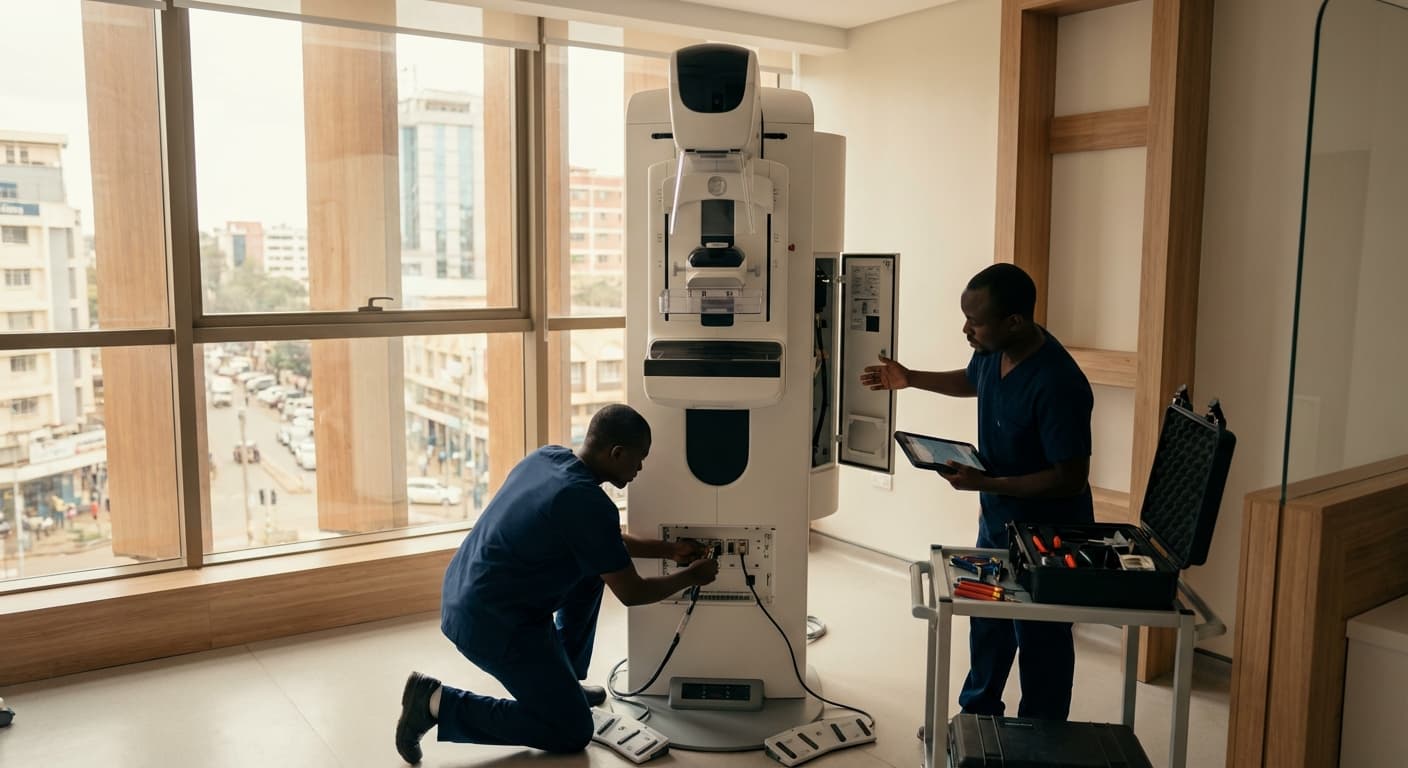
Mammography Installation Service in Ethiopia
Engineering Excellence & Technical Support
Mammography Installation Service High-standard technical execution following OEM protocols and local regulatory frameworks.
Precision Imaging Calibration
Our expert technicians meticulously calibrate every mammography unit to ensure optimal image quality and diagnostic accuracy, adhering to international standards for early breast cancer detection in Ethiopia.
Robust Data Integration & PACS Setup
We provide seamless integration with existing Picture Archiving and Communication Systems (PACS) and Electronic Health Records (EHR), ensuring secure, efficient data management and remote access for healthcare providers across Ethiopia.
Radiation Safety & Compliance
Our installation services prioritize patient and staff safety, guaranteeing full compliance with Ethiopian radiation safety regulations and best practices for all mammography equipment.
What Is Mammography Installation Service In Ethiopia?
Mammography Installation Service in Ethiopia refers to the comprehensive process of setting up, calibrating, and commissioning mammography equipment within healthcare facilities across Ethiopia. This service is critical for enabling accurate and reliable breast cancer screening and diagnostic imaging. It encompasses the physical installation of the mammography unit, integration with existing IT infrastructure (e.g., PACS, RIS), quality assurance testing, and initial staff training to ensure optimal performance and adherence to international standards.
| Who Needs Mammography Installation Service? | Typical Use Cases in Ethiopia | |||||||
|---|---|---|---|---|---|---|---|---|
| Hospitals (public and private) | Breast cancer screening programs targeting high-risk populations | Radiology clinics and diagnostic centers | Early detection of breast abnormalities in symptomatic patients | Government health initiatives and public health projects focused on women's health | Diagnostic workup for palpable breast masses or suspicious imaging findings | Research institutions and academic medical centers requiring advanced imaging capabilities | Follow-up imaging for patients with a history of breast cancer or benign findings | Facilities aiming to comply with national and international diagnostic imaging standards |
Key Components of Mammography Installation Service:
- Site assessment and preparation (electrical, structural, environmental)
- Physical placement and connection of mammography equipment
- Integration with Picture Archiving and Communication Systems (PACS) and Radiology Information Systems (RIS)
- Calibration and alignment of the X-ray tube, detectors, and compression paddle
- Performance testing and quality assurance (QA) checks according to regulatory guidelines (e.g., ACR, IAEA)
- Radiation safety surveys and compliance verification
- Initial operator training and competency assessment
- Post-installation support and documentation
Who Needs Mammography Installation Service In Ethiopia?
Mammography installation is a critical service for healthcare facilities in Ethiopia aiming to enhance their diagnostic capabilities, particularly in the early detection of breast cancer. This service involves the expert setup, calibration, and integration of mammography machines into existing hospital or clinic infrastructure. Proper installation ensures the equipment functions optimally, providing accurate imaging results essential for patient care and treatment planning. The demand for such services is growing as Ethiopia increasingly prioritizes advanced medical technologies for its population's health.
| Target Customer Type | Relevant Departments | Key Needs & Responsibilities |
|---|---|---|
| Public Hospitals | Radiology Department, Oncology Department, Diagnostic Imaging Unit, Biomedical Engineering Department | Ensuring accessibility to advanced diagnostic tools, upgrading existing facilities, training radiology technicians and radiologists, integrating with hospital information systems (HIS). |
| Private Hospitals | Radiology Department, Diagnostic Imaging Unit, Administration/Procurement, Clinical Services Management | Enhancing service offerings, attracting more patients, maintaining a competitive edge, ensuring high-quality patient care, efficient operational setup. |
| Specialty Clinics | Radiology Department, Breast Imaging Unit, Oncology Services, Clinical Management | Providing specialized screening and diagnostic services, focusing on early detection and management of breast cancer, requiring precise and reliable equipment. |
| NGOs/International Aid Organizations | Healthcare Program Management, Procurement & Logistics, Technical Support Teams | Establishing or upgrading diagnostic capabilities in underserved areas, implementing public health initiatives, ensuring sustainability of medical equipment through proper installation and maintenance. |
Target Customers for Mammography Installation Service in Ethiopia
- Public Hospitals (Federal, Regional, and Zonal)
- Private Hospitals
- Specialty Clinics (e.g., Women's Health Centers, Cancer Treatment Centers)
- Non-Governmental Organizations (NGOs) with healthcare programs
- International Aid Organizations involved in healthcare infrastructure development
Mammography Installation Service Process In Ethiopia
This document outlines the comprehensive workflow for mammography installation services in Ethiopia, guiding a client from their initial inquiry to the successful execution of the installation. The process is designed to ensure clarity, efficiency, and compliance with all relevant standards.
| Stage | Description | Key Activities | Responsible Parties | Timeline (Estimated) |
|---|---|---|---|---|
| The client expresses interest in mammography installation services. | Initial contact, understanding client's needs, budget, and desired equipment. Discussing service scope and general timelines. | Client, Service Provider (Sales/Technical Representative) | 1-3 Business Days |
| A thorough evaluation of the installation site is conducted. | On-site visit to assess space, power supply, ventilation, network connectivity, structural requirements, and any specific site constraints. Detailed discussion of technical specifications and regulatory compliance. | Service Provider (Technical Engineer/Site Assessor), Client (Facility Manager/Radiology Department Head) | 3-7 Business Days |
| A detailed proposal outlining the scope of work, equipment, timeline, and cost is prepared. | Compiling site assessment findings, selecting appropriate mammography equipment (if applicable), detailing installation steps, identifying required materials, providing a cost breakdown and estimated project timeline. | Service Provider (Sales/Project Manager) | 3-5 Business Days |
| Formalizing the service agreement between the client and the service provider. | Reviewing the proposal, negotiating terms and conditions, finalizing pricing, payment schedule, warranty, and service level agreements. Signing of the contract. | Client, Service Provider | 3-10 Business Days |
| Acquiring necessary equipment, parts, and materials. | Ordering the mammography unit, accessories, consumables, tools, and any site preparation materials. Arranging for shipping and customs clearance (if applicable). | Service Provider (Procurement/Logistics Department), Client (for any site-specific materials) | 2-8 Weeks (dependent on equipment lead times) |
| Preparing the site for the installation. | Ensuring the designated installation area meets all specified requirements (e.g., electrical work, shielding, ventilation). Confirming availability of necessary infrastructure. | Client (Facility Management), Service Provider (Project Manager) | 1-2 Weeks (can overlap with procurement) |
| The physical installation of the mammography unit. | Unpacking, positioning, and connecting the mammography equipment. Installing all associated hardware and software. Performing initial configuration. | Service Provider (Installation Engineers/Technicians) | 2-5 Business Days |
| Ensuring the mammography unit functions correctly and meets performance standards. | Performing comprehensive functional tests, image quality assessments, radiation safety checks, and calibration against established benchmarks. Verifying adherence to medical imaging standards. | Service Provider (Application Specialist/Field Service Engineer) | 1-3 Business Days |
| Educating the client's staff on the operation and basic maintenance of the unit. | Providing hands-on training for radiographers and technicians on equipment operation, quality control procedures, and basic troubleshooting. Handing over user manuals and relevant documentation. | Service Provider (Application Specialist/Trainer), Client (Radiographers, Technicians) | 1-2 Business Days |
| Completing all necessary paperwork and official handover. | Submitting installation reports, test results, calibration certificates, and warranty information. Obtaining client sign-off on the completed installation. | Service Provider (Project Manager), Client | 1-2 Business Days |
| Providing ongoing support and maintenance services. | Offering warranty support, routine maintenance services, troubleshooting assistance, and access to spare parts. Establishing a service agreement for long-term upkeep. | Service Provider (Customer Support/Field Service Department) | Ongoing |
Mammography Installation Service Workflow in Ethiopia
- Inquiry & Initial Consultation
- Site Assessment & Requirements Gathering
- Proposal Development & Quotation
- Contract Negotiation & Agreement
- Logistics & Procurement
- Pre-installation Preparation
- On-site Installation & Setup
- Testing & Calibration
- Training & Handover
- Documentation & Finalization
- Post-installation Support & Maintenance
Mammography Installation Service Cost In Ethiopia
Installing mammography equipment in Ethiopia involves several cost components, and the final price can vary significantly based on a range of factors. These factors include the type and model of the mammography machine, the chosen vendor, the complexity of the installation site, necessary structural modifications, and the inclusion of additional services like training and maintenance contracts. Understanding these elements is crucial for accurate budgeting and procurement by healthcare facilities in Ethiopia.
| Cost Component | Estimated Range (ETB) | Notes |
|---|---|---|
| Mammography Machine (Digital/FFDM) | 10,000,000 - 50,000,000+ | Varies by brand, features (e.g., tomosynthesis), and new vs. refurbished. |
| Installation & Commissioning Labor | 500,000 - 3,000,000 | Includes technical setup, calibration, and vendor fees. |
| Site Preparation & Structural Modifications (Lead Shielding, Electrical) | 1,000,000 - 7,000,000+ | Highly dependent on existing facility conditions and required upgrades. |
| Training (Radiographers, Radiologists, Technicians) | 500,000 - 2,000,000 | Includes instructor fees, materials, and potential travel. |
| Ancillary Equipment (PACS Viewer, Workstation) | 1,000,000 - 5,000,000 | Cost of hardware, software licenses, and integration. |
| Logistics & Transportation | 200,000 - 1,500,000 | Depends on origin of equipment and destination within Ethiopia. |
| Import Duties & Taxes (VAT, etc.) | 20% - 40% of CIF value | Can significantly increase the landed cost of the equipment. |
| Initial Service & Maintenance Contract (1-2 years) | 1,000,000 - 5,000,000+ | Often bundled or negotiated at installation; crucial for ongoing support. |
Key Pricing Factors for Mammography Installation in Ethiopia:
- Type and Model of Mammography Machine: Digital mammography machines (FFDM) are generally more expensive than analog systems. Advanced features like 3D mammography (tomosynthesis) will also command a higher price. Brand reputation and technological sophistication play a significant role.
- Vendor and Supplier: Different authorized distributors and suppliers will have varying pricing structures. Direct import versus purchasing through local agents can also impact the cost. Negotiation with vendors is a common practice.
- Installation Site Requirements: The physical space designated for the mammography unit needs to meet specific radiation shielding and environmental requirements. If existing infrastructure is insufficient, significant modifications (e.g., lead lining of walls, specialized flooring, ventilation upgrades) will add to the cost.
- Ancillary Equipment and Software: The installation cost may include necessary accessories such as a PACS (Picture Archiving and Communication System) viewer, workstation, ultrasound machines (if bundled), and image processing software. The licensing fees for these can be substantial.
- Training and Commissioning: Comprehensive training for radiographers, radiologists, and technicians is essential. The cost of this training, often provided by the vendor's specialists, is a significant part of the installation package. Commissioning and quality assurance testing also add to the expense.
- Logistics and Transportation: The cost of shipping the mammography machine and its components to the installation site within Ethiopia, especially if it's in a remote area, will contribute to the overall price.
- After-Sales Service and Maintenance Contracts: While not strictly an installation cost, the initial negotiation for a service and maintenance contract often begins during the installation phase. Long-term support is critical for equipment longevity and uptime.
- Import Duties and Taxes: As with most imported medical equipment, import duties, value-added tax (VAT), and other government levies in Ethiopia will significantly influence the final price.
- Site Preparation and Civil Works: This can include electrical upgrades, ensuring stable power supply, and any necessary structural reinforcements to support the weight and vibrations of the equipment.
- Project Management and Consultancy Fees: For larger installations or complex projects, engaging project managers or technical consultants can incur additional fees.
Affordable Mammography Installation Service Options
Securing affordable mammography installation services is crucial for healthcare facilities aiming to provide essential diagnostic imaging without exceeding budget constraints. This involves understanding various service models and implementing smart financial strategies. Value bundles, a common approach, package installation with related services for enhanced cost-effectiveness and streamlined procurement. Cost-saving strategies extend beyond initial bundles to include careful planning, vendor negotiation, and exploring different equipment acquisition models.
| Cost-Saving Strategy | Description | Potential Impact |
|---|---|---|
| Early Planning & Site Assessment | Thoroughly assess the installation site to identify all necessary modifications (e.g., structural, electrical, shielding) well in advance. This prevents costly last-minute changes. | Reduces unexpected construction costs, minimizes project delays, and ensures a smooth installation process. |
| Negotiate with Multiple Vendors | Obtain quotes from several reputable mammography installation service providers. Leverage competitive bidding to negotiate better pricing and terms. | Can lead to significant reductions in installation fees and potentially better service level agreements. |
| Explore Refurbished Equipment Options | Consider purchasing certified, refurbished mammography units. These often come with warranties and can be significantly less expensive than new equipment, reducing the overall project cost. | Lowers the initial capital expenditure, making advanced technology more accessible. |
| Leasing vs. Purchasing Equipment | Evaluate leasing options for mammography equipment. While you won't own the asset, leasing can provide lower upfront costs and predictable monthly payments, often including maintenance. | Improves cash flow and reduces the burden of large capital outlays. |
| Bundling with Equipment Purchase | When purchasing new mammography equipment, inquire about installation services being bundled or offered at a reduced rate by the equipment manufacturer. | Can streamline the process and potentially offer cost savings through combined purchasing power. |
| Phased Installation | If budget is a major constraint, discuss with vendors the possibility of a phased installation, prioritizing essential components and deferring less critical aspects. | Allows for spreading costs over time and managing immediate needs. |
| Long-Term Service Agreements | Negotiate comprehensive, long-term service agreements that include preventive maintenance and prompt repair services. This can prevent costly downtime and emergency repairs. | Ensures equipment reliability and can be more cost-effective than reactive maintenance. |
| In-House Training vs. Vendor Training | Evaluate the cost-benefit of vendor-provided training versus training internal staff. For basic operations, internal training can be more economical in the long run. | Reduces recurring training expenses and builds internal expertise. |
Understanding Value Bundles
- {"title":"Definition","description":"Value bundles are pre-defined packages of services and/or equipment offered by a vendor at a discounted price compared to purchasing each component individually. For mammography installation, this typically includes the physical installation, calibration, testing, and often initial training."}
- {"title":"Components Often Included","description":"Common elements within a mammography installation bundle can encompass: site preparation assessment, equipment delivery and placement, electrical and network connectivity, system calibration and quality assurance testing, basic operator training, and documentation."}
- {"title":"Benefits","description":"Bundles simplify the procurement process, reduce administrative overhead, and offer predictable costs. They can also ensure seamless integration of services, as the vendor is responsible for coordinating all aspects of the installation."}
- {"title":"Types of Bundles","description":"Bundles can vary from basic installation packages to comprehensive solutions that might include extended warranty periods, remote monitoring services, or even integration with Picture Archiving and Communication Systems (PACS)."}
Verified Providers In Ethiopia
In the dynamic landscape of healthcare in Ethiopia, discerning the quality and reliability of service providers is paramount. Franance Health has emerged as a distinguished entity, consistently upholding rigorous standards and demonstrating a deep commitment to patient well-being. Their credentials are not merely markers of compliance but reflect a strategic and ethical approach to healthcare delivery, positioning them as a superior choice for individuals seeking dependable medical services in Ethiopia.
| Credential Type | Significance for Patients in Ethiopia | Franance Health's Commitment |
|---|---|---|
| Ministry of Health Accreditation | Ensures compliance with local regulations, patient safety, and service quality standards. | Franance Health consistently meets and exceeds these mandated requirements, guaranteeing a safe and effective healthcare experience. |
| International Health Partnerships | Provides access to global expertise, advanced treatment protocols, and quality assurance frameworks. | Through these collaborations, Franance Health integrates world-class medical knowledge and practices into their Ethiopian operations. |
| Technological Integration | Offers access to modern diagnostic tools and treatment modalities, leading to more accurate diagnoses and effective outcomes. | Franance Health invests in cutting-edge medical technology to ensure patients receive the most advanced care available. |
| Skilled and Continuously Trained Staff | Guarantees that patients are treated by experienced professionals who are up-to-date with the latest medical advancements. | A core value at Franance Health is ongoing training, empowering their medical team to provide expert and compassionate care. |
| Patient Feedback Mechanisms | Ensures that patient experiences are actively sought, analyzed, and used to improve services. | Franance Health prioritizes patient feedback, fostering an environment of trust and continuous improvement in their services. |
Key Credentials of Franance Health:
- Accreditation by the Ethiopian Ministry of Health: This signifies adherence to national healthcare regulations, safety protocols, and quality standards.
- Partnerships with Reputable International Health Organizations: Demonstrates alignment with global best practices in healthcare management and patient care.
- Certification in Advanced Medical Procedures and Technologies: Highlights their investment in state-of-the-art equipment and highly trained personnel.
- Commitment to Continuous Professional Development: Ensures their medical staff remain at the forefront of medical knowledge and techniques.
- Patient-Centric Service Delivery Model: Focuses on personalized care, transparent communication, and ensuring patient comfort and satisfaction.
- Robust Data Security and Privacy Measures: Upholds strict protocols for protecting sensitive patient information.
Scope Of Work For Mammography Installation Service
This Scope of Work (SOW) outlines the requirements for the installation of a new mammography system. It details the technical deliverables, standard specifications, and responsibilities of all parties involved to ensure a successful and compliant implementation. The service includes site preparation, system installation, calibration, testing, and training for hospital staff.
| Phase | Deliverables | Standard Specifications | Responsible Party |
|---|---|---|---|
| Site Assessment | Site survey report, room dimension verification, power/ventilation assessment | Compliance with manufacturer's site requirements, local building codes, and radiation safety regulations | Vendor Technical Team & Hospital Facilities |
| Physical Installation | Mounted mammography unit, workstation, and accessories | Adherence to manufacturer's installation manual, precise alignment, secure mounting | Vendor Technical Team |
| Electrical & Network | Functional power supply, data network connection | Appropriate voltage/amperage, stable network connectivity (DICOM compliant) | Vendor Technical Team & Hospital IT/Facilities |
| Software Installation | Operating system, mammography application software, QA software | Correct versions, proper configuration for clinical workflow | Vendor Technical Team |
| Calibration & QA | Calibrated system, passed QA tests, performance reports | Manufacturer's calibration protocols, accepted clinical performance metrics, adherence to regulatory standards (e.g., MQSA) | Vendor Technical Team |
| PACS/RIS Integration | Successful image transfer and patient data synchronization | DICOM 3.0 compliance, seamless workflow integration | Vendor Technical Team & Hospital IT/PACS Admin |
| Training | Competent staff (technologists, radiologists, IT), training materials | Comprehensive training on system operation, troubleshooting, QA procedures | Vendor Application Specialist & Hospital Staff |
| Documentation | Installation report, test results, user manuals, warranty information | Complete, accurate, and easily accessible documentation | Vendor Technical Team |
Key Stages of Mammography Installation Service
- Site Assessment and Preparation
- System Delivery and Unpacking
- Physical Installation
- Electrical and Network Connectivity
- Software Installation and Configuration
- Calibration and Quality Assurance Testing
- Integration with PACS/RIS
- Staff Training
- Documentation and Handover
- Post-Installation Support
Service Level Agreement For Mammography Installation Service
This Service Level Agreement (SLA) outlines the guaranteed response times and uptime for the Mammography Installation Service provided by [Your Company Name] (hereinafter referred to as "Provider") to [Client Name] (hereinafter referred to as "Client"). This SLA is incorporated by reference into the Master Service Agreement between the Provider and the Client.
| Service Level | Target Response Time | Uptime Guarantee |
|---|---|---|
| Initial Diagnosis (Critical Failure) | Within 2 Business Hours of notification | 99.5% |
| Initial Diagnosis (Non-Critical Failure) | Within 4 Business Hours of notification | 99.0% |
| On-site Service Commencement (Critical Failure) | Within 8 Business Hours of initial diagnosis | 99.5% |
| On-site Service Commencement (Non-Critical Failure) | Within 16 Business Hours of initial diagnosis | 99.0% |
Definitions
- Installation Service: The complete process of delivering, unpacking, assembling, connecting, testing, and verifying the functionality of a new mammography unit at the Client's designated site.
- Downtime: The period during which the installed mammography unit is unavailable for use due to a malfunction or failure requiring service intervention, and such unavailability is confirmed by the Provider.
- Critical Failure: A complete failure of the mammography unit preventing any image acquisition or diagnostic capability.
- Non-Critical Failure: A partial failure of the mammography unit that allows for some level of operation, but hinders full diagnostic capability or performance.
- Scheduled Maintenance: Planned downtime for routine servicing, calibration, or software updates, communicated to the Client in advance.
- Force Majeure: Events beyond the reasonable control of the Provider, including but not limited to acts of God, natural disasters, war, terrorism, civil unrest, labor disputes, or government actions.
- Business Hours: [Specify your standard business hours, e.g., Monday to Friday, 8:00 AM to 5:00 PM, excluding public holidays in [Specify Region]].
- Emergency Support: Support available outside of Business Hours for Critical Failures.
Frequently Asked Questions

Ready when you are
Let's scope your Mammography Installation Service in Ethiopia project in Ethiopia.

Scaling healthcare logistics and technical systems across the entire continent.