
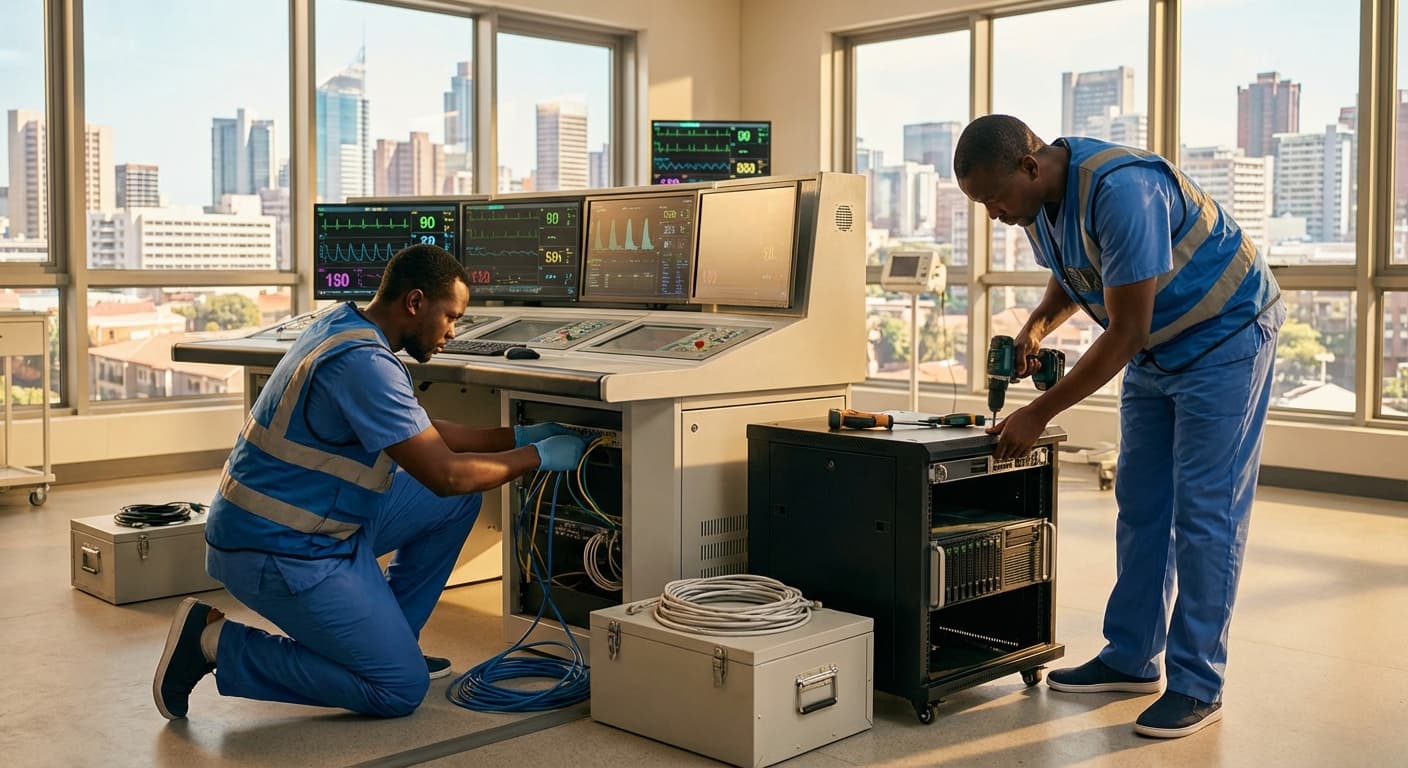
ICU Central Monitoring Station Installation Service in Ethiopia
Engineering Excellence & Technical Support
ICU Central Monitoring Station Installation Service High-standard technical execution following OEM protocols and local regulatory frameworks.
Centralized Patient Visibility & Early Intervention
Our expert installation service provides Ethiopian hospitals with a robust Central Monitoring Station, integrating real-time vital sign data from patient bedside monitors. This empowers clinicians with instant, comprehensive patient overview, enabling proactive identification of critical changes and timely interventions to improve patient outcomes.
Seamless Network Integration & Data Security
We specialize in the secure and reliable integration of your ICU's monitoring infrastructure. Our team ensures seamless network connectivity for all bedside monitors to the Central Monitoring Station, adhering to stringent data privacy and security protocols, guaranteeing the integrity and confidentiality of patient data in accordance with Ethiopian healthcare regulations.
Comprehensive Training & Ongoing Support
Beyond installation, we offer comprehensive, hands-on training for your ICU staff on operating and maximizing the benefits of the Central Monitoring Station. Our commitment extends to providing ongoing technical support and maintenance services, ensuring sustained optimal performance and reliability of your critical monitoring system in Ethiopia.
What Is Icu Central Monitoring Station Installation Service In Ethiopia?
ICU Central Monitoring Station Installation Service in Ethiopia refers to the comprehensive process of deploying, configuring, and integrating a centralized patient monitoring system within Intensive Care Units (ICUs) and potentially other critical care areas in Ethiopian healthcare facilities. This service ensures the seamless operation of a network of patient monitoring devices, allowing a limited number of clinicians to remotely observe and manage multiple critically ill patients from a single, dedicated station. The installation encompasses the physical setup of hardware, network infrastructure, software deployment and customization, system testing, and initial staff training. It is a critical infrastructure upgrade designed to enhance patient safety, improve clinical efficiency, and facilitate timely interventions in high-acuity settings.
| Service Aspect | Description | Target Beneficiaries |
|---|---|---|
| Remote Patient Surveillance | Enables continuous observation of vital signs (ECG, SpO2, BP, respiration, temperature, etc.) from a central location, reducing the need for constant bedside presence for routine checks. | ICU Nurses, Intensivists, Critical Care Physicians, Respiratory Therapists. |
| Alarm Management and Prioritization | Facilitates centralized management of patient alarms, allowing for prompt identification and response to critical events, and potentially reducing alarm fatigue through intelligent filtering. | Nursing Supervisors, Rapid Response Teams, Clinicians overseeing multiple patients. |
| Data Archiving and Retrieval | Provides a centralized repository for patient monitoring data, enabling historical trend analysis, performance evaluation, and research purposes. | Medical Records Department, Quality Improvement Teams, Researchers. |
| Enhanced Communication and Collaboration | Supports efficient communication between the central station and bedside teams, facilitating quick decision-making and interdisciplinary collaboration. | All members of the critical care team. |
| Resource Optimization | Allows for more efficient allocation of nursing staff by enabling one clinician to monitor multiple patients, particularly during periods of low patient acuity or staffing shortages. | Hospital Administrators, Nurse Managers. |
Key Components and Stages of ICU Central Monitoring Station Installation Service:
- Site Assessment and Planning: Evaluating existing infrastructure, network capabilities, power supply, and physical space requirements.
- Hardware Procurement and Installation: Sourcing and physically installing central monitoring workstations, servers, network switches, cabling, and potentially upgrading existing bedside monitors to be compatible.
- Network Integration: Establishing a secure and reliable network connection between bedside monitors and the central station, adhering to hospital IT policies and relevant cybersecurity standards.
- Software Deployment and Configuration: Installing and configuring the central monitoring software, including patient data management, alarm settings, trend analysis, and reporting functionalities.
- System Integration: Interfacing the central monitoring system with other hospital information systems (HIS), such as Electronic Health Records (EHRs) or Picture Archiving and Communication Systems (PACS), for comprehensive data access.
- Calibration and Testing: Rigorous testing of all components, ensuring accurate data acquisition, reliable alarm generation, and proper system functionality under various simulated scenarios.
- User Training: Providing comprehensive training to clinical staff (nurses, physicians, technicians) on the operation, data interpretation, and maintenance of the central monitoring system.
- Post-Installation Support and Maintenance: Offering ongoing technical support, software updates, and routine maintenance to ensure sustained system performance and longevity.
Who Needs Icu Central Monitoring Station Installation Service In Ethiopia?
The installation of an ICU Central Monitoring Station is a critical and specialized service essential for advanced healthcare facilities in Ethiopia. This sophisticated system allows for the real-time, continuous monitoring of multiple ICU patients from a central location, enabling faster response to critical changes in patient condition and optimizing the use of highly skilled nursing staff. The need for this service is driven by the expansion and upgrading of intensive care units, the increasing complexity of patient care, and the commitment to providing the highest standards of critical care.
| Target Department | Primary Need / Use Case | Specific Requirements |
|---|---|---|
| Intensive Care Unit (ICU) | Real-time, centralized patient monitoring, early detection of critical events, improved nursing workflow, data recording for analysis. | Integration with existing ICU equipment (ventilators, ECG, SpO2, NIBP monitors), customizable alarm parameters, clear visual displays, secure data storage and retrieval, robust network infrastructure. |
| Cardiology Department | Continuous cardiac monitoring for high-risk cardiac patients, remote monitoring of ECG trends, rapid response to arrhythmias. | High-fidelity ECG monitoring, long-term ST-segment analysis, arrhythmia detection algorithms, integration with cardiac catheterization lab data. |
| Neurosurgery Department | Close monitoring of neurological status, intracranial pressure (ICP) monitoring integration, seizure detection. | Integration with ICP monitors, advanced EEG monitoring capabilities, trend analysis for neurological parameters. |
| Pulmonology Department | Comprehensive respiratory monitoring, management of severe respiratory distress, ventilator parameter tracking. | Integration with advanced ventilators, SpO2 and EtCO2 monitoring, lung mechanics analysis. |
| Anesthesiology Department | Peri-operative monitoring for critically ill surgical patients, post-operative recovery monitoring. | Comprehensive vital signs monitoring, integration with surgical monitors, data logging for surgical outcomes. |
| Emergency Department (ED) | Early identification and management of critically ill patients arriving at the ED, handover to ICU. | Ability to receive and display data from portable monitoring devices, efficient patient handover protocols. |
Target Customers for ICU Central Monitoring Station Installation Service in Ethiopia:
- Tertiary Referral Hospitals
- University Teaching Hospitals
- Large Private Hospitals with Comprehensive ICU Facilities
- Government-funded National and Regional Hospitals undergoing modernization
- Hospitals actively involved in advanced medical research and training
- Emergency Medical Services Hubs with integrated ICU capabilities
Icu Central Monitoring Station Installation Service Process In Ethiopia
The installation of an ICU Central Monitoring Station (CMS) in Ethiopia involves a structured workflow designed to ensure efficient and compliant deployment. This process typically begins with a client's initial inquiry and progresses through detailed planning, procurement, site preparation, installation, testing, and final handover. Each stage requires close collaboration between the client (hospital or healthcare facility), the service provider (installation company), and potentially regulatory bodies.
| Stage | Description | Key Activities | Deliverables | Key Stakeholders |
|---|---|---|---|---|
| Inquiry and Initial Consultation | The client expresses interest in installing an ICU CMS and seeks information from service providers. | Initial contact, discussion of needs, preliminary understanding of scope. | Interest confirmation, initial scope understanding. | Client (Hospital Management, IT Dept.), Service Provider (Sales/Technical Team) |
| Site Assessment and Requirements Gathering | A detailed evaluation of the hospital's infrastructure and specific CMS requirements. | Site visit, needs analysis, technical infrastructure review (power, networking), user requirement documentation. | Site assessment report, detailed technical and functional requirements document. | Client (Clinical Staff, IT Dept., Biomedical Engineering), Service Provider (Technical Consultants, Engineers) |
| System Design and Proposal | Based on the gathered requirements, a tailored CMS solution is designed, and a formal proposal is submitted. | System architecture design, hardware and software selection, network topology planning, cost estimation, proposal creation. | Detailed system design document, comprehensive proposal with cost breakdown and timeline. | Service Provider (System Architects, Engineers), Client (Technical Review) |
| Contract Negotiation and Agreement | Formalizing the terms and conditions of the installation service. | Review and negotiation of the proposal, contract drafting, signing of agreement. | Signed service contract, payment schedule. | Client (Procurement, Legal), Service Provider (Management, Legal) |
| Procurement and Logistics | Acquiring all necessary hardware, software, and accessories, and arranging for their delivery. | Ordering equipment from manufacturers/suppliers, managing import/customship procedures (if applicable), coordinating delivery to the site. | Procured equipment and software, delivery manifests. | Service Provider (Procurement, Logistics Team), Client (Coordination for site access) |
| Site Preparation and Infrastructure Work | Ensuring the physical environment is ready to receive and operate the CMS. | Electrical work (power outlets, UPS), network cabling and infrastructure setup, environmental controls (if needed), workspace preparation. | Prepared installation sites, functional power and network infrastructure. | Client (Facilities Management, IT Dept.), Service Provider (Installation Team), External Contractors (Electricians, Network Technicians) |
| Equipment Installation | Physical installation of all CMS hardware components. | Mounting servers, workstations, monitors, network devices; connecting cabling; installing patient monitoring devices. | Physically installed CMS hardware components. | Service Provider (Installation Engineers, Technicians), Client (Supervision, Access) |
| System Integration and Configuration | Connecting all hardware and software components and configuring them to work as a unified system. | Installing and configuring CMS software, integrating with existing hospital systems (e.g., EMR, PACS), setting up user profiles and access controls. | Integrated and configured CMS software and hardware. | Service Provider (Software Engineers, Integration Specialists), Client (IT Dept., Clinical Super Users) |
| Testing and Commissioning | Thoroughly testing the entire CMS to ensure it functions as per design and meets all requirements. | Functional testing, performance testing, stress testing, connectivity testing, alarm testing, user acceptance testing (UAT). | Commissioning report, successful test results, UAT sign-off. | Service Provider (Testing Team, Engineers), Client (Clinical Staff, IT Dept.) |
| Training and Handover | Providing comprehensive training to end-users and formally handing over the operational system. | Training sessions for clinical staff, IT personnel, and biomedical engineers; system documentation handover; final project handover meeting. | Trained personnel, complete system documentation, signed handover certificate. | Service Provider (Trainers, Project Manager), Client (End-Users, IT, Management) |
| Post-Installation Support and Maintenance | Ongoing support and maintenance to ensure the CMS continues to operate optimally. | Warranty support, scheduled maintenance, troubleshooting, software updates, performance monitoring. | Service Level Agreement (SLA) adherence, ongoing system performance. | Service Provider (Support Team, Maintenance Engineers), Client (Users) |
ICU Central Monitoring Station Installation Service Process in Ethiopia
- Inquiry and Initial Consultation
- Site Assessment and Requirements Gathering
- System Design and Proposal
- Contract Negotiation and Agreement
- Procurement and Logistics
- Site Preparation and Infrastructure Work
- Equipment Installation
- System Integration and Configuration
- Testing and Commissioning
- Training and Handover
- Post-Installation Support and Maintenance
Icu Central Monitoring Station Installation Service Cost In Ethiopia
Installing an ICU Central Monitoring Station (CMS) in Ethiopia involves a range of costs influenced by several key factors. These factors determine the overall project budget, from the initial hardware and software procurement to the installation and ongoing support. Understanding these elements is crucial for healthcare facilities in Ethiopia planning such an investment.
| Cost Component | Estimated Range (ETB - Ethiopian Birr) | Notes |
|---|---|---|
| Basic ICU CMS (e.g., 4-6 beds) | 500,000 - 1,500,000 | Includes essential bedside monitors and a basic central station. May be for smaller ICUs or with limited features. |
| Mid-Range ICU CMS (e.g., 8-12 beds) | 1,500,000 - 3,500,000 | More advanced bedside monitors, larger central station, basic data management, and potential for limited EHR integration. |
| High-End/Comprehensive ICU CMS (e.g., 12+ beds) | 3,500,000 - 8,000,000+ | Features like advanced waveform analysis, comprehensive data archiving, robust EHR integration, network redundancy, and specialized modules. |
| Installation & Configuration | 100,000 - 500,000+ | Varies based on system complexity, number of beds, and infrastructure requirements. |
| Software Licensing & Basic Customization | 50,000 - 300,000+ | Depends on the chosen software platform and the extent of customization needed. |
| Training | 30,000 - 150,000+ | For clinical and technical staff. Number of staff and duration of training are key factors. |
| Cabling & Infrastructure Upgrades | 20,000 - 200,000+ | Highly dependent on the existing hospital infrastructure. |
| Import Duties, Taxes & Logistics | 15-30% of C&F value (variable) | This can significantly add to the overall cost and is subject to government regulations. |
| Annual Maintenance & Support (Year 1) | 5-15% of hardware/software cost | Often a contractual agreement for ongoing support and updates. |
Key Factors Influencing ICU Central Monitoring Station Installation Cost in Ethiopia
- System Complexity and Features: The number of beds to be monitored, the types of patient parameters to be tracked (ECG, SpO2, NIBP, invasive pressures, respiratory parameters, etc.), and the need for advanced features like data archiving, trend analysis, and integration with Electronic Health Records (EHR) significantly impact costs.
- Hardware Costs: This includes the central monitoring console(s), individual patient bedside monitors, and any necessary networking equipment (switches, routers, cabling). The brand, model, and quantity of these devices are major cost drivers.
- Software Licensing and Development: The CMS software itself, including its operating system and any specialized modules, will have licensing fees. Customization or integration with existing hospital systems may incur additional software development costs.
- Installation and Configuration Services: This encompasses the labor costs for physical installation of equipment, network setup, software configuration, calibration, and initial testing. The complexity of the hospital's existing infrastructure will affect this.
- Training: Comprehensive training for medical staff (doctors, nurses) and IT personnel on operating and maintaining the CMS is essential. The duration and scope of training programs contribute to the overall cost.
- Cabling and Infrastructure: The existing electrical and network infrastructure within the ICU needs to be adequate. If upgrades or new cabling are required, this will add to the expense.
- Vendor and Support Agreements: The reputation and service offerings of the chosen vendor, along with the terms of their installation and ongoing support contracts (maintenance, software updates, technical assistance), play a role in the total cost.
- Import Duties and Taxes: As many of these systems and components are imported into Ethiopia, import duties, VAT, and other applicable taxes will increase the landed cost of the equipment.
- Geographic Location and Site Access: While less significant than other factors, the specific location within Ethiopia and the ease of access to the installation site can sometimes influence logistical costs for the installation team.
Affordable Icu Central Monitoring Station Installation Service Options
Implementing a robust ICU central monitoring station is crucial for patient safety and efficient healthcare delivery. This guide explores affordable installation service options, focusing on value bundles and cost-saving strategies to help facilities maximize their investment. We'll delve into what constitutes a value bundle and how to leverage them, alongside practical tips for reducing overall project expenses.
| Cost-Saving Strategy | Description | Potential Savings |
|---|---|---|
| Value Bundles (Hardware & Software) | Many vendors offer bundled packages that combine essential hardware (monitors, workstations) with central monitoring software licenses. These often come at a discounted rate compared to purchasing components separately. | 10-20% reduction in hardware and software costs. |
| Phased Implementation | Instead of a full-scale installation at once, consider a phased approach. Start with critical ICU units and expand as budget allows. This allows for learning and optimization along the way. | Improved cash flow, reduced upfront capital expenditure. |
| Negotiate Vendor Contracts | Don't accept the first quote. Leverage competitive bidding and negotiate pricing for hardware, software licenses, and installation services. Long-term commitments can sometimes yield better terms. | 5-15% reduction on individual components and services. |
| Refurbished or Used Equipment | For non-critical components or as a temporary solution, consider high-quality refurbished or gently used patient monitors and workstations from reputable suppliers. Ensure they meet current standards and have warranties. | 20-40% reduction on hardware costs. |
| Leverage Existing Infrastructure | Assess your current network and IT infrastructure. Can existing cabling, switches, or servers be repurposed or upgraded rather than a complete overhaul? This minimizes new hardware and installation labor. | Variable savings depending on existing infrastructure, potentially 15-30% on network components. |
| In-House IT Expertise & Training | If your hospital has a skilled IT department, consider having them manage certain aspects of the installation, configuration, and even initial training. This can reduce reliance on external technicians and consultants. | Significant savings on labor and consulting fees, depending on IT team's capacity. |
| Open-Source or Lower-Cost Software Options | While comprehensive EMR/EHR integration is key, explore if there are more affordable or open-source middleware solutions for data aggregation and basic monitoring that can be integrated with your primary central station software. | Potential for significant software licensing savings, but requires careful evaluation of functionality and support. |
| Standardization of Equipment | Choosing a single vendor or a limited range of compatible equipment can simplify procurement, installation, and maintenance, often leading to bulk discounts and reduced training overhead. | 10-15% reduction in procurement and training costs. |
Key Components of Central Monitoring Station Installation
- Hardware Acquisition: Purchasing patient monitors, central workstations, networking equipment, and servers.
- Software Licensing: Obtaining the central monitoring software, data management systems, and any necessary integrations.
- Network Infrastructure: Designing and implementing a reliable network capable of handling real-time data transmission from multiple sources.
- Installation & Cabling: Physical setup of hardware, routing of cables, and ensuring proper power and connectivity.
- System Configuration & Integration: Setting up the central software, integrating with EMR/EHR systems, and customizing alerts and displays.
- Testing & Validation: Thoroughly testing all components and functionalities to ensure accuracy and reliability.
- Training: Educating clinical staff on the use and maintenance of the central monitoring system.
- Ongoing Support & Maintenance: Post-installation technical support, software updates, and hardware maintenance contracts.
Verified Providers In Ethiopia
In Ethiopia's rapidly evolving healthcare landscape, identifying reliable and high-quality healthcare providers is paramount for individuals and organizations. "Verified Providers in Ethiopia" aims to illuminate the path to trustworthy medical services by highlighting key players and their credentials. Franance Health stands out as a beacon of excellence, offering a comprehensive suite of services backed by a strong commitment to patient care, ethical practices, and adherence to international standards. This document details why Franance Health's credentials make them the premier choice for healthcare needs in Ethiopia.
| Credential/Certification | Description | Impact on Patient Care |
|---|---|---|
| Ministry of Health Ethiopia Accreditation | Official recognition and licensing by the Ethiopian Ministry of Health, signifying compliance with national healthcare regulations and standards. | Guarantees that Franance Health operates within the legal framework and meets the basic requirements for providing safe and effective medical services to the Ethiopian population. |
| ISO 9001 Certification (if applicable) | An internationally recognized standard for Quality Management Systems, demonstrating a commitment to consistent service quality and customer satisfaction. | Ensures that processes are standardized, efficient, and focused on meeting patient expectations, leading to reliable and high-quality healthcare delivery. |
| Partnerships with International Medical Networks | Collaborations with renowned international hospitals, clinics, or medical education institutions. | Facilitates access to global best practices, advanced training for staff, and potential referral pathways for complex medical cases, elevating the standard of care available locally. |
| Professional Certifications of Staff | Verification of licenses and certifications for all medical practitioners and staff from recognized professional bodies. | Confirms that healthcare professionals are qualified, competent, and up-to-date with their respective fields, ensuring accurate diagnoses and appropriate treatments. |
| Adherence to WHO Guidelines | Commitment to implementing World Health Organization (WHO) recommendations and guidelines for various medical procedures and public health initiatives. | Aligns Franance Health's practices with globally accepted standards for disease prevention, treatment protocols, and health system strengthening, promoting evidence-based medicine. |
Why Franance Health is the Best Choice for Healthcare in Ethiopia:
- Comprehensive Service Portfolio: Franance Health offers a wide array of medical services, from primary care and diagnostics to specialized treatments and hospital management, catering to diverse healthcare needs.
- Commitment to Quality Assurance: Rigorous quality control measures are integrated into every aspect of their operations, ensuring that all services meet and exceed national and international benchmarks.
- Experienced and Qualified Medical Professionals: The organization boasts a team of highly skilled and internationally trained doctors, nurses, and healthcare administrators dedicated to providing compassionate and effective care.
- State-of-the-Art Facilities and Technology: Franance Health invests in modern medical equipment and infrastructure, ensuring accurate diagnoses and advanced treatment options for patients.
- Patient-Centric Approach: A strong emphasis is placed on patient well-being, privacy, and comfort, fostering a supportive and healing environment.
- Ethical Medical Practices: Franance Health adheres to the highest ethical standards in healthcare delivery, promoting transparency and patient autonomy.
- Strong Local Presence and Understanding: Deep understanding of the Ethiopian healthcare context allows for tailored solutions and effective community engagement.
- Partnerships and Collaborations: Strategic alliances with local and international health organizations enhance their capacity and broaden their reach.
Scope Of Work For Icu Central Monitoring Station Installation Service
This Scope of Work (SOW) outlines the requirements for the installation of an ICU Central Monitoring Station (CMS) service. The project encompasses the design, procurement, installation, configuration, testing, and commissioning of a new ICU CMS, along with necessary network infrastructure and user training. The goal is to provide a robust and reliable monitoring system that enhances patient care and operational efficiency within the Intensive Care Unit.
| Section | Description | Technical Deliverables | Standard Specifications / Requirements |
|---|---|---|---|
| Overall management and planning of the installation project. | Project Plan, Schedule, Risk Management Plan, Communication Plan, Status Reports. | Adherence to industry best practices for project management (e.g., PMI, Agile). Regular stakeholder meetings and reporting frequency. |
| Detailed assessment of the existing ICU environment and infrastructure. | Site Survey Report, Detailed Requirements Document. | Assessment of power, network, physical space, existing monitoring equipment compatibility, and environmental conditions (temperature, humidity). |
| Development of a comprehensive design for the ICU CMS. | System Design Document, Network Architecture Diagram, Data Flow Diagram, Bill of Materials (BOM). | Scalable architecture, high availability design, redundancy, cybersecurity considerations, integration points with existing systems (EHR, HIS). Compliance with relevant healthcare IT standards (e.g., HL7, DICOM). |
| Sourcing and delivery of all necessary hardware, software, and related components. | Procurement Plan, Delivery Schedule, Inventory Management Records. | Procurement of CMS servers, workstations, network switches, cabling, power protection, and any required medical device interfaces. Compliance with hospital procurement policies. |
| Physical installation of hardware and configuration of software and network components. | Installed Hardware, Configured Software, Network Configuration Documentation, System Initialization Report. | Professional installation by certified technicians. Secure mounting of equipment. Cabling management. Network port configuration, IP addressing, firewall rules. Software installation, licensing, and initial setup. Integration with bedside monitors and other medical devices. |
| Connecting the CMS with existing hospital systems. | Successful data exchange with EHR/HIS, Interface Configuration Documentation, Test Results. | Configuration of HL7 interfaces for patient demographics and vital signs. DICOM compatibility if applicable. Secure data transmission protocols. Compliance with data privacy regulations (e.g., HIPAA). |
| Comprehensive testing to ensure system functionality and performance. | Test Plan, Test Cases, System Test Report, User Acceptance Testing (UAT) Report, Performance Benchmark Report. | Functional testing of all CMS features (monitoring, alarming, data display). Performance testing under simulated load. Security testing. UAT by clinical end-users to validate functionality against requirements. |
| Final system readiness check and transition to live operation. | Commissioning Report, Go-Live Support Plan, Post-Implementation Review Report. | Final system verification. Pre-go-live readiness assessment. On-site support during initial go-live period. Contingency planning and rollback procedures. |
| Training of clinical and IT staff on system operation and maintenance. | Training Plan, Training Materials (User Manuals, Quick Guides), Training Attendance Records, Competency Assessment Results. | Role-based training for nurses, physicians, and IT administrators. Hands-on exercises and scenario-based training. Documentation of training effectiveness. |
| Provision of all necessary documentation and formal handover of the system. | As-Built Drawings, System Manuals (Operations, Maintenance, Troubleshooting), Warranty Information, Final Project Report, System Handover Certificate. | Comprehensive and accurate documentation for ongoing operations and future reference. Clear definition of support responsibilities and warranty periods. |
Key Objectives of the ICU Central Monitoring Station Installation:
- To establish a centralized platform for real-time patient vital signs monitoring from multiple ICU beds.
- To improve alarm management and reduce alarm fatigue for clinical staff.
- To enable seamless data integration with existing Electronic Health Records (EHR) systems.
- To provide historical data access for trend analysis and clinical decision-making.
- To ensure high availability and reliability of the monitoring system.
- To equip clinical staff with the necessary skills to operate and maintain the CMS.
Service Level Agreement For Icu Central Monitoring Station Installation Service
This Service Level Agreement (SLA) outlines the response times and uptime guarantees for the installation services of an ICU Central Monitoring Station. This SLA applies to the period commencing from the official project kickoff until the final acceptance of the installed system by the Client.
| Service Component | Response Time Guarantee | Resolution Time Guarantee (for Critical Issues) | Resolution Time Guarantee (for Major Issues) | Resolution Time Guarantee (for Minor Issues) |
|---|---|---|---|---|
| ICU Central Monitoring Station Installation Service | 1 hour during Service Hours | 4 hours during Service Hours | 8 business hours | 24 business hours |
Key Definitions
- Service Hours: 24 hours a day, 7 days a week, 365 days a year.
- Downtime: Any period during which the installed ICU Central Monitoring Station is unavailable or non-functional due to issues related to the installation, as determined by the Provider.
- Response Time: The maximum time allowed for the Provider to acknowledge a reported issue and begin active investigation or remediation.
- Resolution Time: The maximum time allowed for the Provider to resolve a reported issue to restore the ICU Central Monitoring Station to full functionality.
- Critical Issue: A failure that renders the entire ICU Central Monitoring Station inoperable, significantly impacting patient care and requiring immediate attention.
- Major Issue: A failure affecting a significant portion of the ICU Central Monitoring Station's functionality, impacting multiple patients or critical features, but not rendering the entire system inoperable.
- Minor Issue: An issue affecting non-critical functionality or a single patient's monitoring, with minimal impact on overall ICU operations.
Frequently Asked Questions

Ready when you are
Let's scope your ICU Central Monitoring Station Installation Service in Ethiopia project in Ethiopia.

Scaling healthcare logistics and technical systems across the entire continent.