
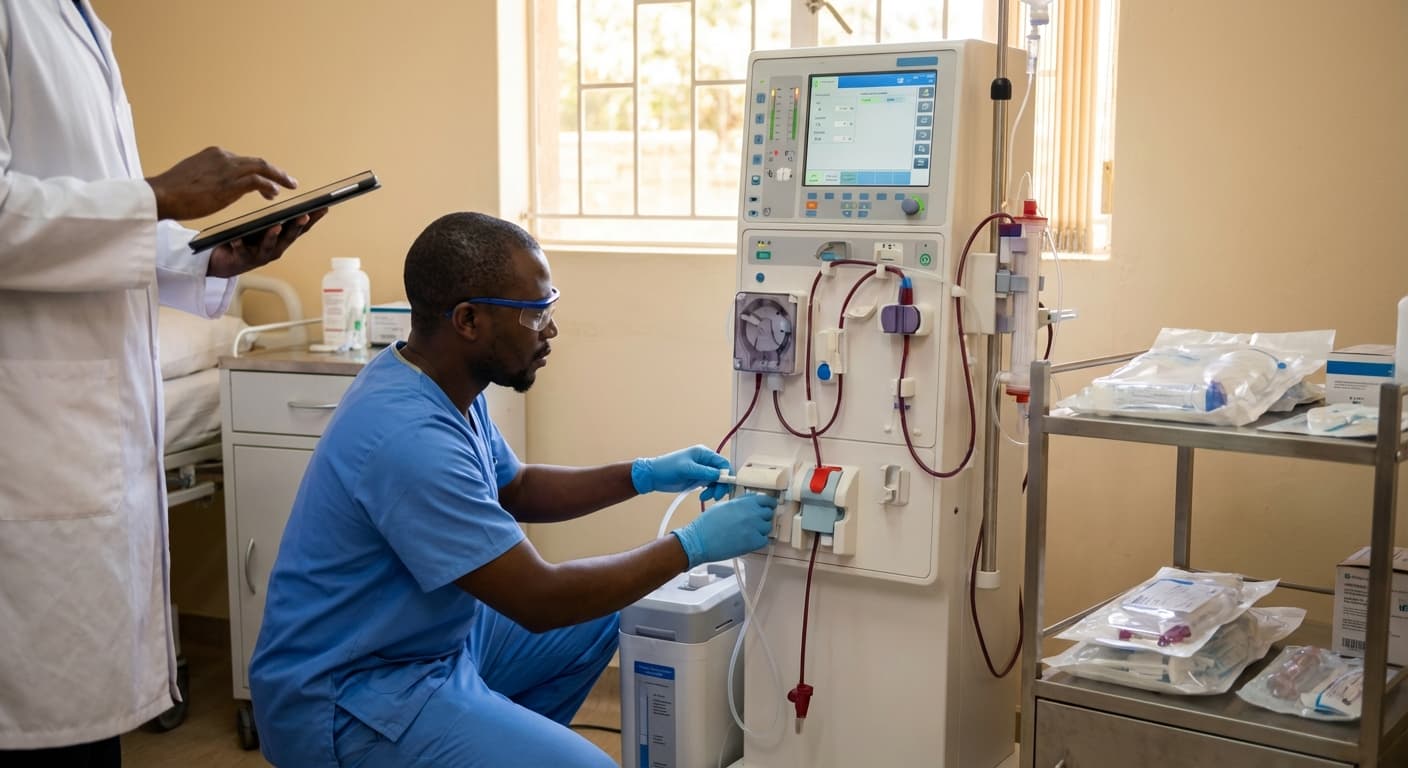
Hemodialysis Machine Installation Service in Ethiopia
Engineering Excellence & Technical Support
Hemodialysis Machine Installation Service High-standard technical execution following OEM protocols and local regulatory frameworks.
Expert Installation & Calibration
Our certified technicians ensure precise installation and rigorous calibration of hemodialysis machines, guaranteeing optimal performance and patient safety according to international standards.
Comprehensive Site Assessment & Readiness
We conduct thorough site assessments to verify water quality, electrical infrastructure, and space requirements, ensuring a seamless integration and operational readiness for your new hemodialysis unit.
Tailored Training & Support
Beyond installation, we provide comprehensive training for your biomedical and nursing staff on machine operation, maintenance, and troubleshooting, backed by responsive technical support for long-term reliability.
What Is Hemodialysis Machine Installation Service In Ethiopia?
Hemodialysis Machine Installation Service in Ethiopia refers to the comprehensive process of setting up, configuring, and validating hemodialysis machines within healthcare facilities across Ethiopia. This service ensures that these critical medical devices are optimally positioned, connected to necessary utilities, and calibrated to meet stringent performance and safety standards required for effective patient treatment. It encompasses a range of technical and logistical activities to prepare the machines for immediate and reliable operation.
| Who Needs Hemodialysis Machine Installation Service? | Typical Use Cases | |||
|---|---|---|---|---|
| Hospitals (Public and Private): Particularly those with nephrology departments or dialysis units. | Dialysis Centers: Dedicated facilities offering hemodialysis as their primary service. | Medical Equipment Suppliers/Distributors: Requiring professional installation of machines sold to healthcare providers. | Government Health Initiatives: For facilities established or upgraded as part of national health programs. | New Healthcare Facility Development: When a new hospital or clinic is being equipped with dialysis capabilities. |
| Establishment of New Dialysis Units: Setting up a completely new hemodialysis facility. | Expansion of Existing Dialysis Services: Adding more machines to accommodate an increasing patient load. | Replacement of Outdated or Malfunctioning Equipment: Installing new machines to replace aging or non-functional units. | Relocation of Dialysis Units: Moving an existing dialysis unit to a new physical location within a facility or to a different site. | Upgrade of Dialysis Infrastructure: Integrating new models of hemodialysis machines with updated functionalities and protocols. |
Key Components of Hemodialysis Machine Installation Service
- Site assessment and preparation (including electrical, plumbing, and ventilation requirements).
- Unpacking, physical placement, and securing of the hemodialysis machine.
- Connection to water treatment systems (RO units) and waste disposal infrastructure.
- Electrical and power supply integration, ensuring surge protection and grounding.
- Calibration and functional testing of all machine components (e.g., pump, dialyzer interface, conductivity and temperature sensors).
- Software configuration and firmware updates.
- Initial operational checks and dummy run procedures.
- User training for biomedical engineers and nursing staff on machine operation and basic troubleshooting.
- Documentation and handover of the installed and tested equipment.
Who Needs Hemodialysis Machine Installation Service In Ethiopia?
Hemodialysis machine installation services are crucial for the effective and safe operation of dialysis units, particularly in a developing healthcare landscape like Ethiopia. These services ensure that complex medical equipment is set up correctly, calibrated for optimal performance, and meets all necessary safety standards. This is vital for providing consistent and high-quality care to patients suffering from kidney failure.
| Target Customer Type | Relevant Departments | Key Considerations |
|---|---|---|
| Public Hospitals | Nephrology Department, Internal Medicine, Biomedical Engineering Department, Procurement Department | Budgetary constraints, compliance with national health standards, need for training local technicians, scalability of services. |
| Private Hospitals and Clinics | Nephrology Unit, Renal Care Department, Operations Management, Facilities Management | Focus on patient experience, advanced technology adoption, service reliability, competitive pricing, rapid turnaround time for installations. |
| NGOs and Charities | Project Management, Medical Services Department, Logistics and Procurement | Cost-effectiveness, sustainability of services, training local staff for maintenance, community impact, ethical considerations. |
| Dialysis Centers | Clinical Operations, Technical Services, Patient Care Management | High volume patient throughput, efficient workflow design, adherence to strict infection control protocols, redundancy planning for equipment. |
| Medical Equipment Suppliers | Sales and Technical Support, Installation and Commissioning Teams, After-Sales Service | Seamless integration with existing infrastructure, timely project completion, comprehensive warranty and maintenance support, customer satisfaction. |
| International Aid Projects | Project Coordination, Healthcare Infrastructure Development, Technical Advisors | Adherence to donor requirements, long-term sustainability planning, capacity building for local healthcare professionals, technology transfer. |
Target Customers for Hemodialysis Machine Installation Services in Ethiopia
- {"item":"Public Hospitals","description":"Government-run hospitals across Ethiopia that are establishing or upgrading their nephrology and dialysis departments. This includes major referral hospitals and regional medical centers."}
- {"item":"Private Hospitals and Clinics","description":"Privately owned healthcare facilities that are expanding their services to include renal care, aiming to offer specialized treatments to a growing segment of the population."}
- {"item":"Non-Governmental Organizations (NGOs) and Charities","description":"Organizations focused on improving healthcare access in Ethiopia, often setting up or supporting dialysis units in underserved areas or in partnership with public facilities."}
- {"item":"Dialysis Centers","description":"Dedicated standalone dialysis centers that are being newly established or requiring the installation of additional machines to meet patient demand."}
- {"item":"Medical Equipment Suppliers and Distributors","description":"Companies that import and sell hemodialysis machines in Ethiopia, often contracting installation services as part of their product offering to clients."}
- {"item":"International Aid Projects","description":"Healthcare initiatives funded by international bodies or foreign governments that aim to bolster Ethiopia's medical infrastructure, including the establishment of dialysis facilities."}
Hemodialysis Machine Installation Service Process In Ethiopia
This document outlines the comprehensive service process for the installation of hemodialysis machines in Ethiopia, from the initial client inquiry to the successful execution and handover. The process is designed to be efficient, transparent, and ensure the optimal functioning of the installed equipment.
| Phase | Key Activities | Responsible Parties | Deliverables/Outcomes | Estimated Timeline |
|---|---|---|---|---|
| Receive client inquiry (e.g., via phone, email, website). Conduct initial consultation to understand client needs, machine specifications, and project scope. Provide preliminary information on services and pricing. Discuss potential project timelines and requirements. | Client, Service Provider Sales/Technical Team | Understanding of client needs, preliminary proposal/quote, client agreement to proceed. | 1-3 business days |
| Schedule and conduct a detailed site visit. Assess the installation location for space, power supply, water quality and supply, drainage, ventilation, and accessibility. Identify any necessary modifications or infrastructure upgrades. Develop a detailed project plan, including a timeline, resource allocation, and risk assessment. | Service Provider Technical Team, Client Facilities Management | Detailed site assessment report, comprehensive project plan, bill of materials for site modifications (if any). | 3-7 business days |
| Finalize the order for the hemodialysis machine and any required accessories/consumables based on the client's specifications and site assessment. Arrange for secure transportation of the equipment to the client's facility in Ethiopia. Manage customs clearance and import procedures. | Service Provider Procurement & Logistics Team, Client Procurement Department | Ordered and shipped hemodialysis machine and accessories, cleared customs, equipment ready for delivery at site. | Varies significantly based on machine origin and shipping methods (weeks to months) |
| Prepare the installation site according to the project plan. This may include electrical work, plumbing, water treatment system installation/setup, and ensuring all safety requirements are met. Verify that all necessary tools and equipment for installation are available. | Client Facilities Management, Service Provider Technical Team, Approved Sub-contractors (if applicable) | Ready installation site, necessary utilities connected and functional, all tools and materials on-site. | 1-2 weeks (concurrent with machine arrival) |
| Unpack and carefully position the hemodialysis machine at the designated location. Connect the machine to power, water supply, and drainage systems. Install and configure any accompanying equipment (e.g., water treatment units, dialysis chairs). Follow manufacturer’s installation guidelines meticulously. | Service Provider Certified Technicians | Physically installed and connected hemodialysis machine and related equipment. | 1-3 days per machine |
| Perform comprehensive functional tests to ensure all components of the machine operate as expected. Calibrate the machine according to manufacturer specifications and relevant medical standards. Conduct water quality testing to ensure it meets dialysis requirements. Validate the entire system's performance to ensure safety and efficacy. | Service Provider Certified Technicians, Client Biomedical Engineering Team | Tested, calibrated, and validated hemodialysis machine, documented test results, water quality report. | 1-2 days per machine |
| Provide comprehensive training to the client's clinical and technical staff on the operation, basic maintenance, troubleshooting, and safety procedures for the hemodialysis machine. Hand over all relevant documentation, including user manuals, service records, and warranty information. Obtain client sign-off on successful installation and training. | Service Provider Technical Trainers, Client Clinical & Technical Staff | Trained staff, completed training records, signed handover document, all relevant documentation provided. | 1-2 days |
| Offer post-installation support to address any immediate concerns or questions. Schedule follow-up visits to ensure the machine is functioning optimally and to provide ongoing technical assistance. Provide access to the service provider's technical support line and facilitate warranty claims if necessary. | Service Provider Technical Support Team, Client Biomedical Engineering Team | Smooth operational integration of the machine, ongoing client satisfaction, prompt resolution of any initial issues. | Ongoing (initial period of 1 month recommended) |
Hemodialysis Machine Installation Service Process in Ethiopia
- Phase 1: Inquiry and Initial Consultation
- Phase 2: Site Assessment and Planning
- Phase 3: Procurement and Logistics
- Phase 4: Pre-Installation Preparation
- Phase 5: Machine Installation and Setup
- Phase 6: Testing, Calibration, and Validation
- Phase 7: Training and Handover
- Phase 8: Post-Installation Support and Follow-up
Hemodialysis Machine Installation Service Cost In Ethiopia
Installing a hemodialysis machine in Ethiopia involves a range of costs that are influenced by several key factors. These factors can significantly impact the final price, making it crucial for healthcare facilities to understand them to budget effectively. The primary considerations include the type and model of the hemodialysis machine itself, the complexity of the installation site, the need for auxiliary equipment, and the service provider's expertise and reputation. Additionally, the geographical location within Ethiopia can also play a role due to logistics and transportation costs. Local currency pricing will fluctuate based on these variables and prevailing market conditions. It's important to obtain detailed quotes from multiple reputable suppliers and installers to ensure competitive pricing and comprehensive service.
| Cost Component | Estimated Range (ETB) | Notes |
|---|---|---|
| Hemodialysis Machine (New) | 1,500,000 - 5,000,000+ | Varies significantly based on brand, model, and features. Refurbished units may be available at lower prices. |
| Water Purification System (RO Unit) | 300,000 - 1,000,000+ | Essential for providing ultrapure water. Capacity and technology influence cost. |
| Site Preparation & Infrastructure Upgrades | 100,000 - 500,000+ | Includes electrical, plumbing, ventilation, and minor construction. Highly site-specific. |
| Installation Labor & Technical Support | 50,000 - 200,000+ | Covers skilled technician fees, travel, and initial setup. Can be bundled with machine purchase. |
| Ancillary Consumables (Initial Stock) | 50,000 - 150,000+ | Dialyzers, bloodlines, disinfectants, saline. Cost depends on volume and type. |
| Testing, Calibration & Commissioning | 20,000 - 70,000+ | Ensuring the machine operates correctly and meets standards. |
| Transportation & Logistics | 20,000 - 100,000+ | Depends on distance, size of equipment, and any import duties/taxes. |
| Training for Staff | 30,000 - 100,000+ | Essential for nurses and technicians to operate and maintain the machine. |
| Warranty (1-2 Years) | Included/Bundled or 5-15% of machine cost | Crucial for peace of mind. Extended warranties may be an additional cost. |
| Total Estimated Installation Cost Range | 2,100,000 - 7,000,000+ ETB | This is a broad estimate. Actual costs can vary significantly based on specific needs and choices. |
Key Pricing Factors for Hemodialysis Machine Installation in Ethiopia
- Type and Brand of Hemodialysis Machine: Advanced features, technological sophistication, and brand reputation often correlate with higher initial purchase and installation costs.
- Site Preparation and Infrastructure: This includes the cost of necessary plumbing, electrical upgrades, ventilation systems, and dedicated space that meets the machine's operational requirements.
- Ancillary Equipment and Consumables: Beyond the machine, essential items like water purification systems (RO units), dialyzers, bloodlines, and disinfectant solutions contribute to the overall setup cost.
- Installation Complexity and Labor: The intricacy of connecting the machine to existing utilities, potential structural modifications, and the specialized skills of the installation team influence labor charges.
- Logistics and Transportation: The distance from the supplier to the installation site, customs duties (if imported), and transportation of heavy equipment add to the overall expense.
- Warranty and Maintenance Packages: The duration and comprehensiveness of the warranty, as well as ongoing maintenance contracts, will affect the initial and long-term investment.
- Service Provider's Expertise and Reputation: Experienced and certified technicians may command higher fees, but often provide superior service and reliability.
- Geographical Location: Installation costs can vary between major cities like Addis Ababa and more remote regions due to differences in operational costs, transportation, and availability of skilled labor.
Affordable Hemodialysis Machine Installation Service Options
Installing a hemodialysis machine is a significant undertaking for healthcare facilities, requiring specialized expertise and careful planning. Securing reliable and affordable installation services is crucial for ensuring operational efficiency and patient safety. This guide explores various service options, highlighting the benefits of value bundles and offering practical cost-saving strategies.
| Service Provider Type | Typical Scope of Work | Potential Cost Considerations | Best For |
|---|---|---|---|
| Manufacturer Installation | Machine setup, calibration, basic training | Often bundled with machine purchase; may be less flexible on pricing | New machine purchases, facilities seeking a single point of contact |
| Third-Party Biomedical Services | Installation, calibration, maintenance, repairs, multi-brand support | Can be more competitive on price; flexible contracts available | Facilities with mixed equipment, those seeking specialized expertise, independent clinics |
| In-House Biomedical Engineering | Full installation, maintenance, repair, and custom solutions | High initial investment in personnel and equipment; significant long-term savings potential | Large healthcare systems with dedicated resources and high equipment volume |
Cost-Saving Strategies for Hemodialysis Machine Installation
- {"title":"Negotiate Package Deals","description":"When purchasing machines, actively negotiate the installation service as part of a larger package to potentially secure discounts."}
- {"title":"Compare Multiple Quotes","description":"Obtain detailed quotes from both manufacturers and reputable third-party service providers to ensure competitive pricing."}
- {"title":"Leverage Existing Infrastructure","description":"If your facility has existing suitable plumbing, electrical, and water treatment systems, highlight this to service providers, as it may reduce site preparation costs."}
- {"title":"Consider Refurbished or Certified Pre-Owned Machines","description":"While not directly an installation cost, the initial purchase price of refurbished machines can be significantly lower, freeing up budget for installation and other needs."}
- {"title":"Opt for Phased Installation","description":"If feasible, consider installing machines in phases, especially for larger projects, to spread out costs and manage installation logistics more effectively."}
- {"title":"Invest in Comprehensive Training","description":"While seemingly an added cost, thorough training from the outset can reduce errors, minimize downtime, and decrease the need for frequent service calls for minor issues."}
- {"title":"Explore Extended Warranties Carefully","description":"Evaluate the cost-benefit of extended warranties. Sometimes, a robust preventative maintenance plan is more cost-effective than a long, expensive warranty."}
Verified Providers In Ethiopia
In the dynamic healthcare landscape of Ethiopia, identifying trusted and verified healthcare providers is paramount for ensuring quality patient care. Franance Health stands out as a beacon of excellence, distinguished by its rigorous credentialing process and unwavering commitment to patient well-being. This document outlines why Franance Health represents the best choice for medical services in Ethiopia, detailing their verification standards and the advantages they offer.
| Credentialing Aspect | Franance Health's Standard | Benefit to Patients |
|---|---|---|
| Professional Licenses & Certifications | Thorough verification of all medical licenses and specialty certifications. | Ensures providers are legally qualified and possess the necessary expertise. |
| Education & Training | Verification of academic credentials and confirmation of continuous medical education (CME). | Guarantees providers are up-to-date with the latest medical knowledge and techniques. |
| Clinical Experience | Assessment of past performance, work history, and peer reviews. | Confirms practical skills and a history of competent patient care. |
| Background Checks | Rigorous checks for any disciplinary actions or ethical violations. | Protects patients by ensuring providers have a clean record and uphold ethical standards. |
| Specialty Competency | Specific validation of expertise within specialized medical fields. | Provides confidence in receiving appropriate care for specific health conditions. |
Why Franance Health is the Best Choice:
- Uncompromising Verification Standards: Franance Health employs a multi-layered credentialing process that goes beyond basic licensing. They meticulously vet all healthcare professionals, including doctors, nurses, specialists, and support staff, ensuring they possess valid certifications, up-to-date training, and a proven track record of ethical practice.
- Commitment to Quality and Safety: Every provider affiliated with Franance Health adheres to strict quality assurance protocols. This includes regular performance reviews, ongoing professional development, and a commitment to adopting the latest medical advancements and safety practices.
- Patient-Centric Approach: Franance Health prioritizes the patient experience. Their verified providers are known for their empathy, clear communication, and dedication to building trusting relationships with patients. This ensures that individuals receive not only expert medical care but also compassionate support.
- Access to Specialized Expertise: Through their network of verified providers, Franance Health offers access to a wide range of medical specialties. Whether you require general healthcare, specialized diagnostics, or advanced treatments, you can be confident that you are being treated by highly qualified professionals in their respective fields.
- Streamlined Access to Care: Franance Health simplifies the process of finding and accessing quality healthcare. Their verified provider network allows patients to easily locate the right medical professional for their needs, reducing the stress and uncertainty often associated with seeking medical attention.
- Ethical Practice and Integrity: A core tenet of Franance Health's credentialing is the assurance of ethical conduct. Providers are expected to uphold the highest standards of medical ethics, ensuring patient privacy, informed consent, and non-discriminatory treatment.
Scope Of Work For Hemodialysis Machine Installation Service
This Scope of Work (SOW) outlines the requirements for the installation services of hemodialysis machines at [Client Name/Facility Name] located at [Facility Address]. The objective of this SOW is to ensure the safe, efficient, and compliant installation of [Number] hemodialysis machines, adhering to all relevant industry standards and manufacturer specifications. This document details the technical deliverables, standard specifications, and responsibilities of both the Service Provider and the Client.
| Section | Description | Standard Specifications / Deliverables |
|---|---|---|
| Site Preparation & Assessment | Pre-installation site survey to confirm power, water, drainage, and environmental requirements are met. | Site readiness report detailing any necessary modifications or pre-installation requirements. Confirmation of adequate space, ventilation, and ambient temperature (18-25°C). |
| Unpacking & Physical Placement | Careful unpacking and inspection of each hemodialysis machine for any transit damage. Precise positioning of the machines in designated areas. | Unpacking of [Number] units of [Hemodialysis Machine Model/Manufacturer]. Visual inspection logs for each unit. Machine placement according to facility layout and manufacturer recommendations. |
| Electrical & Plumbing Connections | Connection of machines to dedicated, grounded electrical outlets and appropriate water supply/drainage systems. | Installation of surge protectors and dedicated circuit breakers for each machine. Connection to treated water supply meeting AAMI/ISO standards (e.g., resistivity > 1 MOhm-cm). Verified proper drainage (gravity or pumped) to prevent backflow. Electrical safety testing (e.g., leakage current, earth continuity) as per IEC 60601. |
| Water Treatment System Integration (if applicable) | Integration of hemodialysis machines with the existing or newly installed water treatment system. | Verification of water quality from the treatment system at the point of connection to the dialysis machine, meeting all relevant standards. Pressure and flow rate checks for water supply. |
| System Setup & Configuration | Initial power-up, software configuration, and setting of basic operating parameters. | Machine initialization and self-testing. Configuration of basic machine parameters as per client requirements and manufacturer defaults. Language and unit settings. |
| Functional Testing & Calibration | Comprehensive testing of all machine functions, including dialysate preparation, blood pump, ultrafiltration, and safety features. Calibration of critical components. | Performance testing of all operational modes (e.g., single-use, re-use if applicable). Calibration of dialysate conductivity, temperature, flow rate, UF volume, and pressure sensors. Safety feature tests (e.g., air detector, arterial pressure limits, venous pressure limits, blood leak detector). |
| Disinfection & Priming | Performing initial disinfection and priming cycles of the machines and associated fluid pathways. | Disinfection protocols executed as per manufacturer guidelines. Priming with sterile saline or appropriate solution. Verification of fluid path integrity. |
| User Training | Training of clinical staff on the operation, basic troubleshooting, and daily maintenance of the hemodialysis machines. | [Number] hours of hands-on training for up to [Number] clinical staff. Training modules to cover machine setup, patient connection, treatment monitoring, alarms, disinfection, and emergency procedures. Training materials provided (e.g., user manuals, quick reference guides). |
| Documentation & Handover | Provision of all necessary documentation and formal handover of the installed machines. | Installation and commissioning report for each machine, including test results and calibration records. Certificate of completion for user training. As-built diagrams of electrical and plumbing connections (if applicable). Manufacturer's warranty activation confirmation. |
| Post-Installation Support (Optional) | Limited period of on-site support to address any immediate issues post-installation. | [Number] days/weeks of on-site support for initial operational queries and minor adjustments. |
Key Objectives
- To successfully install and commission [Number] hemodialysis machines according to manufacturer guidelines and industry best practices.
- To ensure all installations are compliant with local and national healthcare regulations, including those related to medical device safety and infection control.
- To provide comprehensive training to the Client's clinical and technical staff on the operation and basic maintenance of the installed hemodialysis machines.
- To verify the functionality and performance of each installed machine through rigorous testing and calibration.
- To deliver all required documentation, including installation reports, test results, and training certificates.
Service Level Agreement For Hemodialysis Machine Installation Service
This Service Level Agreement (SLA) outlines the guaranteed response times and uptime for the Hemodialysis Machine Installation Service provided by [Your Company Name] to [Client Name]. This SLA aims to ensure minimal disruption to dialysis operations and prompt resolution of any installation-related issues.
| Service Component | Service Level Objective (SLO) | Measurement | Remedy |
|---|---|---|---|
| Initial Response Time (Critical Issue) | 4 hours | Time from initial report of a critical installation issue to the commencement of remote diagnostics or dispatch of technician. | 10% discount on the next installation service for each 2-hour delay beyond the 4-hour target. |
| Initial Response Time (Non-Critical Issue) | 24 business hours | Time from initial report of a non-critical installation issue to the commencement of remote diagnostics or dispatch of technician. | N/A (focus is on timely resolution of critical issues). |
| Installation Completion Time | Within 48 business hours of technician arrival (for standard installations) | Time from technician arrival on-site to successful completion of installation and initial testing. | For each 12-hour delay beyond 48 hours, a credit of [Specify Credit Amount or Percentage] will be applied to the total installation invoice. |
| Post-Installation Support (Critical Functionality Issue) | 24 business hours | Time from report of a critical machine functionality issue (directly related to installation) within 7 days of completion to commencement of resolution efforts. | Service credits equivalent to [Specify Credit Amount or Percentage] of the installation cost for each 24-hour period of unresolved critical functionality issue. |
| Uptime Guarantee (During Installation & Initial Testing) | 99% | Percentage of time the machine is functional and ready for testing/operation during the scheduled installation window, excluding planned downtime for client-specific reasons. | If uptime falls below 99% due to our installation service, a prorated refund for the affected installation time will be issued. |
Scope of Service
- On-site installation of new hemodialysis machines.
- Configuration and testing of installed hemodialysis machines.
- Basic user training on machine operation post-installation.
- Troubleshooting and issue resolution during the installation and initial setup phase.
Frequently Asked Questions

Ready when you are
Let's scope your Hemodialysis Machine Installation Service in Ethiopia project in Ethiopia.

Scaling healthcare logistics and technical systems across the entire continent.