
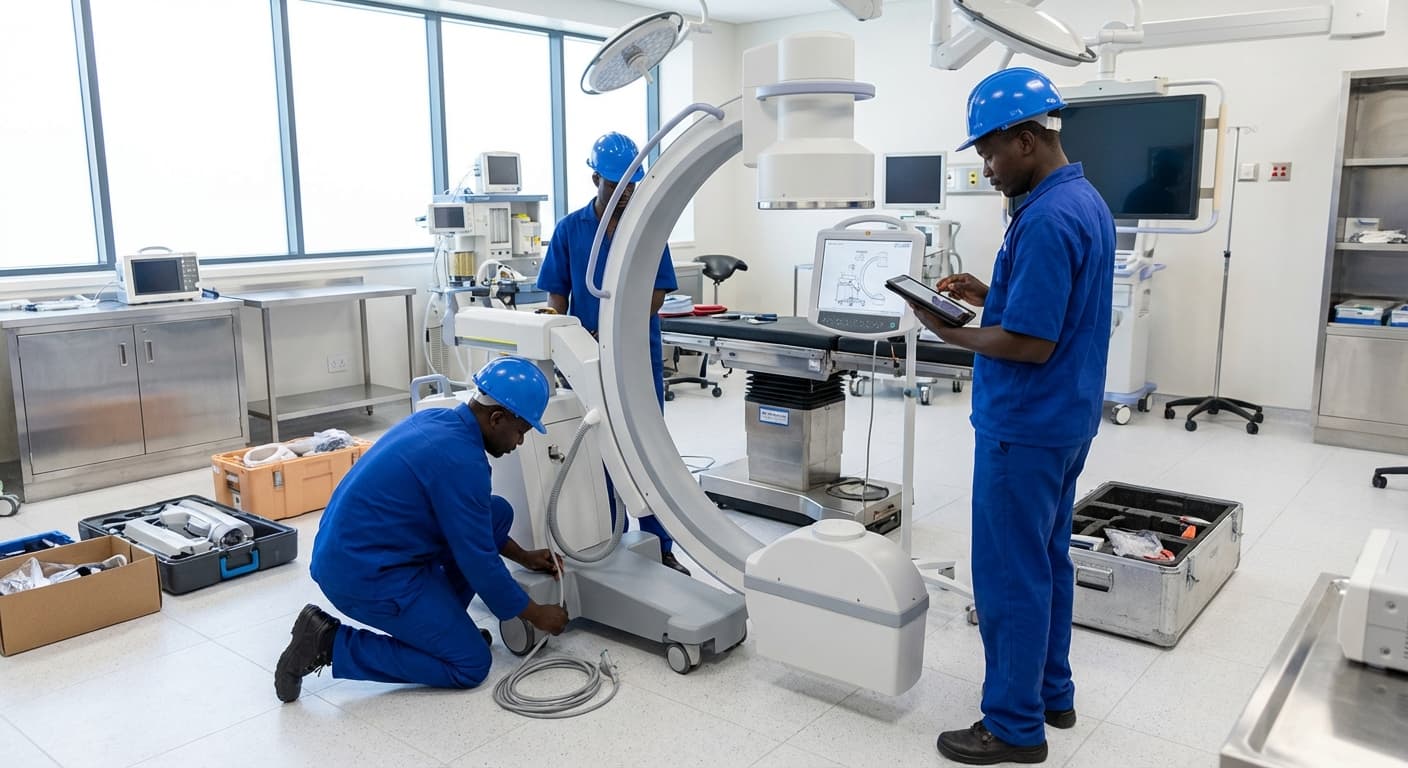
C-Arm Installation Service in Ethiopia
Engineering Excellence & Technical Support
C-Arm Installation Service High-standard technical execution following OEM protocols and local regulatory frameworks.
Nationwide C-Arm Installation & Commissioning
Our expert technicians provide comprehensive C-arm installation, calibration, and initial testing services across all regions of Ethiopia, ensuring immediate operational readiness for your medical facility. We adhere to international best practices and local regulatory standards.
Optimized Workflow & Imaging Performance
We specialize in positioning and configuring C-arm systems for optimal patient access and ergonomic workflow. Our meticulous setup guarantees superior image quality and diagnostic accuracy, enhancing clinical decision-making and patient care.
Safety & Regulatory Compliance Expertise
Ensuring strict adherence to radiation safety protocols and Ethiopian health regulations is paramount. Our team meticulously implements safety features and provides the necessary documentation for compliance, safeguarding both patients and healthcare professionals.
What Is C-arm Installation Service In Ethiopia?
C-Arm Installation Service in Ethiopia refers to the comprehensive process of setting up and integrating a C-arm imaging system within a healthcare facility. This service encompasses the physical placement, electrical and network connectivity, calibration, testing, and initial user training to ensure the C-arm is fully functional, compliant with local regulations, and ready for clinical use. It is a specialized service provided by trained technicians and engineers, often from the C-arm manufacturer or authorized third-party vendors, to guarantee optimal performance and safety of the diagnostic imaging equipment.
| Who Needs C-Arm Installation Service? | Typical Use Cases for C-Arms in Ethiopia | ||||||
|---|---|---|---|---|---|---|---|
| Hospitals (public and private) | Orthopedic surgery (fracture repair, joint replacement) | Cardiology (angiography, stent placement) | Pain management procedures (injections, nerve blocks) | Urology (stone removal, stent insertion) | Gastroenterology (endoscopic procedures) | Emergency departments for trauma assessment and intervention | Surgical centers and specialty clinics |
| Diagnostic imaging centers | Mobile imaging units |
Key Components of C-Arm Installation Service:
- Site Assessment and Planning: Evaluating the installation site for adequate space, power supply, radiation shielding requirements, and network infrastructure.
- Physical Installation: Unpacking, assembling, and positioning the C-arm unit and its associated components (e.g., monitor cart, generator).
- Electrical and Network Connectivity: Connecting the C-arm to the facility's power grid, ensuring proper grounding, and establishing network connections for PACS (Picture Archiving and Communication System) integration or data transfer.
- Radiation Shielding Verification: Confirming that the installation meets local radiation safety standards, which may involve installing or verifying lead shielding in the room.
- System Calibration and Testing: Performing rigorous diagnostic tests, image quality assessments, and functional checks to ensure all components operate within manufacturer specifications.
- Integration with Existing Systems: Connecting the C-arm to hospital information systems (HIS) and EMRs (Electronic Medical Records) as required.
- User Training: Providing initial training to medical personnel (radiologists, surgeons, technicians) on the operation, basic maintenance, and safety protocols of the C-arm system.
- Documentation and Handover: Providing all necessary installation documents, user manuals, and warranty information upon completion.
Who Needs C-arm Installation Service In Ethiopia?
C-arm fluoroscopy units are indispensable tools in modern medical imaging, playing a crucial role in a wide array of surgical and diagnostic procedures. Their mobility and real-time imaging capabilities make them vital for interventions requiring precise visualization. In Ethiopia, as healthcare infrastructure continues to develop and advanced medical practices become more prevalent, the demand for professional C-arm installation services is steadily increasing. These services ensure that these complex medical devices are set up correctly, calibrated to perfection, and integrated seamlessly into existing hospital workflows, guaranteeing optimal performance, patient safety, and compliance with medical imaging standards.
| Target Customer Type | Key Departments Requiring C-Arm Installation |
|---|---|
| Public Hospitals | Orthopedics, Urology, Cardiology, Pain Management, General Surgery, Emergency Medicine, Radiology |
| Private Hospitals | Orthopedics, Urology, Cardiology, Interventional Radiology, Neurosurgery, Pain Management, General Surgery, Gastroenterology |
| Specialty Clinics (e.g., Orthopedic, Pain Management) | Orthopedics (fracture repair, joint replacements), Pain Management (nerve blocks, epidural injections), Urology (urological procedures), Cardiology (interventional cardiology) |
| Diagnostic Imaging Centers | Interventional Radiology, Outpatient Diagnostic Fluoroscopy |
| Surgical Centers | Minimally Invasive Surgery (various specialties), Orthopedic Procedures, Pain Management Procedures |
| University Teaching Hospitals | All departments listed above, particularly those involved in advanced surgical training and research. |
| Government Health Facilities | Primarily those with surgical capabilities, focusing on essential orthopedic, urological, and general surgical procedures. |
| NGO Medical Facilities | Facilities providing surgical outreach or specialized medical care, often in underserved areas. |
Who Needs C-Arm Installation Service in Ethiopia?
- Hospitals (Public and Private)
- Specialty Clinics
- Diagnostic Imaging Centers
- Surgical Centers
- University Teaching Hospitals
- Government Health Facilities
- Non-Governmental Organization (NGO) Medical Facilities
C-arm Installation Service Process In Ethiopia
This document outlines the comprehensive workflow for C-Arm installation services in Ethiopia, guiding clients from their initial inquiry to the successful execution and completion of the installation. The process emphasizes clear communication, meticulous planning, and skilled execution to ensure a seamless and efficient deployment of C-Arm imaging systems.
| Step | Description | Key Activities | Responsible Party | Deliverables |
|---|---|---|---|---|
| Client expresses interest in C-Arm installation. | Initial contact, understanding basic needs, requesting information. | Client | Initial inquiry, basic project scope. |
| Understanding specific requirements and providing preliminary guidance. | Needs assessment, clarifying system type, intended use, site overview. | Service Provider & Client | Understanding of client needs, preliminary solution outline. |
| On-site evaluation of the installation location. | Measuring space, checking power, ventilation, radiation shielding requirements, network connectivity, accessibility. | Service Provider | Detailed site assessment report, identification of potential challenges. |
| Developing a detailed installation plan based on site assessment. | Defining equipment placement, cable routing, power requirements, workflow integration, risk assessment. | Service Provider | Installation plan, technical specifications, timeline. |
| Presenting a formal offer for the installation services. | Itemized costs (equipment, labor, materials, permits), proposed timeline, terms and conditions. | Service Provider | Formal quotation/proposal. |
| Formalizing the engagement between client and service provider. | Review and signing of contract, payment schedule, service level agreement (SLA). | Client & Service Provider | Signed contract. |
| Acquiring and transporting the C-Arm and accessories. | Ordering equipment, managing import/customs clearance (if applicable), arranging transportation to site. | Service Provider | Delivered C-Arm equipment and accessories at site. |
| Ensuring the site is ready for installation. | Infrastructure modifications (e.g., power outlets, flooring), preparing the installation area, safety checks. | Client (with Service Provider guidance) | Ready installation environment. |
| Physical installation of the C-Arm system. | Mounting, connecting components, cable management, initial power-up. | Service Provider (Certified Technicians) | Physically installed C-Arm system. |
| Configuring software and calibrating hardware for optimal performance. | Software setup, image parameter adjustment, geometric calibration, testing all modes. | Service Provider (Certified Technicians) | Configured and calibrated C-Arm system. |
| Verifying the system's functionality and image quality. | Performing diagnostic tests, phantom imaging, dose verification, workflow simulation, radiation safety checks. | Service Provider | Test reports, quality assurance sign-off. |
| Educating the client's staff on system operation. | Hands-on training on operation, basic maintenance, troubleshooting, safety protocols. | Service Provider | Trained medical staff, training documentation. |
| Client acceptance of the installed system. | Joint inspection, addressing any final queries, formal handover documentation. | Client & Service Provider | Client acceptance form, handover certificate. |
| Providing ongoing assistance and addressing issues. | Warranty service, technical support, scheduled maintenance (if applicable). | Service Provider | Ongoing technical support, warranty coverage. |
C-Arm Installation Service Process
- {"title":"Phase 1: Inquiry and Initial Consultation","description":"The process begins with the client expressing interest in C-Arm installation services. This phase involves understanding their specific needs and providing preliminary information."}
- {"title":"Phase 2: Site Assessment and Planning","description":"A crucial phase where our team evaluates the intended installation site to ensure all technical and logistical requirements are met. Detailed planning prevents future complications."}
- {"title":"Phase 3: Quotation and Contract Agreement","description":"Based on the site assessment and client requirements, a comprehensive quotation is prepared. Upon acceptance, a formal contract is signed, outlining the scope of work, timeline, and payment terms."}
- {"title":"Phase 4: Logistics and Procurement","description":"This phase focuses on the physical movement of the C-Arm equipment and necessary accessories to the installation site in Ethiopia. It includes customs clearance and transportation."}
- {"title":"Phase 5: Installation and Configuration","description":"The core of the service, where our certified technicians meticulously install and configure the C-Arm system, ensuring optimal performance and integration."}
- {"title":"Phase 6: Testing and Validation","description":"Rigorous testing is performed to verify that the C-Arm system functions as per specifications and meets all safety and performance standards. This includes image quality assessment."}
- {"title":"Phase 7: Training and Handover","description":"Comprehensive training is provided to the client's medical staff on the operation, maintenance, and basic troubleshooting of the C-Arm system. The system is formally handed over upon client satisfaction."}
- {"title":"Phase 8: Post-Installation Support and Warranty","description":"Our commitment continues after installation with dedicated support and warranty services to address any immediate concerns and ensure long-term operational efficiency."}
C-arm Installation Service Cost In Ethiopia
The cost of C-arm installation services in Ethiopia can vary significantly due to a multitude of factors. These services are specialized and require trained technicians, often with international expertise. The complexity of the installation, the specific model of the C-arm, and the chosen service provider all play a crucial role in determining the final price. It's essential for healthcare facilities to obtain detailed quotes from multiple reputable providers to ensure competitive pricing and a thorough understanding of what is included.
| Service Component | Estimated Cost Range (ETB - Ethiopian Birr) | Notes |
|---|---|---|
| Basic Installation (Simple Unit, Existing Infrastructure) | 80,000 - 150,000 | Assumes minimal site preparation and standard electrical setup. |
| Standard Installation (Moderate Complexity, Minor Preparations) | 150,000 - 250,000 | May include basic shielding, moderate electrical work, and standard training. |
| Complex Installation (Advanced Models, Significant Site Work) | 250,000 - 450,000+ | Involves extensive structural modifications, advanced shielding, specialized integration, and comprehensive training. |
| Site Assessment & Consultation Fee | 5,000 - 15,000 | Often a separate fee to evaluate site suitability and provide recommendations. |
| Travel & Logistics (for remote locations) | 10,000 - 30,000+ | Highly variable depending on distance and accessibility. |
| Extended/Specialized Training Packages | 20,000 - 50,000+ | For advanced features or specialized medical applications. |
Key Pricing Factors for C-Arm Installation in Ethiopia:
- Type and Model of C-Arm: Advanced models with more features and higher imaging capabilities will generally incur higher installation costs.
- Site Assessment and Preparation: The existing infrastructure of the installation site is critical. Costs can increase if structural modifications, special electrical grounding, or radiation shielding are required.
- Geographical Location: Installation in remote or less accessible areas may involve additional travel and logistical expenses for the technicians.
- Complexity of Installation: Factors like ceiling mounts, fixed installations, or integration with existing imaging systems can add to the complexity and cost.
- Training Requirements: The scope of training provided to the facility's staff on operating and maintaining the C-arm can influence the overall service package and price.
- Service Provider Reputation and Expertise: Highly experienced and reputable companies, especially those with international certifications or partnerships, may command higher prices due to their reliability and quality of service.
- Warranty and Support Agreements: The duration and comprehensiveness of warranty and after-sales support included in the installation package can affect the initial cost.
- Additional Equipment and Accessories: Any necessary ancillary equipment or specialized accessories required for the C-arm's function will add to the total cost.
Affordable C-arm Installation Service Options
Acquiring and installing a C-arm is a significant investment for any medical facility. Understanding the available installation service options and exploring strategies to manage costs can make this process more accessible. This guide outlines affordable C-arm installation service options, emphasizing the value of service bundles and practical cost-saving measures.
| Service Option | Description | Typical Value Proposition | Cost-Saving Potential |
|---|---|---|---|
Understanding C-Arm Installation Service Value
- {"title":"What is C-Arm Installation?","description":"C-arm installation is a comprehensive process that includes site assessment, delivery, uncrating, positioning, electrical and network connectivity, calibration, system testing, and basic user training. Professional installation ensures the C-arm operates safely and effectively, adhering to all regulatory standards."}
- {"title":"Why is Professional Installation Crucial?","description":"Incorrect installation can lead to equipment malfunction, safety hazards, downtime, and voided warranties. Expert technicians ensure optimal performance and longevity of your C-arm investment."}
- {"title":"Factors Influencing Installation Cost","description":"Installation costs are influenced by the complexity of the C-arm model, the facility's existing infrastructure (power, space, ventilation), the geographic location, and the level of service required (e.g., basic setup vs. advanced integration with other systems)."}
Verified Providers In Ethiopia
In Ethiopia's evolving healthcare landscape, identifying trusted and credentialed providers is paramount for individuals and organizations seeking quality medical services. Franance Health stands out as a beacon of reliability, offering a comprehensive network of verified healthcare professionals and facilities. This commitment to verification ensures that patients receive care from qualified individuals and that facilities meet stringent standards for safety and efficacy. By prioritizing credentialing, Franance Health not only safeguards patient well-being but also fosters a more robust and trustworthy healthcare ecosystem in Ethiopia. Their rigorous vetting process, encompassing professional licensure, specialized training, and ongoing performance evaluations, underpins their reputation as a superior choice for healthcare access.
| Credential Type | Verification Aspect | Franance Health's Standard |
|---|---|---|
| Medical Licenses & Certifications | Legal authorization to practice medicine, specialist qualifications. | Mandatory, up-to-date, and thoroughly checked against national and international databases. |
| Education & Training | Academic background, specialized residency programs, fellowships. | Verified through official transcripts and certificates; emphasis on accredited institutions. |
| Professional Experience | Years in practice, previous roles, clinical experience. | Thorough review of work history, including references and peer evaluations where applicable. |
| Ethical Conduct & Disciplinary History | Professional behavior, adherence to medical ethics, any past sanctions. | Background checks, review of disciplinary records, and commitment to a strict code of conduct. |
| Facility Standards (for affiliated clinics/hospitals) | Infrastructure, equipment, hygiene, safety protocols, patient care environment. | Regular audits and inspections to ensure compliance with national health regulations and international best practices. |
Why Franance Health is the Best Choice for Verified Providers in Ethiopia:
- Rigorous Credentialing Process: Franance Health employs a multi-layered verification system to ensure all associated providers are fully licensed, certified, and meet high professional standards.
- Focus on Quality of Care: Beyond basic credentials, Franance Health assesses providers for their commitment to patient-centered care, ethical practices, and continuous professional development.
- Comprehensive Network: Access a wide range of specialties and services through Franance Health's extensive network of verified doctors, clinics, and hospitals across Ethiopia.
- Enhanced Patient Trust: Our verification process builds confidence, assuring patients they are receiving care from competent and reputable healthcare professionals.
- Commitment to Accessibility: Franance Health strives to make quality, verified healthcare accessible to a broader population within Ethiopia, overcoming geographical and financial barriers.
- Reputation for Excellence: Years of dedicated service and a consistent track record of positive patient outcomes have solidified Franance Health's position as a leader in verified healthcare provision.
Scope Of Work For C-arm Installation Service
This Scope of Work (SOW) outlines the technical deliverables and standard specifications for the professional installation of a C-Arm imaging system. The service encompasses all necessary steps from site preparation to final system testing and client handover. Adherence to manufacturer guidelines and industry best practices is paramount throughout the process.
| Deliverable | Description | Standard Specification/Requirement | Acceptance Criteria |
|---|---|---|---|
| Site Survey Report | Pre-installation assessment of the physical location. | Includes room dimensions, power availability, environmental conditions (temperature, humidity), accessibility, and existing infrastructure. | Report submitted and approved by client prior to equipment delivery. |
| Installed C-Arm System | Fully assembled and operational C-Arm imaging system. | Includes C-Arm gantry, imaging detectors, X-ray tube, power generator, workstation, and any peripherals. All according to manufacturer's specifications. | System powers on, all components are visually inspected, and mechanical movements are smooth and precise. |
| Connected and Verified Cabling | All necessary power, data, and communication cables installed and connected. | Cables are neatly routed, secured, and labeled. Meets electrical code requirements and manufacturer specifications for signal integrity. | Continuity and signal strength tests passed. No loose connections or exposed wires. |
| Functional Test Results | Documentation of system performance verification. | Includes tests for image acquisition, fluoroscopy, digital radiography modes, image quality, dose monitoring, and emergency stop functionality. All performed according to manufacturer's protocols. | All test results within acceptable ranges as defined by the manufacturer. Image quality is satisfactory and diagnostic. |
| User Training Session | Instruction provided to designated client personnel on system operation and basic maintenance. | Covers system startup/shutdown, imaging protocols, image manipulation, data management, and troubleshooting common issues. Session duration and content to be agreed upon. | Client personnel demonstrate understanding of core functions and ability to operate the system safely. |
| As-Built Documentation | Final documentation package detailing the installation. | Includes site survey report, equipment manifest, wiring diagrams, system configuration settings, test results, and user manuals. Provided in electronic and/or hard copy format. | All documentation is accurate, complete, and approved by the client. |
| Project Close-out Report | Formal sign-off document confirming successful installation. | Summarizes the project, confirms all deliverables have been met, and includes client acceptance. | Signed and dated by authorized client representative and installer. |
Key Stages and Deliverables
- Site Survey and Assessment
- Equipment Delivery and Unpacking
- Cabling and Infrastructure Preparation
- System Assembly and Component Installation
- Power and Grounding Verification
- Network Integration (if applicable)
- Software Installation and Configuration
- System Calibration and Alignment
- Functional Testing and Performance Verification
- User Training and Documentation Handover
- Final Site Clean-up and Waste Disposal
- Project Close-out and Sign-off
Service Level Agreement For C-arm Installation Service
This Service Level Agreement (SLA) outlines the performance standards for the C-Arm Installation Service provided by [Your Company Name]. It defines the response times to reported issues and the guaranteed uptime for the installed C-Arm systems, ensuring minimal disruption to your medical operations.
| Incident Severity | Definition | Response Time Target (within Service Hours) | Uptime Guarantee (Annual) |
|---|---|---|---|
| Critical Incident | System is completely inoperable, impacting patient care. | 1 Business Hour | 99.5% |
| Major Incident | Significant performance degradation or impact on secondary functions. | 4 Business Hours | 99.7% |
| Minor Incident | Minor functional impairments or cosmetic defects. | 8 Business Hours | 99.9% |
Key Definitions
- Service Hours: The period during which support and maintenance services are available, typically [e.g., Monday to Friday, 8:00 AM to 5:00 PM Local Time].
- Business Hours: The standard operating hours for the client's facility, during which a C-Arm system is typically in use.
- Critical Incident: An event that renders the C-Arm system completely inoperable or significantly impairs its primary functionality, directly impacting patient care.
- Major Incident: An event that significantly degrades the performance of the C-Arm system or impacts its secondary functionalities, causing operational inconvenience but not complete incapacitation.
- Minor Incident: An issue that causes minor functional impairments or cosmetic defects, not affecting the core operation or patient safety.
- Response Time: The maximum time allowed for [Your Company Name] to acknowledge a reported incident and initiate diagnostic or remedial actions.
- Resolution Time: The maximum time allowed to resolve a reported incident, aiming to restore the C-Arm system to its full operational status. (Note: Resolution times are often best-effort and depend on the complexity of the issue and availability of parts/personnel).
Frequently Asked Questions

Ready when you are
Let's scope your C-Arm Installation Service in Ethiopia project in Ethiopia.

Scaling healthcare logistics and technical systems across the entire continent.