
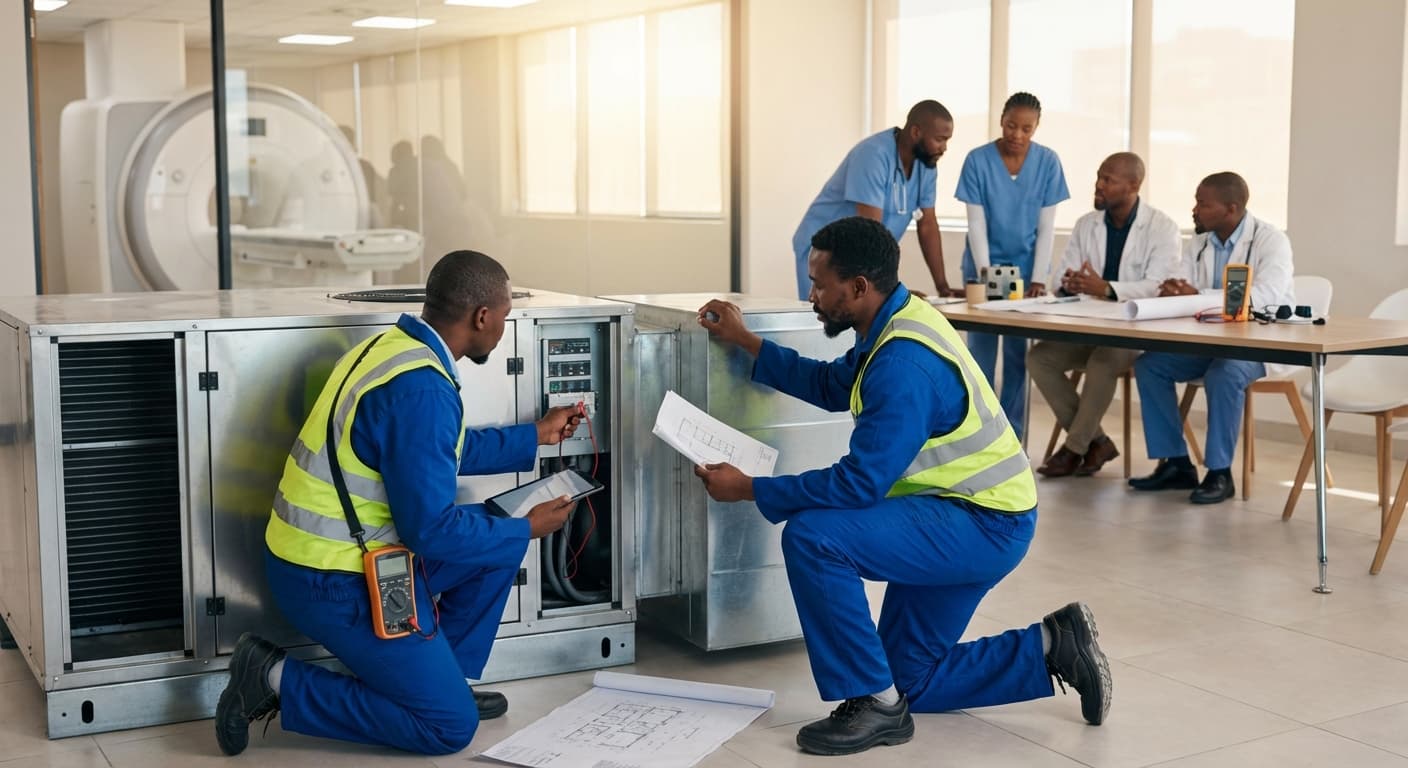
Site Readiness Assessment Service (Space/Access/HVAC/Power/Shielding) in Ethiopia
Engineering Excellence & Technical Support
Site Readiness Assessment Service (Space/Access/HVAC/Power/Shielding) High-standard technical execution following OEM protocols and local regulatory frameworks.
Ethiopia's Space Readiness Expertise
Leveraging deep understanding of Ethiopia's evolving satellite infrastructure and urban development, we conduct granular assessments to guarantee optimal site selection and integration for your satellite ground station needs, minimizing interference and maximizing signal integrity.
Unlocking Ethiopian Access Opportunities
Our service meticulously evaluates site accessibility across Ethiopia's diverse topography and transportation networks, ensuring seamless logistics for equipment deployment, personnel movement, and ongoing operational maintenance, crucial for remote or challenging locations.
Climate-Resilient HVAC & Power for Ethiopia
We specialize in assessing and designing robust HVAC and power solutions tailored to Ethiopia's unique climate profiles, from high-altitude cool zones to equatorial heat, guaranteeing reliable environmental control and uninterrupted power for your critical infrastructure.
What Is Site Readiness Assessment Service (Space/access/hvac/power/shielding) In Ethiopia?
The Site Readiness Assessment Service (Space/Access/HVAC/Power/Shielding) in Ethiopia is a comprehensive evaluation designed to determine the suitability and viability of a proposed or existing physical location for the deployment, operation, and maintenance of critical infrastructure, technology systems, or specialized equipment. This service systematically analyzes key environmental, structural, and utility parameters to ensure that the site can adequately support the intended application, mitigate risks, and optimize performance. The assessment encompasses five primary domains: Space (physical footprint, layout, and expandability), Access (logistical pathways, ingress/egress for personnel and equipment), HVAC (Heating, Ventilation, and Air Conditioning for environmental control), Power (electrical supply, redundancy, and capacity), and Shielding (electromagnetic, radio frequency, or physical protection). This detailed scrutiny is crucial for organizations undertaking new construction, facility upgrades, or the installation of sensitive technology in the Ethiopian context, where localized environmental conditions, infrastructure maturity, and regulatory frameworks can present unique challenges.
| Who Needs This Service? | Typical Use Cases | ||||||||
|---|---|---|---|---|---|---|---|---|---|
| Data Centers and Colocation Facilities: Organizations planning to establish or expand data processing and storage capabilities require assurance that the site can support high-density computing, stringent environmental controls, and robust power redundancy. | Telecommunications Infrastructure Providers: Companies deploying base stations, switching centers, or fiber optic network hubs need to confirm adequate space, secure access, stable power, and environmental stability for their equipment. | Research and Development Laboratories: Institutions involved in sensitive scientific research, medical diagnostics, or advanced manufacturing often require controlled environments, precise power, and protection from external interference. | Critical Industrial Operations: Manufacturing plants, energy facilities, or process control centers with sensitive automation and control systems need reliable power, stable environments, and secure access to maintain operational integrity. | Government and Defense Agencies: Entities requiring secure facilities for sensitive operations, communication hubs, or command and control centers must ensure sites meet stringent physical and environmental security requirements. | Cloud Service Providers: Companies offering cloud computing services need to establish and maintain data centers that are scalable, reliable, and environmentally controlled. | Financial Institutions: Banks and other financial organizations with critical IT infrastructure require highly secure and stable environments to protect transactional data and ensure service availability. | Healthcare Providers: Hospitals and clinics deploying advanced medical imaging equipment, electronic health record systems, or specialized diagnostic tools need reliable power and controlled environments. | Companies Migrating or Upgrading Existing Facilities: Organizations looking to modernize or relocate their IT infrastructure or operational facilities to Ethiopia or within Ethiopia. | New Construction Projects: Developers or investors planning to build facilities intended for specialized technological or industrial use. |
| Deployment of New Data Centers or Server Rooms: Ensuring a physical location is optimized for the thermal, electrical, and spatial requirements of IT hardware. | Installation of Mission-Critical Communication Systems: Verifying that the site can support the power, cooling, and security needs of telecommunications equipment. | Setting up Specialized Manufacturing or Processing Plants: Assessing the environmental and utility requirements for sensitive industrial machinery and automation. | Establishing Secure Government or Military Facilities: Evaluating the physical security, power resilience, and environmental controls for sensitive operations. | Retrofitting Existing Buildings for Technology Use: Determining the feasibility and necessary modifications to adapt older structures for modern IT infrastructure. | Expansion of Existing Infrastructure: Assessing the capacity and compatibility of a site for additional equipment and services. | Risk Mitigation for Technology Investments: Proactively identifying potential issues that could lead to downtime, equipment failure, or performance degradation. | Compliance with Industry Standards and Regulations: Ensuring the site meets specific requirements for uptime, security, and environmental conditions. | Planning for Future Scalability: Evaluating the potential for expansion and growth to accommodate future technological advancements and business needs. | Due Diligence for Mergers and Acquisitions (M&A) involving physical assets: Assessing the readiness of acquired facilities for integration. |
Key Components of the Site Readiness Assessment Service:
- Space Assessment: Evaluating available physical dimensions, ceiling heights, floor loading capacities, potential for expansion, and the optimal layout for equipment racks, cabling, and operational areas.
- Access Assessment: Analyzing ingress and egress routes for personnel and heavy equipment, delivery and loading docks, security checkpoints, internal transportation pathways, and emergency egress considerations.
- HVAC Assessment: Determining the existing or required environmental control systems to maintain optimal temperature, humidity, and air quality, considering factors like heat load from equipment, dust ingress, and redundancy for critical operations.
- Power Assessment: Verifying the availability, reliability, capacity, and quality of electrical power. This includes assessing grid stability, identifying the need for uninterruptible power supplies (UPS), backup generators, and ensuring proper grounding and surge protection.
- Shielding Assessment: Evaluating the necessity and feasibility of shielding to protect sensitive equipment from electromagnetic interference (EMI), radio frequency interference (RFI), or external physical threats. This can include assessing existing structural shielding properties or recommending the installation of specialized shielding materials.
Who Needs Site Readiness Assessment Service (Space/access/hvac/power/shielding) In Ethiopia?
Site Readiness Assessment services, encompassing evaluations of space, access, HVAC (Heating, Ventilation, and Air Conditioning), power, and shielding, are crucial for any organization in Ethiopia planning to establish or significantly upgrade its physical infrastructure. These assessments ensure that a chosen location can adequately support the intended operational needs, be it for data centers, manufacturing facilities, specialized laboratories, secure storage, or any other critical infrastructure. Without a thorough site readiness assessment, projects risk delays, cost overruns, operational inefficiencies, and potential failures due to inadequate environmental controls, insufficient power, or physical limitations.
| Target Customer Segment | Relevant Departments/Functions | Key Needs Addressed by Assessment |
|---|---|---|
| Information Technology & Data Centers | IT Operations, Infrastructure Management, Facilities Management, Security | Power redundancy, cooling capacity (HVAC), physical security (shielding), space for equipment, access for maintenance and upgrades. |
| Manufacturing & Industrial | Operations, Engineering, Facilities Management, Supply Chain | Adequate space for machinery and workflow, stable power supply, environmental controls (temperature, humidity), access for large equipment delivery and personnel. |
| Research & Development / Laboratories | Research Scientists, Lab Technicians, Facilities Management, Safety Officers | Precise environmental controls (HVAC), specialized power requirements, physical security and shielding for sensitive experiments or equipment, access for personnel and materials. |
| Healthcare Facilities | Hospital Administrators, IT Departments, Facilities Management, Biomedical Engineering | Reliable power for critical medical equipment, climate control for sensitive medical devices and pharmaceuticals, secure space for patient records and IT systems, adequate access for staff and equipment. |
| Telecommunications | Network Operations, Infrastructure Planning, Facilities Management | Sufficient space for network equipment, reliable power, environmental controls to prevent overheating, physical security, and accessibility for maintenance. |
| Financial Services | IT Infrastructure, Operations, Risk Management, Facilities Management | High-availability power, robust cooling systems, physical security and shielding for sensitive data, sufficient space for servers and backup systems. |
| Government & Public Sector | Project Management Offices, Infrastructure Development, IT Departments, Security Agencies | Suitability for critical national infrastructure, power and environmental stability, security and shielding for sensitive operations, accessibility for personnel and equipment. |
Who Needs Site Readiness Assessment Services in Ethiopia?
- Organizations establishing or expanding data centers and IT infrastructure.
- Businesses setting up new manufacturing plants or upgrading existing ones.
- Research and development institutions requiring specialized laboratory environments.
- Healthcare providers needing secure and climate-controlled facilities for medical equipment and records.
- Government agencies implementing new critical infrastructure projects.
- Telecommunication companies deploying new network nodes and equipment.
- Financial institutions requiring secure and reliable data storage and processing centers.
- Companies involved in sensitive industrial processes or requiring specialized environmental controls.
- Any organization planning a significant physical expansion or relocation where existing infrastructure may be a constraint.
Site Readiness Assessment Service (Space/access/hvac/power/shielding) Process In Ethiopia
The Site Readiness Assessment Service in Ethiopia, encompassing Space, Access, HVAC, Power, and Shielding, is a crucial step in ensuring that a proposed location is suitable for the intended project, often related to telecommunications, data centers, or specialized industrial facilities. This process ensures that all logistical, environmental, and infrastructure requirements are met before significant investment is made. The workflow typically begins with an initial inquiry and culminates in a comprehensive readiness report and, if necessary, recommendations for remediation.
| Phase | Key Activities | Responsible Parties | Deliverables | Key Considerations (Ethiopia) |
|---|---|---|---|---|
| Client expresses interest in the Site Readiness Assessment Service. Initial discussion to understand project scope, location, and specific requirements (e.g., type of equipment to be housed, power needs, desired uptime). | Client, Service Provider (Sales/Consulting Team) | Understanding of project requirements, preliminary scope of work, quotation. | Clear communication of client's needs in English or local languages. Understanding of local business practices and timelines. |
| Service provider team visits the proposed site. Detailed inspection and measurement of:
| Service Provider (Technical Team: Engineers, Technicians, Site Surveyors) | Raw data, measurements, photographs, video documentation, initial site assessment notes. | Navigating local logistics and transportation. Obtaining necessary permits or access permissions for site inspection. Awareness of local environmental conditions and potential impact on infrastructure. |
| Collected data is analyzed by the technical team. Comparison against project requirements and industry standards. Identification of any gaps, deficiencies, or potential risks. Development of a comprehensive Site Readiness Assessment Report. | Service Provider (Technical Team, Report Writers) | Detailed Site Readiness Assessment Report, including findings, analysis, risk assessment, and preliminary recommendations. | Ensuring the report is clear, concise, and actionable. Translation of key technical terms if necessary for local stakeholders. Consideration of local regulations and building codes. |
| Presentation of the Site Readiness Assessment Report to the client. Discussion of findings and proposed solutions. Development of remediation plans (if required), including cost estimates and timelines for addressing identified issues. Ongoing consultation and support. | Service Provider (Technical Team, Project Managers), Client | Final Site Readiness Assessment Report with actionable recommendations, remediation plans, updated quotations (if applicable). | Facilitating clear communication and understanding of remediation needs. Assisting with procurement of necessary materials or services locally. Building long-term relationships for future project phases. |
Site Readiness Assessment Service Workflow (Ethiopia)
- Inquiry and Initial Consultation
- Site Visit and Data Collection
- Analysis and Reporting
- Recommendations and Follow-up
Site Readiness Assessment Service (Space/access/hvac/power/shielding) Cost In Ethiopia
Assessing site readiness for projects requiring specialized infrastructure like in space-constrained areas, power-intensive operations, or those needing robust HVAC and shielding (e.g., data centers, laboratories, advanced manufacturing) in Ethiopia involves a multi-faceted evaluation. The cost of such a service is not fixed and depends on several variables. This service aims to ensure a location is suitable for specific technical requirements, mitigating risks and optimizing project timelines and budgets. Factors influencing the cost include the complexity of the required infrastructure, the size and accessibility of the site, the expertise of the assessment team, the time required for the assessment, and the specific components of readiness being evaluated (Space, Access, HVAC, Power, Shielding). Local market conditions, the availability of specialized equipment for testing, and the geographic location within Ethiopia can also play a role.
| Assessment Component | Indicative Cost Range (ETB) | Notes |
|---|---|---|
| Basic Space & Access Assessment (e.g., simple office conversion) | 15,000 - 40,000 ETB | Covers initial site visits, basic layout review, and accessibility checks. |
| Standard HVAC & Power Assessment (e.g., small server room, retail) | 30,000 - 75,000 ETB | Includes evaluation of existing HVAC capacity, power supply, and basic load calculations. |
| Advanced HVAC, Power & Shielding Assessment (e.g., data center, lab, manufacturing) | 70,000 - 250,000+ ETB | Requires specialized expertise, detailed load analysis, HVAC design review, and potentially shielding integrity testing. Costs can escalate significantly for complex requirements. |
| Comprehensive Site Readiness Assessment (All Components) | 80,000 - 300,000+ ETB | A holistic evaluation covering all aspects of space, access, HVAC, power, and shielding. The upper range is highly dependent on the project's complexity and scale. |
Key Pricing Factors for Site Readiness Assessment in Ethiopia
- Scope and Complexity of Assessment: Evaluating basic space and access will be less expensive than a comprehensive analysis including sophisticated HVAC, high-capacity power, and specialized shielding requirements.
- Site Size and Accessibility: Larger or remote sites may incur higher logistical costs for the assessment team and equipment.
- Required Expertise and Specialization: The need for highly specialized engineers (e.g., for RF shielding, industrial HVAC) will increase the cost due to their specialized knowledge and potentially higher hourly rates.
- Duration of Assessment: The time required to conduct thorough inspections, data collection, and analysis directly impacts the overall cost.
- Geographic Location within Ethiopia: Travel and accommodation expenses for the assessment team will vary depending on the city or region.
- Equipment and Technology: If specialized testing equipment (e.g., thermal imaging cameras, power quality analyzers, RF signal meters) is required, rental or procurement costs will be factored in.
- Deliverables and Reporting: The level of detail and format of the final report (e.g., basic summary vs. in-depth technical report with recommendations) can influence pricing.
- Provider's Reputation and Experience: Established and reputable firms with a proven track record may command higher fees.
- Regulatory Compliance Checks: If the assessment includes verifying compliance with specific Ethiopian building codes or international standards, this adds to the scope and cost.
Affordable Site Readiness Assessment Service (Space/access/hvac/power/shielding) Options
Ensuring your site is adequately prepared for new equipment or infrastructure is crucial for a smooth and cost-effective deployment. Our Affordable Site Readiness Assessment Service offers comprehensive evaluations of key areas including Space, Access, HVAC, Power, and Shielding. We understand that budget constraints are a reality, so we've designed flexible options and value bundles to meet your needs without compromising on quality. Our goal is to identify potential bottlenecks and costly rework early on, saving you significant time and money in the long run. By proactively assessing these critical factors, you can avoid unexpected delays, optimize resource allocation, and guarantee the success of your project.
| Service Package | Description | Included Assessments | Value Proposition | Starting Price (USD) |
|---|---|---|---|---|
| Core Readiness Check | A fundamental assessment to identify major red flags and basic requirements. | Space, Access, Basic Power & HVAC Check | Identifies critical showstoppers at an entry-level price. Ideal for small-scale or less complex projects. | 450 |
| Standard Readiness Bundle | A comprehensive evaluation covering the most common critical site infrastructure needs. | Space, Access, HVAC Capacity, Power Infrastructure, Basic Shielding Considerations | Provides a balanced overview of site readiness, addressing key infrastructure components. Excellent ROI for most projects. | 750 |
| Advanced Readiness Package | An in-depth assessment for critical or complex deployments requiring detailed analysis. | Detailed Space Planning, Logistics & Access Route Analysis, HVAC Load Calculation & Performance, Power Audits & Capacity Planning, EMI/RFI Shielding Design Review & Requirements | Offers granular insights and actionable recommendations for complex or mission-critical installations. Minimizes risk and ensures optimal performance. | 1200 |
| Customizable Assessment | Tailor-made assessment based on your specific project needs and priorities. | Client-defined scope | Maximum flexibility to focus on your most pressing concerns. Pay only for what you need. | Quote-Based |
Our Site Readiness Assessment Covers:
- Space Availability & Suitability
- Physical Access & Logistics
- HVAC Capacity & Performance
- Power Infrastructure & Requirements
- EMI/RFI Shielding Needs
Verified Providers In Ethiopia
In the evolving landscape of healthcare in Ethiopia, identifying and accessing truly verified and high-quality healthcare providers is paramount for individuals and families seeking reliable medical services. Franance Health has emerged as a leading entity dedicated to ensuring that its network of providers meets rigorous standards, offering a level of trust and assurance that is often difficult to find. This commitment to verification distinguishes Franance Health and makes them a compelling choice for those prioritizing their health and well-being.
| Provider Characteristic | Franance Health's Verification Focus | Benefit to Patients |
|---|---|---|
| Educational Background & Licenses | Thorough validation of degrees, certifications, and active licenses. | Ensures providers have the foundational knowledge and legal authorization to practice. |
| Specialized Expertise | Identification and highlighting of providers with specific medical specializations. | Facilitates access to highly skilled professionals for complex medical needs. |
| Professional Experience | Assessment of practical experience and track record in relevant medical fields. | Increases confidence in the provider's ability to handle various medical situations. |
| Patient Feedback & Reputation | Mechanisms for gathering and considering patient experiences and reviews (where applicable). | Provides insights into a provider's bedside manner and patient satisfaction. |
| Adherence to Ethical Practices | Emphasis on providers maintaining high ethical standards and professional conduct. | Ensures a trustworthy and respectful healthcare interaction. |
Why Franance Health Represents the Best Choice for Verified Providers in Ethiopia:
- Rigorous Credentialing Process: Franance Health employs a multi-faceted approach to vetting its healthcare providers. This includes a thorough review of educational qualifications, professional licenses, board certifications, and work experience. They go beyond surface-level checks to ensure that each provider possesses the necessary expertise and ethical standing.
- Emphasis on Specialization and Expertise: The platform prioritizes identifying specialists within various medical fields. This ensures that patients are connected with professionals who have in-depth knowledge and experience in their specific area of need, leading to more accurate diagnoses and effective treatment plans.
- Patient-Centric Approach: Franance Health understands that beyond credentials, a provider's ability to communicate effectively, show empathy, and prioritize patient comfort is crucial. Their verification process may include elements that assess these soft skills, aiming to connect patients with providers who offer a holistic and supportive healthcare experience.
- Continuous Quality Monitoring: The commitment to quality doesn't end with initial verification. Franance Health is understood to implement systems for ongoing performance review and feedback mechanisms. This ensures that providers consistently meet high standards and adapt to the latest medical advancements.
- Transparency and Accessibility: By providing a clear and accessible platform for identifying verified providers, Franance Health empowers patients. This transparency allows individuals to make informed decisions about their healthcare, reducing uncertainty and anxiety associated with seeking medical attention.
- Contribution to Healthcare Standards: Through their stringent verification processes, Franance Health actively contributes to raising the overall standard of healthcare delivery in Ethiopia. They set a benchmark for excellence that encourages other entities to adopt similar rigorous practices.
Scope Of Work For Site Readiness Assessment Service (Space/access/hvac/power/shielding)
This document outlines the Scope of Work (SOW) for a Site Readiness Assessment Service. The assessment will evaluate the existing site conditions in relation to specific infrastructure requirements for the deployment of new equipment or services. The service encompasses the evaluation of space, access, HVAC, power, and shielding. Technical deliverables and standard specifications are detailed within.
| Area | Description of Assessment | Technical Deliverables | Standard Specifications/Considerations |
|---|---|---|---|
| Space Availability and Configuration | To determine if sufficient physical space is available to accommodate the proposed equipment, considering dimensions, weight, and necessary clearances for installation, operation, and maintenance. | Site Layout Drawings with Proposed Equipment Footprint, Space Utilization Report, Clearance Verification Report | Minimum required clearances (front, rear, sides), floor loading capacity, ceiling height, accessibility for maintenance, future expansion potential. |
| Access Route and Maneuverability | To assess all potential access routes from the point of entry to the final installation location, ensuring equipment can be safely and practically transported. | Access Route Mapping and Obstacle Identification Report, Equipment Transport Feasibility Analysis | Doorway/corridor widths and heights, elevator capacity and dimensions, turning radius, weight restrictions on floors/ramps, stair access, potential need for specialized lifting equipment. |
| HVAC System Capacity and Performance | To verify that the existing HVAC system can adequately manage the heat load generated by the proposed equipment and maintain optimal operating temperatures and humidity levels. | Existing HVAC Load Calculation Report, Proposed Equipment Heat Dissipation Report, HVAC Performance Verification Report, Recommendations for Augmentation | Required temperature and humidity ranges (e.g., 20-25°C, 40-60% RH), heat load calculations (BTU/hr or Watts), air circulation rates, redundancy of cooling systems, air filtration requirements. |
| Power Infrastructure Assessment | To evaluate the existing power supply capacity, distribution, and redundancy to ensure it can support the power demands of the new equipment, including surge protection and grounding. | Existing Power Capacity Report, Proposed Equipment Power Consumption Analysis, Power Distribution Diagram, UPS/Generator Assessment (if applicable), Power Quality Report | Total available power (kVA/kW), dedicated circuits, breaker panel capacity, voltage stability, grounding continuity, availability of backup power (UPS, generator), outlet types and locations, Power Usage Effectiveness (PUE) considerations. |
| Shielding Requirements Analysis | To determine if the site requires specific shielding to mitigate electromagnetic interference (EMI), radio frequency interference (RFI), or radiation, and to assess existing shielding effectiveness. | EMI/RFI Site Survey Report, Radiation Shielding Assessment Report, Shielding Material Recommendations, Attenuation Calculations | Regulatory compliance standards (e.g., FCC, CE), required attenuation levels (dB), frequency ranges of concern, existing shielding materials and their effectiveness, potential sources of interference, impact on surrounding environments. |
Scope of Work Areas:
- Space Availability and Configuration Assessment
- Access Route and Maneuverability Evaluation
- HVAC System Capacity and Performance Verification
- Power Infrastructure Assessment (Capacity, Redundancy, Distribution)
- Shielding Requirements Analysis (EMC, RF, Radiation)
Service Level Agreement For Site Readiness Assessment Service (Space/access/hvac/power/shielding)
This Service Level Agreement (SLA) outlines the commitment of [Your Company Name] to providing Site Readiness Assessment Services. This SLA defines the expected response times and uptime guarantees for the various components of the assessment, ensuring our clients receive timely and reliable services. The scope of this SLA covers the assessment of Space, Access, HVAC, Power, and Shielding requirements for designated client sites.
| Service Component | Response Time (Initial Contact) | Uptime Guarantee (During Assessment Period) |
|---|---|---|
| Space Assessment | 2 business days | N/A (Service is deliverable-based, not continuous) |
| Access Assessment | 2 business days | N/A (Service is deliverable-based, not continuous) |
| HVAC Assessment | 3 business days | N/A (Service is deliverable-based, not continuous) |
| Power Assessment | 3 business days | N/A (Service is deliverable-based, not continuous) |
| Shielding Assessment | 4 business days | N/A (Service is deliverable-based, not continuous) |
Scope of Service Level Agreement
- Space: Assessment of physical dimensions, layout, and environmental conditions required for proposed equipment or infrastructure.
- Access: Evaluation of pathways, entry points, and logistical considerations for equipment installation and maintenance.
- HVAC: Analysis of heating, ventilation, and air conditioning requirements to maintain optimal environmental parameters.
- Power: Assessment of electrical capacity, distribution, and backup power solutions necessary to support operations.
- Shielding: Evaluation of electromagnetic, RF, or other shielding requirements to ensure operational integrity and compliance.
Frequently Asked Questions

Ready when you are
Let's scope your Site Readiness Assessment Service (Space/Access/HVAC/Power/Shielding) in Ethiopia project in Ethiopia.

Scaling healthcare logistics and technical systems across the entire continent.