
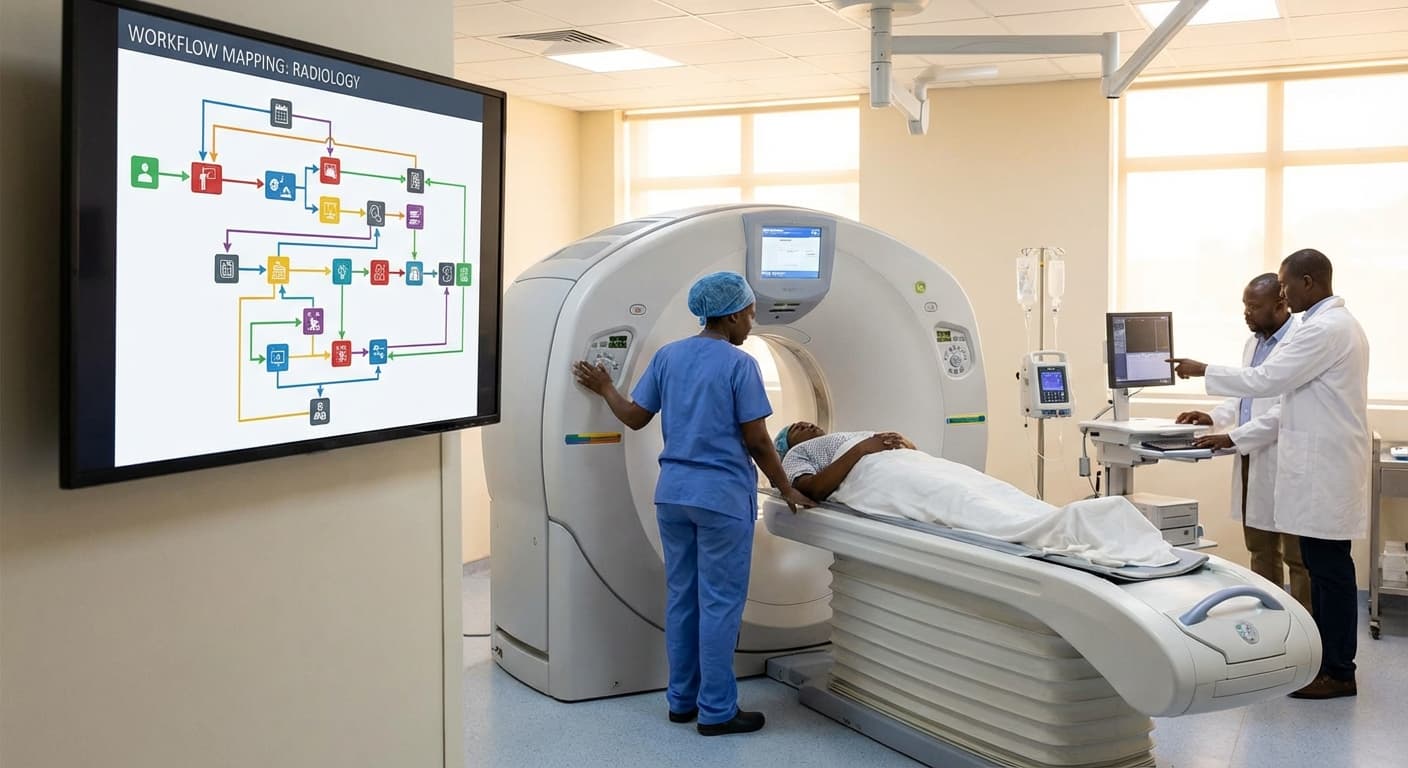
Department Workflow Mapping Service (Radiology/ICU/OT/Lab/Dialysis) in Ethiopia
Engineering Excellence & Technical Support
Department Workflow Mapping Service (Radiology/ICU/OT/Lab/Dialysis) High-standard technical execution following OEM protocols and local regulatory frameworks.
Streamlined Radiology Patient Flow
Optimizing the radiology workflow in Ethiopian hospitals to reduce patient wait times, improve image turnaround, and enhance diagnostic accuracy by mapping the entire patient journey from referral to report generation, including equipment utilization and staff coordination.
Lab Efficiency & Quality Assurance
Mapping critical laboratory processes in Ethiopia to identify bottlenecks, minimize sample contamination risks, and ensure timely delivery of accurate test results, thereby improving patient care and supporting public health initiatives.
Optimized ICU Patient Management
Enhancing the efficiency of Intensive Care Unit (ICU) operations in Ethiopia through detailed workflow mapping. This focuses on patient admission, treatment protocols, resource allocation (staff, equipment), and discharge processes to improve patient outcomes and reduce critical care resource strain.
What Is Department Workflow Mapping Service (Radiology/icu/ot/lab/dialysis) In Ethiopia?
Department Workflow Mapping Service (Radiology/ICU/OT/Lab/Dialysis) in Ethiopia refers to the systematic analysis, documentation, and optimization of operational processes within critical healthcare departments. This service aims to enhance efficiency, reduce errors, improve patient throughput, and ensure adherence to best practices and regulatory standards within Ethiopian healthcare facilities. It involves a detailed examination of all steps from patient registration and request initiation to service delivery, data recording, and resource allocation. The objective is to identify bottlenecks, redundancies, and areas for improvement, ultimately leading to more streamlined and effective patient care.
| Department | Who Needs This Service | Typical Use Cases |
|---|---|---|
| Radiology | Radiology departments, hospital administrators, quality assurance managers, IT departments | Streamlining patient imaging requests and reporting, optimizing equipment scheduling, reducing turnaround times for diagnostic reports, implementing PACS integration, improving radiographer workflow. |
| ICU (Intensive Care Unit) | ICU directors, critical care nurses, physicians, hospital management, patient safety officers | Optimizing patient admission and discharge processes, standardizing critical care protocols, improving interdisciplinary communication, managing equipment and medication delivery, reducing alarm fatigue, enhancing patient monitoring workflows. |
| OT (Operating Theatre) | Surgical department heads, operating room managers, anesthesiologists, surgical nurses, infection control teams | Improving surgical scheduling and patient flow, optimizing instrument and supply management, standardizing pre-operative and post-operative care pathways, enhancing sterilization and equipment turnaround, ensuring compliance with surgical safety checklists. |
| Lab (Laboratory) | Laboratory directors, pathologists, laboratory technicians, phlebotomists, IT personnel | Optimizing specimen collection, processing, and testing workflows, reducing test turnaround times, ensuring quality control procedures are integrated, implementing LIS integration, managing reagent and consumable inventory, improving sample tracking and reporting. |
| Dialysis | Nephrology department heads, dialysis unit managers, nephrologists, dialysis nurses, biomedical engineers | Streamlining patient scheduling and access, optimizing machine setup and cleaning protocols, ensuring efficient patient monitoring and documentation, managing water purification systems, improving medication administration, enhancing emergency response protocols. |
Key Components of Department Workflow Mapping Service
- Process Identification and Documentation: Detailed charting of all activities, decision points, and information flows within the department.
- Resource Analysis: Evaluation of equipment utilization, staff allocation, and material flow.
- Bottleneck Identification: Pinpointing areas where delays or inefficiencies occur.
- Risk Assessment: Identifying potential points of failure, error, or patient safety compromise.
- Technology Integration Assessment: Evaluating the current and potential use of IT systems (e.g., PACS, LIS, HIS) to support workflows.
- Standardization and Optimization: Developing standardized procedures and proposing improvements to increase efficiency and quality.
- Training and Implementation Support: Providing guidance on adopting new workflows and training personnel.
- Performance Measurement Framework: Establishing metrics to monitor workflow efficiency and effectiveness post-implementation.
Who Needs Department Workflow Mapping Service (Radiology/icu/ot/lab/dialysis) In Ethiopia?
In Ethiopia, efficient patient care and operational excellence within critical hospital departments are paramount. Department Workflow Mapping Services are vital for optimizing processes, reducing errors, and enhancing patient outcomes. This service specifically addresses the unique challenges and workflows present in Radiology, Intensive Care Units (ICU), Operating Theaters (OT), Laboratories, and Dialysis centers.
| Target Customer Type | Specific Departments Benefiting | Key Benefits of Workflow Mapping |
|---|---|---|
| Public Hospitals | Radiology, ICU, OT, Lab, Dialysis | Improved patient flow, resource optimization, cost reduction, enhanced service delivery to a wider population. |
| Private Hospitals & Clinics | Radiology, ICU, OT, Lab, Dialysis | Increased patient satisfaction, competitive advantage, revenue enhancement through efficient operations, improved turnaround times. |
| Specialty Centers (e.g., Cardiac, Oncology) | Radiology (for imaging), ICU (for critical care), OT (for procedures), Lab (for diagnostics), Dialysis (if applicable) | Tailored optimization for specialized patient pathways, ensuring seamless integration of diagnostic and treatment services. |
| Government Health Agencies & Ministries | Across all public healthcare facilities | Developing national standards, identifying areas for systemic improvement, facilitating evidence-based policy making, and effective resource allocation. |
| Medical Training Institutions | Radiology, ICU, OT, Lab, Dialysis (as part of curriculum) | Providing practical understanding of operational efficiency, training future healthcare professionals in process optimization and best practices. |
Who Needs Department Workflow Mapping Service in Ethiopia?
- Hospitals seeking to improve efficiency and reduce bottlenecks.
- Healthcare facilities aiming to enhance patient safety and reduce medical errors.
- Organizations looking to standardize processes across different departments or locations.
- Hospitals undergoing digital transformation or implementing new technologies.
- Facilities struggling with resource allocation and staff productivity.
- Radiology departments aiming to streamline image acquisition, interpretation, and reporting.
- ICUs needing to optimize patient monitoring, emergency response, and interdisciplinary communication.
- Operating Theaters requiring precise scheduling, instrument management, and surgical team coordination.
- Laboratories seeking to improve sample tracking, test processing, and result delivery.
- Dialysis centers focused on patient scheduling, treatment delivery, and equipment maintenance.
Department Workflow Mapping Service (Radiology/icu/ot/lab/dialysis) Process In Ethiopia
This document outlines the typical workflow for engaging a Department Workflow Mapping Service specializing in healthcare departments like Radiology, Intensive Care Unit (ICU), Operating Theatre (OT), Laboratory, and Dialysis within Ethiopia. The process is designed to be systematic, ensuring clear understanding, accurate mapping, and effective implementation of optimized workflows.
| Stage | Description | Key Activities | Deliverables | Responsible Parties |
|---|---|---|---|---|
| Inquiry and Initial Consultation | The client (hospital department management) initiates contact with the workflow mapping service provider. | Initial discussions about departmental challenges, goals, and interest in workflow mapping. Provider explains services offered. | Understanding of client's needs, preliminary service offering explanation. | Client (Department Head/Administrator), Service Provider (Business Development Manager/Lead Consultant) |
| Needs Assessment and Scope Definition | A deeper understanding of the specific department's processes and the project's objectives is established. | On-site visits, interviews with key personnel, observation of current processes, identification of pain points and desired outcomes. Defining the scope of the mapping (specific processes, user groups). | Detailed needs assessment report, defined project scope and objectives. | Service Provider (Consultants, Analysts), Client (Department Staff, Management) |
| Proposal and Agreement | A formal proposal outlining the project plan, methodology, timeline, deliverables, and costs is presented. | Development of a comprehensive proposal based on the needs assessment. Negotiation and agreement on terms and conditions. Signing of a contract or Memorandum of Understanding (MOU). | Formal Project Proposal, Signed Contract/MOU. | Service Provider, Client |
| Data Collection and Analysis | Gathering comprehensive information about the existing workflow. | Observation of daily operations, process mapping documentation (flowcharts), interviews, surveys, collection of performance metrics, review of existing SOPs and protocols. | Raw data, observed process documentation, preliminary data analysis report. | Service Provider (Analysts, Consultants), Client (Department Staff) |
| Workflow Mapping and Visualization | Translating collected data into visual representations of the current state. | Developing detailed process maps (e.g., using BPMN, flowcharts), identifying decision points, handoffs, dependencies, and resource utilization. Creating 'as-is' workflow diagrams. | 'As-is' workflow diagrams for selected departmental processes. | Service Provider (Analysts, Workflow Specialists) |
| Review and Validation | Ensuring the accuracy and completeness of the mapped workflows with the client. | Presenting the 'as-is' maps to department stakeholders for feedback, clarification, and validation. Incorporating revisions based on feedback. | Validated 'as-is' workflow diagrams. | Service Provider, Client (Department Staff, Management) |
| Recommendations and Optimization Plan | Identifying areas for improvement and proposing optimized workflows. | Analyzing the 'as-is' maps to identify bottlenecks, inefficiencies, redundancies, and risks. Developing recommendations for 'to-be' workflows, outlining potential solutions, and creating an optimization roadmap. | Recommendations report, proposed 'to-be' workflow diagrams, optimization plan. | Service Provider (Consultants, Analysts) |
| Implementation Support (Optional) | Assisting the client in putting the recommended changes into practice. | Training staff on new processes, developing new SOPs, assisting with technology integration, pilot testing of new workflows, change management support. | Training materials, revised SOPs, implementation progress reports. | Service Provider, Client (Department Staff, IT, Management) |
| Post-Implementation Review (Optional) | Evaluating the effectiveness of the implemented changes. | Measuring performance against baseline metrics, gathering feedback on the new workflows, identifying any further adjustments needed. | Post-implementation review report, lessons learned. | Service Provider, Client |
| Project Closure | Formal conclusion of the workflow mapping engagement. | Final report submission, knowledge transfer, final invoicing, and client sign-off. | Final project report, project closure documentation. | Service Provider, Client |
Workflow Stages
- Inquiry and Initial Consultation
- Needs Assessment and Scope Definition
- Proposal and Agreement
- Data Collection and Analysis
- Workflow Mapping and Visualization
- Review and Validation
- Recommendations and Optimization Plan
- Implementation Support (Optional)
- Post-Implementation Review (Optional)
- Project Closure
Department Workflow Mapping Service (Radiology/icu/ot/lab/dialysis) Cost In Ethiopia
Assessing the cost of Department Workflow Mapping Services in Ethiopia for critical departments like Radiology, ICU, OT (Operating Theater), Lab, and Dialysis requires a nuanced understanding of various pricing factors. These services are crucial for optimizing efficiency, identifying bottlenecks, improving patient flow, and ultimately enhancing the quality of care. The cost is not a fixed figure and can fluctuate significantly based on the complexity of the department, the extent of the mapping required, the experience of the consultants, and the duration of the engagement.
In Ethiopia, these services are typically provided by specialized consulting firms or experienced healthcare management professionals. The pricing is usually determined on a project basis, often with a combination of daily rates for consultants and a fixed project fee. The absence of standardized pricing in the Ethiopian healthcare consulting market means that direct comparisons can be challenging, and obtaining multiple quotes is highly recommended.
Key Pricing Factors:
- Department Complexity: Larger departments with more sub-specialties, a higher volume of patients, and more intricate processes (e.g., a large, busy OT or a specialized radiology department) will naturally incur higher mapping costs due to the increased scope and data collection required.
- Scope of Work: A comprehensive workflow mapping might include process analysis, data collection (patient flow, resource utilization, wait times), identification of inefficiencies, recommendations for improvement, and even implementation support. The more elements included in the scope, the higher the cost.
- Duration of Engagement: The time required for observation, data collection, analysis, and reporting will directly impact the cost. Longer engagements, especially for multiple departments or complex workflows, will be more expensive.
- Consultant Experience and Expertise: Highly experienced consultants with a proven track record in healthcare workflow optimization, particularly within the Ethiopian context, will command higher fees. Their expertise in understanding local healthcare realities is invaluable.
- Number of Consultants: The size of the consulting team deployed will influence the overall cost. Larger teams can potentially accelerate the project but will increase the daily personnel expenses.
- Data Collection Methodology: The tools and techniques used for data collection (e.g., direct observation, interviews, system data extraction) can also affect the cost. Advanced analytical tools or specialized software might add to the overall project expense.
- Deliverables: The nature and depth of the final deliverables (e.g., detailed reports, process flowcharts, implementation roadmaps, training materials) will influence the pricing.
- Location of the Facility: While not a primary driver, travel and accommodation expenses for consultants, especially for facilities located in remote areas of Ethiopia, will be factored into the overall cost.
- Urgency of the Project: Projects with tight deadlines may sometimes incur premium charges.
Cost Ranges in Ethiopian Birr (ETB):
Given the factors above and the dynamic nature of consulting fees in Ethiopia, it is challenging to provide exact figures. However, based on general market understanding for specialized consulting services, the following ranges can be expected for a typical Department Workflow Mapping Service engagement. These are indicative and should be used as a guide for budgeting and negotiation. It's crucial to note that these figures represent the total project cost and not per-department costs unless specified.
| Factor | Impact on Cost | Indicative Range (ETB) |
|---|---|---|
| Department Size & Complexity | Higher complexity/size = Higher cost | Small: ETB 150,000 - 300,000 | Medium: ETB 300,000 - 700,000 | Large: ETB 700,000 - 1,500,000+ |
| Scope of Services | Broader scope (analysis, recommendations, implementation support) = Higher cost | Basic Analysis: ETB 200,000 - 500,000 | Comprehensive: ETB 500,000 - 1,500,000+ |
| Consultant Expertise & Experience | More experienced/specialized consultants = Higher daily/project rates | Senior Consultants: Daily rates ETB 15,000 - 30,000+ (influences overall project cost) |
| Duration of Engagement | Longer projects = Higher total cost | Short-term (1-2 weeks): ETB 150,000 - 400,000 | Medium-term (3-6 weeks): ETB 400,000 - 1,000,000 | Long-term: ETB 1,000,000+ |
| Number of Departments Mapped | Mapping multiple departments = Proportional increase in cost | Single Dept: ETB 250,000 - 800,000 | Multiple Depts: ETB 700,000 - 2,000,000+ |
Estimated Cost Ranges for Department Workflow Mapping Services in Ethiopia (Indicative)
- Small-scale, focused mapping for a single, less complex area (e.g., a specific lab section or a single dialysis station) might range from ETB 150,000 - ETB 300,000.
- Moderate complexity mapping for a single department (e.g., standard Radiology, ICU, OT, Lab, or Dialysis) covering key workflows could range from ETB 300,000 - ETB 700,000.
- Comprehensive mapping for a large or highly specialized department, or for multiple departments within a single facility, could range from ETB 700,000 - ETB 1,500,000+.
- For very large hospital systems requiring extensive workflow analysis across several critical departments, the costs could exceed ETB 1,500,000 and be negotiated on a case-by-case basis.
Affordable Department Workflow Mapping Service (Radiology/icu/ot/lab/dialysis) Options
Streamline your department's operations with our affordable workflow mapping service, tailored for Radiology, ICU, Operating Theatre (OT), Laboratory, and Dialysis units. We identify inefficiencies, optimize processes, and enhance collaboration, leading to significant cost savings and improved patient care. Our service goes beyond simple documentation; we provide actionable insights and implementable solutions.
| Service Bundle | Key Features | Targeted Cost Savings | Example Applications | Pricing Tier |
|---|---|---|---|---|
| Core Workflow Mapping | Process visualization, bottleneck identification, preliminary recommendations. | Reduced overtime, improved staff utilization, minimized rework. | Radiology: Faster report turnaround; ICU: Smoother patient handover; OT: Reduced scheduling conflicts. | Entry-Level |
| Integrated Process Optimization | Inter-departmental analysis, cross-functional team collaboration, resource optimization strategies. | Shorter patient length of stay, decreased supply waste, optimized equipment utilization. | Lab: Faster sample processing and result delivery; Dialysis: Efficient patient scheduling and resource allocation. | Mid-Tier |
| Digital Transformation & Automation | EHR integration opportunities, digital charting, automated alerts, data analytics for performance monitoring. | Reduced administrative burden, minimized errors, improved data accuracy, enhanced decision-making. | All departments: Streamlined communication, reduced manual data entry, predictive maintenance for equipment. | Premium Tier |
| Lean Management Implementation | Kaizen events, value stream mapping, root cause analysis training, standardized work procedures. | Elimination of non-value-added activities, improved patient flow, increased staff satisfaction. | All departments: Continuous reduction of errors and waste, enhanced patient safety. | Add-On/Advanced |
Value Bundles & Cost-Saving Strategies
- {"title":"Core Workflow Mapping (Essential Insights)","description":"A foundational service focusing on critical patient pathways and staff interactions. Identifies major bottlenecks and opportunities for immediate efficiency gains."}
- {"title":"Integrated Process Optimization (Enhanced Efficiency)","description":"Builds upon Core Mapping by analyzing inter-departmental dependencies. Focuses on seamless transitions, reduced wait times, and improved resource allocation."}
- {"title":"Digital Transformation & Automation (Future-Proofing)","description":"Leverages technology to automate repetitive tasks, implement digital checklists, and integrate systems. Maximizes data utilization and minimizes human error."}
- {"title":"Lean Management Implementation (Continuous Improvement)","description":"Embeds Lean principles into your workflow, empowering staff to identify and solve problems proactively. Fosters a culture of ongoing improvement and waste reduction."}
Verified Providers In Ethiopia
In Ethiopia's evolving healthcare landscape, identifying verified providers is crucial for ensuring quality and safety. Franance Health stands out as a leading organization, distinguished by its rigorous credentialing process and unwavering commitment to excellence. This document outlines why Franance Health's verified providers represent the best choice for healthcare services in Ethiopia.
| Franance Health Credentialing Pillars | Description | Benefit to Patients |
|---|---|---|
| License and Certification Verification | Thorough checks of all medical licenses and certifications to ensure they are current and valid. | Guarantees that providers are legally qualified and recognized to practice medicine. |
| Professional Experience Assessment | Evaluation of past work experience, including specialties, duration, and practice settings. | Ensures providers have the practical skills and experience relevant to their claimed expertise. |
| Educational Background Review | Verification of medical degrees, postgraduate training, and any specialized educational achievements. | Confirms a strong theoretical foundation and advanced knowledge in their medical field. |
| Peer Review and Reputation | Gathering feedback from peers and assessing the provider's professional reputation within the medical community. | Provides an independent validation of the provider's clinical judgment and patient care approach. |
| Compliance and Ethical Standards | Ensuring adherence to national healthcare regulations, ethical guidelines, and best practices. | Upholds the highest standards of patient care, safety, and professional conduct. |
Why Choose Franance Health Verified Providers?
- Stringent Verification Process: Franance Health employs a multi-stage credentialing procedure, meticulously examining each provider's qualifications, licenses, experience, and adherence to ethical standards.
- Commitment to Quality: We prioritize patient well-being by partnering only with providers who demonstrate a consistent track record of delivering high-quality, compassionate care.
- Access to Expertise: Our network includes specialists and general practitioners across various medical fields, ensuring access to the best possible expertise for diverse healthcare needs.
- Trust and Reliability: The Franance Health seal of verification signifies a provider who has met our exacting standards, offering peace of mind and building trust with patients.
- Continuous Improvement: Franance Health actively monitors the performance of its verified providers, encouraging ongoing professional development and the adoption of best practices.
Scope Of Work For Department Workflow Mapping Service (Radiology/icu/ot/lab/dialysis)
This document outlines the Scope of Work (SOW) for a comprehensive Department Workflow Mapping Service. The service aims to analyze, document, and optimize workflows within critical hospital departments including Radiology, Intensive Care Unit (ICU), Operating Theatre (OT), Laboratory, and Dialysis. The objective is to identify inefficiencies, bottlenecks, and areas for improvement, ultimately leading to enhanced operational efficiency, patient safety, and service quality. This SOW details the technical deliverables and standard specifications to be adhered to throughout the project lifecycle.
| Deliverable | Description | Standard Specifications / Format | Key Components |
|---|---|---|---|
| Project Kick-off Meeting Minutes | Formal documentation of the initial project meeting, including objectives, scope confirmation, stakeholder identification, communication protocols, and preliminary timelines. | Word Document / PDF | Attendees, Meeting Date, Objectives, Scope Recap, Key Decisions, Action Items, Responsibilities, Deadlines. |
| Current State Workflow Maps (per department) | Visual representations of existing processes within each designated department, detailing steps, roles, systems, and decision points. | Visio Diagrams / Lucidchart / BPMN 2.0 compliant | Process Flowcharts, Swimlane Diagrams, Sequence Diagrams, Data Flow Diagrams. |
| Activity Logs & Interview Transcripts | Raw data collected from stakeholder interviews, observations, and documentation reviews, serving as the basis for workflow mapping. | Word Document / PDF / Spreadsheet | Interview Questions, Participant Information (anonymized where necessary), Date, Time, Key Discussion Points, Observations. |
| Bottleneck & Inefficiency Analysis Report | A comprehensive report identifying specific areas of delay, redundancy, manual workarounds, and potential risks within the current workflows. | Word Document / PDF | Identification of Bottlenecks, Root Cause Analysis, Impact Assessment (time, cost, quality, safety), Risk Register. |
| Optimized Future State Workflow Maps (per department) | Revised visual representations of proposed processes incorporating identified improvements, aiming for enhanced efficiency and effectiveness. | Visio Diagrams / Lucidchart / BPMN 2.0 compliant | Proposed Process Flows, Integration Points, Technology Adoption Opportunities, Resource Allocation Adjustments. |
| Recommendations Report | Detailed proposals for implementing optimized workflows, including technology solutions, policy changes, training needs, and performance metrics. | Word Document / PDF | Specific Recommendations, Implementation Plan Outline, Cost-Benefit Analysis (high-level), KPIs for Success Measurement. |
| Final Workflow Mapping Report | A consolidated document presenting the findings, analysis, and recommendations for all mapped departments. | Word Document / PDF | Executive Summary, Departmental Analysis (Current & Future State), Comprehensive Recommendations, Appendices (e.g., detailed data, glossary). |
| Knowledge Transfer Session Materials | Presentation slides and supporting documentation for sessions designed to transfer knowledge of the new workflows and recommendations to department stakeholders. | PowerPoint Presentation / PDF | Key Findings Review, Optimized Workflow Walkthrough, Implementation Guidance, Q&A Facilitation. |
Project Phases and Activities
- Phase 1: Project Initiation & Planning
- Phase 2: Discovery & Current State Analysis
- Phase 3: Workflow Design & Optimization Recommendations
- Phase 4: Documentation & Deliverables
- Phase 5: Project Closure & Knowledge Transfer
Service Level Agreement For Department Workflow Mapping Service (Radiology/icu/ot/lab/dialysis)
This Service Level Agreement (SLA) outlines the terms and conditions governing the provision of the Department Workflow Mapping Service, specifically for Radiology, Intensive Care Unit (ICU), Operating Theatre (OT), Laboratory, and Dialysis departments. It defines response times for support requests and uptime guarantees for the service.
| Service Component | Response Time Guarantee | Uptime Guarantee | Notes |
|---|---|---|---|
| Initial response to critical support request (e.g., system outage impacting mapping tool) | 2 Business Hours | 99.5% | A critical support request is defined as an issue that completely prevents access to or functionality of the workflow mapping tool, directly impacting the user's ability to perform their core duties related to mapping. |
| Initial response to high-priority support request (e.g., significant bug affecting workflow analysis) | 4 Business Hours | 99.5% | A high-priority support request is defined as an issue that significantly degrades the workflow mapping tool's performance or functionality, but does not completely prevent its use. |
| Initial response to medium-priority support request (e.g., minor bug, feature clarification) | 1 Business Day | 99.5% | A medium-priority support request is defined as an issue that causes minor inconvenience or requires clarification on a feature or process. |
| Initial response to low-priority support request (e.g., general query, enhancement suggestion) | 3 Business Days | 99.5% | A low-priority support request is defined as a general inquiry, a suggestion for improvement, or a request for information not directly related to an immediate operational issue. |
| Service Uptime (excluding scheduled maintenance) | N/A | 99.5% | Uptime is measured monthly. Scheduled maintenance will be communicated at least 48 hours in advance. This guarantee applies to the availability of the workflow mapping platform/tools. |
Scope of Service
- Workflow mapping analysis and documentation.
- Identification of bottlenecks and inefficiencies.
- Recommendations for process optimization.
- Support for understanding and implementing mapped workflows.
Frequently Asked Questions

Ready when you are
Let's scope your Department Workflow Mapping Service (Radiology/ICU/OT/Lab/Dialysis) in Ethiopia project in Ethiopia.

Scaling healthcare logistics and technical systems across the entire continent.