
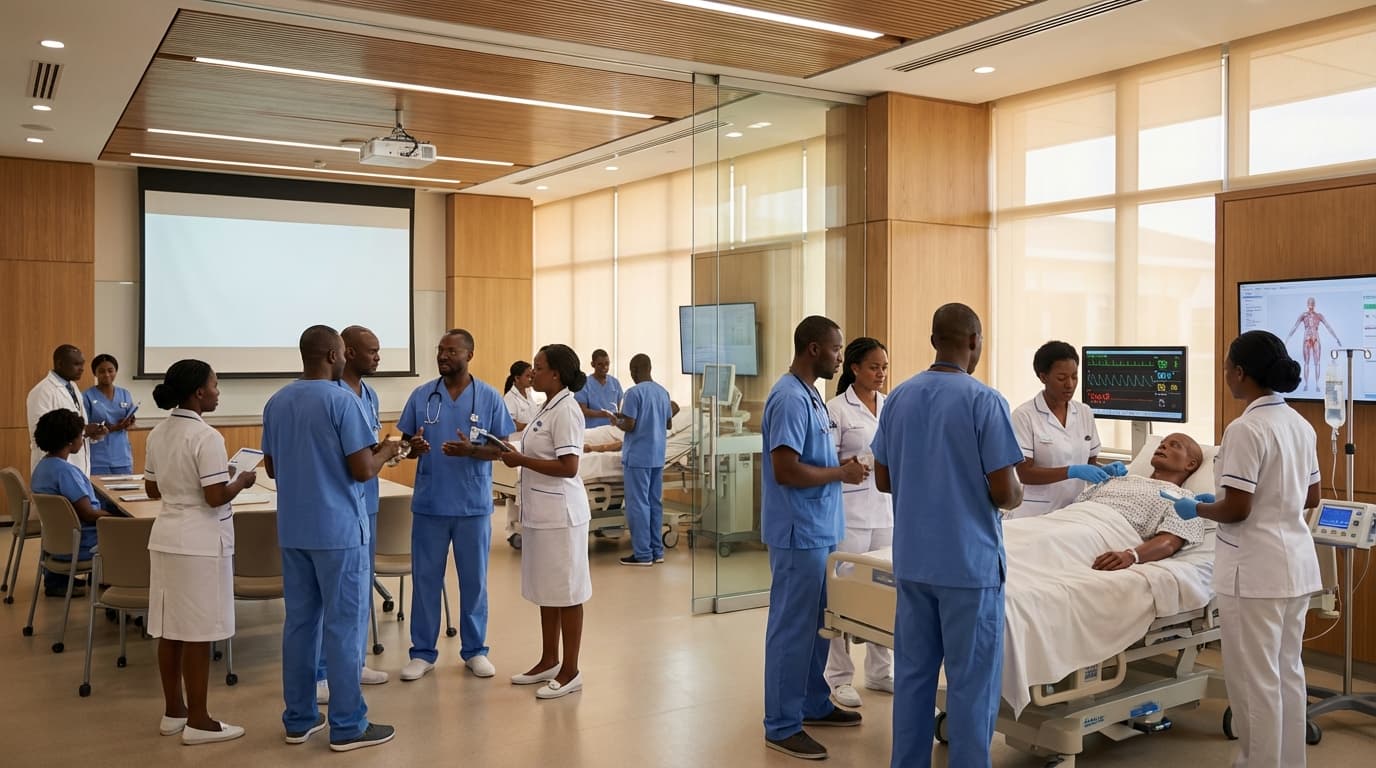
Equipment Training & Education in Eswatini
Engineering Excellence & Technical Support
Comprehensive equipment training and certification programs High-standard technical execution following OEM protocols and local regulatory frameworks.
Digital Learning Platform for Agricultural Equipment
Launched an interactive digital platform featuring animated simulations and step-by-step guides for operating and maintaining key agricultural machinery. This allows farmers and technicians across Eswatini to access training anytime, anywhere, improving efficiency and reducing equipment downtime.
Mobile Training Units for Remote Access
Deployed specially equipped mobile training units that travel to remote rural areas. These units provide hands-on training sessions for heavy machinery operation and basic repair, ensuring that even farmers in isolated communities receive essential skills development to maximize their agricultural productivity.
Virtual Reality (VR) Simulators for Complex Machinery
Introduced advanced VR simulators for training on complex industrial and mining equipment. This immersive technology allows trainees to practice intricate procedures in a safe, controlled environment, drastically reducing the risk of accidents and the cost of material damage during initial training phases.
What Is Equipment Training & Education In Eswatini?
Equipment training and education in Eswatini encompasses the systematic imparting of knowledge and practical skills necessary for the safe, efficient, and compliant operation, maintenance, and troubleshooting of various types of equipment. This service is critical across numerous sectors within the Eswatini economy to ensure productivity, minimize operational risks, and prolong equipment lifespan. It typically involves theoretical instruction, hands-on practical sessions, and performance assessments tailored to specific equipment models and operational contexts.
| Who Needs Equipment Training & Education? | Typical Use Cases | |||||
|---|---|---|---|---|---|---|
| Industrial Operators & Technicians: Personnel involved in the day-to-day operation and maintenance of machinery in manufacturing, processing, and mining sectors. | Agricultural Workers: Farmers and farm managers requiring training on tractors, harvesters, irrigation systems, and other agricultural machinery. | Construction Professionals: Site supervisors, heavy equipment operators, and maintenance crews for construction machinery, cranes, and power tools. | Healthcare Professionals: Medical technicians and engineers operating sophisticated medical diagnostic and therapeutic equipment. | Logistics & Transportation Personnel: Forklift operators, warehouse staff, and vehicle maintenance personnel for material handling and transport equipment. | Energy Sector Employees: Technicians and engineers responsible for the operation and maintenance of power generation and distribution equipment. | IT & Telecommunications Technicians: Individuals managing and maintaining network hardware, servers, and telecommunications infrastructure. |
| New Equipment Deployment: Onboarding new machinery requires comprehensive training for all relevant staff to ensure correct initial setup and operation. | Safety Compliance: Mandatory training to adhere to national and international safety standards, reducing workplace accidents. | Preventive Maintenance Programs: Training operators and technicians on routine checks and minor repairs to extend equipment life and reduce downtime. | Troubleshooting and Repair: Equipping staff to diagnose and fix common issues, minimizing reliance on external support. | Skill Upgradation & Cross-Training: Enhancing the capabilities of existing personnel and enabling them to operate a wider range of equipment. | New Technology Adoption: Training on the latest advancements and upgrades in industrial, medical, or agricultural equipment. | Emergency Preparedness: Educating personnel on procedures to follow in case of equipment failure or accidents. |
Key Components of Equipment Training & Education
- Theoretical Instruction: Covers principles of operation, safety protocols, regulatory compliance (e.g., occupational health and safety, environmental regulations), and technical specifications.
- Practical Skill Development: Focuses on hands-on demonstration and practice of operational procedures, routine maintenance tasks, diagnostic techniques, and emergency response.
- Troubleshooting and Diagnostics: Equips personnel with the ability to identify, analyze, and resolve equipment malfunctions using appropriate tools and methodologies.
- Safety and Risk Management: Integrates comprehensive safety training, hazard identification, risk mitigation strategies, and the correct use of personal protective equipment (PPE).
- Documentation and Record Keeping: Emphasizes the importance of accurate logging of operational data, maintenance activities, and incident reports.
- Performance Evaluation: Includes assessments to verify competency and ensure that personnel meet established standards for equipment operation and maintenance.
Who Needs Equipment Training & Education In Eswatini?
Effective equipment training and education are crucial for a wide range of individuals and organizations in Eswatini to ensure safe, efficient, and productive use of machinery and technology. This training empowers users to maximize equipment lifespan, minimize operational costs, and adhere to industry best practices and safety regulations.
| Sector/Industry | Key Roles Requiring Training | Specific Equipment Examples | Primary Departments Benefiting |
|---|---|---|---|
| Manufacturing | Machine Operators, Technicians, Supervisors | CNC Machines, Lathes, Welders, Conveyor Systems | Production, Maintenance, Quality Assurance |
| Agriculture | Farmers, Farm Managers, Operators | Tractors, Harvesters, Sprayers, Irrigation Pumps | Farm Operations, Agri-Business, Extension Services |
| Construction | Equipment Operators, Foremen, Site Engineers | Excavators, Cranes, Graders, Power Tools | Site Management, Operations, Safety |
| Mining | Mine Operators, Mechanics, Engineers | Loaders, Drills, Crushers, Conveyors | Operations, Maintenance, Engineering, Safety |
| Healthcare | Radiographers, Lab Technicians, Nurses | X-ray Machines, Microscopes, Ventilators, Autoclaves | Radiology, Pathology, Intensive Care, Central Sterilization |
| Logistics & Transportation | Forklift Operators, Warehouse Staff, Drivers | Forklifts, Pallet Jacks, Cranes, Delivery Trucks | Warehouse Operations, Fleet Management, Logistics |
| Energy & Utilities | Plant Operators, Technicians, Engineers | Turbines, Boilers, Switchgear, Water Treatment Units | Operations, Maintenance, Engineering |
| Government & Public Services | Road Maintenance Crew, Firefighters, Waste Management Staff | Road Rollers, Fire Trucks, Waste Compactors, Water Jetters | Public Works, Emergency Services, Sanitation |
| SMEs | Business Owners, Skilled Labor | Varies by business (e.g., printing presses, sewing machines, baking ovens) | All operational departments |
| Education | Instructors, Students | Workshop machinery, lab equipment, simulators | Vocational Training, Technical Colleges |
Target Customers & Departments in Eswatini for Equipment Training & Education
- {"item":"Manufacturing Sector","description":"Workers and supervisors operating heavy machinery, assembly lines, and specialized production equipment. Departments include Production, Maintenance, Quality Control, and Operations."}
- {"item":"Agricultural Sector","description":"Farmers, farm managers, and agricultural extension officers utilizing tractors, harvesters, irrigation systems, and other farm machinery. Departments include Farm Management, Agricultural Extension Services, and Agribusiness."}
- {"item":"Construction Sector","description":"Construction workers, site supervisors, and machinery operators handling excavators, cranes, bulldozers, concrete mixers, and power tools. Departments include Site Management, Operations, and Safety."}
- {"item":"Mining Sector","description":"Miners, engineers, and maintenance staff operating heavy mining equipment, drilling machinery, and processing units. Departments include Operations, Maintenance, Engineering, and Safety."}
- {"item":"Healthcare Sector","description":"Medical professionals and technicians operating diagnostic equipment (e.g., MRI, CT scanners), laboratory equipment, and surgical instruments. Departments include Radiology, Laboratory Services, Surgical Units, and Biomedical Engineering."}
- {"item":"Logistics & Transportation Sector","description":"Drivers, warehouse staff, and logistics managers operating forklifts, trucks, cranes, and other material handling equipment. Departments include Warehouse Management, Fleet Management, and Operations."}
- {"item":"Energy & Utilities Sector","description":"Technicians and engineers involved in the operation and maintenance of power generation equipment, transmission systems, and water treatment facilities. Departments include Operations, Maintenance, and Engineering."}
- {"item":"Government & Public Services","description":"Personnel in departments responsible for infrastructure maintenance (e.g., roads, water), emergency services (e.g., fire trucks, ambulances), and public works operating specialized equipment. Departments include Public Works, Emergency Services, and Municipalities."}
- {"item":"Small & Medium Enterprises (SMEs)","description":"Business owners and employees who invest in and utilize various types of equipment for their operations, requiring basic to advanced operational and maintenance knowledge. This can span across multiple industries."}
- {"item":"Educational Institutions","description":"Vocational training centers, technical colleges, and universities offering courses in trades and technical fields, requiring trainers and students to be proficient with educational equipment and machinery."}
Equipment Training & Education Process In Eswatini
The Equipment Training & Education Process in Eswatini outlines the structured journey from an initial inquiry about equipment training services to the successful execution and completion of the training program. This process is designed to ensure that all stakeholders' needs are met, from understanding the training requirements to delivering high-quality education and providing necessary documentation. The workflow typically involves several key stages, each with specific actions and responsibilities.
| Stage | Key Activities | Responsible Party | Deliverables/Outcomes |
|---|---|---|---|
| Potential client expresses interest in equipment training. Initial discussion to understand basic needs and available training options. Provide general information about services offered. | Prospective Client, Training Provider | Initial contact established. Basic understanding of client's intent. |
| Detailed discussion to identify specific equipment, skill gaps, and training objectives. Site visit may be conducted to assess existing infrastructure. Develop a tailored training proposal outlining scope, methodology, and duration. | Training Provider, Prospective Client | Detailed training needs identified. Formal training proposal submitted. |
| Provide a detailed quotation based on the approved proposal. Negotiate terms, pricing, and contractual agreements. Finalize and sign the training contract. | Training Provider, Prospective Client | Agreed-upon quotation. Signed training contract. |
| Develop or adapt training modules and materials specific to the equipment and client's needs. Define learning objectives, content, and assessment methods. Obtain client approval for training curriculum. | Training Provider (Trainers/Curriculum Developers) | Approved training curriculum and materials. |
| Assign qualified trainers. Book training facilities and necessary equipment. Schedule training dates and times in coordination with the client. | Training Provider (Operations/Logistics Team) | Allocated trainers. Scheduled training sessions. |
| Conduct theoretical and practical training sessions as per the curriculum. Facilitate hands-on practice and demonstrations. Address participant questions and provide guidance. | Training Provider (Trainers), Participants | Completed training sessions. Participants engaged in learning. |
| Assess participant learning through written tests, practical demonstrations, or simulations. Collect feedback from participants on the training effectiveness and delivery. | Training Provider (Trainers), Participants | Assessment results. Participant feedback collected. |
| Issue certificates of completion to successful participants. Provide a comprehensive training report to the client, including attendance, assessment results, and recommendations. | Training Provider (Administration/Training Department) | Certificates of completion. Final training report. |
| Offer follow-up support or refresher sessions if required. Gather final feedback from the client on the overall process and outcomes. Maintain records for future reference. | Training Provider, Client | Client satisfaction confirmed. Records updated. |
Equipment Training & Education Workflow in Eswatini
- Inquiry & Initial Consultation
- Needs Assessment & Proposal Development
- Quotation & Contract Negotiation
- Training Planning & Curriculum Design
- Resource Allocation & Scheduling
- Training Delivery & Execution
- Assessment & Evaluation
- Certification & Documentation
- Post-Training Support & Feedback
Equipment Training & Education Cost In Eswatini
Equipment training and education costs in Eswatini can vary significantly depending on several factors. These factors influence the overall price of acquiring the necessary skills to operate and maintain specific machinery or technology. Understanding these pricing determinants is crucial for businesses and individuals seeking to invest in relevant training programs.
The cost of equipment training in Eswatini is influenced by a combination of global and local economic conditions, as well as the specific nature of the training itself. Key pricing factors include:
- Type and Complexity of Equipment: Training for basic hand tools will be significantly cheaper than for advanced industrial machinery, medical equipment, or specialized software. The more intricate and specialized the equipment, the higher the training cost due to the need for expert trainers and more sophisticated learning materials.
- Duration and Intensity of Training: Shorter, introductory courses will naturally cost less than comprehensive, multi-day workshops or certification programs. The depth of knowledge and practical application required will dictate the length and therefore the price.
- Trainer Expertise and Qualifications: Highly experienced trainers with specialized knowledge and industry certifications will command higher fees. The reputation and proven track record of the training provider also play a role.
- Training Methodology: Hands-on, practical training often incurs higher costs than purely theoretical classroom sessions due to the need for actual equipment, consumables, and dedicated training facilities. Online or blended learning approaches might offer some cost efficiencies but can also have their own associated expenses.
- Training Location and Logistics: If training is conducted on-site at the client's location, costs might include travel, accommodation, and potential disruption to operations. Conversely, training at a dedicated training center may include facility rental and resource allocation.
- Accreditation and Certification: Programs leading to internationally or nationally recognized certifications often come with higher price tags, reflecting the rigor of the assessment process and the value of the credential.
- Training Provider: Different training institutions, vocational schools, and private training companies will have varying pricing structures based on their overhead, market position, and the value they offer.
- Demand and Supply: In areas where there is high demand for specific skills and limited training providers, costs can be higher. Conversely, abundant training options might lead to more competitive pricing.
Pricing Ranges in Eswatini (Emalangeni - SZL):
It's challenging to provide definitive, fixed pricing as it fluctuates. However, based on general market observations, the following ranges can offer a guideline for various types of equipment training in Eswatini. These are approximate and can vary widely.
| Training Category | Approximate Price Range (SZL) | Notes |
|---|---|---|
| Basic Hand Tools & Small Machinery Operation (e.g., lawnmowers, basic construction tools) | SZL 500 - SZL 2,500 | Typically short courses, often conducted by suppliers or local vocational centers. |
| General Industrial Machinery Operation (e.g., forklifts, basic manufacturing equipment) | SZL 2,000 - SZL 7,000 | Includes practical sessions, safety protocols, and potentially basic certification. |
| Agricultural Equipment Operation & Maintenance (e.g., tractors, harvesters) | SZL 3,000 - SZL 8,000 | Often offered by agricultural colleges, government initiatives, or equipment dealerships. |
| Automotive Mechanical Training (e.g., basic mechanics, diagnostics) | SZL 4,000 - SZL 15,000+ | Can range from introductory courses to more in-depth apprenticeship programs at technical institutes. |
| Specialized Industrial Equipment (e.g., heavy construction machinery, advanced manufacturing) | SZL 7,000 - SZL 25,000+ | Requires highly specialized trainers, often conducted by manufacturers or specialized training firms, may include international certification. |
| Medical Equipment Operation & Maintenance (e.g., diagnostic machines, lab equipment) | SZL 10,000 - SZL 50,000+ | Highly specialized, requires certified medical equipment trainers, often conducted by manufacturers or international organizations. |
| IT & Software Training (specific industry software, programming for equipment control) | SZL 3,000 - SZL 20,000+ | Varies greatly based on software complexity, duration, and trainer credentials. Can be online or in-person. |
Key Factors Influencing Equipment Training Costs in Eswatini
- Type and Complexity of Equipment
- Duration and Intensity of Training
- Trainer Expertise and Qualifications
- Training Methodology (e.g., Hands-on vs. Theoretical)
- Training Location and Logistics
- Accreditation and Certification Requirements
- Reputation and Resources of the Training Provider
- Market Demand and Availability of Training
Affordable Equipment Training & Education Options
Acquiring and maintaining specialized equipment is a significant investment for many industries. However, the upfront cost of equipment is only part of the equation. Proper training and education are crucial to ensure safe, efficient, and optimal use, maximizing your return on investment. Fortunately, numerous affordable options exist, often bundled with cost-saving strategies to make this essential training accessible. Value bundles typically combine equipment purchases with training packages, while cost-saving strategies involve leveraging existing resources, exploring group discounts, and utilizing government or industry grants.
| Strategy | Description | Cost-Saving Benefit | |
|---|---|---|---|
| Value Bundles | Purchasing equipment with integrated training packages, often at a discounted rate compared to buying separately. | Reduced overall cost for equipment and essential training. | Leveraging manufacturer discounts or bundled offers. |
| Group Discounts | Organizing training for multiple employees or multiple organizations to benefit from bulk pricing. | Lower per-person training cost. | Pooling resources with neighboring businesses or industry peers. |
| Phased Training | Breaking down comprehensive training into smaller, more manageable modules delivered over time, aligning with budget cycles. | Distributes training costs, easing immediate financial strain. | Focusing on critical skills first, then expanding as budget allows. |
| Train-the-Trainer | Investing in a few key individuals to become internal trainers, who can then train the rest of the workforce. | Significantly reduces long-term training expenses as internal capacity is built. | Leveraging existing expertise within the organization. |
| Government & Industry Grants | Researching and applying for grants or subsidies offered by government agencies or industry bodies to fund training initiatives. | Can cover a substantial portion or even the entirety of training costs. | Proactive research into available funding opportunities. |
| E-Learning & Digital Resources | Utilizing online courses, webinars, and digital manuals, which are often more cost-effective than in-person sessions. | Lower overhead costs associated with physical locations and instructor travel. | Accessibility and self-paced learning reduce scheduling conflicts. |
| Partnerships with Educational Institutions | Collaborating with local colleges or vocational schools for customized training programs or access to their facilities and instructors. | Often more affordable than specialized private training providers. | Negotiating bulk or recurring training contracts. |
Affordable Equipment Training & Education Options
- Online Courses & Webinars
- Manufacturer-Provided Training
- Community College & Vocational Schools
- Industry Association Workshops
- Apprenticeship Programs
- Train-the-Trainer Programs
- Simulation & Virtual Reality Training
- On-the-Job Training (OJT) with Structured Programs
- Open-Source Educational Resources
Verified Providers In Eswatini
In Eswatini's healthcare landscape, identifying genuinely qualified and ethical medical providers is paramount for patient safety and effective treatment. This pursuit often leads to questions about how to distinguish the best from the rest. Franance Health stands out as a beacon of reliability, offering a comprehensive network of verified providers. Their rigorous credentialing process ensures that all affiliated medical professionals meet the highest standards of education, experience, and ethical practice. Choosing a Franance Health verified provider means opting for assurance, expertise, and a commitment to your well-being.
| Provider Type | Key Verification Criteria | Franance Health Assurance |
|---|---|---|
| Doctors (General Practitioners & Specialists) | Medical Council Registration, University Degrees, Residency/Fellowship Completion, Board Certifications | Confirms active licensure, validated academic and practical training, and adherence to Eswatini's medical standards. |
| Nurses (RNs, ENs) | Nursing Council Registration, Diplomas/Degrees, Clinical Experience | Verifies qualified and registered nursing professionals actively practicing within the regulatory framework. |
| Pharmacists | Pharmacy Council Registration, Degree in Pharmacy, Internship Completion | Ensures licensed and competent pharmacists dispensing medications safely and accurately. |
| Medical Laboratories & Diagnostic Centers | Ministry of Health Accreditation, Quality Control Measures, Certified Technicians | Guarantees adherence to diagnostic standards, accurate testing, and the use of qualified personnel. |
| Hospitals & Clinics | Ministry of Health Licensing, Infrastructure Standards, Quality Management Systems, Staff Qualifications | Confirms licensed healthcare facilities meeting safety, operational, and professional staffing requirements. |
Why Franance Health Credentials Matter:
- Rigorous Vetting Process: Franance Health employs a multi-stage verification system that scrutinizes medical licenses, educational qualifications, and professional affiliations.
- Commitment to Ethical Standards: All verified providers adhere to a strict code of conduct, prioritizing patient care, confidentiality, and professional integrity.
- Continuous Professional Development: Franance Health encourages and often mandates ongoing training and education for its network, ensuring providers stay abreast of the latest medical advancements.
- Patient-Centric Approach: Verified providers are recognized for their dedication to patient satisfaction and providing personalized, high-quality healthcare experiences.
- Access to Specialized Expertise: The network encompasses a diverse range of medical specialists, allowing patients to find the right expert for their specific needs.
- Trust and Peace of Mind: Partnering with Franance Health provides a significant level of trust, knowing you are receiving care from accredited and reputable professionals.
Scope Of Work For Equipment Training & Education
This Scope of Work (SOW) outlines the requirements for comprehensive equipment training and educational services. The objective is to ensure that designated personnel gain the necessary knowledge and practical skills to effectively operate, maintain, and troubleshoot the specified equipment, adhering to industry best practices and safety standards. The training program will cover theoretical concepts, hands-on practical exercises, and ongoing support.
| Deliverable Title | Description | Standard Specifications / Acceptance Criteria | Format | Responsibility |
|---|---|---|---|---|
| Training Curriculum Document | Detailed outline of all training modules, learning objectives, and session plans. | Must cover all listed Key Training Modules. Learning objectives to be SMART (Specific, Measurable, Achievable, Relevant, Time-bound). | PDF Document | Training Provider |
| Participant Training Manuals | Comprehensive reference material for each participant, covering all training content. | Includes theoretical explanations, step-by-step procedures, diagrams, and troubleshooting guides. Must be aligned with the Training Curriculum. | Printable PDF, Digital E-book (optional) | Training Provider |
| Hands-on Training Sessions | Practical, instructor-led sessions using actual or simulated equipment. | Minimum of X hours of practical training per module. All exercises to be conducted in a safe environment, following established safety protocols. Successful completion of practical assessments. | Live/Simulated Sessions | Training Provider |
| Assessment Materials (Quizzes/Exams) | Tools to evaluate participant understanding and skill acquisition. | Multiple-choice, short answer, and practical assessment components. Pass rate of Y% required for certification. | Digital/Printable Documents | Training Provider |
| Training Completion Certificates | Formal acknowledgment of successful completion of the training program. | Issued to participants who meet the defined pass rate for assessments. Certificate to include participant name, training dates, and equipment covered. | Digital PDF, Printed Certificate | Training Provider |
| Post-Training Support Plan | Outline of available support channels and resources after initial training. | Includes details on hotline support, email support, access to online knowledge base, and potential for follow-up refresher sessions. | Document (PDF/Word) | Training Provider |
| Trainer Qualifications & Experience Report | Documentation of the qualifications, certifications, and relevant experience of the training instructors. | Instructors must have a minimum of Z years of experience with the specified equipment and relevant training certifications. | Document (PDF/Word) | Training Provider |
| Training Equipment & Facilities | Details of the equipment and facilities used for training. | All training equipment must be in good working order and calibrated. Training environment must be safe, well-lit, and conducive to learning. | Site Inspection Checklist / Confirmation | Training Provider / Client |
| End-User License Agreement (EULA) for Training Software (if applicable) | Terms and conditions for any proprietary training software used. | Must comply with relevant data protection and intellectual property laws. | Digital Document | Training Provider |
| Training Feedback Forms | Mechanism for participants to provide feedback on the training program. | Forms to gather input on trainer effectiveness, content relevance, and overall satisfaction. Analysis of feedback to be provided. | Digital/Printable Forms, Analysis Report | Training Provider |
Key Training Modules & Objectives
- Module 1: Equipment Overview & Safety Procedures
- Module 2: Basic Operation & Controls
- Module 3: Advanced Operation & Performance Tuning
- Module 4: Routine Maintenance & Inspection
- Module 5: Troubleshooting & Problem Diagnosis
- Module 6: Calibration & Quality Control
- Module 7: System Integration & Interfacing
- Module 8: Operator & Maintenance Log Keeping
Service Level Agreement For Equipment Training & Education
This Service Level Agreement (SLA) outlines the commitment to providing timely and effective training and educational services for specified equipment. It defines response times for support requests and uptime guarantees for access to training resources.
| Service Component | Service Level Objective (SLO) | Measurement Period | Remedy for Failure |
|---|---|---|---|
| Response Time for Critical Support Requests (during Business Hours) | 1 Business Hour | Per Request | 10% discount on next training session or 5 hours of free online support. |
| Response Time for Standard Support Requests (during Business Hours) | 4 Business Hours | Per Request | 5% discount on next training session or 2.5 hours of free online support. |
| Uptime Guarantee for Online Training Platform | 99.5% | Monthly | For every 1% of downtime below 99.5%, Client receives a credit of 2% of the monthly subscription fee for the training platform. |
| Availability of Scheduled Training Sessions | 100% | As per agreed schedule | Reschedule at no additional cost, or provide alternative session with equivalent content within 5 business days. |
| Timeliness of Delivery of New Training Materials (as agreed) | As per project timeline | Per agreed project | Extension of support period by 10% of the delay, or a credit of 5% of the material development cost. |
Key Definitions
- Training Session: A scheduled or on-demand learning event focused on equipment operation, maintenance, or troubleshooting.
- Support Request: A formal inquiry submitted by the Client regarding technical issues, clarification on training materials, or scheduling adjustments.
- Uptime: The percentage of time that the designated online training platform or portal is accessible and operational for the Client's users.
- Downtime: The percentage of time that the designated online training platform or portal is inaccessible or non-operational.
- Business Hours: Monday through Friday, 9:00 AM to 5:00 PM (Local Time of Service Provider), excluding public holidays.
- Critical Issue: An issue that significantly impairs the ability to access or utilize core training functionalities, preventing the completion of essential learning objectives.
Frequently Asked Questions

Ready when you are
Let's scope your Equipment Training & Education in Eswatini project in Eswatini.

Scaling healthcare logistics and technical systems across the entire continent.