
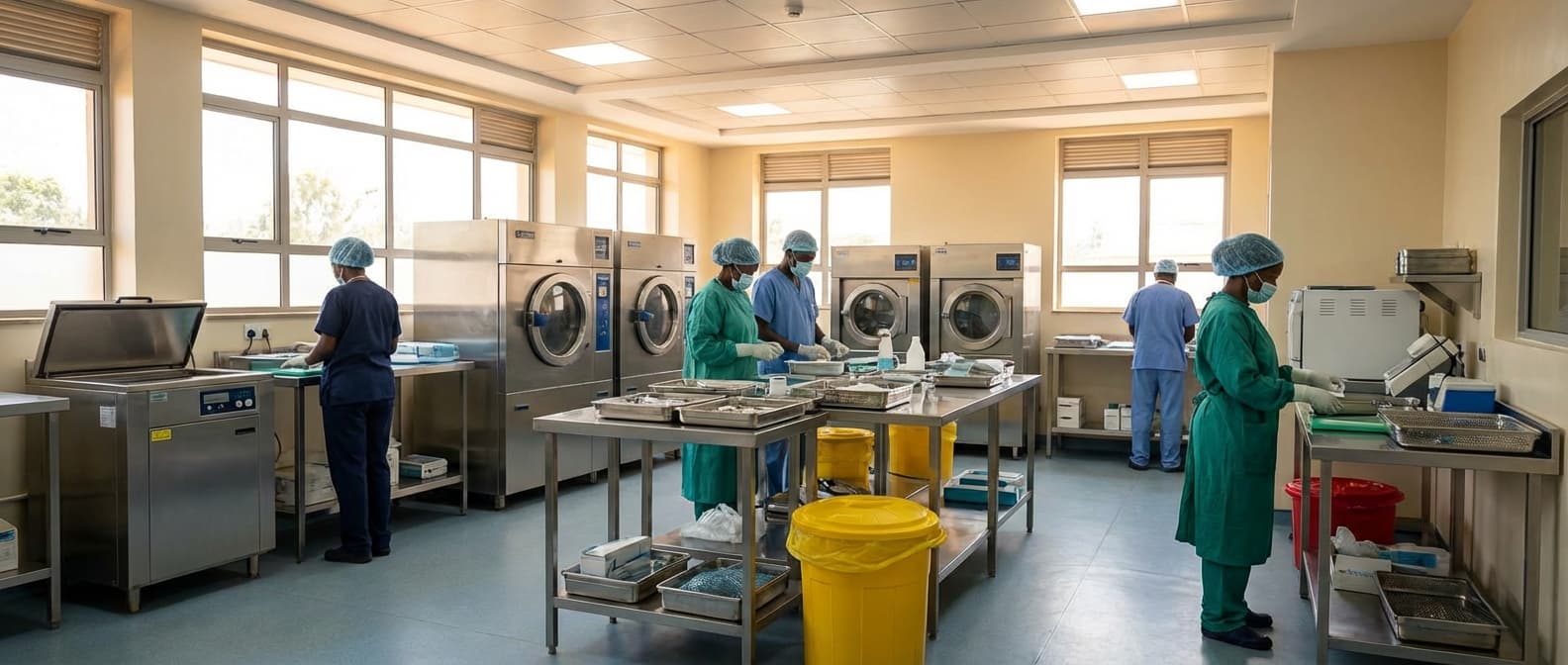
Infection-Control Readiness Support Service for Reusable Equipment in Eswatini
Engineering Excellence & Technical Support
Infection-Control Readiness Support Service for Reusable Equipment High-standard technical execution following OEM protocols and local regulatory frameworks.
Advanced Decontamination Protocols
Leveraging WHO-endorsed, evidence-based decontamination protocols for critical reusable medical equipment, ensuring effective inactivation of pathogens and adherence to international standards. This includes validated multi-step cleaning, disinfection, and sterilization processes tailored to specific equipment types.
Comprehensive Training & Competency Assurance
Implementing a rigorous training program for healthcare personnel on proper handling, cleaning, disinfection, and sterilization of reusable equipment. This includes practical skills assessments and ongoing competency verification to maintain a high standard of infection prevention practices across all supported facilities.
Equipment Maintenance & Quality Control
Providing expert technical support for the maintenance and calibration of decontamination equipment (e.g., autoclaves, washer-disinfectors) and conducting regular quality control checks to ensure optimal performance and consistent sterilization efficacy. This proactive approach minimizes downtime and guarantees the safety of reusable medical devices.
What Is Infection-control Readiness Support Service For Reusable Equipment In Eswatini?
Infection-Control Readiness Support Service for Reusable Equipment in Eswatini refers to a comprehensive program designed to ensure that healthcare facilities in Eswatini possess the necessary infrastructure, personnel, protocols, and resources to safely and effectively clean, disinfect, and sterilize reusable medical equipment. This service aims to mitigate the risk of healthcare-associated infections (HAIs) transmitted through contaminated equipment, thereby enhancing patient safety and improving healthcare outcomes.
| Component | Description | Objective |
|---|---|---|
| Needs Assessment | Systematic evaluation of current practices, resources, and infrastructure. | Identify deficiencies and areas for improvement in infection control readiness. |
| Protocol Development | Creation or revision of Standard Operating Procedures (SOPs) for cleaning, disinfection, and sterilization. | Establish clear, evidence-based guidelines for safe reprocessing. |
| Staff Training | Comprehensive education and practical skills development for healthcare workers. | Enhance staff competency in handling and reprocessing reusable equipment. |
| Equipment & Infrastructure Evaluation | Assessment of sterilization equipment, utilities, and reprocessing spaces. | Ensure adequate and functional resources for effective reprocessing. |
| Quality Monitoring | Implementation of auditing and validation mechanisms for reprocessing processes. | Verify the effectiveness and consistency of infection control measures. |
Typical Use Cases:
- Routine Reprocessing of Surgical Instruments: Ensuring all surgical instruments are meticulously cleaned, disinfected, and sterilized before each use to prevent surgical site infections.
- Management of Endoscopes: Implementing stringent protocols for the high-level disinfection or sterilization of flexible endoscopes used in diagnostic and therapeutic procedures to avoid cross-contamination.
- Sterilization of Dental Instruments: Ensuring the safe reprocessing of dental instruments, such as drills, probes, and forceps, to prevent the transmission of blood-borne pathogens.
- Disinfection of Respiratory Therapy Equipment: Decontaminating nebulizers, ventilators, and other respiratory devices that come into contact with patients' airways.
- Handling of Dialysis Equipment: Implementing specialized protocols for the cleaning and disinfection of reusable components of hemodialysis machines and associated accessories.
- Post-outbreak or Post-event Readiness: Enhancing preparedness and response capabilities following an outbreak of an infectious disease or after a significant event impacting healthcare delivery.
- Introduction of New Reusable Medical Technologies: Providing support for the safe implementation and reprocessing of newly acquired reusable medical equipment.
Who Needs Infection-control Readiness Support Service For Reusable Equipment In Eswatini?
The Infection-Control Readiness Support Service for Reusable Equipment in Eswatini is designed to empower healthcare facilities across the nation to maintain the highest standards of patient safety. This service is crucial for any institution that utilizes reusable medical devices, instruments, and equipment, ensuring they are properly cleaned, disinfected, and sterilized to prevent the transmission of healthcare-associated infections (HAIs).
| Customer Type | Primary Departments Served | Key Needs Addressed |
|---|---|---|
| Hospitals (Tertiary, Regional, Health Centre) | Surgical Theatres, CSSD, Operating Rooms, Maternity, Outpatient, Emergency, Wards | Standardization of cleaning and sterilization protocols, staff training on decontamination processes, equipment maintenance and validation, audit and compliance support, outbreak prevention. |
| Clinics and Health Centres | Treatment Rooms, Minor Procedure Rooms, Dental Clinics | Basic infection control training for reusable items, guidance on appropriate disinfectants and sterilants, establishment of simple but effective reprocessing workflows, ensuring availability of essential supplies. |
| Central Sterile Supply Departments (CSSDs) | All areas involved in the decontamination and sterilization of surgical instruments and equipment | Advanced training on sterilization technologies, quality assurance and control, workflow optimization, management of sterilization equipment, compliance with national and international standards. |
| Infection Prevention and Control (IPC) Committees/Teams | All departments within a healthcare facility | Development and implementation of IPC policies and guidelines related to reusable equipment, risk assessments, surveillance of HAIs, training of healthcare workers, support for regulatory compliance. |
| Ministry of Health & NGOs | National healthcare system oversight and program implementation | Development of national guidelines, capacity building for healthcare facilities, monitoring and evaluation of infection control practices, support for procurement and supply chain management of infection control products. |
Target Customers and Departments
- Hospitals (Tertiary, Regional, and Health Centre Hospitals)
- Clinics and Health Centres
- Surgical Theatres
- Maternity Wards
- Dental Clinics
- Outpatient Departments
- Emergency Departments
- Central Sterile Supply Departments (CSSDs)
- Operating Room Suites
- Infection Prevention and Control (IPC) Committees and Teams
- Ministry of Health and various health-related NGOs
Infection-control Readiness Support Service For Reusable Equipment Process In Eswatini
This service aims to bolster infection-control readiness for the handling and reprocessing of reusable medical equipment in Eswatini. The workflow encompasses a comprehensive process, from the initial identification of a need through to the full implementation and ongoing support of improved infection control practices.
| Phase | Key Activities | Deliverables | Responsible Parties |
|---|---|---|---|
| Healthcare facilities or national health authorities identify a need for improved infection control for reusable equipment. Initial contact and discussion of challenges and objectives. | Inquiry document, preliminary needs overview. | Eswatini Healthcare Facility/Authority, Service Provider. |
| Service provider develops a tailored proposal outlining scope, methodology, timeline, and budget. Negotiation and signing of a service agreement. | Detailed project proposal, signed service agreement. | Service Provider, Eswatini Healthcare Facility/Authority. |
| On-site assessment of current reusable equipment reprocessing workflows, infrastructure, staff knowledge, and existing infection control protocols. Identification of specific gaps and risks. | Diagnostic assessment report, gap analysis findings, risk assessment. | Service Provider (Infection Control Specialists, Technical Experts). |
| Based on the gap analysis, development of tailored Standard Operating Procedures (SOPs), guidelines, checklists, and recommendations for infrastructure improvements. | Revised SOPs, infection control guidelines, infrastructure improvement plan. | Service Provider, with input from Eswatini Healthcare Facility/Authority. |
| Conducting comprehensive training sessions for healthcare workers on correct reprocessing techniques, sterilization, disinfection, waste management, and the use of new protocols and equipment. | Training modules, trained personnel, training attendance records, competency assessments. | Service Provider (Trainers), Eswatini Healthcare Facility Staff. |
| Procurement and delivery of necessary equipment (e.g., sterilizers, washers, testing devices) and consumables (e.g., disinfectants, cleaning agents, PPE) as per the agreed scope. | Delivered equipment and supplies, inventory records. | Service Provider, Eswatini Healthcare Facility/Authority (for customs/receipt). |
| Assisting facilities in implementing the new protocols and using new equipment. Regular monitoring of adherence to SOPs and infection control practices. On-site supervision and feedback. | Implemented protocols, initial monitoring reports, corrective action plans. | Service Provider, Eswatini Healthcare Facility/Authority. |
| Providing remote or on-site support for troubleshooting, addressing new challenges, and conducting periodic evaluations of the effectiveness of implemented measures. Data collection on infection rates and compliance. | Support logs, evaluation reports, performance metrics. | Service Provider, Eswatini Healthcare Facility/Authority. |
| Ensuring knowledge transfer to local champions within facilities for long-term sustainability. Developing plans for continuous quality improvement and internal monitoring mechanisms. | Local champions identified, sustainability plan, quality improvement framework. | Service Provider, Eswatini Healthcare Facility/Authority. |
Infection-Control Readiness Support Service Workflow
- Inquiry & Needs Assessment
- Proposal & Agreement
- Diagnostic Assessment & Gap Analysis
- Development of Customized Solutions
- Training & Capacity Building
- Equipment & Supplies Provision (if applicable)
- Implementation & Monitoring
- Ongoing Support & Evaluation
- Knowledge Transfer & Sustainability
Infection-control Readiness Support Service For Reusable Equipment Cost In Eswatini
This document outlines the pricing factors and estimated cost ranges for an Infection-Control Readiness Support Service for Reusable Equipment in Eswatini, expressed in Eswatini Lilangeni (SZL). The service aims to ensure that healthcare facilities maintain high standards of reusable medical equipment sterilization and disinfection, crucial for preventing healthcare-associated infections (HAIs). The cost is influenced by various operational and logistical elements, catering to the specific needs and scale of individual facilities.
| Service Component | Estimated Monthly Cost Range (SZL) | Notes |
|---|---|---|
| Basic Sterilization Process Support (e.g., autoclaving, chemical disinfection for general ward equipment) | 3,000 - 8,000 | Assumes a small to medium-sized facility with standard equipment. Covers routine checks, basic troubleshooting, and consumable supply management. |
| Intermediate Sterilization Support (e.g., inclusion of low-temperature sterilization for heat-sensitive items, more frequent validation) | 7,000 - 15,000 | Suitable for facilities with a moderate volume of diverse equipment, including some heat-sensitive items. Involves more frequent indicator testing and basic equipment calibration. |
| Advanced Sterilization & Disinfection Support (e.g., complex equipment like endoscopes, high-level disinfection, extensive equipment maintenance, comprehensive validation) | 15,000 - 40,000+ | Applies to larger hospitals or specialized centers with high volumes of complex reusable medical devices. Includes advanced validation, on-site technician support, and potentially minor equipment repair. |
| Consumables (per facility, dependent on volume) | 1,000 - 10,000+ | Includes detergents, disinfectants, indicators, pouches, etc. Highly variable based on the number of cycles and type of sterilization. |
| Equipment Calibration & Validation Services (per incident/scheduled) | 500 - 3,000 | Cost for specific calibration or validation checks of sterilization units. May be bundled into monthly service fees. |
| On-site Technician Support (daily rate) | 800 - 2,000 | If a dedicated technician is required for extended periods. |
| Training & Consultation | 1,000 - 5,000 | Per session or module, depending on the scope of training. |
Key Pricing Factors
- Scope of Service: The breadth of reusable equipment covered (e.g., surgical instruments, endoscopes, respiratory equipment, general ward equipment) and the frequency of the support service (e.g., daily, weekly, monthly).
- Facility Size and Patient Volume: Larger hospitals or those with higher patient throughput will naturally require more comprehensive and frequent support, impacting labor and material costs.
- Type and Complexity of Equipment: Specialized or complex equipment (e.g., laparoscopic instruments, flexible endoscopes) requires more skilled personnel, specialized cleaning agents, and potentially dedicated equipment for validation and testing.
- Current Infrastructure and Existing Protocols: Facilities with existing, but perhaps outdated, sterilization units may require more significant support for process optimization or upgrade recommendations compared to those starting from scratch or with well-established protocols.
- Level of Personnel Training and Skill: The required skill level of the support technicians. More complex sterilization processes necessitate highly trained personnel, which translates to higher labor costs.
- Consumables and Sterilizing Agents: The cost of disinfectants, detergents, sterilization pouches, biological indicators, chemical indicators, and other consumables will vary based on brand, quantity, and supplier agreements.
- Equipment Calibration and Maintenance Support: The extent to which the service includes the calibration, routine maintenance, and repair of sterilization and disinfection equipment. This can be a significant cost driver.
- Geographic Location within Eswatini: Transportation costs for personnel and supplies to remote or less accessible healthcare facilities can influence the overall price.
- Reporting and Documentation Requirements: The level of detail and frequency of reporting on compliance, validation results, and equipment performance can add to administrative costs.
- Contract Duration: Longer-term contracts may allow for economies of scale and potentially more favorable pricing.
- Emergency/On-Demand Services: The availability of rapid response services for urgent needs will likely incur a premium.
Affordable Infection-control Readiness Support Service For Reusable Equipment Options
Our Affordable Infection-Control Readiness Support Service for Reusable Equipment Options is designed to empower healthcare facilities with robust infection prevention protocols without breaking the budget. We understand the critical importance of ensuring reusable medical equipment is always safe for patient use, and we offer flexible, cost-effective solutions to achieve this. Our service focuses on preventative measures, efficient reprocessing, and comprehensive training, all tailored to the specific needs and financial constraints of your organization.
| Cost-Saving Strategy | Description | Benefit |
|---|---|---|
| Preventative Maintenance Integration: | We integrate routine preventative maintenance schedules for your reprocessing equipment with your infection control protocols, identifying potential issues before they lead to costly breakdowns or reprocessing failures. | Reduces unexpected repair costs, minimizes equipment downtime, and ensures consistent reprocessing quality. |
| Optimized Workflow Design: | Our experts analyze your current reprocessing workflows to identify inefficiencies, redundancies, and potential bottlenecks, recommending streamlined processes. | Saves staff time, reduces the risk of errors, and optimizes the utilization of resources and supplies. |
| Staff Training & Empowerment: | Comprehensive and ongoing training empowers your staff to perform reprocessing tasks correctly and efficiently, reducing the need for external intervention and mitigating risks associated with human error. | Lowers the likelihood of costly reprocessing failures, re-dos, and potential patient safety incidents. |
| Leveraging Technology: | We guide you in selecting and implementing cost-effective technologies for tracking, monitoring, and documenting reprocessing cycles, moving towards paperless systems. | Improves traceability, reduces manual data entry errors, and provides valuable data for performance analysis and compliance. |
| Scalable Service Models: | Our tiered value bundles allow you to select the level of support that best fits your current budget and needs, with the option to scale up or down as your requirements change. | Ensures you only pay for the services you need, offering financial flexibility and avoiding overspending on unnecessary support. |
Value Bundles for Comprehensive Support
- Basic Readiness Bundle: Ideal for smaller clinics or facilities with established in-house reprocessing, this bundle includes essential training modules for staff, access to our digital infection control guidelines, and quarterly remote compliance check-ins.
- Standard Readiness Bundle: This popular option provides everything in the Basic Bundle, plus on-site initial training for your reprocessing team, a customized reprocessing workflow assessment, and bi-annual remote auditing of your processes.
- Premium Readiness Bundle: For facilities requiring the highest level of support, this bundle encompasses all Standard Bundle features, along with dedicated on-site support for reprocessing equipment validation, advanced training sessions, and monthly remote performance monitoring with detailed reporting.
Verified Providers In Eswatini
Finding reliable and trustworthy healthcare providers is paramount. In Eswatini, a growing number of healthcare facilities and professionals are undergoing rigorous verification processes. This ensures that patients receive high-quality care from credentialed and competent individuals. One such organization dedicated to elevating healthcare standards is Franance Health. Their comprehensive credentialing process not only validates the qualifications and experience of healthcare providers but also signifies a commitment to ethical practice and patient safety. Choosing a provider accredited by Franance Health offers a significant advantage, providing peace of mind and confidence in the care received.
| Provider Type | Franance Health Verification Indicators | Why it Matters for Patients |
|---|---|---|
| Doctors (General Practitioners & Specialists) | Medical license, postgraduate qualifications, peer reviews, hospital affiliations, continuing medical education records. | Guarantees they possess the necessary medical knowledge and practical skills to diagnose and treat effectively and safely. |
| Nurses (RNs, ENs, etc.) | Nursing council registration, relevant certifications (e.g., advanced life support), experience in specific wards/units, ongoing professional development. | Ensures they have the foundational and specialized skills to provide competent and compassionate patient care. |
| Hospitals & Clinics | Accreditation from recognized health bodies, adherence to safety and infection control standards, availability of essential equipment and services, qualified staffing ratios. | Indicates a safe and well-equipped environment capable of delivering a range of medical services with appropriate oversight. |
| Pharmacists | Pharmacy council registration, dispensing qualifications, knowledge of drug interactions and patient counseling, adherence to medication safety guidelines. | Confirms they can safely and accurately dispense medication and provide crucial advice on drug usage. |
| Allied Health Professionals (e.g., Physiotherapists, Lab Technicians) | Professional body registration, relevant degrees/diplomas, practical experience, adherence to professional codes of conduct. | Assures patients they are receiving care from qualified individuals trained in their specific therapeutic or diagnostic areas. |
Benefits of Choosing Franance Health Verified Providers:
- Ensured Competency: Verified providers have met stringent criteria regarding their education, training, and experience.
- Commitment to Quality: Accreditation signifies adherence to high standards of patient care and safety protocols.
- Reduced Risk: Patients can be more confident in the expertise and ethical conduct of verified professionals.
- Access to Best Practices: Verified providers are often at the forefront of adopting and implementing up-to-date medical knowledge and techniques.
- Enhanced Patient Trust: The verification process fosters greater transparency and builds trust between patients and healthcare providers.
Scope Of Work For Infection-control Readiness Support Service For Reusable Equipment
This Scope of Work (SOW) outlines the requirements for Infection-Control Readiness Support Services specifically focused on reusable medical equipment within healthcare facilities. The service aims to ensure that reusable equipment is handled, cleaned, disinfected, and sterilized according to best practices and regulatory standards, minimizing the risk of healthcare-associated infections (HAIs). The SOW details the technical deliverables and standard specifications required to achieve this objective.
| Technical Deliverable | Description | Standard Specifications/Acceptance Criteria | Timeline (Indicative) |
|---|---|---|---|
| Current State Assessment Report | Comprehensive review of existing reusable equipment processing workflows, including personnel, equipment, consumables, and documentation. | Report includes identification of strengths, weaknesses, gaps, and risks. Benchmarked against relevant guidelines (e.g., CDC, AAMI, ISO). | Week 1-2 |
| Revised SOPs for Reusable Equipment Processing | Development or enhancement of detailed SOPs covering receiving, cleaning, disinfection, sterilization, storage, and distribution of all critical reusable equipment categories. | SOPs align with manufacturer instructions for use (IFUs), regulatory requirements, and best practice guidelines. Include clear step-by-step instructions, required personal protective equipment (PPE), and validation procedures. | Week 3-6 |
| Staff Training Program and Competency Assessment Tools | Curriculum and materials for training staff on the revised SOPs, including hands-on practical training and theoretical knowledge. | Training modules cover principles of infection control, specific equipment processing techniques, and hazard recognition. Competency assessments include written tests and observed practical evaluations with a pass rate of 90% or higher. | Week 4-8 |
| Technology and Equipment Recommendation Report | Evaluation of existing and recommended technologies/equipment for cleaning, disinfection, and sterilization. Includes cost-benefit analysis and suitability for the facility's needs. | Recommendations based on efficacy data, user reviews, regulatory approvals (e.g., FDA clearance), and integration capabilities. Includes specifications for recommended equipment and validation processes. | Week 5-7 |
| Traceability System Design/Enhancement Proposal | Proposal for a system (manual or automated) to track reusable equipment throughout its lifecycle, from patient use to reprocessing and redeployment. | System design includes unique identifiers, process logging (e.g., cleaning, sterilization cycles), and recall management capabilities. Meets requirements for auditable records. | Week 6-8 |
| Quality Assurance (QA) and Monitoring Plan | Development of a plan for ongoing monitoring and auditing of reusable equipment processing activities. | Plan includes key performance indicators (KPIs), auditing schedules, non-conformance reporting and corrective action procedures, and regular review mechanisms. KPIs benchmarked against industry standards. | Week 7-9 |
| Regulatory Compliance Checklist and Gap Analysis | Identification of all relevant federal, state, and local regulations, accreditation standards, and guidelines pertaining to reusable equipment processing. | Checklist and gap analysis document areas of compliance and non-compliance, with actionable recommendations for remediation. Includes specific references to applicable standards (e.g., OSHA, CMS, Joint Commission). | Week 8-10 |
| Final Readiness Report and Implementation Roadmap | Consolidated report summarizing all deliverables, outlining remaining actions, and providing a phased roadmap for full implementation and sustainment of enhanced infection control practices. | Report provides clear, actionable steps for implementation. Includes proposed timelines, resource requirements, and metrics for success. Ready for facility leadership review and approval. | Week 10-12 |
Key Areas of Focus
- Assessment of current infection control processes for reusable equipment.
- Development and/or refinement of Standard Operating Procedures (SOPs) for cleaning, disinfection, and sterilization.
- Training and competency assessment for staff involved in reusable equipment processing.
- Evaluation and recommendation of appropriate cleaning, disinfection, and sterilization technologies and equipment.
- Guidance on the establishment and maintenance of robust tracking and tracing systems for reusable equipment.
- Support in developing and implementing quality assurance and monitoring programs.
- Assistance with regulatory compliance and accreditation preparation related to reusable equipment processing.
Service Level Agreement For Infection-control Readiness Support Service For Reusable Equipment
This Service Level Agreement (SLA) outlines the response times and uptime guarantees for the Infection-Control Readiness Support Service for Reusable Equipment. This service is designed to ensure the prompt availability of expertise and resources to address issues related to the infection control readiness of reusable medical equipment, minimizing operational disruptions and patient safety risks.
| Service Component | Response Time Guarantee | Uptime Guarantee |
|---|---|---|
| Critical Issue Support (e.g., failure of sterilization process, immediate patient safety risk) | Within 30 minutes for initial acknowledgement and triage. Within 2 hours for expert analysis and recommended remediation steps. | N/A (Focus on rapid response and resolution, not continuous uptime of a system itself) |
| High Priority Issue Support (e.g., significant disruption to multiple equipment sets, potential compliance breach) | Within 1 hour for initial acknowledgement and triage. Within 4 business hours for expert analysis and recommended remediation steps. | N/A |
| Medium Priority Issue Support (e.g., minor equipment malfunction impacting infection control, non-critical documentation query) | Within 4 business hours for initial acknowledgement and triage. Within 8 business hours for expert analysis and recommended remediation steps. | N/A |
| General Inquiry/Consultation (e.g., procedural clarification, best practice advice) | Within 1 business day for initial acknowledgement. Resolution dependent on complexity, but aim for within 3 business days. | N/A |
| Availability of Support Personnel | N/A | 99.5% during standard business hours (Monday - Friday, 8:00 AM - 5:00 PM local time, excluding public holidays) |
| Availability of Knowledge Base/Documentation Portal | N/A | 99.9% (scheduled maintenance excluded) |
Service Objectives
- To provide timely technical support for issues affecting the infection control readiness of reusable equipment.
- To ensure a high level of availability for the infection control readiness support team.
- To minimize downtime for critical reusable equipment due to infection control readiness issues.
- To facilitate rapid resolution of reported problems to maintain patient safety and operational efficiency.
Frequently Asked Questions

Ready when you are
Let's scope your Infection-Control Readiness Support Service for Reusable Equipment in Eswatini project in Eswatini.

Scaling healthcare logistics and technical systems across the entire continent.