
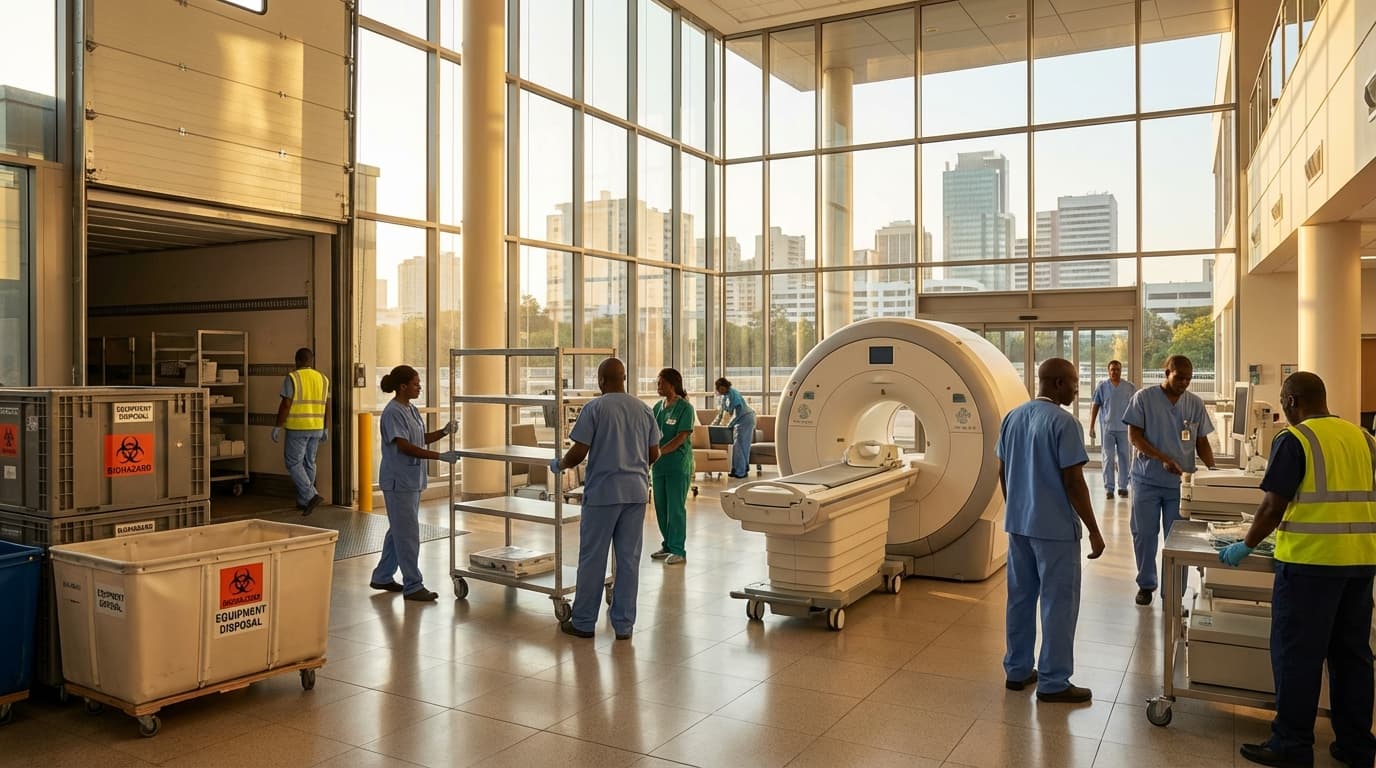
Heavy Medical Equipment De-Installation Service (MRI/CT/Cath Lab) in Eswatini
Engineering Excellence & Technical Support
Heavy Medical Equipment De-Installation Service (MRI/CT/Cath Lab) High-standard technical execution following OEM protocols and local regulatory frameworks.
Specialized De-Installation Expertise
We possess deep technical knowledge and hands-on experience in the meticulous de-installation of high-value, complex medical imaging equipment like MRI, CT scanners, and Cath Labs. Our certified technicians adhere to manufacturer specifications and international safety standards to ensure a seamless and risk-free process.
Secure Transportation & Logistics
Beyond de-installation, we provide comprehensive logistics solutions. This includes the secure packing, crating, and transportation of sensitive medical equipment across Eswatini, utilizing specialized vehicles and trained personnel to maintain equipment integrity throughout the journey.
Compliance & Documentation Assurance
We prioritize regulatory compliance. Our services include thorough documentation of the de-installation process, including asset tagging, inventory lists, and disposal certificates where applicable, ensuring your organization meets all legal and environmental requirements in Eswatini.
What Is Heavy Medical Equipment De-installation Service (Mri/ct/cath Lab) In Eswatini?
Heavy Medical Equipment De-Installation Service (MRI/CT/Cath Lab) in Eswatini refers to the specialized process of safely and systematically dismantling, disconnecting, and preparing large-scale, high-value medical imaging and interventional equipment for relocation, disposal, or upgrade. This service is critical for maintaining operational continuity, ensuring safety, and preserving asset value within healthcare facilities.
| Equipment Type | Key De-installation Considerations | Potential Challenges |
|---|---|---|
| MRI (Magnetic Resonance Imaging) | High-strength superconducting magnet (requires controlled venting/quench procedures), cryogen management (helium), extensive RF shielding, large physical footprint, significant power consumption. | Magnet quench risk, helium loss, damage to RF shielding, structural integrity of the room, precise re-alignment upon re-installation. |
| CT (Computed Tomography) | X-ray tube assembly (potential for radiation exposure during disassembly if not properly shielded), gantry mechanics, high-voltage power supply, cooling systems, detector arrays. | Handling of X-ray components, precise calibration of gantry, power supply disconnection, delicate detector arrays. |
| Cath Lab (Cardiac Catheterization Laboratory) | Large C-arm (heavy and requires specialized lifting), X-ray generator, imaging system, patient table, contrast injectors, various monitoring and support equipment, potential for radioactive isotopes (though less common in standard de-install). | Weight and maneuverability of the C-arm, power and cooling for the generator, integrity of the imaging chain, multiple interconnected ancillary systems. |
Typical Use Cases
- {"title":"Technology Upgrades","description":"Replacing an older generation MRI or CT scanner with a newer, more advanced model necessitates the professional de-installation of the existing unit."}
- {"title":"Facility Renovations or Relocations","description":"When a hospital department is being remodeled or an entire facility is moving, the heavy imaging equipment must be carefully de-installed, transported, and reinstalled (or stored)."}
- {"title":"Equipment Repurposing or Resale","description":"Hospitals may choose to sell functional but underutilized MRI, CT, or Cath Lab systems. A professional de-installation service ensures the equipment is prepared for resale in good condition."}
- {"title":"End-of-Life Equipment Management","description":"For equipment that has reached the end of its operational life, de-installation is the first step in the decommissioning and disposal process, often involving environmental considerations for hazardous materials."}
- {"title":"Consolidation of Services","description":"If a healthcare network is consolidating imaging services into a central hub, equipment from satellite facilities will require de-installation and transfer."}
- {"title":"Emergency Replacements or Temporary Solutions","description":"While less common for de-installation, in scenarios requiring rapid replacement due to irreparable damage or critical failure, the old equipment must be removed to make way for a new installation."}
Who Needs Heavy Medical Equipment De-installation Service (Mri/ct/cath Lab) In Eswatini?
Specialized de-installation services for heavy medical equipment like MRI, CT scanners, and Cath Labs are crucial for a variety of healthcare facilities and departments in Eswatini. These services are essential when existing equipment needs to be removed for upgrades, replacements, relocation, or during facility renovations and closures. The process requires meticulous planning, expert handling, and adherence to strict safety and environmental regulations. This ensures that valuable and complex machinery is safely dismantled, packaged, and prepared for its next stage, whether that's disposal, transport to another site, or resale.
| Department/Area | Specific Equipment Requiring De-Installation | Reasons for De-Installation |
|---|---|---|
| Radiology Department | MRI Scanners, CT Scanners, X-Ray Machines (High-end) | Upgrade to newer technology, Replacement due to age/breakdown, Relocation within facility, End-of-life disposal, Facility renovation |
| Cardiology/Interventional Radiology Department | Cath Lab Systems (Angiography Suites) | Technological advancements, Increased patient volume requiring larger/faster systems, Replacement of outdated components, Facility expansion, Closure of unit |
| Oncology Department | CT Scanners (for treatment planning/simulation), MRI Scanners (for advanced imaging) | Integration with new treatment planning software, Upgrading to more precise imaging capabilities, Equipment failure, Relocation of services |
| Neurology Department | MRI Scanners (specialized neuro-imaging) | Need for higher field strength MRI, Integration with advanced neuro-monitoring, Equipment obsolescence, Redeploying space |
| Hospital Administration/Facilities Management | Any of the above, depending on infrastructure changes | Major facility renovations, Hospital closure or merger, Strategic equipment reallocation, Budgetary constraints necessitating older equipment removal |
| Medical Equipment Suppliers/Service Providers | All heavy medical equipment | Routine upgrades and replacements for clients, Removal of traded-in equipment, Decommissioning of rental units, Site preparation for new installations |
Target Customers and Departments in Eswatini Requiring Heavy Medical Equipment De-Installation:
- Major Hospitals: Both public and private hospitals with advanced diagnostic imaging and interventional cardiology capabilities.
- Specialty Clinics: Clinics focusing on cardiology, neurology, oncology, and radiology that house these large-scale systems.
- Diagnostic Imaging Centers: Dedicated facilities providing advanced imaging services.
- Research and Teaching Hospitals: Institutions involved in medical research and training, often utilizing cutting-edge equipment.
- Government Health Ministries/Departments: Responsible for managing and upgrading public healthcare infrastructure.
- Medical Equipment Suppliers/Distributors: Companies involved in the sale, installation, and maintenance of medical equipment.
- Facility Management and Construction Companies: Involved in hospital renovations, expansions, or new builds requiring the removal of old equipment.
- Disposal and Recycling Companies: Specialized firms that handle the environmentally responsible decommissioning and disposal of medical equipment.
Heavy Medical Equipment De-installation Service (Mri/ct/cath Lab) Process In Eswatini
This document outlines the comprehensive workflow for our Heavy Medical Equipment De-Installation Service (MRI/CT/Cath Lab) in Eswatini. Our process is designed for efficiency, safety, and minimal disruption to your operations, ensuring a smooth transition from initial inquiry to the successful de-installation of your valuable medical assets.
| Stage | Description | Key Activities | Deliverables/Outcomes | Typical Timeline (Days) |
|---|---|---|---|---|
| Receive and process client request; understand scope and requirements. | Initial contact, needs assessment, preliminary equipment identification, discussion of service benefits. | Understanding of project scope, preliminary quotation, client agreement to proceed. | 1-2 |
| On-site evaluation of the equipment and its environment. | Detailed inspection of equipment, building access, power and cooling systems, structural integrity assessment, identification of potential hazards, safety protocol development. | Comprehensive site survey report, detailed risk assessment, refined project plan. | 2-5 |
| Developing a comprehensive strategy for de-installation and transportation. | Detailed de-installation methodology, equipment dismantling sequence, specialized tool identification, transportation route planning, permit acquisition (if required), scheduling of personnel and equipment. | Approved de-installation plan, logistics schedule, confirmation of necessary permits. | 3-7 |
| Ensuring the equipment and site are ready for dismantling. | Power down and lockout procedures, disconnection of all ancillary systems (water, gas, ventilation), securing loose components, ensuring site safety for personnel. | Equipment safely powered down and isolated, work area secured. | 1-2 |
| Careful and systematic disassembly of the medical equipment. | Component-by-component de-installation by certified technicians, adherence to manufacturer specifications, labeling and inventory of all parts, specialized packaging for sensitive components. | Dismantled and securely packaged equipment components, inventory list. | 2-7 (varies by equipment complexity) |
| Safe and efficient movement of de-installed equipment. | Loading of packaged equipment onto specialized transport, transit monitoring, coordination with destination logistics, unloading at the new location (if required). | Equipment safely transported to its destination. | 1-5 (dependent on distance) |
| Finalizing the service and providing documentation. | Handover of all de-installation documentation, client confirmation of service completion, addressing any minor follow-up queries. | De-installation completion report, client sign-off. | 1-2 |
De-Installation Workflow Stages
- Inquiry & Initial Consultation: The process begins with your inquiry, followed by a detailed consultation to understand your specific needs and the equipment to be de-installed.
- Site Survey & Risk Assessment: Our expert technicians will conduct a thorough on-site survey to assess the equipment's location, accessibility, building infrastructure, and potential risks.
- Planning & Logistics: Based on the survey, we develop a detailed de-installation plan, including scheduling, resource allocation, transportation arrangements, and any necessary permits.
- Preparation & Disconnection: Prior to physical de-installation, all necessary safety precautions are taken, and the equipment is meticulously disconnected from power, data, and other essential services.
- Dismantling & Packaging: The equipment is carefully dismantled by our certified technicians, following manufacturer guidelines. Each component is then expertly packaged for safe transportation.
- Transportation & Logistics Management: We manage the entire transportation process, ensuring secure loading, transit, and unloading at the designated destination.
- Post-De-installation Support: After the de-installation, we provide a confirmation report and are available to address any follow-up queries.
Heavy Medical Equipment De-installation Service (Mri/ct/cath Lab) Cost In Eswatini
The cost of de-installing heavy medical equipment such as MRI, CT scanners, and Cath Labs in Eswatini can vary significantly due to several factors. These specialized services require trained technicians, specific tools, and adherence to strict safety and logistical protocols. The pricing is generally quoted on a project-by-project basis, taking into account the complexity and duration of the de-installation.
| Equipment Type | Estimated Cost Range (SZL) | Notes |
|---|---|---|
| CT Scanner | 15,000 - 40,000 | Cost varies with scanner size, weight, and complexity of removal. |
| MRI Scanner (excluding magnet handling) | 25,000 - 60,000 | Magnet de-installation (if required) can significantly increase costs due to specialized safety protocols and helium management. |
| Cath Lab (Interventional X-ray System) | 20,000 - 50,000 | Includes removal of C-arm, generator, patient table, and associated consoles. Complexity of cabling and ceiling mounts impacts cost. |
| X-Ray Machine (Standard) | 5,000 - 15,000 | Generally less complex and time-consuming than the above. |
Key Pricing Factors for Heavy Medical Equipment De-Installation in Eswatini:
- Equipment Type and Complexity: Different machines have varying levels of complexity in their construction and the number of components that need to be safely disconnected and disassembled. MRI magnets, for instance, require specialized handling due to their powerful magnetic fields.
- Size and Weight of Equipment: Larger and heavier equipment necessitates more manpower, specialized lifting equipment (cranes, heavy-duty dollies), and potentially longer setup/dismantling times, all of which contribute to the overall cost.
- Accessibility of the Equipment: The ease of access to the installation site is crucial. De-installation in confined spaces, upper floors, or areas with limited maneuvering room will incur higher costs due to increased labor and specialized equipment needs.
- Dismantling Scope and Level: Some de-installations might involve complete disassembly down to the smallest components, while others may only require partial dismantling for relocation. The depth of disassembly directly impacts the time and labor required.
- Logistics and Transportation: While de-installation focuses on removal from its current site, the logistics of safely moving the equipment within the facility and preparing it for external transportation (if required) are often factored into the service cost.
- Specialized Tools and Equipment: The use of specialized tools, such as cryogenic systems for MRI magnet quenching (if applicable), heavy-duty tools, and safety equipment, adds to the operational costs borne by the service provider.
- Technician Expertise and Certification: De-installation of high-value, complex medical equipment requires highly skilled and certified technicians. Their expertise commands a higher labor rate.
- Project Timeline and Urgency: Rush jobs or projects with tight deadlines may incur additional charges for overtime or expedited service.
- Site Preparation and Restoration: Depending on the agreement, the service provider might be responsible for minor site preparation before de-installation or basic restoration of the area after removal. Significant structural modifications would likely be separate.
- Regulatory Compliance: Ensuring all de-installation activities comply with local health and safety regulations adds to the overhead for the service provider.
Affordable Heavy Medical Equipment De-installation Service (Mri/ct/cath Lab) Options
Relocating or upgrading large medical equipment like MRI, CT scanners, or Cath Labs is a complex and costly undertaking. Finding affordable heavy medical equipment de-installation services is crucial for healthcare providers. This guide explores options, highlights the value of bundled services, and outlines effective cost-saving strategies.
| Value Bundle Option | Included Services | Potential Cost Savings | Ideal For |
|---|---|---|---|
| De-Installation & Rigging Only | Professional dismantling and securing of the equipment for transport. | Lower upfront cost compared to full-service packages. | Providers with in-house logistics or pre-arranged transport. |
| De-Installation, Rigging & Packaging | Includes de-installation, rigging, and protective crating/packaging for safe transit. | Reduces risk of damage during transport, potentially avoiding costly repairs. | Facilities lacking specialized packaging materials or expertise. |
| Full-Service Relocation (De-Installation to Re-Installation) | Comprehensive service from de-installation, rigging, packaging, transportation, to on-site re-installation and testing. | Streamlines the entire process, minimizes coordination headaches, and offers a single point of accountability. | Organizations seeking a hassle-free, end-to-end solution and maximum efficiency. |
| De-Installation & Disposal/Recycling | Professional removal and environmentally responsible disposal or recycling of obsolete medical equipment. | Ensures compliance with environmental regulations and can sometimes yield scrap value. | Healthcare facilities decommissioning old equipment. |
Understanding De-Installation Costs & Factors
- {"title":"Equipment Type and Size","description":"Larger and more complex machines (e.g., high-field MRI) require more specialized tools, expertise, and time for safe de-installation, driving up costs."}
- {"title":"Site Accessibility","description":"Difficult access to the installation site (tight spaces, multiple floors, limited loading docks) can significantly increase labor and equipment rental expenses for moving machinery."}
- {"title":"De-Installation Scope","description":"Basic de-installation versus comprehensive services (including rigging, packaging, crating, and disposal of ancillary equipment) will impact the overall price."}
- {"title":"Geographic Location","description":"Labor rates, permit costs, and transportation expenses vary by region, influencing the final de-installation quote."}
- {"title":"Timeline and Urgency","description":"Rush jobs or tight deadlines often incur premium pricing due to the need for expedited logistics and staffing."}
- {"title":"Specialized Handling Requirements","description":"Some equipment may have specific temperature, humidity, or vibration sensitivity that necessitates specialized transport and handling protocols, adding to the cost."}
Verified Providers In Eswatini
When seeking healthcare services in Eswatini, identifying verified providers is paramount to ensuring quality, safety, and effectiveness of care. Franance Health stands out as a leading organization that not only verifies its network of healthcare professionals but also upholds rigorous standards. This commitment to credentialing means that every provider affiliated with Franance Health has undergone a thorough vetting process, guaranteeing their qualifications, licenses, and professional integrity. Choosing Franance Health translates to access to a network of trusted doctors, specialists, and facilities, offering peace of mind and a higher standard of healthcare delivery in Eswatini.
| Credentialing Aspect | Franance Health's Assurance | Benefit to Patients |
|---|---|---|
| License Verification | All providers' licenses are confirmed with relevant Eswatini medical boards. | Ensures providers are legally authorized to practice. |
| Educational & Training Review | Verification of degrees, certifications, and specialized training. | Confirms providers possess the necessary expertise for their practice. |
| Professional History & Background Checks | Scrutiny of past performance and absence of disciplinary actions. | Guarantees a commitment to ethical and professional conduct. |
| Peer Review & Reputation Assessment | Consideration of professional standing within the medical community. | Highlights providers with a proven track record of excellent patient care. |
| Ongoing Monitoring | Regular reviews to ensure continued adherence to standards. | Maintains a consistently high level of care and trust over time. |
Why Franance Health Credentials Represent the Best Choice:
- Rigorous Verification Process: Franance Health meticulously checks medical licenses, educational backgrounds, and professional experience of all affiliated providers.
- Commitment to Quality Care: Their credentialing ensures providers adhere to established best practices and ethical standards.
- Patient Safety Focus: Verification minimizes the risk of unqualified or fraudulent practitioners, prioritizing patient well-being.
- Access to Trusted Professionals: Franance Health offers a curated network of reliable and competent healthcare professionals.
- Enhanced Patient Confidence: Knowing providers are vetted by a reputable organization builds trust and reduces anxiety for patients.
- Streamlined Healthcare Navigation: Franance Health simplifies the process of finding dependable healthcare in Eswatini.
Scope Of Work For Heavy Medical Equipment De-installation Service (Mri/ct/cath Lab)
This Scope of Work outlines the requirements for the professional de-installation of heavy medical equipment, specifically MRI, CT, and Cath Lab systems. The service includes the safe and efficient disconnection, disassembly, and preparation of the equipment for transportation. All work will be performed by qualified and experienced technicians adhering to manufacturer guidelines, safety protocols, and industry best practices. The objective is to ensure the equipment is de-installed without damage and ready for subsequent relocation or storage.
| Service Component | Description | Standard Specifications / Deliverables | Notes |
|---|---|---|---|
| Site Assessment & Planning | Pre-de-installation evaluation of the equipment and surrounding environment. | Detailed site survey report, including accessibility, power requirements, lifting points, and safety hazards. Development of a project plan. | To be conducted prior to commencement of work. |
| De-Energization & Isolation | Safe disconnection of all electrical, data, and control systems. | Confirmation of power isolation via lockout/tagout procedures. Documentation of all disconnected lines. | Adherence to site-specific LOTO procedures. |
| Fluid Drainage (if applicable) | Safe and environmentally compliant drainage of cooling fluids, refrigerants, or contrast media. | Proper containment and disposal of drained fluids according to environmental regulations. Documentation of drainage process. | Specific procedures will depend on equipment type. |
| Mechanical Disassembly | Systematic dismantling of the main equipment components. | Disassembly into pre-defined transportable modules as per manufacturer's service manual. Labeling of all components and sub-assemblies. | Use of manufacturer-approved tools and procedures. |
| Component Protection & Packaging | Protection of delicate internal and external components during disassembly and for transport. | Use of appropriate protective materials (e.g., bubble wrap, custom crates, anti-static bags). Secure packaging to prevent movement and damage. | Special attention to gantry, detector arrays, and console components. |
| Cable Management | Organized bundling and protection of all removed cables. | Cables to be neatly coiled, labeled, and secured to prevent tangling and damage. | Clear labeling of cable origins and destinations. |
| Documentation & Handover | Comprehensive record-keeping of the entire de-installation process. | Photo/video documentation of key stages. De-installation report detailing actions taken, components removed, and any observations. Certificate of De-installation. | Report to be submitted within 5 business days of completion. |
| Site Clean-up | Restoration of the de-installation area to its original condition. | Removal of all debris, packaging materials, and tools. Site to be left clean and safe. | In accordance with client site requirements. |
| Specialized Equipment (e.g., MRI) | Specific procedures for handling cryogens, magnetic shielding, and RF coils. | De-gassing of helium (if applicable) by certified personnel. Secure storage/handling of RF coils. | Requires specialized knowledge and safety protocols. |
| Specialized Equipment (e.g., CT) | Handling of detector arrays, x-ray tube, and gantry. | Careful removal and packaging of sensitive detector elements. Secure removal of the x-ray tube housing. | Detector sensitivity requires extreme care. |
| Specialized Equipment (e.g., Cath Lab) | Disconnection and securing of imaging detectors, C-arm, patient table, and associated consoles. | Careful handling of heavy detector assemblies. Securement of the C-arm mechanism. | Weight and size of components require specialized lifting equipment. |
Key Objectives:
- Safe and efficient disconnection of all power, data, and ancillary connections.
- Dismantling of equipment into transportable modules according to manufacturer specifications.
- Secure packaging and protection of sensitive components.
- Thorough documentation of the de-installation process.
- Compliance with all relevant safety regulations and site-specific requirements.
Service Level Agreement For Heavy Medical Equipment De-installation Service (Mri/ct/cath Lab)
This Service Level Agreement (SLA) outlines the performance expectations and commitments for the de-installation of heavy medical equipment, specifically Magnetic Resonance Imaging (MRI) scanners, Computed Tomography (CT) scanners, and Cardiac Catheterization (Cath Lab) systems. It defines the agreed-upon response times for service requests and uptime guarantees where applicable (note: uptime guarantees are typically not applicable to de-installation services, but may be relevant for pre-de-installation testing or post-de-installation system status checks if specified).
| Service Event | Service Type | Response Time Target (Business Hours) | Uptime Guarantee (if applicable) | Notes |
|---|---|---|---|---|
| Initial Service Request (De-installation) | De-installation of MRI/CT/Cath Lab | 2 Business Hours (for acknowledgement) | N/A (De-installation is an active service) | Acknowledgement confirms receipt and initiation of scheduling process. |
| On-Site Arrival for Scheduled De-installation | De-installation of MRI/CT/Cath Lab | As per Scheduled De-installation Window | N/A | Actual arrival time may vary slightly based on traffic and site access, but will be within a reasonable timeframe of the scheduled start. |
| Completion of De-installation | De-installation of MRI/CT/Cath Lab | Completion within the agreed-upon Scheduled De-installation Window. | N/A | Duration dependent on equipment complexity and scope of work. Estimated completion time to be provided during scheduling. |
| Technical Support (Pre/Post De-installation Questions) | Support related to de-installation process | 4 Business Hours (for non-critical queries) | N/A | For critical issues impacting de-installation, refer to Service Request. |
| System Status Check (if pre-de-installation testing requested) | Functional test before de-installation | 1 Business Hour (for acknowledgement of request for test) | N/A (Uptime Guarantee applies to system availability, not de-installation process itself) | |
| System Status Check (if post-de-installation verification requested) | Verification of system state post-disconnection | 1 Business Hour (for acknowledgement of request for verification) | N/A |
Key Definitions
- Service Request: Any documented communication (email, ticketing system entry, phone call) from the Client to the Service Provider requesting de-installation services for a specified piece of medical equipment.
- Acknowledgement: The Service Provider's confirmation of receipt of a Service Request.
- On-Site Presence: The arrival of the Service Provider's qualified technicians at the Client's facility.
- De-installation Completion: The point at which the specified medical equipment has been safely and professionally disconnected, disassembled (if necessary), and prepared for transport as per industry standards and agreed-upon scope of work.
- Downtime (Applicable if pre-de-installation testing is included): The period during which the medical equipment is unavailable for its intended diagnostic or therapeutic use due to Service Provider action or inaction, excluding scheduled maintenance or planned de-installation activities.
- Scheduled De-installation Window: The pre-arranged period during which the de-installation service is scheduled to occur.
- Force Majeure: Events beyond the reasonable control of either party, including but not limited to natural disasters, acts of war, terrorism, or widespread public health emergencies.
Frequently Asked Questions

Ready when you are
Let's scope your Heavy Medical Equipment De-Installation Service (MRI/CT/Cath Lab) in Eswatini project in Eswatini.

Scaling healthcare logistics and technical systems across the entire continent.