
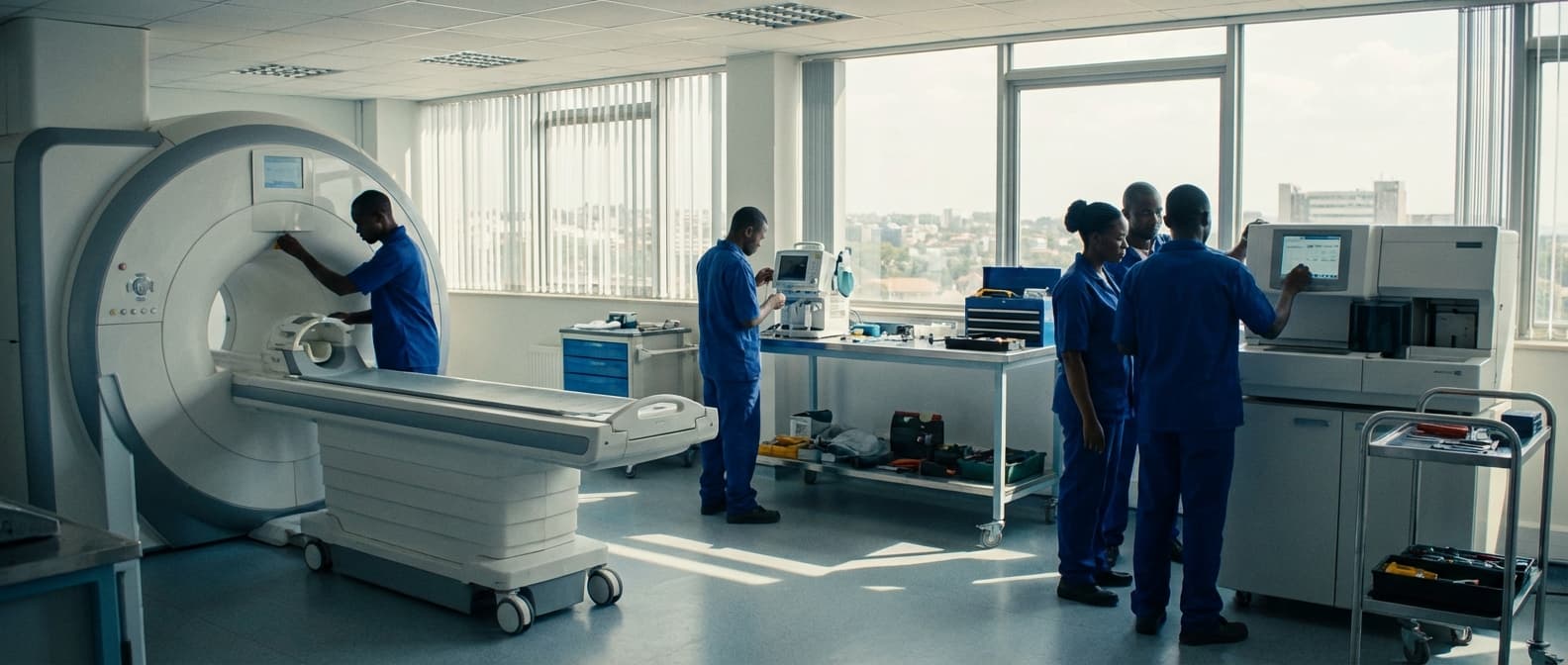
Uptime, Downtime & Root-Cause Analysis Reporting Service in Eswatini
Engineering Excellence & Technical Support
Uptime, Downtime & Root-Cause Analysis Reporting Service High-standard technical execution following OEM protocols and local regulatory frameworks.
Proactive Uptime Assurance
Our service in Eswatini provides continuous, real-time monitoring of your critical IT infrastructure. Leveraging advanced AI, we detect and predict potential performance degradations, enabling us to proactively address issues before they impact service availability and ensure maximum uptime for your business operations.
Rapid Downtime Mitigation
When outages are unavoidable, our expert team in Eswatini acts swiftly. We employ sophisticated diagnostic tools to identify the root cause of downtime with unparalleled speed, minimizing Mean Time To Recovery (MTTR) and restoring your services efficiently to reduce operational and financial impact.
In-depth Root-Cause Analysis
Beyond simply fixing issues, we provide comprehensive root-cause analysis reports tailored for Eswatini's unique IT landscape. Our detailed insights empower you to understand the 'why' behind incidents, enabling strategic improvements to prevent recurrence and enhance the overall resilience of your systems.
What Is Uptime, Downtime & Root-cause Analysis Reporting Service In Eswatini?
Uptime, Downtime, and Root-Cause Analysis (RCA) Reporting Services are critical for any organization in Eswatini relying on technology infrastructure to deliver services and maintain operational continuity. This service focuses on the continuous monitoring, measurement, and analysis of system availability. Uptime refers to the period during which a system or service is operational and accessible. Conversely, downtime is the period when a system or service is unavailable. RCA reporting is the systematic process of identifying the fundamental reasons for a system failure or performance degradation, enabling preventive measures and service improvement. This service is essential for ensuring business continuity, optimizing resource allocation, and meeting service level agreements (SLAs).
| Who Needs This Service? | Typical Use Cases | ||||||||
|---|---|---|---|---|---|---|---|---|---|
| IT Departments & Operations Teams: Responsible for maintaining the availability and performance of the organization's IT infrastructure. | Financial Institutions: To ensure uninterrupted access to banking platforms, ATMs, and online services, critical for transactions and customer trust. | Telecommunication Providers: To guarantee the continuous operation of mobile networks, internet services, and communication platforms. | Government Agencies: For maintaining critical public services, e-government portals, and emergency communication systems. | E-commerce Businesses: To prevent lost revenue and customer dissatisfaction due to website or payment gateway downtime. | Healthcare Providers: To ensure the availability of Electronic Health Records (EHRs), diagnostic systems, and patient communication tools. | Cloud Service Providers: To demonstrate service reliability and meet customer SLAs for hosted applications and infrastructure. | Enterprise Resource Planning (ERP) System Administrators: To ensure continuous access to critical business applications for finance, HR, and supply chain management. | Software-as-a-Service (SaaS) Vendors: To guarantee their platform is accessible to their subscriber base. | Any organization with a significant digital footprint or online presence: Where system availability directly impacts operations, revenue, or customer satisfaction. |
Key Components of Uptime, Downtime & RCA Reporting Services
- Monitoring Infrastructure: Deployment and configuration of monitoring tools (e.g., Nagios, Zabbix, SolarWinds, Prometheus) to track the health and availability of servers, network devices, applications, and cloud services.
- Data Collection & Aggregation: Centralized collection of logs, metrics, and performance data from various sources within the IT environment.
- Uptime/Downtime Calculation: Automated generation of reports quantifying periods of availability and unavailability, often expressed as percentages (e.g., 99.999% uptime).
- Alerting & Notification: Real-time alerts to designated personnel upon detection of critical events, service degradations, or confirmed downtime.
- Incident Management Integration: Linking monitoring data with incident management workflows to streamline troubleshooting and resolution.
- Root-Cause Analysis: Detailed investigation of downtime events to pinpoint the underlying technical or procedural causes. This may involve log analysis, performance profiling, configuration review, and correlating events across systems.
- Reporting & Dashboards: Creation of comprehensive reports and interactive dashboards providing insights into historical uptime, downtime trends, incident frequency, MTTR (Mean Time To Recover), and RCA findings.
- SLA Compliance Tracking: Verification and reporting against contractual obligations regarding system availability.
Who Needs Uptime, Downtime & Root-cause Analysis Reporting Service In Eswatini?
In Eswatini, robust uptime and downtime reporting, coupled with effective root-cause analysis (RCA), are critical for ensuring the smooth operation of businesses and public services. These services are not a luxury but a necessity for organizations seeking to maximize efficiency, minimize financial losses, and maintain customer trust. Understanding and addressing system failures promptly prevents cascading issues, improves service delivery, and supports informed decision-making. Whether it's the financial sector safeguarding sensitive transactions, telecommunications providers ensuring connectivity, or government agencies delivering essential services, reliable IT infrastructure is paramount. Downtime can lead to lost revenue, reputational damage, and reduced productivity, making proactive monitoring and RCA services indispensable.
| Target Customer/Department | Why They Need the Service | Key Benefits |
|---|---|---|
| Financial Institutions (Banks, Microfinance) | Crucial for transaction processing, online banking, ATM networks, and data security. Downtime directly impacts revenue and customer trust. | Ensured continuous service availability, reduced financial losses, maintained regulatory compliance, enhanced customer confidence. |
| Telecommunications Companies (Mobile, Internet Providers) | Essential for maintaining network connectivity, call services, and internet access. Outages lead to widespread customer dissatisfaction and churn. | Improved network reliability, reduced customer complaints, minimized revenue loss, faster issue resolution. |
| E-commerce Businesses & Retailers | Online stores, point-of-sale (POS) systems, and inventory management rely on constant uptime. Downtime means lost sales and abandoned carts. | Maximized sales opportunities, improved customer experience, prevented inventory discrepancies, protected brand reputation. |
| Government Agencies (e.g., Ministry of Health, Public Utilities) | Critical for public service delivery, citizen portals, and internal operations. Service interruptions can impact essential services. | Ensured continuity of essential services, improved citizen access, increased government efficiency, maintained public trust. |
| Healthcare Providers (Hospitals, Clinics) | Electronic Health Records (EHRs), patient monitoring systems, and appointment scheduling require high availability. Downtime can have life-threatening consequences. | Ensured uninterrupted patient care, protected sensitive patient data, improved operational efficiency, reduced risk of medical errors. |
| Manufacturing & Industrial Sector | Production lines, supply chain management, and operational technology (OT) systems are often IT-dependent. Downtime halts production. | Minimized production stoppages, optimized operational efficiency, reduced waste, ensured timely delivery of goods. |
| IT Departments & Managed Service Providers (MSPs) | Responsible for maintaining the IT infrastructure of their organizations or clients. Proactive monitoring and RCA are core functions. | Enhanced proactive problem identification, improved incident response times, better resource allocation, provided value-added services to clients. |
| Logistics & Supply Chain Companies | Tracking systems, inventory management, and communication platforms are vital. Disruptions can cripple the entire supply chain. | Ensured smooth flow of goods, improved delivery times, reduced operational costs, enhanced visibility across the supply chain. |
Who Needs Uptime, Downtime & Root-Cause Analysis Reporting Service in Eswatini?
- Businesses of all sizes relying on IT infrastructure for operations.
- Organizations with critical online services or customer-facing applications.
- Companies where service interruptions lead to significant financial losses.
- Government entities responsible for public service delivery.
- Organizations seeking to improve operational efficiency and reliability.
- Sectors with high regulatory compliance requirements.
- Companies aiming to enhance customer satisfaction and loyalty.
Uptime, Downtime & Root-cause Analysis Reporting Service Process In Eswatini
This document outlines the standard workflow for the Uptime, Downtime & Root-Cause Analysis Reporting Service provided within Eswatini. The process is designed to be efficient, thorough, and transparent, ensuring that clients receive timely and actionable insights into their system performance and potential issues. The service aims to identify the causes of disruptions, recommend corrective actions, and ultimately improve the reliability and availability of IT infrastructure and services.
| Phase | Description | Key Activities | Deliverables | Key Stakeholders |
|---|---|---|---|---|
| The client contacts the service provider to report an issue or request proactive monitoring and analysis. | Client communicates their need, provides initial details of the problem or desired service. Service provider asks clarifying questions to understand the context, affected systems, and desired outcomes. Preliminary scope of the analysis is defined. | Understanding of client needs, initial scope document. | Client Representative, Service Provider Account Manager/Sales |
| Formalizes the engagement and outlines how data will be collected and analyzed. | Service provider creates a formal proposal or quotation based on the defined scope. Upon acceptance, a Service Level Agreement (SLA) or contract is signed. A detailed data collection plan is developed, specifying systems to be monitored, metrics to be tracked, tools to be used, and access requirements. | Signed Service Agreement/Contract, Data Collection Plan. | Client Management, Service Provider Management, Technical Lead |
| Active collection of performance and event data from client systems. | Service provider deploys or configures monitoring tools. Real-time and historical data is collected from specified systems, applications, and network devices. This phase may also involve logs analysis and configuration review. | Raw monitoring data, system logs, configuration files. | Service Provider Technical Team, Client IT Infrastructure Team |
| Detecting and categorizing any disruptions or performance deviations. | Monitoring tools alert the service provider to potential incidents (downtime or significant performance degradation). Initial triage is performed to determine the nature, impact, and potential immediate causes of the incident. | Incident log, preliminary incident categorization. | Service Provider NOC/SOC, Service Provider Technical Lead |
| Investigating the underlying reasons for the incident. | Service provider uses collected data, logs, and expertise to perform a thorough analysis. This involves correlating events, examining system configurations, identifying dependencies, and eliminating potential causes until the true root cause is identified. | Detailed analysis findings, identification of root cause(s). | Service Provider Technical Specialists, Subject Matter Experts (SMEs) |
| Compiling findings into a comprehensive report and proposing solutions. | A formal report is drafted, documenting the incident timeline, impact, root cause(s), and contributing factors. Evidence supporting the findings is included. Actionable recommendations for short-term fixes and long-term preventative measures are developed. | Uptime/Downtime & RCA Report, List of Recommendations. | Service Provider Technical Lead, Report Writer |
| Communicating findings and recommendations to the client. | The service provider presents the report to the client, explaining the findings, root cause(s), and proposed solutions. A Q&A session is held to address client queries and ensure full understanding. | Presented Report, Client understanding and acknowledgment. | Service Provider Account Manager/Technical Lead, Client Management/Technical Team |
| Assisting the client in implementing recommended actions. | If agreed upon, the service provider can offer support in implementing the recommended corrective or preventative measures. This could include configuration changes, system updates, or training. | Implemented solutions, updated system documentation (if applicable). | Service Provider Technical Team, Client IT Implementation Team |
| Evaluating the effectiveness of the resolution and concluding the service engagement. | After recommended actions are implemented, a follow-up may be conducted to verify improvement. A final review of the service provided is conducted, and the engagement is formally closed. Feedback is collected for service improvement. | Service closure documentation, client satisfaction feedback. | Service Provider Account Manager, Client Representative |
Uptime, Downtime & Root-Cause Analysis Reporting Service Workflow
- Initial Inquiry & Scope Definition
- Service Agreement & Data Collection Plan
- Monitoring & Data Gathering
- Incident Identification & Initial Analysis
- Deep Dive Root-Cause Analysis
- Report Generation & Recommendation Development
- Report Presentation & Discussion
- Action Plan Implementation Support (Optional)
- Post-Incident Review & Service Closure
Uptime, Downtime & Root-cause Analysis Reporting Service Cost In Eswatini
This report outlines the pricing factors and estimated cost ranges for Uptime, Downtime, and Root-Cause Analysis (RCA) reporting services in Eswatini. These services are crucial for businesses to ensure operational continuity, quickly identify and resolve issues, and improve overall system reliability. The cost of these services is influenced by several key elements, making it difficult to provide a single fixed price. Understanding these factors will help organizations in Eswatini budget effectively for these essential services.
| Service Type | Estimated Monthly Cost Range (SZL) | Key Considerations & What's Included |
|---|---|---|
| Basic Uptime/Downtime Monitoring & Basic Alerting | 800 - 3,500 SZL | Automated alerts for system unavailability, basic uptime percentage reports. Suitable for small businesses with straightforward IT infrastructure. |
| Comprehensive Uptime/Downtime Reporting & Advanced Alerting | 3,000 - 10,000 SZL | Detailed uptime/downtime reports, configurable alerts, basic incident logging, historical performance data. For medium-sized businesses with moderate IT complexity. |
| Standard Root-Cause Analysis (RCA) Reporting (per incident) | 1,500 - 7,000 SZL (per incident) | Investigates the primary cause of a single downtime incident, provides a concise RCA report with immediate corrective actions. Cost can vary based on incident complexity. |
| Advanced Root-Cause Analysis (RCA) Reporting (per incident/retainer) | 5,000 - 20,000+ SZL (per incident or retainer) | In-depth RCA for complex or recurring issues, analysis of multiple contributing factors, recommendations for long-term prevention, proactive trend analysis. Often offered as part of a managed service or retainer. |
| Managed Uptime, Downtime & RCA Service (Comprehensive Package) | 10,000 - 50,000+ SZL (monthly) | Continuous monitoring, proactive alerting, comprehensive reporting, regular RCA for significant incidents, trend analysis, strategic recommendations. Ideal for larger enterprises or critical systems. |
Key Pricing Factors for Uptime, Downtime & RCA Reporting Services in Eswatini:
- Scope of Services: The breadth and depth of reporting required significantly impact cost. This includes the number of systems or applications monitored, the level of detail in downtime notifications, and the complexity of root-cause analysis investigations.
- Monitoring Complexity & Technology: The sophistication of the monitoring tools and techniques employed plays a role. Services that utilize advanced AI-driven anomaly detection or require integration with diverse IT infrastructure will likely be more expensive than simpler, rule-based monitoring.
- Frequency and Granularity of Reporting: The desired frequency of reports (e.g., daily, weekly, monthly) and the level of granularity (e.g., minute-by-minute logs vs. summarized downtime periods) will influence the effort and therefore the cost.
- Response Time & Service Level Agreements (SLAs): Guaranteed response times for critical incidents and downtime notifications, as well as the defined SLAs for RCA, directly affect pricing. Faster guaranteed response times typically command higher costs.
- Level of Expertise and Certification: The experience, training, and certifications of the analysts performing the RCA can impact pricing. Highly skilled and certified professionals may charge more for their expertise.
- Customization and Integration: The need for custom reporting formats, integration with existing ticketing systems, or tailored RCA methodologies will add to the overall cost.
- Volume of Incidents: For services that charge per incident or per RCA conducted, the expected volume of downtime incidents will be a primary cost driver.
- Provider's Overhead and Reputation: The operational costs, market position, and reputation of the service provider in Eswatini will also be reflected in their pricing structure.
- Geographic Location (Minor Factor): While less significant than other factors, local operational costs within Eswatini might have a minor influence on the overall pricing.
Affordable Uptime, Downtime & Root-cause Analysis Reporting Service Options
This service offers comprehensive uptime monitoring, downtime alerts, and in-depth root-cause analysis reporting to help businesses maintain operational continuity and troubleshoot issues efficiently. We provide flexible value bundles and cost-saving strategies tailored to your specific needs and budget.
| Value Bundle | Included Services | Target Audience | Price Range (Monthly) | Key Cost-Saving Benefit |
|---|---|---|---|---|
| Basic Uptime Guardian | Uptime monitoring for up to 5 endpoints, email alerts, basic RCA summary reports. | Small businesses, startups with limited infrastructure. | $49 - $99 | Essential monitoring at a low entry cost. |
| Pro Uptime & Analysis | Uptime monitoring for up to 20 endpoints, SMS & email alerts, detailed RCA reports, performance metrics. | Growing businesses, IT departments of mid-sized companies. | $149 - $299 | Comprehensive visibility and faster issue resolution, minimizing costly downtime. |
| Enterprise Uptime Suite | Unlimited endpoint monitoring, advanced alerting (Slack integration), in-depth automated RCA with actionable insights, historical trend analysis, dedicated account manager. | Large enterprises, mission-critical operations, organizations with complex IT environments. | $499+ | Maximizes uptime for critical operations, reduces MTTR (Mean Time To Resolution), and prevents recurring issues. |
| Custom Bundle | Tailored to specific needs, can mix and match services and endpoint counts. | Businesses with unique monitoring requirements. | Quote-based | Pay only for what you need, optimizing spend. |
Key Service Components
- Real-time Uptime Monitoring: Continuous checks of your critical systems and applications.
- Instant Downtime Alerts: Immediate notifications via SMS, email, or Slack when issues arise.
- Automated Root-Cause Analysis (RCA) Reports: Detailed reports identifying the origin of downtime events.
- Performance Metrics Tracking: Insights into system performance to proactively identify potential problems.
- Historical Data & Trend Analysis: Review past performance and downtime to inform future strategies.
- Customizable Dashboards: Visualize your uptime and performance data in a way that suits you.
Verified Providers In Eswatini
In Eswatini's growing healthcare landscape, identifying reliable and accredited providers is paramount for ensuring quality care. Franance Health stands out as a beacon of trust, distinguished by its rigorous credentials and unwavering commitment to patient well-being. Their accreditation signifies adherence to the highest international standards of healthcare delivery, encompassing stringent protocols for patient safety, ethical practices, and clinical excellence. Choosing Franance Health means opting for a provider that has been independently verified for its competence, resources, and dedication to optimal health outcomes. This commitment to transparency and excellence makes Franance Health the definitive best choice for healthcare needs in Eswatini.
| Credential/Aspect | Franance Health's Commitment | Benefit to Patients |
|---|---|---|
| Accreditation Body Standards | Adheres to and exceeds recognized national and international accreditation standards. | Ensures consistent quality of care and adherence to best practices. |
| Medical Staff Qualifications | Employs highly qualified and licensed healthcare professionals with verified credentials. | Provides access to experienced and competent medical expertise. |
| Facility and Equipment Standards | Maintains modern, well-equipped facilities that meet stringent safety and hygiene regulations. | Offers a safe and conducive environment for treatment and recovery. |
| Patient Care Protocols | Implements robust protocols for patient assessment, treatment planning, and continuous monitoring. | Ensures personalized, effective, and safe medical interventions. |
| Ethical Conduct and Patient Rights | Upholds the highest ethical standards and respects patient confidentiality and autonomy. | Guarantees respectful, dignified, and patient-centered care. |
| Continuous Quality Improvement | Actively engages in ongoing evaluation and improvement of services. | Promises evolving and enhancing healthcare services to meet changing needs. |
Why Franance Health is the Best Choice:
- Rigorous Accreditation & Verification
- Commitment to International Standards
- Patient Safety Protocols
- Ethical Healthcare Practices
- Clinical Excellence and Expertise
- Transparent and Reliable Service Delivery
- Focus on Optimal Health Outcomes
Scope Of Work For Uptime, Downtime & Root-cause Analysis Reporting Service
This Scope of Work (SOW) outlines the requirements for a Uptime, Downtime & Root-Cause Analysis (RCA) Reporting Service. This service aims to provide comprehensive and actionable insights into system availability and performance, enabling proactive identification and resolution of issues. The deliverables will be provided in a structured and standardized format, primarily JSON, to facilitate integration with existing monitoring and reporting tools.
| Deliverable | Description | Format | Frequency | Standard Specifications |
|---|---|---|---|---|
| Uptime/Downtime Report | Summarizes the availability of specified systems and services over a given period, detailing periods of operation and interruption. Includes key metrics like Availability Percentage (%), Mean Time Between Failures (MTBF), and Mean Time To Repair (MTTR). | JSON | Daily, Weekly, Monthly | JSON schema to include: report_period_start, report_period_end, system_id, system_name, total_duration_minutes, uptime_minutes, downtime_minutes, availability_percentage, mtbf_minutes, mttr_minutes, uptime_periods (array of start/end timestamps), downtime_periods (array of start/end timestamps, incident_id). |
| Downtime Incident Report | Detailed report for each individual downtime event exceeding a predefined threshold (e.g., 5 minutes). Includes incident start/end times, duration, impacted systems, affected users, and initial assessment. | JSON | Per incident (within 24 hours of resolution) | JSON schema to include: incident_id, system_id, system_name, incident_start_time, incident_end_time, duration_minutes, impact_description, affected_users_estimate, initial_assessment, severity_level. |
| Root-Cause Analysis (RCA) Report | Comprehensive analysis of a specific downtime incident, identifying the fundamental cause, contributing factors, immediate actions taken, and recommended preventative measures. This report is a deep dive into the 'why' of the incident. | JSON | Per critical/major incident (within 72 hours of resolution) | JSON schema to include: incident_id, root_cause_description, contributing_factors (array of strings), timeline_of_events (array of timestamps and actions), immediate_resolution_actions (array of strings), recommended_preventative_actions (array of strings), responsible_teams (array of strings), lessons_learned (array of strings), evidence_links (array of URLs). |
| Trend Analysis Report | Identifies recurring patterns, common causes of downtime, and performance degradation trends across the infrastructure over longer periods. Used for strategic planning and proactive risk mitigation. | JSON | Monthly, Quarterly | JSON schema to include: analysis_period_start, analysis_period_end, top_downtime_causes (array of objects with cause and count), systems_with_most_downtime (array of objects with system_id, system_name, and total_downtime_minutes), recurring_incident_patterns (description and frequency), performance_degradation_trends (description and metrics). |
| Alerting and Notification Service | Proactive notification mechanism for significant downtime events, providing immediate awareness to key personnel. Configurable thresholds for criticality and notification recipients. | Email, API (webhook) | Real-time (for critical/major incidents) | Standardized notification payload (JSON) for API, clear subject lines and concise content for email. Payload should include: incident_id, system_id, system_name, incident_start_time, severity_level, brief_description. |
Service Objectives
- To accurately track and report system uptime and downtime across defined infrastructure components.
- To conduct thorough root-cause analysis for all significant downtime events.
- To deliver timely and actionable reports to relevant stakeholders.
- To identify recurring issues and trends to drive continuous improvement.
- To provide data that supports service level agreement (SLA) adherence and performance optimization.
Service Level Agreement For Uptime, Downtime & Root-cause Analysis Reporting Service
This Service Level Agreement (SLA) outlines the guaranteed uptime, definitions of downtime, and the process for root-cause analysis (RCA) reporting for the Uptime, Downtime & Root-Cause Analysis Reporting Service (hereafter referred to as 'the Service').
| Metric | Definition | Target | Measurement Period | Remedy for Breach |
|---|---|---|---|---|
| Uptime Guarantee | The percentage of time the Service is available and functional for customer use. | 99.9% | Monthly | For every 1% or part thereof of uptime below 99.9% but above 99.0%, a credit of [e.g., 5]% of the monthly service fee will be issued. For uptime below 99.0%, a credit of [e.g., 10]% of the monthly service fee will be issued. |
| Unscheduled Downtime Notification | Notification to the customer that the Service is experiencing Unscheduled Downtime. | Within [e.g., 30] minutes of detection | Per incident | N/A |
| Root-Cause Analysis (RCA) Report Delivery | Delivery of a comprehensive RCA report following Unscheduled Downtime events exceeding [e.g., 60] minutes. | Within [e.g., 72] business hours of resolution | Per qualifying incident | N/A |
Key Definitions
- Uptime: The period during which the Service is operational and accessible to the customer for its intended use.
- Downtime: The period during which the Service is not operational or accessible, as defined below. Downtime excludes Scheduled Maintenance.
- Scheduled Maintenance: Pre-announced periods during which the Service may be temporarily unavailable for upgrades, patches, or other necessary maintenance. Customers will be notified at least [e.g., 48] hours in advance.
- Unscheduled Downtime: Downtime that occurs outside of Scheduled Maintenance periods. This can be due to hardware failures, software bugs, network issues, or other unforeseen circumstances.
- Root-Cause Analysis (RCA): A process to identify the fundamental reason for an incident or problem. RCA reporting aims to prevent recurrence.
- Service Credit: A monetary credit applied to the customer's account as compensation for a breach of this SLA.
Frequently Asked Questions

Ready when you are
Let's scope your Uptime, Downtime & Root-Cause Analysis Reporting Service in Eswatini project in Eswatini.

Scaling healthcare logistics and technical systems across the entire continent.