
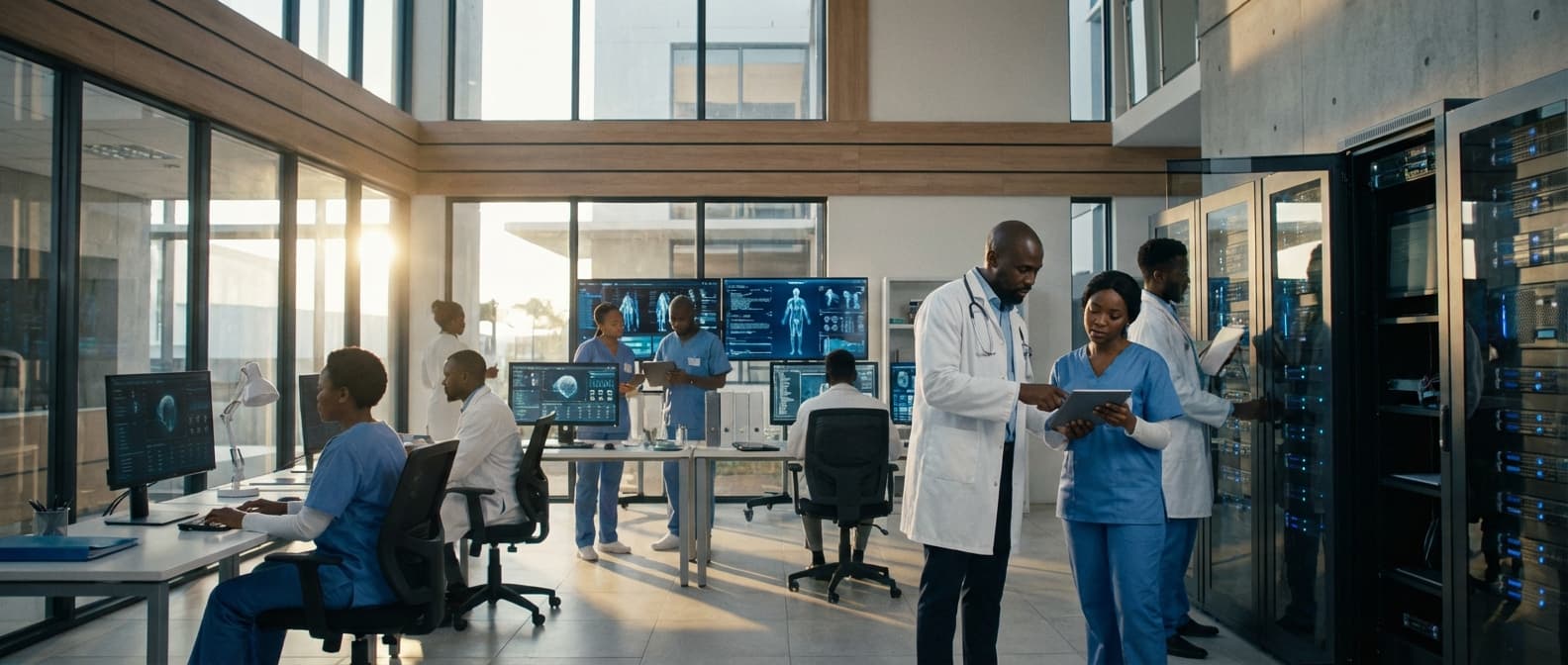
Medical IT Consultation in Eswatini
Engineering Excellence & Technical Support
Strategic technology consulting to optimize healthcare operations, streamline workflows, and integrate cutting-edge medical information systems. High-standard technical execution following OEM protocols and local regulatory frameworks.
Digital Health Infrastructure Assessment & Strategy
Conducting comprehensive assessments of Eswatini's healthcare facilities' existing IT infrastructure, identifying gaps, and developing tailored digital health roadmaps to enhance data management, interoperability, and the adoption of EMR/EHR systems.
Cybersecurity & Data Privacy Enhancement
Implementing robust cybersecurity frameworks and best practices to protect sensitive patient data, ensuring compliance with national and international data privacy regulations, and mitigating risks of cyber threats for Eswatini's health sector.
Telemedicine & Remote Patient Monitoring Solutions
Designing and deploying scalable telemedicine platforms and remote patient monitoring systems to improve access to specialized care, reduce patient travel burdens, and enable continuous health monitoring across Eswatini's diverse geographical landscape.
What Is Medical It Consultation In Eswatini?
Medical IT Consultation in Eswatini refers to the provision of expert advice and strategic planning related to the implementation, optimization, and management of information technology (IT) systems within healthcare organizations in the Kingdom of Eswatini. This service aims to enhance the efficiency, security, and effectiveness of healthcare delivery through the judicious application of technology. It encompasses a broad spectrum of IT domains relevant to the healthcare sector, from electronic health records (EHR) and telemedicine platforms to cybersecurity, data analytics, and network infrastructure. The objective is to align IT initiatives with the overarching goals of improving patient care, operational workflows, and regulatory compliance within the unique context of Eswatini's healthcare landscape.
| Entity/Role | Need for Medical IT Consultation | Typical Use Cases |
|---|---|---|
| Public Hospitals and Clinics | To modernize infrastructure, improve patient record management, enhance data security, and facilitate wider healthcare access through technology. | Implementing Electronic Health Records (EHR), establishing telemedicine services for remote areas, upgrading network infrastructure for better data transfer, enhancing cybersecurity to protect patient data, implementing diagnostic imaging systems (PACS). |
| Private Healthcare Facilities (Hospitals, Clinics, Diagnostic Centers) | To gain a competitive edge, optimize operational efficiency, improve patient experience, and ensure compliance with evolving healthcare IT standards. | Implementing integrated practice management systems, adopting patient portals for appointment scheduling and communication, deploying advanced medical imaging and analysis software, enhancing data analytics for business intelligence, cybersecurity assessments and remediation. |
| Non-Governmental Organizations (NGOs) involved in Healthcare | To leverage technology for program management, data collection and reporting, service delivery in underserved communities, and secure management of beneficiary information. | Developing mobile health (mHealth) solutions for data collection and patient outreach, implementing digital platforms for health education and awareness campaigns, establishing secure databases for program beneficiaries, setting up remote data management systems. |
| Ministry of Health and Government Health Agencies | To develop national health IT strategies, standardize healthcare information systems, improve public health surveillance, and facilitate evidence-based policy-making. | Developing national EHR standards and interoperability frameworks, implementing public health information systems for disease surveillance and reporting, planning for national telemedicine infrastructure, advising on health data privacy and security policies. |
| Medical Training and Research Institutions | To enhance research capabilities, support digital learning environments, and manage institutional data effectively. | Implementing research data management platforms, deploying virtual learning environments and simulation tools, integrating IT for administrative functions, ensuring secure storage and access to research data. |
| Healthcare Startups and Innovators | To validate technological concepts, develop scalable solutions, and navigate the regulatory landscape for digital health products. | Prototyping and testing new digital health applications, developing secure data platforms, advising on regulatory compliance for health tech, scaling IT infrastructure for user growth. |
Key Components of Medical IT Consultation in Eswatini
- Needs Assessment and Gap Analysis: Evaluating existing IT infrastructure, identifying operational bottlenecks, and determining areas for technological improvement.
- System Selection and Procurement: Advising on the selection of appropriate healthcare IT solutions, including EHR/EMR systems, Picture Archiving and Communication Systems (PACS), Laboratory Information Systems (LIS), and other specialized software.
- Implementation and Integration: Overseeing the deployment of new IT systems and ensuring seamless integration with existing infrastructure and workflows.
- Cybersecurity and Data Protection: Developing and implementing robust security protocols to safeguard sensitive patient data (PHI) in compliance with relevant regulations and best practices.
- Network Infrastructure Design and Optimization: Planning, designing, and managing reliable and secure network architectures to support healthcare operations.
- Telemedicine and Remote Patient Monitoring Strategy: Advising on the adoption and integration of telemedicine solutions to extend healthcare access and improve patient management.
- Data Analytics and Business Intelligence: Developing strategies for collecting, analyzing, and leveraging healthcare data to inform decision-making, improve clinical outcomes, and optimize resource allocation.
- IT Policy and Governance Development: Establishing clear policies and procedures for IT usage, data management, and system security.
- Training and Capacity Building: Providing training to healthcare staff on the effective use of new technologies and fostering IT literacy within the organization.
- Disaster Recovery and Business Continuity Planning: Developing strategies to ensure the resilience of IT systems in the event of disruptions or failures.
- Compliance and Regulatory Adherence: Ensuring that IT systems and practices meet national and international healthcare IT standards and regulations.
- Cloud Computing Strategy: Advising on the adoption of cloud-based solutions for scalability, cost-efficiency, and accessibility of healthcare IT services.
Who Needs Medical It Consultation In Eswatini?
Medical IT consultation in Eswatini is essential for a variety of healthcare organizations seeking to optimize their technology infrastructure, improve patient care, and ensure operational efficiency. The landscape of healthcare delivery in Eswatini, like many nations, is increasingly reliant on technology for everything from patient records to diagnostics and administrative functions. Organizations facing challenges with outdated systems, cybersecurity threats, data management, or the implementation of new digital health solutions can significantly benefit from expert IT guidance.
| Customer Type | Key Departments Requiring Consultation | Specific IT Needs Examples |
|---|---|---|
| Hospitals (Public & Private) | IT Department, Administration, Clinical Departments (e.g., Radiology, Pathology, Pharmacy, Wards), Finance, Human Resources | Electronic Health Records (EHR) implementation/optimization, Picture Archiving and Communication Systems (PACS) management, network infrastructure upgrades, cybersecurity assessments, data analytics for operational improvement, telemedicine solutions, cloud migration strategies. |
| Clinics and Health Centers | Management, Front Desk/Administration, Nursing Staff, General Practitioners | Basic IT infrastructure setup, patient registration systems, appointment scheduling software, basic data security, affordable EHR solutions, reliable internet connectivity. |
| Medical Laboratories | Laboratory Information Management Systems (LIMS) Department, IT, Administration | LIMS integration and customization, data integrity and security, laboratory equipment connectivity, barcoding solutions, reporting tools, compliance with data standards. |
| Pharmacies | Pharmacy Management, IT, Inventory Management | Pharmacy management software implementation, inventory control systems, integration with dispensing machines, prescription management, data security for patient information, compliance with pharmaceutical regulations. |
| Diagnostic Imaging Centers | Radiology Department, IT, Administration | PACS implementation and maintenance, DICOM standards compliance, image storage and retrieval solutions, network bandwidth for image transfer, cybersecurity for sensitive imaging data, integration with EHRs. |
| Government Ministry of Health Departments | Health Information Systems Unit, Public Health Departments, Planning and Policy Units, District Health Offices | National health information system development and maintenance, data aggregation and reporting for public health surveillance, policy formulation for digital health, cybersecurity for national health data, infrastructure development across public facilities, training and capacity building for health workers. |
| NGOs focused on health | Program Management, Data Management, Field Operations, IT | Mobile health (mHealth) solutions for data collection, database management for program beneficiaries, secure data sharing protocols, internet connectivity for remote sites, basic IT support and training for staff. |
| Medical Training Institutions | IT Department, Academic Departments, Administration | Learning Management Systems (LMS), simulation software, network infrastructure for academic use, secure access to medical resources, IT support for research activities, cybersecurity for student and faculty data. |
Target Customers and Departments for Medical IT Consultation in Eswatini:
- Hospitals (Public and Private)
- Clinics and Health Centers
- Medical Laboratories
- Pharmacies
- Diagnostic Imaging Centers
- Government Ministry of Health Departments
- Non-Governmental Organizations (NGOs) focused on health
- Medical Training Institutions
Medical It Consultation Process In Eswatini
This document outlines the typical workflow for a Medical IT Consultation process in Eswatini, from the initial inquiry to the final execution of recommendations. The process is designed to ensure that healthcare providers receive tailored IT solutions that address their specific needs and improve patient care and operational efficiency.
| Stage | Description | Key Activities | Deliverables/Outcomes | Typical Duration |
|---|---|---|---|---|
| Inquiry & Initial Contact | The healthcare facility or individual expresses interest in Medical IT consultation services. | Receive inquiry via email, phone, or referral. Initial discussion to understand general needs and availability. Schedule an introductory meeting. | Confirmation of interest. Scheduled introductory meeting. | 1-3 business days |
| Needs Assessment & Scoping | In-depth understanding of the client's current IT infrastructure, challenges, and objectives. | On-site or virtual meetings with key stakeholders (doctors, nurses, administrators, IT staff). Review existing systems, workflows, and pain points. Identify specific goals and desired outcomes. Define the scope of the consultation. | Needs assessment report. Documented scope of work. List of identified challenges and opportunities. | 1-2 weeks |
| Proposal Development | Formulating a tailored IT solution and outlining the consultation plan. | Develop a detailed proposal including recommended IT solutions (e.g., EHR implementation, network upgrades, cybersecurity measures), project timeline, resource allocation, and cost estimates. Present the proposal to the client. | Formal consultation proposal. Presentation of proposed solutions and budget. | 1-2 weeks |
| Agreement & Contract | Formalizing the terms and conditions of the consultation engagement. | Review and negotiate the proposal with the client. Finalize contract terms, including scope, deliverables, payment schedule, and confidentiality agreements. Sign the contract. | Signed consultation agreement/contract. | 1 week |
| Implementation & Execution | Carrying out the agreed-upon IT solutions and recommendations. | Deployment of hardware and software. Configuration of systems. Data migration. Integration with existing systems. Network setup and security implementation. Project management and regular progress reporting. | Implemented IT solutions. Functional and tested systems. Integrated workflows. | Varies significantly based on project scope (weeks to months) |
| Training & Support | Ensuring the client's staff can effectively utilize the new IT systems. | Conducting user training sessions for medical and administrative staff. Providing ongoing technical support and troubleshooting. Developing user manuals and documentation. | Trained staff. Accessible support channels. User documentation. | Ongoing (during and after implementation) |
| Post-Implementation Review & Optimization | Evaluating the effectiveness of the implemented solutions and identifying areas for improvement. | Conducting a review meeting with stakeholders to assess system performance against initial objectives. Gathering feedback. Identifying opportunities for further optimization and future IT strategy development. Providing recommendations for ongoing maintenance and upgrades. | Post-implementation review report. Recommendations for optimization. Future IT roadmap. | 1-2 weeks (after initial implementation period) |
Medical IT Consultation Workflow in Eswatini
- Inquiry & Initial Contact
- Needs Assessment & Scoping
- Proposal Development
- Agreement & Contract
- Implementation & Execution
- Training & Support
- Post-Implementation Review & Optimization
Medical It Consultation Cost In Eswatini
Medical IT consultation costs in Eswatini can vary significantly based on several factors. These include the complexity of the IT needs, the experience and reputation of the IT consultant or firm, the duration of the consultation, and the specific services required. For instance, a consultation focused on basic network setup will differ in price from one involving complex Electronic Health Record (EHR) system implementation or cybersecurity audits. The urgency of the request can also influence pricing, with emergency consultations often commanding a premium. Furthermore, the geographical location within Eswatini and the consultant's travel expenses may be factored into the overall cost.
| Service Level/Complexity | Estimated Price Range (SZL) |
|---|---|
| Basic IT Assessment & Recommendations (e.g., network review, hardware suggestions) | 1,500 - 3,500 |
| Intermediate IT Planning (e.g., software selection guidance, basic cybersecurity strategy) | 3,000 - 7,000 |
| Advanced IT Project Consultation (e.g., EHR implementation strategy, comprehensive cybersecurity audit, cloud migration planning) | 6,000 - 15,000+ |
| Hourly Consultation Rate (for ongoing support or specific ad-hoc issues) | 300 - 800 per hour |
| Project-Based Consultation (fixed fee for defined scope) | Varies widely based on project |
Key Pricing Factors for Medical IT Consultation in Eswatini
- Scope and Complexity of IT Needs
- Consultant/Firm Experience and Reputation
- Duration of the Consultation
- Specific Services Required (e.g., EHR, cybersecurity, network infrastructure)
- Urgency of the Request
- Geographical Location and Travel Expenses
Affordable Medical It Consultation Options
Navigating the complexities of medical IT can be daunting, especially for smaller practices and healthcare organizations with budget constraints. Fortunately, several affordable consultation options exist. These often revolve around understanding your specific needs and leveraging service providers who offer flexible engagement models. Value bundles are a popular strategy, combining multiple services into a single package for a reduced price. This can include everything from initial IT assessments and security audits to cloud migration planning and EMR/EHR implementation support. Beyond bundles, cost-saving strategies involve exploring tiered service levels, leveraging remote support whenever possible, and focusing on preventative maintenance to avoid costly emergency fixes. Negotiating long-term contracts can also yield discounts.
| Consultation Type | Description | Typical Cost-Saving Benefit | Best For |
|---|---|---|---|
| Value Bundles | Pre-packaged sets of IT services (e.g., security + compliance + cloud setup). | Discounted price compared to individual service purchases. | Organizations needing a comprehensive IT overhaul or several integrated services. |
| Managed IT Services (Partial/Full) | Outsourcing IT operations to a third-party provider. | Predictable monthly expenses, often lower than in-house IT staff; economies of scale. | Practices of all sizes seeking to reduce IT management burden and costs. |
| Project-Based Consulting | Hiring consultants for specific, time-bound IT projects (e.g., EMR/EHR implementation, cybersecurity upgrade). | Pay only for the expertise needed for a defined scope; avoids ongoing overhead. | Organizations with a clear IT goal or a specific problem to solve. |
| Remote IT Support | IT assistance provided via phone, email, or remote desktop software. | Significantly reduces travel and on-site visit costs. | Most organizations, for general troubleshooting and maintenance. |
| IT Health Check / Audit Packages | A comprehensive review of current IT infrastructure, security, and compliance. | Identifies inefficiencies and potential risks before they become costly problems; often offered at a fixed price. | New practices or those experiencing IT issues or compliance concerns. |
Affordable Medical IT Consultation Strategies
- Value Bundles: Services grouped for cost savings.
- Tiered Service Levels: Choose the support intensity that fits your budget.
- Remote Support: Utilize virtual assistance to reduce on-site costs.
- Preventative Maintenance: Invest in proactive care to avoid expensive emergency repairs.
- Long-Term Contracts: Negotiate discounts for sustained partnerships.
- Project-Based Consultations: Engage specialists for specific, defined projects.
- Managed IT Services: Outsource IT management for predictable monthly costs.
- Shared Resources: Explore consulting firms that serve multiple practices.
- DIY Assessments (with guidance): Utilize templates and guides for initial self-assessment before engaging a consultant.
- Focus on Essential Needs: Prioritize critical IT functions that directly impact patient care and compliance.
Verified Providers In Eswatini
In Eswatini, accessing reliable and qualified healthcare is paramount. Franance Health has emerged as a leading provider, distinguished by its rigorous credentialing process and commitment to patient well-being. This dedication to excellence ensures that individuals seeking healthcare services can trust the expertise and professionalism of Franance Health's network. Understanding their credentials and the value they bring illuminates why Franance Health stands out as the premier choice for healthcare in Eswatini.
| Why Franance Health is the Best Choice | Key Benefits for Patients | |
|---|---|---|
| Trustworthy and Reliable Care: Our stringent credentialing process eliminates guesswork, providing peace of mind that you are receiving care from qualified professionals. | Access to a network of vetted, licensed, and experienced healthcare professionals. | Reduced risk of encountering unqualified or fraudulent practitioners. |
| Comprehensive Healthcare Solutions: Franance Health offers a wide spectrum of medical services, ensuring you can find the right provider for any health concern. | Convenient access to both general practitioners and specialists. | A one-stop solution for diverse healthcare needs within Eswatini. |
| Patient-Centered Approach: We are committed to ensuring every patient receives compassionate, respectful, and personalized care. | Emphasis on ethical practice, patient rights, and informed decision-making. | A focus on building strong patient-provider relationships. |
| Commitment to Quality: Our ongoing quality assurance measures and dedication to professional development ensure you receive the highest standard of healthcare. | Access to practitioners who are up-to-date with the latest medical knowledge and techniques. | A guarantee of consistently high-quality medical services. |
Key Credentials of Franance Health Providers:
- Accreditation and Licensing: All Franance Health providers undergo thorough vetting to ensure they hold valid accreditations and licenses from recognized Eswatini health authorities. This guarantees adherence to national standards and regulations.
- Professional Qualifications: We meticulously verify the educational background, certifications, and specialized training of every practitioner within our network. This includes ensuring they have completed recognized medical or healthcare programs.
- Experience and Proven Track Record: Franance Health prioritizes providers with a demonstrable history of successful patient care. We look for experience in relevant medical fields and positive feedback from patients and peers.
- Adherence to Ethical Standards: Our commitment extends to ensuring all providers uphold the highest ethical principles in their practice, prioritizing patient confidentiality, informed consent, and compassionate care.
- Continuous Professional Development (CPD): We encourage and, where possible, verify that our network participates in ongoing learning and professional development to stay abreast of the latest medical advancements and best practices.
- Specialized Expertise: Franance Health facilitates access to a diverse range of specialists, ensuring patients can find the right expertise for their specific health needs, from general practice to complex medical conditions.
Scope Of Work For Medical It Consultation
This Scope of Work (SOW) outlines the services to be provided by [Consultant Name/Company Name] (hereinafter referred to as "Consultant") to [Client Name/Organization Name] (hereinafter referred to as "Client") for medical IT consultation. The primary objective is to assess, plan, and implement improvements to the Client's existing medical IT infrastructure and systems to enhance efficiency, security, compliance, and patient care.
| Deliverable Name | Description | Standard Specification / Format | Timeline (Indicative) | Client Responsibility |
|---|---|---|---|---|
| Current State Assessment Report | Comprehensive analysis of existing hardware, software, network, security posture, and IT policies related to medical operations. | Detailed written report, presentation slides. Standard formats: PDF, PPTX. | 2-4 Weeks | Provide access to systems, personnel, documentation. |
| IT Strategy and Roadmap Document | Strategic plan outlining short-term and long-term IT goals, technology recommendations, budget considerations, and implementation phases. | Formal document, presentation slides. Standard formats: PDF, PPTX. | 3-5 Weeks | Review and approve proposed strategy and roadmap. |
| EHR/EMR Optimization Plan | Recommendations for enhancing EHR/EMR functionality, workflows, data integrity, and integration with other systems. | Technical document, workflow diagrams, implementation checklist. Standard formats: PDF, Visio (.vsdx), Excel. | 2-4 Weeks | Provide access to EHR/EMR system and relevant personnel. |
| Cybersecurity Assessment Report | Evaluation of current cybersecurity measures, identification of vulnerabilities, and proposed mitigation strategies to protect patient data. | Detailed written report, vulnerability assessment findings, remediation plan. Standard formats: PDF. | 3-5 Weeks | Grant access to security logs, network configurations, and staff interviews. |
| HIPAA Compliance Gap Analysis | Assessment of current practices against HIPAA regulations, identification of compliance gaps, and recommendations for remediation. | Compliance gap analysis report, policy and procedure recommendations. Standard formats: PDF. | 2-3 Weeks | Provide access to relevant policies, procedures, and staff. |
| Telehealth Infrastructure Plan | Design and planning for telehealth platforms, network requirements, device integration, and user support. | Technical architecture diagram, network specifications, equipment list, implementation guide. Standard formats: PDF, Visio (.vsdx). | 2-3 Weeks | Define telehealth service requirements and target user groups. |
| Medical Device Integration Strategy | Plan for integrating medical devices with existing IT systems, ensuring data flow, interoperability, and security. | Integration architecture, data mapping document, API specifications. Standard formats: PDF, OpenAPI (Swagger/YAML). | 2-4 Weeks | Provide information on existing medical devices and data requirements. |
| Cloud Adoption Strategy Document | Recommendations for cloud migration of healthcare data and applications, including platform selection, security considerations, and cost analysis. | Cloud strategy document, migration plan, cost-benefit analysis. Standard formats: PDF. | 2-3 Weeks | Define data sensitivity and compliance requirements for cloud. |
| Disaster Recovery and Business Continuity Plan | Development of comprehensive plans to ensure IT system availability and data recovery in case of disruptions. | DR/BCP document, recovery procedures, testing protocols. Standard formats: PDF. | 2-4 Weeks | Provide inventory of critical systems and data. |
| Training Materials and Session Plan | Development of user training materials and a plan for conducting training sessions on new or updated IT systems. | Training manuals, user guides, presentation slides, session schedules. Standard formats: PDF, PPTX, Word. | Ongoing (as per project phases) | Identify training needs and schedule sessions. |
Key Areas of Consultation
- Current State Assessment of Medical IT Infrastructure
- Development of IT Strategy and Roadmap aligned with Healthcare Goals
- Electronic Health Record (EHR) / Electronic Medical Record (EMR) System Optimization and Integration
- Healthcare Cybersecurity Assessment and Mitigation Planning
- HIPAA Compliance and Data Privacy Consulting
- Telehealth and Remote Patient Monitoring Infrastructure Planning
- Medical Device Integration and Interoperability Solutions
- Cloud Strategy for Healthcare Data and Applications
- Disaster Recovery and Business Continuity Planning for Medical IT
- User Training and Change Management for IT System Adoption
Service Level Agreement For Medical It Consultation
This Service Level Agreement (SLA) outlines the response times and uptime guarantees for medical IT consultation services provided by [Your Company Name] to [Client Company Name]. This SLA is an addendum to the Master Service Agreement (MSA) executed on [Date of MSA].
| Service Component | Uptime Guarantee | Response Time (Critical) | Response Time (High) | Response Time (Medium) | Response Time (Low) |
|---|---|---|---|---|---|
| Core Consultation Platform Accessibility | 99.9% | 15 minutes | 1 hour | 4 business hours | 8 business hours |
| Access to Consultation Personnel (via agreed channels) | N/A (Focus on response times) | 15 minutes | 1 hour | 4 business hours | 8 business hours |
| Data Security & Integrity for Consultation Data | N/A (Covered by separate security addendum) | N/A | N/A | N/A | N/A |
Definitions
- Service: Refers to the medical IT consultation services provided by [Your Company Name], including but not limited to strategic planning, system implementation support, cybersecurity advisement, and regulatory compliance guidance specific to the healthcare industry.
- Uptime: The percentage of time during a given month that the agreed-upon IT infrastructure and systems supporting the consultation services are operational and accessible to [Client Company Name]. This excludes scheduled maintenance.
- Downtime: The period during which the consultation services are unavailable or inaccessible due to unscheduled technical issues.
- Response Time: The maximum time allowed from the initiation of a support request (via agreed-upon channels) to the commencement of a technician's engagement with the issue.
- Critical Incident: An event that renders a core medical IT system or consultation service completely inoperable, significantly impacting patient care or critical business operations.
- High-Priority Incident: An event that causes a significant degradation in performance of a medical IT system or consultation service, impacting a substantial number of users or a critical function.
- Medium-Priority Incident: An event that causes minor performance degradation or affects a limited number of users/functions, but does not immediately impact patient care or critical business operations.
- Low-Priority Incident: A general inquiry, request for information, or non-critical issue that does not affect system performance or availability.
- Scheduled Maintenance: Pre-planned downtime for system updates, upgrades, or preventative maintenance, communicated to the client at least [Number] days in advance.
Frequently Asked Questions

Ready when you are
Let's scope your Medical IT Consultation in Eswatini project in Eswatini.

Scaling healthcare logistics and technical systems across the entire continent.