
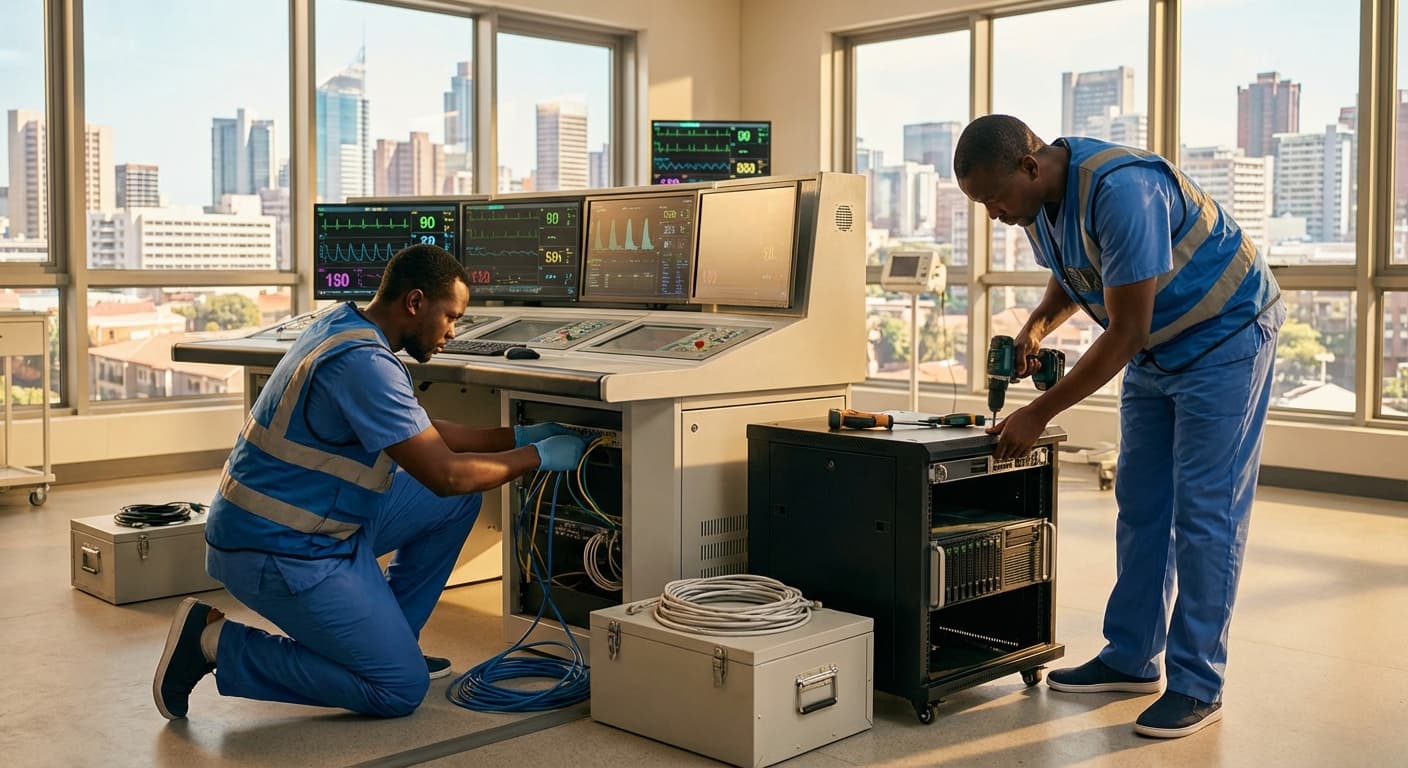
ICU Central Monitoring Station Installation Service in Eswatini
Engineering Excellence & Technical Support
ICU Central Monitoring Station Installation Service High-standard technical execution following OEM protocols and local regulatory frameworks.
Advanced Vital Signs Monitoring
Our ICU Central Monitoring Station installations leverage state-of-the-art technology to provide real-time, continuous tracking of critical patient vital signs including ECG, SpO2, NIBP, and respiration. This empowers medical staff with immediate insights for proactive patient care and rapid response to critical events across Eswatini's healthcare facilities.
Robust Network Integration & Data Security
We ensure seamless and secure integration of monitoring devices into your hospital's network infrastructure. Our expert technicians implement robust data transmission protocols and access controls, guaranteeing the integrity and confidentiality of sensitive patient data, compliant with international healthcare standards within Eswatini.
Comprehensive Training & Ongoing Support
Beyond installation, we provide comprehensive on-site training for your medical and IT teams on operating and maintaining the Central Monitoring Station. Our commitment extends to offering reliable technical support and maintenance services, ensuring the long-term optimal performance and uptime of your critical monitoring systems in Eswatini.
What Is Icu Central Monitoring Station Installation Service In Eswatini?
The ICU Central Monitoring Station Installation Service in Eswatini refers to the comprehensive process of designing, procuring, installing, configuring, and commissioning a centralized system for real-time patient monitoring within Intensive Care Units (ICUs). This service ensures that critical patient data, acquired from bedside monitoring devices, is seamlessly transmitted, aggregated, displayed, and analyzed at a central location, typically an ICU nursing station. The objective is to enhance patient safety, improve clinical decision-making, and optimize resource allocation by providing healthcare professionals with immediate access to vital signs and alarms across multiple ICU beds.
| Who Needs This Service? | Typical Use Cases | ||||||
|---|---|---|---|---|---|---|---|
| Hospitals and Healthcare Facilities in Eswatini: Specifically, departments responsible for Intensive Care Units (ICUs), High Dependency Units (HDUs), Coronary Care Units (CCUs), and other critical care settings. | Continuous Vital Signs Monitoring: Real-time tracking of ECG, blood pressure, heart rate, oxygen saturation, respiration rate, and temperature for multiple patients simultaneously. | Early Detection of Patient Deterioration: Promptly identifying critical changes in patient status through integrated alarm systems, allowing for timely intervention. | Improved Staff Efficiency: Reducing the need for constant bedside checks, allowing nurses to monitor more patients effectively and focus on direct patient care. | Enhanced Communication and Collaboration: Centralized data display facilitates team communication and collaborative decision-making among the ICU team. | Data Analysis and Performance Improvement: Utilizing historical monitoring data for trend analysis, quality improvement initiatives, and research. | Remote Monitoring Capabilities: Enabling off-site or off-shift clinicians to access patient data in emergency situations. | Compliance and Regulatory Requirements: Ensuring adherence to healthcare standards and best practices for patient monitoring in critical care environments. |
Key Components of ICU Central Monitoring Station Installation Service:
- Needs Assessment and System Design: Evaluating existing infrastructure, patient load, and clinical requirements to design a scalable and robust monitoring network. This includes determining the number of monitoring beds, required data points, alarm management strategies, and integration capabilities.
- Hardware and Software Procurement: Sourcing and acquiring specialized central monitoring workstations, network infrastructure (cables, switches, routers), bedside monitors with data output capabilities, and the central monitoring software platform.
- Network Infrastructure Installation and Configuration: Laying out and connecting Ethernet cables, configuring network switches and routers to ensure secure and reliable data transmission from bedside monitors to the central station.
- Bedside Monitor Integration: Connecting and configuring individual bedside patient monitors (e.g., for ECG, SpO2, NIBP, respiration, temperature) to the central monitoring system via wired or wireless networks. This involves establishing communication protocols and ensuring accurate data acquisition.
- Central Workstation Setup and Software Installation: Installing and configuring the central monitoring software on dedicated workstations. This includes setting up user interfaces, alarm parameters, data logging capabilities, and user access controls.
- Alarm Management System Implementation: Configuring sophisticated alarm rules and notifications to alert clinical staff to critical patient events. This can include audible, visual, and even remote notifications.
- Data Archiving and Retrieval: Establishing systems for storing historical patient monitoring data for review, analysis, and potential research purposes. This often involves integrating with Hospital Information Systems (HIS) or Electronic Health Records (EHR).
- System Testing and Validation: Conducting rigorous testing to verify data accuracy, network connectivity, alarm functionality, and overall system performance. This ensures the system meets clinical requirements and regulatory standards.
- User Training and Support: Providing comprehensive training to ICU physicians, nurses, and technical staff on the operation, maintenance, and troubleshooting of the central monitoring system. Ongoing technical support is also a crucial aspect.
Who Needs Icu Central Monitoring Station Installation Service In Eswatini?
The installation of an ICU Central Monitoring Station (CMS) is a critical infrastructure upgrade for any healthcare facility aiming to provide advanced critical care. In Eswatini, this service is essential for hospitals that are either expanding their intensive care capacity, upgrading existing facilities to meet international standards, or establishing new ICU units. The primary beneficiaries are patients requiring continuous, real-time physiological monitoring in a critical state, allowing healthcare professionals to intervene proactively and improve patient outcomes.
| Customer Type | Relevant Departments | Reason for Need |
|---|---|---|
| Public Hospitals (e.g., Mbabane Government Hospital, Raleigh Fitkin Memorial Hospital) | Intensive Care Unit (ICU), Cardiology Department, Respiratory Department, Emergency Department (for stabilization before ICU transfer) | To enhance patient safety, improve response times to critical events, support training of medical staff, and meet national healthcare standards for critical care. |
| Private Hospitals and Clinics (e.g., Manzini Clinic, other private facilities) | Intensive Care Unit (ICU), Surgical Departments, High Dependency Units (HDUs) | To offer advanced critical care services, attract specialized medical professionals, ensure competitive service offerings, and maintain high standards of patient care. |
| Specialized Medical Centers (if any, or future developments) | Cardiac Care Units, Neuro-ICUs, Trauma Centers | To provide dedicated, high-level monitoring for specific patient populations with complex physiological needs. |
| Teaching Hospitals (if applicable in the future) | All Critical Care Units, Medical Education Departments | To facilitate hands-on training for medical students, residents, and nurses in the management of critically ill patients, integrating real-time data into their learning. |
Target Customers and Departments for ICU Central Monitoring Station Installation Service in Eswatini:
- Hospitals in Eswatini (public and private)
- Government Ministry of Health (for public hospitals and national health initiatives)
- Large private healthcare groups or chains operating in Eswatini
- NGOs and international health organizations supporting healthcare infrastructure in Eswatini
Icu Central Monitoring Station Installation Service Process In Eswatini
This document outlines the comprehensive service process for the installation of an ICU Central Monitoring Station in Eswatini, from initial inquiry to final execution. The process is designed to ensure a smooth, efficient, and compliant installation that meets the highest standards of patient care and healthcare infrastructure.
| Phase | Key Activities | Deliverables | Responsible Parties |
|---|---|---|---|
| Receive client inquiry. Understand hospital's ICU requirements, existing infrastructure, budget, and timeline. Identify key stakeholders. | Needs assessment report, initial scope definition. | Client (Hospital Management, ICU Department Heads), Service Provider (Sales/Consulting Team) |
| Develop a detailed technical proposal outlining system architecture, components, software, and services. Prepare a comprehensive quotation including hardware, software, installation, training, and support costs. | Detailed technical proposal, formal quotation. | Service Provider (Technical Team, Sales Team) |
| Review and negotiate proposal terms, pricing, payment schedules, and service level agreements (SLAs). Finalize and sign the contract. | Signed service contract, agreed terms and conditions. | Client (Procurement Department, Legal Team), Service Provider (Legal Team, Management) |
| Conduct an in-depth site survey of the ICU and relevant network infrastructure. Finalize system design, network integration plan, and installation blueprint. Obtain necessary permits/approvals from Eswatini regulatory bodies. | Detailed site survey report, final technical design document, network topology map, permit applications/approvals. | Service Provider (Field Engineers, Network Specialists), Client (IT Department, Facilities Management), Eswatini Regulatory Authorities |
| Procure all necessary hardware, software, and ancillary equipment. Manage customs clearance and transportation to the installation site in Eswatini. | Procured equipment, shipping manifests, customs documentation. | Service Provider (Procurement Team, Logistics Department) |
| Physically install monitoring devices, workstations, servers, and network cabling. Configure software, network settings, and alarm parameters according to the technical design and client specifications. Integrate with existing hospital systems (e.g., EMR) if required. | Installed and cabled hardware, configured software, initial system setup. | Service Provider (Installation Engineers, Network Engineers, Software Specialists), Client (IT Department) |
| Perform comprehensive system testing, including connectivity, data flow, alarm functionality, and integration with other systems. Conduct performance and stress testing. Validate against predefined acceptance criteria. | Test reports, commissioning certificate, performance metrics. | Service Provider (Testing & Commissioning Team), Client (Clinical Staff, IT Department) |
| Provide comprehensive training to ICU clinical staff, IT personnel, and biomedical engineers on system operation, maintenance, and basic troubleshooting. Officially handover the fully functional system to the client. | Trained personnel, training materials, system documentation, formal handover certificate. | Service Provider (Training Specialists), Client (Clinical Staff, IT Department, Biomedical Engineers) |
| Provide ongoing technical support, software updates, and hardware maintenance as per the service contract. Offer preventative maintenance and remote monitoring services. Schedule periodic system reviews and performance checks. | Active support, resolved issues, updated system, maintenance reports. | Service Provider (Support Team, Maintenance Engineers), Client (IT Department, Biomedical Engineers) |
ICU Central Monitoring Station Installation Service Process in Eswatini
- 1. Initial Inquiry & Needs Assessment:
- 2. Proposal & Quotation Development:
- 3. Contract Negotiation & Agreement:
- 4. Site Survey & Technical Design:
- 5. Procurement & Logistics:
- 6. Installation & Configuration:
- 7. Testing & Commissioning:
- 8. Training & Handover:
- 9. Post-Installation Support & Maintenance:
Icu Central Monitoring Station Installation Service Cost In Eswatini
The cost of installing an ICU Central Monitoring Station in Eswatini can vary significantly due to several influencing factors. These factors include the size and complexity of the ICU, the specific features and capabilities required from the monitoring system, the brand and model of the equipment chosen, and the installation and integration services provided by the vendor. Additionally, factors like the need for network infrastructure upgrades, training for staff, and ongoing maintenance agreements will impact the overall investment. It's crucial for healthcare facilities in Eswatini to obtain detailed quotes from multiple reputable suppliers to accurately assess the total cost.
| Cost Component | Estimated Range (Eswatini Lilangeni - SZL) | Notes |
|---|---|---|
| Patient Monitors (per bed, basic to advanced) | SZL 20,000 - SZL 150,000+ | Depends heavily on brand, features, and parameters monitored. |
| Central Monitoring Station Hardware (display, server, UPS) | SZL 80,000 - SZL 400,000+ | Scales with the number of beds supported and processing power. |
| Software Licenses (per bed/central station) | SZL 5,000 - SZL 50,000+ | For basic to advanced analytics and data management features. |
| Installation and Configuration Labor | SZL 30,000 - SZL 150,000+ | Varies based on complexity, integration needs, and vendor rates. |
| Staff Training | SZL 10,000 - SZL 60,000+ | For clinical and IT personnel, depends on duration and content. |
| Network Infrastructure Upgrades (if needed) | SZL 15,000 - SZL 100,000+ | Cost for enhanced cabling, switches, and network security. |
| Annual Maintenance & Support Contract | SZL 15,000 - SZL 75,000+ | Typically 10-20% of the initial hardware and software cost. |
| Total Estimated Project Cost (for a small to medium ICU) | SZL 250,000 - SZL 1,500,000+ | This is a broad estimate. Complex installations with many beds and advanced features can exceed this range significantly. |
Key Pricing Factors for ICU Central Monitoring Station Installation in Eswatini
- Number of Beds/Patient Monitoring Points: The more beds that need to be integrated into the central monitoring system, the higher the cost of sensors, cables, and software licenses.
- Type of Patient Monitoring Equipment: The complexity and sophistication of the patient monitors (e.g., basic vital signs versus advanced multi-parameter monitors with invasive pressure, capnography, etc.) directly influence the cost of the station and its compatibility.
- Software Features and Analytics: Advanced features such as trend analysis, alarm management systems, data archiving, remote access capabilities, and integration with Electronic Health Records (EHR) will increase the price.
- Hardware Components: This includes the central display units, servers, network switches, uninterruptible power supplies (UPS), and any specialized interface modules required.
- Installation and Configuration Services: The labor costs associated with physically installing the equipment, configuring the network, setting up software, and ensuring seamless integration with existing hospital IT infrastructure.
- Training for Clinical and IT Staff: Comprehensive training is essential for effective use and maintenance of the system. The cost of training programs varies based on the duration and depth of instruction.
- Brand and Manufacturer Reputation: Established brands often command higher prices due to their perceived reliability, advanced technology, and customer support.
- Warranty and Maintenance Contracts: Extended warranties and ongoing service level agreements (SLAs) for maintenance and technical support will add to the initial and recurring costs.
- Site Preparation and Infrastructure: Any necessary electrical work, network cabling, or structural modifications within the ICU to accommodate the new system.
- Import Duties and Taxes: For imported equipment, local import duties, taxes, and potential shipping costs will be factored into the final price.
Affordable Icu Central Monitoring Station Installation Service Options
Setting up an Intensive Care Unit (ICU) central monitoring station is a critical investment for any healthcare facility. This technology allows for continuous, real-time observation of multiple patients' vital signs, enabling faster response times and improved patient outcomes. Finding an affordable installation service requires understanding value bundles and implementing cost-saving strategies. This guide explores options and provides practical advice.
| Value Bundle Option | Key Inclusions | Potential Cost Savings | Ideal For |
|---|---|---|---|
| Basic Monitoring Package | Core central monitoring software, a set of standard bedside monitors, and essential network components. Includes standard installation and initial training. | Lower upfront hardware costs, streamlined implementation process, focus on essential functionality. | Smaller ICUs, facilities with budget constraints, or those upgrading from a very basic system. |
| Advanced Analytics Bundle | Includes basic package features plus advanced data analytics capabilities, historical trend analysis, and potential integration with EMR (Electronic Medical Record) systems. May include premium support. | Long-term cost savings through improved clinical decision-making, reduced diagnostic time, and potential for predictive alerts. Bundled software licenses can be more economical. | Larger ICUs, research-oriented facilities, or those aiming for data-driven patient care and operational efficiency. |
| Turnkey Solution | Comprehensive package encompassing all hardware, software, installation, network setup, full EMR integration, extended warranty, and advanced staff training. Often includes project management. | Significant time savings due to a single point of contact and coordinated efforts. Reduced risk of compatibility issues and integration errors. Bulk purchasing discounts may apply. | Facilities undergoing a complete ICU renovation or new construction, or those seeking minimal disruption and a guaranteed seamless integration. |
| Phased Implementation Plan | Breaks down the installation into manageable stages, allowing for budget allocation over time. Each phase includes specific hardware, software, and installation services. | Spreads out capital expenditure, making it more manageable. Allows for learning and adjustments between phases. Can leverage existing infrastructure in early stages. | Facilities with ongoing budget constraints or those wanting to gradually upgrade their monitoring capabilities. |
Key Components of an ICU Central Monitoring Station Installation
- Central Monitoring Software: The core system that aggregates and displays patient data.
- Network Infrastructure: Reliable cabling, switches, and routers to ensure seamless data transmission.
- Workstations/Monitors: High-resolution screens for clinicians to view patient data.
- Patient Bedside Monitors: Devices that collect individual patient vital signs (ECG, SpO2, NIBP, etc.).
- Servers/Data Storage: For storing historical patient data and system logs.
- Installation & Configuration: Professional setup, calibration, and integration with existing hospital systems.
- Training: Ensuring staff are proficient in using the new system.
Verified Providers In Eswatini
Finding reliable and trustworthy healthcare providers in Eswatini is crucial for your well-being. When seeking medical services, it's essential to look for verified professionals who not only possess the necessary qualifications but also demonstrate a commitment to ethical practices and patient care. Franance Health stands out as a beacon of excellence in this regard, offering a network of healthcare providers who have undergone rigorous credentialing processes. Their dedication to verifying the skills, experience, and ethical standing of their practitioners ensures that patients receive the highest quality of care. Choosing Franance Health means opting for peace of mind, knowing you are in the hands of competent and compassionate professionals dedicated to your health.
| Provider Type | Key Qualifications | Franance Health Verification Standard |
|---|---|---|
| General Practitioners | MBBS/MD, valid medical license, proven experience | Verified medical degree, license confirmation, peer review/reference checks. |
| Specialist Physicians (e.g., Cardiologists, Dermatologists) | MBBS/MD, Specialist Board Certification, extensive clinical experience | Verified specialist certification, documented residency/fellowship completion, rigorous credentialing review. |
| Surgeons | MBBS/MD, Specialist Board Certification in Surgery, proven surgical competency | Verified surgical board certification, review of surgical outcomes and professional references. |
| Dentists | BDS/DMD, valid dental license, relevant postgraduate training | Verified dental degree and license, confirmation of specialty training if applicable. |
| Nurses (RNs, ENs) | Nursing Diploma/Degree, valid nursing license, specialized certifications | Verified nursing qualification and license, assessment of clinical competencies and experience. |
Why Franance Health Providers are the Best Choice:
- Rigorous Credentialing: All Franance Health providers undergo a thorough verification process to ensure they meet stringent qualification and experience standards.
- Commitment to Ethical Practices: Franance Health prioritizes providers who demonstrate unwavering ethical conduct and a patient-centered approach.
- Access to Specialized Care: Their network includes a diverse range of specialists, ensuring you can find the right expert for your specific health needs.
- Quality Assurance: Franance Health actively monitors and maintains high standards of care across their network.
- Trust and Reliability: By choosing Franance Health, you are assured of accessing healthcare professionals who are vetted and trusted within Eswatini.
Scope Of Work For Icu Central Monitoring Station Installation Service
This Scope of Work (SOW) outlines the services required for the installation of an Intensive Care Unit (ICU) Central Monitoring Station (CMS). This includes the complete setup, configuration, and integration of the CMS hardware and software, ensuring seamless operation and connectivity with bedside monitors and other critical care devices within the ICU. The objective is to provide clinicians with real-time, comprehensive patient data for enhanced decision-making and patient care. This SOW also details the technical deliverables and standard specifications that the service provider must adhere to throughout the project.
| Technical Deliverable | Description | Standard Specification/Requirement |
|---|---|---|
| Central Monitoring Station Server(s) | High-availability server(s) to host CMS software and manage patient data. | Minimum dual-core processors, 16GB RAM, 1TB RAID 1 storage. Redundant power supplies. Compatible with the selected CMS software. HIPAA/GDPR compliant data storage. |
| Workstations/Consoles | Dedicated workstations for ICU staff to view and manage patient data. | Minimum Intel i5 processor or equivalent, 8GB RAM, 256GB SSD. High-resolution (minimum 24-inch) displays. Ergonomic design. Secure login capabilities. |
| Network Infrastructure | Switches, routers, cabling, and network interface cards (NICs) to facilitate data transmission. | Gigabit Ethernet connectivity. Appropriate bandwidth allocation to avoid data latency. Secure network protocols (e.g., TLS/SSL). Redundant network pathways where feasible. |
| CMS Software | Software platform for data acquisition, display, trend analysis, and alarm management. | Vendor-certified, latest stable version. Supports HL7 integration for EMR connectivity. Configurable alarm parameters. Audit trail capabilities. Multi-user access with role-based permissions. |
| Integration Modules/Gateways | Hardware or software modules for interfacing with various bedside monitors. | Compatible with the specific models of ICU bedside monitors. Support for standard medical device communication protocols (e.g., HL7, DICOM, proprietary protocols). Secure data acquisition. |
| Data Backup and Recovery System | Solution for backing up and restoring patient data. | Automated daily backups. Offsite backup capability. Clearly defined recovery point objectives (RPO) and recovery time objectives (RTO). Regular testing of backup integrity. |
| Installation and Configuration Report | Document detailing the physical installation, software configuration, and network setup. | Includes network topology diagrams, IP addressing scheme, device configuration details, software version information, and integration points. Signed off by hospital IT and clinical representatives. |
| User Training Materials | Comprehensive guides and presentations for end-users. | Includes system operation, alarm management, data interpretation, troubleshooting basics. Tailored to different user roles (nurses, physicians, IT). |
| System Testing and Validation Report | Document outlining the results of functional, performance, and user acceptance testing. | Includes test cases, expected outcomes, actual results, and any identified issues. Signatory by hospital stakeholders. |
| Warranty and Support Documentation | Details of the warranty period and post-installation support services. | Includes contact information for support, service level agreements (SLAs), and hardware/software maintenance procedures. |
Key Activities and Responsibilities
- Site assessment and planning for CMS installation.
- Procurement and delivery of all necessary CMS hardware and software components.
- Installation and physical mounting of CMS server(s), workstations, and network infrastructure.
- Configuration and integration of CMS software with existing hospital network and IT infrastructure.
- Connection and configuration of CMS to all designated ICU bedside monitors and associated patient data acquisition devices.
- Testing and validation of the entire CMS system for functionality, data accuracy, and reliability.
- User training for ICU nursing staff, physicians, and IT support personnel.
- Documentation of the installed system, including network diagrams, configuration settings, and user manuals.
- Post-installation support and warranty management.
Service Level Agreement For Icu Central Monitoring Station Installation Service
This Service Level Agreement (SLA) outlines the response times and uptime guarantees for the installation and initial setup services of the ICU Central Monitoring Station. This SLA applies to all customers who have purchased the ICU Central Monitoring Station Installation Service.
| Service Component | Uptime Guarantee | Response Time (Business Hours) | Response Time (Emergency Support Hours) |
|---|---|---|---|
| CMS Core Functionality (Real-time Vital Sign Display & Alarms) | 99.9% within the first 30 days post-installation | 1 hour (acknowledgement), 4 hours (resolution target) | 2 hours (acknowledgement), 8 hours (resolution target) |
| CMS Reporting & Data Archiving (non-real-time impact) | 99.5% within the first 30 days post-installation | 4 hours (acknowledgement), 24 hours (resolution target) | 8 hours (acknowledgement), 48 hours (resolution target) |
| Initial Installation & Configuration Completion | N/A (Service delivery completion is the objective, not uptime) | As per agreed project timeline. Site readiness verification within 2 business days of request. |
Key Definitions
- Installation Service: The complete process of setting up, configuring, and testing the ICU Central Monitoring Station at the customer's designated facility.
- Central Monitoring Station (CMS): The hardware and software system responsible for receiving, displaying, and alerting on patient vital signs from connected bedside monitors.
- Critical System Failure: A failure of the CMS that prevents the display of any patient vital signs or alarm notifications, rendering the system non-operational for patient monitoring.
- Non-Critical System Failure: A failure of a specific feature or component of the CMS that does not prevent the display of all patient vital signs or alarm notifications. This includes issues with reporting, historical data access (if not impacting real-time monitoring), or non-essential display elements.
- Business Hours: Monday to Friday, 9:00 AM to 5:00 PM local time, excluding national holidays.
- Emergency Support Hours: Outside of Business Hours, including weekends and national holidays.
Frequently Asked Questions

Ready when you are
Let's scope your ICU Central Monitoring Station Installation Service in Eswatini project in Eswatini.

Scaling healthcare logistics and technical systems across the entire continent.