
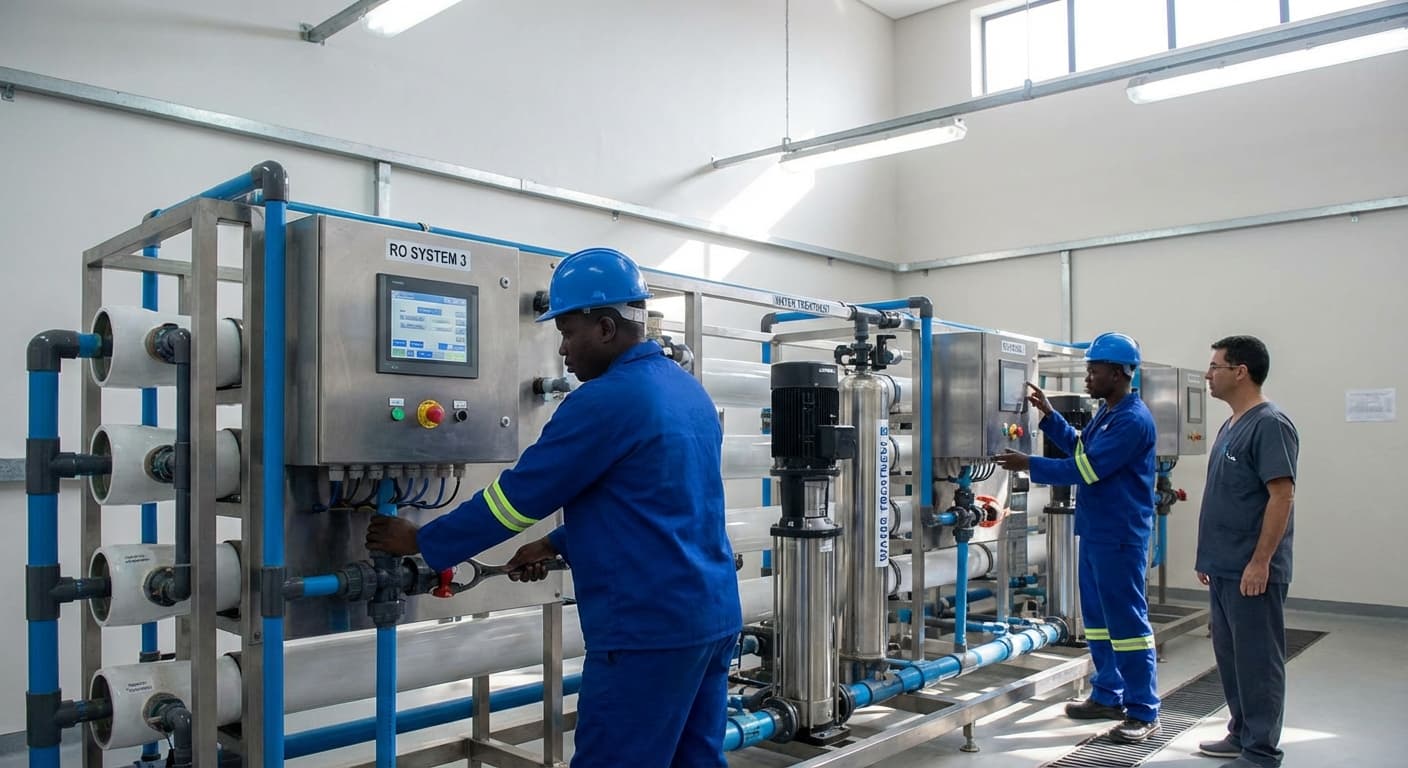
Dialysis RO/Water Treatment Plant Installation Service in Eswatini
Engineering Excellence & Technical Support
Dialysis RO/Water Treatment Plant Installation Service High-standard technical execution following OEM protocols and local regulatory frameworks.
Optimized Reverse Osmosis System Design
We specialize in bespoke RO system design for Eswatini's unique water profiles, ensuring maximum water purity and operational efficiency for your dialysis facility. Our solutions minimize scaling and fouling, extending equipment lifespan.
Expert Installation & Commissioning
Our certified technicians provide seamless installation and rigorous commissioning of dialysis water treatment plants across Eswatini. We guarantee adherence to international standards and local regulations for safe and reliable operation from day one.
End-to-End Quality Assurance
From initial water quality assessment to final performance validation, our comprehensive service package in Eswatini prioritizes the highest standards of water safety and quality, crucial for patient well-being and dialysis efficacy.
What Is Dialysis Ro/water Treatment Plant Installation Service In Eswatini?
Dialysis RO/Water Treatment Plant Installation Service in Eswatini refers to the comprehensive process of designing, supplying, installing, commissioning, and maintaining Reverse Osmosis (RO) and associated water treatment systems specifically tailored for dialysis facilities. These systems are critical for producing ultrapure water, which is a fundamental requirement for hemodialysis procedures. The service ensures that the water used in dialysis is free from contaminants such as bacteria, endotoxins, pyrogens, dissolved solids, and ions that could pose a risk to patient health. This involves a multi-stage treatment process that typically includes pre-filtration, carbon filtration, RO membrane separation, and post-treatment polishing (e.g., UV sterilization or deionization) to meet stringent medical water standards.
| Who Needs It? | Typical Use Cases |
|---|---|
| Dialysis Centers (in-center hemodialysis) | Production of ultrapure water for hemodialysis machines. |
| Hospitals with dedicated nephrology departments or renal units | Ensuring a reliable and safe water supply for both chronic and acute dialysis patients. |
| Mobile dialysis units or temporary treatment facilities | Providing portable or rapidly deployable water treatment solutions for emergency or remote locations. |
| Research institutions conducting studies on water purity for medical applications | Establishing controlled environments for water quality research related to renal care. |
| Government health ministries or public health organizations | Outfitting public dialysis facilities or implementing national renal care infrastructure projects. |
Key Components and Stages of Dialysis RO/Water Treatment Plant Installation:
- Site assessment and requirement analysis
- System design and engineering (including flow rates, water quality targets, redundancy)
- Procurement of specialized RO membranes, filters, pumps, storage tanks, and monitoring equipment
- Plumbing and electrical integration with existing facility infrastructure
- Installation of the complete water treatment train
- System testing, calibration, and performance validation
- Commissioning and handover with operational and maintenance training
- Ongoing technical support, preventative maintenance, and spare parts management
Who Needs Dialysis Ro/water Treatment Plant Installation Service In Eswatini?
Dialysis RO/Water Treatment Plant Installation services are crucial for ensuring the provision of safe and high-quality water essential for hemodialysis treatments. In Eswatini, these services are primarily needed by facilities that operate or plan to operate dialysis units, as well as organizations that support public health infrastructure. The effectiveness of dialysis directly correlates with the purity of the water used, making reliable installation and maintenance paramount.
| Target Customer Type | Specific Departments/Roles |
|---|---|
| Hospitals (Public) | Nephrology Department, Engineering/Maintenance Department, Procurement Department, Administration |
| Hospitals (Private) | Nephrology Department, Biomedical Engineering, Procurement Department, Hospital Management |
| Clinics with Dialysis Units | Clinic Management, Nursing Supervisors (Dialysis), Technical Staff |
| Non-Governmental Organizations (NGOs) | Project Managers (Healthcare Projects), Technical Advisors, Procurement Officers |
| Government Health Ministries/Departments | Directorate of Health Services, Public Health Engineering Division, Procurement Unit, Planning Department |
| International Aid Organizations | Country Representatives, Health Program Managers, Logistics and Procurement Teams |
| Research Institutions | Principal Investigators, Laboratory Managers, Research Support Staff |
Target Customers and Departments for Dialysis RO/Water Treatment Plant Installation Service in Eswatini
- Hospitals (Public and Private)
- Clinics with Dialysis Units
- Non-Governmental Organizations (NGOs) involved in healthcare
- Government Health Ministries/Departments
- International Aid Organizations supporting healthcare
- Research Institutions conducting medical studies
Dialysis Ro/water Treatment Plant Installation Service Process In Eswatini
This document outlines the comprehensive workflow for the installation of Dialysis Reverse Osmosis (RO)/Water Treatment Plants in Eswatini, covering the process from initial inquiry to final execution and handover. Our aim is to provide a clear, structured, and efficient service that meets the specific needs of healthcare facilities.
| Phase | Key Activities | Deliverables | Estimated Duration |
|---|---|---|---|
| Receive client inquiry, understand basic requirements, discuss potential solutions. | Initial meeting, preliminary understanding of project scope. | 1-3 Business Days |
| On-site visit, evaluate water source quality, flow rates, power availability, space, existing infrastructure, and specific dialysis unit needs. | Detailed site assessment report, identification of system requirements and constraints. | 3-7 Business Days (depending on travel and complexity) |
| Design a customized RO/water treatment system (including pre-treatment, RO membranes, post-treatment, sterilization, and monitoring), prepare technical specifications and drawings. | Detailed technical proposal, system schematics, flow diagrams. | 5-10 Business Days |
| Prepare a comprehensive quotation including equipment, installation, commissioning, training, warranties, and payment terms. Negotiate and finalize contract. | Formal quotation, signed contract agreement. | 3-5 Business Days |
| Order all necessary components, manage import/export procedures, arrange for secure transportation of equipment to Eswatini. | Confirmation of orders, shipping documents, arrival schedule. | 4-12 Weeks (dependent on lead times and shipping) |
| Confirm site readiness, coordinate with client for utility connections (power, drainage), arrange for any required civil works (e.g., platform, pipe routing). | Site readiness confirmation, completed civil works (if applicable). | 1-2 Weeks (concurrent with equipment arrival) |
| Expert installation of all system components by certified technicians. Calibration, functional testing, and initial startup of the plant. | Physically installed and operational RO/water treatment plant. | 2-4 Weeks (depending on system size and complexity) |
| Conduct rigorous testing of treated water for all critical parameters (TDS, conductivity, endotoxins, bacteria, chemical contaminants) as per relevant dialysis standards (e.g., AAMI, ISO). Submit validation report. | Comprehensive water quality test results, system validation report. | 2-5 Business Days |
| Provide thorough training to the client's biomedical engineers and technicians on system operation, routine maintenance, basic troubleshooting, and safety protocols. Formal handover of the system. | Trained personnel, operation and maintenance manuals, handover certificate. | 3-5 Business Days |
| Offer warranty services, preventative maintenance packages, remote monitoring (if applicable), and responsive technical support. | Ongoing support, scheduled maintenance visits, readily available technical assistance. | Continuous |
Dialysis RO/Water Treatment Plant Installation Service Process in Eswatini
- Inquiry & Initial Consultation: The process begins with a client reaching out to us with their requirement for a dialysis RO/water treatment plant.
- Site Assessment & Needs Analysis: A thorough evaluation of the client's facility and existing water infrastructure is conducted.
- System Design & Proposal: Based on the assessment, a customized RO/water treatment system design is developed.
- Quotation & Contract Agreement: A detailed quotation outlining costs, timelines, and terms is provided.
- Procurement & Logistics: All necessary components and equipment are sourced and arranged for delivery to Eswatini.
- Pre-Installation Preparation: Site readiness checks, utility connections, and any necessary civil works are addressed.
- Installation & Commissioning: The RO/water treatment plant is physically installed and meticulously commissioned.
- Water Quality Testing & Validation: Comprehensive testing is performed to ensure water quality meets dialysis standards.
- Training & Handover: Client personnel are trained on operation, maintenance, and troubleshooting.
- Post-Installation Support & Maintenance: Ongoing support and maintenance services are offered.
Dialysis Ro/water Treatment Plant Installation Service Cost In Eswatini
The installation of a Reverse Osmosis (RO) and general water treatment plant for dialysis purposes in Eswatini involves a combination of equipment costs, labor, and site-specific considerations. The pricing can vary significantly based on the complexity of the system, the required water purity standards (which are critical for dialysis), the capacity of the plant, and the chosen service provider.
Several factors influence the overall cost. These include:
- System Capacity and Design: The volume of purified water needed per hour or day directly impacts the size and cost of the RO membranes, pumps, pre-filters, and storage tanks. Larger, more sophisticated systems designed for high-volume dialysis centers will naturally be more expensive.
- Water Source Quality: If the raw water source (e.g., municipal tap water, borehole) has high levels of contaminants (TDS, hardness, heavy metals, bacteria), a more robust pre-treatment system will be required. This could involve additional filtration stages like media filters, activated carbon filters, or even water softening, which adds to the overall cost.
- Purity Standards and Redundancy: Dialysis requires extremely pure water. Meeting these stringent standards might necessitate multi-stage RO, polishing filters, and potentially UV sterilization or electro-deionization (EDI) systems. Furthermore, redundancy in critical components (like pumps or membranes) is often built in for uninterrupted operation, increasing the upfront investment.
- Installation Complexity and Site Preparation: The physical location of the installation plays a role. Factors like accessibility for equipment delivery, the need for specialized plumbing, electrical work, a dedicated building or room, drainage, and power supply will affect labor and material costs.
- Brand and Quality of Equipment: Different manufacturers offer varying levels of quality, durability, and technological features. Choosing reputable, medical-grade equipment can lead to higher initial costs but often translates to better performance and lower long-term maintenance.
- Service Provider Expertise and Warranty: The experience and reputation of the installation company are crucial. Companies with specialized knowledge in medical water treatment often command higher prices due to their expertise, adherence to standards, and the warranties they offer on both equipment and workmanship.
- Ongoing Maintenance and Support: While not strictly installation cost, it's essential to consider the service provider's offerings for post-installation maintenance, filter replacements, and technical support, as these will be ongoing expenses.
Pricing Ranges in Eswatini (Emalangeni - E):
It's challenging to provide exact figures without a detailed site assessment and system design. However, based on general industry trends and the factors above, the installation cost for a dialysis RO/water treatment plant in Eswatini can range broadly. This estimate is for the installation service and the core system components, excluding ongoing consumables and maintenance contracts.
For a standard, mid-range dialysis RO system for a small to medium-sized clinic, you might expect costs to start from approximately E 150,000 to E 350,000. For larger facilities or those requiring highly advanced, multi-stage purification systems with significant redundancy, the costs could escalate significantly, potentially reaching E 500,000 or more.
| Service Component | Estimated Cost Range (Eswatini Emalangeni - E) | Notes |
|---|---|---|
| RO System Unit (Mid-Range, ~50-100 LPH) | E 80,000 - E 200,000 | Includes RO membranes, pumps, housings, basic pre-filters. |
| Advanced Pre-treatment (Water Softener, Media Filters, Carbon Filters) | E 20,000 - E 80,000 | Dependent on raw water analysis. |
| Polishing Filters/Post-Treatment (e.g., DI Resin, UV) | E 15,000 - E 50,000 | To meet stringent dialysis water standards. |
| Storage Tanks (RO Water Tank) | E 10,000 - E 40,000 | Material and size dependent (e.g., HDPE, Stainless Steel). |
| Installation Labor & Supervision | E 25,000 - E 70,000 | Includes pipe fitting, electrical connections, system setup. |
| Testing, Commissioning & Water Quality Verification | E 5,000 - E 20,000 | Essential for compliance and safety. |
| Total Estimated Installation Cost (Small to Medium Clinic) | E 155,000 - E 460,000 | This is a broad estimate and can vary significantly. |
Key Pricing Factors for Dialysis RO/Water Treatment Plant Installation in Eswatini
- System Capacity and Design (e.g., LPH/GPD)
- Raw Water Quality and Pre-treatment Requirements
- Required Water Purity Standards (e.g., DI water, <5 mS/cm)
- Redundancy and Backup Systems
- Quality and Brand of RO Membranes, Pumps, and Filters
- Complexity of Plumbing, Electrical, and Site Preparation
- Labor Costs and Technician Expertise
- Logistics and Transportation of Equipment
- Testing and Commissioning Procedures
- Warranty and After-Sales Support Offered by the Provider
Affordable Dialysis Ro/water Treatment Plant Installation Service Options
Finding affordable dialysis RO/water treatment plant installation services is crucial for healthcare facilities aiming to provide safe and effective dialysis treatments without breaking the bank. This involves understanding the various service options available, leveraging value bundles, and implementing smart cost-saving strategies. A well-designed and properly installed water treatment system is paramount to patient safety, preventing complications arising from impurities in the dialysis water. By carefully considering these aspects, facilities can ensure a high-quality, cost-effective solution for their dialysis operations.
| Value Bundle Component | Description | Potential Cost Savings |
|---|---|---|
| Equipment + Installation Package | Bundling the RO/water treatment unit with the professional installation service from the same provider. | Reduced negotiation time, streamlined logistics, potential discounts for combined purchase. |
| System Design + Equipment + Installation | A comprehensive bundle that includes the initial assessment, custom system design, purchase of all necessary components, and complete installation. | Eliminates the need for separate design consultants, reduces risk of incompatible components, optimized system efficiency. |
| Full-Service Contract (Post-Installation) | Includes scheduled maintenance, filter replacements, water quality testing, and emergency repair services alongside the initial installation. | Predictable operational costs, reduced downtime, extended equipment lifespan, avoidance of costly emergency repairs. |
| Training + Installation | Bundling the installation service with comprehensive training for facility staff on system operation and basic maintenance. | Empowers in-house staff for routine tasks, reduces reliance on external technicians for minor issues, ensures proper system usage. |
Understanding Affordable Dialysis RO/Water Treatment Plant Installation Service Options
- Direct Manufacturer Sales & Installation: Some manufacturers offer their RO/water treatment systems directly, often including installation as part of the package. This can eliminate intermediary markups and provide a direct line for technical support.
- Authorized Resellers/Distributors: These entities work with multiple manufacturers and can often bundle equipment from different brands to create a tailored solution. They typically have trained installation teams and can offer competitive pricing through volume purchasing.
- Independent Water Treatment Specialists: Dedicated companies specializing in industrial and medical water treatment can offer expert consultation, design, and installation services. They may not be tied to specific brands, allowing for objective recommendations and potentially more flexibility in sourcing components.
- Turnkey Solutions: These comprehensive packages include everything from initial consultation and system design to installation, commissioning, and even operator training. While seemingly more expensive upfront, they can offer significant cost savings by avoiding multiple vendor coordination and potential delays.
- Lease-to-Own Programs: For facilities with budget constraints, leasing the RO/water treatment system can be an attractive option. This often includes maintenance and service, spreading the cost over time and providing predictable operational expenses.
Verified Providers In Eswatini
Ensuring access to reliable and high-quality healthcare is paramount, and in Eswatini, this means identifying verified providers who uphold the highest standards. Franance Health stands out as a leading organization, offering a robust network of accredited medical professionals and facilities. Their commitment to stringent credentialing processes means that patients can be confident in the expertise and qualifications of the healthcare services they receive. Choosing a verified provider like those within the Franance Health network offers peace of mind, guarantees adherence to best practices, and promotes better health outcomes.
| Key Benefit | Description | Franance Health's Assurance |
|---|---|---|
| Quality of Care | Ensuring patients receive the highest standard of medical treatment. | Franance Health's stringent vetting process guarantees providers meet established quality benchmarks. |
| Professional Expertise | Access to doctors and specialists with verified qualifications and experience. | All listed providers undergo thorough background checks and credential verification by Franance Health. |
| Patient Safety | Minimizing risks through adherence to safety protocols and best practices. | Franance Health partners with accredited facilities that prioritize patient safety and employ up-to-date medical procedures. |
| Trustworthiness | Building confidence in the healthcare services received. | The 'verified' status from Franance Health signifies a commitment to transparency and ethical practice. |
| Accessibility | Connecting patients with a network of reliable healthcare options. | Franance Health streamlines the process of finding and accessing trusted medical professionals in Eswatini. |
Why Franance Health Represents the Best Choice:
- Rigorous Credentialing: Franance Health employs a thorough verification process for all its providers, ensuring they meet stringent professional and ethical standards.
- Qualified Professionals: Access to a network of highly skilled and experienced doctors, nurses, and specialists across various medical disciplines.
- Accredited Facilities: Partnership with reputable hospitals and clinics that adhere to international quality and safety benchmarks.
- Patient-Centric Approach: A commitment to providing compassionate, effective, and accessible healthcare services tailored to individual needs.
- Trust and Reliability: Patients can rely on the integrity and quality of care offered by Franance Health's verified network, minimizing risks and maximizing positive health outcomes.
Scope Of Work For Dialysis Ro/water Treatment Plant Installation Service
This Scope of Work (SOW) outlines the requirements for the installation of a Dialysis Reverse Osmosis (RO) / Water Treatment Plant. It details the technical deliverables, standard specifications, and the responsibilities of the service provider to ensure a functional, safe, and compliant water purification system for dialysis operations. The SOW covers site preparation, equipment installation, system testing, commissioning, training, and documentation.
| Section | Description | Technical Deliverables | Standard Specifications |
|---|---|---|---|
| Site Assessment and Preparation | Initial evaluation of the installation site to determine suitability and identify any required modifications. | Site survey report, proposed site layout, identification of utility requirements (power, water inlet, drainage). | Compliance with local building codes, health and safety regulations. Adequate space for equipment and maintenance access. Availability of required utilities. |
| Equipment Delivery and Storage | Safe and timely delivery of all RO/Water Treatment Plant components to the site. | Delivery manifests, condition reports upon arrival, secure and protected storage on-site. | Protection from environmental damage (moisture, dust, impact). Manufacturer's recommended storage conditions. |
| Installation of RO/Water Treatment Plant Components | Physical installation of all major components including pre-treatment filters, RO membranes, post-treatment systems, storage tanks, and control panels. | Properly installed and secured components, leak-free connections. | Manufacturer's installation guidelines, adherence to equipment layout drawings, secure mounting of all units. |
| Plumbing and Electrical Connections | Connection of water inlet, treated water outlet, drain lines, and electrical power supply to the RO/Water Treatment Plant. | All plumbing and electrical connections made according to design specifications, verified for safety and functionality. | Use of appropriate, potable-water-grade piping materials (e.g., NSF-certified PVC, stainless steel). Adherence to all electrical codes and safety standards. Proper grounding of electrical components. |
| System Integration and Piping | Integration of all installed components into a cohesive and operational system. | Completed and tested piping network, ensuring no leaks and correct flow paths. | Minimizing dead legs in piping, using materials compatible with water quality requirements. Pressure testing of all piping systems. |
| Pre-commissioning Checks | Thorough inspection of all installed systems before system startup. | Checklists for plumbing, electrical, and mechanical integrity, verification of all component installations. | Manufacturer's pre-start checklists, visual inspections, continuity tests. |
| System Testing and Validation | Operation of the RO/Water Treatment Plant to verify performance and water quality. | Performance test reports, water quality analysis reports (TDS, conductivity, microbial counts, specific ions), flow rate verification. | Testing to meet established standards for dialysis water (e.g., AAMI, ISO, local health authority guidelines). Consecutive testing to demonstrate stability. |
| Commissioning and Handover | Final adjustments, calibration, and official handover of the operational system. | Commissioning report, signed acceptance certificate, demonstration of system functionality to client representatives. | System calibrated to optimal performance. All alarm settings verified. Client representatives trained on basic operation. |
| Training | Provision of comprehensive training to client personnel on the operation, maintenance, and troubleshooting of the RO/Water Treatment Plant. | Training materials (manuals, presentations), attendance records, competency assessment. | Training covering daily checks, basic maintenance, emergency procedures, and filter replacement. Tailored to the skill level of the trainees. |
| Documentation and As-Built Drawings | Submission of all relevant documentation, including as-built drawings and operational manuals. | Complete set of as-built drawings, operation and maintenance manuals, spare parts list, warranty documents. | Drawings accurately reflecting the final installed system. Manuals clear, concise, and comprehensive. All documents provided in the agreed format (digital and/or hard copy). |
Key Stages and Activities
- Site Assessment and Preparation
- Equipment Delivery and Storage
- Installation of RO/Water Treatment Plant Components
- Plumbing and Electrical Connections
- System Integration and Piping
- Pre-commissioning Checks
- System Testing and Validation
- Commissioning and Handover
- Training
- Documentation and As-Built Drawings
Service Level Agreement For Dialysis Ro/water Treatment Plant Installation Service
This Service Level Agreement (SLA) outlines the performance standards and response commitments for the installation services of Dialysis Reverse Osmosis (RO) / Water Treatment Plants. It ensures that the installed systems meet the required uptime and operational efficiency for critical dialysis operations. This SLA is an appendix to the main Service Agreement between [Your Company Name] and [Client Name].
| Service Level | Description | Target Performance |
|---|---|---|
| Installation Completion Time | Time from site readiness confirmation to system handover and final sign-off. | Within [Number] business days of site readiness confirmation, excluding delays caused by client or unforeseen site conditions. |
| System Commissioning and Validation | Time to achieve stable and compliant water quality parameters post-installation. | Within [Number] business days of installation completion. |
| Post-Installation Support (Initial) | Availability of technical support for immediate post-installation issues. | 24/7 availability for the first [Number] days after system handover. |
| Response Time for Critical Failures (Post-Commissioning) | Time taken by a technician to acknowledge and begin remote diagnostics for a critical system failure after it's reported. | < 1 hour |
| On-Site Technician Arrival for Critical Failures | Time taken for a qualified technician to arrive on-site to address a critical system failure once it's determined on-site intervention is required. | < 4 hours (within a [Number] km radius of a service center) / < 24 hours (for remote locations, subject to travel availability) |
| System Uptime Guarantee (Post-Commissioning) | Guaranteed operational uptime of the RO/Water Treatment Plant, excluding planned maintenance and scheduled downtime. | 98% uptime per month (averaged over a 12-month period) |
Scope of Service
- Pre-installation site survey and assessment.
- Design and engineering of the RO/Water Treatment Plant to meet client specifications and regulatory requirements.
- Procurement and delivery of all necessary equipment and materials.
- On-site installation and commissioning of the RO/Water Treatment Plant.
- System testing, validation, and performance verification.
- Operator training on system operation and basic maintenance.
- Documentation handover, including manuals and schematics.
Frequently Asked Questions

Ready when you are
Let's scope your Dialysis RO/Water Treatment Plant Installation Service in Eswatini project in Eswatini.

Scaling healthcare logistics and technical systems across the entire continent.