
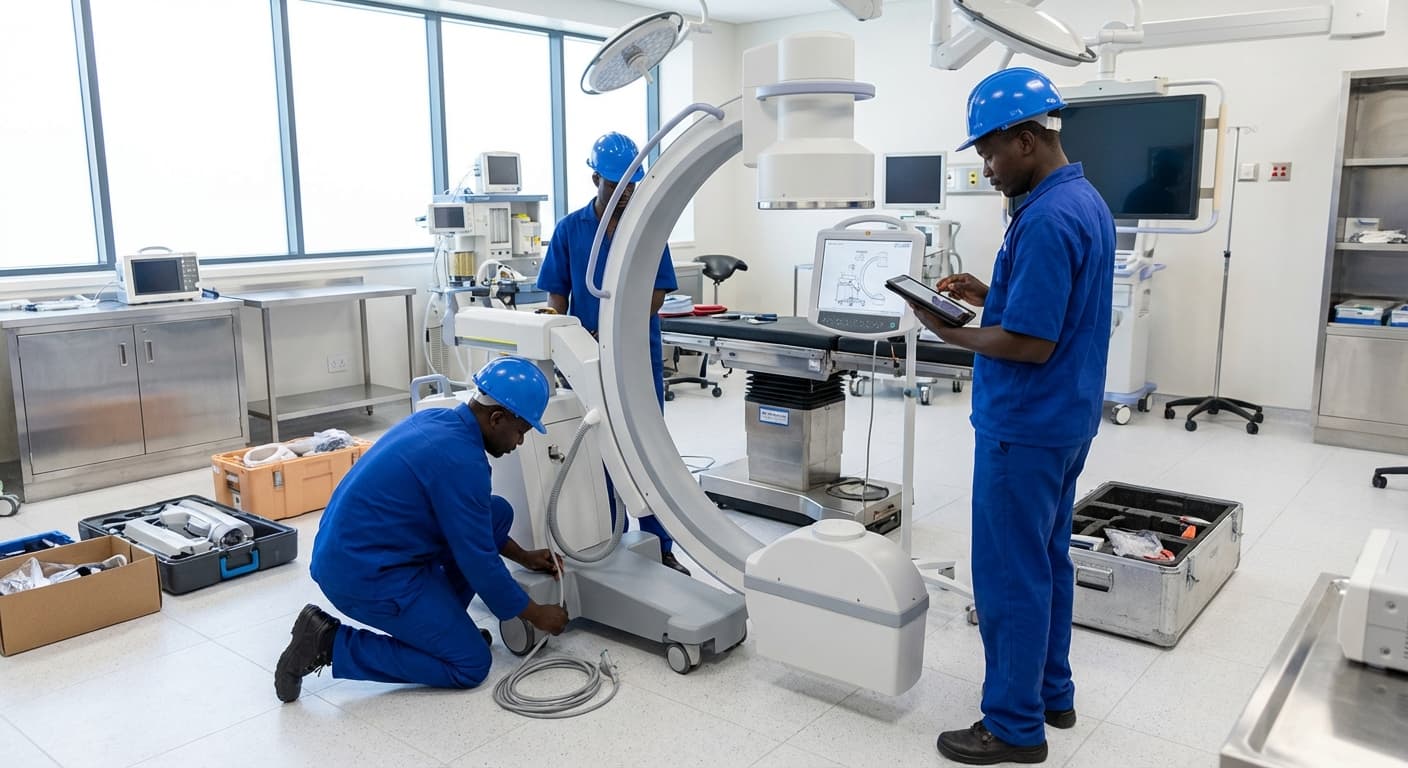
C-Arm Installation Service in Eswatini
Engineering Excellence & Technical Support
C-Arm Installation Service High-standard technical execution following OEM protocols and local regulatory frameworks.
Seamless C-Arm Integration & Calibration
Expert installation of your C-arm system in Eswatini, ensuring precise alignment, optimal image quality, and full compatibility with your existing medical infrastructure. Our certified technicians meticulously calibrate every component for peak performance and diagnostic accuracy.
Regulatory Compliance & Safety Assured
Navigate Eswatini's healthcare regulations with confidence. Our C-arm installation service adheres to all local and international safety standards, providing comprehensive radiation shielding verification and ensuring your equipment meets all compliance requirements for safe patient care.
Swift & Secure On-Site Deployment
Reliable, timely, and secure on-site C-arm installation across Eswatini. We manage the entire process from equipment logistics and site preparation to final setup and initial system testing, minimizing downtime and enabling rapid return to clinical operations.
What Is C-arm Installation Service In Eswatini?
C-arm installation service in Eswatini refers to the professional process of setting up, configuring, and validating a C-arm fluoroscopy imaging system within a healthcare facility in the Kingdom of Eswatini. This service encompasses the physical placement of the C-arm unit, integration with existing medical equipment and imaging networks, calibration, and initial testing to ensure optimal functionality and adherence to diagnostic imaging standards. It is a critical step in deploying this advanced radiological technology, enabling real-time X-ray imaging during surgical procedures, interventional radiology, and pain management therapies.
| Who Needs C-Arm Installation Service? | Typical Use Cases | ||||
|---|---|---|---|---|---|
| Hospitals and Surgical Centers in Eswatini requiring advanced intraoperative imaging capabilities. | Orthopedic Surgery: Real-time visualization for fracture reduction, implant placement (e.g., hip, knee, spine), and arthroscopy. | Cardiology and Interventional Radiology: Guiding catheter placement, stent deployment, angioplasty, and embolization procedures. | Pain Management Clinics: Performing image-guided injections and nerve blocks for spinal and joint pain. | Emergency Departments: Rapid diagnostic imaging during trauma cases and bedside procedures. | Urology: Assisting in procedures like cystography, nephrostomy, and stone removal. |
| New healthcare facilities in Eswatini establishing or upgrading their diagnostic imaging departments. | Existing facilities expanding their surgical or interventional services. | Facilities replacing outdated fluoroscopy equipment. | Medical device distributors or vendors providing comprehensive solutions to their clients in Eswatini. |
Key Components of C-Arm Installation Service
- Site Preparation and Assessment: Evaluating the installation site for power, space, radiation shielding requirements, and network connectivity.
- Physical Placement and Mounting: Precisely positioning and securing the C-arm unit according to manufacturer specifications and ergonomic considerations.
- Electrical and Network Integration: Connecting the C-arm to power sources, grounding systems, and the facility's Picture Archiving and Communication System (PACS) or hospital information system (HIS).
- Radiation Safety Compliance: Implementing and verifying radiation shielding measures and ensuring compliance with local radiation safety regulations.
- System Configuration and Calibration: Configuring imaging parameters, software settings, and performing calibration routines for image quality and accuracy.
- Initial Testing and Quality Assurance: Conducting comprehensive tests to verify all system functions, including image acquisition, processing, storage, and output.
- User Training and Familiarization: Providing initial training to radiographers, physicians, and support staff on the operation and basic maintenance of the C-arm system.
- Documentation and Handover: Providing detailed installation reports, user manuals, and warranty information to the client.
Who Needs C-arm Installation Service In Eswatini?
C-arm imaging systems are essential diagnostic tools in modern healthcare, providing real-time X-ray visualization during surgical and interventional procedures. Their precise installation is crucial for ensuring patient safety, diagnostic accuracy, and operational efficiency. In Eswatini, the need for professional C-arm installation services arises from a growing healthcare sector aiming to enhance its capabilities and offer advanced medical treatments.
| Department | Typical Procedures Requiring C-Arm | Importance of Professional Installation |
|---|---|---|
| Orthopedics | Fracture repair, joint replacement surgeries, spinal surgery, arthroscopy | Ensures precise alignment of implants, verification of fracture reduction, and safe navigation within the surgical field. |
| Pain Management | Epidural steroid injections, nerve blocks, radiofrequency ablation | Accurate needle placement for optimal therapeutic outcomes and minimizing risks of complications. |
| Urology | Lithotripsy (kidney stone treatment), stent placement, prostate procedures | Guidance for instrumentation, visualization of stone fragments, and confirmation of stent positioning. |
| Cardiology (Interventional) | Angioplasty, stent placement, pacemaker implantation | Real-time visualization of blood vessels, catheter manipulation, and device placement to ensure procedural success and patient safety. |
| Gastroenterology (Interventional) | ERCP (Endoscopic Retrograde Cholangiopancreatography), foreign body retrieval | Visualization of bile ducts and pancreatic ducts, guidance for endoscopic instruments, and confirmation of object removal. |
| General Surgery | Placement of drains, biopsies, certain laparoscopic procedures | Assists in precise localization and confirmation of placement during minimally invasive interventions. |
| Emergency Medicine | Initial assessment of trauma patients, foreign body localization | Rapid diagnostic imaging to guide immediate management decisions in critical situations. |
Target Customers and Departments Requiring C-Arm Installation Services in Eswatini
- {"title":"Hospitals (Public and Private)","description":"These are the primary institutions that will benefit from C-arm technology. Both government-funded public hospitals and private healthcare facilities are increasingly investing in advanced diagnostic equipment to improve patient care and expand their service offerings."}
- {"title":"Surgical Centers and Clinics","description":"Facilities specializing in outpatient surgical procedures, particularly those involving orthopedics, pain management, and urology, will require C-arm installation for intraoperative guidance."}
- {"title":"Specialized Medical Centers","description":"This includes facilities focusing on areas like cardiology, neurology, gastroenterology, and vascular surgery, where minimally invasive procedures often rely on real-time imaging."}
- {"title":"Diagnostic Imaging Centers","description":"Centers dedicated to providing comprehensive diagnostic services may acquire C-arms to supplement their existing imaging modalities, especially for interventional radiology."}
- {"title":"Academic and Teaching Hospitals","description":"Institutions involved in training future medical professionals will need C-arms to provide hands-on experience with advanced imaging techniques. Proper installation is key to a safe and effective learning environment."}
C-arm Installation Service Process In Eswatini
This document outlines the standard workflow for C-Arm installation services in Eswatini, guiding clients from their initial inquiry to the successful completion of the installation. We prioritize efficiency, transparency, and adherence to local regulations throughout the process.
| Stage | Key Activities | Description | Responsibility |
|---|---|---|---|
| Receive client request, understand needs, discuss C-Arm model suitability, preliminary site requirements. | Client contacts the service provider with a need for C-Arm installation. A preliminary discussion is held to gather essential information about the client's facility and intended use of the C-Arm. | Client, Service Provider Sales/Technical Team |
| On-site visit, electrical capacity check, space evaluation, structural considerations, accessibility, radiation shielding requirements, network connectivity. | A technical specialist visits the installation site to conduct a thorough assessment. This ensures all environmental and infrastructure requirements are met, identifying any potential challenges or modifications needed for a safe and compliant installation. | Service Provider Technical Team, Client Facility Management |
| Detailed quotation submission, scope of work, timelines, pricing, contractual terms, payment schedule. | Based on the site assessment and client requirements, a comprehensive quotation is provided. This includes all costs associated with the installation, equipment, and any necessary ancillary services. Upon agreement, a formal contract is signed. | Service Provider Sales/Project Management, Client |
| C-Arm procurement/delivery, transportation to Eswatini, customs clearance, pre-installation site preparation (e.g., power outlet installation, mounting), scheduling of installation team. | The C-Arm unit is procured or prepared for shipment. All necessary logistical arrangements, including transportation and customs procedures in Eswatini, are managed. The client is informed of the delivery schedule and any pre-installation work required at their site. | Service Provider Logistics/Project Management, Client |
| Unpacking, positioning, assembly, connection of C-Arm components to power, imaging system, and network. | The certified installation team arrives at the client's site and meticulously unpacks, positions, and assembles the C-Arm according to manufacturer specifications and site-specific requirements. All necessary connections are made. | Service Provider Installation Technicians |
| System power-up, functional checks, image quality assessment, performance testing, radiation safety checks, calibration to local standards. | Once physically installed, the C-Arm undergoes rigorous testing and calibration. This includes verifying all functionalities, ensuring optimal image quality, and confirming compliance with all relevant radiation safety regulations in Eswatini. | Service Provider Technical Team |
| User training on C-Arm operation, basic maintenance, safety protocols, documentation handover (manuals, warranty, test reports). | The client's medical staff receives comprehensive training on the operation, basic maintenance, and safety procedures for the new C-Arm. All relevant documentation, including user manuals, warranty information, and completed test reports, is provided. | Service Provider Technical/Training Team, Client Users |
| Follow-up calls, troubleshooting, warranty support, ongoing maintenance contract options, feedback collection. | After the successful handover, the service provider remains available for any post-installation queries or technical support. This stage also includes offering ongoing maintenance contracts and gathering client feedback to ensure continued satisfaction. | Service Provider Technical Support/Customer Service |
C-Arm Installation Service Workflow in Eswatini
- Initial Inquiry & Consultation
- Site Assessment & Planning
- Quotation & Agreement
- Logistics & Preparation
- On-Site Installation
- Testing & Calibration
- Training & Handover
- Post-Installation Support
C-arm Installation Service Cost In Eswatini
Installing a C-arm, a specialized X-ray imaging device crucial for various medical procedures, involves a complex process that requires expert knowledge and adherence to strict safety regulations. The cost of C-arm installation services in Eswatini can vary significantly based on several key factors. These include the type and model of the C-arm, the complexity of the installation site, the required infrastructure modifications, and the qualifications and experience of the installation team. Local currency pricing (Emalangeni, SZL) will reflect these variables. It's essential for healthcare facilities to obtain detailed quotes from reputable service providers to ensure accurate budgeting and a successful installation.
| Cost Component | Estimated Range (SZL) | Notes |
|---|---|---|
| C-Arm Unit (if included in package) | 150,000 - 800,000+ | Varies widely by brand, model, and features. |
| Professional Installation Labor | 20,000 - 60,000 | Covers skilled technicians, engineers, and project management. More complex installations will be at the higher end. |
| Site Preparation & Minor Modifications | 10,000 - 30,000 | Includes basic electrical checks, minor structural adjustments. Excludes major construction. |
| Radiation Shielding Materials & Installation | 25,000 - 70,000+ | Dependent on room size, required lead thickness, and complexity of coverage. |
| Specialized Electrical Upgrades | 5,000 - 20,000 | For power supply stabilization, dedicated circuits, or minor panel upgrades. |
| Testing, Calibration, and QC | 5,000 - 15,000 | Ensuring optimal performance and diagnostic accuracy. |
| Travel & Logistics (if applicable) | 2,000 - 10,000 | For installations outside major urban centers. |
| Contingency (unexpected issues) | 5-10% of total estimated cost | Recommended for unforeseen challenges. |
Factors Influencing C-Arm Installation Costs in Eswatini
- C-Arm Model and Complexity: Higher-end, more advanced C-arms with additional features (e.g., advanced imaging capabilities, robotic arms) will generally incur higher installation costs due to their intricate nature and specialized calibration requirements.
- Site Preparation and Infrastructure: The existing condition of the installation room plays a significant role. This includes the need for reinforced flooring, adequate shielding (lead lining), specialized power outlets, ventilation, and a stable network infrastructure for data transfer. Extensive modifications will increase labor and material costs.
- Electrical and Power Requirements: C-arms are power-intensive. Ensuring the facility's electrical system can support the C-arm's demand, including potential upgrades to transformers or circuit breakers, will impact the overall expense.
- Radiation Shielding: Compliance with radiation safety standards is paramount. The cost of lead shielding for walls, doors, and windows, along with specialized shielding materials, is a substantial component of the installation.
- Specialized Tools and Equipment: The installation process often requires specific tools and lifting equipment, especially for heavier C-arm units. The rental or purchase of these can add to the cost.
- Geographical Location within Eswatini: While Eswatini is a relatively small country, travel and logistical expenses for the installation team to reach more remote healthcare facilities might be factored into the pricing.
- Service Provider Expertise and Reputation: Highly experienced and certified installation teams, often associated with the C-arm manufacturer or authorized distributors, may command higher fees due to their proven track record and specialized knowledge.
- Post-Installation Testing and Calibration: Thorough testing, performance verification, and precise calibration are crucial for accurate imaging. These services are integral to the installation cost.
- Training: While sometimes offered separately, basic operator training may be included or bundled within installation packages. The extent of training can influence the overall service cost.
- Warranty and Service Agreements: The initial warranty period and any subsequent service agreements that are negotiated as part of the installation can also impact the upfront cost.
Affordable C-arm Installation Service Options
Investing in a C-arm fluoroscopy system is a significant step for any medical facility, but the installation process itself can present unexpected costs. Fortunately, understanding your options and employing smart strategies can make C-arm installation more affordable. This guide explores value bundles and cost-saving tactics to help you manage your installation budget effectively.
| Value Bundle Component | Description | Cost-Saving Strategy |
|---|---|---|
| Basic Installation Package | Includes standard setup, power connection, and basic functional testing. | Often the most budget-friendly option. Suitable for facilities with minimal site modification needs. |
| Comprehensive Installation Bundle | Includes basic package plus site assessment, minor electrical work, lead shielding assessment, and extended technical support. | While higher initial cost, it can prevent unforeseen expenses and delays by addressing potential issues upfront. |
| Full-Service Installation | Covers everything from initial consultation, detailed site preparation, installation, calibration, staff training, and ongoing maintenance coordination. | Best for new facilities or major renovations. While the most expensive, it offers the most predictable and hassle-free experience, potentially saving money on future issues. |
| Bundled with Equipment Purchase | Installation services offered as part of a larger C-arm system purchase from the manufacturer or a certified reseller. | Negotiate the installation cost during equipment purchase. Sometimes, manufacturers offer discounted or included installation to close a deal. |
Key Considerations for Affordable C-Arm Installation
- Understand the Scope of Installation: Beyond the C-arm unit itself, consider costs associated with site preparation (power, shielding, flooring), shipping, rigging, technical support, and potential upgrades to existing infrastructure.
- Research Installation Service Providers: Don't settle for the first quote. Compare pricing, experience, and customer reviews from multiple accredited installation companies.
- Timing is Crucial: Off-peak installation periods might offer better rates. Consider scheduling during slower operational times for your facility.
- Leverage Manufacturer Support: Some C-arm manufacturers offer bundled installation services with their equipment purchase, which can sometimes be more cost-effective than standalone services.
Verified Providers In Eswatini
In Eswatini, discerning individuals and organizations seeking reliable health services require assurance of quality and credibility. Verified providers stand out, and among them, Franance Health has established itself as a leading force. This document outlines the credentials of Franance Health and illuminates why they represent the optimal choice for healthcare needs in Eswatini.
| Credential Type | Description | Benefit to Patients |
|---|---|---|
| National Healthcare Regulatory Body Approval | Compliance with Eswatini's Ministry of Health regulations and licensing requirements. | Ensures legal and ethical practice, guaranteeing basic safety and quality standards. |
| International Quality Standards (e.g., ISO 9001) | Adherence to globally recognized quality management principles for consistent service delivery. | Provides assurance of efficient processes, continuous improvement, and a focus on customer satisfaction. |
| Specialized Medical Certifications (e.g., specific departmental accreditations) | Recognition for excellence in particular medical fields or services offered. | Confirms expertise and advanced capabilities in specialized areas of care. |
| Partnerships with Reputable Medical Associations | Affiliation with national and international medical bodies, fostering knowledge exchange and best practices. | Ensures access to the latest medical advancements and a commitment to ongoing professional development. |
Franance Health Credentials and Strengths
- Accreditation and Certifications: Franance Health adheres to stringent national and international healthcare standards, holding key accreditations that validate their operational excellence and commitment to patient safety. These certifications are a testament to their robust quality management systems.
- Highly Qualified Medical Professionals: The backbone of Franance Health is its team of experienced and board-certified physicians, nurses, and allied health professionals. Their expertise spans a wide range of medical disciplines, ensuring comprehensive and specialized care.
- State-of-the-Art Facilities and Technology: Franance Health invests in modern medical equipment and advanced diagnostic tools, enabling accurate diagnoses and effective treatment plans. Their facilities are designed to provide a comfortable and efficient patient experience.
- Patient-Centric Approach: A core principle at Franance Health is a commitment to personalized patient care. They prioritize understanding individual needs, fostering open communication, and empowering patients in their healthcare journey.
- Community Engagement and Outreach: Beyond clinical services, Franance Health actively participates in community health initiatives, promoting wellness and providing accessible healthcare to underserved populations. This dedication highlights their role as a responsible healthcare partner.
- Strong Reputation and Trust: Over years of dedicated service, Franance Health has cultivated a strong reputation for reliability, integrity, and superior patient outcomes. They are widely recognized and trusted by individuals and institutions across Eswatini.
Scope Of Work For C-arm Installation Service
This Scope of Work (SOW) outlines the detailed requirements and deliverables for the installation of a C-arm imaging system. The service encompasses the complete process from site readiness assessment to final system handover and basic user training. Adherence to all relevant safety regulations, manufacturer specifications, and facility protocols is mandatory. The technical deliverables include installation, calibration, testing, and documentation, ensuring the C-arm operates at peak performance and meets all specified standards.
| Phase | Activities | Technical Deliverables | Standard Specifications/Requirements |
|---|---|---|---|
| Phase 1: Planning & Site Assessment | Initial site survey, power requirements verification, environmental checks (temperature, humidity), space assessment, imaging room preparation, network connectivity planning. | Site Readiness Report, Pre-installation Checklist Completion. | Compliance with manufacturer's site planning guide. Stable power supply (e.g., dedicated circuit, UPS), appropriate shielding (if required by modality), adequate ventilation, accessible network port, clear access path for equipment delivery. |
| Phase 2: Equipment Delivery & Unpacking | Receipt and inspection of C-arm system components, verification of shipping manifest, secure transport to installation location. | Confirmation of all received components against manifest, visual inspection for shipping damage. | Handling procedures to prevent damage. Secure and controlled environment for unpacking. |
| Phase 3: Physical Installation | Assembly and mounting of C-arm, positioning of detector, X-ray tube, workstation, and associated peripherals. Cable management and routing. | Fully assembled and positioned C-arm system, securely mounted and connected. | Adherence to manufacturer's assembly instructions. Proper cable management for safety and aesthetics. Secure mounting of all components. |
| Phase 4: Electrical & Network Connections | Connection to power supply (UPS, dedicated circuit), network connectivity (PACS, RIS integration if specified). | Operational power supply connection, functional network link established. | Compliance with electrical codes. Verification of network interface card (NIC) configuration and IP address assignment. Successful ping test to PACS/RIS server. |
| Phase 5: System Configuration & Calibration | Initial system power-on, software installation and configuration, parameter setup, image acquisition parameter calibration, fluoroscopy and radiography mode calibration. | Configured system software, calibrated imaging parameters, initial test images generated. | Manufacturer-recommended software versions and settings. Calibration performed using manufacturer-provided phantom or test equipment. DICOM conformance verification. |
| Phase 6: Testing & Quality Assurance | Functional testing of all C-arm movements, imaging modes (fluoroscopy, radiography), image quality assessment (resolution, contrast, noise), safety features testing (interlocks, emergency stop). | Passed functional tests, satisfactory image quality reports, safety features verified. | Test protocols documented and executed. Image quality metrics within manufacturer specifications. Radiation safety protocols followed. Acceptance testing protocols (e.g., AAPM TG-235) as applicable. |
| Phase 7: Integration & Workflow Testing | Integration with PACS/RIS for image archival and retrieval (if specified). Workflow simulation and testing with clinical scenarios. | Successful image transfer to PACS, retrieval from RIS. Workflow demonstration. | DICOM send/receive functionality verified. Workflow analysis to ensure seamless integration into clinical practice. |
| Phase 8: User Training & Handover | Basic operator training on system functions, image acquisition, basic troubleshooting, and safety procedures. System documentation handover. | Trained personnel, completed training records, comprehensive installation and user manual. | Training tailored to end-users. Documentation includes installation report, calibration records, user manuals, and warranty information. |
| Phase 9: Post-Installation Support | Initial period of on-site support, troubleshooting of any immediate issues. | Stable system operation, resolution of immediate post-installation issues. | Defined post-installation support period as per contract. Prompt response to critical issues. |
Key Objectives of C-Arm Installation
- Ensure safe and compliant installation of the C-arm system.
- Verify optimal system performance through comprehensive testing and calibration.
- Provide thorough documentation of the installation process and system configuration.
- Conduct basic user training for effective operation.
- Minimize disruption to ongoing clinical operations.
Service Level Agreement For C-arm Installation Service
This Service Level Agreement (SLA) outlines the agreed-upon service levels for the installation of C-Arm imaging systems, focusing on critical aspects like response times for technical issues and uptime guarantees for the installed equipment. This SLA is designed to ensure minimal disruption to clinical operations and maximize the availability of the C-Arm for patient care.
| Service Component | Definition | Service Level Objective (SLO) | Measurement | Reporting Frequency |
|---|---|---|---|---|
| Initial Response Time (Critical Issue) | Time taken to acknowledge and begin active diagnosis of a reported critical system malfunction. | Within 2 business hours of verified ticket submission. | Timestamp of ticket submission vs. timestamp of technician acknowledgment/first diagnostic action. | Monthly |
| Initial Response Time (Non-Critical Issue) | Time taken to acknowledge and begin active diagnosis of a reported non-critical system issue or request. | Within 4 business hours of verified ticket submission. | Timestamp of ticket submission vs. timestamp of technician acknowledgment/first diagnostic action. | Monthly |
| Resolution Time (Critical Issue) | Time taken to restore the C-Arm system to full operational status after a critical issue is reported. | Target: Within 8 business hours. Maximum acceptable: 24 business hours (excluding parts availability delays). | Timestamp of ticket submission vs. timestamp of system restoration and confirmation. | Monthly |
| Resolution Time (Non-Critical Issue) | Time taken to resolve a reported non-critical issue or fulfill a request. | Target: Within 48 business hours. | Timestamp of ticket submission vs. timestamp of issue resolution and confirmation. | Monthly |
| System Uptime Guarantee | Percentage of time the installed C-Arm system is available for use, excluding scheduled maintenance and pre-approved downtime. | 99.5% Uptime per calendar month. | (Total available hours - Downtime hours) / Total available hours * 100 | Monthly |
| Scheduled Maintenance Notification | Advance notice provided for planned system maintenance that will cause downtime. | Minimum 7 calendar days written notice. | Date of notification issuance. | As applicable |
Key Service Objectives
- To provide prompt and effective technical support following C-Arm installation.
- To ensure the installed C-Arm system operates reliably and meets performance expectations.
- To minimize downtime and its impact on patient workflows.
- To establish clear communication channels and escalation procedures.
Frequently Asked Questions

Ready when you are
Let's scope your C-Arm Installation Service in Eswatini project in Eswatini.

Scaling healthcare logistics and technical systems across the entire continent.