
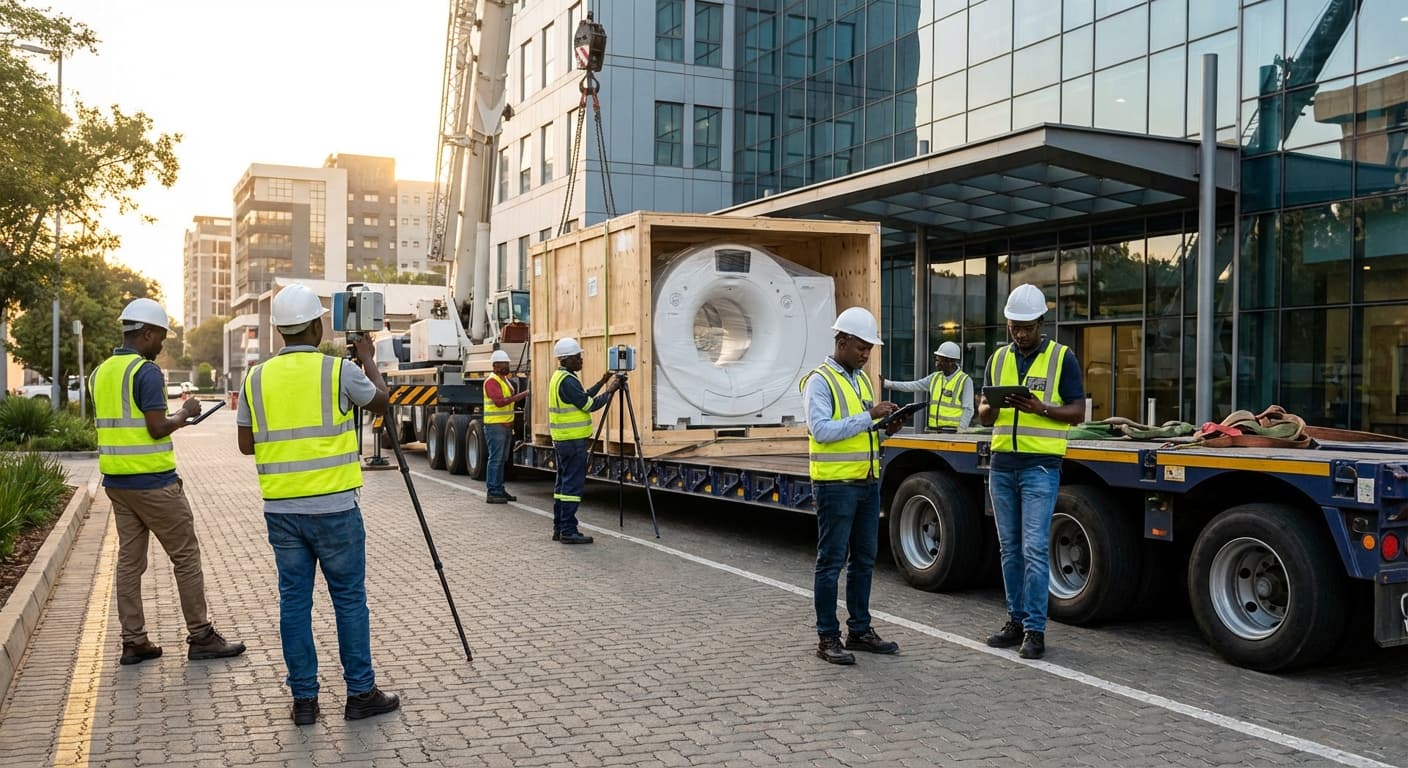
Route Survey & Rigging Plan Service for Heavy Medical Equipment in Eswatini
Engineering Excellence & Technical Support
Route Survey & Rigging Plan Service for Heavy Medical Equipment High-standard technical execution following OEM protocols and local regulatory frameworks.
Precision Route Mapping & Clearance Analysis
Leveraging advanced GIS and LiDAR technologies, we conduct meticulous route surveys to identify optimal transport paths for heavy medical equipment across Eswatini. Our analysis includes detailed clearance assessments for bridges, overpasses, power lines, and narrow urban passages, ensuring safe and efficient transit and minimizing the risk of infrastructure damage or project delays.
Engineered Rigging & Lift Plans
Our certified rigging engineers develop bespoke, data-driven rigging and lift plans. We meticulously calculate load capacities, select appropriate lifting gear (cranes, gantries, specialized lifting frames), and define secure anchoring points, considering Eswatini's unique environmental factors and logistical constraints to guarantee the safe and stable handling of sensitive and high-value medical equipment.
Comprehensive Risk Mitigation & Site Assessment
We perform thorough site-specific risk assessments, identifying potential hazards during transport and installation in Eswatini's diverse terrains. This includes evaluating ground bearing capacity, weather pattern impact, and accessibility challenges. Our integrated approach proactively mitigates risks, ensuring seamless project execution and the integrity of the critical medical equipment from port to final placement.
What Is Route Survey & Rigging Plan Service For Heavy Medical Equipment In Eswatini?
Route Survey & Rigging Plan Service for Heavy Medical Equipment in Eswatini is a specialized engineering and logistics service focused on the safe and efficient transportation and installation of large-scale, high-value medical apparatus within Eswatini. This service integrates meticulous site assessment, pathfinding, and detailed operational planning to mitigate risks associated with moving and positioning equipment that often exceeds standard logistical parameters due to its weight, dimensions, and fragility.
| Who Needs the Service | Typical Use Cases in Eswatini |
|---|---|
| Hospitals and Healthcare Facilities (Public and Private) | Installation of new MRI scanners, CT scanners, linear accelerators, and large-scale laboratory equipment. |
| Medical Equipment Manufacturers and Distributors | Delivery and installation of specialized medical devices at client sites. |
| Government Ministries (e.g., Ministry of Health) | Procurement and deployment of critical medical infrastructure to public healthcare institutions across Eswatini. |
| Project Management Firms and Engineering Consultancies | Overseeing the integration of heavy medical equipment into new or renovated healthcare facilities. |
| Construction Companies undertaking healthcare projects | Ensuring that building designs accommodate the precise requirements for heavy medical equipment installation. |
Key Components of the Service:
- Route Reconnaissance and Optimization: Comprehensive assessment of all potential transport routes, identifying obstacles, clearances (height, width, load capacity), road conditions, gradient, and potential hazards. This includes evaluating public roadways, private access routes, and internal building pathways.
- Structural Integrity Assessments: Examination of building structures, including floors, walls, doorways, corridors, and elevator capacities, to ensure they can withstand the weight and movement of the equipment. This may involve consulting architectural and structural blueprints.
- Rigging and Lifting Plan Development: Detailed methodologies for lifting, maneuvering, and securing the equipment. This encompasses specifying appropriate lifting equipment (cranes, gantries, forklifts, jacks), rigging hardware (slings, shackles, spreader bars), and their rated capacities.
- Load Calculation and Distribution: Precise determination of the equipment's weight and center of gravity to ensure stable lifting and transport. Strategies for managing load distribution during transit and final placement.
- Risk Assessment and Mitigation: Identification of potential risks (e.g., damage to equipment or infrastructure, personnel injury, operational downtime) and the development of proactive mitigation strategies, including contingency planning.
- Method Statement and Work Procedure Creation: Formal documentation outlining step-by-step procedures for every phase of the operation, ensuring clarity and adherence to safety protocols.
- Permitting and Regulatory Compliance: Assistance with obtaining necessary permits for road closures, overweight/oversized loads, and ensuring compliance with Eswatini's transportation and construction regulations.
- On-site Supervision and Execution: Expert oversight during the rigging and installation phases to ensure the plan is executed flawlessly and safely.
- Post-Installation Verification: Confirmation of the equipment's final position and integrity after installation.
Who Needs Route Survey & Rigging Plan Service For Heavy Medical Equipment In Eswatini?
Securing specialized Route Survey & Rigging Plan services for heavy medical equipment in Eswatini is crucial for a variety of organizations and their specific departments. This ensures the safe, efficient, and compliant transportation and installation of critical healthcare infrastructure, minimizing risks and potential damage. The complexity of moving and positioning large, sensitive medical devices requires expert planning and execution.
| Customer Type | Relevant Departments | Types of Equipment Commonly Handled |
|---|---|---|
| Hospitals & Healthcare Facilities | Radiology, Oncology, Surgery, Cardiology, Laboratory Services, Facilities Management | MRI Scanners, CT Scanners, Linear Accelerators, X-ray Machines, Cath Lab Equipment, Surgical Robots, Large Centrifuges, Sterilizers |
| Ministry of Health (Eswatini) | Procurement, Planning & Infrastructure, Public Health Facilities Management | As per hospital needs, plus hospital-wide infrastructure upgrades and mobile clinics |
| Specialized Medical Clinics | Clinical Operations, Technical Services, Administration | High-end Ultrasound Machines, Advanced Endoscopy Systems, Digital X-ray Suites, Specialized Therapy Equipment |
| Medical Equipment Suppliers/Manufacturers | Logistics, Installation & Commissioning Teams, Project Management | All types of heavy medical equipment being imported, delivered, and installed |
| Construction & Infrastructure Companies | Project Management, Site Operations, Health & Safety | Equipment access points, pathway clearance, and installation bays for medical machinery |
| NGOs & Aid Agencies | Program Management, Logistics, Equipment Deployment | Donated or procured medical equipment for specific health initiatives |
Target Customers & Departments for Heavy Medical Equipment Route Survey & Rigging Plan Services in Eswatini
- {"title":"Hospitals & Healthcare Facilities","description":"Both public and private hospitals are primary recipients of this service. They often upgrade or expand their imaging, surgical, or laboratory departments, requiring the movement of CT scanners, MRI machines, linear accelerators, and large surgical tables."}
- {"title":"Ministry of Health (Eswatini Government)","description":"The government, responsible for public healthcare infrastructure, frequently procures and deploys heavy medical equipment to various public hospitals and clinics across the nation. They require these services for national health projects and upgrades."}
- {"title":"Specialized Medical Clinics & Diagnostic Centers","description":"Private entities focusing on specific medical disciplines (e.g., cardiology, oncology, radiology) that invest in advanced, large-scale diagnostic and treatment equipment."}
- {"title":"Medical Equipment Suppliers & Manufacturers","description":"Companies that sell and install heavy medical equipment in Eswatini often subcontract or require these specialized services to ensure their products reach their final destination safely and are properly commissioned."}
- {"title":"Construction & Infrastructure Development Companies","description":"Companies involved in building or renovating healthcare facilities will require these services during the construction phase to plan for the entry and installation of large medical machinery."}
- {"title":"Non-Governmental Organizations (NGOs) & Aid Agencies","description":"Organizations working on healthcare projects or providing medical equipment donations in Eswatini will need these services to facilitate the successful delivery and installation of the equipment."}
Route Survey & Rigging Plan Service For Heavy Medical Equipment Process In Eswatini
This document outlines the comprehensive workflow for our Route Survey & Rigging Plan Service for the process of transporting and installing heavy medical equipment in Eswatini. Our service ensures the safe, efficient, and compliant movement of critical medical assets from their point of arrival to their final installation site, addressing all logistical and technical challenges.
| Stage | Description | Key Activities | Deliverables | Timeline (Indicative) |
|---|---|---|---|---|
| Understanding the client's specific needs and the details of the medical equipment. | Receive inquiry, discuss equipment specifications (weight, dimensions, fragility), destination site, and desired timeline. Provide preliminary service overview and cost estimation. | Initial proposal, preliminary cost estimate, service scope definition. | 1-3 business days |
| On-site evaluation of the arrival points, transit routes, and the final installation location within Eswatini. | Conduct detailed site surveys: measure doorways, corridors, stairwells, lift capacities, floor load capacities. Assess road infrastructure, bridge clearances, turning radii, and potential obstacles. Collect all relevant technical data. | Detailed site survey report, photographic evidence, collected site data (CAD drawings if available). | 3-7 business days (dependent on site complexity and location) |
| Developing the safest and most efficient transportation path from the point of arrival (e.g., port, airport) to the final installation site. | Analyze collected data, identify potential route conflicts (e.g., low bridges, narrow roads, traffic restrictions). Optimize route considering minimal disruption, travel time, and equipment safety. Map out the optimal path with precise turning points and potential staging areas. | Detailed route map(s) with critical waypoints, identification of potential hazards and mitigation strategies. | 2-4 business days |
| Creating a comprehensive plan for the safe lifting, maneuvering, and placement of the heavy medical equipment. | Design detailed rigging and lifting procedures: select appropriate lifting equipment (cranes, hoists, gantries), determine lifting points on the equipment, calculate load capacities, specify rigging gear (slings, shackles, spreader bars). Develop step-by-step installation procedures. | Comprehensive rigging & lifting plan including diagrams, equipment specifications, load calculations, safety checklists, and personnel roles. | 5-10 business days (dependent on equipment complexity) |
| Securing all necessary permits and ensuring compliance with local Eswatini regulations. | Identify and apply for road permits, special transport permits, and any other required regulatory approvals. Liaise with relevant authorities (e.g., police, road authorities). Ensure all activities comply with local safety and environmental regulations. | Approved permits and licenses, confirmation of regulatory compliance. | 7-21 business days (highly variable based on Eswatini's regulatory processes) |
| Finalizing all arrangements and briefing all involved parties before the execution phase. | Schedule the execution date and time. Coordinate with transport providers, rigging crews, site personnel, and any necessary security or traffic management teams. Conduct pre-job safety briefings and confirm all equipment is ready and certified. | Execution schedule, confirmed personnel availability, pre-execution checklists. | 2-3 business days |
| Overseeing the safe and efficient transportation and installation of the medical equipment. | Supervise the loading, transportation, unloading, and final positioning of the equipment. Ensure adherence to the developed route and rigging plans. Manage any unforeseen issues that arise during execution. Implement safety protocols at all times. | On-site supervision, real-time problem-solving, progress updates. | Duration of the move and installation (variable) |
| Concluding the project, providing documentation, and obtaining client feedback. | Conduct a post-execution review to ensure successful installation and identify lessons learned. Compile all project documentation, including the final route survey report, rigging plan, permits, and any incident reports. Obtain client sign-off and feedback. | Final project report, photographic documentation of the completed move, client satisfaction survey. | 2-5 business days |
Workflow Stages
- Inquiry & Initial Consultation
- Site Assessment & Data Collection
- Route Planning & Optimization
- Rigging & Lifting Plan Development
- Permitting & Regulatory Compliance
- Pre-Execution Coordination
- Execution & Supervision
- Post-Execution Review & Documentation
Route Survey & Rigging Plan Service For Heavy Medical Equipment Cost In Eswatini
This document outlines the typical cost factors and ranges for route survey and rigging plan services for heavy medical equipment in Eswatini, presented in Eswatini Lilangeni (SZL). These services are crucial for ensuring the safe and efficient transportation and installation of specialized and often delicate medical machinery. The pricing is influenced by several key elements, which are detailed below.
| Service Component | Estimated Cost Range (SZL) | Notes |
|---|---|---|
| Route Survey (Initial Assessment & Mapping) | SZL 5,000 - SZL 15,000 | Covers preliminary site visits, basic mapping, identification of potential route challenges. Varies with distance and complexity. |
| Detailed Route Survey & Engineering Report | SZL 10,000 - SZL 30,000 | Includes detailed measurements, obstacle clearance calculations, gradient analysis, and a comprehensive report with proposed routes. |
| Rigging Plan Development | SZL 8,000 - SZL 25,000 | Focuses on the lifting, securing, and maneuvering of the equipment. Includes equipment selection, load calculations, and safety procedures. |
| Combined Route Survey & Rigging Plan Package | SZL 15,000 - SZL 50,000 | Offers a bundled approach for significant cost savings. The upper end reflects highly complex projects. |
| Permit Application & Management Fees | SZL 2,000 - SZL 10,000 (per permit) | Actual government fees and administrative charges for required permits. Can vary significantly. |
| Site Preparation Consultation | SZL 3,000 - SZL 8,000 | Advisory services for necessary site modifications. This does not include the cost of the actual preparation work. |
| Contingency Planning & Risk Mitigation | SZL 5,000 - SZL 15,000 | Included in comprehensive plans, addressing potential unforeseen issues and safety protocols. |
| Overall Project Management (for survey/rigging phase) | SZL 10,000 - SZL 40,000+ | For larger projects, a dedicated project manager may be required to coordinate all aspects of the survey and rigging planning. |
Key Pricing Factors for Route Survey & Rigging Plan Services
- Equipment Size and Weight: Larger and heavier equipment necessitates more complex planning, specialized rigging gear, and potentially more extensive route modifications. This directly impacts the labor and equipment costs.
- Complexity of the Route: The distance to be covered, road conditions (paved, unpaved, inclines, sharp turns), potential obstacles (low bridges, narrow roads, utility lines), and traffic management requirements all contribute to the survey and planning effort.
- Number of Rigging Points and Technical Requirements: The number of times the equipment needs to be lifted, moved, or secured, along with specific rigging requirements (e.g., ultra-precise positioning, cleanroom handling), will influence the technical expertise and time needed.
- Site Accessibility and Preparation: The ease of access to both the delivery and installation sites is vital. If significant site preparation is needed (e.g., widening gates, reinforcing floors, removing obstructions), this will add to the overall cost.
- Specialized Equipment and Tools: The requirement for specific cranes, lifting devices, specialized dollies, or protective wrapping materials will affect the equipment rental or purchase costs.
- Risk Assessment and Mitigation: A thorough risk assessment is a core part of the planning process. The extent of potential risks (e.g., damage to equipment, site infrastructure, personnel safety) will dictate the level of detail and contingency planning required.
- Regulatory Approvals and Permits: Obtaining necessary permits for transporting oversized loads, road closures, or working near public infrastructure can incur administrative fees and require dedicated time for application and follow-up.
- Expertise and Experience of the Service Provider: Highly experienced and specialized rigging and survey companies will often command higher fees due to their proven track record, skilled personnel, and comprehensive insurance coverage.
- Project Timeline and Urgency: Expedited services or tight deadlines may incur surcharges.
- Geographical Location within Eswatini: While Eswatini is relatively small, remoteness or logistical challenges in specific areas might slightly influence travel and accommodation costs for the survey team.
Affordable Route Survey & Rigging Plan Service For Heavy Medical Equipment Options
Navigating the complexities of heavy medical equipment installation requires meticulous route surveying and rigging planning to ensure safety, efficiency, and cost-effectiveness. Our service offers expert solutions tailored to your specific needs, from initial site assessment to the final rigging strategy. We understand that budget constraints are crucial in healthcare, which is why we've developed flexible value bundles and cost-saving strategies to make this essential service accessible.
| Value Bundle | Description | Included Services | Cost-Saving Benefits | Ideal For |
|---|---|---|---|---|
| Essential Route Planning | Focuses on core route survey and basic rigging considerations. | Basic site walk-through, standard route mapping, initial rigging recommendations. | Lower upfront cost, suitable for less complex installations. | Smaller clinics, standard imaging equipment, straightforward building layouts. |
| Comprehensive Installation Package | Includes detailed route analysis and a complete rigging plan. | 3D route mapping, structural load assessment, detailed rigging schematics, risk assessment. | Minimizes unexpected costs during installation, reduces potential for damage, ensures efficient setup. | Hospitals, complex imaging suites, specialized surgical equipment, multi-level facilities. |
| Expedited Service Add-on | Prioritizes and accelerates the survey and planning process. | Dedicated project manager, rapid site visit scheduling, priority report generation. | Reduces project downtime, meets tight deadlines, minimizes business interruption. | Urgent equipment replacements, critical facility upgrades, time-sensitive project completions. |
| Modular Planning Solutions | Allows customization of services based on specific project needs. | Choose from a menu of services to build a bespoke plan. | Pay only for what you need, highly adaptable to budget and project scope. | Unique equipment types, challenging site conditions, specific regulatory requirements. |
Our Affordable Route Survey & Rigging Plan Service Features:
- Comprehensive Site Assessment: Detailed evaluation of access points, pathways, structural integrity, and potential obstructions.
- 3D Route Mapping: Advanced visualization of the transport path for precise planning and risk identification.
- Load Capacity Analysis: Ensuring all structural elements and lifting equipment can safely support the equipment's weight.
- Customized Rigging Plans: Tailored strategies using appropriate lifting devices, securing methods, and personnel.
- Risk Mitigation Strategies: Proactive identification and planning to address potential challenges and hazards.
- Coordination with Stakeholders: Seamless collaboration with facility management, equipment manufacturers, and logistics teams.
- Regulatory Compliance Checks: Ensuring adherence to all relevant safety standards and local regulations.
Verified Providers In Eswatini
In Eswatini, ensuring you're engaging with verified healthcare providers is paramount for quality and safety. Franance Health stands out as a leading credentialing body, meticulously vetting healthcare professionals and facilities across the nation. Their rigorous process guarantees that providers meet the highest standards of expertise, ethics, and patient care. Choosing a Franance Health-verified provider means opting for reliability, competence, and peace of mind, knowing you're in capable hands. This commitment to verification not only safeguards patients but also elevates the overall healthcare landscape in Eswatini. Explore the benefits of choosing Franance Health credentials for a superior healthcare experience.
| Credentialing Aspect | Franance Health Standard | Patient Benefit |
|---|---|---|
| Education and Training Verification | Rigorous checks of degrees, diplomas, and specialized training from accredited institutions. | Ensures providers possess the foundational knowledge and skills for effective treatment. |
| Professional Experience Assessment | Thorough review of past roles, responsibilities, and performance evaluations. | Confirms practical application of knowledge and proven ability to manage patient care. |
| Licensure and Regulatory Compliance | Verification of current and valid professional licenses with relevant Eswatini medical boards. | Guarantees providers are legally authorized and compliant with national healthcare regulations. |
| Ethical Conduct and Background Checks | Assessment of professional conduct and absence of disciplinary actions or malpractice claims. | Protects patients from unethical practices and ensures a safe care environment. |
| Specialization and Competency Validation | Confirmation of specific expertise in areas of practice through certifications and peer reviews. | Allows patients to confidently seek out providers with the exact skills needed for their condition. |
| Continuing Professional Development (CPD) Adherence | Verification of ongoing participation in relevant educational activities and skill enhancement. | Assures patients that providers are up-to-date with the latest medical knowledge and techniques. |
Why Franance Health Credentials Represent the Best Choice in Eswatini:
- Uncompromising Quality Assurance: Franance Health's stringent vetting process scrutinizes educational background, professional experience, and licensure, ensuring only the most qualified individuals are accredited.
- Commitment to Ethical Practice: Providers accredited by Franance Health adhere to a strict code of ethics, prioritizing patient well-being, confidentiality, and informed consent.
- Enhanced Patient Safety: Verification reduces the risk of unqualified practitioners, ensuring patients receive care that meets established safety protocols and standards.
- Access to Expertise: Franance Health identifies and endorses specialists and centers of excellence, making it easier for patients to find the specific care they need.
- Trust and Credibility: A Franance Health credential is a mark of distinction, providing patients with a reliable indicator of a provider's competence and trustworthiness.
- Continuous Professional Development: The accreditation process often includes requirements for ongoing training and education, ensuring providers stay current with medical advancements.
- Improved Healthcare Standards: By setting a high bar for accreditation, Franance Health contributes to the overall improvement and standardization of healthcare services in Eswatini.
Scope Of Work For Route Survey & Rigging Plan Service For Heavy Medical Equipment
This Scope of Work (SOW) outlines the requirements for Route Survey and Rigging Plan services necessary for the safe and efficient transportation and installation of heavy medical equipment. The service provider will be responsible for conducting detailed site assessments, developing comprehensive rigging plans, and providing all necessary documentation and technical deliverables as per the specified standards.
| Phase | Activity | Technical Deliverables | Standard Specifications/Notes |
|---|---|---|---|
| Phase 1: Planning & Preliminary Assessment | Site Visit & Initial Assessment | Site Survey Report (including preliminary route assessment, access points, potential obstructions, and preliminary rigging considerations) | Visual inspection, measurements, photographic documentation. Consideration of building access, door sizes, corridor widths, floor load capacities, elevator availability and dimensions. |
| Phase 1: Planning & Preliminary Assessment | Equipment Data Review | Equipment Specification Sheet Compilation (weight, dimensions, center of gravity, lifting points, fragility) | Provided by client. Verification of critical dimensions and weight is crucial. |
| Phase 1: Planning & Preliminary Assessment | Risk Assessment Matrix | Preliminary Risk Assessment Report (identifying potential hazards and initial mitigation strategies) | Categorization of risks (e.g., structural, operational, environmental) and proposed initial controls. |
| Phase 2: Detailed Route Survey | Detailed Route Mapping | Detailed Route Survey Report (including precise measurements, 3D modeling of key sections if required, identification of all potential obstacles and their dimensions) | Use of laser measuring devices, tape measures, and potentially drones for inaccessible areas. CAD drawings or annotated photographic evidence. |
| Phase 2: Detailed Route Survey | Obstacle Analysis & Mitigation | Report on identified obstacles and proposed solutions (e.g., temporary structural reinforcement, door widening, power outage coordination, traffic management) | Feasibility study for each proposed mitigation, including cost and timeline implications. |
| Phase 2: Detailed Route Survey | Floor Load Capacity Assessment | Floor Load Capacity Report (verification of load-bearing capacity along the entire route) | Consultation with structural engineers if required. Utilization of load calculation software. |
| Phase 2: Detailed Route Survey | Environmental Factor Assessment | Assessment of environmental factors (e.g., temperature, humidity, vibration sensitivity of the equipment, dust control) | Recommendations for environmental controls during transport and installation. |
| Phase 3: Rigging Plan Development | Rigging Strategy Design | Detailed Rigging Plan (including selection of appropriate lifting equipment, slings, shackles, trolleys, dollies, and other rigging gear) | Calculations for load distribution, safety factors (minimum 5:1 for lifting slings), and equipment load ratings. Consideration of manufacturer recommendations for lifting points. |
| Phase 3: Rigging Plan Development | Equipment Placement & Stabilization | Plan for precise positioning and temporary stabilization of equipment | Detailed instructions for anchoring and securing the equipment at its final location. |
| Phase 3: Rigging Plan Development | Operational Procedures | Step-by-step operational procedures for all lifting, moving, and installation activities | Clear, concise language with visual aids (diagrams, sketches) where beneficial. Include emergency procedures. |
| Phase 3: Rigging Plan Development | Contingency Planning | Contingency Plan (detailing backup strategies for unforeseen issues, equipment failure, or adverse conditions) | Identification of alternative equipment and personnel, communication protocols. |
| Phase 4: Documentation & Handover | Final Deliverables Compilation | Comprehensive Project Dossier (including all reports, plans, diagrams, equipment specifications, risk assessments, and sign-off sheets) | Organized in a clear, searchable format (e.g., digital PDF with bookmarks). All documents to be reviewed and approved by the client. |
| Phase 4: Documentation & Handover | Client Briefing & Handover | Presentation of the final rigging plan and route survey findings to the client's project team | Opportunity for client questions and final clarifications. Formal sign-off on the deliverables. |
Key Objectives
- Ensure the safe and secure movement of heavy medical equipment from point of delivery to its final installation location.
- Identify and mitigate all potential risks and obstacles associated with the transportation and rigging process.
- Develop detailed, actionable rigging plans compliant with industry best practices and regulatory requirements.
- Provide clear and concise technical documentation for all survey findings and rigging procedures.
Service Level Agreement For Route Survey & Rigging Plan Service For Heavy Medical Equipment
This Service Level Agreement (SLA) outlines the response times and uptime guarantees for the Route Survey & Rigging Plan Service provided for the delivery and installation of heavy medical equipment. This SLA is an integral part of the overall service contract between [Your Company Name] (hereinafter referred to as "Provider") and [Client Company Name] (hereinafter referred to as "Client").
| Service Component | Response Time Target | Uptime Guarantee | Notes |
|---|---|---|---|
| Initial Acknowledgment of Service Request (for new surveys/plans) | Within 4 business hours of receipt | N/A | This includes acknowledging receipt and confirming the scope of work. |
| Commencement of Route Survey & Rigging Plan Development (upon confirmed scope) | Within 2 business days | N/A | This refers to the start of active planning and site assessment. |
| Provision of Draft Route Survey Report | Within 5 business days of commencement | N/A | Timeline may vary based on complexity and site accessibility. |
| Provision of Draft Rigging Plan | Within 7 business days of commencement (can be concurrent with Route Survey) | N/A | Timeline may vary based on complexity and equipment type. |
| Response to Client Queries during Planning Phase | Within 8 business hours | N/A | Applies to clarifying questions about the survey or plan. |
| Urgent Support for Critical Issues (during active rigging/transport) | Within 1 business hour | 99.5% during scheduled project execution periods | This includes availability of key personnel for immediate consultation and problem-solving. Uptime is measured monthly. |
| Availability of Key Personnel for Project Consultation | Within 4 business hours | 99.0% during standard business hours (Mon-Fri, 9 AM - 5 PM [Client's Timezone]) | This refers to the availability of the designated project manager and lead engineers for scheduled consultations. |
Definitions
- Route Survey: The process of assessing and planning the optimal and safest path for the transportation of heavy medical equipment from its origin to its final installation site, considering all logistical and structural constraints.
- Rigging Plan: A detailed plan outlining the methods, equipment, and procedures required for the safe lifting, moving, and positioning of heavy medical equipment.
- Service Request: A formal request initiated by the Client for Route Survey & Rigging Plan services, submitted through the agreed-upon communication channel.
- Response Time: The maximum time allowed for the Provider to acknowledge receipt of a Service Request and initiate the necessary actions, as defined in this SLA.
- Uptime Guarantee: The guaranteed availability of the Provider's support and planning resources to address critical issues and provide ongoing consultation related to the Route Survey & Rigging Plan.
- Critical Issue: An unforeseen event or complication that prevents the execution of the planned rigging or route, posing a significant risk to the project timeline, equipment safety, or personnel.
Frequently Asked Questions

Ready when you are
Let's scope your Route Survey & Rigging Plan Service for Heavy Medical Equipment in Eswatini project in Eswatini.

Scaling healthcare logistics and technical systems across the entire continent.