
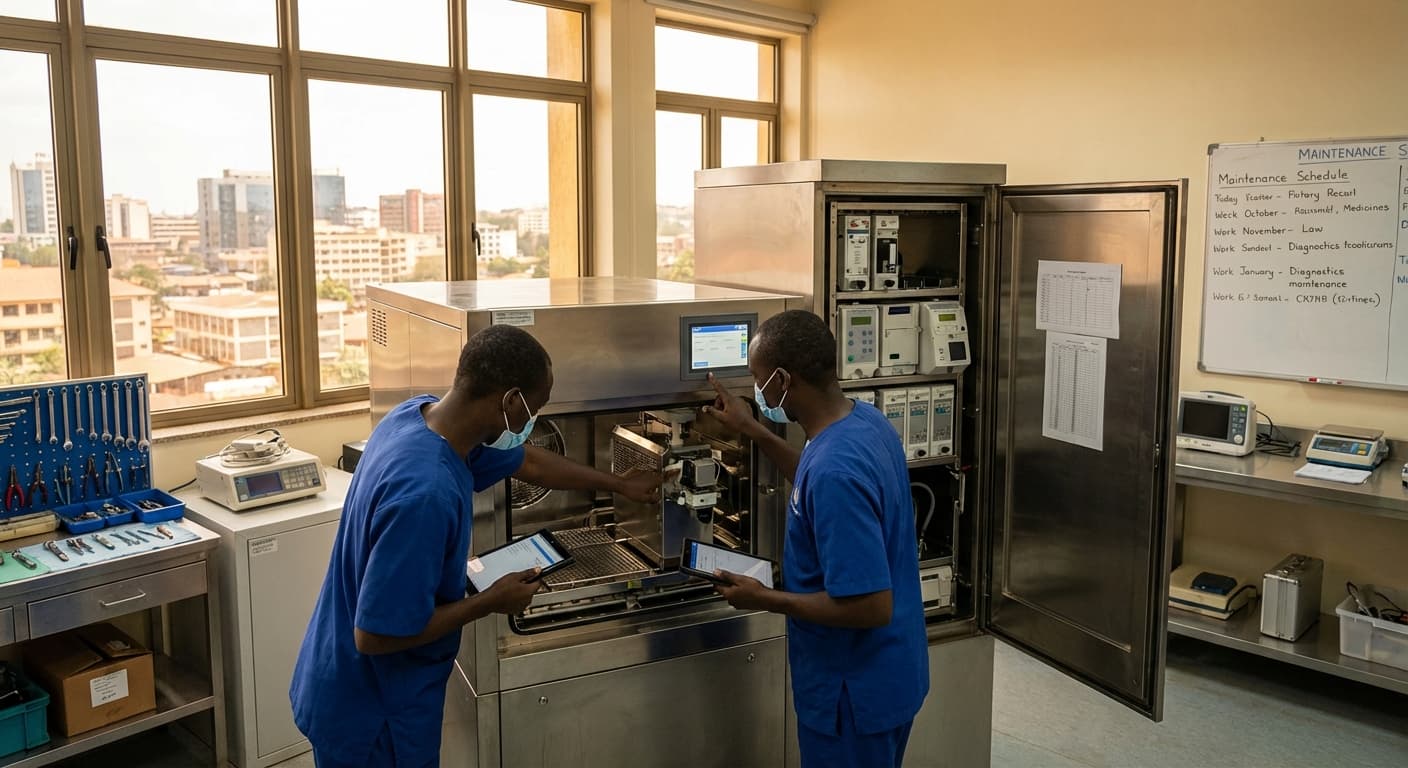
Total Cost of Ownership (TCO) & Lifecycle Budgeting Service in Eswatini
Engineering Excellence & Technical Support
Total Cost of Ownership (TCO) & Lifecycle Budgeting Service High-standard technical execution following OEM protocols and local regulatory frameworks.
Optimized Capital Expenditure (CAPEX) Planning
Leverage advanced analytics to precisely forecast and budget initial investment costs for infrastructure and technology, ensuring Eswatini's projects are aligned with long-term financial sustainability and minimize upfront financial strain.
Predictive Operational Expense (OPEX) Management
Implement sophisticated modeling to anticipate and control ongoing operational costs, including maintenance, energy, and consumables, enabling Eswatini to achieve significant savings and enhance resource allocation throughout the lifecycle of assets.
Strategic Lifecycle Value Maximization
Utilize comprehensive TCO analysis to guide strategic decisions from procurement to disposal, identifying opportunities for asset optimization, extended lifespan, and enhanced residual value, ultimately boosting Eswatini's return on investment and operational efficiency.
What Is Total Cost Of Ownership (Tco) & Lifecycle Budgeting Service In Eswatini?
Total Cost of Ownership (TCO) and Lifecycle Budgeting services in Eswatini provide a comprehensive framework for evaluating the true financial implications of an asset, system, or project throughout its entire lifespan. This methodology extends beyond initial acquisition costs to encompass all direct and indirect expenses incurred from acquisition, operation, maintenance, and eventual disposal. Lifecycle budgeting, a core component of TCO, systematically allocates financial resources over the asset's operational life, ensuring that all future expenditures are anticipated and planned for. This approach is critical for strategic financial planning, risk mitigation, and optimizing long-term value realization within the Eswatini economic context.
| Who Needs TCO & Lifecycle Budgeting Services in Eswatini? | Typical Use Cases | ||
|---|---|---|---|
| Government Ministries & Agencies: For infrastructure projects (roads, utilities), public transport fleets, IT systems, and long-term asset management strategies. | Procurement of major capital equipment (e.g., heavy machinery for mining, industrial processing units). | Evaluation of public-private partnerships for long-term service delivery. | Development of national IT infrastructure strategies. |
| Large Enterprises (Mining, Agriculture, Manufacturing, Telecommunications): For evaluating capital investments, fleet management, IT infrastructure upgrades, and production facility expansions. | Selection of critical operational technology (e.g., ERP systems, SCADA systems). | Fleet acquisition and management strategies (trucks, agricultural machinery, vehicles). | Planning for energy efficiency improvements in industrial processes. |
| Financial Institutions & Investors: For assessing the long-term viability and risk of investments in projects and assets. | Due diligence for project financing and investment appraisal. | Valuation of assets for leasing or securitization. | Risk assessment for infrastructure funding. |
| Utilities Companies (Water, Electricity): For planning infrastructure replacement, new plant construction, and managing operational expenses over decades. | Long-term planning for power generation and distribution networks. | Water infrastructure maintenance and expansion strategies. | Renewable energy project feasibility studies. |
| Real Estate Developers & Facility Managers: For buildings, commercial properties, and complex facilities, considering construction, operation, and eventual demolition or renovation. | New building construction cost-benefit analysis. | Renovation and retrofitting project justification. | Long-term facility maintenance and operational budgeting. |
Key Components of TCO & Lifecycle Budgeting Services
- Acquisition Costs: Purchase price, taxes, import duties, installation, initial training.
- Operational Costs: Energy consumption, consumables, labor for operation, software licenses, network connectivity.
- Maintenance & Repair Costs: Scheduled maintenance, unscheduled repairs, spare parts, technician labor.
- Upgrade & Enhancement Costs: Retrofits, technology updates, performance improvements.
- Decommissioning & Disposal Costs: Dismantling, environmental remediation, resale value of salvaged components, recycling fees.
- Indirect Costs: Downtime, impact on productivity, security risks, regulatory compliance, financing costs.
Who Needs Total Cost Of Ownership (Tco) & Lifecycle Budgeting Service In Eswatini?
In Eswatini, the strategic implementation of Total Cost of Ownership (TCO) and Lifecycle Budgeting (LCB) services is crucial for organizations aiming for long-term financial sustainability, efficient resource allocation, and informed decision-making. These services move beyond initial purchase price to encompass all costs associated with an asset or project throughout its entire lifespan, from acquisition and operation to maintenance and eventual disposal. This comprehensive approach helps mitigate unforeseen expenses, optimize operational efficiency, and maximize return on investment, especially in a developing economy where resource constraints necessitate prudent financial management.
| Target Customer Type | Specific Departments/Roles |
|---|---|
| Government Ministries & Agencies | Finance Department, Planning Unit, Procurement Office, Infrastructure Development Department, Public Works, Ministry of Finance, Ministry of Economic Planning and Development |
| State-Owned Enterprises (SOEs) | Finance and Accounting, Operations, Engineering, Procurement, Asset Management, Strategic Planning |
| Large Private Sector Businesses (Manufacturing, Agriculture, Mining, Telecommunications, Tourism) | Finance Department, Procurement and Supply Chain Management, Operations Management, Engineering and Maintenance, Strategic Planning, Capital Budgeting Team, Asset Management |
| Financial Institutions (Banks, Insurance Companies) | Finance and Treasury, IT Department, Operations, Risk Management, Facilities Management |
| Non-Governmental Organizations (NGOs) & Development Partners | Finance and Administration, Program Management, Operations, Procurement, Monitoring and Evaluation |
| Educational Institutions (Universities, Colleges) | Finance Department, Facilities Management, IT Department, Procurement Office, Campus Planning |
| Healthcare Providers (Hospitals, Clinics) | Finance Department, Procurement, Biomedical Engineering, Facilities Management, Hospital Administration |
Who Needs TCO & Lifecycle Budgeting Services in Eswatini?
- Organizations with significant capital investments (infrastructure, equipment, technology).
- Public sector entities managing long-term assets and public funds.
- Businesses seeking to improve operational efficiency and reduce waste.
- Companies undergoing major project planning or asset replacement cycles.
- Institutions focused on sustainable development and responsible resource management.
Total Cost Of Ownership (Tco) & Lifecycle Budgeting Service Process In Eswatini
The Total Cost of Ownership (TCO) & Lifecycle Budgeting service process in Eswatini is designed to provide businesses and organizations with a comprehensive understanding of the financial implications of their assets and projects over their entire lifespan. This process is crucial for informed decision-making, strategic financial planning, and maximizing return on investment. The workflow typically begins with an initial inquiry and progresses through several distinct stages to final execution and reporting.
| Phase | Key Activities | Objective | Deliverables |
|---|---|---|---|
| Initial contact from client, understanding of the asset/project, identification of key stakeholders, clarification of project scope and objectives. | To understand the client's requirements, the nature of the asset/project, and establish a preliminary scope for the TCO and lifecycle budgeting service. | Client brief, preliminary scope document. |
| Development of a detailed service proposal outlining methodology, timelines, resources, fees, and terms. Negotiation and signing of the service agreement. | To clearly define the scope of work, expected outcomes, and contractual obligations. To secure client commitment. | Service proposal, signed service agreement. |
| Gathering of all relevant data, including acquisition costs, operating expenses (energy, maintenance, consumables), repair costs, disposal costs, training, and any potential revenues or savings. This involves site visits, interviews with relevant personnel, and review of historical records. | To collect comprehensive and accurate data necessary for building the TCO and lifecycle cost models. | Compiled raw data, initial data validation reports. |
| Structuring the collected data into a robust TCO and lifecycle cost model using appropriate software or spreadsheets. This includes defining cost categories, applying discount rates (for Net Present Value calculations), and projecting costs over the asset/project's lifespan. | To create a quantitative model that accurately reflects all costs associated with the asset/project over its entire lifecycle. | TCO & Lifecycle Cost Model (spreadsheet or software-based), definition of cost components and assumptions. |
| Developing various scenarios (e.g., different operating conditions, maintenance strategies, inflation rates) and performing sensitivity analysis to understand how changes in key variables impact the overall TCO. This helps identify risks and opportunities. | To assess the robustness of the TCO model and understand potential financial vulnerabilities and upside potentials under different future conditions. | Scenario analysis reports, sensitivity analysis charts, risk assessment. |
| Compiling a comprehensive report detailing the TCO and lifecycle budget findings, including key cost drivers, projected expenditures, Net Present Value (NPV), and payback periods. Presenting these findings to stakeholders, explaining methodologies, and answering queries. | To communicate the TCO and lifecycle budget outcomes clearly and effectively, enabling informed decision-making. | Detailed TCO & Lifecycle Budgeting Report, executive summary, presentation slides. |
| Assisting the client in implementing recommendations derived from the TCO analysis (e.g., procurement strategies, maintenance plans). Establishing monitoring mechanisms to track actual costs against projections. | To support the client in translating the analytical findings into actionable strategies and to ensure ongoing financial alignment with lifecycle plans. | Implementation recommendations, monitoring framework, initial progress reports. |
| Conducting periodic reviews of actual costs against the lifecycle budget. Refining the models based on actual performance and changing market conditions. Providing ongoing advisory services. | To ensure the TCO and lifecycle budget remain relevant and accurate, and to facilitate continuous improvement in financial management of assets and projects. | Performance review reports, updated TCO models, ongoing advisory notes. |
TCO & Lifecycle Budgeting Service Workflow in Eswatini
- Inquiry and Needs Assessment
- Proposal Development and Agreement
- Data Collection and Analysis
- TCO & Lifecycle Cost Model Development
- Scenario Planning and Sensitivity Analysis
- Reporting and Presentation
- Implementation Support and Monitoring
- Post-Execution Review and Refinement
Total Cost Of Ownership (Tco) & Lifecycle Budgeting Service Cost In Eswatini
The Total Cost of Ownership (TCO) and Lifecycle Budgeting services are crucial for organizations in Eswatini to understand the true financial impact of an asset or project over its entire lifespan. This includes not just the initial purchase price but also operational costs, maintenance, upgrades, and eventual disposal. Pricing for these specialized consulting services in Eswatini is influenced by a variety of factors, leading to a range of costs. Understanding these factors is key for businesses when budgeting and seeking proposals.
Key Pricing Factors:
- Scope and Complexity of the Project/Asset: A larger, more complex asset (e.g., industrial machinery, fleet of vehicles, large IT infrastructure) will require more in-depth analysis and a longer engagement period, thus increasing costs. Simpler assets or smaller projects will naturally be less expensive.
- Duration of the Lifecycle Being Analyzed: The longer the timeframe for TCO analysis (e.g., 5 years vs. 20 years), the more data points and projections are required, leading to higher costs.
- Data Availability and Quality: The ease with which historical data (maintenance records, operational logs, purchase history) can be accessed and its quality will impact the consultant's efficiency. If significant data collection or cleansing is required, it adds to the cost.
- Required Level of Detail and Granularity: Some TCO analyses might require very detailed breakdowns of every cost component, while others can be more high-level. A more granular analysis demands more time and expertise.
- Consultant's Experience and Reputation: Highly experienced and reputable TCO and lifecycle budgeting consultants in Eswatini will command higher rates due to their proven track record and specialized knowledge.
- Number of Stakeholders Involved: Managing communication and gathering input from multiple departments or stakeholders can extend the project timeline and thus the cost.
- Use of Specialized Software or Tools: While some consultants may use standard spreadsheets, others might employ sophisticated TCO software, which can influence their pricing.
- Travel and Accommodation (if applicable): If the consulting firm is based outside the specific region where the asset or project is located, travel and accommodation costs will be factored in.
- Reporting and Presentation Requirements: The format and complexity of the final TCO report, including presentations to management, can also affect the overall price.
Pricing Ranges in Eswatini (Emalangeni - E):
Given the specialized nature of these services and the local market dynamics in Eswatini, pricing can vary significantly. The figures below are indicative and can fluctuate based on the factors mentioned above. It's always recommended to obtain specific quotes from multiple service providers.
For smaller, less complex analyses or shorter lifecycle periods, expect costs to be at the lower end. For extensive, complex projects with long lifecycle analyses and a high degree of detail, costs can be substantially higher.
| Service Component/Project Scale | Indicative Pricing Range (Eswatini Lilangeni - E) | Notes |
|---|---|---|
| Small-Scale Asset TCO Analysis (e.g., single piece of equipment, short lifecycle) | E 15,000 - E 30,000 | Covers basic acquisition, operational, and maintenance costs over a few years. |
| Medium-Scale Asset/Project TCO & Lifecycle Budgeting (e.g., small fleet, IT system, 5-10 year lifecycle) | E 30,000 - E 75,000 | Includes more detailed operational, maintenance, and potential upgrade analysis. |
| Large-Scale Asset/Complex Project TCO & Lifecycle Budgeting (e.g., industrial plant, major infrastructure, 15+ year lifecycle) | E 75,000 - E 250,000+ | Extensive data gathering, complex modeling, risk assessment, and detailed long-term forecasting. |
| Hourly Consulting Rate (for ad-hoc advice or specific tasks) | E 800 - E 1,500 per hour | Varies based on consultant's expertise and the complexity of the task. |
| Report Generation & Presentation Fee (separate from analysis) | E 5,000 - E 20,000 | Depends on the level of detail, number of revisions, and presentation requirements. |
Typical Services Included in TCO & Lifecycle Budgeting:
- Initial acquisition cost analysis
- Operational cost forecasting (energy, labor, consumables)
- Maintenance and repair cost estimation (preventive and corrective)
- Downtime cost assessment
- Upgrade and enhancement cost projections
- Disposal or resale value estimation
- Risk assessment and contingency planning
- Development of lifecycle cost models
- Benchmarking against industry standards
- Recommendations for cost optimization
Affordable Total Cost Of Ownership (Tco) & Lifecycle Budgeting Service Options
Our Affordable Total Cost of Ownership (TCO) & Lifecycle Budgeting Service empowers organizations to make informed financial decisions throughout the entire lifespan of their assets and projects. We go beyond initial purchase price to analyze all direct and indirect costs, enabling significant long-term savings. Our value bundles are designed to be flexible and scalable, catering to businesses of all sizes. We focus on strategic cost-saving strategies, including preventative maintenance optimization, energy efficiency initiatives, vendor negotiation leverage, and proactive risk mitigation. By understanding the true TCO, you can allocate resources effectively, avoid unexpected expenses, and maximize your return on investment.
| Value Bundle | Description | Target Audience | Key Features & Cost-Saving Strategies |
|---|---|---|---|
| Essential TCO Audit | A foundational analysis of your existing assets or a specific project to identify immediate cost-saving opportunities and establish a baseline TCO. | Small to medium-sized businesses, startups, or for a single project assessment. | Initial asset inventory, direct cost analysis (purchase, installation, operation), initial recommendations for energy efficiency and basic maintenance scheduling. |
| Comprehensive Lifecycle Budgeting | Extends the TCO analysis to cover the entire lifecycle of assets, including acquisition, operation, maintenance, and disposal. Includes detailed projections and risk assessments. | Growing businesses, organizations with significant asset portfolios, or for long-term strategic planning. | Includes Essential TCO Audit features plus: predictive maintenance planning, lifecycle cost forecasting, vendor performance analysis, end-of-life planning, and initial sustainability assessments. |
| Strategic TCO Optimization Suite | Our most robust offering, combining in-depth TCO analysis with proactive optimization strategies and ongoing support. Focuses on maximizing long-term value and minimizing total expenditure. | Large enterprises, organizations with complex operations, or those seeking continuous improvement in asset management and cost control. | Includes Comprehensive Lifecycle Budgeting features plus: advanced energy management strategies, detailed supply chain cost optimization, negotiation support for contracts, technology refresh planning, and continuous performance monitoring and reporting. Emphasis on preventative maintenance ROI and total cost reduction through informed decisions. |
| Customizable TCO Solution | Tailored to meet the unique needs of your organization, focusing on specific assets, projects, or challenges. We collaborate with you to define the scope and deliverables. | Organizations with unique requirements or specialized industries. | Scope and features are defined based on client consultation, can include any combination of strategies from other bundles. |
Key Benefits of TCO & Lifecycle Budgeting:
- Accurate financial forecasting and planning.
- Identification of cost reduction opportunities.
- Improved asset management and utilization.
- Enhanced decision-making for procurement and upgrades.
- Reduced operational risks and unexpected expenditures.
- Optimized return on investment (ROI).
Verified Providers In Eswatini
In Eswatini, accessing reliable and high-quality healthcare is paramount. 'Verified Providers' signifies a commitment to excellence, safety, and adherence to stringent standards. Franance Health stands out among these verified providers, offering a comprehensive suite of services backed by robust credentials. Their dedication to patient-centered care, coupled with their investment in state-of-the-art facilities and highly qualified medical professionals, makes them a leading choice for individuals and families seeking exceptional healthcare solutions in the Kingdom.
| Credential/Feature | Franance Health's Commitment | Benefit to Patients |
|---|---|---|
| Medical Licensing and Accreditation | All practitioners hold valid licenses from Eswatini's Ministry of Health and relevant professional bodies. Continuous professional development is mandatory. | Ensures competence and ethical practice, providing assurance of qualified medical professionals. |
| Facility Standards | Facilities meet or exceed Eswatini's healthcare infrastructure requirements, emphasizing hygiene, safety, and accessibility. | Provides a safe, comfortable, and accessible environment for diagnosis and treatment. |
| Quality Assurance Programs | Regular internal audits, patient feedback mechanisms, and adherence to evidence-based medicine protocols. | Guarantees high-quality care, patient satisfaction, and continuous improvement of services. |
| Data Security and Privacy | Strict adherence to data protection laws and implementation of robust cybersecurity measures for patient records. | Protects sensitive patient information, fostering trust and confidentiality. |
| Emergency Preparedness | Well-defined emergency response plans and trained personnel to handle medical emergencies effectively. | Ensures immediate and appropriate care during critical situations. |
| Specialized Services | Offers a broad spectrum of specialized medical services, with a focus on areas crucial to Eswatini's health landscape. | Provides comprehensive and integrated care, reducing the need for extensive referrals. |
Why Franance Health is the Best Choice:
- Adherence to strict Eswatini healthcare regulations and international best practices.
- Commitment to patient safety through rigorous protocols and continuous quality improvement.
- Investment in modern medical technology and equipment for accurate diagnostics and effective treatments.
- A team of experienced and accredited healthcare professionals with diverse specializations.
- Focus on a patient-centric approach, prioritizing individual needs and comfort.
- Transparent pricing and ethical billing practices.
- Strong community ties and understanding of local health challenges in Eswatini.
Scope Of Work For Total Cost Of Ownership (Tco) & Lifecycle Budgeting Service
This Scope of Work (SOW) outlines the services to be provided for a comprehensive Total Cost of Ownership (TCO) and Lifecycle Budgeting analysis. The objective is to deliver a detailed understanding of all costs associated with an asset or system throughout its entire lifecycle, enabling informed decision-making, optimized resource allocation, and proactive financial planning. The service includes defining TCO elements, establishing lifecycle phases, data collection and validation, cost modeling, scenario analysis, and the delivery of actionable reports and recommendations.
| Deliverable Title | Description | Standard Specifications | Format |
|---|---|---|---|
| TCO Framework Document | Defines the scope, methodology, assumptions, and key cost categories to be included in the TCO analysis. | Includes clearly defined TCO components (e.g., acquisition, operation, maintenance, disposal), data sources, calculation methods, and units of measure. Aligned with industry best practices (e.g., ISO 55000). | PDF Document |
| Lifecycle Stage Definition Report | Outlines the distinct phases of the asset/system lifecycle from inception to disposal. | Clearly defines and describes each lifecycle stage (e.g., planning, acquisition, deployment, operation, maintenance, upgrade, decommissioning, disposal). | PDF Document |
| Data Collection Plan & Templates | Details the process for gathering relevant cost data, including specific templates for data entry. | Identifies required data points for each cost category and lifecycle stage. Includes standardized templates (e.g., Excel spreadsheets) for consistent data input. | PDF Document & Excel Templates |
| Validated Cost Data Repository | A centralized and validated collection of all cost data identified and gathered. | Data is cleaned, validated for accuracy and completeness, and organized in a structured format. Includes audit trail of validation steps. | Secure Cloud Storage / Database (e.g., CSV, Excel) |
| TCO & Lifecycle Cost Model | The mathematical model used to calculate and project costs across the lifecycle. | A dynamic, well-documented model (e.g., Excel-based) that allows for inputs, calculations, and outputs. Demonstrates logic and transparency. | Excel Spreadsheet with accompanying documentation |
| TCO & Lifecycle Cost Analysis Report | Presents the findings of the TCO analysis, including total costs, cost breakdowns by category and phase, and key cost drivers. | Includes summary of TCO, detailed breakdown of costs, graphical representations of cost trends, identification of major cost drivers, and benchmarking against relevant standards if available. | PDF Document |
| Scenario Analysis & Sensitivity Report | Evaluates the impact of different assumptions or external factors on the TCO. | Presents results of 'what-if' scenarios (e.g., changes in energy prices, maintenance intervals, inflation rates) and sensitivity analysis to identify critical cost variables. | PDF Document |
| Lifecycle Budgeting Projections | Forecasts future budget requirements based on the TCO analysis and lifecycle phases. | Detailed budget projections for each upcoming lifecycle phase, including capital expenditures (CAPEX) and operational expenditures (OPEX). | PDF Document & Excel Spreadsheet |
| Recommendations Report | Provides actionable insights and recommendations to optimize costs and improve financial planning. | Specific, evidence-based recommendations for cost reduction, risk mitigation, investment prioritization, and operational improvements. Includes short-term and long-term strategies. | PDF Document |
| Knowledge Transfer & Training Materials | Documentation and sessions to transfer understanding of the TCO model and process to internal staff. | User manuals for the TCO model, training presentations, and facilitated workshop sessions to ensure internal capability in TCO analysis. | PDF Documents & Presentation Slides |
Key Service Components
- TCO Framework Development
- Lifecycle Phase Definition
- Data Collection & Validation
- Cost Modeling & Analysis
- Scenario Planning & Sensitivity Analysis
- Reporting & Recommendations
- Knowledge Transfer & Training
Service Level Agreement For Total Cost Of Ownership (Tco) & Lifecycle Budgeting Service
This Service Level Agreement (SLA) outlines the response times and uptime guarantees for the Total Cost of Ownership (TCO) & Lifecycle Budgeting Service. It is designed to ensure reliable and timely support for users of our TCO and Lifecycle Budgeting platform.
| Service Impact Level | Description | Response Time (Business Hours) | Target Resolution Time (Business Hours) |
|---|---|---|---|
| Critical (System Outage) | Complete loss of access to the TCO & Lifecycle Budgeting Service, rendering it unusable. | 15 minutes | 4 hours (initial workaround/resolution plan) |
| High (Major Functionality Impaired) | Significant portion of the TCO & Lifecycle Budgeting Service is unavailable or a core feature is not functioning correctly, impacting multiple users. | 30 minutes | 8 business hours |
| Medium (Minor Functionality Impaired) | A non-critical feature is not functioning as expected, or a performance degradation affecting a subset of users. | 2 business hours | 24 business hours |
| Low (Inquiry/Request) | General inquiries, feature requests, or requests for minor configuration changes. | 4 business hours | 48 business hours (information provided/request logged) |
Service Level Objectives (SLOs)
- Uptime Guarantee: The TCO & Lifecycle Budgeting Service will be available 99.9% of the time, measured monthly.
- Response Times: Service requests will be acknowledged and initial responses provided within the specified timeframes.
- Resolution Times: While specific resolution times are dependent on the complexity of the issue, our aim is to resolve issues as efficiently as possible, with proactive communication throughout the process.
Frequently Asked Questions

Ready when you are
Let's scope your Total Cost of Ownership (TCO) & Lifecycle Budgeting Service in Eswatini project in Eswatini.

Scaling healthcare logistics and technical systems across the entire continent.