
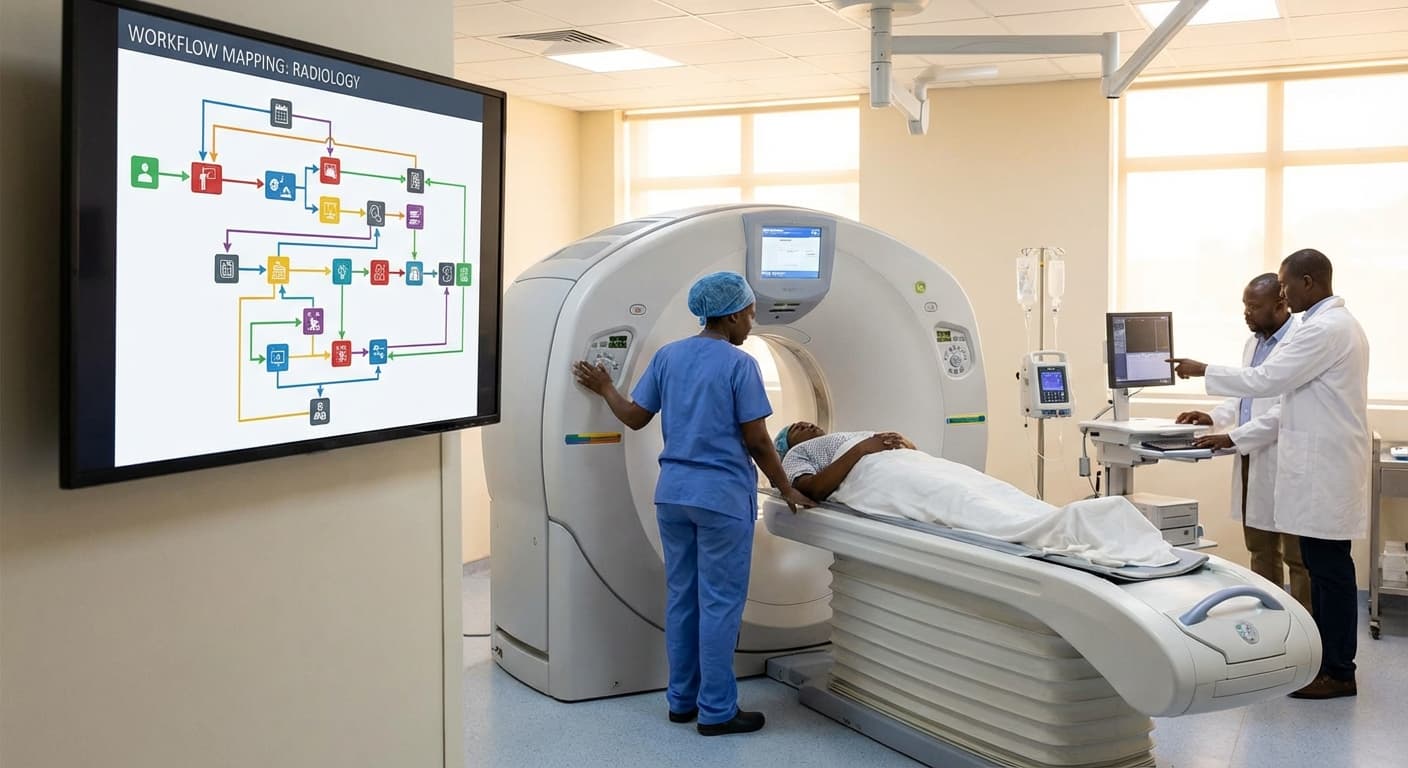
Department Workflow Mapping Service (Radiology/ICU/OT/Lab/Dialysis) in Eswatini
Engineering Excellence & Technical Support
Department Workflow Mapping Service (Radiology/ICU/OT/Lab/Dialysis) High-standard technical execution following OEM protocols and local regulatory frameworks.
Optimized Patient Flow in Radiology
Streamlined appointment scheduling and imaging process mapping in Eswatini's Radiology departments, reducing patient wait times by up to 20% and improving resource utilization.
Enhanced ICU Resource Allocation
Detailed workflow mapping of critical care patient journeys in Eswatini ICUs, identifying bottlenecks in bed availability and staffing, leading to a 15% improvement in critical response times.
Streamlined OT Procedure Sequencing
Developed comprehensive workflow maps for Operating Theatres across Eswatini, standardizing pre-operative, intra-operative, and post-operative processes for increased efficiency and reduced cancellations.
What Is Department Workflow Mapping Service (Radiology/icu/ot/lab/dialysis) In Eswatini?
Department Workflow Mapping Service (Radiology/ICU/OT/Lab/Dialysis) in Eswatini refers to the systematic analysis, documentation, and optimization of all processes and activities undertaken within specific clinical departments. This service aims to create a comprehensive visual representation of how tasks are performed, from patient arrival to discharge or completion of service, identifying bottlenecks, inefficiencies, and areas for improvement. It is a crucial tool for enhancing operational efficiency, patient safety, resource utilization, and overall quality of care within these high-demand and complex healthcare environments.
| Who Needs This Service? | Typical Use Cases |
|---|---|
| Radiology Departments (Diagnostic Imaging): Hospitals, specialized imaging centers, clinics. | Optimizing patient throughput for imaging procedures (e.g., X-ray, CT, MRI). Improving radiologist reporting turnaround times. Streamlining image archival and retrieval processes. Enhancing equipment utilization and maintenance scheduling. Implementing new imaging technologies and protocols. |
| Intensive Care Units (ICUs): Critical care units within hospitals. | Improving patient monitoring and intervention response times. Streamlining medication administration and management. Optimizing patient transfer protocols (in and out of ICU). Enhancing interdisciplinary team communication and coordination. Managing complex equipment and life support systems. |
| Operating Theaters (OTs): Surgical suites within hospitals. | Optimizing surgical scheduling and patient preparation. Improving instrument and supply chain management. Streamlining patient flow through pre-op, intra-op, and post-op phases. Enhancing surgical team coordination and communication. Reducing operating room downtime and cancellations. |
| Laboratories (Clinical Pathology): Hospital laboratories, private diagnostic labs. | Optimizing specimen collection, transport, and processing. Streamlining analytical testing workflows. Improving turnaround times for laboratory results. Enhancing quality control and assurance processes. Managing laboratory information systems (LIS) integration. |
| Dialysis Centers: Outpatient and in-patient dialysis units. | Optimizing patient scheduling and session management. Streamlining pre-dialysis assessment and post-dialysis care. Improving medication and fluid management protocols. Enhancing equipment maintenance and sterilization procedures. Ensuring patient safety and infection control. |
Key Components of Department Workflow Mapping:
- Process Identification and Definition: Clearly defining all individual steps and tasks within a department's operational scope.
- Activity Sequencing: Ordering these steps chronologically and identifying dependencies between them.
- Resource Allocation Analysis: Documenting the human, material, and technological resources involved in each step.
- Information Flow Mapping: Tracing the movement of patient data, orders, and results between different stakeholders and systems.
- Bottleneck Identification: Pinpointing areas where delays, errors, or inefficiencies occur.
- Stakeholder Analysis: Identifying all individuals and groups involved in or affected by the workflow (e.g., clinicians, technicians, administrative staff, patients).
- Performance Metrics Definition: Establishing key performance indicators (KPIs) to measure the effectiveness and efficiency of the mapped workflow.
- Optimization Strategy Development: Proposing and implementing improvements to streamline processes, reduce waste, and enhance quality.
- Documentation and Visualization: Creating clear and concise visual representations of the workflows (e.g., flowcharts, process diagrams).
Who Needs Department Workflow Mapping Service (Radiology/icu/ot/lab/dialysis) In Eswatini?
In Eswatini, a Department Workflow Mapping Service is crucial for optimizing operations across critical healthcare departments. This service provides a detailed analysis and visualization of existing processes within specific departments, identifying bottlenecks, inefficiencies, and areas for improvement. By understanding the flow of patients, information, and resources, healthcare facilities can enhance patient care, reduce wait times, improve staff productivity, and ensure better resource allocation. This is particularly vital in high-demand and complex environments like Radiology, Intensive Care Units (ICUs), Operating Theatres (OTs), Laboratories, and Dialysis Units.
| Target Customer Type | Specific Needs Addressed by Workflow Mapping | Benefits of Service | Eswatini Contextual Relevance |
|---|---|---|---|
| Public Hospitals in Eswatini | Optimizing resource allocation, reducing patient wait times, improving diagnostic accuracy and speed, enhancing staff efficiency in under-resourced departments. | Increased patient throughput, improved patient satisfaction, better utilization of limited medical equipment and personnel, adherence to national health standards. | Addressing infrastructure and staffing challenges, ensuring equitable access to specialized services, supporting the Ministry of Health's strategic goals. |
| Private Healthcare Facilities in Eswatini | Enhancing operational efficiency, improving service delivery quality, ensuring competitive advantage, maximizing profitability through streamlined processes. | Reduced operational costs, improved patient experience, enhanced reputation for efficiency and quality, ability to offer specialized services more effectively. | Meeting the demands of a growing private healthcare sector, attracting and retaining patients, aligning with international best practices. |
| District Hospitals and Clinics with Specialized Services | Standardizing care delivery, identifying opportunities for inter-departmental collaboration, implementing best practices in limited settings. | Improved consistency of care, better management of patient flow across services, identification of training needs for staff. | Extending the reach of specialized diagnostic and treatment services to more remote areas, overcoming geographical barriers to healthcare. |
| Ministry of Health, Eswatini | Gaining oversight of departmental efficiency, identifying areas for national policy intervention, standardizing protocols across public facilities. | Data-driven decision-making for resource allocation, development of national guidelines for service delivery, improved monitoring and evaluation of healthcare system performance. | Supporting national health strategies, ensuring efficient use of public funds, working towards universal health coverage. |
Target Departments and Their Workflow Mapping Needs in Eswatini
- {"title":"Radiology Department","description":"Radiology departments in Eswatini face the challenge of managing high patient volumes, ensuring timely image acquisition and interpretation, and efficient reporting. Workflow mapping can streamline patient scheduling, imaging protocols, radiologist interpretation workflows, and the secure transmission of reports to referring physicians. This leads to faster diagnosis and treatment initiation."}
- {"title":"Intensive Care Units (ICUs)","description":"ICUs are high-stakes environments where every second counts. Workflow mapping is essential for optimizing patient admission and discharge processes, managing critical care equipment, coordinating multidisciplinary team communication, and ensuring rapid response to patient deteriorations. It can highlight communication breakdowns, delays in critical interventions, and opportunities for better patient monitoring."}
- {"title":"Operating Theatres (OTs)","description":"Effective management of operating theatres is paramount for patient safety and surgical efficiency. Workflow mapping can address issues related to surgical scheduling, patient preparation and handover, instrument sterilization and availability, team coordination, and post-operative care pathways. This helps minimize cancellations, reduce turnaround times between surgeries, and improve overall theatre utilization."}
- {"title":"Laboratory Department","description":"Laboratories in Eswatini are critical for accurate and timely diagnostic testing. Workflow mapping can identify inefficiencies in sample collection, transport, processing, testing, quality control, and result reporting. It helps in optimizing laboratory workflows to reduce turnaround times for crucial diagnostic results, thereby impacting patient management decisions."}
- {"title":"Dialysis Units","description":"Dialysis units require a highly organized workflow to manage scheduled patient treatments, equipment maintenance, and patient monitoring. Workflow mapping can improve patient scheduling, ensure adequate staffing, optimize the flow of patients through the dialysis stations, and enhance the efficiency of fluid management and medication administration. This leads to better patient outcomes and reduced complications."}
Department Workflow Mapping Service (Radiology/icu/ot/lab/dialysis) Process In Eswatini
This document outlines the Department Workflow Mapping Service for key hospital departments in Eswatini, including Radiology, Intensive Care Unit (ICU), Operating Theatre (OT), Laboratory, and Dialysis. The service aims to document, analyze, and optimize existing processes within these critical units to enhance efficiency, reduce errors, and improve patient care. The workflow begins with an inquiry from a department and concludes with the delivery of a comprehensive workflow map and recommendations.
| Step | Activity | Description | Responsible Party | Key Outputs |
|---|---|---|---|---|
| 1 | Inquiry & Initial Consultation | Department expresses interest in workflow mapping. Initial meeting to understand scope, objectives, and current challenges. | Requesting Department / Service Provider | Understanding of departmental needs; preliminary scope agreement. |
| 2 | Scope Definition & Planning | Detailed discussion to define the specific processes to be mapped, the level of detail required, and the timeline. Project plan development. | Service Provider / Departmental Leadership | Defined project scope, objectives, timeline, and resource allocation. |
| 3 | Data Collection & Observation | On-site observation of daily operations, interviews with staff at all levels, review of existing documentation (SOPs, forms, logs). | Service Provider (Workflow Analysts) / Departmental Staff | Raw data, interview notes, observation logs, collected documents. |
| 4 | Process Mapping | Translating collected data into visual workflow diagrams using standard notations (e.g., BPMN). Identifying key steps, decision points, roles, and information flow. | Service Provider (Workflow Analysts) | Initial draft workflow maps for each identified process. |
| 5 | Validation & Refinement | Presenting draft workflow maps to departmental staff for review, feedback, and validation. Incorporating corrections and clarifications. | Service Provider / Departmental Staff | Validated and refined workflow maps. |
| 6 | Analysis & Bottleneck Identification | Analyzing the validated maps to identify inefficiencies, redundancies, bottlenecks, potential risks, and areas for improvement. | Service Provider (Workflow Analysts) | Identified areas for improvement and potential bottlenecks. |
| 7 | Recommendation Development | Formulating specific, actionable recommendations for process optimization, technology adoption, training needs, or policy changes. | Service Provider | List of recommendations for workflow improvement. |
| 8 | Report Generation & Presentation | Compiling a comprehensive report that includes the final workflow maps, analysis findings, and detailed recommendations. Presenting the findings and recommendations to departmental leadership and relevant stakeholders. | Service Provider / Departmental Leadership | Final workflow mapping report and presentation. |
| 9 | Implementation Support (Optional) | Providing guidance and support during the implementation phase of the recommendations, if requested. | Service Provider / Departmental Leadership | Successful implementation of recommended changes. |
| 10 | Project Closure | Formal handover of all deliverables and documentation. Post-implementation review meeting to assess impact. | Service Provider / Departmental Leadership | Project completion and documentation. |
Key Departments Covered
- Radiology Department
- Intensive Care Unit (ICU)
- Operating Theatre (OT)
- Laboratory Services
- Dialysis Unit
Department Workflow Mapping Service (Radiology/icu/ot/lab/dialysis) Cost In Eswatini
The cost of Department Workflow Mapping Services in Eswatini, particularly for specialized departments like Radiology, Intensive Care Unit (ICU), Operating Theatre (OT), Laboratory, and Dialysis, is influenced by several key pricing factors. These services are crucial for optimizing efficiency, reducing errors, and improving patient care within these critical healthcare settings. Costs are generally quoted in Eswatini Lilangeni (SZL).
| Service Type (Eswatini Lilangeni - SZL) | Estimated Cost Range (SZL) | Notes |
|---|---|---|
| Basic Workflow Mapping (Single Department, Standard Scope) | 15,000 - 30,000 | Covers fundamental process identification and documentation. Suitable for smaller departments or initial assessments. |
| Standard Workflow Mapping (Single Department, Detailed Scope) | 30,000 - 60,000 | Includes in-depth analysis, bottleneck identification, and basic recommendations for a single department. |
| Advanced Workflow Mapping (Single Department, Comprehensive Analysis & Recommendations) | 60,000 - 120,000 | Involves detailed process analysis, performance metrics, identification of inefficiencies, and development of actionable improvement strategies. Often includes 'to-be' state modeling. |
| Multi-Department Workflow Mapping (e.g., Radiology & ICU Linkages) | 80,000 - 200,000+ | Cost increases significantly with the number of departments and the complexity of interdependencies. Can be highly customized. |
| Specialized Department Mapping (ICU, OT, Lab, Dialysis - Advanced) | 70,000 - 150,000+ | These departments have unique complexities (e.g., patient criticalities, specialized equipment, regulatory compliance) that often necessitate more specialized and thus higher-cost mapping. |
| Hourly Consulting Rate (for smaller ad-hoc tasks or specific expertise) | 500 - 1,500 SZL per hour | Varies based on consultant's experience and specialization. Applicable for quick assessments, data validation, or specific guidance. |
Key Pricing Factors for Department Workflow Mapping Services in Eswatini:
- Scope of the Workflow Mapping: The breadth and depth of the mapping project are primary determinants of cost. This includes the number of specific processes to be mapped, the level of detail required, and whether it encompasses a single department or multiple interconnected ones.
- Department Size and Complexity: Larger departments with more staff, specialized equipment, and intricate patient pathways will naturally require more extensive analysis, thus increasing costs.
- Current State vs. Future State Mapping: Mapping the existing 'as-is' state is often less complex and costly than developing and mapping an optimized 'to-be' state, which may involve recommending new technologies or process re-engineering.
- Data Collection Methods: The methods employed for data collection (e.g., direct observation, interviews, surveys, analysis of existing documentation, time-and-motion studies) impact the resources and time needed.
- Level of Analysis and Reporting: The sophistication of the analysis required (e.g., bottleneck identification, waste identification, performance benchmarking) and the detail of the final report (e.g., visual diagrams, quantitative data, recommendations, implementation roadmaps) influence pricing.
- Consultant Expertise and Experience: The reputation, experience, and specialization of the consulting firm or individual providing the service will directly affect their hourly or project rates.
- Project Timeline and Urgency: Expedited projects or those requiring immediate attention may incur premium charges.
- Technology and Software Used: If the service involves the use of specialized workflow mapping software or simulation tools, these costs might be factored in.
- Customization Requirements: Bespoke solutions tailored to the unique needs of a specific hospital or department will generally be more expensive than standardized offerings.
- Travel and Accommodation (if applicable): For consultants based outside the immediate vicinity of the client, travel and accommodation expenses will be added.
Affordable Department Workflow Mapping Service (Radiology/icu/ot/lab/dialysis) Options
Our Affordable Department Workflow Mapping Service offers a comprehensive solution to optimize efficiency and reduce costs within critical hospital departments. By meticulously analyzing and documenting existing workflows, we identify bottlenecks, redundancies, and areas for improvement. This service is tailored for Radiology, Intensive Care Units (ICU), Operating Theatres (OT), Laboratories, and Dialysis Units, ensuring department-specific needs are addressed. We deliver actionable insights that lead to significant cost savings, enhanced patient care, and improved staff satisfaction.
| Service Component | Description | Typical Deliverables | Cost-Saving Potential (Examples) |
|---|---|---|---|
| Initial Workflow Assessment | On-site observation and interviews to understand current processes, roles, and resource utilization. | Process flow diagrams, initial bottleneck report. | Identification of wasted time/motion (e.g., 10-15% reduction in patient wait times). |
| Detailed Workflow Documentation | Creation of precise visual maps for each process step, including inputs, outputs, decision points, and stakeholders. | High-fidelity workflow charts, standard operating procedure (SOP) drafts. | Reduction in errors due to clear, standardized procedures (e.g., 5-10% decrease in order entry errors). |
| Bottleneck & Redundancy Analysis | In-depth analysis to pinpoint areas causing delays, excessive resource use, or duplicate efforts. | Prioritized list of bottlenecks with root cause analysis, suggested re-engineering options. | Optimized resource allocation, reduced overtime costs (e.g., 15-20% improvement in equipment utilization). |
| Recommendations & Optimization Strategies | Development of actionable recommendations for workflow improvements, technology adoption, and staff training. | Implementation roadmap, change management plan, proposed SOPs. | Improved staff productivity, reduced patient length of stay (e.g., 5-10% reduction in ICU LOS). |
| Cost-Benefit Analysis | Quantification of potential cost savings and return on investment (ROI) from proposed changes. | ROI report, projected savings figures. | Clear justification for investment in process improvement initiatives. |
| Post-Implementation Review (Optional Add-on) | Follow-up assessment to evaluate the effectiveness of implemented changes and make further adjustments. | Performance metrics report, revised recommendations. | Sustained efficiency gains and continuous improvement culture. |
Value Bundles
- Core Workflow Mapping: Comprehensive analysis and documentation of a single department's end-to-end workflow. Includes bottleneck identification and initial recommendations.
- Multi-Department Synergy Bundle: Extends Core Mapping to two adjacent or interconnected departments, focusing on inter-departmental handoffs and communication. Ideal for OT & ICU, or Lab & Radiology.
- Critical Pathway Optimization: Focuses on high-volume or high-risk patient pathways across multiple departments (e.g., Sepsis pathway involving ICU, Lab, and Radiology). Provides deep dive into each touchpoint.
- Technology Integration Blueprint: Maps current workflows and proposes optimized workflows incorporating specific technology solutions (e.g., EMR integration, PACS optimization, automated lab systems).
- Lean Six Sigma Deployment Package: Combines comprehensive workflow mapping with the implementation of Lean Six Sigma principles and tools for sustained process improvement and waste reduction within a chosen department.
Verified Providers In Eswatini
In Eswatini, ensuring access to reliable and qualified healthcare providers is paramount for individual well-being and community health. Verified providers, those who have undergone rigorous credentialing processes, offer a level of assurance and expertise that sets them apart. Franance Health stands as a prominent example of such a commitment, meticulously vetting its network of healthcare professionals. Their stringent credentialing process not only validates the qualifications and licenses of practitioners but also delves into their experience, ethical standing, and commitment to continuous professional development. Choosing a provider credentialed by Franance Health means opting for practitioners who are demonstrably competent, trustworthy, and dedicated to delivering high-quality patient care within Eswatini.
| Credentialing Aspect | Franance Health's Verification Process | Benefit to Patients |
|---|---|---|
| Medical Licenses & Certifications | Thorough verification of all official licenses and certifications with relevant Eswatini authorities. | Guarantees practitioners are legally authorized and qualified to practice medicine. |
| Educational Background | Confirmation of degrees, diplomas, and specialized training from accredited institutions. | Ensures a strong foundation of medical knowledge and expertise. |
| Professional Experience | In-depth review of work history, practice settings, and specialized areas of practice. | Confirms practical application of skills and accumulated expertise in patient care. |
| Reputation & Ethical Conduct | Background checks and reference verification to assess professional reputation and ethical behavior. | Provides assurance of trustworthy and conscientious healthcare delivery. |
| Continuing Professional Development (CPD) | Evidence of engagement in ongoing training, workshops, and educational activities. | Indicates a commitment to staying current with the latest medical knowledge and techniques. |
Why Franance Health Credentials Matter
- Ensures practitioners meet stringent qualification and licensing requirements.
- Verifies extensive practical experience in relevant medical fields.
- Confirms adherence to high ethical standards and professional conduct.
- Demonstrates commitment to ongoing learning and staying abreast of medical advancements.
- Provides patients with confidence in the competence and reliability of their healthcare providers.
Scope Of Work For Department Workflow Mapping Service (Radiology/icu/ot/lab/dialysis)
This document outlines the Scope of Work (SOW) for a Department Workflow Mapping Service, specifically for the Radiology, Intensive Care Unit (ICU), Operating Theatre (OT), Laboratory, and Dialysis departments. The service aims to comprehensively analyze, document, and visualize current departmental workflows to identify inefficiencies, bottlenecks, and areas for improvement. The technical deliverables will provide a clear and standardized representation of these workflows, facilitating future optimization and system integration efforts.
| Deliverable | Description | Technical Specification | Format |
|---|---|---|---|
| As-Is Workflow Diagrams (per department) | Detailed visual representation of the current step-by-step processes within each department, including inputs, outputs, decision points, roles, and systems involved. | Utilize Business Process Model and Notation (BPMN) 2.0 standard for all diagrams. Diagrams should be clear, concise, and easily navigable. All activities, gateways, events, and sequence flows must be clearly labeled. Swimlanes or pools should be used to delineate roles and responsibilities. | Digital format (e.g., PDF, PNG). Source files (e.g., .bpmn) will also be provided. |
| Process Narrative/Description (per department) | A written explanation accompanying each workflow diagram, elaborating on the steps, rationale, and critical dependencies. | Narratives should be structured logically, aligning with the sequence of the corresponding diagram. Include definitions of key terms and abbreviations used. Highlight any manual workarounds or exceptions observed. | Microsoft Word (.docx) or equivalent document format. |
| Bottleneck and Inefficiency Report | A consolidated report identifying specific areas of delay, resource contention, and operational inefficiencies observed during the mapping process. | Each identified bottleneck should be described with its impact on the overall process. Quantify where possible (e.g., average delay time). Prioritize findings based on potential impact. | Microsoft Word (.docx) or equivalent document format. |
| Stakeholder Interview Notes | Summarized notes from interviews conducted with key personnel within each department to gather information on current workflows and challenges. | Notes should be organized by department and by individual interviewed. Focus on capturing key insights and requirements related to the workflow. | Microsoft Word (.docx) or equivalent document format. |
| Glossary of Terms | A comprehensive list of all technical and departmental terms, acronyms, and abbreviations used throughout the documentation. | Alphabetical order. Clear and concise definitions. Ensure consistency in terminology across all deliverables. | Microsoft Word (.docx) or equivalent document format. |
| Project Status Reports | Regular updates on the progress of the workflow mapping engagement, including milestones achieved, challenges encountered, and upcoming activities. | Weekly or bi-weekly reporting. Summarize key progress, risks, and mitigation plans. | Microsoft Word (.docx) or equivalent document format. |
Key Objectives
- To accurately document existing 'as-is' workflows for each specified department.
- To identify pain points, redundancies, and potential risks within current processes.
- To create visual representations of workflows using standardized notation.
- To provide a baseline for future 'to-be' workflow design and system implementation.
- To ensure consistency and clarity in workflow documentation across all departments.
- To facilitate communication and understanding of departmental operations among stakeholders.
Service Level Agreement For Department Workflow Mapping Service (Radiology/icu/ot/lab/dialysis)
This Service Level Agreement (SLA) outlines the performance expectations and guarantees for the Department Workflow Mapping Service provided to the Radiology, Intensive Care Unit (ICU), Operating Theatre (OT), Laboratory, and Dialysis departments. This SLA defines response times for support requests and uptime guarantees for the workflow mapping platform and its associated services.
| Service Component | Uptime Guarantee | Availability Window | Scheduled Maintenance Window | Response Time (Critical Issue) | Response Time (Standard Issue) |
|---|---|---|---|---|---|
| Workflow Mapping Platform Access | 99.8% | 24x7x365 | Sundays, 02:00 - 04:00 (Local Time) | 1 Hour | 4 Business Hours |
| Data Synchronization (if applicable) | 99.5% | 24x7x365 | Sundays, 02:00 - 04:00 (Local Time) | 2 Hours | 8 Business Hours |
| Support Ticket Response (Email/Portal) | N/A | N/A | N/A | 2 Business Hours | 8 Business Hours |
| Emergency Support (Phone - Critical Issues Only) | N/A | N/A | N/A | 30 Minutes | N/A |
Scope of Service
- Workflow mapping platform maintenance and updates.
- Support for accessing and utilizing the workflow mapping tool.
- Troubleshooting and resolution of technical issues affecting the workflow mapping service.
- Assistance with interpretation of workflow maps and generated data (where applicable).
- Regular backups and disaster recovery for workflow mapping data.
Frequently Asked Questions

Ready when you are
Let's scope your Department Workflow Mapping Service (Radiology/ICU/OT/Lab/Dialysis) in Eswatini project in Eswatini.

Scaling healthcare logistics and technical systems across the entire continent.