
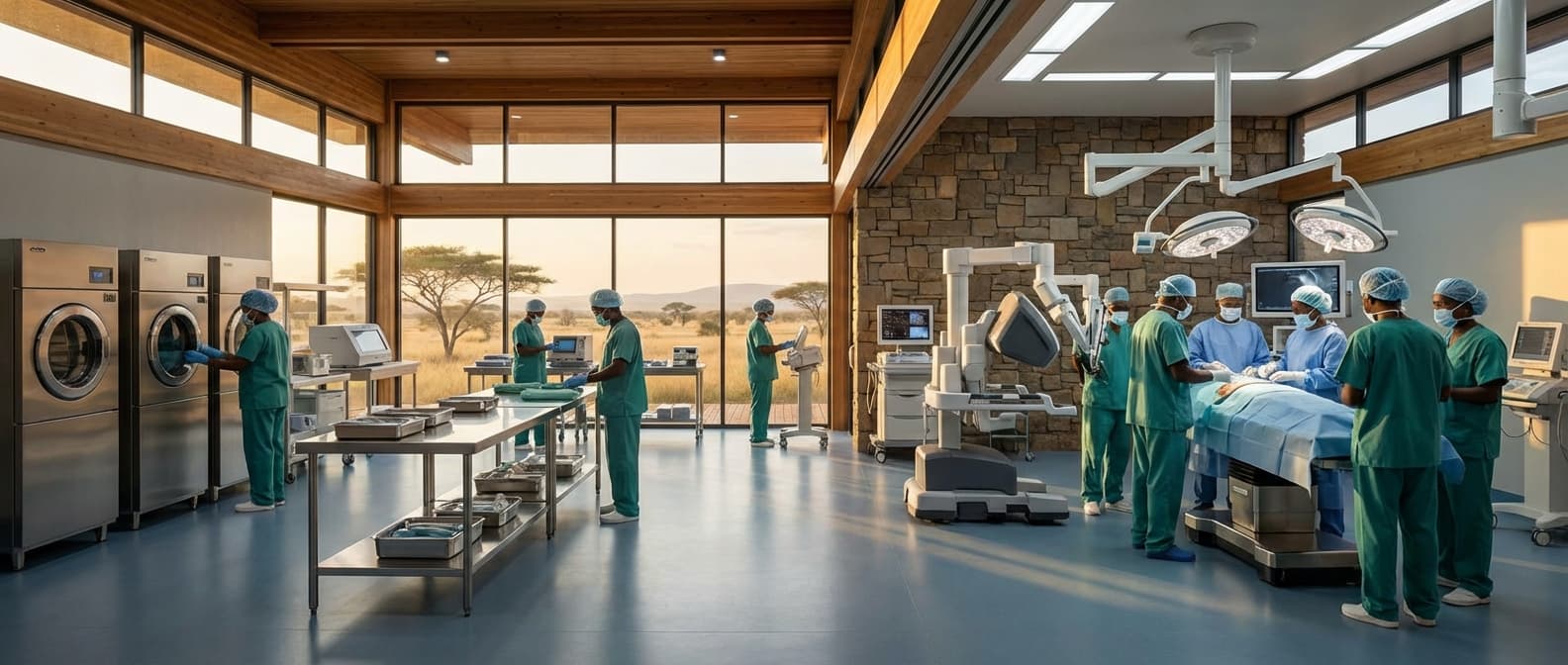
Operating Theatre Turnkey Build in Eswatini
Engineering Excellence & Technical Support
Complete OR design, equipment integration and commissioning High-standard technical execution following OEM protocols and local regulatory frameworks.
Advanced Surgical Suite Integration
We deliver fully integrated operating theatres in Eswatini, equipped with state-of-the-art surgical lighting, imaging systems, and instrument booms, ensuring optimal workflow and sterility for complex procedures.
Sterile Environment Assurance
Our turnkey solutions prioritize patient safety through advanced HEPA filtration systems, laminar airflow design, and validated negative pressure differentials, guaranteeing a class-leading sterile environment for all surgical interventions.
Robust Power & Medical Gas Infrastructure
We engineer resilient power distribution networks, including UPS and backup generators, alongside reliable medical gas pipelines (oxygen, medical air, vacuum), ensuring uninterrupted operation and critical supply continuity for Eswatini's healthcare facilities.
What Is Operating Theatre Turnkey Build In Eswatini?
An Operating Theatre Turnkey Build in Eswatini refers to a comprehensive service where a specialized contractor assumes full responsibility for the design, construction, and equipping of a fully functional operating theatre suite. This 'turnkey' approach signifies a project delivered in a ready-to-operate state, encompassing all phases from initial concept to final handover. The service is characterized by its end-to-end management, eliminating the need for the client to coordinate multiple vendors and contractors, thereby streamlining the project lifecycle and ensuring adherence to international healthcare standards and local regulatory requirements pertinent to Eswatini.
| Who Needs It? | Typical Use Cases in Eswatini | ||||
|---|---|---|---|---|---|
| Hospitals and Healthcare Facilities: Both public and private hospitals in Eswatini seeking to establish new operating theatres or upgrade existing ones to meet modern surgical demands and infection control protocols. | Expansion of Surgical Services: Establishing new specialized surgical departments (e.g., cardiology, neurosurgery, orthopedics) requiring dedicated, state-of-the-art operating facilities. | Rural Healthcare Improvement: Implementing or upgrading surgical capacity in underserved areas to improve access to essential medical procedures. | Tertiary Care Centers: Development of advanced surgical suites for complex procedures and patient management. | Research and Teaching Institutions: Facilities requiring integrated audiovisual and IT systems for training and research purposes. | Emergency Redevelopment Projects: Rapid deployment of functional operating theatres in response to public health crises or disaster situations. |
Key Components of an Operating Theatre Turnkey Build:
- Site Assessment and Feasibility Studies: Evaluating existing infrastructure, patient flow, and operational needs to determine project viability and scope.
- Architectural and Engineering Design: Developing detailed plans for theatre layout, HVAC systems, medical gas infrastructure, lighting, infection control measures, and structural integrity, compliant with relevant Eswatini health regulations and international best practices (e.g., HTM, ASHRAE standards).
- Civil and Construction Works: Undertaking all necessary building modifications, new construction, interior finishing, and compliance with fire safety and accessibility codes.
- Specialized Systems Installation: Integrating critical systems such as advanced HVAC with HEPA filtration and laminar airflow, medical gas pipelines (oxygen, nitrous oxide, vacuum), nurse call systems, emergency power, and UPS.
- Medical Equipment Procurement and Installation: Sourcing and installing a full suite of surgical equipment, including operating tables, surgical lights, anesthesia machines, electrosurgical units, patient monitors, imaging equipment, and sterilization units.
- Integrated IT and Audiovisual Solutions: Implementing theatre control systems, patient data management integration, and audiovisual equipment for recording and tele-surgery capabilities.
- Commissioning and Validation: Rigorous testing and validation of all installed systems and equipment to ensure optimal performance, safety, and compliance with regulatory standards.
- Training and Handover: Providing comprehensive training to clinical and technical staff on the operation and maintenance of the new theatre and its equipment, followed by formal project handover.
Who Needs Operating Theatre Turnkey Build In Eswatini?
A turnkey operating theatre build offers a comprehensive, end-to-end solution for establishing state-of-the-art surgical facilities. This includes design, construction, equipment installation, and commissioning, all managed by a single provider. For Eswatini, where healthcare infrastructure is continually developing, such a service is invaluable for those seeking to rapidly and efficiently upgrade or establish high-quality surgical capabilities. The demand is driven by the need for modern, safe, and well-equipped surgical spaces that can meet international standards and cater to a growing population's healthcare needs.
| Customer Type | Primary Departments Requiring Turnkey Builds |
|---|---|
| Public Hospitals (e.g., National Referral Hospital, Regional Hospitals) | General Surgery, Orthopedics, Obstetrics & Gynecology, Urology, Ophthalmology, ENT, Emergency Surgery, Intensive Care Unit (ICU) adjacent operating rooms |
| Private Hospitals and Clinics | All surgical specialties including General Surgery, Orthopedics, Cardiothoracic Surgery, Neurosurgery, Plastic Surgery, Urology, Ophthalmology, ENT, IVF and Fertility Surgeries, Endoscopy Suites |
| Specialty Medical Facilities (e.g., dedicated eye centers, orthopedic clinics) | Specialized surgical suites tailored to the specific discipline, requiring advanced imaging and surgical equipment. |
Target Customers & Departments in Eswatini for Operating Theatre Turnkey Builds
- Hospitals (Public and Private)
- Surgical Centers and Clinics
- Specialty Medical Facilities
Operating Theatre Turnkey Build Process In Eswatini
The process of a turnkey operating theatre (OT) build in Eswatini, from the initial inquiry to the final handover and execution, involves a structured and phased approach. This ensures meticulous planning, compliance with regulations, and the delivery of a fully functional, state-of-the-art surgical environment. A 'turnkey' project signifies a complete solution where the contractor handles all aspects of the build, from design to commissioning, delivering a ready-to-use facility.
| Phase | Description | Key Activities | Deliverables | Typical Timeline (Indicative) |
|---|---|---|---|---|
| The client (e.g., Ministry of Health, private hospital) expresses interest and defines their basic requirements for a new or refurbished OT. | Understand client needs, project scope, preliminary budget, and site assessment. | Initial project brief, preliminary site report. | 1-2 Weeks |
| A detailed evaluation of the project's viability, including technical, economic, and operational aspects. | Site surveys, needs analysis (number and type of OTs, required specialties), regulatory review, initial risk assessment, budget validation. | Feasibility report, detailed needs assessment document, refined budget estimation. | 2-4 Weeks |
| Development of the overall concept, layout, and preliminary specifications, leading to a more concrete budget. | Architectural conceptualization, selection of key technologies, preliminary equipment list, space planning, cost estimation. | Conceptual design drawings, preliminary equipment schedule, refined project budget, proposal document. | 4-6 Weeks |
| Comprehensive architectural, structural, and MEP (Mechanical, Electrical, Plumbing) design, including all specialized OT systems. | Production of detailed blueprints, specifications, HVAC design (laminar flow, air changes), electrical layouts, medical gas schematics, lighting plans, IT integration. | Complete set of construction drawings, technical specifications, Bill of Quantities (BOQ). | 8-16 Weeks |
| Securing all necessary permits and approvals from local authorities in Eswatini (e.g., Ministry of Health, local councils). | Submission of design documents, addressing feedback, obtaining building permits, environmental clearances, and health facility licenses. | Approved building permits, relevant licenses and certificates. | 4-12 Weeks (can vary significantly) |
| Sourcing and ordering all materials, equipment, and services required for the project. | Supplier selection, contract negotiation, purchase orders, logistics planning for imported and local materials, quality control of sourced items. | Procurement plan, secured supply chain, delivered long-lead items. | Ongoing throughout the project, initial procurement can take 4-8 Weeks |
| Preparing the construction site and undertaking the foundational and structural building activities. | Site clearance, excavation, foundation laying, structural framework construction, concrete pouring, wall construction, roofing. | Completed building shell, foundational structure. | 12-24 Weeks |
| Installation of all mechanical, electrical, and plumbing systems to support the OT's function. | HVAC systems, electrical wiring, lighting, plumbing, drainage, backup power systems (generators, UPS). | Installed and tested MEP infrastructure. | 8-16 Weeks |
| Installation of specialized medical gas pipelines and outlets (oxygen, medical air, vacuum, nitrous oxide). | Pipeline installation, manifold systems, alarm systems, testing of purity and pressure. | Installed and certified medical gas systems. | 4-6 Weeks |
| Installation and integration of critical surgical equipment. | Surgical lights, booms, anesthesia machines, patient monitors, imaging equipment integration, scrub sinks, sterilization units. | Installed and pre-tested medical equipment. | 6-12 Weeks |
| Completing the interior aesthetics and functionality of the operating rooms and supporting areas. | Wall and floor finishes (anti-bacterial, seamless), ceiling installation, door fitting, painting, installation of cabinetry and fixtures. | Completed interior spaces, sterile environment prepared. | 6-10 Weeks |
| Rigorous testing of all systems to ensure they meet design specifications and operational requirements. | Functional testing of HVAC (air changes, filtration), electrical systems, medical gases, alarms, lighting. Validation of sterility and environmental parameters. Performance testing of equipment. | Commissioning reports, validation certificates, final test results. | 4-8 Weeks |
| Training of hospital staff on the operation and maintenance of the new OT and its equipment. | On-site training sessions, provision of O&M manuals, demonstration of equipment functionality. Formal handover of the completed facility. | Trained staff, Operation & Maintenance manuals, Handover certificate. | 2-3 Weeks |
| Ongoing support and maintenance services provided by the turnkey contractor. | Warranty period support, scheduled maintenance, troubleshooting, spare parts provision. | Maintenance agreements, ongoing operational support. | Ongoing (as per contract) |
Turnkey Operating Theatre Build Process in Eswatini: Workflow from Inquiry to Execution
- Inquiry and Initial Consultation
- Feasibility Study and Needs Assessment
- Conceptual Design and Budgeting
- Detailed Design and Engineering
- Regulatory Approvals and Permitting
- Procurement and Supply Chain Management
- Site Preparation and Civil Works
- MEP (Mechanical, Electrical, Plumbing) Installation
- Medical Gas Systems Installation
- Specialized OT Equipment Installation
- Finishing and Interior Fit-out
- Testing, Commissioning, and Validation
- Training and Handover
- Post-Handover Support and Maintenance
Operating Theatre Turnkey Build Cost In Eswatini
The cost of building a turnkey operating theatre in Eswatini can vary significantly based on a multitude of factors. A "turnkey" project implies a fully equipped and ready-to-use facility, encompassing design, construction, specialized medical equipment, and installation. The pricing is influenced by the size and complexity of the theatre, the quality and type of medical equipment chosen, the level of finishing, and the specific requirements for infection control and specialized systems like medical gases. It's crucial to engage with specialized construction firms and medical equipment suppliers for accurate quotations. Prices are typically quoted in Eswatini Lilangeni (SZL).
| Category | Estimated Cost Range (SZL) | Notes |
|---|---|---|
| Basic Operating Theatre (Small to Medium, Standard Equipment) | 1,500,000 - 3,000,000 SZL | Focus on essential equipment, simpler finishes, standard HVAC. |
| Intermediate Operating Theatre (Medium to Large, Mid-Range Equipment) | 3,000,000 - 6,000,000 SZL | Higher quality finishes, more advanced medical equipment, integrated medical gases, basic laminar flow. |
| Advanced/Specialized Operating Theatre (Large, High-End Equipment) | 6,000,000 - 15,000,000+ SZL | Includes specialized procedure requirements, top-tier medical equipment, advanced laminar flow, full suite of medical gases, sophisticated HVAC, emergency power, robust infection control. |
| Medical Equipment (Per Theatre) | 800,000 - 5,000,000+ SZL | Highly variable based on the brand, model, and quantity of critical equipment. |
| Specialized Systems (Medical Gases, HVAC, Laminar Flow) | 300,000 - 1,500,000+ SZL | Costs depend on the complexity and extent of the systems installed. |
| Design and Project Management Fees | 100,000 - 500,000 SZL | Typically a percentage of the total construction cost, varying by firm. |
Key Pricing Factors for Turnkey Operating Theatre Builds in Eswatini
- Theatre Size and Scope: The overall square footage of the operating theatre suite, including the theatre room itself, pre-operative holding areas, scrub rooms, recovery areas, and sterilization spaces, directly impacts material and labor costs.
- Level of Specialization: Basic surgical theatres will cost less than highly specialized ones, such as those for cardiac surgery, neurosurgery, or advanced laparoscopic procedures, which require more complex infrastructure and equipment.
- Medical Equipment Selection: This is often the most significant cost component. The choice between basic, mid-range, and high-end surgical equipment (e.g., surgical lights, operating tables, anesthesia machines, monitors, electrosurgical units) will dictate a substantial portion of the budget.
- Finishing and Materials: The quality of interior finishes, including wall cladding (e.g., anti-microbial panels vs. standard paint), flooring (e.g., specialized anti-static, seamless vinyl vs. epoxy), ceiling systems, and lighting fixtures, contributes to the overall cost.
- Specialized Systems: Installation of medical gas pipelines (oxygen, nitrous oxide, medical air, vacuum), specialized ventilation and air conditioning (HVAC) systems with HEPA filtration for laminar flow and positive/negative pressure control, and emergency power backup systems are critical and add significant expense.
- Architectural and Engineering Design: The complexity of the design, including structural considerations, layout optimization, and integration of services, will influence professional fees.
- Regulatory Compliance and Certification: Meeting national and international healthcare building standards and obtaining necessary certifications can involve additional costs for specialized consultations and inspections.
- Location and Site Conditions: Accessibility of the site for material delivery, prevailing ground conditions, and the need for any preliminary site preparation can impact construction costs.
- Contractor and Supplier Expertise: Engaging experienced and reputable firms with a track record in healthcare construction and medical equipment supply will generally command higher, but more reliable, pricing.
- Contingency: It is always advisable to include a contingency fund to account for unforeseen circumstances or minor design adjustments during the build.
Affordable Operating Theatre Turnkey Build Options
Building an operating theatre can be a significant investment, but several affordable turnkey build options exist. These solutions aim to streamline the construction process and reduce overall costs by offering comprehensive packages and implementing smart cost-saving strategies. Understanding value bundles and identifying areas for savings is crucial for maximizing your budget without compromising on quality or functionality.
| Value Bundle Category | Description | Cost-Saving Strategies |
|---|---|---|
| Basic Operational Suite | Includes essential elements for routine surgeries: sterile core, standard lighting, basic surgical equipment, and essential ventilation. | Opting for standard, non-customized equipment. Utilizing pre-designed, modular wall and ceiling systems. Focusing on essential HVAC requirements rather than advanced, high-spec systems where not strictly necessary. |
| Intermediate Procedure Room | Adds enhanced imaging capabilities, more specialized lighting, and advanced patient monitoring. | Bundling equipment from preferred suppliers for volume discounts. Choosing multi-functional equipment that can serve multiple purposes. Leveraging energy-efficient lighting and HVAC systems for long-term operational savings. |
| Advanced Surgical Hub | Incorporates high-definition imaging, robotic surgery integration, advanced ventilation with HEPA filtration, and specialized anesthesia setups. | Phased integration of advanced technologies, allowing for upgrades as budget permits. Negotiating long-term maintenance contracts with equipment providers. Exploring refurbished or demonstrator models for non-critical components. |
| Specialty Focus Module | Tailored for specific surgical disciplines like cardiology, orthopedics, or neurosurgery, with specialized equipment and infrastructure. | Collaborating closely with surgeons to define 'must-have' versus 'nice-to-have' equipment. Prioritizing shared equipment across similar specialties where feasible. Investigating leasing options for high-cost, specialized equipment. |
Key Components of Affordable Turnkey Operating Theatre Builds
- Pre-fabricated or modular components that reduce on-site construction time and labor.
- Standardized layouts and equipment packages designed for common surgical procedures.
- Integrated HVAC and medical gas systems that are pre-designed and tested.
- Turnkey project management, including design, procurement, construction, and commissioning.
- Phased construction options to spread costs over time.
Verified Providers In Eswatini
In Eswatini, ensuring you are receiving healthcare from Verified Providers is paramount for your well-being. This means partnering with entities that have undergone rigorous vetting processes, adhere to stringent quality standards, and possess the necessary accreditations. Among these, Franance Health stands out as a premier choice, demonstrating exceptional commitment to patient care, ethical practices, and advanced medical services. Their credentials reflect a deep understanding of healthcare needs within Eswatini and a dedication to exceeding expectations.
| Credential Type | Franance Health Verification | Significance for Patients |
|---|---|---|
| Ministry of Health Accreditation | Fully Accredited | Guarantees adherence to national healthcare standards and regulations, ensuring legal and safe operation. |
| Professional Body Registration (Doctors, Nurses, etc.) | All Staff Registered and Certified | Confirms that medical professionals possess the required qualifications, training, and are actively licensed to practice. |
| Quality Management Systems (e.g., ISO) | Implementing Robust Quality Protocols | Demonstrates a systematic approach to maintaining and improving service quality, patient safety, and operational efficiency. |
| Patient Feedback and Satisfaction Scores | Consistently High Scores | Indicates a strong track record of positive patient experiences and effective care delivery. |
| Partnerships with Reputable Medical Suppliers | Certified Partnerships | Ensures the use of high-quality, authentic medical supplies and pharmaceuticals. |
Why Franance Health is the Best Choice for Verified Healthcare in Eswatini:
- Accreditation and Licensing: Franance Health holds all necessary licenses and accreditations from Eswatini's Ministry of Health, ensuring compliance with national healthcare regulations and standards.
- Qualified Medical Professionals: Their team comprises highly trained and experienced doctors, nurses, and specialists who are all registered and in good standing with relevant professional bodies.
- Patient-Centric Approach: Franance Health prioritizes patient comfort, safety, and satisfaction, offering personalized care plans and fostering strong patient-provider relationships.
- State-of-the-Art Facilities and Equipment: They invest in modern medical technology and maintain clean, well-equipped facilities to provide accurate diagnoses and effective treatments.
- Commitment to Continuous Improvement: Franance Health actively engages in professional development and adopts best practices to stay at the forefront of medical advancements.
- Ethical Practices and Transparency: Upholding the highest ethical standards, they ensure transparent communication regarding treatment options, costs, and expected outcomes.
- Community Focus: Dedicated to serving the Eswatini community, Franance Health strives to make quality healthcare accessible and affordable to a wider population.
Scope Of Work For Operating Theatre Turnkey Build
This Scope of Work (SOW) outlines the requirements for the turnkey construction and commissioning of a state-of-the-art Operating Theatre (OT). It encompasses all aspects from design and engineering to final handover, ensuring a fully functional and compliant medical facility. The SOW details the technical deliverables expected and the standard specifications to be adhered to.
| Category | Technical Deliverables | Standard Specifications/Requirements | ||||||||||||
|---|---|---|---|---|---|---|---|---|---|---|---|---|---|---|
| Design & Engineering | Architectural Drawings (floor plans, elevations, sections) | Compliance with local building codes, international healthcare design standards (e.g., HTM, FGI) | Structural Engineering Drawings | MEP (Mechanical, Electrical, Plumbing) Drawings | Detailed Equipment Layout Plans | Infection Control Risk Assessment (ICRA) Integration | HVAC (Heating, Ventilation, and Air Conditioning) Design (negative/positive pressure, air changes per hour) | Lighting Design (general, surgical, examination) | Medical Gas Pipeline System (MGPS) Design | Acoustic Design | Ergonomic Design Considerations | 3D Renderings and BIM Models | ||
| Civil Works | Site Preparation and Excavation | Foundation and Structural Framework | Wall Construction (including radiation shielding if required) | Floor Finishes (seamless, anti-static, non-porous, chemical resistant) | Ceiling Systems (cleanable, integrated lighting, access panels) | Door Systems (hermetically sealed, swing/sliding, interlocks) | Window Systems (if applicable, with appropriate shading/glazing) | Architectural Finishes (paint, wall protection, etc.) | ||||||
| MEP Systems | Electrical Power Distribution (redundant power sources, UPS, generator integration) | Lighting Control Systems (dimmable, zoned) | Medical Gas Pipeline System (compliant with ISO 7396 series) | Suction Systems (vacuum, waste) | Compressed Air Systems | Ventilation and Air Conditioning Systems (HEPA filtration, temperature/humidity control) | Plumbing and Drainage Systems (including sterile water supply, waste management) | Fire Detection and Suppression Systems | Communication and Data Cabling (nurse call, intercom, data ports) | |||||
| Operating Theatre Equipment | Surgical Lights (LED, examination lights, configurable) | Operating Tables (hydraulic/electric, articulated) | Anesthesia Workstations | Surgical Drapes and Gowns | Patient Monitors | Electrosurgical Units (ESU) | Infusion Pumps | Ventilators | Endoscopy Towers | Imaging Equipment (e.g., C-arm, intraoperative MRI/CT - if specified) | Sterilization Equipment (if integrated within OT suite) | Laminar Flow Systems (if required) | Integrated AV/IT Systems (recording, display) | Wall-mounted Equipment Booms |
| Specialized OT Features | Laminar Airflow Systems (for ultra-clean environments) | Radiation Shielding (lead lining for X-ray rooms) | Hermetically Sealed Doors | Integrated Control Panels (for lighting, gases, AV) | Antimicrobial Surfaces | Modular OT Wall Systems | ||||||||
| Testing & Commissioning | MEP System Performance Testing | HVAC Airflow and Filtration Verification | Medical Gas Purity and Pressure Testing | Electrical System Load Testing | Lighting Level Measurements | Acoustic Testing | Infection Control Compliance Verification | Equipment Functionality Testing | Integrated System Testing | User Acceptance Testing (UAT) | Commissioning Report | As-Built Drawings | Operation and Maintenance Manuals | |
| Validation & Compliance | Performance Qualification (PQ) | Operational Qualification (OQ) | Design Qualification (DQ) | Compliance with relevant regulatory bodies (e.g., local health authorities, FDA if applicable) | Documentation for regulatory submission | |||||||||
| Training & Handover | User Training for all installed equipment | Training on OT operational procedures | Maintenance Training | Final Project Handover Documentation | Warranty Information |
Key Phases and Deliverables
- Phase 1: Design and Planning
- Phase 2: Construction and Fit-out
- Phase 3: Equipment Installation and Integration
- Phase 4: Testing, Commissioning, and Validation
- Phase 5: Training and Handover
Service Level Agreement For Operating Theatre Turnkey Build
This Service Level Agreement (SLA) outlines the guaranteed response times and uptime for the Operating Theatre Turnkey Build project. It is designed to ensure timely resolution of issues and consistent operational availability throughout the project lifecycle.
| Issue Severity | Response Time Guarantee | Resolution Time Target | Uptime Guarantee (Post-Handover) | Service Credits (per instance/period) |
|---|---|---|---|---|
| Critical Issue | 1 Hour | 4 Business Hours | 99.9% (Monthly) | 5% of Monthly Project Fee |
| Major Issue | 2 Business Hours | 8 Business Hours | 99.5% (Monthly) | 3% of Monthly Project Fee |
| Minor Issue | 4 Business Hours | 2 Business Days | N/A (addressed during scheduled maintenance or next available slot) | 1% of Monthly Project Fee (for recurring minor issues) |
| Scheduled Maintenance | Advance Notification (min. 7 days) | As per scheduled duration | N/A (excluded from uptime calculation) | N/A |
Key Performance Indicators (KPIs)
- Response Time: The maximum time allowed for the project team to acknowledge and begin addressing a reported issue.
- Uptime Guarantee: The minimum percentage of time the operating theatre facility (as per the agreed-upon scope of the turnkey build) is expected to be operational and accessible for planned activities, excluding scheduled maintenance.
- Critical Issue: A problem that renders the operating theatre entirely unusable or poses an immediate risk to patient safety and the successful completion of planned procedures.
- Major Issue: A problem that significantly impairs the functionality of the operating theatre, affecting multiple systems or preventing a substantial portion of planned procedures.
- Minor Issue: A problem that causes minor inconvenience or affects non-critical functionality, with minimal impact on overall operations.
- Scheduled Maintenance: Pre-planned periods for system updates, inspections, or upgrades, communicated in advance to the client.
Frequently Asked Questions

Ready when you are
Let's scope your Operating Theatre Turnkey Build in Eswatini project in Eswatini.

Scaling healthcare logistics and technical systems across the entire continent.