
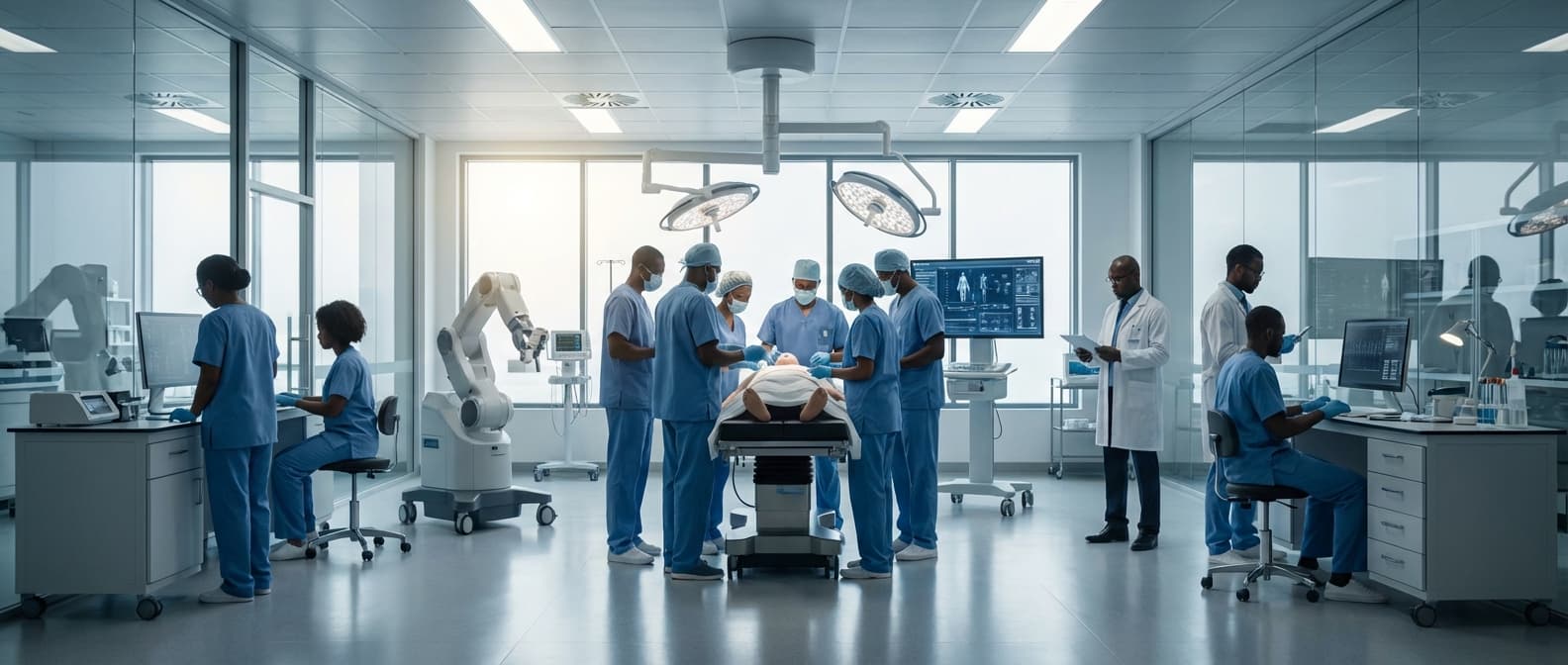
Managed Equipment Service (MES) in Eswatini
Engineering Excellence & Technical Support
Long‑term equipment provision with uptime SLAs and lifecycle management. High-standard technical execution following OEM protocols and local regulatory frameworks.
Optimized Asset Lifecycle Management
Leveraging advanced analytics and predictive maintenance strategies, MES in Eswatini ensures your critical medical equipment operates at peak performance throughout its lifecycle. This translates to reduced downtime, minimized repair costs, and extended equipment lifespan, maximizing your return on investment.
Ensured Regulatory Compliance & Patient Safety
Our MES framework in Eswatini guarantees adherence to all local and international medical device regulations. Through rigorous calibration, preventative maintenance, and comprehensive documentation, we proactively mitigate risks and uphold the highest standards of patient safety and care delivery.
Streamlined Operational Efficiency & Cost Control
By centralizing equipment management, our MES solution in Eswatini provides unparalleled visibility into asset utilization, maintenance schedules, and expenditure. This allows for optimized resource allocation, predictable budgeting, and significant cost savings compared to traditional, fragmented maintenance approaches.
What Is Managed Equipment Service (Mes) In Eswatini?
Managed Equipment Service (MES) in Eswatini refers to a comprehensive operational model wherein an external specialist provider assumes responsibility for the procurement, installation, maintenance, management, and eventual disposal of medical equipment on behalf of healthcare facilities. This service aims to optimize equipment utilization, reduce operational burdens on healthcare providers, and ensure the consistent availability and functionality of critical medical assets. MES typically operates under a service level agreement (SLA) that delineates performance metrics, response times, and cost structures. The overarching objective is to enable healthcare institutions to focus on their core mission of patient care by outsourcing the complexities associated with medical equipment lifecycle management.
| Who Needs MES? | Typical Use Cases | ||||
|---|---|---|---|---|---|
| Public Hospitals and Clinics: Particularly those with limited in-house technical expertise or budget constraints for capital equipment acquisition and maintenance. MES can provide access to advanced medical technology without significant upfront investment. | Private Hospitals and Specialist Centers: Facilities seeking to streamline operations, reduce overhead, and ensure the highest levels of equipment availability for specialized procedures. This allows them to focus on patient throughput and service quality. | District and Regional Health Networks: Organizations managing multiple healthcare facilities can benefit from centralized MES to standardize equipment, optimize resource allocation, and ensure consistent service delivery across their network. | Government Health Initiatives: Projects focused on expanding healthcare access or upgrading medical infrastructure can leverage MES to efficiently deploy and manage a large volume of equipment. | Tertiary and Referral Hospitals: These institutions often have a high volume and diversity of complex medical equipment, making MES a valuable solution for ensuring operational continuity and managing specialized technical needs. | |
| Diagnostic Imaging Departments: MRI scanners, CT scanners, X-ray machines, and ultrasound devices require regular calibration, specialized maintenance, and prompt repair to ensure diagnostic accuracy and patient throughput. | Surgical Suites: Anesthesia machines, ventilators, surgical lights, electro-surgical units, and patient monitors are critical for operative procedures. MES ensures their readiness and reliability. | Intensive Care Units (ICUs): A high concentration of life-support equipment such as ventilators, infusion pumps, and cardiac monitors necessitates continuous uptime and rapid maintenance response. | Laboratory Services: Sophisticated laboratory analyzers, microscopes, and diagnostic equipment require precise calibration and regular servicing for accurate test results. | Rehabilitation and Physiotherapy Centers: Specialized equipment like treadmills, exercise bikes, and electrotherapy devices benefit from scheduled maintenance to ensure patient safety and therapeutic efficacy. | Sterilization and CSSD (Central Sterile Supply Department) Equipment: Autoclaves and other sterilization equipment are vital for infection control and require strict maintenance protocols. |
Key Components of Managed Equipment Service (MES) in Eswatini
- Equipment Sourcing and Procurement: Identifying, selecting, and acquiring appropriate medical equipment based on the facility's needs and budget, often leveraging the provider's market expertise and purchasing power.
- Installation and Commissioning: Overseeing the professional installation, calibration, and testing of new equipment to ensure it meets manufacturer specifications and regulatory requirements.
- Preventive Maintenance: Implementing scheduled maintenance programs to proactively identify and address potential issues, minimizing downtime and extending equipment lifespan.
- Corrective Maintenance and Repair: Providing timely and efficient repair services for equipment malfunctions, often with guaranteed response times and access to qualified technicians and spare parts.
- Technical Support and Training: Offering ongoing technical assistance and comprehensive training programs for healthcare staff on the proper operation, maintenance, and troubleshooting of equipment.
- Asset Management and Tracking: Maintaining a detailed inventory of all managed equipment, including its location, service history, and depreciation status, to facilitate efficient resource allocation and financial planning.
- Decommissioning and Disposal: Managing the safe and environmentally compliant removal and disposal of obsolete or end-of-life equipment.
- Performance Monitoring and Reporting: Continuously tracking equipment performance against agreed-upon SLAs and providing regular reports to the healthcare facility on utilization, costs, and service effectiveness.
Who Needs Managed Equipment Service (Mes) In Eswatini?
Managed Equipment Service (MES) offers a comprehensive solution for organizations in Eswatini grappling with the complexities of acquiring, maintaining, and upgrading medical equipment. By outsourcing these functions, healthcare providers can benefit from cost efficiencies, improved equipment uptime, and access to the latest technology, ultimately leading to enhanced patient care. The service model typically involves a third-party provider taking responsibility for the entire lifecycle of medical equipment, from procurement and installation to maintenance, repair, and eventual replacement.
| Target Customer Type | Relevant Departments/Functions | Key Benefits of MES |
|---|---|---|
| Public Hospitals (e.g., Mbabane Government Hospital, Raleigh Fitkin Memorial Hospital) | Procurement Department, Biomedical Engineering Department, Clinical Departments (Radiology, Surgery, ICU, etc.), Finance Department | Reduced capital outlay, predictable operational costs, improved equipment availability, access to advanced technology, enhanced patient safety and outcomes. |
| Private Hospitals and Clinics (e.g., The Radiology Centre, Private Clinics in major towns) | Hospital Administration, Department Heads, IT Department, Finance & Accounts | Streamlined operations, focus on patient care, competitive advantage through modern equipment, efficient resource allocation, reduced downtime. |
| Government Health Ministry/Regional Health Management Teams | Planning & Policy Department, Procurement Unit, Infrastructure and Logistics, Public Health Programs | National equipment standardization, equitable access to healthcare technology, better resource planning and budgeting, improved public health service delivery, data-driven decision making. |
| Non-Governmental Organizations (NGOs) and Faith-Based Organizations (FBOs) providing healthcare services | Program Management, Procurement & Logistics, Finance and Administration, Medical Teams | Cost-effective access to essential medical equipment, operational efficiency, improved service delivery in underserved areas, sustainability of healthcare programs. |
| Tertiary Healthcare and Specialist Centers | Clinical Service Directors, Biomedical Engineering, Research & Development, IT and Data Management | Access to highly specialized and advanced equipment, expert maintenance and calibration, support for cutting-edge medical procedures, integration with digital health systems. |
Who Needs Managed Equipment Service (MES) in Eswatini?
- Organizations in Eswatini that face challenges in procuring and maintaining expensive medical equipment.
- Healthcare facilities with limited in-house technical expertise for equipment servicing and repair.
- Hospitals and clinics looking to optimize their operational costs and capital expenditure on medical technology.
- Government health ministries and agencies aiming to standardize and upgrade their medical equipment infrastructure across the nation.
- Private healthcare providers seeking to offer cutting-edge medical services without the burden of equipment management.
- Research institutions and universities that require specialized and reliable medical equipment for their studies and training.
Managed Equipment Service (Mes) Process In Eswatini
The Managed Equipment Service (MES) process in Eswatini is a comprehensive system designed to ensure the availability and effective utilization of medical equipment within public healthcare facilities. It involves a partnership between the Ministry of Health (MoH) and a private service provider who takes responsibility for the procurement, installation, maintenance, and eventual replacement of specified medical equipment. The workflow is structured to be transparent, efficient, and ultimately beneficial to patient care.
| Phase | Description | Key Activities | Responsible Party |
|---|---|---|---|
| Inquiry/Needs Identification | Identifying the requirement for specific medical equipment or services at a health facility. | Hospital staff identifying deficiencies or needs; MoH identifying strategic equipment priorities. | Health Facility Staff, Ministry of Health (MoH) |
| Needs Assessment & Planning | Evaluating the specific requirements, including type, quantity, technical specifications, and site readiness for the equipment. | Site surveys, technical consultations, developing equipment lists and justifications. | MES Provider, MoH Technical Team |
| Procurement | The acquisition of the specified medical equipment by the MES provider according to the agreed contract and technical specifications. | Tendering, supplier selection, order placement, quality assurance of procured items. | MES Provider |
| Installation & Commissioning | Physically installing the equipment at the health facility and ensuring it is fully operational and calibrated. | Site preparation, equipment setup, testing, calibration, user training on basic operation. | MES Provider |
| Service & Maintenance | Ongoing proactive and reactive maintenance to ensure the equipment's functionality and longevity. | Preventive maintenance schedules, corrective maintenance (repairs), spare parts management, troubleshooting. | MES Provider |
| Performance Monitoring & Reporting | Tracking equipment uptime, service response times, and overall performance against contractual obligations. | Data collection on equipment usage and downtime, regular performance reports to MoH, adherence to Service Level Agreements (SLAs). | MES Provider, MoH |
| Equipment Replacement/End-of-Life Management | Planning for and executing the replacement of equipment that has reached the end of its operational or contractual lifespan. | Life cycle planning, budget allocation for replacements, procurement of new equipment, decommissioning of old equipment. | MES Provider, MoH |
| Payment & Financial Management | The financial mechanism through which the MES provider is remunerated for their services. | Invoice processing, payment to the MES provider based on agreed terms and performance metrics. | Ministry of Health (MoH) |
Managed Equipment Service (MES) Workflow in Eswatini
- The MES workflow begins with an 'Inquiry' or identification of a need for specific medical equipment or services.
- A 'Needs Assessment' is conducted to determine the suitability and quantity of equipment required for a particular health facility.
- Following the assessment, a 'Procurement' process is initiated by the MES provider, adhering to agreed-upon specifications.
- Once procured, 'Installation and Commissioning' of the equipment take place at the designated health facility.
- The core of the MES is 'Service and Maintenance', encompassing routine checks, repairs, and spare parts management.
- Regular 'Performance Monitoring and Reporting' ensures the equipment is functioning optimally and that service level agreements (SLAs) are met.
- At the end of the equipment's lifecycle, 'Replacement' is managed by the MES provider as per the contract.
- The overarching goal is 'Improved Healthcare Delivery' through reliable access to functioning medical equipment.
Managed Equipment Service (Mes) Cost In Eswatini
Managed Equipment Service (MES) in Eswatini involves a comprehensive agreement where a third-party provider supplies, installs, maintains, and upgrades medical equipment for healthcare facilities. The cost of MES is influenced by a variety of factors, and while precise, publicly available pricing ranges in Eswatini's local currency (the Lilangeni, SZL) are scarce due to the bespoke nature of MES contracts, we can outline the key drivers of cost and provide estimated ranges based on industry benchmarks and local economic conditions.
Pricing Factors for MES in Eswatini:
Several elements contribute to the overall cost of an MES agreement in Eswatini. These include:
- Type and Number of Equipment: The most significant factor is the nature and quantity of medical devices included in the service. High-value, complex diagnostic imaging equipment (like MRI or CT scanners) will naturally incur higher costs than basic patient monitoring systems or sterilization units.
- Service Level Agreement (SLA) Scope: The depth and breadth of services included in the MES contract significantly impact pricing. This can range from basic maintenance and repairs to proactive servicing, calibration, training for clinical staff, software updates, and even replacement of obsolete equipment.
- Technology and Innovation: The inclusion of the latest technological advancements and cutting-edge equipment will increase the MES cost. Providers often factor in the amortization of new technologies and the continuous investment in innovation.
- Contract Duration: Longer-term MES contracts can sometimes offer economies of scale, potentially leading to lower annual costs compared to shorter agreements, as it allows providers to amortize their investment over a longer period.
- Facility Size and Usage Volume: Larger hospitals with higher patient throughput and greater equipment utilization will typically have higher MES costs due to increased wear and tear and demand for services.
- Provider's Overhead and Profit Margin: Like any business, MES providers have operational costs, including staff salaries, administrative expenses, insurance, and a required profit margin, which are factored into the pricing.
- Geographic Location within Eswatini: While Eswatini is a relatively small country, accessibility to remote facilities might incur additional logistical costs for service technicians, spare parts delivery, and potential travel allowances, which could subtly influence pricing.
- Spare Parts and Consumables: The cost and availability of specific spare parts and essential consumables (if included in the MES) can affect the overall price. Sourcing specialized parts in Eswatini might have different cost implications than in larger markets.
- Training and Skill Development: The provision of comprehensive training for healthcare professionals on the use and basic maintenance of equipment is a valuable service that adds to the MES cost.
- Risk Transfer: A significant aspect of MES is the transfer of risk associated with equipment failure, obsolescence, and maintenance costs from the healthcare facility to the provider. This risk premium is embedded in the pricing.
Estimated Pricing Ranges in Eswatini (Lilangeni - SZL):
Due to the absence of standardized, public pricing in Eswatini for MES, the following ranges are estimations based on typical MES cost structures and the local economic context. These are not definitive quotes but illustrative figures to provide a general understanding.
- Small to Medium-Sized Clinics/Hospitals (Basic Equipment Package): For facilities with a moderate number of essential medical devices (e.g., basic diagnostic tools, patient monitors, sterilization units), the annual MES cost could range from SZL 150,000 to SZL 500,000. This would typically cover standard maintenance, repairs, and a defined service level for a limited scope of equipment.
- Medium to Large Hospitals (Intermediate Equipment Package): For larger facilities requiring a broader range of equipment, including some specialized diagnostic tools (e.g., X-ray machines, ultrasound), the annual MES cost might fall between SZL 500,000 to SZL 2,000,000. This would likely include more comprehensive servicing, proactive maintenance, and potentially some software upgrades.
- Major Hospitals/Tertiary Care Centers (Comprehensive/High-End Equipment Package): For the largest institutions with advanced and high-volume diagnostic and therapeutic equipment (e.g., CT scanners, potentially MRI if available, advanced surgical equipment), the annual MES cost could be significantly higher, ranging from SZL 2,000,000 to SZL 10,000,000+. This level of service would encompass state-of-the-art equipment, extensive maintenance, rapid response times, staff training, and continuous technological refresh.
Important Considerations for Eswatini:
- Negotiation is Key: MES contracts are highly negotiable. Healthcare facilities in Eswatini should engage in detailed discussions with potential providers to tailor the service to their specific needs and budget.
- Local vs. International Providers: The presence of local distributors or service arms of international MES providers can influence pricing. Local operations might have lower overheads, while international firms may offer access to a wider range of technologies and expertise.
- Government Subsidies or Partnerships: Any potential government initiatives, grants, or public-private partnerships in Eswatini could impact the effective cost of MES for public healthcare facilities.
- Currency Exchange Rates: While the Lilangeni is pegged to the South African Rand (ZAR), fluctuations can indirectly affect the cost of imported equipment and spare parts, which MES providers must account for.
In conclusion, the cost of Managed Equipment Service in Eswatini is a complex equation with numerous variables. Facilities must carefully assess their equipment needs, desired service levels, and engage in thorough due diligence and negotiation with MES providers to secure an agreement that offers both value and long-term sustainability for their healthcare operations.
| Facility Size/Complexity | Equipment Scope | Estimated Annual MES Cost (SZL) |
|---|---|---|
| Small to Medium Clinics/Hospitals | Basic Equipment Package | SZL 150,000 - SZL 500,000 |
| Medium to Large Hospitals | Intermediate Equipment Package | SZL 500,000 - SZL 2,000,000 |
| Major Hospitals/Tertiary Care Centers | Comprehensive/High-End Equipment Package | SZL 2,000,000 - SZL 10,000,000+ |
Key Factors Influencing MES Costs in Eswatini
- Type and quantity of medical equipment
- Scope of the Service Level Agreement (SLA)
- Inclusion of advanced technology and innovation
- Duration of the MES contract
- Size and usage volume of the healthcare facility
- Provider's operational overheads and profit margin
- Geographic accessibility within Eswatini
- Cost and availability of spare parts and consumables
- Training and skill development services provided
- Risk transfer associated with equipment management
Affordable Managed Equipment Service (Mes) Options
Managed Equipment Service (MES) offers businesses a way to outsource the management and maintenance of their critical equipment, reducing operational burdens and ensuring optimal performance. Affordable MES options are crucial for companies of all sizes looking to control costs while maintaining efficiency. This involves understanding how value bundles and strategic cost-saving measures can significantly enhance the affordability of MES solutions.
| MES Strategy | Description | Cost-Saving Benefit | Value Addition |
|---|---|---|---|
| Value Bundling | Combining multiple MES services (e.g., maintenance, monitoring, parts) into a single package at a discounted rate. | Reduced overall service cost compared to purchasing individual services. | Streamlined vendor management, predictable budgeting, and comprehensive support. |
| Tiered Service Levels | Offering different service packages with varying levels of support and response times to match specific equipment criticality and budget. | Pay only for the level of service needed, avoiding overspending on non-critical assets. | Flexibility to scale services up or down as business needs change. |
| Long-Term Contracts | Committing to a longer MES contract duration, often in exchange for preferential pricing. | Lower per-unit service costs due to provider's guaranteed business. | Stability and predictability of service costs over an extended period. |
| Performance-Based Contracts | Linking a portion of the MES provider's compensation to achieving specific performance metrics (e.g., uptime, energy efficiency). | Incentivizes the provider to actively optimize equipment, leading to direct cost savings. | Shared risk and reward, ensuring provider alignment with business objectives. |
| Strategic Sourcing of Parts | MES providers leveraging their bulk purchasing power and established supplier relationships to acquire parts at lower costs. | Reduced cost of replacement parts, a significant component of equipment maintenance expenses. | Faster access to genuine and quality parts, minimizing downtime. |
| Predictive Maintenance Adoption | Implementing advanced analytics and IoT sensors to anticipate equipment failures. | Minimizes unexpected downtime and costly emergency repairs, allowing for planned and less expensive interventions. | Increased equipment lifespan and improved operational efficiency. |
| Consolidated Vendor Management | Using a single MES provider for a wide range of equipment, rather than multiple specialized vendors. | Reduced administrative overhead, simplified contract negotiation, and potential for volume discounts. | Single point of contact for all equipment-related issues, improving responsiveness. |
Key Components of Affordable MES
- Proactive Maintenance: Regular inspections and preventative repairs to avoid costly breakdowns.
- Remote Monitoring & Diagnostics: Utilizing technology to identify and resolve issues before they escalate.
- On-Demand Technical Support: Access to expert technicians for timely assistance.
- Parts Management & Inventory: Efficient sourcing and management of necessary spare parts.
- Performance Optimization: Strategies to ensure equipment operates at peak efficiency, reducing energy consumption and waste.
- Compliance & Safety: Ensuring equipment meets all regulatory standards and safety protocols.
Verified Providers In Eswatini
In Eswatini, ensuring access to high-quality healthcare is paramount. When seeking medical services, it's crucial to rely on verified providers who demonstrate a commitment to ethical practices, professional standards, and patient well-being. Franance Health stands out as a leading example of such a provider. Their rigorous credentialing process and dedication to excellence make them the optimal choice for your healthcare needs in Eswatini.
| Credentialing Aspect | Franance Health's Approach | Benefit to Patients |
|---|---|---|
| Licensing and Certification Verification | Thorough verification of all medical licenses and board certifications. | Ensures practitioners are legally qualified and recognized within their specialties. |
| Professional Background Checks | In-depth review of professional history, including past performance and disciplinary actions. | Guarantees experienced and reputable healthcare providers. |
| Continuing Medical Education (CME) Compliance | Mandatory adherence to CME requirements to stay updated with medical advancements. | Ensures patients receive care based on the latest knowledge and techniques. |
| Ethical Practice Review | Assessment of ethical conduct and commitment to patient confidentiality. | Promotes trust and confidence in the provider-patient relationship. |
| Peer Review and Performance Monitoring | Ongoing evaluation of clinical performance and patient feedback. | Upholds consistently high standards of care and service. |
Why Franance Health is the Best Choice for Verified Healthcare in Eswatini
- Rigorous Credentialing: Franance Health meticulously vets all its healthcare professionals, ensuring they possess the necessary qualifications, licenses, and certifications. This process goes beyond basic requirements, focusing on a proven track record of competence and ethical conduct.
- Commitment to Patient Safety: Patient safety is at the forefront of Franance Health's operations. They adhere to strict protocols and best practices to minimize risks and ensure positive health outcomes.
- Comprehensive Range of Services: Whether you require general medical care, specialized treatments, or preventative services, Franance Health offers a comprehensive suite of healthcare solutions to address diverse needs.
- Experienced and Compassionate Professionals: Their team comprises highly skilled and experienced medical practitioners who are also dedicated to providing compassionate and patient-centered care.
- Adherence to International Standards: Franance Health aligns its practices with recognized international healthcare standards, guaranteeing a level of quality and service that meets global benchmarks.
- Technological Integration: Embracing modern medical technology, Franance Health enhances diagnostic accuracy, treatment effectiveness, and overall patient experience.
Scope Of Work For Managed Equipment Service (Mes)
This document outlines the Scope of Work (SOW) for a Managed Equipment Service (MES) contract. It details the technical deliverables expected from the MES provider and the standard specifications that will govern the service. The MES aims to ensure the optimal performance, availability, and lifecycle management of critical medical equipment within the client's healthcare facilities.
| Technical Deliverable | Description | Standard Specification / Requirement | Key Performance Indicator (KPI) |
|---|---|---|---|
| Equipment Inventory & Asset Register | Comprehensive database of all managed equipment, including manufacturer, model, serial number, location, acquisition date, and service history. | Real-time, auditable database accessible by client and provider. Standardized data fields. Regular (e.g., quarterly) reconciliation. | Accuracy of Asset Register: >= 99.5%. |
| Preventive Maintenance (PM) Program | Scheduled maintenance activities to ensure equipment reliability, safety, and longevity. | Adherence to manufacturer recommendations, industry best practices (e.g., AAMI, IEC), and client-specific protocols. Defined PM schedules for each equipment type. | PM Completion Rate: >= 98% of scheduled PMs within the designated timeframe. |
| Corrective Maintenance (CM) & Repair Response | Timely and effective repair of equipment failures to minimize downtime. | Defined response times based on equipment criticality (e.g., Tier 1: 2 hours, Tier 2: 4 hours, Tier 3: 8 hours). Use of OEM or approved third-party parts. Qualified and certified technicians. | Mean Time to Repair (MTTR) for critical equipment: < X hours. Equipment Uptime: >= 95% for critical equipment. |
| Equipment Performance Monitoring | Continuous or periodic assessment of equipment performance against established benchmarks. | Utilization tracking, performance trending, and identification of potential issues before failure. Data collection via integrated systems or manual logs. | Number of proactive interventions to prevent failure: X per month/quarter. |
| Technical Training for Clinical Staff | Training on the safe and effective use of medical equipment. | Development and delivery of operator training, including new equipment introductions, refresher courses, and competency assessments. Documentation of training provided. | Training Completion Rate: >= 90% for targeted staff. User Satisfaction with Training: >= 85%. |
| Technology Refresh Planning | Proactive identification and planning for the replacement of aging or obsolete equipment. | Lifecycle analysis, cost-benefit analysis for replacement, and recommendations for new technology. Alignment with clinical needs and budget constraints. | Number of proactive technology refresh recommendations per year: X. |
| Regulatory Compliance & Safety Audits | Ensuring all managed equipment meets relevant safety regulations and standards. | Adherence to FDA, HIPAA, local regulatory body requirements. Participation in internal and external equipment safety audits. Documentation of compliance activities. | Number of non-compliance findings during audits: 0 for critical regulations. |
| Service Level Agreements (SLAs) Reporting | Regular reporting on the performance of the MES against agreed-upon KPIs. | Monthly or quarterly reports detailing equipment status, maintenance activities, repair times, uptime, costs, and compliance. Transparent and accessible reporting platform. | SLA Compliance Rate: >= 95% across all defined SLAs. |
| Parts & Consumables Management | Efficient management of spare parts and consumables for equipment maintenance and repair. | Inventory management systems, lead time tracking, cost optimization for parts. Ensuring availability of critical spare parts. | Stockout Rate for critical spare parts: < 5%. |
| Incident Management & Root Cause Analysis | Systematic approach to managing and investigating equipment-related incidents. | Defined incident reporting procedures, investigation process, and implementation of corrective/preventive actions (CAPAs) to prevent recurrence. | Timeliness of Incident Investigation: < X business days. Effectiveness of CAPAs: Measured by recurrence reduction. |
Key Components of the Managed Equipment Service (MES)
- Equipment Management Strategy & Planning
- Procurement & Installation Support
- Clinical Engineering & Risk Management
- Maintenance & Repair Services (Preventive & Corrective)
- Asset Management & Tracking
- Technology Refresh & End-of-Life Management
- Performance Monitoring & Reporting
- Staff Training & Competency Development
- Supply Chain Management for Parts & Consumables
- Regulatory Compliance & Accreditation Support
Service Level Agreement For Managed Equipment Service (Mes)
This Service Level Agreement (SLA) outlines the performance standards and guarantees for the Managed Equipment Service (MES) provided by [Your Company Name] to [Client Name]. It defines the response times for incidents and the uptime guarantees for the managed equipment.
| Equipment Category/Type | Severity Level | Response Time Target | Resolution Time Target | Uptime Guarantee |
|---|---|---|---|---|
| Critical Equipment (e.g., Production Line, Core Network Infrastructure) | Severity 1 (System Down, Major Impact) | 15 Minutes | 4 Hours | 99.9% |
| Critical Equipment (e.g., Production Line, Core Network Infrastructure) | Severity 2 (Degraded Performance, Significant Impact) | 30 Minutes | 8 Hours | 99.9% |
| High Availability Equipment (e.g., Servers, Key Workstations) | Severity 1 (System Down, Major Impact) | 30 Minutes | 6 Hours | 99.8% |
| High Availability Equipment (e.g., Servers, Key Workstations) | Severity 2 (Degraded Performance, Significant Impact) | 1 Hour | 12 Hours | 99.8% |
| Standard Equipment (e.g., User Workstations, Printers) | Severity 3 (Minor Impact, Workaround Available) | 2 Business Hours | 24 Hours | 99.5% |
Key Definitions
- Managed Equipment Service (MES): The comprehensive service provided by [Your Company Name] for the management, maintenance, and support of specified equipment at [Client Name]'s premises.
- Incident: Any event that causes or may cause an interruption to the normal operation of the managed equipment, or a degradation of its performance.
- Response Time: The maximum time allowed from the notification of an incident to the commencement of investigation and/or remediation efforts by [Your Company Name]'s support team.
- Resolution Time: The maximum time allowed from the notification of an incident to the restoration of the managed equipment to its normal operational state.
- Uptime: The percentage of time the managed equipment is fully operational and available for use, excluding scheduled maintenance periods.
- Scheduled Maintenance: Planned periods of downtime for routine maintenance, upgrades, or inspections, communicated in advance to [Client Name].
Frequently Asked Questions

Ready when you are
Let's scope your Managed Equipment Service (MES) in Eswatini project in Eswatini.

Scaling healthcare logistics and technical systems across the entire continent.