
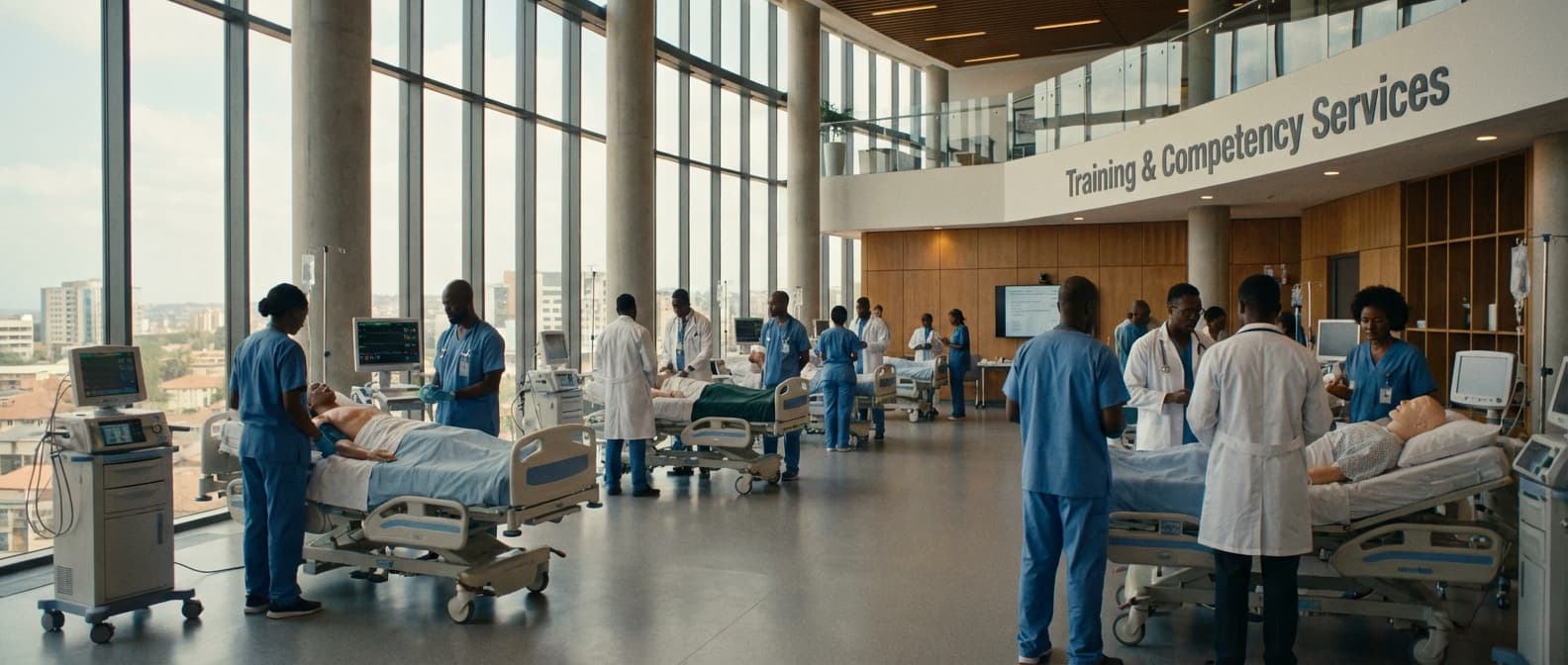
Ventilator User Training Service (Nurses) in Eritrea
Engineering Excellence & Technical Support
Ventilator User Training Service (Nurses) High-standard technical execution following OEM protocols and local regulatory frameworks.
Ventilator Mechanics & Settings Mastery
Understand the fundamental principles of mechanical ventilation, including key settings (tidal volume, respiratory rate, PEEP, FiO2) and their physiological impact. Learn how to select appropriate initial settings based on patient presentation and goals of care in the Eritrean context, considering available resources.
Patient Monitoring & Alarm Management
Develop expert skills in continuously monitoring ventilated patients for signs of distress or complications. Master the identification, interpretation, and appropriate response to various ventilator alarms, ensuring prompt and effective interventions to maintain patient safety and optimize outcomes.
Troubleshooting Common Ventilator Issues
Gain confidence in identifying and resolving common ventilator malfunctions and patient-ventilator dyssynchrony. Learn practical, step-by-step troubleshooting techniques for scenarios likely to be encountered in Eritrean healthcare facilities, emphasizing resourcefulness and adaptability.
What Is Ventilator User Training Service (Nurses) In Eritrea?
Ventilator User Training Service (Nurses) in Eritrea refers to a specialized educational program designed to equip registered nurses and other relevant healthcare professionals within the Eritrean healthcare system with the knowledge and practical skills required to safely and effectively operate, monitor, and manage mechanical ventilators. This service is crucial for enhancing patient care outcomes, particularly for individuals experiencing respiratory failure or requiring ventilatory support.
| Who Needs This Service? | Typical Use Cases | |||||
|---|---|---|---|---|---|---|
| Registered Nurses (RNs) working in critical care units (ICUs), emergency departments, operating rooms, and general wards where mechanical ventilation is employed. | Post-operative patients requiring respiratory support after major surgery. | Patients with acute respiratory distress syndrome (ARDS) due to pneumonia, sepsis, or trauma. | Patients experiencing severe exacerbations of chronic obstructive pulmonary disease (COPD) or asthma. | Patients with neurological conditions affecting respiratory drive (e.g., spinal cord injury, Guillain-Barré syndrome). | Pediatric and neonatal patients requiring ventilatory assistance due to prematurity or respiratory complications. | Healthcare professionals in remote or resource-limited areas where access to specialized respiratory therapists may be constrained. |
Key Components of Ventilator User Training Service (Nurses) in Eritrea
- Theoretical Foundations: Understanding the principles of mechanical ventilation, including respiratory physiology, modes of ventilation (e.g., volume-controlled, pressure-controlled, SIMV, PSV), ventilator settings, and their impact on gas exchange and hemodynamics.
- Equipment Familiarization: Hands-on training with specific ventilator models commonly utilized in Eritrean healthcare facilities, covering setup, calibration, alarm management, and routine maintenance procedures.
- Patient Assessment and Monitoring: Developing skills in assessing patients requiring ventilation, interpreting arterial blood gases (ABGs), waveform analysis (pressure, flow, volume), and recognizing signs of inadequate ventilation or complications.
- Ventilator Management Strategies: Learning to initiate and adjust ventilator settings based on patient condition, weaning protocols, and management of specific respiratory conditions (e.g., ARDS, COPD exacerbation, pneumonia).
- Troubleshooting and Emergency Procedures: Training in identifying and responding to common ventilator malfunctions, circuit disconnections, patient-ventilator asynchrony, and emergency scenarios requiring immediate intervention.
- Infection Control and Safety: Emphasis on aseptic techniques during ventilator setup and maintenance, as well as strategies to prevent ventilator-associated pneumonia (VAP) and other healthcare-associated infections.
- Ethical and Legal Considerations: Understanding ethical principles related to life support, informed consent, and documentation requirements for ventilator management.
Who Needs Ventilator User Training Service (Nurses) In Eritrea?
This service is designed to equip nurses in Eritrea with the essential skills and knowledge to safely and effectively operate mechanical ventilators. Proper training is crucial for improving patient outcomes, reducing complications, and ensuring the efficient use of these life-saving medical devices, especially in critical care settings. The training will cover ventilator principles, patient assessment, mode selection, troubleshooting, and maintenance.
| Department | Specific Role/Focus | Reason for Training |
|---|---|---|
| Intensive Care Unit (ICU) | ICU Nurses | Direct management of critically ill patients requiring mechanical ventilation. |
| Emergency Department (ED) | ED Nurses | Initial stabilization and management of patients presenting with respiratory failure requiring urgent ventilation. |
| Post-Anesthesia Care Unit (PACU) | PACU Nurses | Monitoring and weaning of patients recovering from anesthesia who may require temporary mechanical ventilation. |
| Neonatal Intensive Care Unit (NICU) | NICU Nurses | Ventilator management for premature infants and newborns with respiratory distress syndrome. |
| Respiratory Care Department | Respiratory Nurses/Therapists | Specialized care and management of patients with complex respiratory conditions, often involving ventilator support. |
| General Wards (with critical care capacity) | Nurses assigned to step-down or high-dependency units | Managing patients who have been recently weaned from ventilators or require closer respiratory monitoring. |
| Operating Room (OR) | Perioperative Nurses | Assisting with ventilator setup and initial management during surgical procedures requiring general anesthesia. |
Target Customers and Departments
- Nurses in critical care units
- Nurses in intensive care units (ICUs)
- Nurses in emergency departments
- Nurses in post-anesthesia care units (PACUs)
- Nurses in neonatal intensive care units (NICUs)
- Nurses working in respiratory care departments
- Nurses involved in patient transport with ventilators
Ventilator User Training Service (Nurses) Process In Eritrea
This document outlines the workflow for the Ventilator User Training Service for nurses in Eritrea, from the initial inquiry to the successful execution of the training program. The process is designed to be clear, efficient, and ensure that all necessary steps are taken to provide high-quality training.
| Phase | Key Activities | Responsible Parties |
|---|---|---|
| Inquiry & Planning | Initial contact, needs assessment, proposal development, quotation | Requesting Entity, Training Provider |
| Agreement & Preparation | Proposal/quotation approval, contract/MOU signing, participant nomination, material preparation, logistics | Requesting Entity, Training Provider |
| Execution & Assessment | Training delivery, practical sessions, participant assessment, feedback collection | Training Provider, Participants |
| Completion & Post-Training | Certification, data updating, follow-up support, program evaluation | Training Provider, Requesting Entity |
Ventilator User Training Service (Nurses) Process in Eritrea: Workflow
- {"step":1,"title":"Inquiry and Needs Assessment","description":"Training institutions, hospitals, or individual nurses express interest in ventilator user training. This initial inquiry triggers a needs assessment phase. Information gathered includes the number of nurses requiring training, their current skill level, specific ventilator models to be covered, and preferred training timelines and locations. This phase may involve direct communication, submission of a formal request form, or a designated online portal."}
- {"step":2,"title":"Proposal and Quotation Development","description":"Based on the needs assessment, the training provider (e.g., Ministry of Health, designated training center, or external provider) develops a comprehensive training proposal. This proposal details the curriculum, learning objectives, duration, training methodology (e.g., theoretical lectures, practical simulations, hands-on sessions), trainer qualifications, required equipment, and logistical arrangements. A detailed quotation outlining all associated costs is also provided."}
- {"step":3,"title":"Approval and Agreement","description":"The requesting entity (e.g., hospital administration, Ministry of Health department) reviews the proposal and quotation. Upon satisfaction with the terms, budget, and content, formal approval is granted. This may involve signing a contract or a Memorandum of Understanding (MOU) outlining the responsibilities of both parties, payment schedules, and service level agreements."}
- {"step":4,"title":"Participant Nomination and Pre-assessment","description":"The approved training program is communicated to the relevant departments or facilities. Nominated nurses are identified and provided with details about the training. Depending on the program's structure, a pre-assessment may be conducted to gauge existing knowledge and tailor the training content further. Registration forms are collected."}
- {"step":5,"title":"Training Material Preparation and Logistics","description":"The training provider prepares all necessary materials, including presentations, handouts, case studies, and practical simulation scenarios. Logistical arrangements are finalized, including booking training venues, ensuring availability of functional ventilators (actual or simulation models), audiovisual equipment, and any other required resources. Transportation and accommodation arrangements for trainers and participants (if applicable) are confirmed."}
- {"step":6,"title":"Training Execution","description":"The training program commences as per the agreed schedule. The curriculum is delivered through a blend of theoretical sessions (lectures, discussions) and practical hands-on sessions. Trainers provide demonstrations, guide participants through ventilator settings, troubleshoot common issues, and facilitate case study analysis. Emphasis is placed on safe and effective ventilator management principles."}
- {"step":7,"title":"Assessment and Evaluation","description":"Throughout and at the end of the training, participants are assessed to gauge their understanding and practical skills. This may involve written tests, practical skill demonstrations, and scenario-based evaluations. Participant feedback is also collected through evaluation forms to assess the effectiveness of the training, trainers, and materials."}
- {"step":8,"title":"Certification and Follow-up","description":"Upon successful completion of the training and passing the assessments, participants receive a certificate of completion. The training provider may also offer post-training support, such as follow-up consultations or refresher courses. Data on trained personnel is updated in relevant databases. The training provider may also conduct a post-training review to identify areas for improvement in future training programs."}
Ventilator User Training Service (Nurses) Cost In Eritrea
Determining the precise cost of ventilator user training for nurses in Eritrea is challenging due to limited publicly available data and the highly variable nature of such services. However, we can discuss the key pricing factors that would influence the cost and provide estimated ranges based on general industry practices and regional economic considerations. It's crucial to understand that these are estimations, and actual quotes would require direct engagement with training providers.
| Training Type | Estimated Cost Range (Nfk/Participant) | Notes |
|---|---|---|
| Basic Ventilator Operation (1-2 Days) | 1,500 - 4,000 | Covers fundamental principles, machine setup, and basic modes. Assumes local trainers and on-site facility. |
| Intermediate Ventilator Management (3-5 Days) | 4,000 - 10,000 | Includes more advanced modes, weaning strategies, troubleshooting, and patient monitoring. May involve simulation. |
| Advanced Critical Care Ventilation (5+ Days) | 8,000 - 20,000+ | Focuses on complex patient scenarios, specific disease pathologies, and advanced ventilator graphics. Often requires specialist trainers. |
| On-site Training (Full Course) | Negotiable (package based) | Costs will depend on the number of participants, duration, and specific requirements. This would be quoted as a total package. |
| International Trainer (Additional Cost) | Add 5,000 - 15,000+ (per trainer, per trip) | This is a significant additional cost covering flights, accommodation, visa, and daily expenses. |
Factors Influencing Ventilator User Training Costs in Eritrea
- {"title":"Type and Duration of Training","description":"Basic introductory courses will be less expensive than advanced, specialized training covering complex ventilation modes, troubleshooting, and critical care scenarios. The number of days or hours dedicated to training directly impacts the overall cost."}
- {"title":"Trainer Expertise and Qualifications","description":"Highly experienced and certified respiratory therapists or critical care nurses as trainers will command higher fees. Their specialized knowledge and ability to deliver effective, practical training are valuable assets."}
- {"title":"Training Venue and Resources","description":"Whether the training is conducted on-site at a healthcare facility, a dedicated training center, or virtually will affect costs. On-site training might include facility rental, equipment usage fees, and catering. Virtual training may incur platform subscription costs."}
- {"title":"Equipment and Simulation Materials","description":"Access to functional ventilators for hands-on practice is essential. The cost of using or renting these machines, along with any simulation manikins or other training aids, will be factored in."}
- {"title":"Curriculum Development and Customization","description":"Off-the-shelf training programs are generally cheaper than those that need to be customized to a specific hospital's protocols, the types of ventilators in use, or the specific patient population they serve."}
- {"title":"Number of Participants","description":"While larger groups might receive a per-person discount, the overall cost of the training event will increase with more attendees due to the need for more instructors, materials, and potentially larger venues."}
- {"title":"Logistics and Travel for Trainers","description":"If trainers need to travel to Eritrea from another country, their travel expenses, accommodation, and per diem will significantly add to the overall cost."}
- {"title":"Certification and Assessment","description":"The inclusion of formal assessments, examinations, and the issuance of certificates will likely incur additional fees for administration and evaluation."}
- {"title":"Provider Reputation and Market Demand","description":"Established training providers with a strong reputation or in high demand may charge a premium for their services."}
Affordable Ventilator User Training Service (Nurses) Options
This document outlines affordable ventilator user training service options specifically designed for nurses, focusing on value bundles and cost-saving strategies. Effective ventilator management is crucial for patient outcomes, and providing nurses with comprehensive, accessible training is paramount. We aim to deliver high-quality education that maximizes value without imposing an undue financial burden on healthcare institutions.
| Value Bundle Option | Key Features Included | Target Audience | Estimated Price Range (USD) | Cost-Saving Strategy Highlight |
|---|---|---|---|---|
| Basic Foundational Package | Core ventilator principles, modes of ventilation (basic), patient assessment, troubleshooting common alarms. Primarily online modules with recorded Q&A sessions. | New graduate nurses, nurses transitioning to critical care, refresher training. | $150 - $300 per nurse | Leverages scalable online content delivery to reduce instructor-to-student ratios and travel costs. |
| Intermediate Skills Bundle | Includes Basic Package plus advanced modes, weaning parameters, specific patient populations (e.g., pediatrics, neonates), and advanced troubleshooting. Combines online modules with live virtual simulation sessions. | Experienced critical care nurses, nurses seeking advanced ventilator competencies. | $300 - $550 per nurse | Virtual simulations reduce the need for expensive physical simulation equipment and dedicated lab time. |
| Comprehensive Mastery Program | Includes Intermediate Bundle plus hands-on ventilator management workshops (in-person or via live remote instruction with dedicated equipment), case studies, and advanced physiological concepts. On-site training options available for larger groups. | Advanced practice nurses, educators, nurses in specialized critical care units. | $500 - $1000+ per nurse (on-site group rates available) | Group discounts for on-site training and tailored curricula minimize per-person cost for larger teams. |
| Customizable Training Solutions | Tailored modules and delivery methods based on specific organizational needs, existing skill sets, and available equipment. Can include train-the-trainer components. | Any healthcare institution requiring specialized or highly customized training. | Priced per project, with potential for significant savings through optimized content and delivery. | Focuses on delivering precisely what is needed, avoiding unnecessary modules and associated costs. Train-the-trainer models empower institutions for long-term cost-effectiveness. |
Key Features of Affordable Ventilator Training Services
- Modular Curriculum: Training is broken down into digestible modules covering essential topics, allowing for flexible learning and targeted skill development.
- Blended Learning Approach: Combines online theoretical components with hands-on simulation or in-person practical sessions.
- On-Demand Access: Provides flexibility for nurses to access training materials at their convenience, fitting around busy clinical schedules.
- Certified Instructors: Ensures training is delivered by experienced and qualified professionals with extensive clinical and teaching backgrounds.
- Regular Updates: Content is consistently reviewed and updated to reflect current best practices, technological advancements, and regulatory changes.
- Competency Assessment: Includes robust evaluation methods to confirm understanding and practical skill proficiency.
- Scalable Solutions: Designed to accommodate varying team sizes and organizational needs, from individual nurse training to large-scale institutional programs.
Verified Providers In Eritrea
In Eritrea, ensuring access to reliable and qualified healthcare providers is paramount for individual and community well-being. "Verified Providers in Eritrea" highlights the importance of choosing healthcare professionals who meet stringent standards of competence, ethics, and professionalism. Among these, Franance Health stands out as a premier organization, offering a robust credentialing process that significantly benefits patients seeking quality care.
| Credentialing Aspect | Franance Health's Approach | Benefit to Patients |
|---|---|---|
| Education & Training | Verifies academic records, degrees, and specialized training. | Ensures providers have the foundational knowledge and skills. |
| Clinical Experience | Confirms duration and scope of practical experience. | Guarantees providers have hands-on expertise. |
| Licensure & Certifications | Validates current and valid professional licenses and certifications. | Confirms legal and professional authorization to practice. |
| Professional References | Seeks feedback from supervisors and colleagues. | Offers insights into work ethic and patient interaction. |
| Criminal Background Checks | Screens for any relevant legal issues. | Promotes a safe and secure patient environment. |
| Adherence to Standards | Assesses compliance with medical board regulations and ethical codes. | Ensures providers practice responsibly and with integrity. |
Why Franance Health Credentials Represent the Best Choice:
- Rigorous Verification Process: Franance Health employs a comprehensive vetting system that goes beyond basic licensing. This includes thorough background checks, verification of educational qualifications, validation of clinical experience, and assessment of adherence to ethical guidelines.
- Commitment to Competence: Their credentialing ensures that healthcare professionals possess the necessary knowledge, skills, and experience to provide safe and effective care. This reduces the risk of medical errors and improves patient outcomes.
- Enhanced Patient Trust and Safety: By choosing a Franance Health-credentialed provider, patients can have greater confidence in the quality of care they receive. This transparency builds trust and fosters a safer healthcare environment.
- Adherence to International Standards: Franance Health aligns its credentialing criteria with internationally recognized best practices in healthcare, ensuring that Eritrean providers are operating at a high global standard.
- Continuous Professional Development: The credentialing process often includes requirements for ongoing education and professional development, ensuring that Franance Health providers remain up-to-date with the latest medical advancements and techniques.
- Ethical Practice Assurance: Franance Health places a strong emphasis on ethical conduct, ensuring that their credentialed providers adhere to a strict code of ethics, promoting patient-centered care and respect.
Scope Of Work For Ventilator User Training Service (Nurses)
This Scope of Work (SOW) outlines the requirements for providing comprehensive ventilator user training services specifically tailored for registered nurses. The objective is to equip nurses with the necessary knowledge and practical skills to safely and effectively operate and manage mechanical ventilators in various clinical settings. The training will cover theoretical principles, device-specific operation, patient monitoring, troubleshooting, and emergency procedures. Technical deliverables will include training materials, competency assessments, and attendance records. Standard specifications for the training program will ensure consistency, quality, and adherence to best practices in respiratory care.
| Technical Deliverable | Description | Standard Specification |
|---|---|---|
| Training Curriculum Document | Detailed outline of all training modules, learning objectives, and duration. | Aligned with current evidence-based guidelines (e.g., AARC guidelines) and regulatory requirements. Version controlled and readily accessible. |
| Training Manuals/Handouts | Comprehensive written materials for each module, including key concepts, diagrams, and reference information. | Clear, concise language. Includes glossary of terms. Available in digital and/or printable format. |
| Presentation Slides | Visual aids for instructor-led sessions, summarizing key points and illustrating concepts. | High-resolution images and graphics. Consistent branding. Accessible for review post-training. |
| Case Studies and Scenarios | Realistic clinical scenarios to apply theoretical knowledge and decision-making skills. | Variety of patient conditions and complexities. Promotes critical thinking and problem-solving. |
| Skills Demonstration Checklist | Checklist for instructors to assess nurses' proficiency in practical ventilator management tasks. | Specific, observable actions. Performance-based evaluation. Aligned with learning objectives. |
| Competency Assessment Tool | Written examination or simulation-based assessment to evaluate overall knowledge and skill retention. | Objective scoring criteria. Validated assessment methods. Pass/fail threshold clearly defined. |
| Training Attendance Records | Documentation of nurses who attended the training and completed all required components. | Includes name, date, duration of training, and completion status. Securely stored and retrievable. |
| Post-Training Evaluation Form | Feedback mechanism for participants to evaluate the training program, instructors, and materials. | Anonymous feedback encouraged. Questions cover content relevance, instructor effectiveness, and overall satisfaction. Used for continuous improvement. |
| Ventilator Device Manuals/Guides | User manuals and quick reference guides for the specific ventilator models used in training. | Up-to-date versions provided. Accessible to participants during and after training. |
Key Training Modules
- Introduction to Mechanical Ventilation: Principles, indications, and contraindications.
- Ventilator Modes and Settings: Understanding different modes (e.g., Volume Control, Pressure Control, SIMV, CPAP), initial setup, and adjustments.
- Patient-Ventilator Interface: Endotracheal tube management, humidification, and leak assessment.
- Monitoring and Assessment: Interpreting ventilator graphics, physiological parameters, and patient response.
- Alarms and Troubleshooting: Identifying common alarms, their causes, and appropriate interventions.
- Ventilator Weaning and Discontinuation: Criteria for weaning, weaning protocols, and post-extubation care.
- Specialized Ventilation Strategies (Optional/Advanced): Non-invasive ventilation (NIV), high-frequency ventilation (HFV) - dependent on client needs.
- Infection Prevention and Control: Maintaining ventilator circuits and preventing ventilator-associated pneumonia (VAP).
- Emergency Procedures: Managing equipment failure and critical patient events.
- Ethical and Legal Considerations: Patient consent, documentation, and scope of practice.
Service Level Agreement For Ventilator User Training Service (Nurses)
This Service Level Agreement (SLA) outlines the guaranteed response times and uptime for the Ventilator User Training Service (Nurses). This service is crucial for ensuring the safe and effective operation of ventilators by trained nursing staff, directly impacting patient care.
| Service Component | Response Time Guarantee | Uptime Guarantee (Training Platform) |
|---|---|---|
| On-demand remote support (operational questions) | Within 15 minutes during business hours (8 AM - 6 PM, Monday-Friday) | N/A (not applicable to the support itself) |
| Scheduled training session availability | Within 48 business hours of request confirmation | N/A (not applicable to the scheduling) |
| Online training modules and resources | 24/7 access | 99.5% availability (excluding scheduled maintenance) |
| Technical assistance for training platform | Within 4 business hours for non-critical issues, within 1 business hour for critical issues | 99.5% availability (excluding scheduled maintenance) |
Key Service Components
- On-demand remote support for immediate operational questions.
- Scheduled training sessions for new equipment or refresher courses.
- Access to online training modules and resources.
- Technical assistance for training platform issues.
Frequently Asked Questions

Ready when you are
Let's scope your Ventilator User Training Service (Nurses) in Eritrea project in Eritrea.

Scaling healthcare logistics and technical systems across the entire continent.