
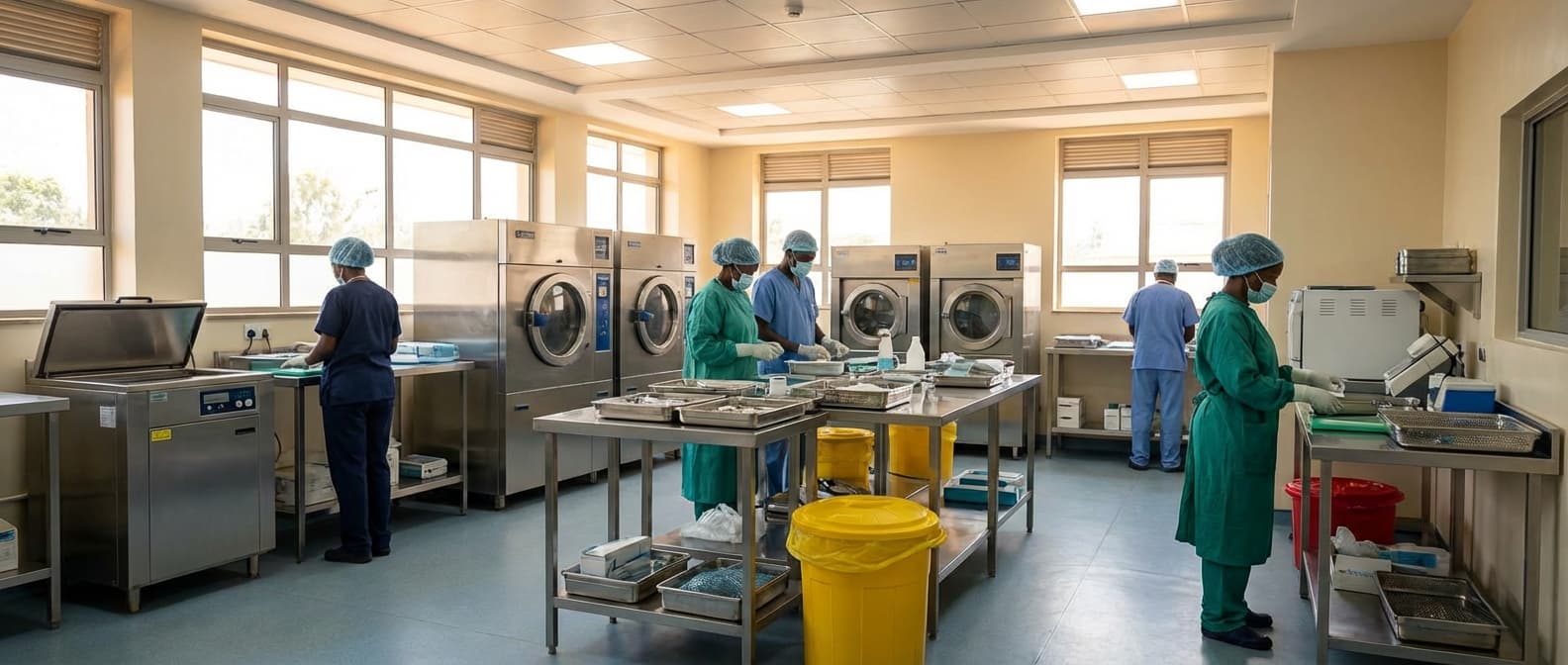
Infection-Control Readiness Support Service for Reusable Equipment in Eritrea
Engineering Excellence & Technical Support
Infection-Control Readiness Support Service for Reusable Equipment High-standard technical execution following OEM protocols and local regulatory frameworks.
Centralized Decontamination Hubs
Establish and equip dedicated, centrally managed decontamination hubs across Eritrea to ensure standardized, high-level disinfection and sterilization of reusable medical equipment, minimizing cross-contamination risks.
Traceability & Sterility Assurance
Implement robust tracking systems and biological/chemical indicator monitoring for all sterilized equipment, providing auditable proof of effective decontamination and safeguarding patient safety.
Skilled Workforce Development
Provide comprehensive, hands-on training programs for healthcare personnel on infection prevention protocols, proper equipment handling, and the operation of decontamination equipment, fostering a culture of safety and expertise.
What Is Infection-control Readiness Support Service For Reusable Equipment In Eritrea?
Infection-Control Readiness Support Service for Reusable Equipment in Eritrea refers to a specialized technical assistance program designed to ensure that healthcare facilities in Eritrea are adequately prepared and equipped to safely reprocess, sterilize, and store reusable medical devices. This service aims to mitigate the risk of healthcare-associated infections (HAIs) by establishing and maintaining robust infection prevention and control (IPC) protocols for all reusable equipment within the healthcare ecosystem.
| Who Needs the Service | Typical Use Cases |
|---|---|
| Hospitals and large healthcare facilities with multiple departments utilizing a wide range of reusable medical instruments (e.g., surgical theaters, dental clinics, laboratories, emergency rooms). | Ensuring the safe reprocessing of surgical instruments, endoscopes, dental instruments, anesthesia equipment, and laboratory glassware. |
| Primary healthcare centers and clinics that handle basic reusable medical supplies (e.g., syringes, needles, examination tools). | Standardizing the cleaning and sterilization of commonly used items to prevent transmission of blood-borne pathogens and other infectious agents. |
| Public health institutions involved in disease surveillance, diagnosis, and treatment programs. | Validating and enhancing reprocessing protocols for diagnostic equipment and sampling tools used in the field or laboratories. |
| Medical training and educational institutions responsible for training future healthcare professionals in IPC practices. | Integrating hands-on training and practical demonstration of effective reusable equipment reprocessing techniques within the curriculum. |
| Ministry of Health and national health authorities overseeing public health standards and IPC policies. | Developing and enforcing national guidelines for reusable equipment reprocessing, conducting facility audits, and identifying areas for national-level intervention and resource allocation. |
Key Components of the Service
- Assessment of current IPC practices and infrastructure related to reusable equipment.
- Development and implementation of Standard Operating Procedures (SOPs) for cleaning, disinfection, and sterilization.
- Provision of technical training and capacity building for healthcare personnel involved in reprocessing.
- Guidance on the selection, procurement, and maintenance of appropriate reprocessing equipment and consumables.
- Establishment of monitoring and evaluation mechanisms to ensure compliance with IPC standards.
- Support in developing and implementing waste management protocols for contaminated materials.
- Recommendations for facility design and workflow optimization to prevent cross-contamination.
- Dissemination of updated guidelines and best practices from national and international health organizations.
Who Needs Infection-control Readiness Support Service For Reusable Equipment In Eritrea?
In Eritrea, a dedicated Infection-Control Readiness Support Service for Reusable Equipment is crucial for ensuring patient safety and preventing the spread of healthcare-associated infections (HAIs). This service aims to bolster the capacity of healthcare facilities to properly clean, disinfect, sterilize, and store reusable medical devices, a cornerstone of effective infection prevention and control (IPC). The demand for such support stems from the need to standardize practices, address knowledge gaps, and improve the availability and maintenance of essential IPC equipment.
| Department/Unit | Specific Needs and Roles | Impact of Support |
|---|---|---|
| Central Sterile Services Department (CSSD) / Operating Theatre Sterilization Units | Advanced training on sterilization techniques (autoclaving, chemical sterilization), validation processes, equipment maintenance, and quality control. Ensuring adequate supply of consumables. | Reduced risk of surgical site infections, improved patient outcomes, efficient workflow, and compliance with international standards. |
| Infection Prevention and Control (IPC) Committees/Officers | Training on developing and implementing IPC policies, conducting risk assessments, monitoring compliance, outbreak investigation, and data management for reusable equipment. | Strengthened institutional capacity for IPC, proactive identification and mitigation of risks, and effective response to IPC challenges. |
| Surgical Departments (General Surgery, Obstetrics & Gynecology, Ophthalmology, etc.) | Ensuring appropriate handling, cleaning, and immediate pre-cleaning of instruments before they reach CSSD. Understanding specific instrument reprocessing requirements. | Reduced transmission of infections through surgical instruments, improved surgical safety, and preservation of instrument longevity. |
| Emergency Departments / Intensive Care Units (ICUs) | Rapid and effective reprocessing of critical and semi-critical reusable equipment (e.g., ventilators, endoscopes, respiratory therapy equipment). Training on high-level disinfection and sterilization for time-sensitive items. | Minimized risk of HAIs in vulnerable patient populations, availability of essential equipment for critical care, and improved patient safety. |
| Maternal and Child Health (MCH) Units / Maternity Wards | Safe reprocessing of reusable delivery kits, speculums, and other instruments used in childbirth and infant care. Emphasis on preventing vertical transmission of infections. | Improved maternal and neonatal safety, reduced incidence of postpartum infections, and protection against mother-to-child transmission of pathogens. |
| Outpatient Clinics / Primary Health Centers | Training on basic cleaning and disinfection of reusable diagnostic and treatment tools (e.g., thermometers, stethoscopes, syringes). Ensuring proper storage and disposal of contaminated items. | Enhanced safety in primary care settings, reduced risk of cross-contamination between patients, and improved basic IPC practices. |
| Laboratory Departments | Sterilization and disinfection of reusable laboratory equipment and glassware. Safe handling of infectious materials. | Accurate diagnostic results, prevention of laboratory-acquired infections, and safe specimen handling. |
| Maintenance and Biomedical Engineering Departments | Training on the preventive maintenance, calibration, and repair of sterilization and disinfection equipment (autoclaves, washer-disinfectors, etc.). Understanding technical specifications for optimal performance. | Ensured functionality and efficiency of IPC equipment, extended lifespan of valuable assets, and reliable sterilization/disinfection processes. |
| Procurement and Logistics Departments | Guidance on selecting appropriate, high-quality IPC equipment, consumables, and detergents. Understanding the lifecycle costs and maintenance requirements of procured items. | Cost-effective procurement of essential IPC resources, acquisition of durable and effective equipment, and adherence to quality standards. |
Target Customers and Departments Requiring Infection-Control Readiness Support Service for Reusable Equipment in Eritrea
- Healthcare Facilities: All types of healthcare facilities, from tertiary hospitals to remote health posts, are primary recipients of this service.
- Ministry of Health and Regional Health Bureaus: These governing bodies require support to establish and enforce national IPC standards, train personnel, and procure necessary resources.
- Non-Governmental Organizations (NGOs) and International Partners: Organizations involved in healthcare delivery or capacity building within Eritrea will benefit from integrated IPC support.
- Healthcare Training Institutions: Medical schools, nursing schools, and technical colleges need to ensure their curricula and practical training incorporate best practices in reusable equipment reprocessing.
Infection-control Readiness Support Service For Reusable Equipment Process In Eritrea
This document outlines the workflow for the 'Infection-Control Readiness Support Service for Reusable Equipment Process' in Eritrea, detailing the steps from initial inquiry to successful execution. The service aims to ensure that healthcare facilities in Eritrea are equipped and trained to safely reprocess reusable medical equipment, thereby preventing healthcare-associated infections.
| Stage | Key Activities | Responsible Parties | Deliverables | Timeline (Indicative) |
|---|---|---|---|---|
| Healthcare facility or Ministry of Health expresses interest. Initial discussions to understand specific needs, challenges, and existing infrastructure related to reusable equipment reprocessing. | Requesting Facility/MOH, Service Provider's Business Development Team | Confirmation of interest, preliminary understanding of scope. | 1-2 Weeks |
| Service provider develops a tailored proposal outlining scope of work, methodologies, timelines, resource requirements, and cost. Negotiation and signing of Service Level Agreement (SLA) or Memorandum of Understanding (MOU). | Service Provider, Requesting Facility/MOH | Detailed Service Proposal, Signed Agreement. | 2-4 Weeks |
| On-site visit to assess current reprocessing facilities, equipment, water supply, waste management, and staff knowledge. Identification of gaps in infrastructure, equipment, and human resources. | Service Provider's Technical Team, Facility Staff | Site Assessment Report, Baseline Readiness Evaluation Document. | 1-3 Weeks |
| Based on the assessment, recommendations for appropriate reprocessing equipment (e.g., washers, disinfectors, sterilizers). Assistance with procurement processes (e.g., tendering, supplier selection). Supervision or direct involvement in equipment installation and initial testing. | Service Provider's Procurement & Technical Teams, Facility Management, Suppliers | Procurement recommendations, Installed and tested equipment. | 4-12 Weeks (depending on procurement lead times) |
| Development of comprehensive training modules covering safe handling, cleaning, disinfection, sterilization, and record-keeping. Conducting hands-on training sessions for healthcare workers (nurses, technicians, biomedical engineers). | Service Provider's Training Specialists, Facility Staff | Training curriculum, Training materials, Trained personnel. | 2-4 Weeks (per training cohort) |
| Development or refinement of facility-specific SOPs for each type of reusable equipment reprocessing. Guidance on implementation and integration of SOPs into daily practice. | Service Provider's Infection Control Specialists, Facility Infection Control Committee, Department Heads | Approved SOPs, Implemented reprocessing workflows. | 2-4 Weeks |
| Establishment of monitoring systems for tracking process adherence, equipment performance, and infection rates. Regular quality checks, including process validation and staff competency assessments. | Service Provider's Quality Assurance Team, Facility Infection Control Committee, Designated Staff | Monitoring plan, Quality assessment reports, Performance metrics. | Ongoing (post-implementation) |
| Periodic follow-up visits to address challenges, provide ongoing support, and identify areas for improvement. Review of performance data and updating of SOPs and training as needed. | Service Provider's Project Manager & Technical Team, Facility Management | Follow-up reports, Recommendations for improvement, Updated protocols. | Quarterly/Bi-annually (as per agreement) |
Workflow: Infection-Control Readiness Support Service for Reusable Equipment Process in Eritrea
- Inquiry and Needs Assessment
- Service Proposal and Agreement
- Site Assessment and Baseline Evaluation
- Equipment Procurement and Installation Support
- Training Program Development and Delivery
- Standard Operating Procedure (SOP) Development and Implementation
- Quality Assurance and Monitoring
- Follow-up and Continuous Improvement
Infection-control Readiness Support Service For Reusable Equipment Cost In Eritrea
The cost of infection-control readiness support services for reusable medical equipment in Eritrea is influenced by several key pricing factors. These include the scope of services (e.g., initial assessment, training, equipment procurement, ongoing monitoring), the complexity and volume of reusable equipment requiring support, the specific types of equipment (e.g., surgical instruments, endoscopes, diagnostic tools), the location and accessibility of healthcare facilities within Eritrea, and the duration of the support contract. Furthermore, the availability of local expertise and the need for imported specialized cleaning agents or disinfection equipment can significantly impact overall costs. Given the current economic landscape and import considerations in Eritrea, precise pricing ranges are difficult to establish definitively and are subject to frequent fluctuation. However, a conceptual framework for pricing can be outlined.
| Service Component | Estimated Local Currency Range (Eritrean Nakfa - ERN) | Notes on Variability |
|---|---|---|
| Initial Infection Control Assessment & Gap Analysis | 2,000 - 8,000 ERN | Depends on facility size, number of departments, and existing documentation. May involve travel costs. |
| Staff Training (Basic Disinfection & Sterilization) | 3,000 - 15,000 ERN per training session/group | Based on the number of trainees, duration of training, and qualifications of trainers. Includes materials. |
| Staff Training (Advanced Techniques & Equipment Specific) | 5,000 - 25,000 ERN per training session/group | For specialized equipment or complex protocols. May require external expertise. |
| Procurement Support for Disinfection/Sterilization Equipment (e.g., Autoclaves, Disinfectors - small to medium scale) | Variable (significant capital investment) | Highly dependent on equipment type, capacity, and origin. Includes import duties, taxes, and installation. |
| Procurement Support for Infection Control Consumables (e.g., chemical disinfectants, sterilization pouches) | 1,000 - 10,000 ERN per month (estimated) | Based on equipment volume, usage patterns, and frequency of procurement. Import costs are a major factor. |
| Development of Standard Operating Procedures (SOPs) | 3,000 - 10,000 ERN per set of SOPs | Complexity of equipment and protocols will influence cost. Requires expert input. |
| Ongoing Monitoring & Quality Assurance Visits | 1,000 - 5,000 ERN per visit | Frequency of visits, travel distances, and scope of audit will determine cost. |
| Consultancy Fees (Ad-hoc / Project-based) | 200 - 1,000 ERN per hour (estimated) | Subject to the expertise of the consultant and the nature of the consultation. |
Key Pricing Factors for Infection-Control Readiness Support Services
- Scope of Services (Assessment, Training, Procurement, Monitoring)
- Volume and Complexity of Reusable Equipment
- Types of Reusable Equipment (Surgical, Diagnostic, etc.)
- Location and Accessibility of Healthcare Facilities
- Duration of Support Contract
- Availability of Local Expertise and Training Capacity
- Cost of Imported Consumables (Cleaning Agents, Disinfectants)
- Import Duties, Taxes, and Shipping Costs
- Logistical Challenges (Transportation, Infrastructure)
- Potential for Government Subsidies or Grants
Affordable Infection-control Readiness Support Service For Reusable Equipment Options
Our Affordable Infection-Control Readiness Support Service is designed to empower healthcare facilities with robust infection prevention strategies for their reusable medical equipment. We understand the critical need for maintaining high hygiene standards while managing operational costs. This service focuses on providing accessible, effective solutions for disinfection, sterilization, tracking, and staff training, ensuring compliance with regulatory requirements and minimizing the risk of healthcare-associated infections (HAIs).
We offer flexible value bundles tailored to different facility needs and sizes. These bundles combine essential services and resources at a more economical price point compared to purchasing them individually. Our cost-saving strategies are embedded within the service model, focusing on efficiency, preventive measures, and optimized resource utilization.
| Value Bundle Tier | Included Services | Target Facility Size | Estimated Annual Cost Savings | Key Cost-Saving Strategy |
|---|---|---|---|---|
| Essential Readiness | Basic protocol review, staff training modules, compliance checklist assistance. | Small clinics, private practices. | 10-15% reduction in supply waste and staff time. | Standardized protocols reduce errors and re-cleaning. |
| Comprehensive Care | Full protocol development, on-site training sessions, basic equipment tracking setup, risk assessment. | Medium-sized hospitals, specialized surgical centers. | 15-20% reduction in HAI-related costs and staff time. | Proactive risk management prevents costly outbreaks. |
| Integrated Excellence | Customized protocol integration, advanced training (e.g., specialized equipment), robust tracking system implementation, regular audits, supply chain consultation. | Large hospitals, multi-site healthcare systems. | 20-25% reduction in operational costs and potential litigation. | Optimized supply chain and efficient processes lead to significant savings. |
Key Components of Our Support Service
- Equipment Disinfection & Sterilization Protocols: Expert guidance and best practices for cleaning, disinfection, and sterilization of reusable medical devices.
- Compliance & Regulatory Support: Assistance in navigating and adhering to relevant infection control standards and guidelines (e.g., CDC, AAMI).
- Staff Training & Education: Comprehensive training modules for healthcare personnel on proper handling, cleaning, and storage of reusable equipment.
- Equipment Tracking & Inventory Management: Solutions to monitor the lifecycle of reusable equipment, ensuring timely maintenance and replacement.
- Risk Assessment & Auditing: Periodic assessments to identify potential infection control vulnerabilities and recommend corrective actions.
- Consumables & Supply Chain Optimization: Recommendations for cost-effective sourcing of disinfectants, sterilization wraps, and other necessary supplies.
Verified Providers In Eritrea
Navigating the healthcare landscape in Eritrea requires trust and certainty. When seeking medical services, identifying verified providers is paramount to ensure you receive safe, effective, and professional care. Franance Health stands out as a premier organization, offering a network of healthcare professionals and facilities that have undergone rigorous credentialing processes. This commitment to verification not only safeguards patient well-being but also elevates the standard of healthcare available. Understanding Franance Health's credentialing methodology highlights why they are the optimal choice for your health needs.
| Provider Type | Franance Health Verification Includes | Why This Matters to You |
|---|---|---|
| Doctors & Specialists | Medical Degree Verification, Specialty Board Certification, Licensure, Peer Reviews, Criminal Background Check | Ensures you are treated by a qualified and experienced professional, reducing the risk of misdiagnosis or improper treatment. |
| Nurses | Nursing Degree Verification, Licensure, Clinical Competency Assessments | Guarantees that nursing staff possess the necessary skills and knowledge for safe and effective patient care. |
| Clinics & Hospitals | Facility Licensing, Accreditation Status, Infection Control Protocols, Equipment Maintenance Records, Staff-to-Patient Ratios | Confirms that the facility is safe, clean, well-equipped, and adequately staffed to provide quality medical services. |
| Laboratories & Diagnostic Centers | Regulatory Compliance, Equipment Calibration Records, Quality Control Procedures, Personnel Qualifications | Assures that diagnostic tests are accurate and reliable, crucial for effective treatment planning. |
Franance Health Credentialing Process - What It Means for You:
- Rigorous Verification: Franance Health meticulously checks the qualifications, licenses, and certifications of all their affiliated healthcare providers. This ensures practitioners meet national and international standards.
- Experience & Expertise: Beyond basic credentials, Franance Health evaluates the practical experience and specialized expertise of their providers, matching patients with the most suitable medical professionals for their specific conditions.
- Professional Conduct: Background checks and a review of their professional history are conducted to ensure a commitment to ethical practices and patient-centered care.
- Facility Standards: For affiliated clinics and hospitals, Franance Health assesses infrastructure, equipment, hygiene protocols, and adherence to safety regulations, guaranteeing a secure and well-equipped environment.
- Continuous Monitoring: The credentialing process isn't a one-time event. Franance Health engages in ongoing monitoring to ensure providers and facilities consistently maintain their high standards.
- Patient Trust & Safety: By partnering exclusively with verified providers, Franance Health provides peace of mind, assuring patients that they are in capable and trustworthy hands.
Scope Of Work For Infection-control Readiness Support Service For Reusable Equipment
This Scope of Work (SOW) outlines the services to be provided for infection-control readiness support concerning reusable medical equipment. The objective is to ensure that healthcare facilities maintain optimal infection prevention and control practices for all reusable equipment throughout its lifecycle, from receipt to reprocessing and subsequent use. This SOW specifies the technical deliverables and standard specifications that will guide the service provider in achieving these objectives.
| Technical Deliverable | Description | Standard Specification/Reference | Format/Reporting |
|---|---|---|---|
| Current State Assessment Report | A comprehensive report detailing the existing infection control practices, infrastructure, staffing, and challenges related to reusable equipment reprocessing. | ISO 13485:2016 (Medical devices -- Quality management systems -- Requirements for regulatory purposes), CDC Guidelines for Disinfection and Sterilization in Healthcare Facilities. | Written report, presentation slides |
| Standard Operating Procedures (SOPs) for Reprocessing | Detailed, step-by-step SOPs for the cleaning, disinfection, and sterilization of various categories of reusable medical equipment. | AAMI ST79: Comprehensive Guide to Steam Sterilization and Sterility Assurance in Health Care Facilities, relevant manufacturer instructions for use (IFUs). | Documented procedures, flowcharts, checklists |
| Staff Training Program and Competency Assessment | Development and delivery of a training program for all personnel involved in reusable equipment handling, cleaning, disinfection, and sterilization, including initial training and ongoing competency validation. | Association for the Advancement of Medical Instrumentation (AAMI) standards, local regulatory requirements, industry best practices. | Training modules, competency assessment tools, training records |
| Reprocessing Equipment Validation Protocols | Protocols for the initial and periodic validation of all automated reprocessing equipment (e.g., washer-disinfectors, sterilizers) to ensure efficacy. | Manufacturer's Installation Qualification (IQ), Operational Qualification (OQ), Performance Qualification (PQ) protocols, relevant ISO standards (e.g., ISO 17665 for steam sterilization). | Validation protocols, validation reports |
| Process Monitoring and Auditing Plan | A plan outlining methods for regular monitoring of reprocessing processes (e.g., biological indicators, chemical indicators, process parameters) and scheduled audits of compliance with SOPs. | ISO 11135: Sterilization of health care products -- Ethylene oxide -- Requirements for the development, validation and routine control of a sterilization process for medical devices, relevant national guidelines. | Monitoring logs, audit checklists, audit reports |
| Root Cause Analysis (RCA) and Corrective Action Plan | Framework and tools for conducting RCA for any identified breaches in infection control related to reusable equipment and developing effective corrective and preventive actions (CAPA). | ISO 9001:2015 (Quality management systems -- Requirements), healthcare accreditation standards. | RCA reports, CAPA documentation |
| Equipment Inventory and Risk Assessment | A comprehensive inventory of all reusable medical equipment and a risk assessment to prioritize reprocessing efforts based on potential risk of infection transmission. | Healthcare risk management frameworks, medical device classification systems. | Equipment register, risk assessment matrix |
| Recommendations for Equipment and Consumables | Evidence-based recommendations for the selection and procurement of appropriate reprocessing equipment, detergents, disinfectants, and sterilization consumables. | Manufacturer's IFUs, efficacy data for cleaning agents and disinfectants, regulatory approvals. | Technical specifications, vendor comparison reports |
Key Areas of Focus for Infection-Control Readiness Support
- Assessment of current infection control protocols for reusable equipment.
- Development and implementation of standardized reprocessing workflows.
- Training and competency assessment of staff involved in reusable equipment handling and reprocessing.
- Validation and verification of reprocessing equipment and processes.
- Monitoring, auditing, and continuous improvement of infection control practices.
- Guidance on selection and procurement of appropriate reprocessing equipment and consumables.
- Development of policies and procedures aligned with national and international guidelines.
Service Level Agreement For Infection-control Readiness Support Service For Reusable Equipment
This Service Level Agreement (SLA) outlines the response times and uptime guarantees for the Infection-Control Readiness Support Service for Reusable Equipment. This service is designed to ensure that critical reusable equipment is maintained at optimal readiness levels for infection control, minimizing downtime and operational impact.
| Service Component | Response Time Target | Uptime Guarantee | Escalation Protocol |
|---|---|---|---|
| Critical Equipment Readiness Monitoring | Within 2 business hours for any detected anomaly requiring immediate attention. | 99.8% proactive readiness maintenance, minimizing scheduled downtime. | Immediate notification to facility management and relevant department heads upon critical risk identification. |
| Emergency Support for Malfunctions | Within 4 business hours for critical equipment malfunctions affecting patient care. | N/A (focus on rapid resolution, not guaranteed uptime during active malfunction). | Dedicated support line for emergency calls. Escalation to on-call specialist within 1 hour if initial response is insufficient. |
| Routine Maintenance and Preventative Care | Scheduled according to agreed-upon preventative maintenance plans. | 100% adherence to scheduled maintenance, contributing to overall equipment reliability. | Notification 48 hours in advance for scheduled maintenance to allow for operational adjustments. |
| Consultation and Advisory Services | Response to inquiries within 1 business day. | N/A (service is consultative, uptime not applicable). | Scheduled follow-up meetings as required for complex issues. |
Key Service Components
- Proactive readiness checks and maintenance scheduling.
- Rapid response to equipment malfunctions or identified risks.
- Expert consultation on infection control best practices for reusable equipment.
- Documentation and reporting on equipment status and service activities.
Frequently Asked Questions

Ready when you are
Let's scope your Infection-Control Readiness Support Service for Reusable Equipment in Eritrea project in Eritrea.

Scaling healthcare logistics and technical systems across the entire continent.