
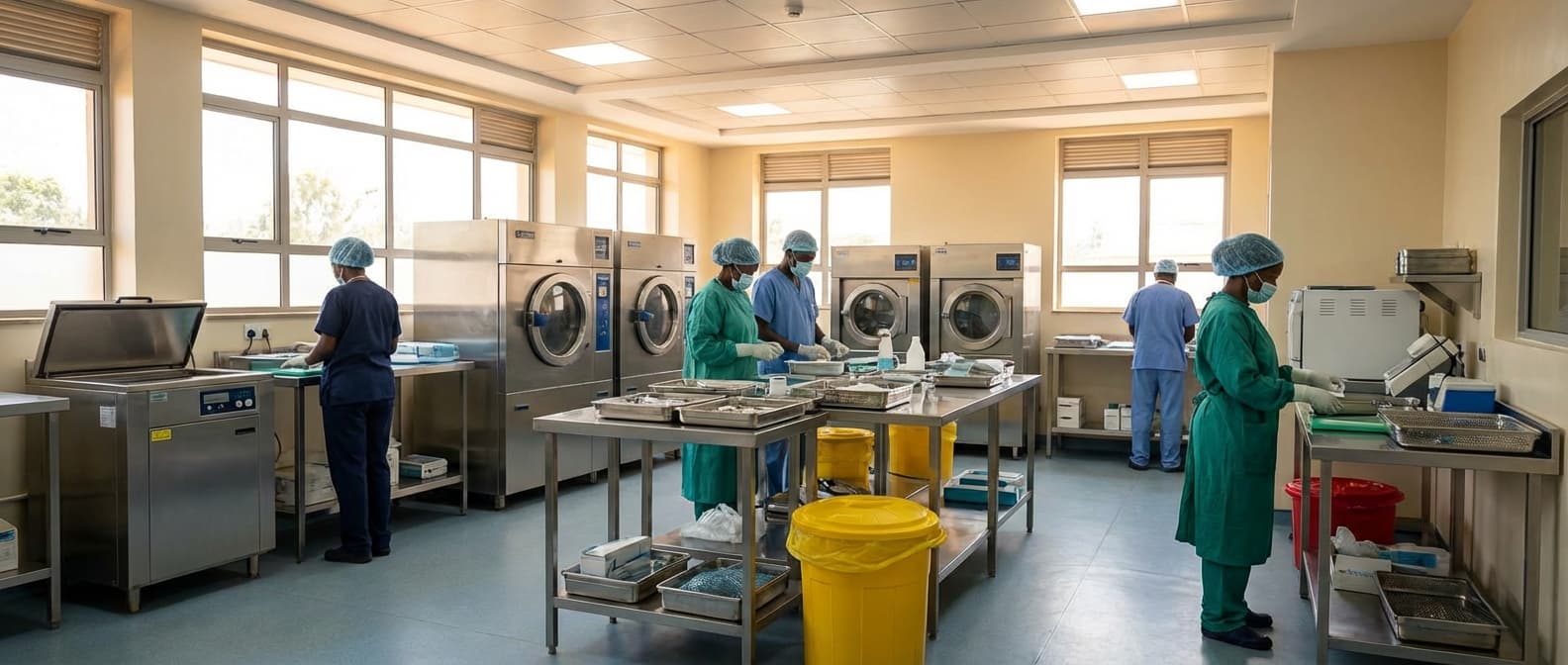
Autoclave Validation Support Service in Eritrea
Engineering Excellence & Technical Support
Autoclave Validation Support Service High-standard technical execution following OEM protocols and local regulatory frameworks.
Ensuring Sterilization Efficacy
Our Autoclave Validation Support Service in Eritrea provides meticulous testing and documentation to guarantee your autoclaves achieve and maintain the required sterilization parameters. We utilize industry-standard biological and chemical indicators, alongside advanced temperature and pressure mapping, to confirm effective microbial inactivation and prevent healthcare-associated infections.
Regulatory Compliance & Audit Readiness
Navigating Eritrea's healthcare regulations for sterilization equipment can be complex. Our expert team ensures your autoclaves meet all local and international compliance standards (e.g., ISO 13485, WHO guidelines), providing comprehensive validation reports that stand up to rigorous audits and maintain your operational integrity.
Optimizing Equipment Performance & Longevity
Beyond basic validation, our service includes performance analysis and preventative recommendations. By identifying subtle deviations or potential inefficiencies in your autoclaves, we help extend equipment lifespan, reduce downtime, and optimize energy consumption, ensuring reliable and cost-effective sterilization operations for healthcare facilities in Eritrea.
What Is Autoclave Validation Support Service In Eritrea?
Autoclave Validation Support Service in Eritrea refers to the systematic process of ensuring that an autoclave unit consistently performs its sterilization cycle effectively and reproducibly, meeting established regulatory and quality standards. This service is critical for organizations that rely on steam sterilization for the inactivation of microorganisms, guaranteeing the sterility of medical devices, laboratory equipment, and other critical materials. The service involves a comprehensive assessment of the autoclave's performance through rigorous testing and documentation, ensuring its operational integrity and compliance with relevant guidelines such as those set by international standards bodies (e.g., ISO, AAMI) and local health authorities.
| Service Recipient | Reason for Requiring Service | Typical Use Cases |
|---|---|---|
| Hospitals and Healthcare Facilities | Ensuring the sterility of surgical instruments, medical devices, and patient care equipment to prevent healthcare-associated infections (HAIs). | Sterilization of scalpels, forceps, syringes, endoscopes, anesthesia equipment, and sterile disposable supplies. |
| Dental Clinics | Maintaining aseptic conditions for dental instruments and materials used in patient procedures. | Sterilization of dental handpieces, drills, mirrors, probes, and other reusable instruments. |
| Laboratories (Medical, Research, Industrial) | Sterilizing laboratory glassware, media, equipment, and waste to prevent contamination and ensure experimental integrity or product safety. | Sterilization of culture media, petri dishes, pipettes, biohazard waste, and equipment in microbiology, chemistry, and pharmaceutical labs. |
| Pharmaceutical and Biotechnology Companies | Validating sterilization processes for manufacturing equipment, sterile packaging, and production environments. | Sterilization of vials, stoppers, stoppers, processing equipment, and components for sterile drug manufacturing. |
| Veterinary Clinics and Animal Research Facilities | Ensuring the sterility of instruments and equipment used in animal care and research. | Sterilization of surgical instruments, cages, and laboratory equipment in veterinary settings. |
Service Components and Requirements
- Installation Qualification (IQ): Verifies that the autoclave is installed according to the manufacturer's specifications and regulatory requirements.
- Operational Qualification (OQ): Tests the autoclave's functionality across its operational range, ensuring it performs as intended under various conditions.
- Performance Qualification (PQ): Demonstrates that the autoclave consistently delivers the validated sterilization parameters (temperature, pressure, time, steam penetration) under typical user loads.
- Calibration and Preventive Maintenance: Regular calibration of critical instruments (thermometers, pressure gauges) and scheduled maintenance to ensure ongoing reliability.
- Documentation and Reporting: Comprehensive generation of validation reports, certificates, and maintenance logs, providing auditable evidence of compliance.
- User Training: Education for personnel on the proper operation, maintenance, and troubleshooting of the autoclave.
Who Needs Autoclave Validation Support Service In Eritrea?
Autoclave validation is a critical process that ensures the sterility of medical equipment and the safety of patient care. In Eritrea, several organizations and departments rely on robust autoclave performance for their operations. This service is essential for any entity that utilizes autoclaves for sterilization purposes, particularly in healthcare settings where the risk of infection transmission is paramount. Without proper validation, the effectiveness of sterilization cannot be guaranteed, leading to potential patient harm and operational disruptions.
| Target Customer Type | Key Departments/Functions Requiring Validation | Why Validation is Crucial |
|---|---|---|
| Hospitals | Operating Rooms, Central Sterile Supply Department (CSSD), Emergency Rooms, Dental Units, Outpatient Clinics, Maternity Wards | Ensures surgical instruments are sterile, preventing hospital-acquired infections (HAIs); critical for patient safety during procedures. |
| Clinics (General & Specialized) | Examination Rooms, Minor Procedure Rooms, Sterilization Areas | Guarantees the sterility of instruments used in routine examinations and minor procedures, protecting patients from infections. |
| Dental Practices | Dental Surgery Rooms, Sterilization Areas | Essential for sterilizing dental instruments, preventing the transmission of blood-borne pathogens and other infectious agents among patients. |
| Laboratories (Medical, Research, Industrial) | Microbiology Labs, Pathology Labs, Research Labs, Quality Control Labs | Ensures the sterility of glassware, media, and equipment used in experiments and diagnostic procedures, preventing contamination and ensuring reliable results. |
| Veterinary Clinics | Surgical Suites, Treatment Rooms, Sterilization Areas | Crucial for sterilizing surgical instruments used on animals, preventing post-operative infections and disease transmission. |
| NGOs with Medical Facilities | Mobile Clinics, Temporary Health Posts, Stationary Health Centers | Ensures the safety and efficacy of sterilization in resource-limited settings, where proper validation is often overlooked but critically important. |
| Government Health Agencies | Public Health Laboratories, National Medical Stores, Regional Health Offices | Oversees and regulates sterilization practices across public health facilities, ensuring compliance with national and international standards. |
| Dialysis Centers | Dialysis Procedure Areas, Sterilization Units | Critical for sterilizing equipment used in dialysis to prevent the spread of infections among vulnerable patients. |
Target Customers and Departments in Eritrea Requiring Autoclave Validation Support Service:
- {"item":"Hospitals and Clinics"}
- {"item":"Dental Practices"}
- {"item":"Laboratories (Medical, Research, and Industrial)"}
- {"item":"Veterinary Clinics and Animal Hospitals"}
- {"item":"Non-Governmental Organizations (NGOs) with Medical Facilities"}
- {"item":"Government Health Agencies"}
- {"item":"Dialysis Centers"}
- {"item":"Sterilization Centers (if any)"}
Autoclave Validation Support Service Process In Eritrea
This document outlines the Autoclave Validation Support Service Process in Eritrea, detailing the workflow from initial inquiry to the final execution of services. The process is designed to ensure compliance with relevant standards and provide reliable validation for autoclave equipment.
| Stage | Description | Key Activities | Deliverables | Responsible Party | Timeline (Estimated) |
|---|---|---|---|---|---|
| The process begins when a client expresses interest in autoclave validation services. | Client contacts service provider, discusses needs, autoclave type, capacity, and desired validation standards (e.g., ISO 17665). Provider assesses preliminary scope and offers initial guidance. | Understanding of client's requirements, preliminary scope assessment. | Client & Service Provider | 1-2 Business Days |
| Based on the initial consultation, a detailed quotation and service agreement are prepared. | Service provider develops a comprehensive quotation including scope of work, methodology, validation parameters, equipment calibration status, travel, and associated costs. Client reviews and accepts the quotation, leading to a formal service agreement. | Formal quotation, Service Level Agreement (SLA) signed. | Service Provider & Client | 2-3 Business Days |
| Detailed planning for the on-site validation activities. | Service provider schedules the validation visit, confirms logistical requirements (access, power, water, operating staff availability), and reviews the autoclave's maintenance and previous validation records. Pre-validation checks of the autoclave might be performed. | Validated schedule, confirmed logistics, pre-validation checklist. | Service Provider & Client | 1-2 Business Days (before on-site visit) |
| The core validation activities are performed at the client's facility. | Installation Qualification (IQ), Operational Qualification (OQ), and Performance Qualification (PQ) tests are conducted according to the agreed protocol. This includes calibration checks of probes, biological and chemical indicator testing, cycle parameter verification (temperature, pressure, time), and air removal efficacy. | Raw validation data, executed test protocols, completed checklists. | Service Provider | 1-3 Days (depending on autoclave and scope) |
| Collected data is analyzed to determine compliance and generate a validation report. | Service provider analyzes all collected data, compares it against predefined acceptance criteria, and compiles a comprehensive validation report. The report includes methodologies, results, deviations (if any), and conclusions. | Draft validation report, data analysis summary. | Service Provider | 3-5 Business Days |
| Finalization of the validation process and issuance of certification. | Client reviews the draft report. Upon approval, the final validation report and certificate are issued. Recommendations for improvement or revalidation schedules may be provided. A post-validation debrief might be conducted. | Final validation report, validation certificate, recommendations (if applicable). | Service Provider & Client | 1-2 Business Days (after client approval) |
Autoclave Validation Support Service Process Workflow
- Inquiry and Initial Consultation
- Quotation and Agreement
- Pre-Validation Planning
- On-Site Validation Execution
- Data Analysis and Reporting
- Follow-up and Certification
Autoclave Validation Support Service Cost In Eritrea
Autoclave validation is a critical process for ensuring the efficacy and safety of sterilization equipment used in healthcare, laboratories, and other sensitive industries. In Eritrea, the cost of autoclave validation support services is influenced by several key factors. These factors determine the overall pricing and can lead to a range of costs for businesses requiring this essential service. Understanding these elements is crucial for budgeting and selecting the most appropriate service provider.
| Service Component | Estimated Cost Range (ERN) | Notes |
|---|---|---|
| Initial Full Autoclave Validation (IQ/OQ/PQ) | 50,000 - 150,000+ | This is a broad range and highly dependent on the factors listed above. Includes installation, operational, and performance qualification. |
| Annual Revalidation (OQ/PQ) | 30,000 - 80,000+ | Typically less complex than initial validation, focusing on maintaining operational and performance standards. |
| Specific Qualification Phase (e.g., PQ only) | 20,000 - 60,000 | If only a specific part of the validation process is required. |
| Consultation & Report Review | 10,000 - 25,000 | For existing validation reports or to discuss validation strategies. |
| Minor Calibration/Service bundled with Validation | Additional 5,000 - 15,000 | If minor adjustments or calibrations are needed during the validation process. |
Key Pricing Factors for Autoclave Validation Support Services in Eritrea
- Type of Validation: The complexity and scope of the validation required significantly impact cost. This can include Installation Qualification (IQ), Operational Qualification (OQ), and Performance Qualification (PQ). A full validation cycle is naturally more expensive than a single qualification phase.
- Autoclave Size and Capacity: Larger autoclaves with greater chamber volumes and more complex control systems generally require more time, resources, and potentially specialized equipment for validation, leading to higher costs.
- Number of Cycles/Load Types to Validate: Validating multiple sterilization cycles or different types of loads (e.g., porous, solid, liquid) for an autoclave will increase the validation effort and associated costs.
- Frequency of Validation: While initial validation is a one-time cost, ongoing revalidation is usually required periodically (e.g., annually). Service agreements for regular revalidation might offer slightly different pricing structures.
- Provider's Expertise and Reputation: Reputable service providers with a proven track record and highly skilled technicians may command higher prices due to their reliability and the quality of their validation reports. Smaller or newer providers might offer more competitive rates.
- Geographic Location within Eritrea: While Eritrea is a relatively small country, travel and logistical costs for the validation team to reach more remote locations could potentially influence the final price.
- Included Services: The scope of services included in the quote is important. This could range from just the validation process and reporting to including minor calibrations or even recommendations for improvements.
- Availability of Local Expertise vs. External Consultants: If there are few locally based, accredited validation specialists, relying on international consultants or companies that fly in personnel will incur additional travel and accommodation expenses, significantly increasing the cost.
- Documentation and Reporting Standards: The level of detail and adherence to specific international or local regulatory documentation standards required for the validation report will also affect the service provider's effort and thus the cost.
- Urgency of Service: If validation is needed on short notice or outside standard working hours, premium charges may apply.
Affordable Autoclave Validation Support Service Options
Ensuring your autoclave operates within strict validation parameters is critical for maintaining sterility and compliance. Our affordable Autoclave Validation Support Service offers flexible solutions to meet your needs and budget. We understand that validation costs can be a significant concern, which is why we've developed a range of value bundles and implemented cost-saving strategies to make this essential service accessible.
| Cost-Saving Strategy | Description | Benefit |
|---|---|---|
| Pre-Scheduled Annual Contracts | Commit to a year of validation services at a discounted rate. This allows for predictable budgeting and ensures your validation is always up-to-date. | Significant price reduction per validation cycle, consistent service availability, and reduced administrative overhead. |
| Bundled Service Discounts | Combine your autoclave validation with other equipment validation needs (e.g., incubators, refrigerators) for a package discount. | Lower overall validation expenditure and streamlined service coordination. |
| Off-Peak Scheduling Options | Flexible scheduling during less busy periods can lead to reduced service fees. | Lower hourly rates and minimal disruption to your operational workflow. |
| Remote Support & Guidance | For minor issues or pre-validation checks, our expert technicians can offer remote support to help your team address common problems and prepare for validation. | Reduced need for on-site visits for simple issues, saving time and travel costs. |
| Tiered Service Levels | Choose the level of service that best matches your risk assessment and regulatory requirements, avoiding unnecessary costs for features you don't need. | Pay only for the validation rigor and reporting that is essential for your compliance. |
Value Bundles for Autoclave Validation Support
- Essential Validation Package: Includes routine performance qualification (PQ) testing, calibration, and a basic validation report. Ideal for facilities with established protocols and minimal validation complexity.
- Comprehensive Validation Package: Expands on the Essential package by including process challenge device (PCD) testing, extended cycle validation, and detailed trend analysis with recommendations. Suited for facilities requiring more in-depth assurance and a robust documentation trail.
- Compliance Assurance Package: The most complete offering, encompassing all aspects of the Comprehensive package plus on-site training for your internal staff on basic maintenance and pre-validation checks, as well as priority scheduling. Perfect for organizations prioritizing long-term internal capacity and uninterrupted operations.
- Customizable Validation Solutions: We can tailor a package to your specific autoclave model, industry regulations, and testing frequency requirements. Contact us for a personalized quote.
Verified Providers In Eritrea
In Eritrea's evolving healthcare landscape, identifying trusted and credentialed providers is paramount for ensuring quality patient care. Franance Health stands out as a leading organization, offering a robust framework for verifying healthcare professionals and facilities. Their meticulous credentialing process goes beyond superficial checks, delving into the academic achievements, professional experience, and ethical standing of each provider. This dedication to thorough vetting ensures that patients engaging with Franance Health-certified entities can do so with confidence, knowing they are accessing care from individuals and institutions that meet the highest standards of competence and integrity. Choosing a Franance Health-verified provider is not merely selecting a healthcare option; it's an assurance of quality, safety, and commitment to patient well-being.
| Credential Aspect | Franance Health's Verification Standard | Benefit to Patients |
|---|---|---|
| Academic Qualifications | Verification of degrees, diplomas, and specialized training from recognized institutions. | Ensures providers have the foundational knowledge and theoretical expertise. |
| Clinical Experience | Thorough review of past roles, duration of practice, and patient caseloads. | Confirms practical application of medical knowledge and real-world problem-solving skills. |
| Licensure and Certifications | Validation of current, unencumbered medical licenses and relevant certifications. | Guarantees legal and professional authorization to practice. |
| Professional Conduct and Ethics | Background checks and reviews of disciplinary records or ethical complaints. | Assures that providers operate with integrity and prioritize patient welfare. |
| Facility Accreditation (where applicable) | Evaluation of infrastructure, equipment, hygiene, and operational protocols. | Ensures a safe, well-equipped, and well-managed healthcare environment. |
Why Franance Health Credentials Represent the Best Choice for Healthcare in Eritrea:
- Uncompromising Vetting Process: Franance Health employs a rigorous, multi-faceted evaluation system that scrutinizes academic qualifications, clinical experience, licensure, and professional conduct. This ensures that only the most competent and ethical practitioners are accredited.
- Commitment to Patient Safety: By verifying credentials, Franance Health directly contributes to patient safety by minimizing the risk of encountering unqualified or fraudulent healthcare providers.
- Elevated Standards of Care: Accreditation by Franance Health signifies adherence to established best practices and quality benchmarks, leading to a higher standard of medical treatment and patient outcomes.
- Building Trust and Confidence: The Franance Health seal of approval serves as a beacon of trust for patients, allowing them to make informed decisions about their healthcare with greater confidence.
- Promoting Professional Excellence: The credentialing process incentivizes healthcare professionals and facilities to maintain and continuously improve their skills, knowledge, and operational standards.
- Facilitating Access to Quality Healthcare: By identifying and endorsing verified providers, Franance Health simplifies the process for individuals seeking reliable and high-quality medical services within Eritrea.
Scope Of Work For Autoclave Validation Support Service
This Scope of Work (SOW) outlines the services to be provided by [Service Provider Name] to [Client Name] for the validation of an autoclave. The service includes planning, execution, and reporting of the validation activities according to applicable regulatory standards and client-specific requirements. The objective is to confirm that the autoclave consistently operates within defined parameters to achieve sterilization.
| Deliverable | Description | Standard Specification / Reference |
|---|---|---|
| Validation Master Plan (VMP) | A comprehensive document outlining the overall validation strategy, scope, responsibilities, protocols, acceptance criteria, and schedule for all validation activities. | ICH Q7, ISO 13485, EU GMP Part 11, Client's internal SOPs. |
| Installation Qualification (IQ) Protocol | A protocol detailing the tests and checks to verify that the autoclave has been installed correctly according to manufacturer's specifications and design. | Manufacturer's Installation Manual, Site Preparation Checklist, relevant local regulations. |
| Installation Qualification (IQ) Report | A report documenting the execution of the IQ protocol, including results, deviations, and the conclusion on whether the autoclave passed IQ. | IQ Protocol, Installation records, Calibration certificates. |
| Operational Qualification (OQ) Protocol | A protocol detailing the tests and checks to verify that the autoclave operates within its defined operational range and meets specified performance criteria. | Manufacturer's O&M Manual, relevant safety standards, FDA Guidance for Industry on Process Validation. |
| Operational Qualification (OQ) Report | A report documenting the execution of the OQ protocol, including results, deviations, and the conclusion on whether the autoclave passed OQ. | OQ Protocol, Test logs, Instrument calibration records, Alarm history. |
| Performance Qualification (PQ) Protocol | A protocol detailing the tests and checks to verify that the autoclave consistently performs its intended function (sterilization) under normal operating conditions and with the actual product/load. | USP <1211> Sterilization, ISO 17665 series, Client's product/load specifications, AAMI ST79. |
| Performance Qualification (PQ) Report | A report documenting the execution of the PQ protocol, including results, deviations, and the conclusion on whether the autoclave passed PQ. This includes validation of representative sterilization cycles. | PQ Protocol, Biological indicator (BI) and chemical indicator (CI) results, Temperature/pressure mapping data, Load uniformity data, Sterilization cycle records. |
| Requalification Protocol (if applicable) | A protocol for periodic revalidation or after significant maintenance/modification. | Original Validation Master Plan, relevant regulatory guidance for periodic revalidation. |
| Requalification Report (if applicable) | A report documenting the execution and results of the requalification activities. | Requalification Protocol, relevant test data. |
| Final Validation Report | A comprehensive report summarizing all validation activities (IQ, OQ, PQ) and providing an overall conclusion on the validated status of the autoclave. | All preceding validation reports, VMP, Client's Quality System requirements. |
| Calibration Certificates | Certificates for all instruments used during validation, demonstrating they are calibrated against traceable standards. | NIST traceable standards, Accredited calibration laboratory procedures. |
| Raw Data and Logs | All original data generated during the validation process, including instrument logs, test records, and observation notes. | Client's Data Integrity policies, ALCOA+ principles. |
Key Objectives
- To demonstrate that the autoclave consistently achieves the required sterilization parameters (e.g., temperature, pressure, time).
- To ensure the autoclave's performance is reproducible and reliable.
- To provide documented evidence of the autoclave's validated state for regulatory compliance.
- To identify and address any performance deviations or potential risks.
Service Level Agreement For Autoclave Validation Support Service
This Service Level Agreement (SLA) outlines the commitment of [Your Company Name] ('Provider') to its client ('Client') regarding the Autoclave Validation Support Service. This SLA defines the response times and uptime guarantees for critical support functions related to the Client's autoclave validation processes. This agreement is effective as of [Start Date] and will continue until [End Date] or as otherwise terminated according to the Master Service Agreement.
| Service Component | Uptime Guarantee | Response Time (during Business Hours) | Response Time (outside Business Hours/Emergency) |
|---|---|---|---|
| Autoclave Validation Support Hotline/Email | 99.5% Uptime (excluding Scheduled Maintenance) | 2 Business Hours | 4 Business Hours |
| Remote Troubleshooting & Diagnostic Support | N/A (dependent on Client system access and availability) | 4 Business Hours (after initial response) | 8 Business Hours (after initial response) |
| On-site Support (if required and agreed) | N/A (service availability depends on technician scheduling and travel) | Within [Number] Business Days (after remote diagnosis and approval) | Within [Number] Business Days (priority scheduling, subject to availability) |
| Documentation Review & Guidance | N/A (service availability depends on reviewer's schedule) | 3 Business Days | N/A |
Key Definitions
- Autoclave Validation Support Service: Refers to the technical assistance, troubleshooting, and guidance provided by the Provider concerning the Client's autoclave validation protocols, documentation, and equipment performance for validation purposes.
- Critical Incident: A validated or suspected failure of an autoclave that directly impedes or has the potential to impede a critical sterilization process essential for the Client's operations, leading to a halt or significant risk to production or patient safety.
- Response Time: The maximum allowable time from the Client reporting an incident to the Provider acknowledging receipt of the report and initiating investigation or action.
- Resolution Time: The target time for the Provider to resolve an incident, returning the Autoclave Validation Support Service to its agreed-upon operational status. This may involve providing a workaround or a permanent fix.
- Uptime: The percentage of time that the Autoclave Validation Support Service is available and functional as per the agreed-upon service levels, excluding scheduled maintenance.
- Scheduled Maintenance: Pre-announced periods during which the Autoclave Validation Support Service may be temporarily unavailable for updates, upgrades, or routine maintenance. Notice will be provided at least [Number] business days in advance.
- Business Hours: [Specify Business Hours, e.g., Monday to Friday, 9:00 AM to 5:00 PM Local Time].
Frequently Asked Questions

Ready when you are
Let's scope your Autoclave Validation Support Service in Eritrea project in Eritrea.

Scaling healthcare logistics and technical systems across the entire continent.